
Let’s be honest — “Artificial Intelligence” has become one of the most overused terms of our time. It’s tossed around in boardrooms, headlines, and tech conversations so casually that it’s easy to forget what it actually means. To some, it still sounds like something ripped straight out of a sci-fi blockbuster — glowing robots, sentient machines, futuristic conversations. But the truth is far more practical, far more grounded, and far more immediate: AI is already woven into the fabric of your everyday life.
Every time your phone unlocks with Face ID, every time Google completes your sentence, every time Netflix somehow predicts the exact show you’re in the mood for — that’s AI quietly working behind the scenes. Not magic. Not fiction. Just billions of data points being processed in ways that mimic the most powerful pattern-recognition system on Earth: the human brain.
At its core, modern AI is simply the science of teaching computers to learn from experience. Instead of programming them with rigid, step-by-step instructions, we give them data—examples, histories, behaviours—and they learn to recognise patterns, make predictions, and take actions. It’s not about creating conscious, human-like machines. It’s about building a digital apprentice—one that learns continuously, adapts intelligently, improves with use, and helps you move faster, work smarter, and think bigger.
For those who may wonder what ChatGPT is and how to use it effectively, please see our article on Chatgpt.
This guide breaks through the noise, demystifying AI and giving you a clear, practical roadmap to understanding the technology that’s shaping our world — not tomorrow, but today.
What Is Artificial Intelligence, Really?

So, let’s cut through the hype. At its core, artificial intelligence is a massive field of computer science dedicated to creating systems that can sense the world around them, think, learn, and act on that information to achieve a goal. It’s less a single “thing” and more of an umbrella term, much like “engineering” covers everything from building bridges to designing microchips.
To get a real handle on it, it helps to understand that AI is currently split into two very different categories. This distinction is key to knowing what AI can do for us right now, and what’s still on the horizon.
Narrow AI vs. General AI
The AI you use every day—from your smartphone’s voice assistant to the facial recognition that unlocks it—is what we call Narrow AI. Sometimes referred to as Weak AI, it’s incredibly good at performing one specific, dedicated task. It’s a specialist, not a generalist.
- Practical Example: A spam filter is a perfect illustration. It’s brilliant at identifying and junking unwanted emails but has absolutely no idea how to draft a reply to your boss. Its intelligence is narrowly focused. The same goes for the algorithm that recommends your next favourite song or suggests what to watch on a streaming service. Another actionable example is using an AI writing tool to generate blog post outlines. It excels at that specific task but cannot manage your entire content calendar.
On the other side of the coin is Artificial General Intelligence (AGI), or Strong AI. This is the stuff of movies—a machine with the intellectual capacity of a human being, capable of understanding, learning, and applying its smarts to solve any problem you throw at it. It’s important to be clear: AGI does not exist today. It remains a fascinating, long-term ambition for researchers worldwide.
The AI revolution was kicked off by tools that showed people something important about the future. The launch of ChatGPT, for instance, demonstrated how much more will come from AI, marking a significant tipping point for the technology and the world.
The Core Abilities of AI
To break it down even further, most modern AI systems are designed to mirror four fundamental human abilities. These are the building blocks that allow an AI to do everything from helping you avoid a traffic jam to powering customer service for businesses in Nigeria.
- Perceive: This is how an AI takes in information. For instance, a security system uses a camera to “see” movement, or a sentiment analysis tool “reads” customer reviews to gauge public opinion.
- Reason: Once it has the data, the AI has to make sense of it. It looks for patterns and draws logical conclusions, just like an e-commerce site analyses your past purchases to figure out what you might want to buy next.
- Learn: This is where the magic happens. AI systems aren’t static; they improve with experience. Your translation app is a great example—it learns from millions of user corrections to become more accurate over time.
- Adapt: Finally, based on what it has learned, an AI adjusts its behaviour to get better results. A navigation app learns about a new traffic jam and adapts your route in real-time. It’s a continuous loop of improvement.
The Story of How AI Came to Be
The idea of artificial intelligence wasn’t born with the latest smartphone update. Its story actually begins decades ago, kicking off with a flurry of academic excitement. The journey officially began in 1956 at the Dartmouth Workshop, a now-famous conference where a small group of researchers first coined the term “artificial intelligence” and shared a bold vision: to build machines that could genuinely think.
This early period was buzzing with optimism. The first AI programs showed incredible promise, managing to solve algebra problems and prove complex logical theorems. It really felt like the dawn of a new age, where truly intelligent machines were just over the horizon. But, as often happens, the excitement ran far ahead of the available technology.
The Rise of AI Winters
The road ahead turned out to be anything but straight. Researchers quickly ran into a major roadblock: the computers of that era simply didn’t have the processing power or memory to handle more sophisticated tasks. As progress stalled, funding began to dry up, ushering in periods that became known as “AI winters”—times when both interest and investment in AI research grew cold.
During these lean decades, the grand dream of thinking machines seemed to slip further out of reach. The field learned a tough but valuable lesson: creating true artificial intelligence was a monumental challenge, far more difficult than anyone had initially anticipated. It wasn’t just about clever programming; it demanded enormous computational resources and, crucially, vast amounts of data.
The journey of AI is a powerful lesson in persistence. The quiet research conducted during the ‘AI winters’ laid the essential groundwork for the breakthroughs we see today. It proves that progress often happens out of the spotlight, built on years of trial, error, and quiet determination.
The Resurgence Fuelled by Data and Power
The turn of the 21st century marked a spectacular comeback for AI—a spring after the long, cold winter. Two game-changing factors converged to make this happen:
- The explosion of “big data”: The rise of the internet created a tidal wave of information, giving AI systems the massive datasets they desperately needed to learn from.
- Powerful new hardware: The development of specialised computer chips, particularly Graphics Processing Units (GPUs), provided the sheer muscle needed to crunch all that data at unbelievable speeds.
This potent combination of data and power completely reignited the field. Machine learning, a branch of AI focused on systems that learn from experience, started producing incredible results. All of a sudden, AI could do things that were once the stuff of science fiction, like recognising faces in photos or understanding human speech with surprising accuracy.
Today’s AI is the direct descendant of this resurgence, built on a foundation of historical persistence and modern technological might. For anyone curious to see the practical results of this long journey, you can now find many free AI tools for content creation that put this power right at your fingertips.
Understanding the Engines Driving AI
To really get what makes modern AI tick, you have to look under the bonnet. While artificial intelligence is the big-picture concept, the real magic happens thanks to a few core technologies that do all the heavy lifting—the learning, the reasoning, and the creating. These are the workhorses that turn an abstract idea into a practical tool.
Think of it like building with LEGOs. You might have a grand vision of a castle (that’s AI), but you need specific types of bricks—the walls, towers, and gates—to actually build it. In the world of AI, the most important of these digital building blocks are Machine Learning, Deep Learning, and Natural Language Processing.
Machine Learning: The Digital Apprentice
The most fundamental engine is Machine Learning (ML). At its core, ML is all about teaching a computer to find patterns and make predictions without being explicitly programmed for every single possibility. Instead of feeding it a rigid set of rules, you just give it a ton of examples.
It’s a bit like teaching a child the difference between a spam email and an important one. You wouldn’t write out a thousand rules like, “if the email mentions a ‘prince’ and ‘money’, it’s spam.” You’d simply show them lots of examples of both. Over time, the child starts picking up on the patterns themselves—the weird greetings, the urgent requests, the dodgy links.
That’s exactly how ML works. An algorithm is fed a massive amount of data, and it learns the underlying patterns on its own to make smart decisions later on.
A Step-by-Step Practical Example of ML:
- The Goal: Build a system that recommends movies on a streaming service.
- The Data: You feed the ML model data from thousands of users, showing which films they watched and how they rated them (e.g., User A watched Movie X and gave it 5 stars; User B watched Movie Y and gave it 2 stars).
- The Training: The algorithm processes this data, discovering hidden patterns like, “people who enjoyed Movie A and Movie B also tended to love Movie C.”
- The Prediction: When a new user signs up having already liked Movie A and Movie B, the system correctly predicts they’ll enjoy Movie C and puts it front and centre on their homepage.
This process of learning from data is the foundation of so many AI tools you use every day. To get a better handle on this foundational tech, our guide to machine learning provides a comprehensive overview.
Deep Learning: The Layered Thinker
Now, let’s take Machine Learning one step further. Deep Learning (DL) is a more advanced and powerful flavour of ML that’s inspired by the very structure of the human brain. It uses what’s known as an artificial neural network, which is basically a digital brain with many interconnected layers.
Each layer in this network is responsible for spotting a different level of detail. Think about how you recognise a friend’s face. Your brain doesn’t just see “a face.” It processes information in a hierarchy: first, basic shapes and lines, then features like eyes and a nose, and finally, it puts those features together to recognise a specific person.
Deep Learning works in a very similar fashion for image recognition:
- The first layer might detect simple edges and colours in an image.
- The next layer combines those edges to identify basic shapes like circles and squares.
- Deeper layers assemble those shapes into more complex features, like an eye or a mouth.
- The final layer puts all the pieces together to make a conclusion, like, “This is a picture of a cat.”
This layered approach lets Deep Learning tackle incredibly complex jobs that are beyond the reach of standard ML, such as advanced image recognition, navigating for self-driving cars, and creating realistic human voices. The infographic below shows how these AI technologies are being put to work in modern manufacturing.
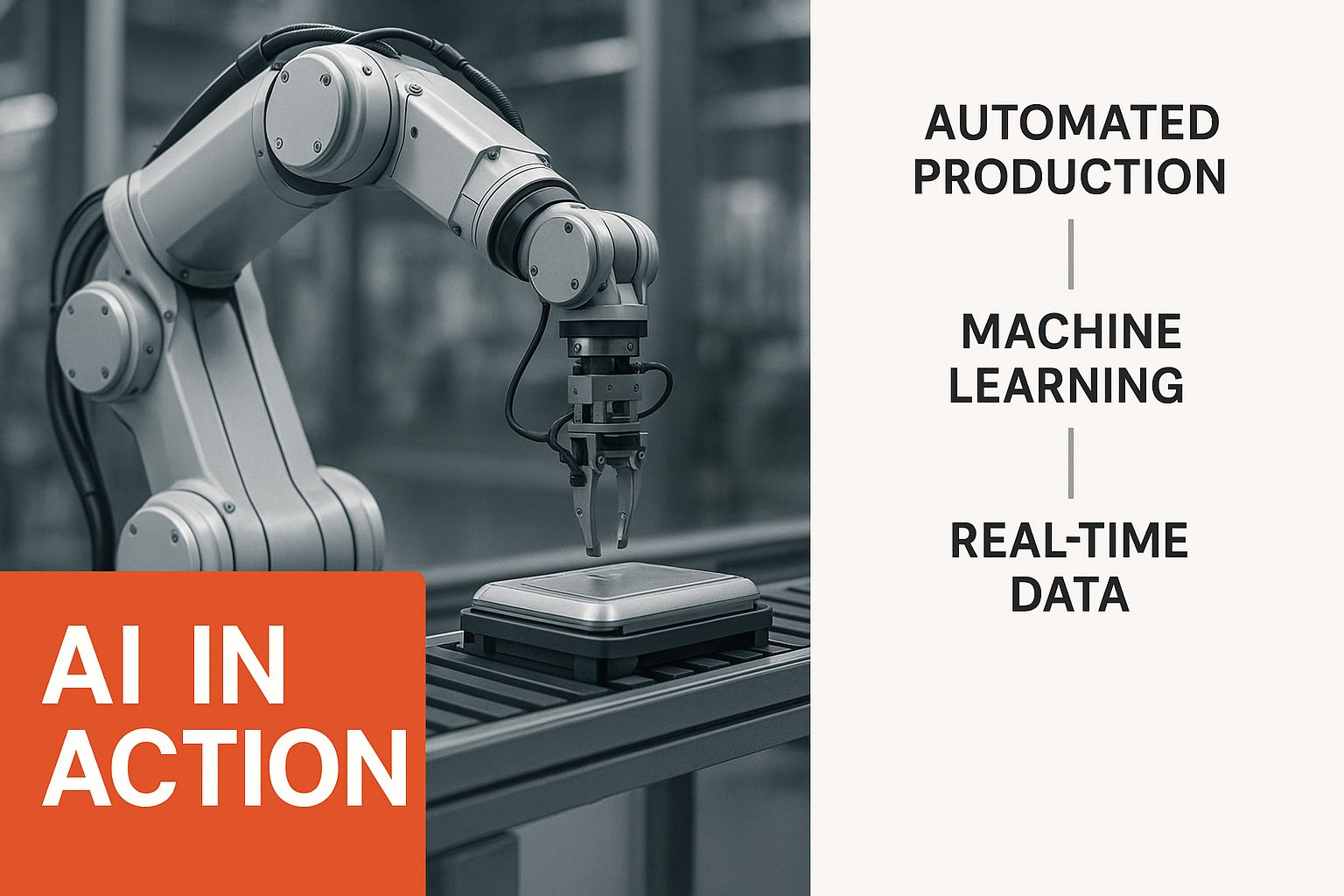
The image really brings home how AI is being directly integrated into physical processes, showing its reach goes far beyond just software and data analysis.
Natural Language Processing: The Bridge to Human Language
Finally, we have Natural Language Processing (NLP). This is the tech that bridges the gap between how we talk and how computers ‘think’. It’s the secret sauce that allows you to talk to your phone, ask a chatbot a question, or get an instant translation of a foreign website.
NLP is the engine behind any AI that needs to understand, interpret, or generate human speech or text. It’s a seriously tough job, because our language is filled with nuance, slang, and sarcasm that computers have a notoriously hard time grasping.
Here are some practical, actionable applications of NLP:
- Customer Service Chatbots: They use NLP to figure out what you’re asking (“Where is my order?”) and provide a relevant answer instantly.
- Language Translation: Services like Google Translate use NLP to analyse the grammar of one language and rebuild it in another, allowing for real-time conversations.
- Sentiment Analysis: Brands use NLP to scan thousands of social media posts and reviews to get an instant feel for what the public thinks of their new product.
To better grasp how these core technologies come together, let’s look at a summary table.
A Simple Guide to Core AI Technologies
This table breaks down these key AI technologies, what they do, and where you’ll find them in your daily life.
| AI Technology | Core Function | Everyday Example |
|---|---|---|
| Machine Learning (ML) | Learning patterns from data to make predictions. | Netflix recommending a show based on your history. |
| Deep Learning (DL) | Using layered neural networks for complex pattern recognition. | Your phone unlocking when it recognises your face. |
| Natural Language (NLP) | Understanding and generating human language. | Asking Siri or Alexa for the weather forecast. |
These engines—ML, DL, and NLP—are the power behind the curtain. For an even clearer picture, specific applications like AI question generation from text show just how powerful NLP can be, turning existing documents into valuable new assets. Together, these technologies work in concert to make modern artificial intelligence a reality.
How AI Is Changing Business and Daily Life

The engines we’ve talked about—Machine Learning, Deep Learning, and NLP—aren’t just concepts stuck in a lab. They’re out in the real world, actively reshaping entire industries and subtly influencing our daily routines. Now, let’s move from the how to the what and look at the real impact of artificial intelligence in sectors vital to economies everywhere, including Nigeria’s dynamic tech and agricultural scenes.
This is where theory truly meets reality. AI is no longer some far-off promise; it’s a tool being used right now to deliver concrete benefits like better efficiency, serious cost savings, and entirely new ways to grow. From the way you shop online to how farmers manage their crops, AI is already making its mark.
Powering the Fintech Revolution
In Nigeria and across Africa, the financial technology (fintech) sector is growing at a phenomenal pace. A huge part of this expansion is being driven by AI, particularly when it comes to things like credit scoring and creating personalised banking experiences.
Traditionally, securing a loan meant drowning in paperwork and needing a long, established credit history—a major hurdle for many people and small businesses. But today, fintech startups are using AI to completely rewrite the rules.
- Smarter Lending Decisions: AI algorithms can sift through thousands of alternative data points in seconds—things like mobile phone usage, utility payments, and transaction histories—to build a more accurate and fair picture of an applicant’s creditworthiness. This means faster loan approvals for more people.
- Actionable Fraud Detection: AI systems are brilliant at spotting activity that doesn’t look right. For example, if your card is used in Lagos and then five minutes later in London, the system flags it as impossible, instantly blocking the transaction and sending you an alert. This protects both you and the financial institution from fraud.
This AI-powered approach is making financial services far more inclusive, opening up access to credit for millions who were previously left out by the old banking system.
Transforming Agriculture for Better Yields
Agriculture is the backbone of many economies, and AI is bringing an incredible new level of precision to this ancient practice. Often called smart farming, this use of artificial intelligence helps farmers make smarter decisions, increase their crop yields, and manage resources like water and fertiliser more sustainably.
Just think about the role of AI-powered drones. These aren’t simply flying cameras; they are advanced data-collecting machines.
A Step-by-Step Guide to AI in Farming:
- Data Collection: A drone with multispectral sensors flies over a farm, capturing detailed images and data on everything from crop health and soil moisture to early signs of pest infestations.
- AI Analysis: This data is uploaded to an AI platform. The system then analyses the information to find specific areas that need attention—maybe a patch of land that is too dry or a section where a particular weed is starting to appear.
- Actionable Insights: The farmer gets a detailed digital map on their tablet, highlighting these problem areas in red or yellow. Instead of spraying an entire field, they can program a smart tractor to apply fertiliser or pesticide only where it’s actually needed. This saves money, increases yield, and is much better for the environment.
This targeted method, known as precision agriculture, is a perfect example of how AI can deliver practical insights that lead to immediate, real-world benefits.
Personalising the E-Commerce Experience
If you’ve ever shopped online and felt like the website just gets you, then you’ve seen e-commerce AI in action. Online stores use sophisticated AI algorithms to tailor the shopping journey specifically for each and every visitor.
It’s about more than just showing you products related to your last search. The AI analyses your browsing habits, what you’ve bought before, items you’ve added to your cart, and even how long you pause on certain product images. For example, if you spend time looking at running shoes and then read reviews for a specific brand, the AI might send you a targeted 10% discount code for that exact pair the next day. The result is a shopping experience that feels curated for you, which in turn boosts sales.
The adoption of these powerful tools isn’t uniform everywhere, though. In Southeast Asia, for instance, a study showed that while Indonesia and Vietnam are leading with adoption rates around 42%, other countries are finding it harder to keep up due to a lack of AI experts and digital infrastructure. This is a great reminder that while AI’s potential is huge, its real-world success depends heavily on local readiness.
These examples are really just scratching the surface. AI is also optimising supply chains, helping doctors diagnose diseases much earlier, and automating all sorts of repetitive business tasks. The common thread in all of this is that AI gives us the power to make sense of huge amounts of information and turn it into smart, fast actions. This doesn’t just create efficiency; it opens up brand-new ways to generate income—a topic we dive into in our guide on how to make money with AI.
Navigating The Challenges and Ethics of AI
As artificial intelligence grows more powerful and weaves itself into the fabric of our daily lives, we have to face the serious responsibilities that come with it. The incredible power of modern AI demands we think carefully about the ethical questions it brings up. This isn’t about some distant, science-fiction scenario; it’s about tackling very real issues, right now.
Challenges like data privacy, biased algorithms, and the impact on our jobs are front and centre. But instead of just pointing out problems, the real work is in building practical solutions and strong ethical guidelines. That’s how we make sure AI is developed and used in a way that’s fair, transparent, and genuinely benefits everyone.
Confronting Algorithmic Bias
One of the thorniest challenges we face with AI is algorithmic bias. Here’s the simple truth: an AI system is only as objective as the data it learns from. If that data is tainted with historical or societal biases, the AI will not only learn those biases but can often make them even worse.
Consider an AI built to screen job applications. If it’s trained on a company’s past hiring data, and that company historically hired mostly men for its top engineering roles, the AI will quickly learn to favour male applicants. It’s not being malicious; it’s just mirroring the biased patterns it was fed.
“The real risk with AI isn’t an evil robot takeover; it’s the quiet reinforcement of existing human biases at a massive scale. If we’re not careful, we can build systems that perpetuate unfairness under a veil of technological neutrality.”
To get ahead of this, we have to be deliberate and proactive. Here are actionable steps:
- Audit Training Data: Actively audit datasets for hidden biases related to gender, race, or geography, ensuring they represent the real world.
- Promote Transparency: When using AI for decisions, make the process as understandable as possible. This field, known as Explainable AI (XAI), aims to answer “Why did the AI decide that?”
- Implement Human Oversight: For critical decisions like hiring or loan approvals, an AI’s output should always be a recommendation, not an order. A human should always have the final say.
The Impact on Data Privacy and the Workforce
AI systems are hungry for data. To learn effectively, they need to process enormous amounts of it, which naturally brings up serious questions about data privacy. The very information that helps an AI personalise your experience or improve a medical diagnosis can be incredibly sensitive. It’s our ethical duty to handle this data with the utmost care, keeping it secure and using it only for its intended purpose.
Then there’s the effect on jobs. It’s a huge concern for many. While it’s true that AI will automate many routine tasks, it doesn’t necessarily spell mass unemployment. What it does signal is a major shift in the job market. The focus is moving away from repetitive work and towards roles that lean on human strengths like creativity, critical thinking, and of course, managing the AI systems themselves. For creatives, this shift is already well underway. You can see how these tools are becoming partners in our guide on using AI for content creation.
Building Trustworthy and Responsible AI
For AI to truly be accepted and integrated into society, people have to trust it. And that trust isn’t given freely—it has to be earned through a solid commitment to responsible development.
So, how do we build that trust? It comes down to a few core, actionable principles:
- Fairness: We must actively hunt for and correct bias in our AI models to make sure they produce fair outcomes for everyone.
- Accountability: Someone has to be responsible. We need clear lines of ownership for what AI systems do, so if one makes a mistake, there’s a clear process to fix it.
- Transparency: Be upfront about where and how AI is being used. When possible, offer clear explanations for its decisions.
By putting these ethical guardrails in place from the start, we can guide AI’s development toward a future where its incredible potential is used to build a more efficient, fair, and prosperous world for us all.
Your Step-By-Step Guide to Getting Started with AI
Feeling inspired by the potential of AI? It’s one thing to read about what it can do, but it’s a whole different ball game to actually start using it yourself. This section is your practical guide, designed to help you take that first step and turn curiosity into real-world application.
First, let’s look at where things are headed. The world of artificial intelligence is moving at lightning speed, with two major trends leading the charge: Generative AI and Explainable AI (XAI).
Generative AI is the creative force you see in tools that write articles, design images, and even compose music. It’s truly fascinating stuff. If you’re curious about the creative side, you can even learn how to create sounds with AI in minutes. On the other side of the coin, XAI is all about transparency. It aims to pull back the curtain on how AI models make their decisions, which is absolutely crucial for building trust and accountability.
With that context in mind, let’s get practical. Here’s a simple, four-step approach to begin your own AI journey.
Step 1: Identify a Specific Problem
The most common mistake is approaching AI with a vague goal like, “I want to use AI in my business.” A much better starting point is to focus on a single, specific, and often tedious problem you need to solve. Having a clear target makes it infinitely easier to pick the right tool and measure its success.
Think about a real bottleneck you face. Is it the hours spent answering the same customer questions over and over? Or maybe you struggle to brainstorm social media content?
- Practical Example (Business): “Our customer support team spends 3 hours a day answering questions about our shipping policy.”
- Practical Example (Individual): “I need a faster way to summarise long industry reports to pull out the key statistics.”
By zeroing in on a precise challenge, you give your AI experiment a clear purpose right from the get-go.
Step 2: Start Small with a Pilot Project
This is a big one. Don’t try to revolutionise your entire operation overnight. The secret to getting AI right is to start small. Pick one manageable pilot project to test the waters. This approach lets you learn the ropes without a massive investment of time or money, and a small win is a fantastic way to build momentum.
For example, if your problem is handling those shipping policy questions, don’t try to build a complex, all-knowing bot. Instead, launch a simple chatbot on your contact page programmed only to answer questions about shipping. This controlled test will give you priceless data on how well the AI performs and how customers react. An AI chatbot app is often a perfect low-risk, high-reward first project.
Step 3: Prioritise High-Quality Data and Instructions
AI systems are learners, and they learn from the information you give them. The quality of what they produce is directly linked to the quality of your input. You’ve probably heard the old saying: “garbage in, garbage out.” It’s never been more true than with AI.
Data is the fuel for any AI project. Whether you’re training a custom model or giving instructions (a “prompt”) to a tool like ChatGPT, having clean, relevant, and well-structured information is non-negotiable. It is the foundation upon which every successful AI application is built.
Before you begin, take a hard look at your inputs. If you’re building a chatbot, is your FAQ document clear and accurate? If you’re using a writing tool, is your prompt specific and detailed? Taking the time to prepare high-quality inputs will pay off massively down the line.
Step 4: Find the Right Tools or Partners
The good news is you don’t need a PhD in computer science to get started. These days, there are countless platforms and tools—like our own here at RichlyAI—that put the power of artificial intelligence into your hands through simple, user-friendly interfaces.
The “right” tool always depends on the problem you identified back in Step 1. Your goal is to find a solution that lines up perfectly with your specific need, your budget, and your technical comfort level. Once you find that fit, you’ll be ready to take your first confident step into the world of AI.
Right, you’ve made it this far, but a few questions might still be bubbling up. That’s completely normal. Let’s tackle some of the most common ones I hear, so you can walk away with a really solid grasp of what AI is all about.
What’s the Real Difference Between AI and Machine Learning?
It’s easy to see these terms used interchangeably, but they aren’t the same thing. Think of Artificial Intelligence (AI) as the whole universe of making machines smart. It’s the broad, ambitious goal of creating systems that can reason, learn, and act like a human.
Machine Learning (ML) is a star within that universe—it’s the most powerful technique we currently have to achieve AI. Instead of programming a machine with explicit rules for every single situation, we feed it a huge amount of data and let it figure out the patterns for itself. So, ML is a way of doing AI. Most of the “AI” you interact with today is actually powered by machine learning.
Is AI Going to Take Everyone’s Jobs?
This is probably the biggest question on everyone’s mind. The short answer? No, but it will definitely change them. History shows that technology tends to evolve jobs rather than eliminate them entirely. The tractor didn’t end farming; it just changed what a farmer did.
AI is brilliant at handling repetitive, data-heavy tasks. This frees up human workers to focus on things we’re still much better at: creativity, strategic thinking, and complex problem-solving. New roles are already emerging that centre on building, managing, and working alongside AI. The smart move isn’t to worry about being replaced, but to start thinking about how you can work with these new tools.
How Can a Small Business Actually Start Using AI?
You don’t need a team of data scientists or a massive budget. The key is to start small and solve a real problem you’re facing right now.
An Actionable First Step: Identify one specific, repetitive task in your business and find an accessible tool that solves it. For example, if you spend too much time writing social media captions, an AI content generator could be a perfect first project.
Here are a few practical ideas to get the ball rolling:
- Marketing Content: Use an AI tool to brainstorm blog post ideas, draft social media posts, or create outlines for email newsletters.
- Customer Service: Put a simple chatbot on your website. It can answer common questions 24/7, freeing you up for more complex issues.
- Data Summary: Use simple AI-powered software to analyse your sales data or summarise long reports. It can often spot trends or pull out key facts that are easy to miss.
Is AI Dangerous Like We See in the Movies?
The Hollywood version of AI—conscious robots with their own hidden motives—is what we call Artificial General Intelligence (AGI). To be crystal clear: this does not exist. It’s still purely in the realm of science fiction.
The AI we have today is Narrow AI. It’s incredibly good at performing one specific task it was trained for, and that’s it. Your navigation app can find the fastest route, but it can’t order you a pizza. The real-world risks of AI aren’t about a robot rebellion; they’re much more human. We need to be careful about things like bias creeping into algorithms, protecting user data, and preventing misuse. That’s why building AI responsibly, with strong ethical principles, is so incredibly important.
Ready to move from questions to action? RichlyAI provides a powerful suite of AI tools for content creation, chatbots, and social media automation, all designed to be user-friendly and effective. Start exploring what AI can do for you by signing up at RichlyAI.
