
Artificial intelligence is no longer a futuristic concept; it’s a rapidly expanding industry creating thousands of high-impact, high-paying jobs across the globe, including in growing tech hubs like Nigeria. But with so many specialisations emerging, from machine learning to AI ethics, navigating the field can feel overwhelming. How do you identify the right path for your skills and ambitions? This guide is designed to provide clarity.
We will break down the top 10 careers in artificial intelligence, offering a practical, in-depth look into what each role truly entails. For each career, you’ll find a detailed rundown of the core responsibilities, the specific technical and soft skills required to succeed, typical salary expectations, and future growth prospects. For a comprehensive look at how to navigate the diverse landscape of AI and Machine Learning, consider attending an AI/ML Career Pathways event to gain even deeper insights.
Whether you are a recent graduate mapping out your future, a software developer looking to specialise, or an entrepreneur aiming to leverage AI, this article provides the actionable information you need. We’ll move beyond generic descriptions to deliver a clear roadmap, helping you understand the real-world impact you can make and how to strategically build a future-proof career in this dynamic domain.
1. Machine Learning Engineer
Among the most sought-after careers in artificial intelligence, the Machine Learning (ML) Engineer stands out for its crucial role in bringing AI concepts to life. These professionals are the architects and builders of AI systems, responsible for designing, constructing, and deploying machine learning models at a production scale. They act as the vital link between data science, where models are conceptualised and tested, and software engineering, which ensures these models can operate efficiently in real-world applications.
Practical Example: A Machine Learning Engineer at Spotify takes the algorithm that suggests new songs (developed by data scientists) and builds the robust, scalable system that delivers these recommendations to millions of users in real-time, ensuring it works flawlessly on the app.
Their primary focus is on operationalising models, ensuring they are robust, scalable, and maintainable. This involves a deep understanding of MLOps (Machine Learning Operations), cloud infrastructure, and software development best practices to create systems that can handle immense traffic and data loads reliably.
Key Responsibilities and Skills
To succeed in this role, you must be proficient in programming languages like Python and familiar with core ML frameworks such as TensorFlow and PyTorch. A strong foundation in software engineering principles and experience with cloud platforms (like AWS, Google Cloud, or Azure) are non-negotiable.
Actionable Steps to Get Started:
- Step 1: Master the Core Tools. Focus on Python and its libraries (Pandas, NumPy, Scikit-learn). Then, gain proficiency in a major framework like TensorFlow or PyTorch by building simple models.
- Step 2: Build an End-to-End Project. Create a simple web application that uses a machine learning model. For example, build an image classifier and deploy it as a basic web service using Flask or FastAPI on a cloud service like Heroku or AWS Elastic Beanstalk. This demonstrates you can handle the full lifecycle.
- Step 3: Learn MLOps Fundamentals. Get hands-on with Docker to containerise your application. Then, explore tools like MLflow for experiment tracking and model versioning. This shows you understand production-level practices.
This summary box highlights the essential aspects of a Machine Learning Engineer’s career.
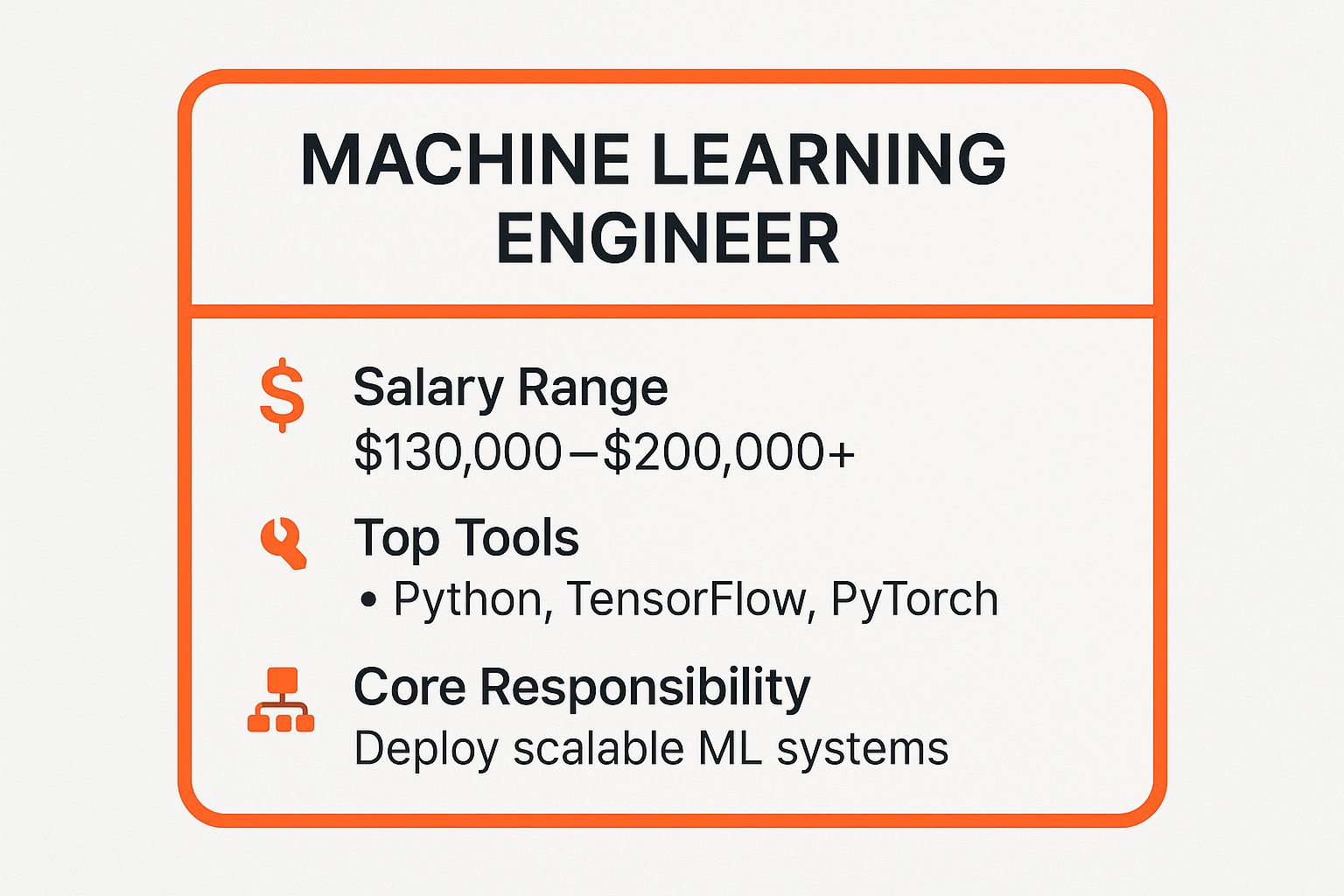
As the infographic shows, this career path is not only intellectually rewarding but also financially lucrative, with a core focus on the practical deployment of AI systems. If you are passionate about building tangible AI products, you can learn more about how machine learning works to start your journey.
2. Data Scientist
Often seen as the detectives of the digital age, Data Scientists are pivotal figures in the landscape of careers in artificial intelligence. They are experts at sifting through vast, complex datasets to uncover hidden patterns, trends, and actionable insights. Unlike ML Engineers who focus on productionising models, Data Scientists are primarily concerned with asking the right questions, formulating hypotheses, and using statistical analysis and machine learning to answer complex business problems.
Practical Example: A Data Scientist at a ride-sharing company like Uber might analyse trip data, weather patterns, and local events to create a predictive model for demand. This insight helps the company implement surge pricing strategically and ensure enough drivers are available during peak times.
Their role is a unique blend of statistician, computer scientist, and business strategist. They analyse historical data to build predictive models and communicate their findings in a compelling way to non-technical stakeholders, directly influencing strategic decisions and organisational growth.
Key Responsibilities and Skills
Success as a Data Scientist requires a strong command of programming languages like Python or R, mastery of SQL for data manipulation, and a deep understanding of statistics and machine learning algorithms. Strong business acumen and communication skills are equally crucial for translating complex data into tangible business value.
Actionable Steps to Get Started:
- Step 1: Build a Strong Statistical Foundation. Before diving into code, ensure you understand concepts like hypothesis testing, probability distributions, and regression. Khan Academy is an excellent free resource for this.
- Step 2: Master Data Wrangling with SQL and Pandas. The majority of a data scientist’s time is spent cleaning and preparing data. Practice by finding messy, real-world datasets and using SQL and Python’s Pandas library to make them analysis-ready.
- Step 3: Develop a Portfolio of Data Stories. Don’t just show your code. For each project, create a clear presentation or blog post that explains the business problem, your methodology, the key insights you found, and your final recommendations. This demonstrates your communication skills.
3. AI Research Scientist
At the frontier of innovation, AI Research Scientists are the trailblazers pushing the boundaries of what is possible in artificial intelligence. Unlike engineers who focus on application, these professionals conduct fundamental research to invent new algorithms, theories, and architectures. They are the driving force behind breakthroughs like OpenAI’s GPT models or DeepMind’s AlphaGo, fundamentally advancing the field.
Practical Example: An AI Research Scientist at Google’s DeepMind might work on developing a more efficient type of neural network architecture, publishing a paper on their findings that could eventually lead to AI models that require significantly less computational power to train.
Their work is highly theoretical and experimental, often leading to publications in top-tier academic conferences and journals. An AI Research Scientist explores uncharted territory, asking foundational questions and developing novel methodologies that can redefine entire industries. They are the visionaries who build the theoretical bedrock upon which future AI technologies are constructed, making this one of the most intellectually demanding careers in artificial intelligence.
Key Responsibilities and Skills
Success in this role requires a deep theoretical understanding of mathematics, statistics, and computer science, alongside expertise in a specific AI subfield like reinforcement learning or computer vision. A PhD is often a prerequisite, as the role demands rigorous scientific inquiry and the ability to produce novel research.
Actionable Steps to Get Started:
- Step 1: Excel in Academia. Focus on achieving a high GPA in a quantitative field (Computer Science, Math, Statistics) and engage in undergraduate research opportunities with professors.
- Step 2: Target a Specialisation. As you approach graduate studies, identify a niche area you’re passionate about (e.g., reinforcement learning, generative models). Read seminal papers in that field and try to replicate their results.
- Step 3: Publish and Network. Aim to publish your research in workshops or conferences. Attend academic events like NeurIPS or ICML to connect with leading researchers and learn about the latest breakthroughs.
4. Computer Vision Engineer
A pivotal role within the expanding universe of careers in artificial intelligence, the Computer Vision Engineer specialises in creating systems that enable machines to interpret, understand, and act on visual information from the real world. These experts are the driving force behind technologies that see and process images and videos, translating visual data into actionable insights. They are the architects of algorithms that power everything from self-driving cars navigating complex city streets to medical systems that diagnose diseases from scans with superhuman accuracy.

Practical Example: A Computer Vision Engineer at Amazon Go develops the system of cameras and sensors that automatically detects which items a shopper picks up. This involves creating algorithms for object tracking and recognition that work in a complex, real-time store environment.
This field combines deep learning, image processing, and geometry to solve complex perception problems. A Computer Vision Engineer’s work is less about abstract models and more about building tangible systems that interact with and perceive the physical world, making it one of the most exciting and impactful AI specialisations.
Key Responsibilities and Skills
Success in this career demands a mastery of Python and deep learning frameworks like PyTorch or TensorFlow, with a special emphasis on libraries like OpenCV for image processing. A solid understanding of camera systems, optics, and 3D geometry is also crucial for building robust perception systems.
Actionable Steps to Get Started:
- Step 1: Master OpenCV. Before diving into deep learning, start with the fundamentals of image processing. Use the OpenCV library to build simple projects like a face detector or a program that tracks a specific colour in a video feed.
- Step 2: Build with Pre-trained Models. Learn to use models from libraries like TensorFlow Hub or PyTorch Hub. Build an application that uses a pre-trained model (like YOLO for object detection) on your own webcam feed. This teaches you how to implement existing solutions.
- Step 3: Fine-tune a Convolutional Neural Network (CNN). Find a public dataset (e.g., a set of cat and dog images) and practice fine-tuning an existing CNN architecture like ResNet. This is a core skill for adapting models to specific tasks.
This summary box highlights the essential aspects of a Computer Vision Engineer’s career.
As the infographic shows, this career path blends advanced software engineering with deep learning to create systems that can truly “see.” If you are fascinated by the challenge of teaching machines to understand the visual world, this is a highly rewarding specialisation to pursue.
5. Natural Language Processing (NLP) Engineer
Among the most revolutionary careers in artificial intelligence, the Natural Language Processing (NLP) Engineer specialises in bridging the gap between human language and computer understanding. These professionals design and build systems that can interpret, analyse, and generate human text and speech. They are the masterminds behind the technology that allows us to communicate with machines as if they were human, transforming how we access information and interact with digital services.
Practical Example: An NLP Engineer at Grammarly develops and refines the algorithms that analyse your writing to suggest grammatical corrections, check for tone, and identify plagiarism. This involves creating models that understand syntax, semantics, and context.
From the conversational prowess of OpenAI’s ChatGPT to the seamless translations offered by Google Translate, the work of NLP Engineers is everywhere. Their primary goal is to create algorithms and models that can comprehend the nuances, context, and intent behind language. This involves a unique blend of computer science, artificial intelligence, and computational linguistics to develop applications like chatbots, sentiment analysis tools, and voice assistants such as Amazon’s Alexa and Apple’s Siri.

Key Responsibilities and Skills
To excel in this field, a deep understanding of machine learning models, particularly transformer architectures and attention mechanisms, is essential. Proficiency in Python, along with libraries like NLTK, SpaCy, and Hugging Face, is a standard requirement. A foundational knowledge of linguistics helps in understanding the complexities of language structure.
Actionable Steps to Get Started:
- Step 1: Learn Text Pre-processing. Start by mastering techniques like tokenisation, stemming, and lemmatisation using libraries like NLTK or SpaCy. This is the foundational step for nearly all NLP tasks.
- Step 2: Build a Classic NLP Application. Create a project that performs sentiment analysis on a dataset of movie or product reviews. This teaches you how to convert text into numerical representations (embeddings) and apply classification models.
- Step 3: Leverage the Hugging Face Ecosystem. Dive into the Hugging Face library. Learn how to use their pre-trained transformer models (like BERT or DistilBERT) for a specific task, such as text summarisation or question-answering. This is a highly in-demand skill.
This summary box highlights the essential aspects of a Natural Language Processing (NLP) Engineer’s career.
As the infographic suggests, this specialisation offers a chance to work on the cutting edge of AI, creating systems that fundamentally change human-computer interaction. If you are fascinated by the intersection of language and technology, you can discover more about how NLP is simplifying life to begin your exploration.
6. Robotics Engineer
Bridging the gap between the digital and physical worlds, the Robotics Engineer is one of the most dynamic careers in artificial intelligence. These professionals are the masterminds behind intelligent machines, responsible for designing, building, and programming robots that perceive and interact with their environment. They merge AI algorithms with mechanical engineering, sensors, and control systems to create solutions for manufacturing, healthcare, and exploration.
Practical Example: A Robotics Engineer at a company like iRobot designs the navigation and mapping algorithms for the Roomba vacuum cleaner. This involves using sensor data (like bumpers and infrared) to create a program that allows the robot to autonomously clean a room while avoiding obstacles and stairs.
From the agile robots developed by Boston Dynamics to the sophisticated surgical systems like the da Vinci, Robotics Engineers are pushing the boundaries of what is possible. Their work involves creating robots that can perform tasks autonomously or semi-autonomously, making industries more efficient and human lives safer. This field requires a unique blend of hardware and software expertise, focusing on creating physical agents that can intelligently execute complex tasks in the real world.
Key Responsibilities and Skills
Success in this role demands a multidisciplinary skill set, combining mechanical design with advanced programming. Proficiency in languages like C++ and Python, alongside experience with the Robot Operating System (ROS), is essential. A deep understanding of kinematics, control theory, and embedded systems forms the foundation of this career.
Actionable Steps to Get Started:
- Step 1: Get Hands-On with Microcontrollers. Start with an Arduino or Raspberry Pi kit. Learn to control LEDs, motors, and read data from sensors. This builds a crucial intuition for hardware-software interaction.
- Step 2: Learn a Robotics Simulator. Before working with expensive hardware, master a simulator like Gazebo or CoppeliaSim. Practice programming a virtual robot to navigate a space or manipulate an object.
- Step 3: Master the Robot Operating System (ROS). ROS is the industry standard for robotics software development. Complete the official tutorials and build a project that uses ROS to control your simulated (or physical) robot.
This summary box highlights the essential aspects of a Robotics Engineer’s career.
As the infographic illustrates, this career path offers a unique opportunity to create tangible, intelligent systems that interact with the physical world. If you are fascinated by the fusion of hardware and AI, you can learn more about the evolution of robotics to inspire your path forward.
7. AI Product Manager
Distinct from purely technical roles, the AI Product Manager is a strategic leader who guides the vision and development of AI-powered products. They serve as the critical intersection between business objectives, user needs, and technical capabilities. Their role ensures that the AI solutions being built are not only technically brilliant but also commercially viable, ethically responsible, and genuinely solve a problem for the target market. This is one of the most dynamic careers in artificial intelligence, requiring a unique blend of technical literacy and business acumen.
Practical Example: An AI Product Manager at Netflix would be responsible for the “Recommendations” feature. They would decide what data to use (viewing history, ratings), define success metrics (e.g., increased user engagement), and work with engineers to prioritise improvements, such as testing a new algorithm to suggest content based on time of day.
Think of the seamless integration of Microsoft’s Copilot across its product suite; an AI Product Manager orchestrates these initiatives. They define the product roadmap, prioritise features based on impact and feasibility, and translate complex market requirements into clear specifications for data science and engineering teams. They are ultimately responsible for the success of the AI product in the market, from conception to launch and beyond.
Key Responsibilities and Skills
Success in this role demands a strong understanding of product management frameworks alongside a solid grasp of AI and machine learning concepts. You don’t need to be a coder, but you must be able to hold intelligent conversations with your technical team. Communication, strategic thinking, and data-driven decision-making are paramount.
Actionable Steps to Get Started:
- Step 1: Gain Technical Literacy. You don’t need to code, but you must understand the basics. Take a course like “AI for Everyone” by Andrew Ng to learn the vocabulary and grasp the capabilities and limitations of AI.
- Step 2: Develop Core Product Management Skills. Learn how to create a product roadmap, write user stories, and conduct market research. Practice these skills by analysing an existing AI product (like Spotify Discover Weekly) and creating a mock roadmap for its next three features.
- Step 3: Focus on Data-Driven Decisions. Learn to use analytics tools like Google Analytics or Mixpanel. Frame product decisions as hypotheses that can be tested with data (e.g., “We believe adding feature X will increase user retention by 5%”).
8. AI Ethics Specialist/AI Safety Researcher
As AI systems become more integrated into society, the role of the AI Ethics Specialist and AI Safety Researcher is rapidly growing in importance. These professionals are the conscience of the AI industry, dedicated to ensuring that artificial intelligence is developed and deployed responsibly, fairly, and safely. They work at the intersection of technology, philosophy, and policy to identify and mitigate potential harms like algorithmic bias, privacy violations, and unintended societal consequences.
Practical Example: An AI Ethics Specialist at a bank would be tasked with auditing their loan approval algorithm. They would use specialised tools to test if the model unfairly denies loans to applicants based on protected attributes like race or gender, and then work with the engineering team to mitigate that bias.
Their focus is on embedding ethical principles directly into the AI development lifecycle, from initial concept to deployment and beyond, addressing both immediate concerns and long-term risks associated with advanced AI.
Key Responsibilities and Skills
Success in this field requires a unique blend of technical understanding and humanistic insight. Proficiency in AI concepts is crucial, but it must be paired with a strong grasp of ethics, law, and social sciences. You must be able to analyse complex systems, communicate abstract ethical concepts clearly, and advocate for responsible practices within technical teams.
Actionable Steps to Get Started:
- Step 1: Build a Multidisciplinary Foundation. If you have a technical background, take courses in philosophy, sociology, or public policy. If you have a humanities background, take introductory courses on data science and machine learning.
- Step 2: Learn to Audit for Bias. Get hands-on with open-source toolkits like Google’s What-If Tool or IBM’s AI Fairness 360. Use them to analyse a standard dataset (like the “Adult” income dataset) and identify potential biases.
- Step 3: Engage with the Community. Follow and read the work of leading thinkers in the space like Timnit Gebru, Joy Buolamwini, and the Future of Humanity Institute. Participate in online forums and discussions to understand the current ethical debates.
This career path is critical for building trustworthy AI and offers a profound opportunity to shape the future of technology for the better. If you are passionate about ensuring AI serves humanity, you can learn more about transitioning into an AI ethics role to begin your journey.
9. AI/ML Infrastructure Engineer
While ML Engineers build models, AI/ML Infrastructure Engineers build the robust foundations upon which those models run. This career in artificial intelligence is for the specialists who design, create, and maintain the large-scale computing systems required for AI development and deployment. They are the architects of the digital highways and power grids that enable data scientists and ML engineers to work efficiently.
Practical Example: An AI/ML Infrastructure Engineer at OpenAI is responsible for building and managing the massive clusters of GPUs used to train models like GPT-4. They ensure the hardware is provisioned, the software stack is optimised, and the entire system is stable enough for a training run that might last for weeks.
Their focus is on ensuring the entire AI lifecycle, from data ingestion to model training and serving, is scalable, reliable, and automated. This involves deep expertise in cloud computing, distributed systems, and the principles of MLOps, ensuring that the organisation’s AI initiatives can operate without technical bottlenecks.
Key Responsibilities and Skills
To excel in this role, you must master cloud platforms and containerisation technologies like Docker and Kubernetes. Proficiency in infrastructure as code (IaC) tools such as Terraform is essential for managing complex environments programmatically. A solid understanding of distributed systems and data pipelines is also crucial for building resilient AI platforms.
Actionable Steps to Get Started:
- Step 1: Master a Cloud Platform and IaC. Choose one cloud provider (AWS, GCP, or Azure) and aim for a foundational certification. Simultaneously, learn Terraform to automate the provisioning of resources on that platform. Create a simple project, like deploying a web server automatically.
- Step 2: Learn Docker and Kubernetes. First, use Docker to containerise a machine learning application you’ve built. Then, learn the basics of Kubernetes by deploying that container to a managed service like Google Kubernetes Engine (GKE) or Amazon EKS.
- Step 3: Build an MLOps Pipeline. Use a tool like Kubeflow or MLflow to create a simple, automated pipeline. It should be able to automatically train a model, version it, and deploy it to a staging environment when new code is pushed to a repository.
This role is foundational, offering a unique opportunity to shape an entire organisation’s AI capabilities. If you are passionate about building the powerful systems that drive modern AI, you can learn more about AI infrastructure to advance your knowledge.
10. Business Intelligence/AI Analyst
Positioned at the intersection of data analytics and strategic decision-making, the Business Intelligence (BI)/AI Analyst is one of the most impactful careers in artificial intelligence. These professionals use AI-driven tools to dissect complex business data, uncover trends, and deliver actionable insights that guide company strategy. They serve as translators, converting raw data and model outputs into clear, compelling narratives for business stakeholders.
Practical Example: A BI/AI Analyst at a retail company might use a dashboard powered by an AI forecasting model to show which products are projected to sell out in the next month. They would present this data to the supply chain team with a clear recommendation: “We need to increase our order of Product X by 15% to avoid a stockout.”
Their core function is to bridge the gap between technical data analysis and practical business application, ensuring that AI initiatives produce measurable results and a tangible return on investment. They empower organisations to move beyond traditional reporting to predictive and prescriptive analytics.
Key Responsibilities and Skills
To excel in this role, you must master BI visualisation tools like Tableau or Power BI and possess strong SQL skills for data querying. A foundational understanding of AI concepts is crucial to know what is possible and how to interpret model results effectively. Industry-specific domain knowledge is a significant advantage, allowing you to contextualise data accurately.
Actionable Steps to Get Started:
- Step 1: Become an Expert in SQL and a BI Tool. These are your primary instruments. Practice writing complex SQL queries to join and aggregate data. Then, master either Tableau or Power BI to visualise the results. Aim to achieve a certification in one of these tools.
- Step 2: Develop Data Storytelling Skills. Find a public dataset and create a dashboard that tells a clear story. Don’t just show charts; use titles, annotations, and a logical flow to guide the viewer to a key insight.
- Step 3: Learn to Interpret AI Models. You don’t need to build the models, but you need to understand their output. Take a course that covers the basics of classification and regression models and learn to evaluate their performance using metrics like accuracy, precision, and recall.
This career path is ideal for those who enjoy using data to solve real-world business problems. If you are keen to merge analytical prowess with business acumen, you can learn more about thriving in an automated world to prepare for this dynamic role.
Top 10 AI Careers: Role & Skills Comparison
| Role | Implementation Complexity 🔄 | Resource Requirements ⚡ | Expected Outcomes 📊 | Ideal Use Cases 💡 | Key Advantages ⭐ |
|---|---|---|---|---|---|
| Machine Learning Engineer | High complexity — scalable ML systems, robust deployment | Strong programming, cloud platforms, MLOps tools | Production-ready ML models, scalable AI systems | Large-scale AI applications requiring robustness and reliability | High demand, excellent salary, cutting-edge tech |
| Data Scientist | Moderate complexity — data analysis, modeling, and storytelling | Statistical tools, programming (SQL, Python/R), visualization software | Data-driven insights, predictive models | Business decision support, analytics, forecasting | Versatile role, good work-life balance, strong analytics focus |
| AI Research Scientist | Very high complexity — novel algorithm development and research | Advanced academic resources, high compute, PhD-level expertise | Published research, new AI methodologies | Foundational AI research, academia, cutting-edge innovations | Groundbreaking research, high compensation, intellectual stimulation |
| Computer Vision Engineer | High complexity — image/video processing, real-time analysis | Deep learning frameworks, specialized hardware (cameras, sensors) | Vision-enabled systems, autonomous tech, AR/medical imaging | Autonomous vehicles, facial recognition, AR applications | Tangible results, diverse applications, strong salary potential |
| NLP Engineer | High complexity — language understanding, synthesis, multilingual systems | NLP libraries, transformer architectures, linguistics knowledge | Conversational AI, translation, speech systems | Chatbots, voice assistants, language translation | Growing demand, interdisciplinary, diverse industry use |
| Robotics Engineer | Very high complexity — hardware/software integration, control systems | Mechanical and software engineering skills, embedded systems | Autonomous physical robots, intelligent machines | Automation, manufacturing, healthcare robotics | Tangible physical outcomes, interdisciplinary, growing market |
| AI Product Manager | Moderate complexity — bridging tech & business, strategic planning | Technical AI understanding, product management tools | Market-fit AI products, ethical and feasible AI solutions | Product development, AI feature integration, cross-team coordination | Strategic impact, leadership, strong compensation |
| AI Ethics Specialist | Moderate complexity — bias detection, ethical frameworks | Ethics knowledge, AI technical understanding, policy expertise | Responsible and fair AI deployments | AI governance, bias mitigation, societal impact | Societal impact, interdisciplinary, growing recognition |
| AI/ML Infrastructure Engineer | High complexity — cloud systems, MLOps pipelines, scalability | Cloud platforms, containerization, distributed systems | Reliable, scalable AI infrastructure | AI platform development, production ML environments | Critical role, high demand, transferable skills |
| Business Intelligence/AI Analyst | Low to moderate complexity — data analysis and reporting | BI tools, SQL, basic programming, AI evaluation | Business insights, AI ROI measurement | Business strategy, AI adoption analysis | Direct business impact, good entry point, combines tech & business |
Taking Your First Step into an AI Career
We have journeyed through the dynamic and expansive landscape of careers in artificial intelligence, from the deep-code world of the Machine Learning Engineer to the strategic foresight of the AI Product Manager and the crucial oversight of the AI Ethics Specialist. The overarching theme is clear: the field of AI is not a monolith. It is a vibrant ecosystem with diverse entry points, welcoming individuals with varied talents, whether in programming, data analysis, research, or product vision.
The common thread weaving through all these roles is the necessity for a dual commitment: continuous learning and practical application. Theoretical knowledge forms the foundation, but real-world experience is what builds a career. The journey from aspiring professional to seasoned expert is paved with projects, experiments, and a portfolio that demonstrates your capabilities beyond a CV.
Your Actionable Path Forward
To transition from aspiration to reality, consider these concrete next steps:
- Identify Your Niche: Reflect on the roles we’ve detailed. Does the creativity of an NLP Engineer appeal to you, or does the foundational work of an AI/ML Infrastructure Engineer excite you more? Pinpointing your area of interest is the critical first step that directs your learning path.
- Build a Tangible Portfolio: Start small. Find a public dataset on platforms like Kaggle or Zindi and build a predictive model. Develop a simple chatbot using an open-source framework. Contribute a small fix to a popular AI library on GitHub. These projects are your proof of work.
- Master Foundational Skills: Regardless of your chosen specialisation, a strong grasp of Python, SQL, and core machine learning concepts is non-negotiable. Enrol in specialised online courses, but more importantly, apply what you learn immediately to a personal project.
- Network and Prepare for the Modern Workplace: Connect with professionals in your desired AI role on LinkedIn. Engage in discussions and learn from their experiences. As many AI roles are remote-first, honing your ability to communicate your skills effectively in a virtual setting is vital. As you prepare to apply for roles in the AI sector, mastering remote interviews can be a crucial skill for securing your desired position.
Ultimately, the most significant barrier to entry in the field of AI is often inertia. By taking one small, actionable step today, you initiate the momentum needed to build a fulfilling and impactful career. The future is not just being written by AI; it is being written by the people who build, manage, and guide it. You have the opportunity to be one of them, shaping a future where technology amplifies human potential in Nigeria, Africa, and beyond.
Ready to take your first practical step? Explore the capabilities of modern AI tools with RichlyAI. Whether you’re a developer needing to generate code snippets, a marketer creating campaign copy, or a student drafting a research paper, our platform provides a hands-on way to understand and leverage artificial intelligence. Sign up for free at RichlyAI and start building your practical AI skills today.
