
Prompt engineering is the art of communicating with AI in a way it understands to get the exact result you want. It’s not about complex coding; it’s about clear, strategic communication. This is the key skill for getting the most out of AI.
Think of it like this: you wouldn’t just tell a top chef to “make some food.” You’d give them a detailed recipe, right? That’s what prompt engineering is—giving the AI a great recipe instead of a vague suggestion. Check out our latest article on the 12 Actionable AI Prompt Examples to Master in 2026.
The Art of Instructing AI
At its heart, prompt engineering bridges the gap between what you’re thinking and what the AI actually does. While Large Language Models (LLMs) like GPT-4 are incredibly smart, they take everything you say literally. They don’t automatically grasp your goals, the background context, or what you might have left unsaid.
The quality of what you put in directly dictates the quality of what you get out.
This skill turns a fuzzy idea into a specific, actionable instruction. It’s how you ensure the AI doesn’t just give you an answer, but gives you the right answer, in precisely the format and tone you need.
Why Does It Matter So Much?
Knowing how to craft a good prompt is fast becoming a fundamental skill in almost every industry. Whether you’re a marketer drafting ad copy or a developer trying to debug code, being able to clearly instruct an AI tool saves a ton of time, boosts accuracy, and simply leads to better outcomes.
Here’s how different roles get practical, actionable results:
- Marketing Teams: Instead of just asking for “social media ideas,” they use prompts like,
Generate 5 Instagram Reel ideas for a Nigerian skincare brand targeting Gen Z. Include a hook, visual concept, and suggested audio for each.This provides a ready-to-execute content plan. - Software Developers: A vague request like “write a Python function” becomes
Write a Python function that takes an email address as a string and returns 'True' if it's a valid format and 'False' if it is not. Include docstrings explaining the logic.This delivers usable, documented code. - Customer Support: Instead of a generic query, they use a template like
Draft an empathetic response to a customer whose package is late. Mention order number [number] and offer a 10% discount on their next purchase.This standardizes quality and saves time.
Prompt engineering is more than just asking questions; it’s a strategic dialogue with technology. Mastering this skill means you can direct AI to perform complex tasks with precision, moving from a passive user to an active creator.
The Growing Demand in Nigeria
This skill isn’t just a global trend; it’s becoming crucial right here in Nigeria, where the AI market is poised for massive growth. As more local businesses start using AI, there’s a growing need for people who can fine-tune AI outputs for our specific contexts, languages, and even local dialects.
For example, Nigeria’s massive telecommunications sector, which serves over 200 million subscribers, uses AI chatbots for customer service. These bots only work well if they’re guided by smart prompt engineering. This shift makes it clear that skills in customising AI are going to be in high demand over the next few years. You can read more about the growing global market for these skills and find additional insights on Precedence Research.
Ultimately, learning prompt engineering is about taking control of these powerful tools. It empowers you to create consistent, high-quality results, making you far more efficient and effective in your work. If this sounds like a path for you, our guide on How to Become a Prompt Engineer in 2025: A Step-by-Step Guide offers a clear roadmap.
The Four Pillars of an Effective Prompt

Moving from just talking about prompt engineering to actually doing it well means getting to grips with its core components. A great prompt isn’t a single, simple instruction. Instead, think of it as a solid structure built on four essential pillars.
Getting these right is the secret to turning a vague, hit-or-miss request into a powerful command that delivers exactly what you need, time and again. These pillars are Clarity, Context, Constraints, and Persona. Let’s break down each one and see how they work together with practical examples.
1. Clarity: Be Direct and Specific
First things first: clarity. This is the bedrock of any good prompt. You have to remember that an AI model isn’t a mind reader; it can only work with the precise words you give it. Vague prompts will always get you vague, generic, and often useless answers.
Actionable Insight: Instead of using broad terms, use specific nouns and action verbs. Define the exact task you want the AI to perform.
Step-by-Step Example:
- Start with a verb:
Write,Create,Summarize,List,Translate. - Define the topic precisely: Instead of “social media marketing,” use “social media marketing for small business owners in Nigeria.”
- State the goal: Add “to explain its importance in reaching local customers.”
Before (Vague):Write about social media marketing.
After (Clear):Write a 200-word introduction to social media marketing for small business owners in Nigeria. Explain its importance in reaching local customers.
That small adjustment transforms the request from a massive, open-ended topic into a focused task with a clear audience and a defined goal.
2. Context: Provide the Necessary Background
Next up is context. This is the “why” behind your request. Context gives the AI the background information it needs to truly understand your goal and see the bigger picture. Without it, the model is forced to make assumptions, and let’s be honest, its guesses are often way off the mark.
Actionable Insight: Include key details about the audience, the purpose of the content, and any relevant background information that will shape the final output.
Practical Example: You need a social media post.
- Vague Prompt:
Write a social media post about our new coffee blend. - Prompt with Context:
Our company, "Lagos Roast," is launching a new coffee blend called "Island Sunrise." It has notes of citrus and is sourced from Ethiopia. Write a fun and energetic Instagram caption targeting young professionals in Lagos. The goal is to drive them to our website to purchase.
Providing context is the single fastest way to elevate a generic prompt into a specific, targeted instruction. It bridges the gap between what you ask for and what you actually want.
3. Constraints: Set Clear Boundaries
Constraints are the rules of the game. They’re your way of taking control and telling the AI exactly how you want the output to be structured, formatted, and delivered. This is a crucial step that many people skip, but it’s what separates a messy draft from a polished final product.
Actionable Insight: Use constraints to define the “shape” of the answer before the AI even starts writing.
Practical Examples of Constraints:
- Format: “Generate the output as a JSON object with keys ‘title’ and ‘body’.” or “Create a two-column table comparing Product A and Product B.”
- Tone of Voice: “Write in a witty and humorous tone, similar to the style of Wendy’s Twitter account.”
- Length: “Summarize the following article in exactly three bullet points.”
- Exclusions: “Explain the concept of inflation but do not use the words ‘money’ or ‘price’.”
By adding these rules, you guide the AI to a much more useful and specific outcome.
4. Persona: Assign a Role to the AI
Finally, we have persona. This is where you tell the AI who it should be when it responds. It’s a surprisingly powerful technique that guides the model’s entire style, level of expertise, and point of view. When you ask the AI to “act as” a certain expert, it taps into the knowledge and communication style associated with that role.
Actionable Insight: Start your prompt with Act as a [Role] to immediately frame the AI’s response style and knowledge base.
Before (No Persona):Explain the benefits of content marketing.
After (With Persona):Act as a digital marketing consultant advising a new startup. Explain the top three benefits of content marketing for building brand awareness and generating leads.
By assigning a persona, you unlock a deeper level of specialised knowledge and targeted communication. The AI’s output suddenly becomes far more useful. If you’re curious about how this can apply to branding, we have a whole guide on using AI to design your brand logo, CV, flyer, or website that you might find helpful.
From Vague to Valuable Prompt Transformation
To see these pillars in action, let’s look at how they can transform a weak prompt into a powerful one. This table breaks down the process, showing the practical difference each principle makes.
| Core Principle | Ineffective Prompt Example | Improved Prompt Example (Applying Principle) | Expected Outcome Difference |
|---|---|---|---|
| Clarity | Tell me about remote work. |
List 5 key benefits of remote work for tech companies. |
The output moves from a generic essay to a focused, scannable list of specific advantages. |
| Context | Write a marketing email. |
Write a marketing email to our existing customers announcing a 20% flash sale on all shoes this weekend only. |
The AI now understands the audience, purpose, and key message, resulting in a relevant and actionable email. |
| Constraints | Explain blockchain. |
Explain blockchain to a complete beginner in under 150 words. Use an analogy. Do not use technical jargon. |
The response changes from a complex, technical explanation to a simple, concise, and easy-to-understand summary. |
| Persona | How do I improve my website's SEO? |
Act as an SEO expert with 10 years of experience. Provide 3 actionable tips for a small e-commerce site to improve its search ranking. |
The advice becomes more credible, practical, and tailored to a specific use case, coming from an “expert” viewpoint. |
As you can see, layering these principles doesn’t just tweak the output—it completely transforms it from something you might have to heavily edit into something that’s practically ready to use.
A Practical Workflow for Refining Your Prompts
Let’s be honest: great prompt engineering rarely happens on the first try. It’s not about magic; it’s a process of tweaking and refining. The pros don’t just type a command and hope for the best. They follow a clear workflow to steer the AI towards exactly what they need. This step-by-step guide shows you how to do it.
Let’s use a real-world example: you’re a marketing manager for a new fintech app in Nigeria, and you need blog post ideas to attract young professionals.
Step 1: Start with a Clear Objective
Before you type a single word, define your goal. What does success look like?
- Bad Objective: Get some blog ideas.
- Good Objective: Generate a list of ten blog post titles for a new fintech app targeting Nigerian millennials (ages 22-35). The titles must be engaging and focus on financial literacy.
This specific goal gives you a clear target to aim for.
Step 2: Draft Your Initial Prompt (V1)
With your objective set, write your first simple prompt. Don’t worry about perfection.
Initial Prompt:Give me blog post ideas for a new fintech app.
This is too vague. The likely output will be generic titles like “What is Fintech?” or “How to Save Money,” which aren’t tailored to your audience.
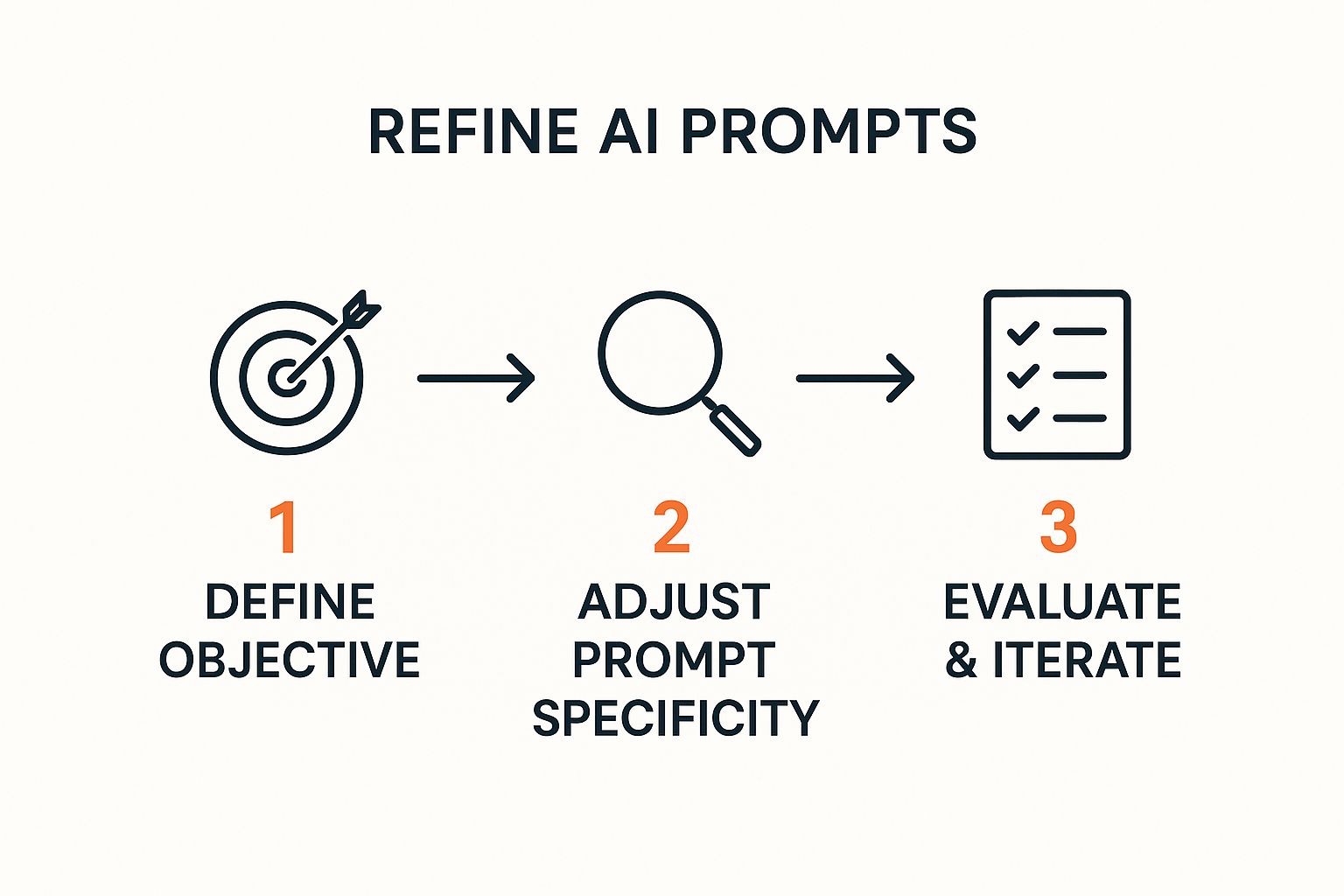
This visual nails the core idea of prompt refinement: define what you want, adjust your instructions, and evaluate the result. This iterative cycle is what turns a basic thought into a high-performance command.
Step 3: Analyse the Output and Identify Gaps
Run the prompt and look at the results. Compare them to your objective from Step 1.
- Output: “Top 5 Budgeting Apps,” “Investing for Beginners.”
- Analysis: The output is generic. It completely misses the target audience (Nigerian millennials) and the desired tone (engaging, literacy-focused). The gap is a lack of context and constraints.
If you want to get back to basics on what goes into an instruction, our guide on what is an AI prompt is a great place to start.
Step 4: Refine and Iterate with Precision (V2)
Now, add the missing information to create a more powerful prompt. This is where you apply the four pillars.
Second Iteration (Adding Context and Constraints):Generate 10 blog post titles for a new fintech app targeting Nigerian millennials (ages 22-35). The tone should be informative and aspirational. The titles should focus on practical financial tips.
This version is much better. You’ve added the target audience, location, tone, and topic focus. The AI will now generate more relevant titles like “5 Smart Money Moves for Young Professionals in Lagos” or “How to Start Investing with Just ₦10,000.”
Step 5: Final Polish (V3) (Optional)
If the results are good but not great, you can add another layer. Let’s introduce a persona to improve the style.
Third Iteration (Adding Persona and Style Constraint):Act as a senior content strategist for a leading African fintech blog. Create 10 click-worthy blog titles for an app targeting Nigerian millennials. Focus on themes of financial independence and smart investing. Make them sound modern and engaging, using conversational language.
This final version pushes the AI to adopt an expert persona and focus on a specific creative style, giving you titles that are not just relevant but also compelling. This simple loop—draft, analyse, refine—is the core workflow that separates basic requests from powerful, high-performing prompts.
Real-World Prompting Examples for Business

Theory is one thing, but seeing prompt engineering in action is where it all clicks. To show you how powerful this can be, here are some actionable, ready-to-use prompt templates for common business tasks. These are designed to give you a head start.
Generating a Marketing Campaign Brief
A solid brief is the backbone of any marketing campaign. This prompt ensures you cover all the bases from the start, saving hours of work.
Actionable Prompt Template:Act as a Senior Marketing Strategist. Create a comprehensive marketing campaign brief for the launch of a new mobile banking app called 'NairaSmart' in Nigeria. The primary target audience is tech-savvy students and young professionals aged 18-30 in Lagos and Abuja.
The brief should include these specific sections, using the details provided:1. **Campaign Goal:** Increase app downloads by 50,000 within the first three months.2. **Key Message:** "Your smart, simple, and secure way to manage money on the go."3. **Target Audience Persona:** A detailed profile of 'Tunde', a 24-year-old university student who values convenience and digital solutions.4. **Key Channels:** Instagram, Twitter (X), and campus activations at UNILAG and the University of Abuja.5. **Budget:** A proposed budget breakdown for a total of ₦5,000,000, allocating funds for social media ads, influencer collaborations, and event logistics.6. **Timeline:** A 3-month launch plan with key milestones for each month.
Why It Works: This prompt gives the AI a specific role (persona), rich context (product, audience, locations), and clear constraints (the required sections and data). This forces the AI to structure the output as a professional, actionable document.
Drafting Empathetic Customer Support Emails
AI can help your support team draft consistent and empathetic replies, especially during busy periods. This prompt is designed to resolve a common problem with the right tone.
Actionable Prompt Template:Act as an experienced and highly empathetic Customer Support Specialist. A customer is upset because their online order (#12345) has been delayed by three days. The delay was due to a logistics issue at our Lagos warehouse.
Draft an email response under 150 words that follows these steps:1. Start with a sincere apology for the delay and acknowledge their frustration.2. Briefly and transparently explain the reason for the delay.3. Provide the new estimated delivery date (e.g., "in 2 business days").4. Offer a 15% discount code ('SORRY15') for their next purchase as a gesture of goodwill.5. End by reassuring them and providing a direct contact for further questions.
Why It Works: The magic here is the combination of persona (“empathetic specialist”) and the clear, step-by-step instructions. It dictates the emotional tone and logical flow, while the word count constraint ensures the email is concise and respectful.
The way we use precise language in prompts mirrors how great copy works. For instance, looking at viral ad copy examples shows how carefully chosen words can drive specific actions—a lesson that applies directly to prompt engineering.
Creating a Python Script for Data Analysis
Prompting is a fantastic way for developers to generate boilerplate code, saving time for more complex problem-solving.
Actionable Prompt Template:Act as a Senior Python developer specializing in data analysis with the pandas library. Write a Python script that performs the following steps in order:1. Imports the pandas library.2. Reads a CSV file named 'customer_data.csv' into a DataFrame.3. Assume the CSV has these columns: 'CustomerID', 'PurchaseDate', 'Amount', and 'Location'.4. Removes any rows that have missing values in any column.5. Groups the data by the 'Location' column and calculates the sum of the 'Amount' for each location.6. Prints the resulting sales data to the console, formatted as a clean, readable table.7. Add comments to the code to explain each major step.
Why It Works: This prompt is effective because it’s a clear, logical checklist. It specifies the technology (Python, pandas), the data structure, and the exact sequence of operations. The instruction to “add comments” is a crucial constraint that ensures the code is not just functional but also maintainable.
By breaking down a complex task into a series of simple, sequential instructions, you empower the AI to generate accurate and reliable code, dramatically speeding up development workflows.
These examples are just the tip of the iceberg. For more ideas tailored to our local context, take a look at our guide on the top 10 AI prompts every Nigerian entrepreneur should know.
Advanced Prompting Techniques That Get Results
Once you’ve mastered the four pillars, you can explore more sophisticated strategies to tackle complex tasks. These advanced techniques help guide the AI through complex reasoning, making it possible to solve problems that a simple prompt would fail at.
Guide the AI with Few-Shot Prompting
Few-Shot Prompting is the technique of showing, not just telling. You provide the AI with several examples of a task done correctly before giving it the new task. This trains the model on the exact format and logic you expect.
Actionable Step-by-Step Guide:
- Define the Task: Start with a clear instruction, e.g., “Categorize these news headlines into ‘Technology’, ‘Business’, or ‘Sports’.”
- Provide Examples: Give 2-3 examples of an input and its corresponding correct output.
- Make Your Request: Provide the new input you want the AI to process.
Practical Example: Sentiment Analysis
Let’s see this in action for classifying customer feedback.
Prompt:Classify the sentiment of the following customer reviews as Positive, Negative, or Neutral.
Review: "The delivery was super fast and the product is amazing!"Sentiment: Positive
Review: "I've been waiting for two weeks and it still hasn't arrived."Sentiment: Negative
Review: "The item is exactly as described on the website."Sentiment: Neutral
Review: "I'm so disappointed with the quality, it broke after one use."Sentiment:
By seeing the examples, the AI learns the pattern and will confidently classify the final review as Negative. This is highly effective for tasks requiring specific formatting or nuanced judgment.
Unlocking Logic with Chain-of-Thought Prompting
For problems that require logical steps, Chain-of-Thought (CoT) Prompting is a game-changer. You prompt the AI to “think out loud” by providing an example where you break down the reasoning process step-by-step.
This forces the AI to follow a logical path instead of jumping to a conclusion, drastically improving its accuracy on math, logic, and reasoning tasks.
Chain-of-Thought prompting is like asking a student to show their work on a maths problem. By seeing the steps, you can trust the final answer more, and the student is less likely to make a simple mistake along the way.
Practical Example: A Simple Logic Puzzle
Standard Prompt (Without CoT):Q: A cafeteria had 23 apples. If they used 20 for lunch and bought 6 more, how many apples do they have?A:
This might produce the right answer, but it’s a gamble.
CoT Prompt (With Reasoning Steps):Q: There are 15 trees in the grove. Grove workers will plant trees in the grove today. After they are done, there will be 21 trees. How many trees did the grove workers plant today?A: We start with 15 trees. Later, we have 21 trees. The difference must be the number of trees they planted. So, we must subtract 15 from 21. 21 - 15 = 6. The answer is 6.
Q: A cafeteria had 23 apples. If they used 20 for lunch and bought 6 more, how many apples do they have?A:
By showing the step-by-step logic in your example, you teach the model how to reason. It will now follow that pattern for your new question, explaining: “The cafeteria started with 23 apples. They used 20, so 23 – 20 = 3. They bought 6 more, so 3 + 6 = 9. The answer is 9.”
Advanced Prompting Techniques Compared
To help you decide which technique fits your needs, the table below gives a quick breakdown of these two powerful methods.
| Technique | Core Concept | Best Used For | Example Snippet |
|---|---|---|---|
| Few-Shot Prompting | Provide examples of the desired input-output format. | Classification, data formatting, and style replication. | Text: "I love it!" Sentiment: Positive |
| Chain-of-Thought | Encourage the AI to break down its reasoning into steps. | Maths problems, logic puzzles, and multi-step questions. | First, calculate the initial amount... Then, add the new amount... |
Mastering advanced techniques like these is what separates a casual user from a serious prompt engineer.
Common Prompting Mistakes and How to Fix Them
Even pros make mistakes. When an AI gives you a useless answer, it’s often due to a simple flaw in the prompt. Learning to spot these common errors is the fastest way to improve your results. Here’s an actionable guide to fixing them.
Mistake 1: Being Too Vague
This is the number one error. Vague instructions force the AI to guess, and it usually guesses wrong.
Flawed Prompt:Write about business.
Actionable Fix: Add the “Who, What, Why, and Where” to your prompt.
- What: The top three challenges.
- Who: Small retail businesses.
- Where: In Nigeria.
- Why: To inform new entrepreneurs.
Corrected Prompt:Write a 300-word summary of the top three challenges facing small retail businesses in Nigeria. The tone should be informative and aimed at new entrepreneurs.
By answering these questions in your prompt, you provide the necessary clarity and context for a focused response.
Mistake 2: Forgetting to Specify a Format
If you don’t tell the AI how to present the information, it will default to a block of text.
Flawed Prompt:Tell me the benefits of using AI for customer service.
Actionable Fix: Always explicitly state the output structure you need. Think about how you plan to use the information. Is it for a presentation, a report, or a social media post?
A common mistake is assuming the AI knows the best way to present information. Always specify your desired format to ensure the output is structured for its intended purpose.
Corrected Prompt:List the top five benefits of using AI for customer service in a bulleted list. For each benefit, provide a one-sentence explanation.
Now the output is clean, scannable, and ready to be dropped into a slide deck or a blog post. This is especially useful when creating materials like prompts for customer services, where clarity is critical.
Mastering these simple fixes is a game-changer. Once you get the hang of it, you’ll see a massive improvement in the quality of your AI-generated content.
Your Prompt Engineering Questions Answered
As you start digging into prompt engineering, you’ll probably find a few questions keep coming up. Let’s tackle some of the most common ones to clear things up before we move on.
Do I Need to Be a Coder to Learn Prompt Engineering?
Absolutely not. It’s a common misconception, but prompt engineering is fundamentally a communication skill, not a coding one. Think of it more like being a great director than a programmer.
Your success hinges on your ability to give precise, logical, and context-rich instructions in plain English. If you can write a clear email or a detailed project brief, you’ve already got the foundational skills you need to get started. It’s all about clarity and creative problem-solving.
How Do Prompting Techniques Differ Between AI Models?
While the core principles are universal, you do need to adapt your approach depending on the AI model. Different models have their own unique strengths and quirks. For instance, a model like GPT-4 is a powerhouse for complex reasoning and creative writing, whereas a model like Claude often shines when you give it long documents to summarise.
The good news is that the fundamentals—clear context, specific constraints, and a well-defined persona—will improve your results on any model. The real trick is to get in there and experiment.
Think of it like driving different types of cars. The basics of steering, accelerating, and braking are the same, but you’d handle a high-performance sports car a bit differently than a rugged SUV to get the best out of it.
What Does the Future of Prompt Engineering Look Like?
This field is moving incredibly fast. As AI models get smarter and more intuitive, they’ll become much better at figuring out what you mean, even from vague or incomplete requests. For simple, everyday tasks, the need for super-detailed, manual prompting will likely fade.
But don’t mistake that for the skill becoming obsolete. The real value will shift towards strategic thinking. It will be less about crafting a single perfect instruction and more about designing complex, multi-step workflows. We’re moving from having a simple conversation with an AI to managing AI agents that can tackle bigger goals with less hand-holding.
Ready to put these principles into practice? With RichlyAI, you can access powerful AI tools to generate high-quality text, images, and code with just a few clicks. Start creating smarter content today by exploring our platform.
