
Data science roles have quickly become some of the most influential and in-demand careers across Nigeria’s tech and business worlds. These jobs are all about using scientific approaches, clever processes, and robust systems to pull meaningful insights from data—both the neat, organised kind and the messy, unstructured kind. Ultimately, these insights shape business strategy and drive real innovation.
Why Data Science Jobs Are Booming In Nigeria

In Nigeria’s fast-paced economy, simply collecting data isn’t enough anymore. Businesses are now putting that data to work to get ahead of the competition.
Think of a data professional as a master navigator for a company. The captain of the ship (the CEO) points to a destination on the map—say, “increase profits by 20%.” It’s the navigator who uses the charts, weather patterns, and instruments (the data) to plot the safest and quickest route to get there. This is exactly what data professionals are doing for businesses today.
This fundamental shift has elevated data science jobs from a back-office technical role to a vital strategic partnership. Companies in every major industry are waking up to the reality that their survival and growth depend on making smart, data-backed decisions. This guide is your roadmap to understanding and landing one of these career-defining roles.
The Forces Fuelling The Demand
So, what’s really behind this explosion in data careers? A few key factors are at play. With the widespread adoption of digital platforms, companies are sitting on a mountain of customer information. But raw information is just noise until an expert comes along to turn it into a clear, actionable strategy.
Let’s look at some practical examples:
- In Finance: Banks like Kuda or Access Bank use data scientists to build sophisticated models that can spot fraudulent transactions in real-time. For instance, a model might flag a transaction as suspicious if a card is used in Lagos and then, five minutes later, in Abuja. This saves customers and the company millions of Naira.
- In E-commerce: Jumia and Konga analyse your clicks and past purchases to offer personalised recommendations. If you buy a smartphone, their system might automatically suggest a screen protector and a case, a simple, data-driven action that dramatically increases sales.
- In Telecommunications: MTN and Glo use data to predict which customers might be thinking of switching to a competitor (a concept called “churn”). By analysing call patterns and data usage, they can proactively offer a personalised data bonus to a high-risk customer, keeping them loyal.
This strategic value isn’t just a corporate trend; it’s being recognised on a national scale. You can read more about this in Nigeria’s National AI Strategy, a vision for inclusive innovation and global leadership, which underscores how critical data is to the nation’s future.
In short, data professionals are the modern-day detectives of the business world. They uncover the hidden opportunities and risks buried deep within the numbers, helping a company understand not just what happened, but why it happened and what’s likely to come next.
To help you get started on this journey, we’ve put together a quick overview of the main career paths you’ll find in the data science field. This guide will dive deep into each one, but this table gives you a great starting point.
Overview of Key Data Science Career Paths in Nigeria
| Job Role | Core Focus | Key Industries |
|---|---|---|
| Data Scientist | Predictive modelling and advanced statistical analysis | Finance, E-commerce, Healthcare |
| Data Analyst | Interpreting past data and creating business reports | Retail, Marketing, Logistics |
| Machine Learning Engineer | Building and deploying automated predictive systems | Tech, FinTech, Telecommunications |
| Data Engineer | Creating and maintaining data infrastructure and pipelines | All data-heavy industries |
This table provides a snapshot of the landscape, but each role has its own unique flavour and set of challenges. Let’s break them down further.
Understanding the Different Data Science Roles
Jumping into the world of data science can feel a bit like alphabet soup, with job titles that sound confusingly similar. But don’t let that fool you. Each role plays a very specific and vital part in the journey from raw, messy data to real business value. Figuring out these differences is your first big step toward finding the path that truly clicks with your skills and passions.
To make sense of it all, let’s imagine we’re building a brand-new, high-tech smart city. Each data professional is a key specialist, and the city simply can’t function without them.
The Data Engineer: The City Architect
First up is the Data Engineer, who is essentially the master architect and civil engineer of our smart city. Their job is massive: they design and build the entire foundational infrastructure that everything else depends on. Think of them as laying down the data “roads” (pipelines), setting up the “power grids” (databases), and digging the “reservoirs” (storage solutions) to guarantee a constant, reliable flow of information.
Practical Example: A data engineer at a bank might build a system that pulls transaction data from ATMs, mobile apps, and website logins every minute, cleans it, and loads it into a central data warehouse. Without this reliable flow of data, no one else can do their job.
The Data Analyst: The City Planner
Next, we have the Data Analyst. In our city analogy, they are the city planners. Their main goal is to understand what’s happening in the city right now by looking at all the historical data they can get their hands on. They’ll study traffic patterns (past sales data), check population density (customer demographics), and monitor utility usage (website engagement) to create detailed reports and easy-to-read dashboards.
Practical Example: A data analyst for an e-commerce company answers questions like, “Which products had the highest sales in the last month?” They would create a dashboard showing top-selling items, sales by region, and customer demographics, giving the marketing team actionable insights for their next campaign. If you’re trying to decide where you fit, comparing the Data Analyst vs Data Scientist roles is a great way to see which one aligns better with your interests.
The Data Scientist: The Urban Futurist
Now for the Data Scientist—the city’s visionary, its urban futurist. While the analyst is focused on the past and present, the scientist uses that very same data to predict the future. They build complex predictive models to tackle big questions like, “Where will traffic be most congested in five years?” or “How can we design a public transport system that meets future demand?”
Practical Example: A data scientist at a logistics company like GIGL would build a model to predict the most efficient delivery routes for their drivers, considering traffic, weather, and package volume. This model doesn’t just report on past deliveries; it actively forecasts the best path forward to save time and fuel. This forward-looking work is central to the growth of artificial intelligence in Nigeria.
The Machine Learning Engineer: The Automation Specialist
Finally, we meet the Machine Learning Engineer. This is the specialist who takes the futurist’s brilliant models and turns them into real, automated systems that run the entire city. So, if a data scientist develops an amazing new traffic prediction model, it’s the ML Engineer who builds the intelligent, real-time traffic control system that automatically adjusts the traffic lights based on that model’s output.
Practical Example: At a fintech company like Paystack, after a data scientist builds a fraud detection model, the ML Engineer integrates it directly into the payment processing system. This system then automatically blocks suspicious transactions in milliseconds, without needing a human to review each one. They productionize the AI.
You’ll find these roles often work together on the same projects. For instance, an e-commerce company trying to reduce customer churn might have a data engineer build a pipeline to pull customer activity data. The data analyst would then study past churn to find common warning signs. Next, the data scientist would build a model to predict which customers are most likely to leave. Finally, the machine learning engineer deploys that model into an automated system that triggers targeted retention offers in real-time.
This image shows how the core skills overlap across these distinct roles.
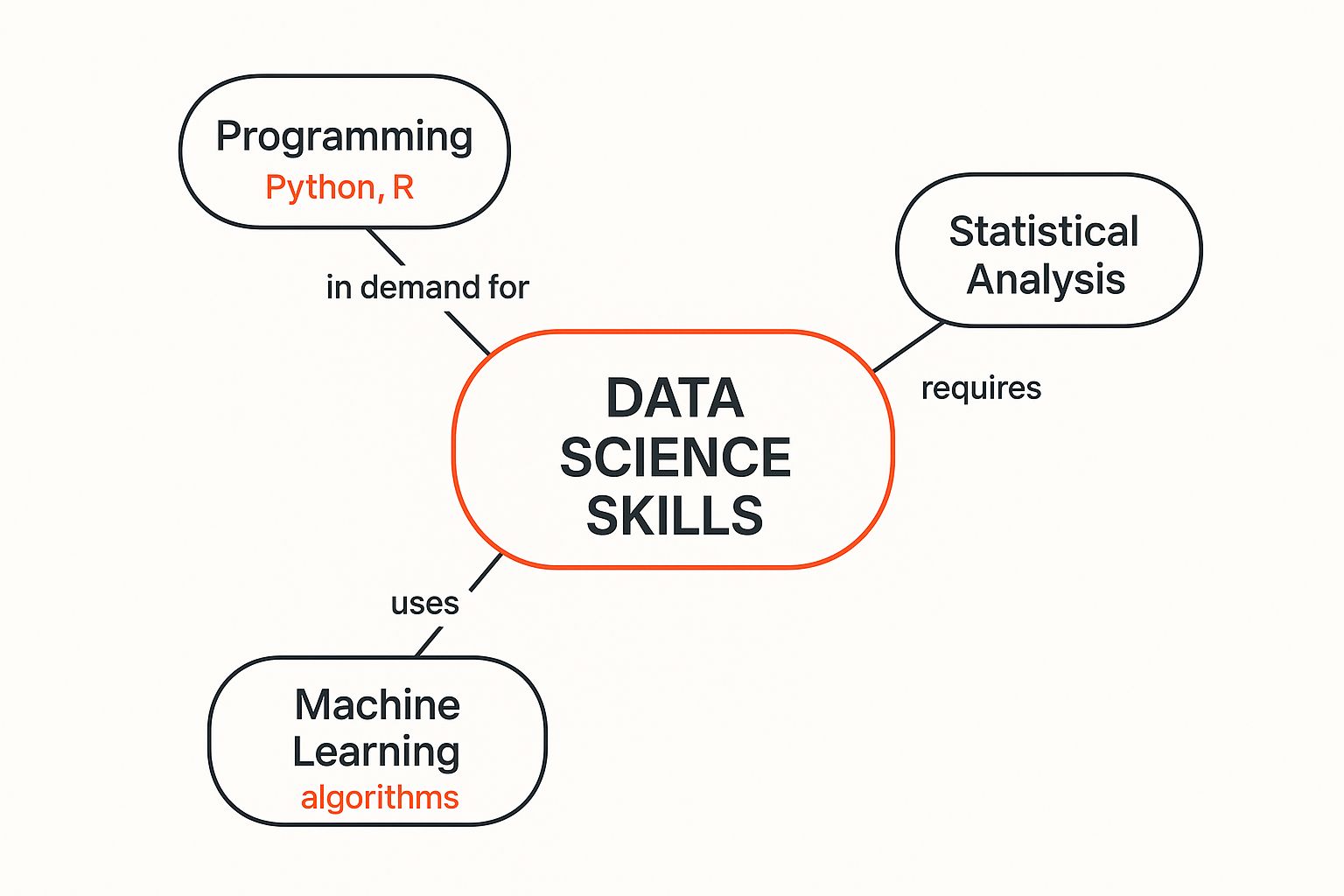
As you can see, even though the jobs are different, they all share a common foundation of programming, statistical knowledge, and machine learning principles.
Building Your Data Science Skillset
Landing a great job in data science isn’t just about knowing the theory. It’s about building a practical, well-rounded set of skills. Think of it like a chef: you need both top-notch knives (the tools) and a deep understanding of flavour combinations (the strategy) to create a fantastic meal.
In data science, this breaks down into two crucial areas: your technical tools and your strategic mindset. Mastering both is what separates a good data professional from a truly great one. After all, a powerful predictive model is useless if it doesn’t solve a real business problem, and a brilliant insight is wasted if you can’t convince anyone to act on it.

Mastering the Technical Tools
Your technical toolkit is the absolute foundation of your career. These are the languages and platforms you’ll use every day to wrangle, analyse, and model data. The real skill isn’t just learning the syntax; it’s about knowing how to apply these tools to solve business challenges from beginning to end.
Here’s a step-by-step guide to a typical project workflow:
- Step 1: Extract Data with SQL. Your journey almost always starts with Structured Query Language (SQL) to pull the right information from a company’s databases. Actionable Task: Practice by writing a SQL query to select all customers from a sample database who have not made a purchase in the last 90 days.
- Step 2: Clean and Explore with Python/Pandas. With the raw data in hand, you’ll jump into a programming language like Python. Use the Pandas library to clean the data—fixing inconsistencies and filling in missing values. Actionable Task: Take the customer data you extracted and use Pandas to remove any duplicate entries and calculate the average time between purchases for each customer.
- Step 3: Build Models with Python/Scikit-learn. This is where you make predictions. With a library like Scikit-learn, you can build a machine learning model to spot patterns that predict future behaviour. Actionable Task: Use your cleaned customer data to build a simple logistic regression model that predicts which customers are most likely to churn.
This combination of tools is the bedrock of most data science roles. Getting comfortable here means you can confidently handle the entire technical journey of a data project.
Developing a Strategic Mindset
But here’s the thing: technical chops alone won’t get you to the top. The most valuable data professionals are the ones who can connect their work directly to business outcomes. This requires a strategic mindset built on problem-solving, storytelling, and a solid dose of business savvy. As the field evolves, knowing how to thrive in the age of AI and automation often boils down to sharpening these uniquely human skills.
A powerful model is only valuable if you can explain its business implications to stakeholders, transforming complex findings into a compelling story that drives action.
This strategic side is what turns raw data into smart decisions. It’s built on a few core components:
Problem-Solving: This is all about asking the right questions before you write a single line of code. Instead of just taking an order to “build a churn model,” a strategic thinker digs deeper: “What’s the real goal here? Are we trying to cut churn by 10%? Or are we focused on saving our highest-value customers?” This frames the entire project around a clear, impactful objective.
Data Storytelling: Your analysis will uncover complex patterns and probabilities. Storytelling is the art of translating those numbers into a clear, persuasive narrative for people who aren’t data experts. Practical Example: Don’t say, “The model shows a feature importance of 0.87 for ‘failed payments’.” Instead, tell a story: “Our analysis found that customers whose payments fail twice are 90% more likely to cancel. This is the single biggest red flag we have. I recommend we send an automated SMS after the first failed payment to help them update their card.”
Business Acumen: This is your gut-level understanding of how the company works, how it makes money, and what it’s trying to achieve. With good business acumen, you can prioritise the projects that will make the biggest difference. You’ll understand that a model that is 2% less accurate but can be launched a month sooner might be far more valuable than a “perfect” model that arrives too late.
To give you a clearer picture, let’s break down how these skills come together in the real world.
Essential Skills for Data Science Professionals
The following table lays out the key technical and strategic skills, showing how they’re applied in everyday scenarios.
| Skill Category | Specific Skill | Practical Application Example |
|---|---|---|
| Technical | SQL | Writing a query to extract user sign-up and activity data from the last six months from a production database. |
| Technical | Python with Pandas | Cleaning the extracted data by removing duplicates, handling missing dates, and standardising text fields for consistency. |
| Technical | Machine Learning (Scikit-learn) | Building a logistic regression model to predict which users are likely to make a purchase based on their activity patterns. |
| Technical | Data Visualisation (Tableau/Matplotlib) | Creating a dashboard that shows sales trends over time and highlights the performance of a recent marketing campaign. |
| Strategic | Problem-Solving | Asking the marketing team: “Is our goal to increase total sales, or improve the conversion rate of first-time visitors?” |
| Strategic | Data Storytelling | Presenting model results by saying, “We found that users who visit our pricing page three times are 75% more likely to buy.” |
| Strategic | Business Acumen | Recommending against a complex project because the potential revenue gain doesn’t justify the six-month development time. |
By focusing on both your technical toolkit and your strategic mind, you’re not just preparing for your first job—you’re building a foundation for long-term growth and leadership in the ever-evolving world of data science.
What You Can Expect to Earn in Data Science in Nigeria
Let’s talk money. Knowing your potential earnings is a huge part of mapping out your career. In Nigeria, the demand for sharp data professionals is booming, and that’s created a really competitive salary scene. Put simply, what you earn is a direct reflection of your experience and the real-world value you can deliver to a business.
This section will give you a straightforward look at what you can expect to be paid. We’ll break down the salary ranges for entry, mid, and senior-level data jobs, tying them to the kind of work you’ll be doing at each stage. The goal is to give you the confidence to know your worth and negotiate your salary effectively.
Entry-Level Data Professional Salaries
When you’re just starting out, your first role is all about building a solid foundation. You’ll be focused on specific, well-defined tasks like cleaning up messy data sets, running initial analyses, and building basic reports or dashboards. It’s about learning the ropes and showing you’ve got the technical chops.
Practical Example: As a junior data analyst at an e-commerce startup in Lagos, a typical task might be using SQL to extract recent sales figures and then using a tool like Tableau to create a weekly performance dashboard for the marketing team. Your work provides the essential numbers they need to see which campaigns are working.
The Nigerian data science job market is on a steep upward curve, driven by more and more companies in finance, telecoms, and e-commerce waking up to the power of data. According to recent data from Nigeria, entry-level Data Scientists can expect to earn between ₦300,000 and ₦600,000 per month. For a deeper dive into these numbers, you can find more detailed insights on the Nigerian market over at DataLab.
Mid-Level Data Professional Salaries
After a few years in the game, you’ll step into a mid-level role. At this point, you’re doing more than just executing tasks. You’ll start to take charge of smaller projects, guide the junior members of your team, and own the entire data analysis process—from figuring out what the business needs to presenting your final insights to decision-makers.
Practical Example: A mid-level data scientist at a fintech company might be tasked with building a new credit risk model. This involves working with product managers to define what success looks like, building the model in Python, and then presenting its performance to senior leadership, explaining how it can reduce loan defaults by 15%. This added responsibility and direct business impact commands a higher salary. Mid-level pros typically earn between ₦600,000 and ₦1,200,000 monthly.
Senior-Level Data Professional Salaries
When you reach the senior level, you’ve evolved from a doer to a strategist. Your focus shifts away from the daily technical grind and towards shaping the data strategy for your team or even the entire organisation. You’re the one leading the most important projects, pushing for new ways of doing things, and providing insights that guide the C-suite.
Practical Example: A senior data scientist at a top Nigerian bank might lead a team to build and launch a real-time fraud detection system. This project involves complex machine learning, collaboration with engineering teams, and has a clear, massive impact on the company’s profits by preventing millions of Naira in losses.
This is why senior data scientists command the highest salaries, often ranging from ₦1,200,000 to over ₦3,000,000 per month. Their expertise becomes a key ingredient for business success, a theme closely related to empowering Nigeria’s economic growth with generative AI solutions.
Navigating Your Data Science Career Path

A career in data science isn’t a single destination; it’s a journey with distinct stages. Think of it less like a straight road and more like climbing a mountain. At each new altitude, you need different skills, and the view of the business landscape gets broader and clearer. Getting a handle on this progression is crucial for mapping out your success in the Nigerian tech scene.
Here is a practical, step-by-step guide to career progression:
The Junior Stage: Executing and Learning
As a junior data professional, your main job is to be a reliable doer. You’ll be handed well-defined tasks like cleaning up messy datasets, building a specific report, or running some initial analysis. This phase is all about sharpening your technical chops on real-world problems and proving you can deliver accurate results.
Actionable Step: Your goal is to become the go-to person for a specific task. For example, master writing SQL queries so well that senior colleagues come to you for help extracting complex data. Or become an expert in building clear, insightful dashboards in Tableau.
The Mid-Level Stage: Owning and Mentoring
Once you’ve proven you can handle the technical work, you’ll step into a mid-level role. Here, the focus shifts dramatically from simply completing tasks to owning entire projects. You’ll be responsible for a project from the initial idea all the way to presenting the final insights to stakeholders.
Actionable Step: Volunteer to lead a small project. Instead of just analysing the data, create the project plan, set the deadlines, and be the one to present the final results to the marketing or product team. This demonstrates ownership and communication skills.
The Senior and Leadership Stage: Strategising and Influencing
At the senior level, your role becomes far more strategic. You are now a trusted advisor to the business, using your deep expertise to influence major decisions. Instead of getting bogged down in individual projects, you’re helping to set the entire data strategy for your department or even the whole company.
Actionable Step: Start thinking like a business owner. In your next team meeting, don’t just present your findings; propose a new project based on an opportunity you identified in the data. For example, “I noticed our top 10% of customers drive 60% of our revenue. I propose we build a model to identify similar potential high-value customers at sign-up.”
Many professionals find their way to data science from other fields; knowing effective strategies for pivoting careers can be a huge advantage when aiming for this level.
Landing Remote Data Science Opportunities
The way we work has fundamentally changed, and for Nigerian data professionals, this is a game-changer. The explosion of remote work has thrown the doors to the global job market wide open, meaning you can now contribute to major international projects right from home. This isn’t just about working in your pyjamas; it’s about accessing a whole new world of career growth and financial freedom.
The financial leap can be huge. While local data science roles are competitive, international companies often pay in USD, which can dramatically outpace Nigerian salaries. It’s not uncommon to see remote data science jobs open to Nigerians paying between $70,000 and $155,000 a year. The exact figure often depends on the company’s size, with smaller start-ups hovering around the $70,000 mark and mid-sized companies pushing towards $155,000. This shift allows Nigerian talent to earn a global-standard income, all while living and spending locally.
Your Step-by-Step Guide to Securing Global Roles
Bagging one of these top-tier remote roles doesn’t happen by accident. It takes a smart, deliberate approach. You’re not just competing locally anymore; you need to position yourself as a world-class professional ready to solve problems on a global scale.
Here’s a practical, step-by-step guide to get you there:
- Step 1: Build a World-Class Portfolio. Your portfolio is your ticket to an interview. Go beyond generic tutorials. Actionable Task: Find a messy, real-world dataset from an international source (e.g., public health data from the WHO). Document your entire cleaning, analysis, and modelling process in a GitHub repository. Write a blog post explaining not just what you did, but the business value of your findings. For example, “How I built a model to predict disease outbreaks, which could help NGOs allocate resources more effectively.”
- Step 2: Optimize Your LinkedIn Profile for Recruiters. International recruiters live on LinkedIn. Actionable Task: Change your headline from “Data Scientist” to something more specific and value-driven like “Data Scientist | Building Predictive Models to Reduce Customer Churn for SaaS Companies.” Actively participate in global data science groups by commenting on posts with insightful questions or answers. This increases your visibility.
- Step 3: Master the Virtual Interview. Remote interviews are a unique skill. Actionable Task: Record yourself answering common data science interview questions. Watch it back to check your clarity, body language, and pacing. Practice explaining a complex project to a non-technical person. Ensure your technical setup (internet, lighting, audio) is flawless.
“To succeed in the global remote job market, your communication skills must be as sharp as your technical abilities. Clearly articulating the business impact of your work is what will set you apart from other candidates.”
As you look beyond local borders, it helps to have a solid game plan. You can find many expert tips and strategies for applying for jobs abroad that can really help you navigate the international job search. This global shift is a massive opportunity for Nigerian talent to shine on the world stage.
Common Questions About Data Science Careers
Diving into the world of data science can feel a bit overwhelming. You’ve got the ambition, but a dozen questions are probably rattling around in your head. That’s perfectly normal. This section is here to give you straight, practical answers to the questions we hear most often from people looking to break into the field.
Think of this as a friendly chat to clear up some of the big uncertainties so you can focus on building a solid career plan.
Do I Need a Master’s Degree for a Data Science Job?
Honestly, not always. While a Master’s degree can definitely give you a leg up, especially for senior or research-focused roles, many Nigerian companies are shifting their focus. They’re becoming much more interested in what you can actually do with data.
Actionable Insight: A killer portfolio demonstrating practical skills is often more valuable than a degree. For example, a GitHub project where you build a model to predict Lagos rental prices using real-world data will impress a hiring manager more than a theoretical thesis. Focus on building projects that solve tangible problems.
What Is the Best Programming Language to Learn First?
If you have to pick one, make it Python. It’s the undisputed champion in the data science world for a reason. Its syntax is clean and relatively easy to grasp for beginners, but the real magic lies in its massive collection of libraries built specifically for data tasks.
Think of Python as your all-in-one toolkit. You have libraries like Pandas and NumPy for slicing, dicing, and cleaning data, and then you have Scikit-learn, which is your go-to for building powerful machine learning models.
While R is still a strong language, particularly in academic circles and for heavy-duty statistical work, Python’s versatility makes it the most in-demand language across the Nigerian tech scene. Starting with Python will simply open more doors for you, faster.
How Can I Build a Portfolio Without Job Experience?
This is the classic chicken-and-egg problem, but there’s a straightforward solution: you don’t need an employer to get experience. All you need is curiosity, a dataset, and a problem to solve. A great place to start is by grabbing free, public datasets from platforms like Kaggle, Zindi, or even the Nigerian government’s open data portal.
Here’s a simple, step-by-step guide:
- Step 1: Find a Relevant Dataset. Pick a dataset that relates to a Nigerian problem. For example, find Lagos traffic data or agricultural yield data. This makes your project more relatable to local employers.
- Step 2: Define a Clear Business Problem. Frame a question. For example, “Can we predict the busiest times on the Third Mainland Bridge to help commuters plan their travel?” or “Which crops have the highest yield in different Nigerian states?”
- Step 3: Execute an End-to-End Project. Follow the full data science workflow: data cleaning, exploratory data analysis (EDA), feature engineering, model building, and evaluation. Document every step clearly in a Jupyter Notebook.
- Step 4: Showcase Your Work Effectively. Upload your project to GitHub with a detailed
README.mdfile explaining the project’s goal, your process, and your findings. Write a short blog post on Medium or LinkedIn to explain the business implications of your results. This demonstrates both technical and communication skills.
Having just three to five solid, well-documented projects like this in your portfolio is one of the most effective ways to prove to a hiring manager that you have what it takes.
Ready to create compelling content and streamline your workflow? RichlyAI offers a suite of AI-powered tools to help you generate high-quality text, images, and code in minutes.
