
For years, Apple’s approach to artificial intelligence felt cautious, almost defensive. While competitors like Google, Microsoft, and OpenAI launched headline-grabbing, cloud-based AI, Apple championed on-device processing, making privacy its core differentiator. This strategy built a fortress of user trust but often left products like Siri feeling a step behind in raw capability.
That era is over. Apple’s evolving AI strategy in 2026 marks a significant shift with profound implications for voice assistants, consumer AI experiences, and the entire tech ecosystem. By embracing a powerful hybrid model that combines on-device intelligence with secure cloud processing, Apple is finally moving from a defensive posture to an offensive, feature-forward strategy.
This guide will explain what’s changed in Apple’s AI playbook, why it matters, and how this new direction will impact you as a user, developer, or industry watcher. We’ll explore the strategic shift, the rebirth of Siri as a true AI assistant, and the broader implications for the competitive landscape as we head toward 2026.
II. Background: Apple’s Historical Approach to AI
To understand the magnitude of the current shift, it’s crucial to look at where Apple came from. Its AI philosophy was historically defined by a deep commitment to user privacy, which shaped both its strengths and its limitations.
The Legacy of Siri
Siri was a pioneer, introducing the world to the concept of a voice assistant on a smartphone. Its early promise was immense, but real-world performance often fell short. While competitors like Google Assistant and Amazon’s Alexa rapidly improved through cloud-based learning, Siri’s capabilities grew more slowly. This was a direct result of Apple’s strategic decision to keep processing on the device, limiting the data available for model training and complex query handling.
Prior AI Priorities
Apple’s AI investments weren’t dormant; they were just focused elsewhere. The company poured resources into areas that directly enhanced the user experience without compromising privacy:
- Computational Photography: Features like Portrait Mode and Deep Fusion use on-device machine learning to produce stunning photos.
- Personalization: AI powers predictive text, facial recognition in Photos, and personalized recommendations in Apple Music, all processed locally.
- On-device ML: The Neural Engine, a specialized processor core in Apple silicon, was engineered specifically for fast, efficient, on-device AI tasks. These are all examples of the everyday AI tools you’re already using, often without realizing it.
Competitor Contrast
Meanwhile, the rest of the industry raced ahead with cloud-centric AI. Google Assistant leveraged Google’s massive search index, Alexa dominated the smart home, and OpenAI’s ChatGPT set a new standard for conversational AI. Apple’s cautious, privacy-first stance became both a key differentiator and a perceived weakness, leaving it appearing less innovative in the rapidly evolving generative AI space.
III. What’s Changed in Apple’s AI Strategy (2026)
The signals of Apple’s strategic pivot are clear and multifaceted, evident in new hires, product features, and a fundamental architectural shift.
A. New Strategic Signals
The transformation is backed by tangible actions. Apple has been on an aggressive hiring spree, bringing in top AI researchers and engineers from competing labs and expanding its internal AI/ML teams. This isn’t just about catching up; it’s about building foundational models in-house. Furthermore, the strategic partnership with OpenAI to integrate ChatGPT for broader knowledge queries signals a new willingness to collaborate where it makes sense, moving beyond its traditionally closed ecosystem. For developers, new frameworks and APIs supporting generative AI are the clearest evidence of this new direction.
B. AI in the Apple Product Ecosystem
Apple Intelligence is now being woven into the fabric of every major product. This is not a standalone app but a system-wide layer of intelligence.
- Practical Example (Mail Summarization): Upon opening the Mail app with a long thread of unread messages, a banner appears at the top: “Summarize this thread?” With a single tap, the on-device AI reads the emails and provides a concise, bulleted summary of the key points and action items, all without the content ever leaving your device.
- Generative Capabilities: Core services like Pages, Keynote, and Notes now include generative tools for drafting text, creating images, and cleaning up rough notes.
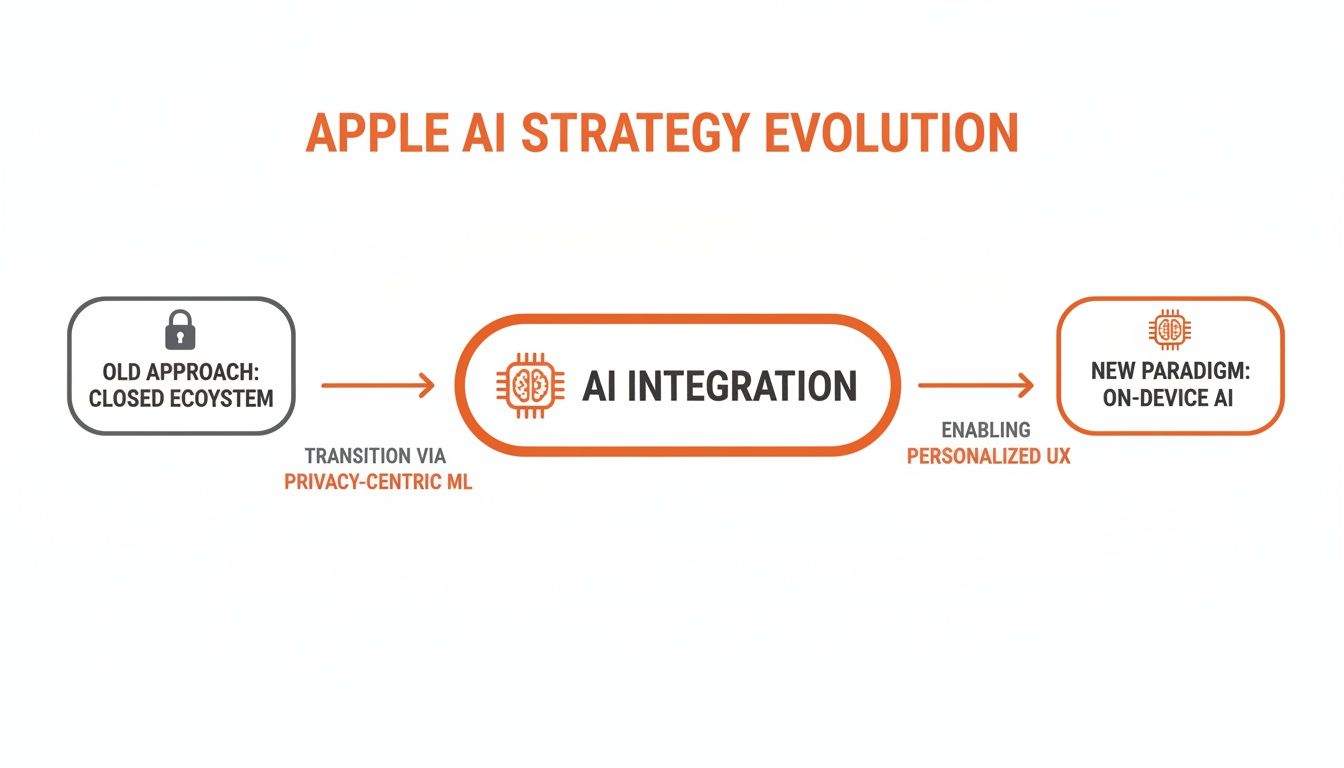
Alt text: A flowchart illustrating Apple’s AI strategy evolution, starting from a closed ecosystem, moving to on-device AI with privacy-centric ML, and culminating in a hybrid model that adds Private Cloud Compute for enhanced personalized user experiences.
C. Shifting Priorities
The core change is the move from a rigid, device-centric model to a flexible hybrid architecture. “Apple Intelligence” intelligently decides where to process each request. Simple, personal tasks are handled on-device. More complex queries that require larger models are offloaded to Private Cloud Compute—Apple silicon servers designed to process requests without storing user data. This allows Apple to deliver powerful, cloud-enabled AI experiences while maintaining its foundational commitment to privacy.
IV. The Voice Assistant Reimagined: Siri in 2026
Siri is arguably the biggest beneficiary of this strategic shift. It is being rebuilt from a simple command-taker into a proactive, conversational partner.
A. What Voice Assistant Evolution Means
The new Siri is designed to understand context—not just in a single question, but across apps, conversations, and devices. This persistent awareness allows it to handle complex, multi-step requests that were previously impossible. The goal is a transition from reactive commands (“What’s the weather?”) to proactive, conversational actions (“Book a table for two at that new Italian place my wife mentioned yesterday”).
Alt text: A person sits at a kitchen table using a smartphone, with a graphic overlay that reads ‘SIRI Reimagined’ to symbolize the voice assistant’s evolution.
B. Siri’s New Capabilities
- Natural Language Reasoning: Siri can now parse more complex, natural sentences and infer user intent.
- Multimodal Responses: You can interact with Siri via text, voice, and on-screen taps, and it can respond with text, visuals, and audio.
- Cross-device Continuity: Start a request on your iPhone and finish it on your Mac or Apple Watch, with Siri maintaining context throughout.
C. AI Assistants vs. Voice Assistants
This evolution blurs the line between a traditional voice assistant and a true AI assistant. A voice assistant reacts to commands. An AI assistant understands intent, orchestrates actions across multiple apps, and learns your preferences to act proactively. Siri is now firmly in the latter category.
D. Practical Use Cases
Step-by-Step Example: Smart Scheduling
Imagine you receive an email with a PDF attachment of a flight confirmation.
- User Command: While viewing the email, you say, “Hey Siri, add this flight to my calendar and remind me to check in 24 hours before.”
- Siri’s Action (On-Device):
- Siri uses on-screen awareness to identify the active app (Mail) and the document in focus.
- It securely parses the PDF on-device, extracting the flight number, departure/arrival times, and airline.
- It opens the Calendar app and creates a new event with all the correct flight details.
- It then creates a linked reminder in the Reminders app for 24 hours before the departure time.
- Confirmation: Siri displays a summary of the created event and reminder for your approval.
This seamless workflow, accomplished with a single voice command, demonstrates the power of an AI assistant that can understand context and orchestrate multiple applications.
V. Broader Consumer AI Implications
Apple’s strategy extends far beyond voice, aiming to embed intelligence into the core user experience across all its devices.
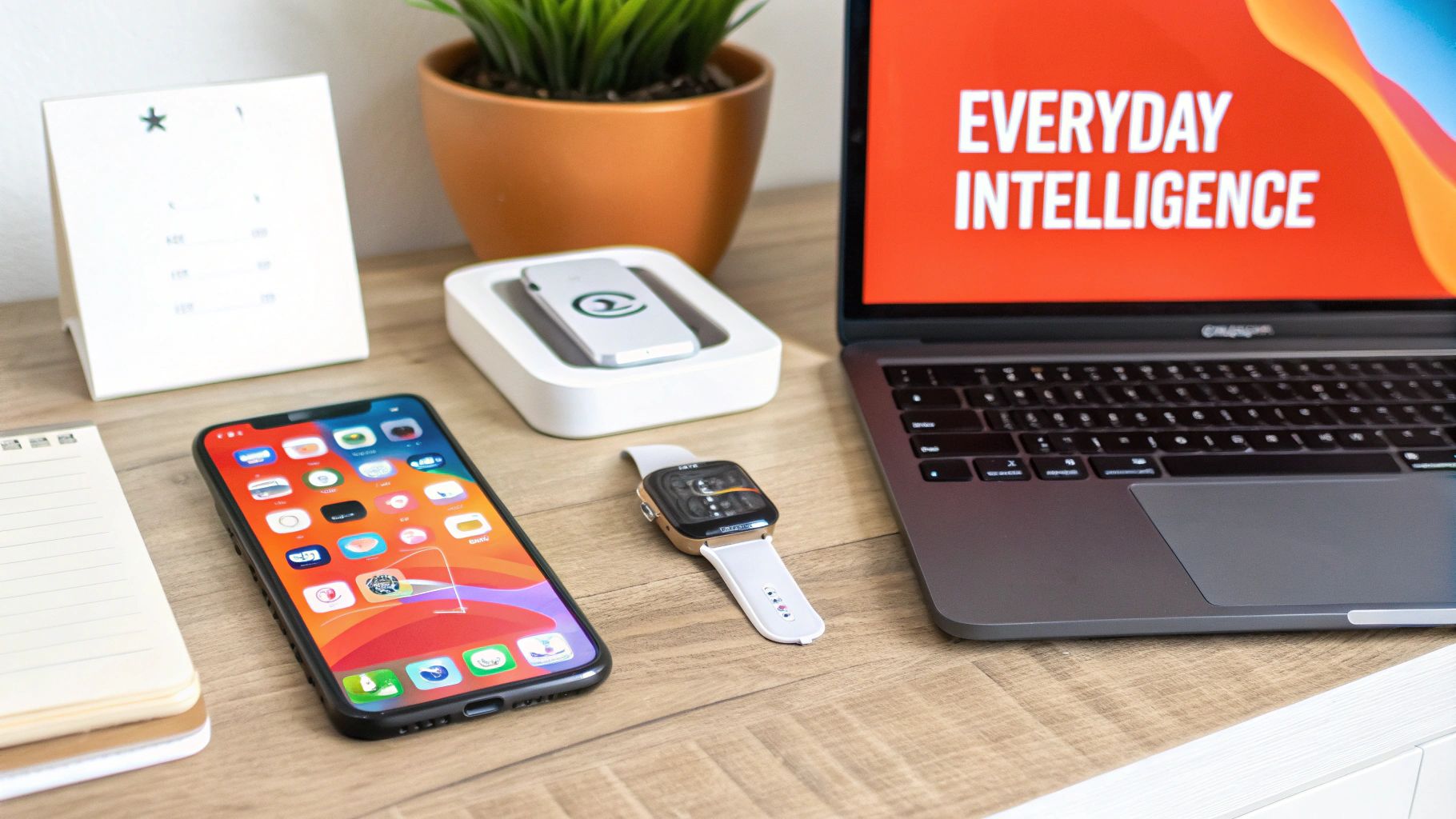
Alt text: A modern wooden desk with an iPhone, Apple Watch, and MacBook neatly arranged, representing Apple’s integrated device ecosystem.
A. Personalized AI Everywhere
By 2026, “Apple Intelligence” will feel like an ambient layer. Your devices will proactively offer suggestions based on your habits, from organizing your photos into compelling “Memories” to suggesting the perfect playlist for your morning commute. System-level AI will make iOS 20+ and future macOS versions feel less like static operating systems and more like dynamic, personal partners.
B. On-Device AI Meets Cloud Power
The hybrid architecture is the key. It delivers the speed and privacy of on-device processing for everyday tasks while providing the raw power of the cloud for more demanding generative AI requests. This allows Apple to compete with services like ChatGPT and Gemini on capability without compromising its privacy promises.
C. Developer Ecosystem
Apple is providing new APIs and frameworks, like the supercharged App Intents, to allow third-party developers to tap into this system-level intelligence. This will spark a new generation of apps that are not just smart but truly context-aware.
- Tools/Resources for Developers:
- Core ML: For running optimized models on-device.
- Create ML: For training models without deep ML expertise.
- App Intents Framework: To expose app functionality to Siri and the system.
D. Consumer Expectations
Apple’s approach aims to deliver AI that is useful and reliable rather than flashy. While ChatGPT set expectations for creative and expansive text generation, Apple is focusing on “personal intelligence”—AI that knows you and helps you get things done. This prioritizes usability and privacy over a model’s ability to write a sonnet, a deliberate choice that will shape consumer expectations for what personal AI should be.
VI. Strategic Industry Impacts
Apple’s calculated AI pivot is designed to reshape the competitive landscape by playing to its strengths: vertical integration and consumer trust.
A. Competitive Response
This move puts direct pressure on Google, Microsoft, and Amazon. It’s no longer enough to have a powerful AI model; the new competitive benchmark is seamless integration across a user’s entire device ecosystem, backed by tangible privacy protections. The AI commerce wars between Google and OpenAI will now have a third major player focused on a privacy-first, ecosystem-deep approach.

Alt text: A data center with rows of server racks, with a transparent graphic overlay that reads ‘Private Cloud Compute’ to illustrate Apple’s secure AI processing infrastructure.
B. Privacy as Competitive Advantage
Apple is weaponizing privacy. Its Private Cloud Compute architecture, engineered to cryptographically ensure user data is never stored or accessed by Apple, is a direct challenge to the data-hungry models of its rivals. This aligns perfectly with growing consumer awareness and regulatory scrutiny around data privacy, positioning Apple as the responsible choice.
C. The AI Ecosystem
By providing powerful, privacy-preserving AI APIs, Apple encourages developers to build on its platform. This creates a virtuous cycle: better, more intelligent apps make the ecosystem more attractive to users, which in turn attracts more developers. This strategy could challenge the dominance of cross-platform AI services by offering deeper, more seamless integration for apps within the Apple ecosystem.
VII. Risks and Challenges
Despite the promising strategy, Apple faces several hurdles on its path to AI leadership.
A. Technical Limitations
- On-device constraints: While powerful, the Neural Engine still has limitations on model size and complexity compared to massive data center GPUs.
- Model accuracy and latency: Balancing on-device speed with the accuracy of larger cloud models is a continuous engineering challenge. Hallucinations or incorrect responses, even if rare, can erode user trust.
B. Privacy vs. Personalization Tensions
The core challenge is delivering deeply personalized experiences without crossing privacy boundaries. The hybrid model is a clever solution, but any perceived failure or security lapse could damage Apple’s hard-won reputation for user trust. Maintaining transparency about how and where data is processed will be critical.
C. Market Risks
- Developer Adoption: The success of the ecosystem hinges on developers embracing the new AI frameworks. If adoption is slow, the platform’s full potential won’t be realized.
- Perception Challenges: Apple is still playing catch-up in the public’s perception of AI leadership. It must prove that its thoughtful, integrated approach is superior to the more powerful, open-ended models from competitors.
VIII. What It Means for Users
Translating strategy into real-world outcomes, here’s what you can expect by 2026:
- Enhanced User Experience: Your devices will feel smarter and more anticipatory, helping you with tasks before you even ask.
- More Responsive Assistants: Siri will be a far more capable partner, able to handle complex, multi-app requests with natural language.
- Cross-Device Consistency: AI features will work seamlessly across your iPhone, iPad, Mac, and Vision Pro, maintaining context as you switch devices.
- Privacy-First Personalization: You will get the benefits of a personalized AI without having to sacrifice your personal data.
IX. What It Means for Businesses and Developers
The commercial impact is significant:
- Integration Opportunities: Businesses can use new APIs to integrate their services directly into the core OS, offering users proactive assistance through Siri and system suggestions.
- New Markets: The rise of on-device AI creates opportunities for developers to build powerful, privacy-preserving tools that don’t rely on the cloud.
- AI-Enabled Ecosystems: Apple’s platforms are becoming powerful AI-enabled ecosystems, making them more attractive for developing sophisticated applications, especially with the rise of the prompt to app workflow.
X. Analyst Perspectives & Forecasts (2026)
Industry analysts are largely bullish on Apple’s AI trajectory.
- Gartner predicts that by 2026, Apple’s privacy-centric AI model will become a key purchasing driver, particularly in regulated industries and among privacy-conscious consumers.
- IDC forecasts that the integration of “Apple Intelligence” will trigger a significant hardware upgrade cycle—an “AI Supercycle”—as users seek devices with the latest Neural Engines to access the full suite of features.
- Forrester notes that Apple’s biggest challenge will be communicating the value of “personal intelligence” over the raw power of competitor models, but its loyal user base gives it a significant advantage. You can discover more insights about these predictions.
XI. Conclusion
Apple’s AI strategy shift is a landmark moment. By moving from a cautious, on-device-only approach to a sophisticated hybrid model, the company is finally poised to deliver on the long-held promise of a truly personal and helpful AI. This is not merely an upgrade to Siri; it is a fundamental reimagining of how we will interact with technology.
The big picture is clear: Apple is leveraging its unique integration of hardware and software to shape a future where consumer AI is powerful, seamless, and, above all, private. For a deeper look into how this will impact app development and business operations, explore what agentic AI really means for developers and businesses in 2026.
As we head toward 2026, the key is to watch how this strategy unfolds. For developers, businesses, and consumers alike, the time to prepare for this new era of integrated, privacy-centric AI is now.
Actionable Takeaways
- For Users: Start practicing more complex, conversational commands with Siri to explore its new cross-app capabilities.
- For Developers: Prioritize exploring the updated App Intents framework and other AI-centric APIs to build proactive, deeply integrated experiences.
- For Businesses: Re-evaluate your mobile strategy to identify opportunities where your service can leverage system-level AI for personalization and proactive assistance.
- Stay Informed: Keep a close eye on Apple’s WWDC announcements for the latest tools and frameworks that will define the next wave of intelligent applications.
- Explore AI Tools: Familiarize yourself with the capabilities of modern AI by exploring some of the best AI Tools.
XII. References & Suggested Reading
- Official Apple Keynote Announcements and Developer Documentation.
- Gartner, IDC, and Forrester reports on AI trends in consumer technology.
- Industry analyses comparing AI strategies from Apple, Google, Microsoft, and Amazon.
At RichlyAI, we believe in making advanced AI accessible to everyone. Our platform helps you create high-quality text, images, and code with ease, empowering your creativity and productivity. Explore the future of AI creation with us at RichlyAI.
