
Let’s be clear: Artificial Intelligence isn’t some far-off, complicated technology reserved for global corporations. It’s a practical tool that small and medium-sized businesses across Africa are using right now to solve everyday problems and spark real growth.
The secret is to stop focusing on the tech itself and start looking at your specific business challenges. Whether you’re trying to improve customer service or get better at predicting your sales, AI has tangible solutions that can make a difference.
Your Starting Point for AI Growth
Embarking on your AI journey doesn’t start with writing code; it starts with getting clear on your goals. For many SME owners in Nigeria and across the continent, the mere mention of AI brings to mind massive costs and a need for deep technical expertise. But that’s simply not the case anymore. You can get started without a huge budget or a dedicated team of developers.

alt text: A group of African business professionals collaborating around a laptop in a modern office, symbolizing SME growth and technology adoption.
The trick is to pinpoint those high-impact opportunities that already exist within your business operations. Think of this guide as your roadmap to finding those areas, choosing the right affordable tools, and launching your first AI project with confidence.
Finding Your Core Business Challenges
Before you even think about looking at AI tools, you need to take a good, hard look at your business and identify what’s holding you back. Where are the bottlenecks? Are your teams bogged down by repetitive admin work that eats up their day? Are your marketing campaigns just not hitting the mark?
These are precisely the kinds of problems that AI excels at solving.
A Practical Example: A Kenyan Coffee Shop
Imagine a coffee shop in Nairobi. The owner notices her staff spends an hour every morning manually creating the daily social media post. This is a recurring bottleneck.
- The Problem: Repetitive, time-consuming content creation.
- The AI Solution: Use an AI content generator. The owner can set up a simple template and prompt, like: “Create an engaging Instagram post about our ‘Coffee of the Day’, a Kenyan AA bean from Nyeri. Mention its notes of blackcurrant and a 10% discount. Use a friendly and warm tone.”
- The Outcome: This task is now done in 5 minutes, freeing up an hour of staff time for customer-facing activities.
For many of these applications, a foundational technology is at play. Taking a moment for understanding what is Natural Language Processing (NLP) can be incredibly helpful. It’s the engine behind tools like chatbots and customer feedback analysis. You don’t need to be an expert, but grasping the basics will make choosing the right solution much easier.
This isn’t just theory; it’s a massive trend unfolding across the continent. A recent study found that 85% of African enterprises have either invested in AI or plan to within the next 3–5 years. This isn’t a future fad; it’s becoming a fundamental part of staying competitive in today’s market.
Actionable Takeaways
- Identify One Repetitive Task: Find one task your team does daily or weekly that could be automated (e.g., social media posts, answering common emails).
- Map Customer Questions: List the top 5 questions you get from customers. This is your starting point for an AI chatbot.
- Analyze Your Marketing: Look at your last email campaign. Could AI have helped write a better subject line or personalize the content?
Tools & Resources
- AI Content Generation: Jasper, Copy.ai, ChatGPT
- Further Reading: A great next step is our guide on how AI and bots work together.
Pinpointing Where AI Can Make the Biggest Difference
Before you jump on the AI bandwagon and start spending money, let’s be real. Pouring cash into a new tool without knowing exactly what problem you’re trying to fix is a fast track to disappointment. The first step is to take a hard, honest look at your daily grind and find the real sticking points—the bottlenecks that eat up time and stunt your growth.

alt text: An African SME owner focused on a laptop screen, analyzing business data and pinpointing growth opportunities.
This isn’t about some complex corporate audit. Just start by talking to your team. Ask them: What are the repetitive tasks that drive you crazy every week? Which customer questions do you feel like you answer in your sleep? A quick review of your core business activities will shine a light on the best places to start.
Taking Stock of Your Operations
Let’s get practical. The biggest wins for SMEs usually come from improving one of three areas: customer service, marketing, or your day-to-day operational tasks. Think of these as the engine room of your business. A small tweak here can create massive ripples across the entire company.
A Real-World Example: A Lagos E-commerce Store
Imagine you run an online shop from Lagos, selling beautiful, locally made crafts. You’ve got a small, dedicated team, but you notice they’re spending nearly four hours every single day just answering the same questions on WhatsApp: “When will my order arrive?”, “Do you accept bank transfers?”, “Is this item still in stock?”.
This is a classic bottleneck and a perfect job for AI.
Step-by-Step AI Chatbot Setup:
- Choose a Tool: Select a user-friendly chatbot platform like Tidio that integrates with WhatsApp.
- Create a FAQ Document: Compile a list of the top 10-15 questions and their standard answers in a simple document.
- Train the Bot: Upload your FAQ document to the chatbot platform. Most tools allow you to do this with a few clicks. The AI will “learn” the answers.
- Set Up Automated Flows: Create simple conversation flows for key questions. For “When will my order arrive?”, the bot can be programmed to ask for an order number and then look it up in your system (via integration).
- Test and Deploy: Test the bot yourself to ensure it works correctly, then activate it on your WhatsApp Business account.
An AI-powered chatbot could handle 80% of these routine questions instantly, day or night. Suddenly, your team is freed up. They can now focus on handling tricky customer problems, making sure orders go out perfectly, or even helping you source new products.
The smartest AI projects for small businesses don’t try to reinvent the wheel. They find one specific, measurable problem—like cutting down customer wait times or automating sales leads—and solve it brilliantly.
Actionable Takeaways
- Run a ‘Repetitive Task Audit’: Ask each team member to track their tasks for one day and highlight the 3 most repetitive ones.
- Analyze Your Inbox/DMs: Spend 30 minutes reviewing your customer messages. Categorize the top 5 questions you receive.
- Review Your Sales Process: Identify one manual step in your sales process (e.g., sending follow-up emails) that could be automated.
Tools & Resources
- Chatbot Platforms: Tidio, ManyChat, Intercom.
- Further Reading: Explore how AI and bots work together to see how this could work for you.
Choosing the Right AI Tools on an SME Budget
The market is flooded with AI tools, but let’s be clear: you don’t need the most expensive or complicated platform to get fantastic results. For SMEs in Africa, the smart money is on tools that are affordable, user-friendly, and deliver value without needing a dedicated tech team.
Think of it this way. You’re not trying to build a car from scratch. You just need a reliable vehicle that gets you where you need to go, and many AI platforms are designed to do just that.
Start With What You Already Know
Honestly, the best place to begin is often with the software you’re already using every day. So many popular business platforms have quietly added powerful AI features, meaning you can start experimenting without a massive learning curve or extra expense.
- Customer Relationship Management (CRM): Take a look at your CRM. Platforms like Zoho CRM now have AI assistants that can score your leads, predict which deals are likely to close, and even automate follow-up emails. It’s already there, waiting for you.
- Customer Support: If you use a live chat tool, it probably has an AI chatbot feature. Something like Tidio lets you set up a bot in minutes to handle common customer questions on your website, freeing up your team.
- Data Analysis: Even familiar tools like Microsoft Power BI use AI to help you spot trends in your sales data. You don’t need to be a data scientist to find valuable insights anymore.
This approach is all about lowering the barrier to entry. You get to test the waters of AI within a familiar environment, which makes the whole process far less intimidating.
A Real-World Example: An E-commerce Store in Lagos
Picture a small e-commerce business in Lagos selling fashion accessories. They do well, but during peak seasons like Christmas or Eid, they’re constantly wrestling with stock management. They either sell out of popular items too quickly or get stuck with inventory they can’t move.
How They Use AI for Inventory:
- Connect Their Data: They use an affordable inventory management tool (like Zoho Inventory or a similar platform with AI features) and connect it to their sales platform (e.g., Shopify).
- AI Analyzes Past Sales: The AI model automatically analyzes historical sales data, identifying patterns around holidays, promotions, and seasons.
- Generate a Forecast: The tool generates a predictive forecast, suggesting reorder quantities. For example: “Based on last year’s Eid sales, we recommend ordering 150 units of the ‘Adire Silk Scarf’ by November 1st to avoid stockouts.”
- Set Up Low-Stock Alerts: They configure the system to send automatic alerts when stock for best-selling items hits a certain threshold.
With this one change, they could easily reduce overstock by 25% and capture more sales, directly boosting their bottom line.
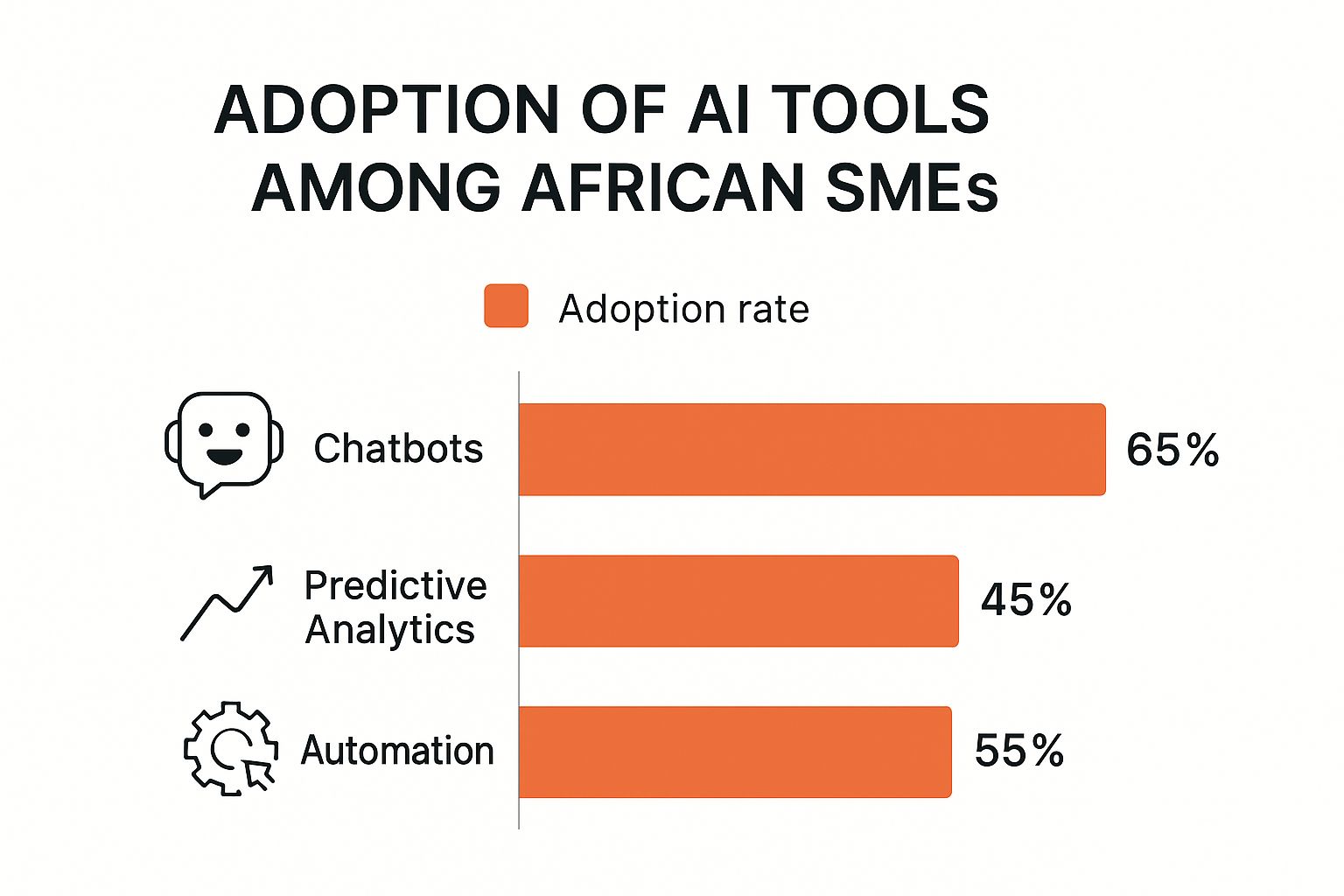
alt text: A chart showing the popularity of AI tools among SMEs, with chatbots and content creation leading, indicating a focus on practical business solutions.
When it comes to affordable solutions, it’s worth exploring the many AI content creation tools that can take a huge load off your marketing efforts. These tools can help with everything from writing social media posts to drafting blog articles. For a detailed comparison, checking out a list of the best AI content creation tools is a great next step.
Actionable Takeaways
- Audit Your Existing Software: Check if your current CRM, accounting, or marketing platforms have AI features you can activate.
- Prioritize “Plug-and-Play”: Look for tools designed for non-technical users that offer a quick and easy setup.
- Start with a Free Trial: Always test a tool’s free trial or freemium plan on a small, specific problem before committing money.
- Focus on One Problem at a Time: Pick one high-impact area—like customer support or inventory—and find the right tool for that single job.
Tools & Resources
- CRM with AI: Zoho CRM
- Customer Support Chatbot: Tidio
- Data Analysis: Microsoft Power BI
Taking the Plunge: Launching Your First AI Project
Enough with the theory. Real progress comes from getting your hands dirty. This is where you shift from planning to doing by launching your first AI initiative—starting with a small, manageable pilot project. The goal here isn’t to transform your entire business overnight. It’s about proving the concept, learning on the fly, and building momentum.

alt text: An African entrepreneur launching her first AI project on a laptop, looking confident and determined.
Starting small is smart. It keeps risk low and helps you demonstrate value quickly. A successful pilot project builds the confidence your team needs for broader AI adoption, turning any initial doubt into genuine support. It’s all about scoring a quick win that gets everyone excited about what’s next.
Define a Clear, Measurable Goal
Before you do anything else, you need to define what success actually looks like for this project. A vague goal like “improve customer service” is almost useless because you can’t measure it. You need a specific, measurable target.
A much better goal would be something like: “Reduce customer response time on WhatsApp by 30% within 60 days.” Now that’s a concrete target. It’s easy to track, gives you a clear finish line, and makes it obvious whether your project worked.
Step-by-Step Pilot Project: A Nairobi Tour Operator
Picture a small tour operator based in Nairobi. Their team spends hours every single day answering the same questions about tour details, pricing, and availability. They decide to bring in an AI booking assistant to handle these routine queries.
Here is their step-by-step plan:
- Define the Goal: “Reduce time spent on answering repetitive booking queries by 50% in the first 30 days.”
- Prepare the Data: They create a single document containing: a list of the top 20 FAQs, detailed tour descriptions, pricing tables, and booking policies. Clean, organized data is crucial.
- Choose and Integrate the Tool: They select a user-friendly chatbot platform that connects easily with their website and WhatsApp. The setup involves uploading their prepared document to “teach” the AI. If you’re curious, our article on building an AI chatbot app offers a great overview.
- Train the Team (and the AI): They assign one staff member to be the “AI Supervisor.” This person’s job is to monitor the chatbot’s conversations daily, correct any mistakes, and add new information as questions arise. This human-in-the-loop approach ensures the AI gets smarter and maintains the company’s friendly brand voice.
- Measure and Report: After 30 days, they compare the time spent on queries before and after the chatbot. They find they’ve reduced query-handling time by 60%, exceeding their goal. This success proves the value and justifies expanding its use.
This phased approach is the key to success. It allows the tour operator to test the AI in a controlled environment, refine its performance based on real customer chats, and prove its value before making a bigger investment.
Actionable Takeaways
- Start with One Specific Problem: Don’t try to boil the ocean. Pick a single, frustrating bottleneck and focus all your energy there.
- Set a Quantifiable Goal: Define success with a clear number (e.g., reduce time by X%, increase leads by Y%).
- Assign an “AI Champion”: Put one person on your team in charge of the project. They’ll be responsible for monitoring performance and training the AI.
- Prepare Your Data First: Before you even look at tools, gather and organize the information the AI needs. Clean data is everything.
Tools & Resources
- Chatbot Platforms: Tidio, Intercom
- Project Management: Trello, Asana (Free tiers are great for tracking a pilot project).
- Further Reading: How to Build a Powerful AI Chatbot App from Scratch.
Measuring Success and Scaling Your AI Strategy
So, you’ve rolled out your first AI tool. That’s a huge milestone, but the real work starts now. The true value isn’t just in having the technology; it’s in proving its worth and figuring out what to do next. For any SME in Africa, a data-first mindset is non-negotiable if you want AI to genuinely fuel your growth.
It’s easy to get distracted by flashy numbers, like how many chats your new bot handled. But we need to look past these “vanity metrics” and zero in on the numbers that actually move the needle for your business. This is how you ensure your AI investments are building a stronger company, not just creating a buzz.
Tracking KPIs That Actually Matter
Before you can measure success, you have to define what it looks like. This means setting clear, quantifiable goals from day one. When you’re just starting with an AI tool, your focus should be laser-sharp: how is this impacting our efficiency, our costs, or our revenue?
A Practical Example: Measuring Chatbot Success
Let’s go back to our Lagos e-commerce store. They launched a chatbot to handle routine queries.
- Vanity Metric: 1,000 conversations handled this month. (This sounds good but doesn’t show impact).
- Actionable KPI #1: First-Contact Resolution Rate. They track how many customer issues are fully solved by the bot without human help. They aim for a 70% rate.
- Actionable KPI #2: Reduction in Support Ticket Volume. They compare the number of support tickets created this month versus the month before the chatbot. A 20% drop is a concrete win, proving the bot is reducing the team’s workload.
- Actionable KPI #3: Customer Satisfaction (CSAT) Score. After a bot interaction, they ask customers to rate the help they received. An average score of 4/5 or higher shows the AI is effective.
It’s one thing to know that AI drives cost reduction across organisations, but it’s far more powerful when you can prove it with your own numbers.
Here’s the bottom line: The best way to judge your AI’s performance is to tie it directly to a business goal. If it isn’t saving you time, making you money, or tangibly improving customer happiness, it’s not pulling its weight.
Deciding What Comes Next
Seeing positive results from your initial project is exciting—it’s the green light to think bigger. But “scaling” isn’t just about buying more software. It’s a strategic move that should be backed by the data you’ve just collected.
Think about your next steps using a simple framework:
- Replicate Success: Did your AI chatbot slash customer service response times? Great! Could you deploy a similar bot internally to handle common HR questions for your staff?
- Deepen the Investment: Maybe your first marketing AI tool showed a lot of promise. Now might be the time to upgrade to a more sophisticated platform with predictive analytics that can forecast what your customers will do next.
- Maintain and Optimise: Sometimes, the smartest move is to stick with what’s working. You can continue to refine your current tool, feed it better data, and fine-tune its performance before you even think about expanding.
This measured, evidence-based approach is incredibly important. It mirrors what’s happening on a larger scale, with countries like Kenya launching national AI strategies. You can read more about these African AI strategies on globalcenter.ai. By measuring your impact and scaling thoughtfully, you’re not just growing a business—you’re part of a bigger technological shift happening across the continent.
Actionable Takeaways
- Define specific, measurable KPIs for any AI project before it goes live.
- Focus on what impacts the bottom line: cost savings, revenue growth, and efficiency gains.
- Let the data from your first project guide your next move—replicate, deepen, or optimize.
- Regularly review your AI’s performance and be ready to tweak your strategy based on the results.
Tools & Resources
- Analytics: Google Analytics, Microsoft Power BI.
- Further Reading: Check out our guide on how AI and bots can work together to take your efficiency to the next level.
Answering Your Top Questions About AI for African SMEs
https://www.youtube.com/embed/zRg6OBC_VIk
Diving into AI is exciting, but it’s natural for questions to pop up. It’s a new frontier for many of us. Here, I’ll tackle the most common concerns I hear from SME owners across the continent, giving you straight answers to help you get started with confidence.
How Much Does It Really Cost to Start with AI?
This is usually the first thing on everyone’s mind, and for a good reason. But here’s the good news: the cost to get started is much lower than you probably think. You don’t need a huge budget to start seeing how SMEs in Africa can use AI for growth.
So many powerful AI tools today run on a freemium model. This is perfect for us because it means you can start with a completely free plan that covers the basics. You only need to think about paying when your business grows and you need more advanced features.
- Free-Tier Tools: Think of platforms like Zoho Books for your accounting or Tidio for a website chatbot. They offer ‘forever-free’ plans that are more than enough to get you off the ground.
- Low-Cost Subscriptions: When you’re ready for more, many tools have monthly plans starting from just $10–$30. It’s a predictable, manageable expense—nothing like a massive upfront investment.
The trick is to start small. Pinpoint one specific headache in your business and find one affordable tool to solve it. Once you see the value it brings, then you can consider expanding.
Do I Need a Tech Team to Use These Tools?
Definitely not. In fact, the new wave of AI platforms is built precisely for business owners who aren’t tech experts. If you can handle your social media accounts or send an email, you’re already skilled enough to use most of these tools.
They are designed with user-friendly dashboards, drag-and-drop features, and simple guides to get you set up. The whole point is to make AI accessible to everyone, not just programmers. You could genuinely have a customer service chatbot or an email marketing campaign up and running in an afternoon, without touching a single line of code.
What About Data Privacy and Security?
This is a critical point. Handling customer information means you have a responsibility to protect it, and that’s something you should take seriously. The good news is, reputable AI companies know this and invest heavily in security.
When you’re looking at different tools, always check for these things:
- Clear Privacy Policies: A trustworthy company will be upfront about the data they collect and how they use it.
- Compliance with Regulations: See if the tool complies with local data protection laws, like Nigeria’s NDPA.
- Data Encryption: Make sure the platform encrypts your data, both when it’s being sent and when it’s stored.
A smart way to start is by using AI for tasks that don’t involve sensitive customer data. For instance, try it out for generating marketing copy or analysing general website traffic. Get comfortable with it there before you move on to handling personal information.
Can AI Really Understand Local African Contexts?
What a great question. For a long time, this was a real problem. Most AI models were trained on data from the US and Europe, so they struggled with our local languages, dialects, and cultural nuances. But things are changing, and fast.
Newer AI models are being trained on much more diverse sets of data, which makes them way better at understanding local contexts. For example, some chatbots can now handle a conversation in Nigerian Pidgin or pick up on location-specific slang.
A Practical Example:
Imagine a restaurant in Accra is using an AI tool to analyse customer reviews. An older AI might get confused by a comment like, “The jollof was on point, but the traffic to get there was something else!” A modern, context-aware AI would correctly identify the positive feedback on the food (“jollof was on point”) and the separate, negative point about the location (“traffic”). This gives the owner much clearer, more useful insight.
The best way forward is to simply test them out. Most tools offer free trials, so you can see for yourself how well they handle your local language and customer interactions before you decide to invest.
Ready to stop wondering and start doing? RichlyAI gives you an all-in-one platform to create high-quality content, build intelligent chatbots, and automate your marketing. Sign up for your free plan and see how easy it is to put AI to work for your business today.
