
It’s easy to get tangled up in the terms AI and bots. People often throw them around as if they mean the same thing, but they’re fundamentally different.
Think of it like this: AI is the brain. It’s the complex system that can think, learn from experience, and adapt its approach. A bot, on the other hand, is the hand—it’s a tool designed to do exactly what it’s told, over and over again. Getting this distinction right is the key to using them properly and getting real results.
From Buzzword to Business Tool: Understanding AI and Bots
We hear about artificial intelligence and bots constantly, but what do they actually do for a business? Let’s try another analogy. Imagine AI is a master chef. This chef understands intricate flavour combinations, invents new recipes from scratch, and gets better with every dish they cook.
A bot, in this kitchen, is the trusty stand mixer. It does one job—mixing ingredients—and does it perfectly every single time, but it can’t create a new recipe on its own.
This guide will cut through the noise and show you the practical side of these technologies. We’ll look at how AI and bots can work together, where they shine on their own, and how your business can use them to genuinely grow. If you’re looking for a straightforward starting point, check out our simple explanation of what AI is for Nigerians.
The Power of Combination
The real magic starts when you give a bot an AI brain. A standard, non-AI bot is pretty rigid; it just follows a script. For instance, a basic customer service bot might be programmed to see the words “password reset” and spit out a link. That’s all it can do.
Now, an AI-powered bot is a different beast entirely. It can analyse a user’s message, detect frustration in their tone, and ask smart follow-up questions to understand the real problem. Instead of just sending a link, it might guide them through a few troubleshooting steps first. This turns a simple tool into an intelligent, helpful assistant.
Practical Example: A customer types, “I’m so fed up, I can’t log in again!”
- Simple Bot: Sees “log in,” sends a link to the password reset page.
- AI-Powered Bot: Detects “fed up,” understands the frustration. It responds with, “I’m sorry you’re having trouble logging in. Let’s get this sorted. Have you already tried resetting your password?” This conversational approach is far more effective.
By 2025, the adoption of AI is set to explode. Already, 42% of organisations are using advanced forms of AI, and another 44% plan to get started within the next year. This shows a clear shift away from basic automation towards truly intelligent systems.
This move isn’t just for global tech giants, either. Businesses of all sizes are figuring out how to use these tools to their advantage. Here are some actionable insights:
- Automate routine tasks: Set up a bot to handle appointment scheduling or answer common customer questions like “Where is my order?”
- Find valuable insights: Use an AI tool to analyze customer reviews and identify recurring complaints or feature requests.
- Create better customer experiences: Deploy an AI chatbot that provides instant, personalized support 24/7.
At the end of the day, knowing the difference between AI and bots helps you pick the right tool for the job. That’s how you unlock real efficiency and open the door to new opportunities.
What Really Separates AI From a Bot
It’s a common mix-up to think every bot is a genius. The reality? Many bots are surprisingly basic. The real difference boils down to a single, crucial element: whether or not it has a brain. A standard bot is essentially a script, a puppet following a very strict set of instructions. Artificial intelligence, on the other hand, is the brain that gives a system the power to think, learn, and adapt on its own.
Think about the simple FAQ chatbot you often see on websites. You ask, “What are your opening hours?” and it instantly gives you the schedule. It works because it’s been programmed with a simple rule: if it sees the keyword “hours,” it spits out a pre-written answer. This is a classic rule-based bot.
But what happens if you ask something slightly different, like, “Are you guys open late on weekends?” or even make a typo like “wht r ur hrs”? The simple bot freezes. It hasn’t been given a rule for those specific phrases, so it’s stumped. It’s a lot like a vending machine—it only works if you use the exact right coin for the exact right product.
The Brain Behind the Bot: AI in Action
This is where AI completely changes the game. An AI-powered bot doesn’t just hunt for exact keywords; it actually understands what you mean. It uses powerful technologies like Natural Language Processing (NLP) to figure out the intent and context behind your words, even if you use slang or misspell something.
Practical Example: An AI-powered retail bot receives the query, “Do you have any blue trainers in a size 10?”
- It doesn’t just look for “trainers.” It understands the intent (find a product), identifies the attributes (colour: blue, size: 10), and checks the inventory in real-time.
- It can then respond intelligently: “Yes, we have three styles of blue trainers in size 10. Would you like to see them?” This ability to understand, adapt, and even learn from past conversations is what truly sets it apart from a simple bot.
This distinction is massive for businesses deciding what kind of automation they need. The following data shows just how companies are adopting different types of AI bots and where they’re seeing the most value.
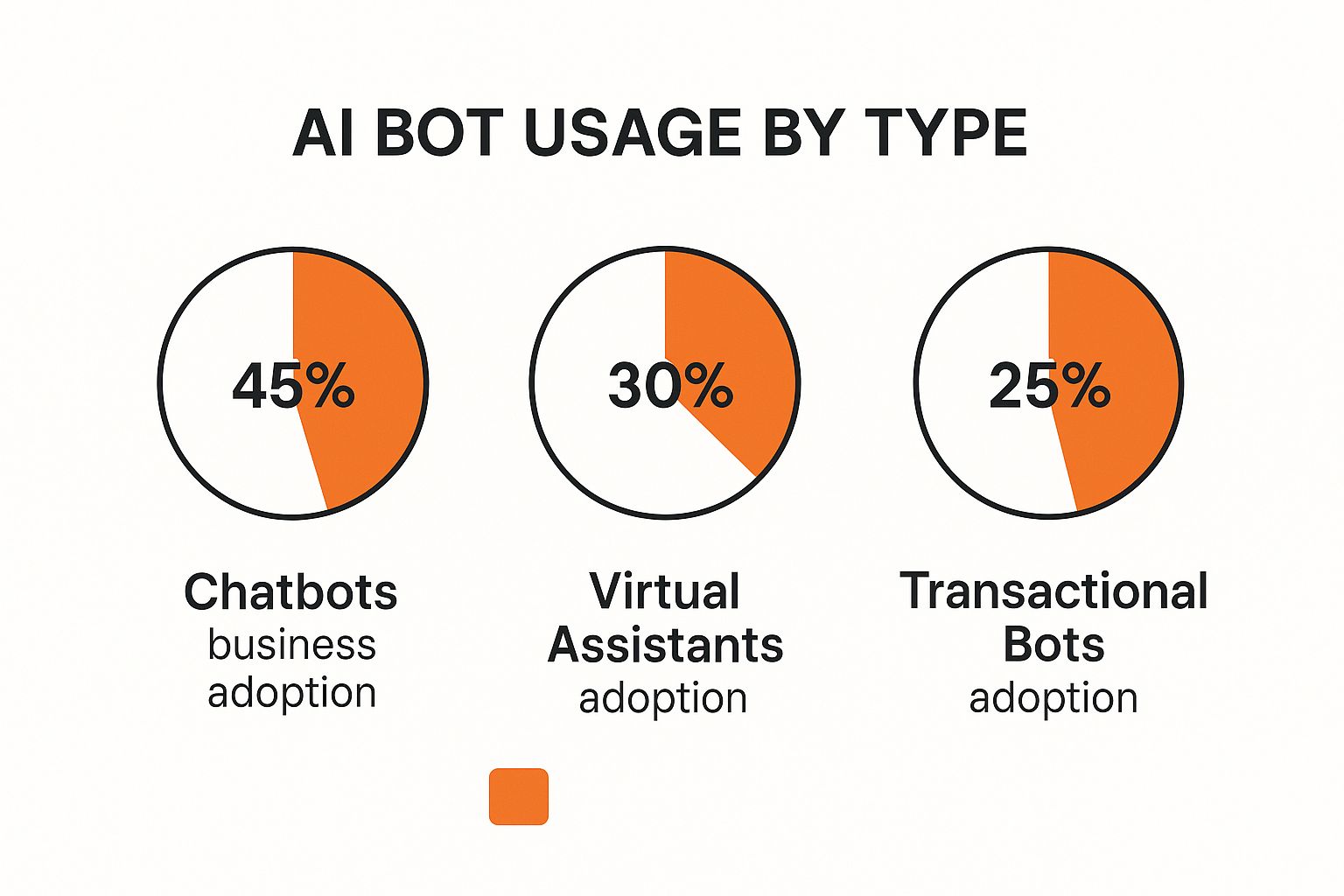
As you can see, chatbots are leading the pack, with 45% of businesses using them. It’s clear they offer a direct and powerful way to make customer interactions and support much, much better.
To make the differences crystal clear, let’s break them down in a simple table.
Key Distinctions: AI vs Rule-Based Bots
| Attribute | Rule-Based Bot | AI-Powered System |
|---|---|---|
| Core Function | Follows predefined rules and scripts. | Interprets intent and makes decisions. |
| Intelligence | Not intelligent; performs tasks as programmed. | Exhibits learning and adaptive intelligence. |
| Task Complexity | Handles simple, linear, and predictable tasks. | Manages complex, dynamic conversations. |
| Learning Ability | Static; requires manual updates to change. | Learns from data and improves over time. |
Essentially, a rule-based bot is a reliable follower of instructions, while an AI system is a dynamic problem-solver.
When to Use a Simple Bot vs an AI-Powered Bot
So, which one is right for you? It’s not about which is “better”—it’s about picking the right tool for the job.
Actionable Insight: Use this checklist to decide.
You should stick with a simple, rule-based bot when:
- Tasks are repetitive and straightforward. Think scheduling appointments or checking an order status, where the inputs are always the same.
- The conversation follows a strict path. A great example is a pizza-ordering bot that always asks for size, then toppings, then address, in that exact order.
- Your budget is tight. Rule-based bots are much cheaper and quicker to get up and running.
On the other hand, you absolutely need an AI-powered bot when:
- Conversations are complex and unpredictable. This is a must-have for customer support, where you never know what issue a user will have.
- Personalisation is a priority. An AI bot can dig into a customer’s history to offer tailored advice or product recommendations.
- You need the system to get smarter on its own. AI bots learn from every interaction, becoming more accurate and helpful without you needing to constantly update them.
The takeaway is simple.
A bot is an automator designed to follow instructions perfectly. An AI-powered system is a problem-solver that can think for itself, navigate unexpected scenarios, and deliver a far more human-like experience.
How AI and Modern Bots Actually Work
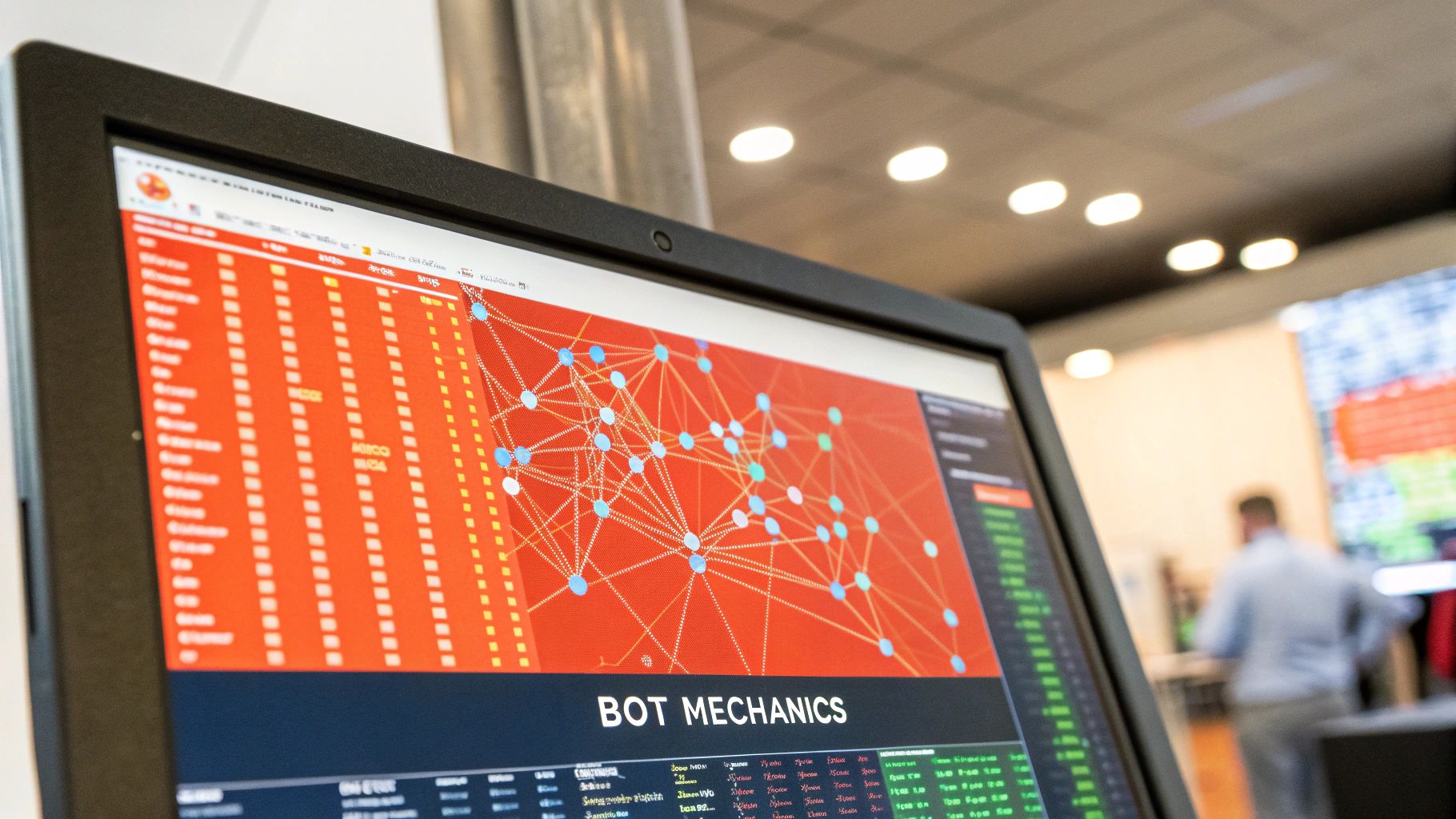
So, what’s the real difference between a simple, scripted bot and a genuinely intelligent AI assistant? To get it, we need to peek behind the curtain and see what’s powering them. The magic isn’t magic at all; it’s a combination of two core technologies: Machine Learning (ML) and Natural Language Processing (NLP).
These aren’t just industry buzzwords. They’re the engines that make modern AI and bots so effective. Grasping what they do makes it clear why an AI can navigate a complex problem while a basic bot stumbles at the first sign of a typo.
The Learning Engine: Machine Learning (ML)
At its heart, Machine Learning is a way for computers to learn from information without being given a rigid set of instructions for every possible scenario. It’s the reason an AI system can improve and adapt over time.
Think about teaching a computer to recognise a cat. The old-fashioned way involved writing endless code to define what a cat is: “pointy ears,” “has whiskers,” “is furry.” This approach is not only tedious but also incredibly brittle. What about a cat with folded ears?
ML flips that idea on its head. Instead of feeding the computer rules, you feed it data—thousands upon thousands of pictures, all labelled “cat.” The ML algorithm sifts through these examples, finds the common patterns for itself, and builds its own understanding of what a cat looks like. After enough training, it can confidently spot a cat in a photo it’s never seen before.
This same idea applies directly to business.
- Practical Example (Predictive Analytics): An e-commerce site uses ML to analyze past purchases. The system learns that customers who buy coffee beans often buy filters and a specific brand of milk. It then automatically recommends these items to the next person who adds coffee beans to their cart, increasing the average order value.
- Practical Example (Ad Optimisation): A marketing platform uses ML to analyze the performance of 100 different ad images. It learns that ads featuring people smiling get more clicks and automatically prioritizes showing those ads to new audiences.
The Communication Bridge: Natural Language Processing (NLP)
If ML is the brain, then Natural Language Processing (NLP) is the mouth and ears. NLP is a field of AI focused on giving machines the ability to read, understand, and interpret human language, both spoken and written. It’s the translator between our world and theirs.
Consider how much meaning we pack into a simple phrase. A customer might type, “My order is late and I’m really upset.” A basic, keyword-driven bot might just spot “order is late” and spit out a generic tracking link.
An AI-powered bot using NLP digs much deeper.
- It identifies the topic—a delayed order.
- It detects the sentiment—the customer is frustrated.
- It understands the intent—they need a solution, not just information.
This level of understanding allows the AI to respond with actual intelligence. It might apologise, offer a discount, and escalate the issue to a human agent if the sentiment is strong enough. To see this in action, it’s worth exploring how an AI agent for accounting uses similar principles to automate and understand financial tasks.
The core function of modern AI assistants is fundamentally different from old-school bots. They don’t just follow scripts; they fetch and process information in real-time to answer a specific user’s question, much like a human assistant would.
These technologies are no longer just for massive tech corporations. For anyone curious about taking the first step, our guide on how to start using AI without any experience is a great place to begin.
By weaving together the pattern-spotting power of ML with the language skills of NLP, today’s AI and bots can handle complex processes, deliver personalised experiences, and solve problems in ways that were pure science fiction not long ago.
Putting AI and Bots to Work in Your Business
It’s one thing to understand the technology behind AI and bots, but it’s another thing entirely to see how they actually make a difference in a business. Let’s move past the theory and look at how smart companies are using this tech to get ahead. These aren’t just ideas for the future; they’re real, practical strategies being used right now.
From customer support and lead generation to streamlining the messy, complex stuff that happens behind the scenes, the applications are everywhere. Each use case is a blueprint for how you can work more efficiently, make better decisions, and give your customers a much better experience.
Elevating Customer Service With Intelligent Automation
Customer service is one of the areas where AI and bots have made the biggest splash. Today’s customers want answers immediately, and AI-powered bots are the perfect tool to deliver that kind of instant support, 24/7.
Step-by-Step Guide: Automating Returns with a Chatbot
Take an online clothing shop, for example. Their support team used to sink hours every day just processing routine return requests. After they brought in an AI chatbot, that entire process became automated.
Here’s a simple breakdown of how it works:
- Initiate: A customer clicks the chat icon on the website and selects “Start a Return.”
- Verify: The bot prompts, “No problem! Please enter your order number to get started.”
- Identify: After verifying the order, the bot shows images of the items and asks, “Which item would you like to return?”
- Understand Reason: It then presents common reasons (e.g., “Wrong size,” “Doesn’t fit,” “Not as expected”) for the customer to choose from.
- Action: Once a reason is selected, the bot instantly generates a pre-paid shipping label and emails it to the customer with clear packing instructions.
This simple, automated flow frees up human agents to handle complex issues, like helping a frustrated customer with a damaged delivery or offering personal styling advice. The result? A faster, smoother process for everybody.
Supercharging Marketing and Sales Efforts
In the world of marketing and sales, timing is everything. AI and bots can work like tireless assistants, making sure no lead falls through the cracks and every potential customer gets the attention they need.
Practical Example: Qualifying Leads with a Bot
Think about a B2B software company with hundreds of daily website visitors. Instead of making people fill out a tedious form, they use a friendly chatbot to start a conversation.
The bot keeps it simple, asking a few key qualifying questions:
- “What’s your company size?”
- “What’s the biggest headache in your current workflow?”
- “Are you the person who decides on new software?”
Based on the replies, the bot knows in seconds if it’s talking to a serious prospect. If the lead is qualified, it can check the sales team’s calendar via an integration and book a demo right there in the chat. If not, it might offer a helpful e-book or case study instead, keeping them engaged without taking up the sales team’s valuable time.
Optimising Operations and Logistics
Behind the scenes, AI and bots are a powerhouse for streamlining operations. This technology can sift through massive amounts of data to predict what’s going to happen next and automate communication before a problem even arises.
Practical Example: Proactive Shipment Alerts
A logistics company, for instance, uses an AI system to monitor its entire shipping network. The AI constantly analyzes thousands of data points—weather forecasts, port traffic, flight delays, and local road closures.
If the system predicts a shipment to London will be delayed by 24 hours due to a storm, it doesn’t just raise an internal flag. It automatically triggers a bot to send a personalized SMS to the customer: “Hi [Customer Name], we’re seeing a potential weather delay affecting your shipment [Tracking #]. Your new estimated delivery is now [Date]. We apologize for the inconvenience.” This small, automated step turns a potentially frustrating experience into a positive one, just by managing expectations.
If you’re thinking about how to bring these tools into your own workflows, it helps to look at specific guides on topics like harnessing Artificial Intelligence in IT Operations. These examples from customer service, marketing, and logistics show that AI and bots aren’t just abstract ideas—they are tangible tools that deliver real, measurable value.
Busting Common Myths About AI and Bots
There’s a lot of noise out there about AI and bots, and it’s easy to get caught up in either the hype or the fear. These misconceptions can hold businesses back, preventing them from exploring tools that could give them a real competitive edge. Let’s clear the air and look at what’s really going on.
The biggest worry? That AI is coming for everyone’s job. While it’s true that automation is changing how we work, the story isn’t that simple. AI is brilliant at handling the repetitive, data-heavy stuff, which is actually good news. It frees up human teams to focus on strategy, creative problem-solving, and the kind of nuanced customer interactions that machines just can’t handle.
The real purpose of AI isn’t to replace human intelligence, but to amplify it. By taking over routine processes, it lets people shift from mundane tasks to high-value work and innovation.
Instead of just eliminating jobs, AI is creating entirely new ones. Think about roles like AI ethicists, prompt engineers, or machine learning specialists—these positions didn’t even exist a decade ago. It’s a fundamental shift in the skills that are needed, not a wholesale replacement. This transition is why understanding the ethical use of AI in the workplace is so important; it’s all about building a collaborative future for people and machines.
Myth 1: You Have to Be a Tech Giant to Use AI
Another myth that just won’t quit is the idea that you need a huge budget and a squad of data scientists to get into AI. That might have been the case years ago, but today, things have completely changed. There’s a massive ecosystem of affordable, user-friendly AI tools built specifically for small and medium-sized businesses.
Actionable Insight: You are likely already using AI. Many software-as-a-service (SaaS) platforms have AI features built-in.
- Email Marketing: Tools like Mailchimp use AI to suggest the best time to send a campaign for maximum open rates.
- Accounting Software: Platforms like QuickBooks use AI to automatically categorize expenses and scan invoices.
- Customer Relationship Management (CRM): Systems like HubSpot use AI to score leads, predicting which prospects are most likely to convert.
Research backs this up. A study of online sellers in Southeast Asia revealed that while 89% believe AI is important for their productivity, a whopping 64% see cost and complexity as major roadblocks. It shows a real gap between knowing AI is useful and actually putting it to work, often because of these outdated assumptions. You can dig into more of the findings from this study on AI adoption trends. The reality is, you can start small with a simple chatbot or an AI content tool without breaking the bank.
Myth 2: All Bots Are Super-Intelligent
Finally, let’s tackle the assumption that every bot is “smart.” As we’ve discussed, there’s a world of difference between a simple, rule-based bot and a genuine AI-powered system. Mixing them up is a recipe for disappointment.
A rule-based bot is a reliable workhorse, not a deep thinker. It follows its script to the letter, but throw it a curveball, and it’s completely lost. An AI bot, on the other hand, uses machine learning and natural language processing to get the gist of a conversation, learn from interactions, and give more flexible, human-like responses.
Getting this distinction is crucial. It keeps you from expecting a basic FAQ bot to solve complex support tickets or from splurging on a sophisticated AI system when a simple scripted bot would have worked perfectly. Knowing the different kinds of AI and bots available means you can pick the right tool for the job, every single time.
What’s Next for AI and Bots in the Workplace?
The world of AI and bots is moving incredibly fast. What seems groundbreaking today will likely feel like old news in just a few years. The real excitement isn’t just about making tasks faster; it’s about creating intelligent partners that work with us in ways we’re only beginning to imagine. To stay ahead, you need to understand where this is all heading.
We’re moving beyond basic personalisation into an era of what you could call hyper-personalisation. Think of an AI that doesn’t just react to a customer’s question but actually anticipates it. It could dynamically change a website’s layout for a specific visitor or rewrite a marketing email on the fly based on their last few clicks. The goal is a completely unique experience for every single person.
The Arrival of Agentic AI
The next big shift is the rise of agentic AI. This is a huge leap from where we are now. Instead of giving AI a single, simple command, you’ll be able to assign it complex, multi-step goals. It’s like having an autonomous project manager on your team.
Practical Example: Instead of manually setting up a new marketing campaign, you could assign a goal to your AI agent: “Launch a campaign for our new running shoes, targeting marathon runners in London with a budget of £5,000.” The agent would then execute the entire process autonomously.
Here is a step-by-step breakdown of what it might do:
- Research: It analyzes market data to identify the best channels to reach London-based marathon runners (e.g., running club forums, Instagram hashtags, specific blogs).
- Create: It drafts compelling ad copy and generates visuals suitable for each platform.
- Budget: It intelligently allocates the £5,000 budget, assigning more funds to the channels with the highest predicted ROI.
- Launch & Optimize: It launches the ads, monitors their performance in real-time, and automatically adjusts targeting and creative to improve results.
This doesn’t make the human marketer redundant. Far from it. It frees them from the operational grind, giving them a powerful assistant to handle the execution while they focus on high-level strategy. This is a good time to start thinking about how to future-proof your career in the age of AI and automation.
Becoming a Part of Our Everyday Tools
Maybe the biggest change we’ll see is how AI disappears into the background, becoming a natural part of the software we use every day. Powerful AI features won’t just live in specialised platforms anymore; they’ll be built right into our email, our project management apps, and even our spreadsheets. This will put some seriously sophisticated tools into everyone’s hands.
People are already catching on. A 2024 Deloitte survey revealed that 67% of employees and 86% of students in Singapore have already used generative AI. What’s even more telling is that the number of daily users is projected to jump by 203% over the next five years. AI is quickly becoming a normal part of how we work and live. You can discover more insights about AI adoption in Southeast Asia on seasia.co.
The future workplace isn’t about humans versus machines. It’s a partnership. AI agents and intelligent bots will take on the heavy lifting, freeing up our uniquely human capacity for creativity, critical thinking, and solving the big problems.
By understanding these trends now, you can start building the right skills and adapting your workflows. The workplace is changing, and the businesses that get ready today are the ones that will thrive tomorrow.
Answering Your Questions About AI and Bots
Diving into the world of AI and bots can feel a bit overwhelming, but getting started is usually much easier than you’d expect. Let’s tackle some of the most common questions business owners ask, giving you clear, straightforward answers to help you move forward.
How Can My Small Business Start Using Bots?
The best advice is always to start small and aim for a quick win. Don’t fall into the trap of trying to automate everything at once. Instead, pinpoint one single task that’s repetitive and eats up your team’s time.
Actionable Step-by-Step Guide:
- Identify the Bottleneck: For one week, track the questions your customer service team answers most often. Pick the top 3-5 recurring queries (e.g., “What are your hours?”, “What is your return policy?”).
- Choose a No-Code Tool: Select a user-friendly chatbot platform like Tidio, Intercom, or Drift. Many offer free or low-cost starter plans.
- Build Your First Flow: Use the platform’s visual builder to create a simple conversational flow. For the question “What is your return policy?”, create a response that clearly explains the steps.
- Deploy on Your Website: Add the chatbot to your website. This usually involves just copying and pasting a single line of code.
- Measure and Improve: After a week, check the bot’s analytics to see how many queries it handled. This immediately frees up your team for more important work.
Do I Need to Know How to Code to Build a Bot?
Not at all. This is probably the biggest myth that stops business owners from even trying. The days when you needed a developer on standby to build a simple bot are long gone.
Today, the market is full of powerful no-code and low-code platforms. These tools let you build conversation flows visually using intuitive drag-and-drop interfaces. It’s more like creating a flowchart than writing code.
These platforms are specifically designed for business users, not programmers. This means you can create, customise, and launch a fully functional bot without writing a single line of code, making automation accessible to everyone.
This shift puts the power back in your hands. You can run your own automation projects, test new ideas, and tweak things on the fly without waiting for technical help. It makes you so much more agile.
When Should I Choose an AI-Powered Bot Over a Simple One?
The choice between a simple bot and an AI-powered one really boils down to the complexity of the job at hand. It’s all about matching the tool to your specific goal.
A simple, rule-based bot is your best bet for straightforward, predictable tasks. It’s brilliant for things like:
- Practical Example: A bot on a restaurant website that asks “Would you like to make a reservation or view the menu?” and guides the user down one of two fixed paths.
- Answering a list of frequently asked questions (FAQs).
- Walking a customer through a clear, step-by-step process, like checking an order status.
On the other hand, it’s time to upgrade to an AI-powered bot when things get more complicated. You’ll need AI when you want your bot to:
- Practical Example: A telecom company’s bot that can understand vague complaints like “My internet is acting weird” and ask diagnostic questions to troubleshoot the problem.
- Handle a huge range of unpredictable questions.
- Personalise the chat based on who the user is or what they’ve done before.
- Actually learn from conversations and get smarter over time.
Here’s a good way to think about it: a simple bot is like a helpful receptionist working from a script, whereas an AI bot is like an experienced assistant who can think for themselves.
Ready to put the power of AI to work for your business? RichlyAI offers a complete suite of tools to create intelligent chatbots, generate high-quality content, and automate your workflows. Start for free on richlyai.com and see what you can build.
