
In 2026, AI research is sprinting ahead of capital allocation, creating a rare opportunity for founders who understand where innovation is headed. This article explains why this lag exists and how you can strategically leverage it.
While AI labs are shipping breakthroughs every quarter, many investors are still funding yesterday’s ideas. This 3–5 year lag between cutting-edge research and investor understanding is quietly creating one of the biggest opportunities in modern tech.
For founders who see where the puck is going, this isn’t a problem—it’s an unfair advantage. This gap between fast-moving AI research and slower capital allocation allows you to build in less crowded spaces, attract top talent, and establish a defensible market position long before the hype cycle brings in the copycats. The key is to stop chasing today’s funding trends and start building what will be funded in 2029.
The Core Problem: The AI Investment Lag
The “AI investment lag” is the significant delay between a new technology being proven in a research lab and venture capital finally showing up to fund it at scale. While AI research moves at a blistering pace, capital is, by nature, slower and more conservative.
Investors tend to back what they already know or what’s trending, not the complex, nuanced work emerging from research papers. This creates a predictable 3–5 year lag, a stat reported by venture and research experts and cited by Business Insider in its analysis of the https://www.business-insider.com/ai-investment-hype-cycle-lag-research-leonis-capital-jenny-xiao-2026-1
Deloitte notes that despite rising AI investment, measurable ROI remains elusive — which partially explains cautious capital deployment https://www.deloitte.com/nl/en/issues/generative-ai/ai-roi-the-paradox-of-rising-investment-and-elusive-returns.html
Venture capital rounds for deep AI startups are rarer than general AI startups. (Backed by industry trend reporting.) https://emerj.com/how-investors-feel-about-artificial-intelligence-from-29-ai-founders-and-executives/
This gap exists because of the AI investment trends that dominate the market. Most venture capital AI funding follows a hype cycle, where money floods into “safe” buzzwords like chatbots and copilots long after the real innovation has moved on.
By the time a concept becomes a mainstream funding category, the frontier has already advanced. Understanding this dynamic in the AI startup funding 2026 landscape is your first step. The real opportunity isn’t in today’s hot sector; it’s in building what will be hot in three years.
High-impact AI research is moving so fast that much of the investment world is funding technology that was cutting-edge years ago. This creates a rare strategic window for founders building the next wave of foundational AI infrastructure.
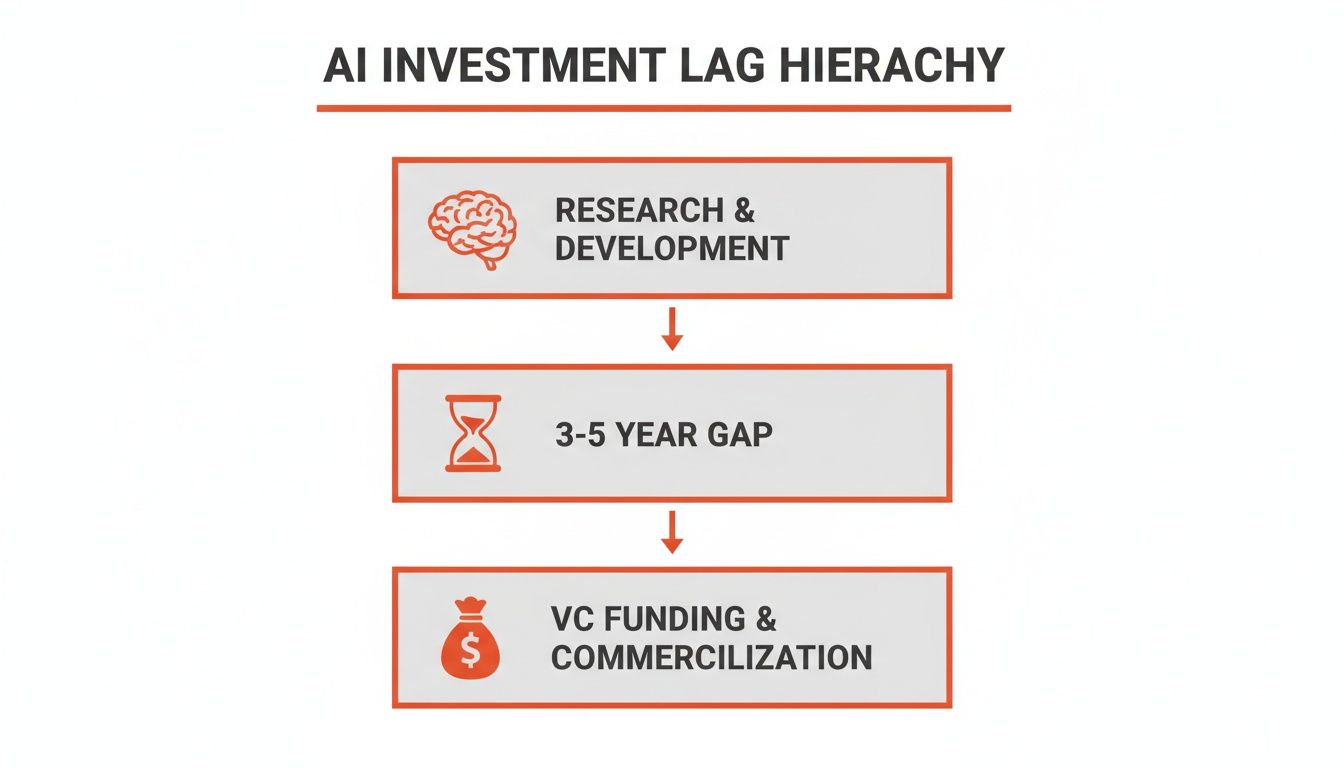
alt text: A diagram illustrating the AI research to commercialization pipeline, showing a 3-5 year gap labeled ‘The Founder Opportunity’ between ‘Frontier Research’ and ‘Mainstream VC Funding’.
Why Investors Fall Behind (Root Causes)
Knowing the investment lag exists is one thing; understanding why gives you the edge. This gap isn’t a fluke; it’s a systemic issue baked into how venture capital operates.
Speed Mismatch
AI research moves monthly; VC moves quarterly. Groundbreaking papers can shift the state-of-the-art in weeks. Venture capital, with its due diligence, partner meetings, and formal processes, operates on a much slower timeline. By the time a fund develops a thesis and gets approval to invest in a new trend, the research community is already focused on the next big thing.
Technical Complexity
Most investors aren’t deep AI engineers. Their expertise lies in finance, go-to-market strategy, and scaling companies—all vital skills, but not the ones needed to evaluate a novel neural network architecture. This technical gap forces them to rely on proxies like founder pedigree or social proof from other funds, which often leads them to overlook genuine technological leaps from unknown teams.
Pattern Matching Bias
Venture capital is built on pattern matching: funding new companies that look like past winners. This works well in mature markets but fails spectacularly in frontier tech. Investors looking for the “next great SaaS wrapper” are, by definition, filtering out companies building something entirely new. They are funding what worked before—like chatbots, wrappers, and generic tools—not what will define the future.
Hype Over Substance
Money follows headlines, not scientific papers. When a technology like text-to-video captures the public imagination, capital rushes in, creating a reactive cycle that chases hype. Founders quietly building in less sexy but more critical areas, like model optimization or data infrastructure, struggle to get meetings, even if their technology solves a more fundamental problem. Discerning founders must learn to practice separating hype from substance.
Where AI Research Is Leading — Beyond What Investors See
To get ahead of the curve, you need a map of the territory most VCs haven’t explored. While funding conversations orbit familiar concepts, the groundbreaking work is happening several layers deeper. This is where you can build something genuinely defensible.
Here’s what investors haven’t caught up to yet:
- Agentic Systems: Moving beyond copilots to AI agents that can take a high-level goal, create a multi-step plan, and execute it autonomously across different applications.
- Autonomous Workflows: Building systems that don’t just assist with a task but own the entire workflow from start to finish, like planning and executing a marketing campaign without human intervention.
- Multimodal Reasoning: Developing models that can ingest, understand, and synthesize information from text, images, audio, and video simultaneously to solve complex problems.
- AI Orchestration Layers: Creating the “air traffic control” systems that manage fleets of specialized AI models, intelligently routing tasks to the best agent for the job.
- Vertical AI Agents: Training specialized models on niche, proprietary data for industries like law, medicine, or engineering to perform tasks with superhuman accuracy. Some specialized funds like deep tech funds for Quantum AI are emerging, but they are the exception.
- Model Optimization/Infrastructure: The race to create more efficient model architectures and hardware to slash the immense computational cost of training and running AI.

alt text: A researcher in a lab points to a computer screen displaying complex data graphs under the heading ‘Frontier AI Research’, representing cutting-edge innovation.
The Hidden Advantage: Where Smart Founders Win
The 3–5 year lag isn’t a bug; it’s a feature you can exploit. While others fight for funding in crowded sectors, you operate in a blue ocean. This gap is your head start—a quiet period to build something real before the noise and competition arrive.
This leads to several key advantages:
- Less Competition: Building on emerging research means you aren’t fighting a dozen other startups for the same customers and keywords.
- Cheaper Talent: You can attract mission-driven talent passionate about solving hard problems, often before they become prohibitively expensive.
- Slower Copycats: By the time competitors figure out what you’re doing, you have a multi-year lead in product, data, and customer relationships.
- Easier Product-Market Fit: You have the breathing room to find genuine product-market fit before the pressure of a hyped-up market forces you to scale prematurely.
This opens up specific opportunities:
- Building in Underfunded Niches: Focus on complex, high-value problems that will never be on the cover of a magazine, like AI for industrial manufacturing or data center optimization.
- Focusing on Infrastructure vs. Flashy Demos: Sell the “picks and shovels” of the AI gold rush. AI orchestration layers and model optimization tools become sticky, indispensable infrastructure.
- Solving Real Workflow Problems: Target deep, messy workflows where agentic systems can deliver 10x value, not just incremental improvements.
- Educating Investors Instead of Pitching Buzzwords: Reframe your pitch as an exclusive look into an emerging market. You aren’t just a founder; you’re the guide to the next massive opportunity.
Practical Playbook for Founders
Turning this knowledge into a strategic advantage requires a specific playbook. Here are the actionable steps to build ahead of the investment curve.

alt text: A founder uses a stylus on a tablet that displays the words ‘BUILD AHEAD’ surrounded by strategic business and technology icons.
- Track research, not just TechCrunch. Your information diet must change. Ditch the tech blogs and go to the primary sources. Set up Google Scholar alerts for specific keywords, follow the newsletters from OpenAI, DeepMind, and Anthropic, and scan the abstracts on arXiv’s computer science section daily.
- Read papers & labs. You don’t need to be a Ph.D. to read the abstract and conclusion of a research paper. This habit helps you spot patterns and understand the direction of the field long before it becomes a mainstream trend. Focus on the “why” and the “what’s next” sections.
- Build ahead of investor narratives. Use your research insights to build solutions for problems the market doesn’t fully appreciate yet. A solid practical guide to your Go To Market Strategy is essential to bridge your future-facing tech with today’s customer needs.
- Position with “business outcomes,” not “AI magic.” When you talk to investors, translate your complex technology into simple, undeniable business value. Don’t say: “We use a novel mixture-of-experts architecture.” Say: “Our platform reduces customer support costs by 60% by automating tier-1 inquiries.”
- Use the lag as a moat. Your deep, early knowledge is your most defensible asset. While competitors scramble to understand a new paper, you are already months or years ahead in product development. This head start is nearly impossible to overcome. Our guide on how to launch an AI startup in 2025 can help you structure this process.
Case Examples / Mini Scenarios
To make this concrete, here are two realistic scenarios of how founders can leverage the investment lag.
- Scenario 1: The Agentic Ops Tool. A founder reads early research on multi-agent systems and starts building a tool that automates complex back-office operations for logistics companies. For the first 18 months, investors are skeptical, calling it “too complex” and “a science project.” The founder secures a small seed round from a deep-tech fund and focuses on a single flagship customer. Twelve months later, “agentic AI” explodes as a buzzword. Suddenly, every VC is trying to fund the category, but our founder is now the established market leader with proven case studies and a two-year head start.
- Scenario 2: The Infrastructure Startup. A team of engineers notices that as companies deploy more specialized AI models, they have no way to manage them efficiently. They build an “AI orchestration layer”—a boring but critical piece of infrastructure. While VCs are busy funding flashy generative AI apps, this team quietly signs up mid-size tech companies, becoming deeply embedded in their workflows. When the market realizes that managing dozens of models is a massive, expensive problem, the infrastructure startup is already the default solution, making them a prime acquisition target or an easy Series A investment.
Risks & Counterpoint
Building ahead of the curve is a high-reward strategy, but it carries significant risks. Acknowledging them adds credibility and prepares you for the journey.
- Funding Difficulty: Pitching a concept that is 3-5 years ahead of its time means most investors won’t get it. Expect a higher rejection rate and the need to find specialized, deep-tech investors.
- Education Burden: You are not just a founder; you are an evangelist. Every pitch and sales call requires you to first educate the audience on why the problem you’re solving will be massive, which can be exhausting.
- Long Sales Cycles: If the market isn’t ready for your solution, convincing the first customers to take a chance can be a long, arduous process. You need a capital runway to survive this early adoption phase.
- Market Timing Risk: The biggest danger is being too early. If you build a brilliant solution but run out of money before the market matures, you risk dying on the vine—only to see a competitor succeed years later. Navigating future AI regulation policies also adds a layer of uncertainty.
2026 Outlook: What Happens Next
As the investment lag continues, several trends will define the next wave of AI startups. Founders who align with these shifts will be best positioned for success.
- Agents > Copilots: The market will mature from AI assistants that help humans to autonomous agents that replace entire workflows.
- Vertical AI > Horizontal Tools: General-purpose tools will be commoditized. The most valuable companies will be vertical AI agents trained on proprietary data for specific industries like medicine, law, and finance.
- Infra Plays Win: As AI adoption scales, the companies providing the “picks and shovels”—orchestration, optimization, and data infrastructure—will become incredibly valuable and defensible.
- Investors Will Rush Late: Expect VCs to pile into these categories 3-5 years from now, creating massive hype cycles. The founders who are already established by then will reap the rewards.
Keep an eye on the bigger picture of emerging AI trends to stay ahead.
Key Takeaways
- AI research moves 3–5 years ahead of investors. This creates a strategic window for founders to build in uncrowded markets.
- Most capital chases hype, not breakthroughs. Venture funding follows established trends, leaving frontier tech underfunded in its early stages.
- Founders who track research gain unfair advantages. By reading papers and following labs, you can identify opportunities before they become mainstream.
- Infrastructure and agentic systems are early opportunities. These “boring” areas are where the next generation of foundational AI companies will be built.
- Education-driven storytelling wins funding. Instead of pitching buzzwords, educate investors on an emerging market you understand better than anyone else.
Conclusion
The biggest opportunities aren’t where investors are looking. They’re where they haven’t learned to look yet. The gap between cutting-edge research and mainstream funding is not a barrier; it is your single greatest strategic advantage.
By tracking the research, building for the future, and educating the market, you can create a defensible business long before the competition even knows the game has started. Your job isn’t to follow the money; it’s to get to where the money will be in three years.
In short, the AI investment lag isn’t a handicap — it’s a strategic advantage. By understanding research trends and building defensible technology ahead of capital flows, founders can capture market real estate years before mainstream funding arrives.
If you want to turn these insights into action, follow RichlyAI for weekly analysis and tools. To get started building your idea, Explore RichlyAI’s free tools today.
