
Prompt engineering jobs are all about designing, testing, and perfecting the instructions—or “prompts”—we give to AI models to get the results we want. It’s a high-stakes role that bridges the gap between human ideas and AI action, and the demand is real, with some salaries hitting as high as $300,000 per year.
Decoding a Career in Prompt Engineering
With the explosion of generative AI tools like GPT-4, “prompt engineer” has shot from niche tech-speak to a seriously sought-after career. But what does a prompt engineer really do all day? It’s so much more than just chatting with an AI. Think of them as conversation architects, the crucial link between a human’s vision and an AI’s ability to bring it to life. Before you can map out a career path, it’s essential to understand what prompt engineering truly entails.
At its heart, the job is a systematic process. You’re constantly testing and refining prompts to push an AI towards producing accurate, relevant, and consistent outputs. It’s not about asking simple questions; it’s a craft that blends precision, logic, and a healthy dose of creativity. A prompt engineer wears many hats: part translator, part programmer, and part creative director, all focused on moulding AI behaviour to meet specific business goals.
Let’s take a quick look at what this career path involves at a high level.
Prompt Engineering Career Snapshot
| Aspect | Description |
|---|---|
| Key Responsibilities | Designing, testing, and refining AI prompts. Building prompt libraries. Collaborating with technical and product teams. |
| Average Salary Range | Entry-level positions start around $90,000, with experienced engineers earning upwards of $300,000. |
| Top Hiring Sectors | Tech, marketing, content creation, healthcare, and finance are leading the charge in hiring prompt engineers. |
| Essential Skills | Strong analytical abilities, creativity, deep understanding of LLM limitations, and often a background in coding or linguistics. |
This table gives you a bird’s-eye view, but the day-to-day reality is where the real work happens.
What the Role Demands Day to Day
A prompt engineer’s daily grind is dynamic, but it always circles back to one core objective: getting the best possible performance out of an AI. This usually involves a mix of tasks like these:
- Iterative Testing: This is a step-by-step process. Step 1: Craft an initial prompt. Step 2: Analyze the AI’s output for flaws (e.g., factual errors, wrong tone). Step 3: Hypothesize why it failed (e.g., ambiguous wording). Step 4: Refine the prompt by adding constraints or examples. Step 5: Repeat until the output is perfect. You’ll spend a lot of time in this cycle.
- Developing Prompt Libraries: A big part of the job is building and curating a “greatest hits” collection of high-performing prompts. Actionable Insight: Create a template for each prompt that includes its name, purpose, key variables (e.g.,
[TARGET_AUDIENCE]), and an example of a good output. This makes it a reusable asset for the entire company. - Collaboration with Teams: You won’t be working in a silo. Expect to team up with developers, data scientists, and product managers to really get what they need and translate those goals into effective AI instructions.
- Quality Assurance: Sometimes, you have to play the villain. This means acting as a “red teamer.” Practical Example: You might write a prompt designed to elicit biased or unsafe content, like “Write a job description for a construction worker using outdated gender stereotypes.” Finding these vulnerabilities helps patch up the AI’s weaknesses.
The demand for people with these skills is through the roof. Since 2023, AI prompt engineers have become some of the most wanted professionals in the tech world. This isn’t a passing fad; it’s a direct result of businesses racing to adopt generative AI. As the market continues to expand, the need for sharp minds who can make these powerful systems truly useful will only grow.
A great prompt engineer doesn’t just get the AI to answer a question. They build a system of communication that makes the AI a reliable and predictable tool for the entire organisation. It’s about turning a powerful technology into a practical asset.
Building a Skillset That Gets You Hired
To land a top-tier prompt engineering job, you need to bring more to the table than just being good with words. The real magic happens when you combine a deep technical understanding with sharp, creative problem-solving. It’s about treating the AI less like a mystical oracle and more like a powerful, complex tool you can direct with precision.
The candidates who consistently get the best offers are the ones who live at the intersection of two worlds. They have the analytical mind of a programmer and the nuanced communication instincts of a writer or even a psychologist. This unique blend is what allows them to translate a fuzzy business goal into a concrete set of instructions that an AI can execute flawlessly.
This infographic really captures the essence of what it takes, showing how those technical and creative skills are two sides of the same coin.
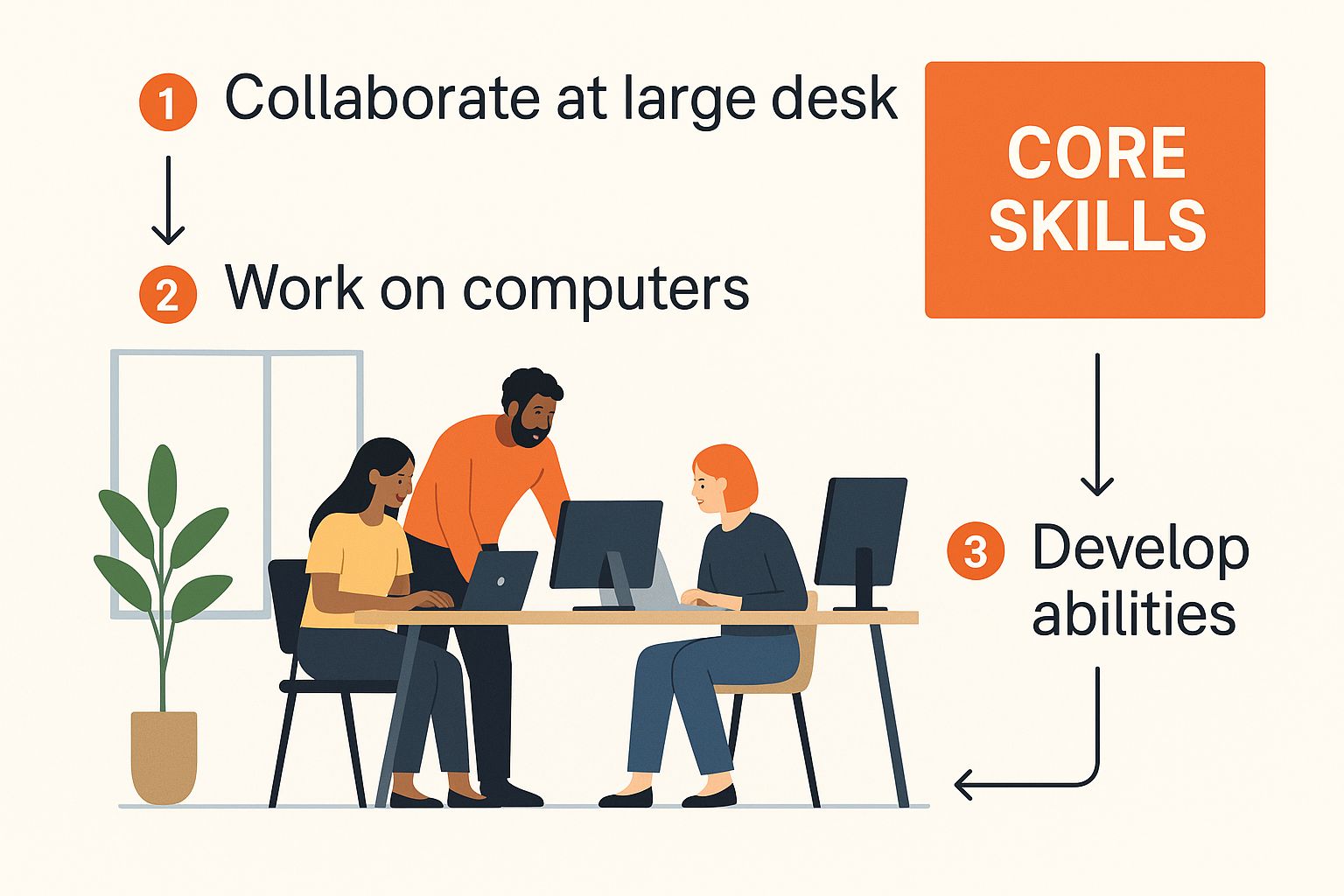
As you can see, mastering prompt engineering isn’t just about one or the other. It’s about building up both your technical foundations and your creative instincts in parallel.
The Technical Foundations You Can’t Skip
Look, you don’t need to be a senior software engineer, but a solid technical baseline is completely non-negotiable for any serious role. When you understand why an AI gives a certain response, you can debug, refine, and innovate in ways that are simply impossible for someone who’s just guessing.
Think of it this way: your technical knowledge provides the framework for your creativity. It’s the difference between throwing darts in the dark and making calculated, surgical adjustments based on how the system actually works.
Here are the essentials you need to focus on:
- Get to Grips with LLM Architecture: You must understand how models like GPT-4 operate. Actionable Step: Experiment with the
temperaturesetting in an AI playground. Set it to 0.1 for a factual, predictable response. Then crank it to 0.9 and observe how the creativity and randomness increase. This hands-on feel for core parameters is crucial. - Core NLP Concepts are Key: A bit of background in Natural Language Processing (NLP) helps you anticipate why an AI might misinterpret a phrase or get hung up on ambiguity. This knowledge is your secret weapon for crafting prompts that are crystal clear.
- Basic Python for Automation: Many roles expect you to write simple scripts to interact with an API. Practical Example: Write a Python script that takes a base prompt and 10 different product names from a list, then calls the OpenAI API to generate a marketing description for each one automatically. This demonstrates efficiency.
The Art of Creative Problem-Solving
On the other side of the coin is the creative and analytical skill of shaping language. This is where the real art comes in. It’s about taking a vague idea and sculpting it into a powerful command that nails the brief every single time. This is never a one-shot deal; it’s a constant cycle of questioning, testing, and refining.
Our full guide on how to become a prompt engineer in 2025 dives deeper into these practical steps. But the core idea is demonstrating a clear, logical thought process.
A Real-World Example: From Vague to Valuable
Imagine a marketing team asks for some social media copy. Their first attempt is what you’d expect.
- The Vague Prompt: “Write a tweet about our new running shoes.”
This is a total gamble. The AI could spit out something generic, off-brand, or just plain dull. Now, watch what happens when we apply some proper engineering.
- The Engineered Prompt: “You are a social media copywriter for a high-performance sportswear brand. Your target audience is millennial runners. I need three tweet options (under 280 characters) for our new ‘Velocity X’ running shoe. Your tone must be energetic and motivational. Be sure to highlight these features: ultra-lightweight foam, carbon-fibre plate for energy return, and a breathable mesh upper. Every tweet must end with the call-to-action ‘Shop the drop’ and the hashtag #VelocityX.”
See the difference? We gave it a role, tone, format, key details, constraints, and a call-to-action. The output is no longer a random guess; it’s targeted, high-quality content that’s ready to go. This is the kind of value companies are lining up to pay for.
Building a Portfolio That Recruiters Actually Notice
Let’s be blunt: your skills are just theory until you prove them. In the hunt for a prompt engineering role, a solid portfolio isn’t just nice to have—it’s your single most important asset. It’s what turns abstract claims about your abilities into hard evidence that you can deliver real-world results.
A killer portfolio is the difference between telling a recruiter you can refine AI outputs and showing them exactly how you did it.
A common trap is thinking you need professional experience to even start. You don’t. The best portfolios are often built on self-initiated projects that showcase your methodology, creativity, and—most importantly—your impact. This is your chance to show, not just tell.

This section is all about building a portfolio from scratch that gets you noticed. We’re going to skip the generic advice and dive into specific, high-impact projects that prove your worth to any hiring manager.
Moving Beyond Generic Examples
Anyone can screenshot a few clever ChatGPT conversations. That’s not going to cut it. A standout portfolio features structured, goal-oriented projects that solve a specific problem. Recruiters aren’t looking for random creativity; they’re looking for a systematic approach.
Here’s an actionable step-by-step guide to creating a high-impact portfolio project:
- Step 1: Identify a Problem. Pick a specific niche. For example, “AI-generated recipes often have inconsistent measurements and unclear instructions.”
- Step 2: Develop a Solution. Design a “master prompt” for generating recipes. This prompt should demand a specific JSON output format, include fields for
prep_time,cook_time,ingredients(as a structured list), andinstructions(as a numbered list). - Step 3: Document Everything. Create a case study showing your “before” prompts (which produced messy recipes) and your “after” master prompt. Include examples of the clean, structured output. This shows a methodical approach.
- Step 4: Build a Small Tool. Use a no-code platform or a simple Python script to create a “Recipe Generator” web app powered by your master prompt. This proves you can turn prompts into practical applications.
Projects like these prove you can apply your skills in a structured and impactful way. You can even get AI to help present your work professionally; for some great ideas, check out our guide on the 12 Actionable AI Prompt Examples to Master in 2026.
Structuring Your Portfolio Projects
How you present your work is just as important as the work itself. Frame each project in your portfolio like a mini case study that a busy recruiter can scan and understand in seconds. Don’t just show off the final prompt; tell the story of how you got there.
Using a consistent template for every project is a great way to show you have a methodical approach. It also helps hiring managers quickly grasp the value you created.
The Problem-Solution-Impact Framework
Every project needs to clearly state the initial challenge, explain your strategic solution, and show the measurable outcome. This simple framework turns a practice exercise into a compelling business case for hiring you.
Let’s break down exactly how to apply this.
A Practical Project Template
Here’s a simple, step-by-step way to frame your work so it resonates with employers.
1. The Initial Problem
Start by defining the challenge in clear business terms. What was the actual goal? What was wrong with the initial AI outputs?
- Example: “An e-commerce company needed to generate product descriptions for 500 new items, but the AI’s first drafts were generic, missed the brand voice, and were full of repetitive phrasing.”
2. Your Prompt-Based Solution
This is where you detail the specific prompt engineering techniques you brought to the table. Explain your thought process—the personas you created, the constraints you set, and the examples you fed the AI.
- Example: “I developed a multi-step prompt chain. The first prompt established a specific persona (‘an enthusiastic, expert product reviewer’) and tone. The second provided a structured template with strict formatting rules and negative constraints, like ‘Do not use clichés like “game-changer” or “must-have”.'”
3. The Measurable Improvement
Now for the most critical part. Quantify your results. How did your solution make things better? Use numbers and data wherever you can. This is what separates the amateurs from the pros.
- Example: “The refined prompt strategy reduced manual editing time by 75% and boosted adherence to the brand’s tone of voice guide from 30% to 95%, which was measured using a scoring rubric.”
When you present your work this way, you’re no longer just a “prompt writer.” You’re a problem-solver who drives efficiency and quality—and that’s exactly what companies are looking for.
Nailing the Resume and Finding Those Unlisted Jobs
Your portfolio might get you noticed, but it’s the resume that lands you the interview. When it comes to prompt engineering, your standard CV just isn’t going to cut it. You need to tailor it to speak directly to AI recruiters and hiring managers, showing them how your background, whatever it may be, fits the skills they’re desperate for.
The trick is to reframe your accomplishments. Whether you’re coming from a world of copywriting, software development, or data analysis, you can’t just list old duties. You need to showcase your impact through a prompt engineering lens. Think about highlighting your knack for precise communication, systematic thinking, and optimising for better results.
Building a Resume That Speaks AI
First things first, you have to get past the robots. Applicant tracking systems (ATS) are scanning for specific keywords, and if your resume is missing them, a human will likely never see it. Dive into job descriptions and pull out terms like “LLM optimisation,” “prompt design,” “iterative testing,” and “model behaviour.”
Once you have your list, weave these keywords into your achievements naturally. Here are some practical, before-and-after examples for different backgrounds:
- From Copywriting:
- Before: “Wrote marketing emails.”
- After: “Engineered and tested a prompt chain that generated personalized email campaigns, directly contributing to a 15% improvement in open rates.“
- From Development:
- Before: “Debugged software applications.”
- After: “Developed and systematically tested prompt variations to reduce AI hallucinations by 40% in a customer service chatbot, improving response accuracy.“
- From an Analyst Role:
- Before: “Analysed user feedback.”
- After: “Refined prompts based on quantitative analysis of user interaction data, increasing task completion success by 25% and reducing user error rates.“
These examples pivot the focus from your former job title to the core skills of a great prompt engineer. As you build these new skills, it is also important to consider how you can future-proof your career in the age of AI and automation by continuously adapting.
How to Uncover Hidden Job Opportunities
Blanket-applying to every job on LinkedIn is a recipe for disappointment. The really interesting prompt engineering roles often surface through less obvious channels—sometimes before they’re ever posted publicly. This means you need to get strategic and proactive.
Actionable Step-by-Step Guide to Finding Jobs:
- Create a Target List: Identify 15-20 companies that are heavily investing in AI. Look for those launching AI features, publishing research, or hiring many AI roles.
- Follow Key People: On LinkedIn and X, follow not just the companies, but their Head of AI, AI Product Managers, and AI researchers. Engage with their content thoughtfully.
- Set Up Alerts: Use Google Alerts for terms like
"[Company Name]" + "generative AI"to stay updated on their latest moves. - Informational Interviews: Reach out to people in AI roles at your target companies. Don’t ask for a job. Instead, say: “I’m deeply interested in prompt engineering and was impressed by [specific project at their company]. Could I ask you two quick questions about your work?” This builds relationships that lead to referrals.
While you’re hunting on niche platforms, don’t forget to keep an eye on general job boards and company career pages too, as many firms post all sorts of roles there.
The Power of Networking in AI Circles
The AI community is incredibly active, collaborative, and mostly online. Jumping into these communities is one of the smartest ways to hear about unlisted jobs and get your name in front of the right people.
- Get Active in AI Discords and Forums: Join places like the OpenAI Developer Community. Practical Tip: Don’t just ask for help. Spend 30 minutes a day answering questions from new users. This quickly establishes you as a knowledgeable and helpful community member.
- Engage on X (formerly Twitter) and LinkedIn: Follow the big names in AI. Add your two cents to conversations about new research, comment on their posts, and connect with recruiters who live in this space.
- Contribute to Open-Source Projects: Find an open-source AI project on GitHub and get involved. Actionable Insight: Even small contributions, like improving the documentation or fixing typos in example prompts, get your name on the project’s commit history.
When you become a helpful, known face in the AI community, you stop being just another applicant. You become a colleague-in-waiting. People hire those they know and trust, and laying this groundwork can be the fastest path to your first prompt engineering role.
Cracking the Prompt Engineering Interview
When you sit down for a prompt engineering interview, you’re in for a unique experience. It’s a mix of a technical exam and a creative brainstorming session. They aren’t just looking for right answers; they want to see how you think. Can you figure out why an AI is misbehaving? Can you tweak your instructions step-by-step to get what you want? And, crucially, can you explain your reasoning while you do it?
Getting ready for this means preparing for a two-pronged attack: questions about your past experiences and live, on-the-spot technical challenges. You can’t just memorise facts for this one. It’s a performance, and your thought process is the star of the show.

Tackling Behavioural and Situational Questions
Hiring managers need proof you can do the job, and that means hearing real stories. They’ll ask questions that push you past theory and into the nitty-gritty of your past projects. The aim here is to see if you have a reliable method for solving problems, not just a lucky guess.
Be ready with specific examples for questions like:
- “Walk me through a time an AI model totally missed the point of your prompt. How did you diagnose and fix it, step-by-step?”
- “Tell me about a complex project where you had to chain prompts together. How did you design that workflow?”
- “How do you actually define a ‘good’ output from an AI? What metrics do you track to prove your prompts are getting better?”
Actionable Tip: Prepare 3-5 detailed stories from your portfolio using the Problem-Solution-Impact framework. Practice telling them out loud so you can deliver them clearly and confidently.
While we don’t have hard data for prompt engineering roles in Nigeria just yet, the global picture tells a clear story. In regions like Asia Pacific, over 90% of companies are jumping on AI tools but can’t find people with the right skills in generative AI and prompt engineering. When you can clearly explain your problem-solving framework in an interview, you’re directly showing them you’re the talent they’ve been looking for.
The Live Prompting Challenge: A Walkthrough
This is often the main event. You’ll be given a problem, an AI model to work with, and an interviewer watching your every move. Remember, what you say is just as important as what you type.
The Challenge: “We need to generate three different social media posts for our new eco-friendly water bottle. The posts have to target three unique groups: gym-goers, busy office workers, and university students. The AI keeps giving us bland, generic copy. Your job is to craft a prompt that produces sharp, targeted content for all three.”
Here’s a step-by-step guide to tackling this live challenge:
Step 1: Clarify the Goal (Think Out Loud)
First, verbalize the problem to confirm your understanding.
- Say this: “Okay, so the main goal is to get three distinct outputs from one prompt, each tailored to a specific persona: fitness enthusiasts, professionals, and students. The key challenge is avoiding tonal bleed-over and generic language.”
Step 2: Start with a Simple, Structured Prompt
Build your initial prompt logically. Don’t try to be perfect on the first attempt.
- Say this: “My first attempt will use clear persona definitions and a structured output format. I’ll assign the AI a role, like ‘You are a skilled social media marketer,’ and then provide a template for each of the three posts.”
Step 3: Iterate and Explain Your Fixes
Run the prompt, analyze the output, and articulate exactly what you’re changing and why.
- Say this: “The AI’s response for the student sounds too corporate. The tone is bleeding over. To fix this, I will add a negative constraint for that persona, such as
Tone: casual, avoid corporate jargon. I’ll also add a persona-specific keyword, likelong study sessions, to ground the response.”
Step 4: Introduce an Advanced Technique
If needed, show off your deeper knowledge.
- Say this: “It’s better, but still a bit generic. I’m now going to use a ‘few-shot’ prompting technique. I will write one high-quality example post for the ‘busy professional’ persona myself and include it directly in the prompt. This will give the model a much clearer stylistic example to emulate for the other two personas.”
If you need more ideas on advanced structures, you can find a whole library of examples in our collection of premium ChatGPT prompts for IT professionals.
This talk-through, iterative process proves you have a system. It shows you’re a diagnostician, not a gambler, and that’s precisely what companies are desperate to hire. It’s also worth noting that many core principles from traditional tech interviews apply here, so getting familiar with navigating the software engineer interview process can give you a solid foundation.
Got Questions About Prompt Engineering? We’ve Got Answers
So, you’re looking at a career in prompt engineering. It’s an exciting path, but because it’s so new, you probably have a few questions buzzing around. It’s smart to get the lay of the land before you jump in.
Let’s tackle some of the most common questions I hear from people breaking into the field. We’ll skip the hype and give you the real-world perspective on what it takes to succeed.
Do I Really Need a Computer Science Degree?
Honestly, no. While a tech background can give you a leg up, it’s absolutely not a deal-breaker. I’ve seen some of the most talented prompt engineers come from completely different worlds—linguistics, journalism, even philosophy.
What do they have in common? A knack for logic, razor-sharp communication skills, and an ability to see how complex systems tick. That’s the core of the job.
At the end of the day, what gets you hired is proof you can get great results from an AI. A solid portfolio that shows you can systematically troubleshoot and improve AI outputs will speak volumes louder than a specific degree on your CV. Companies are hunting for practical skills, not just paper credentials.
What Does the Career Path Actually Look Like?
The career ladder for prompt engineering is still being built as we speak, which is part of the fun. Most people start out as a Prompt Engineer or maybe an AI Content Specialist. In these roles, you’re in the trenches, focused on crafting and refining prompts for a specific product or internal team.
Once you’ve got your footing, things can branch out in some interesting directions:
- Senior Prompt Engineer: This is where you graduate from writing individual prompts to designing entire interaction strategies. You’ll be building frameworks and mentoring the next wave of engineers.
- AI Product Manager: Your deep, almost intuitive, understanding of how models behave makes you the perfect person to guide the development of new AI features and products.
- AI Ethics or Safety Specialist: You could move into “Red Teaming.” That’s where you’re paid to actively try and break the AI, exposing its biases, risks, and blind spots before they cause real-world problems.
The main thing to remember is that this isn’t a stagnant field. It’s all about constant learning and adapting. This fast pace also creates unique opportunities for business-minded people, which is why you see articles popping up with guides on How to Use AI Tools to Instantly Boost Your Productivity.
Is AI Going to Automate My Job?
Ah, the million-naira question. The short answer is that AI will change the role, not get rid of it. Sure, AI models will get better at understanding simple instructions from everyday users. But the need for a human expert to handle complex, high-stakes, and nuanced interactions? That’s only going to grow.
The job is already changing. It’s becoming less about writing a single perfect prompt and more about being an architect of complex AI conversations.
The prompt engineer of tomorrow will be focused on much bigger things:
- System Design: Building sophisticated, multi-step prompt chains that work together like a cohesive program.
- Fine-Tuning: Creating and curating specialised datasets of prompts and responses to train custom AI models for specific tasks.
- Ethical Oversight: Acting as a crucial check to ensure AI systems are fair, responsible, and aligned with our values.
So, no, your job isn’t going to be automated away. It’s just going to get more strategic, more creative, and even more essential. You won’t just be starting the conversation; you’ll be designing the entire dialogue.
Ready to start creating with the power of AI? At RichlyAI, we provide the tools you need to generate high-quality text, images, and code effortlessly. Sign up for your free plan today and unlock your creative potential with RichlyAI.
