
Customer service representative jobs are often the first step into a rewarding career, placing you right at the heart of a company as its frontline ambassador and go-to problem-solver. This role is so much more than just answering phones; it’s about building genuine brand loyalty and collecting the kind of feedback that can actually shape a business’s future. In Nigeria, a great CSR is a cornerstone of any successful company.
What a Customer Service Representative Really Does
Let’s get rid of that old picture of someone stuck in a call centre, just reading from a script. The customer service representative jobs of today require a special mix of skills that make you the human face of a business. It’s less about being an operator and more about being a skilled detective, a brand diplomat, and a strategic partner, all in one.
Your main goal is to make sure every customer has a positive experience. This isn’t just a “nice-to-have”; it’s critical for survival. Think about it: research shows that a staggering 86% of customers will walk away from a a company after just one bad experience. That number alone shows that your role isn’t just about fixing issues—it’s about keeping customers and, ultimately, protecting the company’s bottom line.
The Problem-Solving Detective
At its core, being a CSR is all about digging in and finding solutions. When a customer gets in touch with a problem, they usually don’t know what’s causing it. Your job is to listen carefully, ask the right questions, and connect the dots to figure it out.
Here’s a practical example:
Imagine a customer calls your e-commerce company because their payment for an order isn’t going through. A basic response is to tell them to try again. But a great CSR acts like a detective.
- Ask clarifying questions: “Could you tell me the exact error message you’re seeing?” or “Have you tried a different web browser?”
- Isolate the issue: Based on their answers, you might realise the problem is a temporary glitch with a specific bank’s payment gateway.
- Provide a clear solution: You can then give them actionable advice, like, “It seems there’s a temporary issue with XYZ Bank. Could you please try another payment method like Paystack or a different card? I can also offer you a 5% discount for the trouble.” That’s how you solve a problem effectively.
The Brand Ambassador
Every single conversation you have as a CSR is a chance to define how people see the brand. You are the voice and personality of the company. A positive, understanding, and professional chat can easily turn a frustrated customer into a lifelong fan.
A CSR doesn’t just answer questions; they manage relationships. Your ability to show genuine empathy and understanding, even when you can’t give a customer exactly what they want, can make all the difference in building long-term trust.
This means you’re responsible for:
- Providing spot-on product information: You need to know your company’s products inside out, ready to explain how they work clearly and simply.
- Handling complaints with a cool head: It’s vital to stay calm and professional, even when someone on the other end is angry or upset.
- Building a connection: Making a personal connection helps customers feel seen and heard, making them feel good about their choice to do business with you.
The Strategic Information Gatherer
Beyond just fixing one-off problems, CSRs are essentially on the front line of market research. You’re the first person to hear about product bugs, confusing website layouts, or recurring customer questions. That feedback is pure gold.
A Step-by-Step Guide to Gathering Feedback:
- Listen and Document: During conversations, keep a simple log of recurring issues. For example: “Noticed 5 customers this week asked how to find the ‘Track Order’ page.”
- Categorise the Feedback: At the end of each day or week, group similar comments into categories like “Website Usability,” “Product Flaws,” or “Feature Requests.”
- Report Actionable Insights: Share this organised feedback with your team lead. Instead of just saying “people are confused,” provide a specific suggestion: “Many users struggle to find the tracking page. I suggest we add a more visible link to it on the main homepage.” This actionable insight proves how customer service representative jobs directly contribute to business growth.
Mastering the Core Skills for CSR Success

Landing a great customer service representative job takes more than just a friendly voice. The best CSRs have a specific toolkit of skills—both soft and hard—that lets them turn a frustrated customer into a loyal fan of the brand.
Think of it like this: your soft skills are all about how you connect with people—your empathy, your patience, your communication style. Hard skills, on the other hand, are the technical things you need to know to get the job done, like using specific software or understanding company policies. To really shine, you need to be a master of both.
Let’s break down exactly what these skills are, what they look like in the real world, and how you can start building them today.
Foundational Soft Skills You Cannot Ignore
Soft skills are the heart of great customer service. They aren’t about what you know, but how you are. These are the human touches that technology can’t quite replicate, which makes them incredibly valuable to employers.
1. Active Listening and Empathy in Action
Anyone can hear words, but active listening means you’re tuning into the emotion and the real problem behind what a customer is saying. Pair that with empathy—the ability to genuinely understand how they’re feeling—and you have a powerhouse combination.
- Here’s a practical example: A customer calls, fuming because a delivery is late. A standard response is, “I’m sorry for the delay.” An empathetic one is, “I can only imagine how frustrating this is, especially when you were expecting it for an important event. Let me pull up the tracking information right now and see exactly where your package is.” This simple shift validates their feelings before you even start solving the problem.
- Actionable Tip: Practice by role-playing with a friend. Have them act as an upset customer, and your only goal is to summarise their problem and feelings back to them accurately before offering a solution.
2. Crystal-Clear Communication
Being able to explain complicated things in a simple, clear way is a non-negotiable skill. Misunderstandings just lead to more frustration for the customer and more work for you. Using positive language is also a game-changer.
Instead of saying, “That product is out of stock and unavailable until next month,” try this: “While that product is currently sold out, I can confirm it will be back in stock on the first of next month. Would you like me to place a pre-order for you so it ships out immediately?” The first is a dead end; the second is a helpful solution.
- Actionable Tip: Before sending an email or ending a call, do a quick mental check: “Is there any jargon in my explanation? Is there a simpler way to say this?” Developing essential live chat agent skills is another great way to sharpen your communication for the modern workplace.
Essential Hard Skills for the Modern CSR
While your soft skills build the relationship, your hard skills are what solve the problem efficiently. These are the teachable, technical abilities that make you a competent and reliable member of the team.
Navigating CRM Software and Other Tools
Most companies today rely on Customer Relationship Management (CRM) software like Salesforce, Zoho, or HubSpot to track every customer interaction. Getting comfortable with technology isn’t just a plus; it’s a must.
- How to get up to speed: Many popular CRM platforms offer free online tutorials or demo videos on YouTube. Spend an hour watching a “Beginner’s Guide to HubSpot” to familiarise yourself with the interface. Also, use free online tools like Typing.com to boost your typing speed—aiming for over 50 words per minute can make you significantly more efficient.
Understanding Key Performance Metrics
Companies need a way to measure how well their customer service team is doing, and they use specific metrics to do it. Knowing what these are helps you focus on what really matters.
Here are a couple of key metrics you’ll definitely encounter:
- First Call Resolution (FCR): This tracks the percentage of customer problems solved on the very first try. A high FCR is a huge win—it means the team is both efficient and knowledgeable.
- Average Handle Time (AHT): This is the average time it takes to handle a customer interaction from beginning to end. The goal isn’t just to be fast, but to be effective within a reasonable timeframe.
It’s also becoming more important to understand how AI can help with these tasks. To learn more, take a look at our guide on using prompts for customer services to make your workflow smoother and your responses sharper. By building this blend of people-focused soft skills and practical hard skills, you’ll set yourself up as the kind of candidate any company would be thrilled to hire.
What Can You Earn As A CSR In Nigeria?

Let’s talk money. It’s one of the biggest questions on anyone’s mind when looking for a job, and it’s no different for customer service roles. Knowing what you can realistically expect to earn is crucial for planning your career and knowing your worth when an offer comes in.
In Nigeria, a CSR’s salary isn’t a simple, one-size-fits-all figure. It’s a combination of several important factors, including your experience, where you work, and the industry you’re in.
How Experience Shapes Your Paycheck
More than anything else, your experience level will have the biggest impact on your earnings. It makes sense, doesn’t it? Companies will always pay more for a seasoned pro who can tackle tricky customer problems on their own and even guide newer team members.
The salary data for customer service jobs in Nigeria tells a clear story of growth. The average annual salary for a CSR is around NGN 1,537,500. But this is just an average.
If you’re just starting out, you might be looking at something closer to NGN 799,300, while senior-level experts can command salaries up to NGN 2,352,500.
To get a clearer picture of how salaries progress, here’s a simple breakdown of average annual earnings based on experience.
CSR Salary Benchmarks In Nigeria By Experience Level
| Experience Level | Average Annual Salary (NGN) |
|---|---|
| Entry-Level (0-2 years) | NGN 908,200 |
| Mid-Level (2-5 years) | NGN 1,224,800 |
| Senior-Level (5+ years) | NGN 2,352,500+ |
As you can see, jumping from an entry-level position to a mid-level role after a few years can result in a significant pay bump—often a 34% increase or more. This shows that putting in the time and honing your skills directly pays off.
The Impact Of Location And Industry
Where you work in Nigeria is another major factor. Big city life usually means bigger paychecks. Commercial centres like Lagos and Abuja typically offer higher salaries to help balance the higher cost of living. There’s also more competition for top talent in these cities, which naturally drives wages up.
The industry you choose matters, too. Some sectors just pay better because the job requires more specialised skills.
- Finance and Tech: These industries are often at the top of the pay scale. CSRs here need to understand complex products and strict regulations. For example, a fintech CSR might need to explain transaction security protocols.
- Telecommunications: This is a huge employer of CSRs and offers competitive pay, but the roles can be quite demanding. A practical example would be guiding a customer through troubleshooting their home internet connection step-by-step.
- E-commerce and Retail: These are great entry points into the field, with salaries often aligning with the national average.
For a wider view of how salaries differ across various markets, it’s worth checking out global customer support representative salary trends.
Looking Beyond The Basic Salary
When a job offer lands in your inbox, don’t just fixate on the base salary. You need to look at the whole package. Many Nigerian companies offer benefits that add real value to your overall compensation.
Your total compensation is more than just the monthly figure that hits your bank account. It includes allowances, bonuses, and benefits that support your well-being and financial security.
Always ask about these other elements:
- Health Insurance: A good health management organisation (HMO) plan is a massive plus.
- Performance Bonuses: Many companies reward great work with yearly or quarterly bonuses.
- Transport and Lunch Allowances: These perks can seriously reduce your daily expenses, especially in cities like Lagos.
- Pension Contributions: This is essential for your long-term financial health.
It’s also smart to keep an eye on the future. Technology is constantly changing how we work, and it’s worth learning how automation transforms everyday tasks to understand how your role might evolve. By getting a handle on all these different components, you’ll be in a much stronger position to evaluate job offers and make the best choice for your career.
Mapping Your CSR Career Path and Growth
It’s a common myth that a customer service representative job is just an entry-level stopgap. The reality? It’s a powerful launchpad for a dynamic and rewarding career. The skills you master on the front line—real-world problem-solving, sharp communication, and genuine empathy—are the very foundation for leadership and specialised roles in almost any industry.
This role gives you a unique window into what customers truly want and how the business operates, opening doors you might not expect. With the right mindset and a bit of planning, you can map out a journey from the front lines right up to a senior leadership role.
The Traditional Promotion Ladder
The most well-trodden path for a CSR is moving up through the ranks within the customer service department. Each step up the ladder brings greater responsibility, a more strategic focus, and, of course, better pay.
Think of this as a testament to your growing expertise. In Nigeria, for instance, the average base salary for a CSR is around ₦621,939, but this number climbs steadily with experience. An entry-level rep with less than a year under their belt might start around ₦589,581 yearly. But for senior or specialised positions, salaries can soar as high as ₦2 million per year, proving there’s a clear path for financial growth. You can dig into more detailed salary benchmarks on CSR pay in Nigeria/Salary).
The image below lays out the typical career hierarchy you’d find in a customer service team.
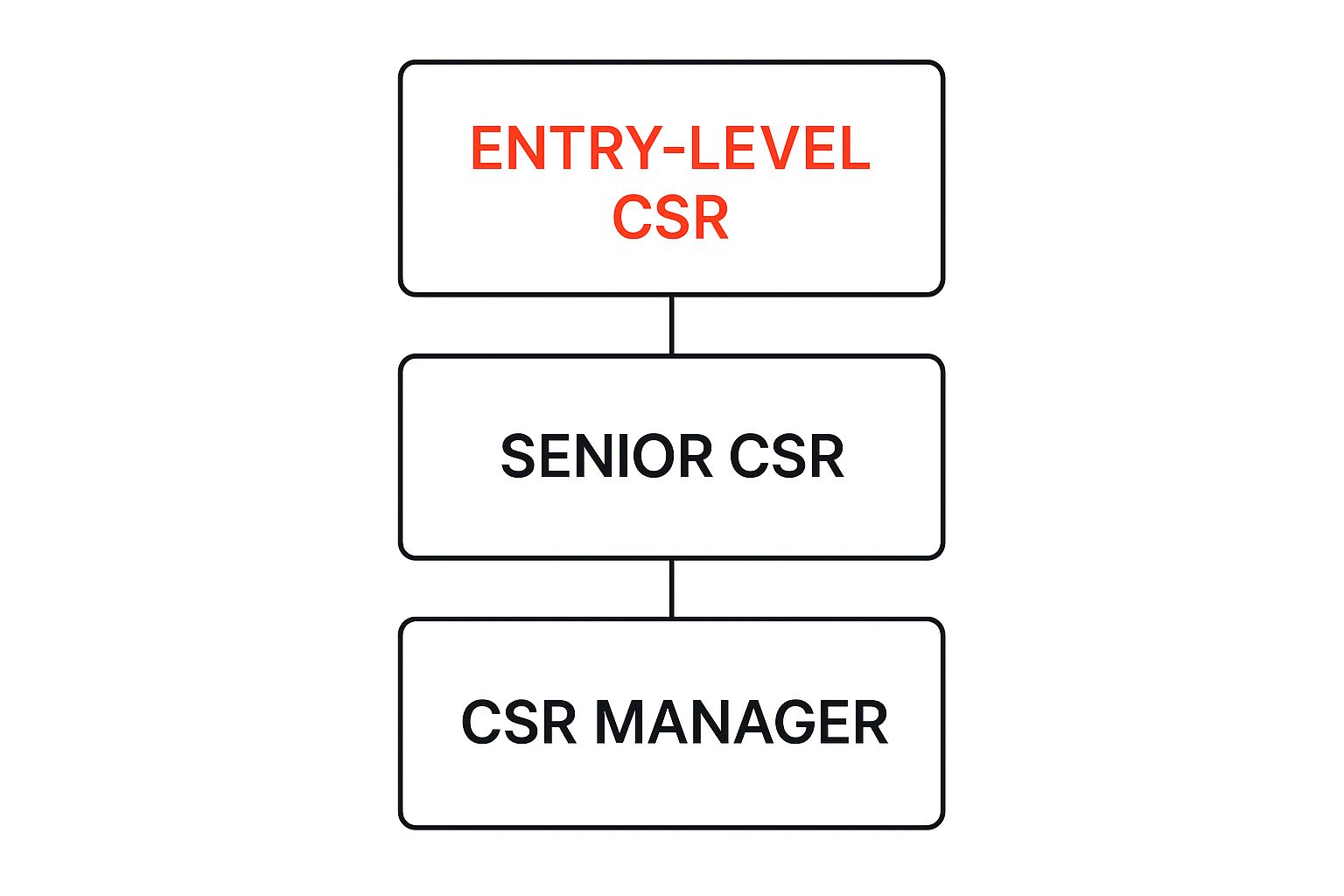
This visual shows a clear and achievable progression, with each level building on the skills of the one before it.
Let’s break down what each stage really involves:
- CSR to Senior CSR or Team Lead: Once you’ve consistently exceeded your performance targets (like maintaining a high First Call Resolution rate), the first step up is often to a Senior CSR or Team Lead. Here, you start mentoring new hires, handling escalated customer issues that junior reps can’t solve, and helping your manager compile weekly performance reports.
- Team Lead to Customer Service Manager: As a manager, your focus shifts from solving individual tickets to steering the entire team. Your tasks become more strategic: setting quarterly team goals, tracking key performance indicators (KPIs), designing training programs, and interviewing new candidates.
- Manager to Head of Customer Experience: At this senior level, you’re no longer just managing a team; you’re shaping the entire customer journey. It’s a highly strategic role where you’ll create company-wide service policies, champion the adoption of new technologies (like AI chatbots), and analyse data to ensure every customer touchpoint is positive.
Exploring Alternative Career Paths
The skills you gain as a CSR are incredibly versatile, which means you’re not stuck in one department. Many professionals use their front-line experience as a springboard into completely different—but related—fields within the company.
Your deep understanding of customer needs and pain points makes you a valuable asset to almost any team. You have firsthand data on what customers love, what they hate, and what they wish the company offered.
This unique insight opens up some exciting possibilities:
- Quality Assurance (QA) Specialist: If you have a keen eye for detail, you could move into QA. A practical example of your day would be reviewing call recordings and chat transcripts to score them against a quality rubric, then providing constructive, one-on-one feedback to help other CSRs improve.
- Corporate Trainer: Enjoy mentoring? You can specialise in training new hires. You’ll develop the onboarding curriculum and teach everything from product knowledge to best practices for using the company’s CRM software.
- Technical Support Specialist: For those with a knack for technology, a move into technical support allows you to focus on solving more complex, product-specific problems, like guiding a user through a software installation.
- Product Development or Marketing: Your insights are pure gold for these teams. For instance, you could tell the product team, “Customers are constantly asking for a feature that does X,” providing direct, data-backed input for the next product update.
As technology continues to reshape the industry, staying adaptable is crucial. To get ahead, check out our guide on how to future-proof your career and thrive in the age of AI. This journey proves that customer service isn’t just a job; it’s a versatile and promising start to a fulfilling professional life.
How to Find and Land a CSR Job in Nigeria
Alright, you know the skills you need, what the pay looks like, and where the career can take you. Now for the most important part: the action plan. Getting a good customer service job in Nigeria isn’t just about sending out applications left, right, and centre. It’s about a smart, targeted strategy that makes you look like the perfect candidate at every stage.
Think of this section as your personal playbook. We’ll walk through exactly where to look for the best roles, how to craft a CV that actually gets read, and how to walk into an interview and absolutely nail it.
Where to Find the Best CSR Opportunities
Your job hunt begins with knowing where the real opportunities are. If you cast your net wide across the right platforms, you dramatically increase your chances of finding a role that’s a perfect fit. Don’t just stick to one website; get active on a few.
Here are the heavy hitters for finding customer service jobs in Nigeria:
- Jobberman: This is one of the biggest job sites in Nigeria for a reason. You’ll find a massive number of listings from all sorts of companies, from fresh-faced startups to the big corporate players.
- LinkedIn: LinkedIn is so much more than a job board—it’s your professional network. Follow the companies you’d love to work for, connect with their recruiters, and join industry groups. You’d be surprised how many great jobs are never formally advertised.
- Indeed Nigeria: As a global giant, Indeed pulls in job listings from thousands of different websites. It’s a fantastic one-stop-shop to get a broad view of what’s out there.
- Company Career Pages: Don’t sleep on this one. If you have your heart set on working for a specific bank, tech company, or airline, go straight to the source. Bookmark their official “Careers” page and check it regularly.
Crafting a CV That Stands Out
Let’s be real: recruiters are busy. They might only spend a few seconds scanning your CV. Yours needs to grab their attention immediately and scream, “I am the solution to your customer problems!” Stop thinking of your CV as just a history of your past jobs. It’s a marketing document, and the product is you.
Your Step-by-Step Guide to a Winning CSR CV:
- Start with a Punchy Professional Summary: Ditch the generic “Seeking a CSR role.” Instead, lead with something powerful like, “Empathetic and results-driven Customer Service Professional with 3+ years of experience resolving complex issues and boosting customer satisfaction scores by 15%.”
- Focus on Achievements, Not Duties: Don’t just list what you did—show the impact. Instead of writing “Answered customer phone calls,” rephrase it to highlight your performance: “Successfully resolved an average of 50+ customer inquiries daily with a 95% satisfaction rating.“
- Create a Dedicated, Action-Oriented Skills Section: Make it easy for them to see your value. Split it into soft skills (e.g., Active Listening, Empathy, Conflict Resolution) and hard skills (e.g., Proficient in Zendesk, Microsoft Office Suite, Typing Speed: 65 WPM).
Your CV should tell a story about a problem-solver. Numbers are your best friend here. Quantifying what you’ve accomplished makes it real and incredibly impressive to a hiring manager.
Nailing the CSR Interview with the STAR Method
The interview is your chance to bring that amazing CV to life. For customer service roles, you can bet you’ll be asked behavioural questions—they want to hear how you’ve actually handled tricky situations in the past. The single best way to answer these is with the STAR method.
It’s a simple framework that helps you tell a clear and compelling story. It stands for:
- S – Situation: Briefly describe the context. Where were you? What was the challenge?
- T – Task: What was your specific goal or responsibility in that situation?
- A – Action: Describe the specific steps you took. This is the most important part.
- R – Result: What was the positive outcome? Use numbers to quantify it!
Let’s see it in action. Interview Question: “Describe a time you dealt with a difficult customer.”
Here’s how you’d break down your answer using STAR:
- Situation: “At my last job in e-commerce, a customer called, clearly upset. A birthday gift they’d ordered hadn’t arrived on the promised date, and the party was that evening.”
- Task: “My immediate goal was twofold: first, to calm the customer down and make them feel heard, and second, to find that package and come up with a solution that would save the day.”
- Action: “First, I let them explain everything without interrupting and said, ‘I completely understand your frustration; let’s solve this together.’ I then located the package and saw it was stuck at a local delivery hub. Instead of just sending an email, I called the hub manager directly, explained the urgent situation, and arranged for a special same-day courier to deliver it. I also processed a full refund for their shipping fees as a gesture of goodwill.”
- Result: “The customer received the gift just in time for the party. They were so relieved that they left a 5-star review mentioning me by name and our company’s excellent service. This single interaction turned a potential bad review into positive public feedback.”
Getting comfortable with this technique shows the interviewer that you’re a structured thinker who gets results. As you think about your long-term career, it’s also worth reading our guide on how to outsmart AI, master new skills, and land your dream job in 2030.
Why Lagos is a Hotspot for Customer Service Careers

Lagos isn’t just Nigeria’s biggest city; it’s the nation’s commercial engine room. This vibrant, fast-paced environment has created the perfect conditions for customer service roles to flourish, turning the city into a genuine career hotspot.
Think about it: the sheer density of businesses—from tech startups and major banks to multinational corporations—drives an intense and constant demand for skilled customer service representatives. Every new company needs a frontline team to build and manage customer relationships, meaning the pool of job openings is always being refreshed.
Salaries and Opportunities in the Mega City
Naturally, where there’s high demand, salaries tend to follow. Thanks to its status as an economic powerhouse, CSRs in Lagos often earn more than their counterparts elsewhere in the country. The latest data shows the average annual salary for a customer service rep in Lagos is around ₦1,570,900.
Of course, this is just an average. The salary range can start from ₦767,500 for entry-level positions and climb past ₦2,447,200 for seasoned professionals. This wide spectrum reflects both the city’s diverse job market and its higher cost of living. Experience really does pay off here, with CSRs holding 2-5 years of experience earning roughly 29% more than newcomers. For a deeper dive, you can explore salary trends for CSR roles in Lagos.
Industries Driving the Hiring Boom
While you can find CSR opportunities in almost every sector, a few key industries are leading the charge. Knowing where the action is can give you a massive advantage in your job search.
In Lagos, the customer is king, and businesses know it. Companies in these fast-growing sectors are investing heavily in their customer service teams to build loyalty and stand out in a crowded market.
These are the industries most aggressively hiring for customer service talent right now:
- Fintech: As digital banking and payment platforms like Paystack and Kuda Bank explode in popularity, they need sharp CSRs to guide users through onboarding, troubleshoot failed transactions, and build trust in their services.
- E-commerce: The online retail market is absolutely booming with companies like Jumia and Konga. These businesses require large teams to handle everything from tracking orders and processing returns to providing instant support via live chat.
- Telecommunications: This is a sector that never stops innovating. Telecoms giants like MTN and Airtel are always on the lookout for reps who can handle technical queries, explain new data plans clearly, and resolve network issues.
Common Questions About CSR Jobs in Nigeria
Thinking about a career as a customer service representative? It’s natural to have a few questions. Getting straight answers is the best way to kick off your job hunt with confidence, so let’s tackle some of the most common queries we see from aspiring CSRs in Nigeria.
The big one that always comes up is about qualifications. Is a university degree a deal-breaker?
Do I Need a University Degree for a CSR Job?
Not necessarily. While a degree certainly doesn’t hurt—especially for roles in technical or financial sectors—it’s not always a requirement. Today, many Nigerian employers prioritise demonstrable skills and relevant experience over a specific university certificate.
For many entry-level CSR positions, a secondary school certificate (SSCE) is the minimum educational requirement. What hiring managers truly look for are practical abilities.
- Actionable Insight: If you don’t have a degree, create a “Projects” or “Volunteer Experience” section on your CV. For example, mention how you managed communications for a local community event or handled customer inquiries for a small online business. This provides concrete evidence of your communication and problem-solving skills.
Are Remote Customer Service Jobs Available?
Absolutely! The number of remote CSR jobs in Nigeria has surged. Tech startups, e-commerce companies, and businesses with a global customer base are leading the way in offering fully remote or hybrid (part-time in-office) positions.
This setup offers incredible flexibility, but it comes with its own set of demands.
- Actionable Insight: To prepare for a remote role, ensure you have the right setup. This means a reliable internet connection (at least 10 Mbps), a quality headset with a microphone to ensure clear audio, and a quiet, dedicated workspace. Mentioning your “home office readiness” in your cover letter can be a strong selling point.
What Are the Biggest Challenges?
Let’s be real—every job has its tough days, and being a CSR is no different. The biggest hurdles usually involve dealing with highly emotional or frustrated customers. It takes significant patience and emotional control to remain professional and helpful when someone is upset. Another challenge is meeting performance metrics, such as a target for First Call Resolution or a low Average Handle Time.
The key is emotional resilience.
- Practical Tip for Handling Stress: Develop a simple post-call ritual. After a particularly tough interaction, take 60 seconds to step away, take a few deep breaths, and stretch. This small break can help you reset emotionally before engaging with the next customer, preventing burnout.
Overcoming these challenges is exactly how you build a powerful skill set. Getting better at turning a bad customer experience into a good one is essential for boosting customer satisfaction with Richly AI and similar tools, which ultimately makes you a more valuable professional.
Ready to streamline your work and boost your productivity? RichlyAI offers a powerful suite of AI tools to help you create high-quality content, automate social media, and build intelligent chatbots in minutes. Discover how our platform can support your career growth by visiting RichlyAI and signing up for a free plan today.
