
The demand for data entry jobs work from home is on the rise in Nigeria, creating a fantastic and flexible way for people to join the remote workforce. But don’t be fooled—these roles are much more than just typing. You’re the one responsible for accurately inputting and managing the digital information that keeps businesses running smoothly.
What Remote Data Entry in Nigeria Really Involves

When most people hear “data entry,” they picture someone typing endlessly. The reality is far more nuanced. You’re essentially building the digital backbone for all sorts of industries, from healthcare to e-commerce. A typical day is less about monotonous keyboard clatter and more about ensuring that information is precise, well-organised, and ready to be used.
Working from home in this role demands a unique mix of self-discipline and an eagle eye for detail. Since there’s no manager looking over your shoulder, your success hinges on your ability to manage your time effectively and maintain incredibly high standards all on your own.
A Look at Daily Data Entry Responsibilities
The tasks you’ll tackle can change a lot from one job to the next, so it’s good to get a feel for what’s out there. This table breaks down some common tasks and the practical skills required for each, giving you a clear picture of what the job entails.
A Look at Daily Data Entry Responsibilities
| Common Task | Example Scenario | Key Skill Required |
|---|---|---|
| Updating CRM Systems | A marketing firm asks you to input new lead information from a conference attendee list into their CRM, making sure every name and contact detail is perfect. | High level of accuracy and familiarity with CRM software like Salesforce or HubSpot. |
| Transcribing Audio Files | A university researcher sends you audio recordings of interviews. Your job is to listen and transcribe the conversations word-for-word into a text document. | Excellent listening skills, fast typing speed (WPM), and patience for detailed work. |
| Cleansing Spreadsheet Data | An online store needs you to clean up their product inventory spreadsheet. You’ll find and fix errors, delete duplicate entries, and standardise formats. | Strong command of Excel or Google Sheets, with a knack for spotting inconsistencies. |
Understanding these scenarios helps you see exactly where your strengths might lie and what kind of roles to look out for.
“Beyond speed, the most valuable asset in data entry is an unwavering commitment to accuracy. A single misplaced decimal or incorrect name can have significant consequences, making meticulous attention to detail non-negotiable.”
The Growing Remote Work Culture
The move towards remote work isn’t just a global trend; it’s happening right here in Nigeria. While the culture is still taking root, the cost savings for companies are impossible to ignore. As of 2025, about 17% of jobs in Nigeria are remote, and that number is climbing fast as more businesses see the benefits.
In fact, employers save an average of ₦17 million each year for every employee who works from home, which is a massive incentive to keep hiring for roles like data entry.
As you start your search for data entry jobs work from home, remember that you’ll be handling sensitive company data. It’s absolutely vital to get to grips with essential remote work security best practices to protect yourself and your client. Taking this seriously shows you’re a professional and helps build that all-important trust with any potential employer.
Developing the Skills That Get You Hired

If you’re serious about landing a remote data entry role, you need to think beyond just being a fast typist. Sure, speed helps, but what employers really want is accuracy, reliability, and someone who knows their way around the right digital tools. Honing these core skills is what will get your application moved to the top of the pile.
The first, most obvious skill is your typing. It’s a great idea to actively work to improve typing speed and, just as importantly, your accuracy. Most companies will look for a minimum of 40-50 words per minute (WPM), but a high WPM with a bunch of errors is useless. Precision is everything, because one tiny mistake can create huge headaches down the line.
Mastering the Essential Software
Putting “Proficient in Microsoft Office” on your CV is a classic move, but it doesn’t really say much anymore. You need to show you have practical, hands-on experience with the specific programs that data entry pros live in every day, especially spreadsheets.
- Microsoft Excel: Don’t just stop at basic data input. Really dig in and learn the functions that make managing massive datasets a breeze.
- Google Sheets: As a free, cloud-based tool, it’s incredibly popular with remote teams. Getting comfortable with its real-time collaboration features is a massive advantage.
Want a surefire way to impress? Master a few high-impact functions. For instance, learn VLOOKUP. It’s a function that helps you find and link related data across different sheets or tables—a task you’ll probably do all the time. Another game-changer is Pivot Tables, which let you summarise thousands of rows of data into a clean, understandable report. You can find tons of free tutorials for both on YouTube.
A non-negotiable soft skill is the ability to handle confidential information with absolute discretion. When you’re working from home, your employer has to trust that you can manage sensitive data securely and professionally without someone looking over your shoulder.
Don’t Forget Your Soft Skills
Your technical skills will get your foot in the door, but it’s your soft skills that prove you can thrive in a remote environment. These are the personal qualities that show an employer you’re a reliable professional who can work independently.
Key Soft Skills to Emphasise:
- Self-Motivation: Can you manage your own time and hit deadlines without needing constant reminders? This is the bedrock of any successful work-from-home career.
- Clear Communication: Since you won’t be talking face-to-face, your ability to write clear, concise emails and messages is critical for working with your team.
- Problem-Solving: What happens when you spot an error or an inconsistency in the data? A great remote worker doesn’t just wait for instructions—they proactively flag the issue and suggest a solution.
These skills are just as valuable as your WPM. Even if you’re starting from scratch, learning how to use modern tools can give you a professional edge. To get a head start on crafting your applications, you might find our guide on https://richlyai.com/blog/how-to-start-using-ai-without-any-experience helpful.
By building a solid foundation of both technical and soft skills, you’ll present yourself as the well-rounded, dependable candidate that companies are eager to hire for remote roles.
Where to Find Legitimate Remote Data Entry Jobs
Knowing you have the right skills is one thing; finding genuine data entry jobs work from home is the real challenge. The internet is flooded with “opportunities,” but it can be tough to separate legitimate roles from the noise. The key is to focus your search on platforms where real clients and companies are actively looking for help.
Your journey should start with well-established international freelance marketplaces. These sites have built-in systems to protect both clients and freelancers, which makes them a much safer bet than responding to a random social media post.
Global Freelance Marketplaces
Platforms like Upwork and Fiverr are my go-to recommendations because they have a constant, rolling stream of data entry projects. Better yet, they attract clients from all over the world, giving you a chance to earn in foreign currency.
- Upwork: This is a fantastic place to find both quick, one-off projects and long-term contracts. Clients post detailed job descriptions, and you submit tailored proposals to win the work.
- Fiverr: On Fiverr, you flip the script. You create a “Gig,” which is essentially a service package you offer (e.g., “I will perform 5 hours of accurate data entry for ₦XXXX”). Clients then find and purchase your service directly.
Be warned, the competition on these platforms can be fierce. This means your profile needs to do more than just list your skills—it needs to sell your reliability.
Building a Profile That Stands Out: A Step-by-Step Guide
Even if you have no formal experience, you can create a profile that grabs a client’s attention. The secret is to showcase the qualities they care about most: accuracy, reliability, and professionalism. Here’s how to do it:
- Craft a Professional Headline: Instead of “Data Entry Clerk,” try something more results-oriented like, “Accurate and Efficient Data Entry Specialist | Excel & Google Sheets Expert.”
- Write a Compelling Summary: In the first two sentences, state what you do and what makes you reliable. For example: “I help businesses organise and maintain their data with exceptional accuracy and a commitment to meeting deadlines. I specialise in data cleansing, CRM updates, and transcription.”
- Showcase Transferable Skills: Don’t have direct experience? No problem. Talk about a time you caught an error that others missed, even if it was in a personal or volunteer project. This demonstrates your core ability.
- Take Skills Tests: Use the built-in tests on platforms like Upwork for typing speed or Microsoft Excel. Displaying high scores provides instant, tangible proof of your capabilities.
The most effective profiles tell a story of dependability. Mentioning your commitment to meeting deadlines and your methodical approach to double-checking work can be far more persuasive to a client than a long list of qualifications.
Tapping into the Nigerian Job Market
While international sites are great, don’t overlook local Nigerian job boards like Jobberman or MyJobMag. Many Nigerian companies are now hiring for remote roles, and you might find the competition on these platforms a bit less intense. I always recommend setting up job alerts for keywords like “remote data entry” or “virtual administrative assistant” to get notified the moment new positions are posted.
Remote data entry jobs in Nigeria represent a significant part of the work-from-home scene, with incomes ranging roughly between $4,000 and $6,000 annually, depending on the employer and the complexity of the tasks. While the field is competitive—often only about 2% of applicants get shortlisted—it provides a very accessible entry point into the remote workforce. To get a feel for what’s out there, you can explore current data entry opportunities for Nigerians.
Ultimately, your best strategy is to cast a wide net across both international and local platforms. And as data entry roles become more intertwined with new technologies, it’s a smart move to keep an eye on the future. You can learn more about thriving in the age of AI and automation in our guide, which will help you stay ahead of the curve.
How to Spot and Avoid Common Job Scams
The high demand for data entry jobs work from home has, unfortunately, made it a prime target for scammers. Getting good at telling a real opportunity from a fake one is a skill you absolutely need to develop. Here’s the bottom line: a legitimate employer will never, ever ask you to pay them for the privilege of working.
The most obvious red flag is any request for money. Scammers get creative, often dressing it up as a fee for “specialised training,” “proprietary software,” or even a “background check.” Real companies absorb these expenses; they’re simply the cost of doing business. If a job offer requires you to open your wallet, it’s almost certainly a scam.
The Tell-Tale Signs of a Fraudulent Job Posting
Beyond the outright request for cash, there are other warning signs to watch for. Scammers often try to rush you into a bad decision by creating a false sense of urgency or using sloppy, unprofessional communication.
Keep an eye out for these classic signs of a scam:
- Unbelievably High Pay: If an ad is promising a massive salary for simple tasks with zero experience needed, your alarm bells should be ringing. Real data entry roles offer fair, competitive pay, not a lottery win.
- Vague Job Descriptions: Legitimate job posts are specific. They outline the duties, software, and skills required. A scam ad is often incredibly generic, using fuzzy terms like “processing data” without giving you any real substance.
- Unprofessional Communication: Notice the little things. Is the employer using a personal email address (like Gmail or Yahoo) instead of a corporate one? Are their emails or the job post itself riddled with typos and poor grammar? These are major red flags.
The golden rule here is simple: if it feels too good to be true, it almost certainly is. Always trust your gut. A real employer will have a professional online presence and a clear, transparent hiring process.
This flow chart lays out the typical, legitimate steps for landing a remote job.
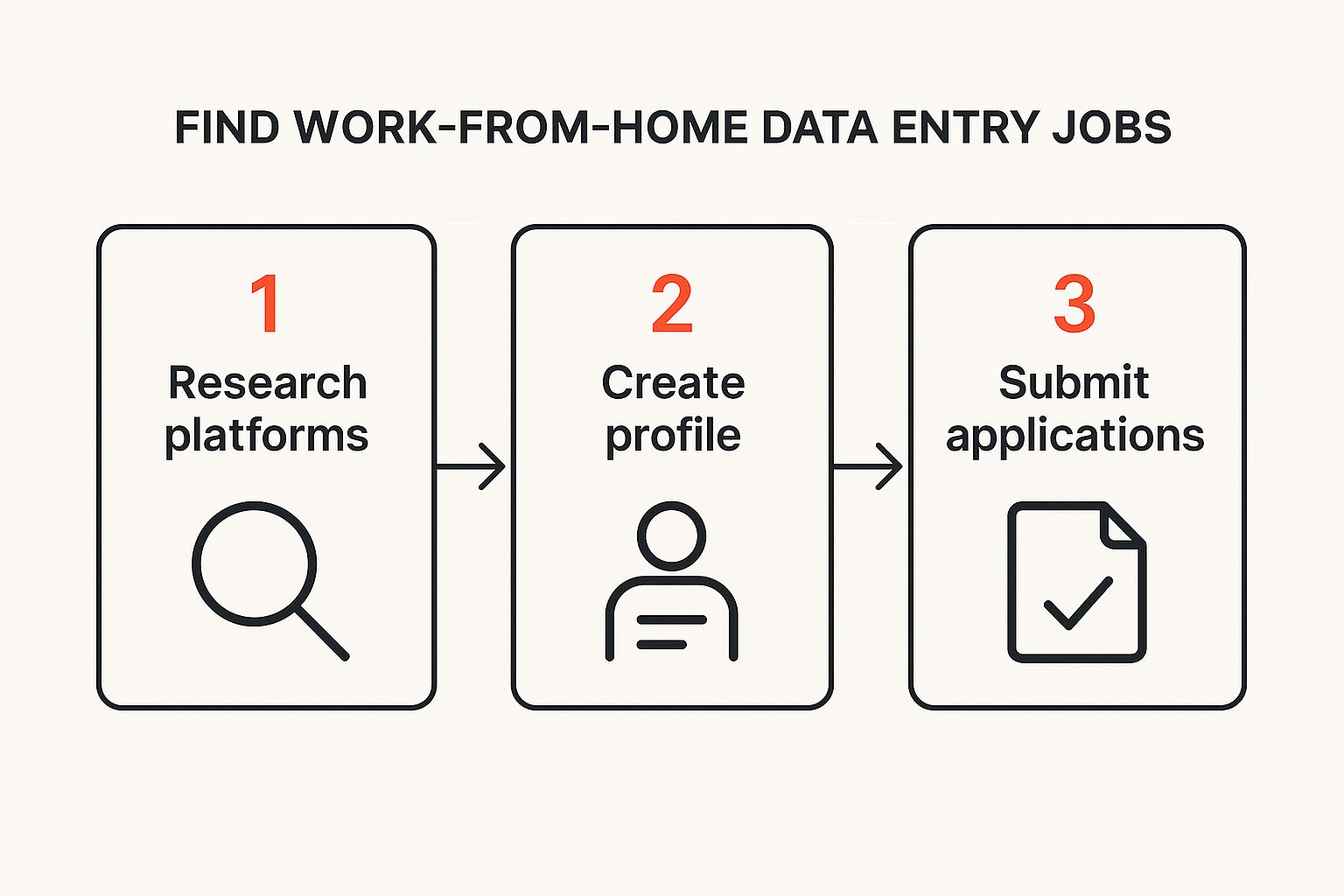
The key takeaway is that the process always starts with you presenting your skills—never your money.
Your Practical Vetting Checklist: A Step-by-Step Guide
Before you even think about applying or sharing any personal details, take a few moments to run through this quick checklist. Investing a few minutes upfront can save you a world of trouble later.
- Research the Company: Start with a simple web search for the company name. Do they have a professional-looking website? Can you find them and their employees on LinkedIn? A company that’s supposedly hiring but has no online footprint is a huge problem.
- Verify the Contact Method: Check the email address of the person contacting you. A legitimate recruiter will use a corporate email (e.g.,
[email protected]), not a generic one ([email protected]). - Protect Your Personal Data: Never give out your bank details, national identification number, or other sensitive data until you have a signed, official contract from a company you have thoroughly verified.
- Check for an Online Footprint: Look for reviews on sites like Glassdoor, articles, or any mentions of the company on third-party sites. For a business hiring remote workers, a complete lack of an online presence is deeply suspicious.
Protecting yourself goes beyond just dodging financial scams; it’s about safeguarding your data, too. To lock down your home office setup, it’s worth reviewing these 8 Critical Remote Work Security Best Practices. Furthermore, understanding the ethical use of AI in the workplace can give you a better feel for how modern, reputable companies operate with transparency and integrity.
Making Your Application Stand Out
Think of your application as your first handshake. For remote data entry jobs, you can’t rely on a firm grip and a winning smile—your CV and cover letter have to do all the work. They need to shout from the rooftops that you’re accurate, reliable, and ready to hit the ground running.
Sending out generic, copy-paste applications is the quickest route to the rejection pile. Trust me, hiring managers have seen it all before and can spot a template a mile away. Your mission is to show them you’ve actually read their job description and that your skills are the solution to their problems.
Pinpointing Your Key Skills
You don’t need a CV packed with official “Data Entry Clerk” titles to qualify. Many jobs you’ve already had have given you the exact skills employers are desperate for. The real trick is learning how to talk about them.
Take a look back at your work history and see where you’ve used these abilities:
- Worked in retail or as a cashier? You handled money with precision and managed stock levels. That’s a perfect example of attention to detail and data accuracy.
- Been an admin or receptionist? You were juggling schedules, organising files, and handling important messages. Those are top-notch organisational skills and effective communication.
- Done any customer service? You probably spent your day updating customer information in a database. That’s direct experience with database management and handling sensitive information discreetly.
When you write your CV, use powerful action verbs to describe these experiences. Don’t just say, “Responsible for stock.” Instead, try something like, “Accurately managed a 500-item inventory using an in-house stock management system.” See the difference? One is passive, the other shows you delivering real results.
Writing a Cover Letter They’ll Actually Read: A 3-Step Guide
Your cover letter is where you connect the dots for the person doing the hiring. Keep it short, direct, and—most importantly—customised for the job you want. Sending the same letter everywhere is a massive red flag to employers.
Here’s a simple structure that works every time:
- The Hook (Paragraph 1): Start by stating the exact role you’re applying for (e.g., “Remote Data Entry Clerk”) and where you saw the advert. Mention one key requirement from the ad and express your excitement. For example: “I am writing to express my enthusiastic interest in the Remote Data Entry Clerk position I found on Jobberman. Your requirement for exceptional accuracy immediately caught my eye, as this is a core strength I have developed throughout my career.”
- The Pitch (Paragraph 2): Pick two or three non-negotiable requirements from the job description. Then, give a quick, concrete example of how you’ve met them in a previous role. For instance: “In my previous role as an Administrative Assistant, I was responsible for inputting over 100 client records daily into our CRM system with a 99.8% accuracy rate. I am also highly proficient in Microsoft Excel, including using VLOOKUP and Pivot Tables to consolidate sales data.”
- The Close (Paragraph 3): Reaffirm your enthusiasm for the role and your confidence in delivering the high-quality, accurate work they need. Include a clear call to action. For example: “I am confident that my skills in precise data management and my dedication to quality will make me a valuable asset to your team. I have attached my CV for your review and welcome the opportunity to discuss my application further.”
A great cover letter doesn’t just list your skills—it tells the employer exactly how those skills will solve their specific problem or fill their specific need. It’s about them, not just you.
AI can be a great sparring partner for refining your application. For some brilliant starting points, take a look at our guide on ten ChatGPT prompt ideas for job seekers on LinkedIn.
Nailing the Online Skills Test
It’s becoming really common for companies to use online skills tests to filter applicants. This isn’t something to be scared of—it’s your moment to prove you have the practical skills for the job. Never go into one of these tests cold. A bit of practice goes a very long way.
You’ll want to brush up on the essentials: typing speed and accuracy, 10-key data entry (the number pad), and maybe some basic spreadsheet skills. There are tons of free practice sites out there. Getting a few rounds in beforehand not only sharpens your abilities but also settles your nerves, so you can perform your best when it actually matters.
Got Questions About Remote Data Entry? Let’s Get Them Answered
Diving into remote data entry for the first time? It’s natural to have a ton of questions. Getting straight answers is the best way to figure out if this is the right path for you and how to get started on the right foot.
Here, I’ll break down some of the most common things people ask when looking for data entry work from home in Nigeria.
What’s the Real Earning Potential?
This is the big one, isn’t it? The truth is, what you earn from data entry jobs work from home can really swing depending on a few key factors. The biggest influencers are who you’re working for (local companies versus international clients), how tricky the tasks are, and which platform you’re using to find gigs.
When you’re brand new, you’ll likely start with smaller, entry-level projects that don’t pay a huge amount. But don’t let that discourage you. Once you prove you’re fast, accurate, and reliable, you can start landing much better long-term contracts.
It’s not uncommon for experienced Nigerian data entry pros working with international clients to pull in between $4,000 and $6,000 annually. Getting there is all about consistency and building a stellar reputation.
What Gear Do I Actually Need to Start?
You can relax—you don’t need to break the bank on a fancy home office. The essential gear is pretty basic, and you probably already have most of it.
Here’s the absolute minimum you’ll need:
- A decent computer or laptop that runs smoothly.
- A stable internet connection is non-negotiable.
- A quiet space where you can actually concentrate. Accuracy is everything.
Some jobs might ask for specific software like Microsoft Office, but honestly, many are moving to free cloud-based tools like Google Sheets. Don’t let the fear of not having the “right” equipment hold you back. You can land your first job with a very simple setup.
Data entry is a fantastic way to break into remote work. It gives you core skills that can unlock doors to more advanced roles later on.
Is Data Entry a Smart Career Move for the Long Haul?
Definitely. It’s easy to think of data entry as just a stepping stone, but it’s a solid foundation for a real career. The skills you’ll sharpen—things like data management, becoming a pro with different software, and having an eagle eye for detail—are valuable everywhere.
Once you have some experience under your belt, you can pivot into more specialised roles. I’ve seen many people move from data entry into positions like Data Analyst, Database Manager, or even high-demand Virtual Assistants, especially in booming fields like finance and healthcare.
Plus, with the ongoing digital shift across the country, as Nigeria embraces RichlyAI tech, your ability to handle data efficiently is only going to become more sought-after.
Ready to create standout application materials that get noticed? RichlyAI provides powerful tools to help you write compelling CVs, generate professional cover letters, and polish your communication skills, giving you the edge you need to land your first remote data entry job. Explore your potential at https://richlyai.com.
