
The AI industry has invested enormous energy in making models more capable.
Modern AI systems can draft documents, analyse evidence, write code, generate ideas, explain difficult subjects and support complex professional tasks.
But for many people, access to a capable model is no longer the main problem.
The harder questions are:
- What exactly should I ask the AI to do?
- What information should I provide?
- What evidence should the output rely on?
- What steps should happen before and after generation?
- How do I prevent unsupported assumptions?
- What must remain under human control?
- How do I turn one useful result into a repeatable working process?
These are not simply model questions.
They are work-design questions.
That is the problem RichlyAI set out to address with Amo.ng, pronounced “among.”
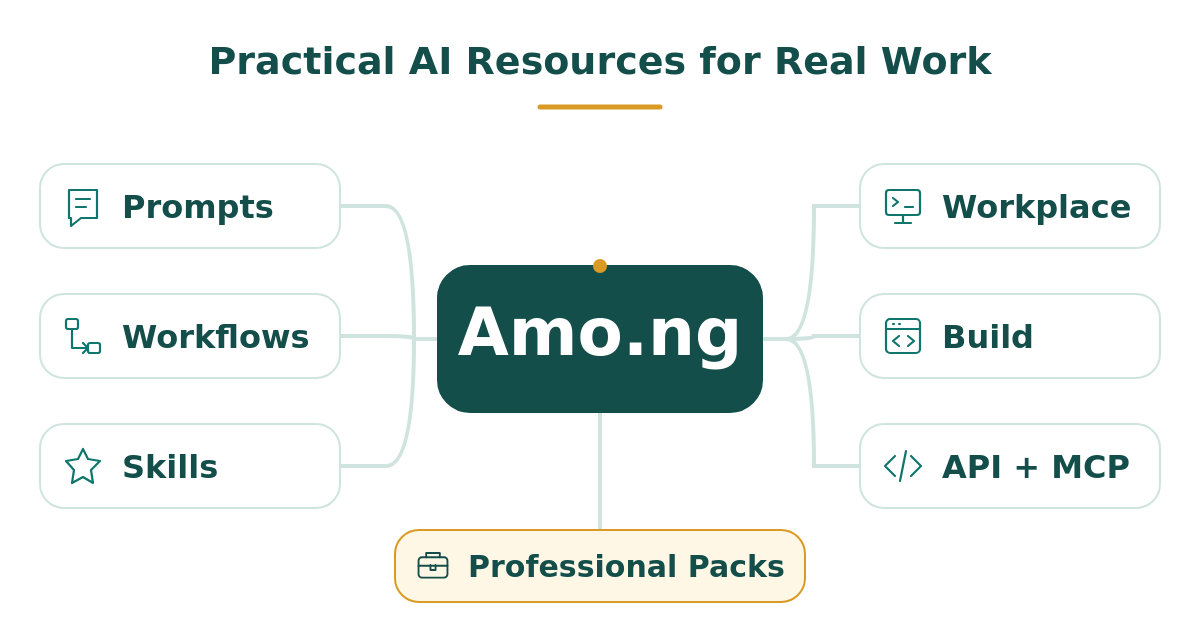
Amo.ng began as a library of professionally structured AI Prompts. It has since grown into a broader practical AI work platform that connects Prompts, Workflows, Skills, Professional Packs, Topics, private AI execution, browser-based building tools and machine-readable access through an API and the Model Context Protocol.
Everything is free, with no subscription, paywall or account creation required.
The goal is straightforward: help people move from experimenting with AI to using it more deliberately, safely and productively for real work.
The gap between having AI and using it well
Most professionals can open ChatGPT, Claude, Gemini or another AI tool and type a question.
That does not mean they have a reliable working process.
A vague request may produce a confident but incomplete answer. A long instruction may still fail if the evidence is unavailable, the task boundaries are unclear or the required output is poorly defined.
The quality of professional AI work depends on more than clever wording.
It depends on structure.
A strong AI task should make clear:
- The job that needs to be done.
- The evidence and context available.
- The limits of the review.
- The assumptions that must not be invented.
- The checks that should be performed.
- The output that must be produced.
- The decisions that remain with an authorised person.
Amo.ng resources are designed around these elements.
They are not intended to make AI sound more complicated. They are intended to make the work clearer.
What is Amo.ng?
Amo.ng is a free public platform for discovering and using structured resources for practical AI work.
The platform currently includes:
- Prompts
- Workflows
- Skills
- Professional Packs
- Topics
- Amo.ng Workplace
- Amo.ng Build
- A public API
- A read-only MCP server
- A growing Definition of Terms
Each layer solves a different part of the practical AI adoption problem.
A Prompt helps with one task.
A Workflow connects multiple tasks.
A Skill captures a reusable capability.
A Professional Pack organises resources around the real work of a profession.
Topics make the library easier to explore.
Workplace provides a supported space for private runs with the user’s chosen AI provider.
Build helps users create websites and browser-based tools.
The API and MCP make public Amo.ng resources available to other applications and compatible AI clients.
1. Prompts: structured instructions for real tasks
Amo.ng Prompts are not designed as short novelty commands.
A typical professional Prompt may include:
- a clear use case;
- required inputs;
- evidence boundaries;
- privacy and operating limits;
- a defined review method;
- stopping rules;
- an output contract;
- human-decision fields;
- instructions for handling missing evidence;
- guidance on how to use the resource.
For example, a finance professional may use a Prompt to review an account reconciliation and its unresolved differences.
The Prompt does not simply say:
“Review this reconciliation.”
It asks the user to supply the relevant account and period, the reconciliation, source evidence, matching rules, applicable policies and decision owners.
It then directs the AI to distinguish facts, assertions, calculations, assumptions, missing evidence, unresolved differences and human decisions.
The aim is not merely to produce a polished explanation.
The aim is to produce working material that a professional can review, challenge and use responsibly.
Amo.ng currently contains resources across areas such as:
- finance and accounting;
- internal audit;
- marketing;
- business strategy;
- software engineering;
- automation;
- cybersecurity;
- education;
- academic research;
- vendor management;
- data analysis;
- governance and compliance.
2. Workflows: moving beyond one-shot prompting
A single Prompt may be enough for a bounded task.
Larger pieces of work usually require a sequence.
Amo.ng Workflows connect multiple Prompts into an ordered process. Each step has a purpose, required inputs and a defined handoff to the next stage.
A Workflow may help a user:
- move from evidence collection to analysis;
- move from planning to testing;
- review an output before relying on it;
- separate AI work from manual or external tasks;
- preserve decisions and unresolved matters between steps.
Examples include Workflows for:
- preparing an evidence-controlled internal audit working paper;
- building and challenging a driver-based budget and rolling forecast;
- preparing a period-end close for controller review;
- reviewing production AI evaluation reliability;
- producing an evidence-traceable literature review;
- conducting vendor procurement due diligence;
- planning and reviewing complex software changes.
This approach recognises an important fact:
AI-supported work is rarely one instruction followed by one final answer.
It is usually a controlled sequence of evidence, analysis, review, correction and human decision-making.
3. Skills: reusable professional capabilities
Amo.ng Skills capture capabilities that can be reused across different assignments.
A Skill may help someone:
- trace consequential claims to original evidence;
- assess AI evaluation evidence;
- reconstruct delegated authority chains;
- review sensitive-context propagation;
- challenge analytical conclusions;
- assess vendor-procurement readiness;
- review software or API boundaries;
- prepare reproducible research material.
Skills are lighter than full Workflows, but more reusable than one narrow task.
They help users think in terms of repeatable capability:
“What should I be able to do consistently?”
rather than only:
“What should I ask the AI today?”
4. Professional Packs: organising AI around professions
One of the most important developments in Amo.ng is the introduction of Professional Packs.
A Professional Pack does not begin with the question:
“Which existing prompts can we place on one page?”
It begins with:
“What does a professional in this field actually need to do?”
The job map is defined first. Existing Amo.ng resources are then reviewed against that map. Missing resources are created where necessary.
This profession-first approach is intended to reduce gaps and avoid building Packs around whatever happens to exist in the catalogue.
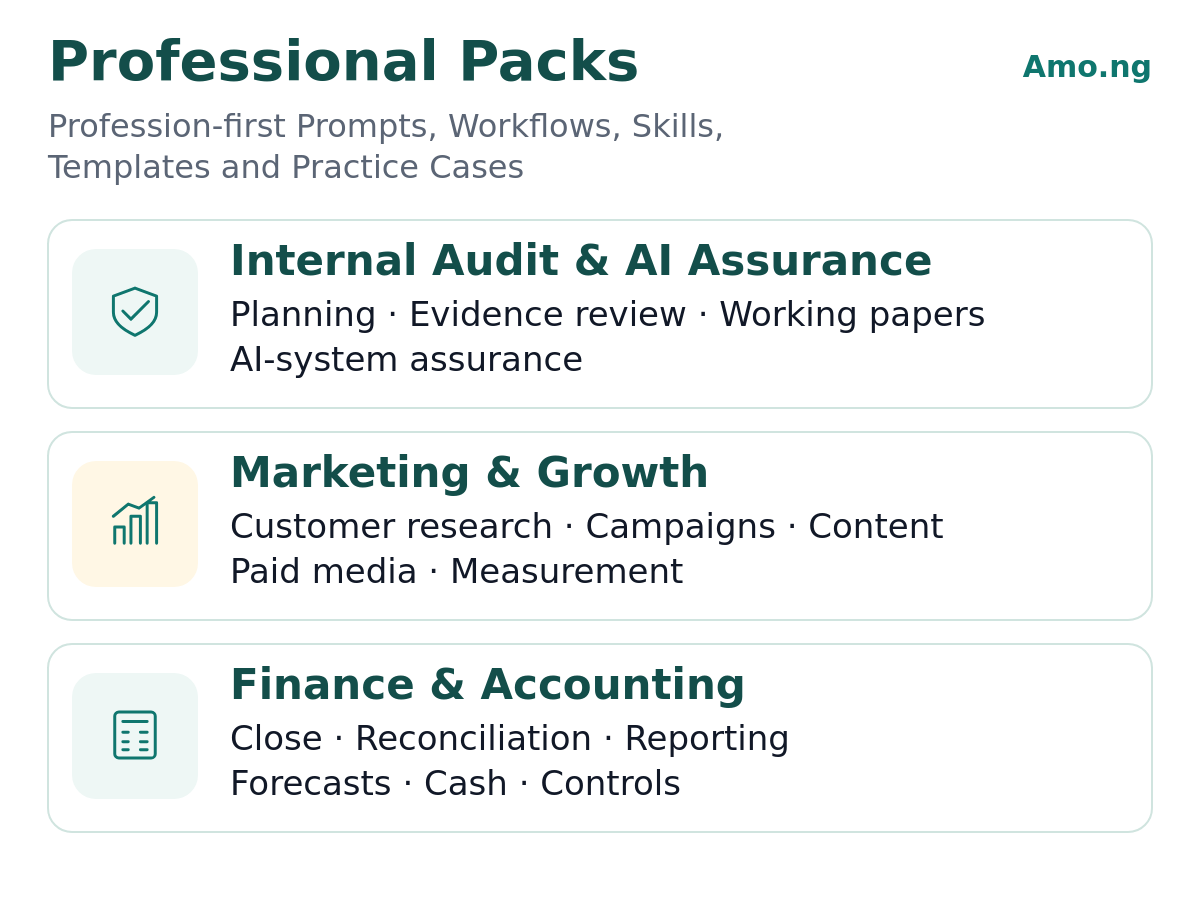
At the time of publication, three Professional Packs are available.
Internal Audit & AI Assurance
The Internal Audit & AI Assurance Pack has two tracks:
- using AI responsibly in internal audit work;
- examining AI-enabled systems.
It includes resources for audit planning, evidence review, control-test design, working papers, findings, management responses, closure evidence, vendor review, AI evaluation and system controls.
It also includes editable Templates, synthetic Practice Cases and real-world cases.
Marketing & Growth
The Marketing & Growth Pack supports work such as:
- customer and market research;
- audience review;
- positioning;
- campaign planning;
- content development;
- paid-media decisions;
- lifecycle marketing;
- CRM and lead routing;
- measurement;
- experimentation.
It is designed to help marketing teams use AI not merely to generate more content, but to challenge evidence and make better-supported decisions.
Finance & Accounting
The Finance & Accounting Pack includes jobs such as:
- closing the month;
- reviewing reconciliations;
- challenging journals, accruals and estimates;
- checking statements and disclosure evidence;
- preparing or reviewing budgets and forecasts;
- understanding cash pressure;
- analysing margins and variances;
- challenging capital requests;
- reviewing controls and spreadsheet reliability.
Its Templates and Practice Cases help users move from theory into applied professional work.
5. Topics: finding resources by work area
A large resource library can become difficult to navigate if everything is organised only by format.
A user may know that they need help with cybersecurity or governance, but may not know whether the best starting point is a Prompt, Workflow or Skill.
Amo.ng Topics organise resources by practical domain.
Current Topics include:
- AI Agents;
- Automation;
- Cybersecurity;
- Vendor Management;
- Data Analysis;
- Education and Learning;
- Academic Research;
- Business Strategy;
- Governance and Compliance;
- Marketing and Growth;
- Operations and Incident Response;
- Productivity and Workflows;
- Build and Ship;
- Laravel and Software Engineering;
- SEO and AI Search.
Topics allow the user to begin with the problem area and discover the relevant resource types from there.
6. Amo.ng Workplace: bring your own AI
The public Amo.ng library helps users discover structured resources.
Amo.ng Workplace helps users run supported resources privately with their own selected AI provider.
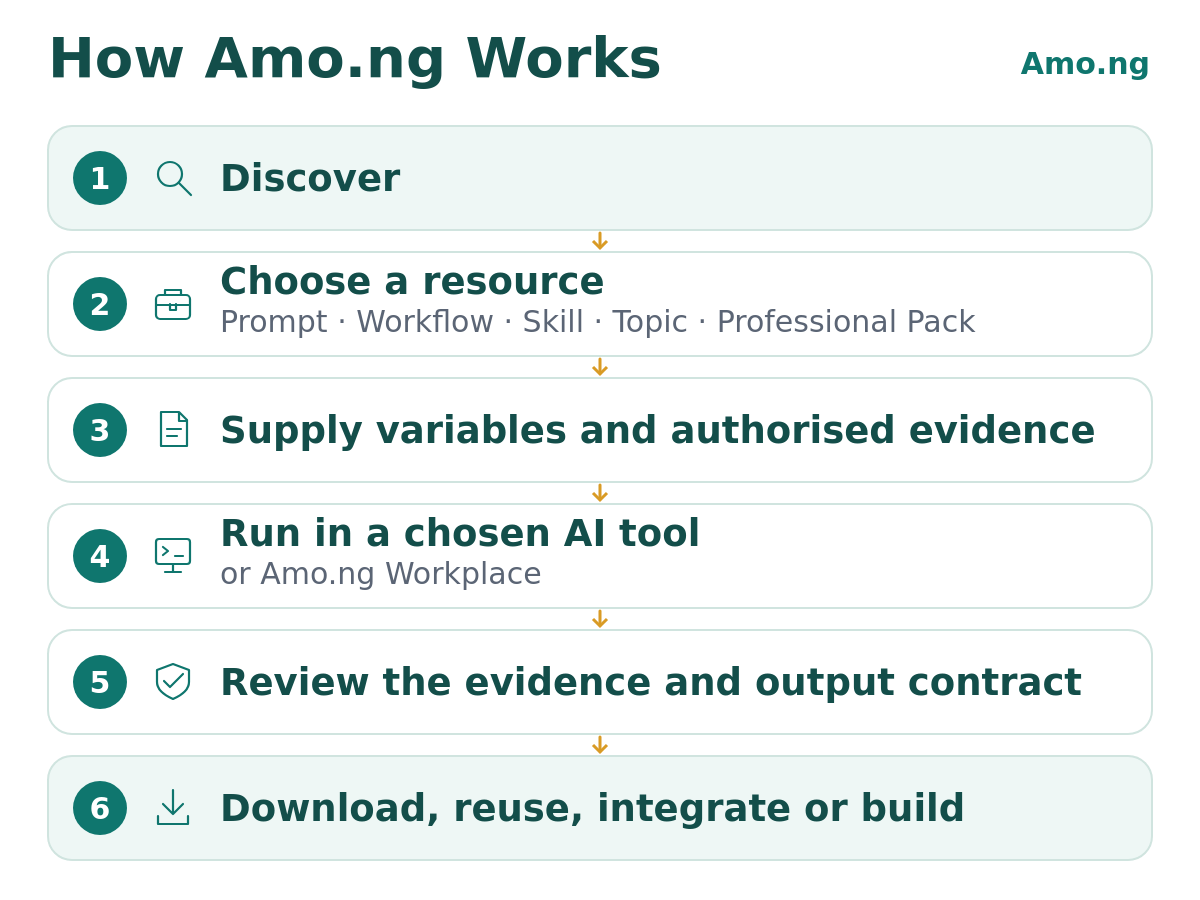
The intended journey is:
- Discover a professionally structured resource.
- Open it in Workplace.
- Supply the required variables.
- Choose a supported AI provider.
- Run the task.
- Review the result.
- Store it locally or download it.
No Amo.ng account is required.
Saved provider keys remain in the user’s browser. Execution may involve transient processing as described in the Amo.ng Privacy Policy.
This bring-your-own-AI approach keeps Amo.ng separate from the model provider.
Amo.ng structures the task.
The user chooses the provider.
The provider generates the output.
The authorised person remains responsible for reviewing and using the result.
7. Amo.ng Build: moving from instructions to working projects
Some tasks should end with more than a document.
Amo.ng Build extends the platform into website and browser-tool creation.
It is intended to help users move from an approved brief or template into a usable browser-based project without exposing unnecessary infrastructure complexity.
This adds another layer to the Amo.ng journey:
“Discover the resource → structure the work → produce the output → build something usable.”
Build is particularly relevant for professionals and small teams that need practical digital deliverables but do not want to begin with a blank development environment.
8. API and MCP: making Amo.ng machine-readable
Amo.ng is not only designed for human browsing.
The public Amo.ng API exposes published Prompts, Workflows, Skills, Topics and Professional Packs through stable identifiers and structured responses.
Each resource uses a stable Amo ID, such as:
- AMO-P- for Prompts;
- AMO-W- for Workflows;
- AMO-S- for Skills.
Amo.ng also provides a read-only Model Context Protocol server.
Compatible AI clients can use it to:
- search published Prompts;
- retrieve a Prompt by Amo ID or slug;
- search and retrieve Workflows;
- search and retrieve Skills;
- list Professional Packs;
- retrieve Pack jobs, Templates and Practice Cases;
- list Topics;
- retrieve Topic relationships.
At the time of publication, the Amo.ng ChatGPT app had been submitted for review.
This machine-readable layer is important because it allows Amo.ng resources to remain centrally maintained while being discovered through other interfaces.
A new Prompt, Workflow, Skill or Professional Pack can be published once on Amo.ng and then become available to compatible clients without creating a separate content catalogue for each application.
Verification, evidence and human judgement
Amo.ng is not built on the assumption that AI output should be accepted because it sounds confident.
Professional resources are reviewed for elements such as:
- task clarity;
- evidence requirements;
- stopping rules;
- professional boundaries;
- output contracts;
- missing-information handling;
- human-decision fields;
- privacy and safety constraints.
Verification is version-specific.
If a published Prompt changes, the new version must be considered separately rather than inheriting the status of the old version automatically.
Amo Verified does not mean:
- a professional body has endorsed the resource;
- the output is automatically correct;
- an audit opinion has been issued;
- a financial decision has been approved;
- legal compliance has been certified;
- a marketing claim has been authorised.
It means the specific resource version has passed Amo.ng’s defined quality and evidence process.
Human judgement remains essential.
What Amo.ng is—and what it is not
Amo.ng is:
- a structured resource platform;
- a discovery layer;
- a professional work-design system;
- a library of reusable AI methods;
- a private execution pathway for supported tasks;
- a machine-readable catalogue;
- a practical bridge between AI capability and real work.
Amo.ng is not:
- an AI model provider;
- a substitute for professional judgement;
- an automatic approval system;
- a compliance-certification service;
- a replacement for authorised audit, accounting, legal, security or management decisions;
- a system that should be trusted without reviewing the evidence and output.
The platform is intended to improve how work is framed, executed and reviewed—not to remove accountability.
Early growth and usage
Amo.ng is still an early-stage project.
However, the initial signs of usage and external discovery have been encouraging.
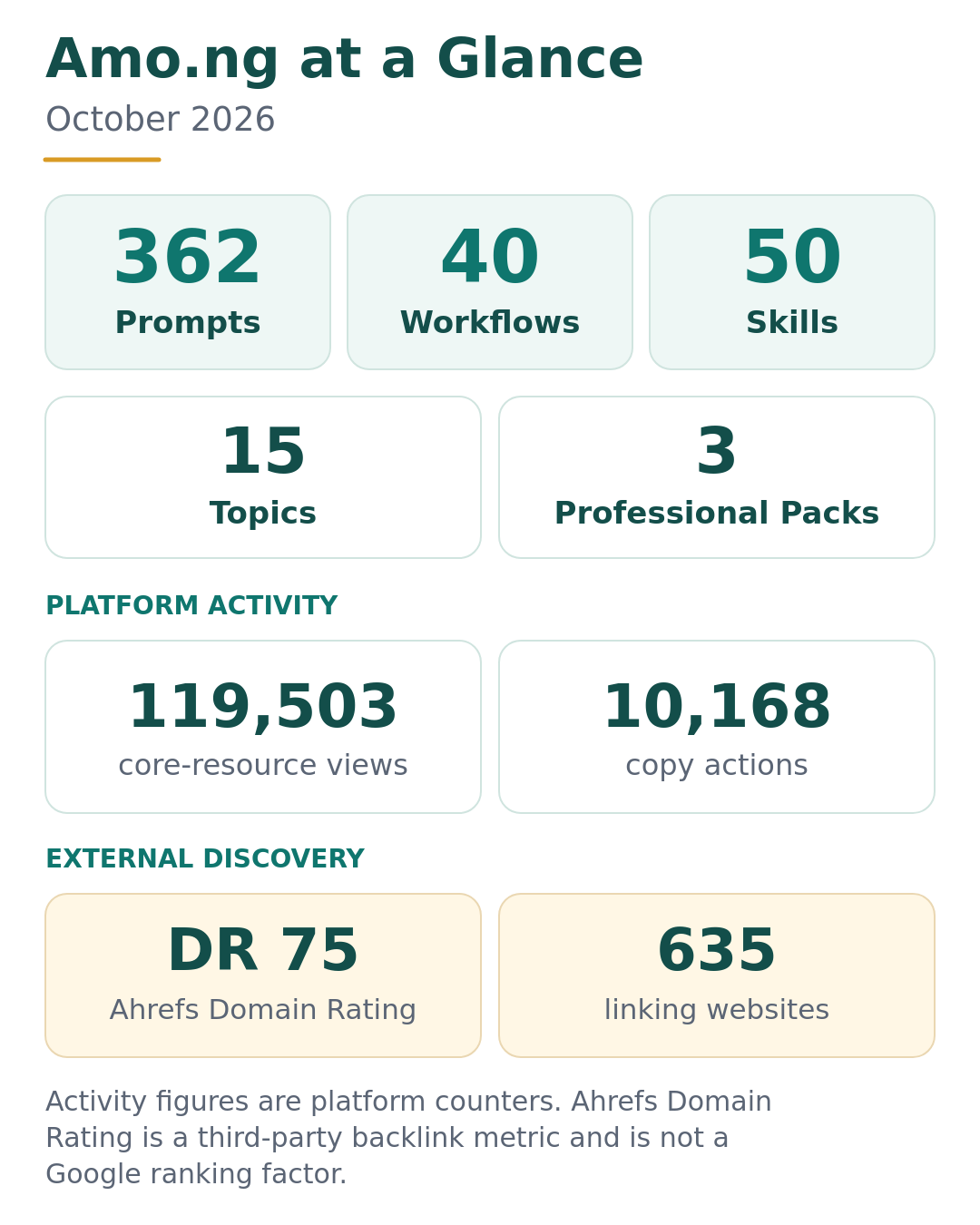
As of October 2026, the platform includes:
| Resource | Current count |
|---|---|
| Prompts | 362 |
| Workflows | 40 |
| Skills | 50 |
| Topics | 15 |
| Professional Packs | 3 |
Across Prompts, Workflows and Skills, the platform has recorded:
- 119,503 views;
- 10,168 copy actions.
These are platform activity counters, not claims of unique users.
Amo.ng has also grown from an Ahrefs Domain Rating of approximately 3 when the active project began to DR 75 at the time of writing, with 635 linking websites.
Domain Rating is not a Google ranking factor, and it is not the same as business success, revenue or organic traffic.
But the growth is one encouraging indication that the platform is being discovered, referenced and linked to across the web.
Who is Amo.ng for?
Amo.ng is designed for people who want more than casual AI experimentation.
Professionals
Accountants, auditors, marketers, researchers, educators, developers, security practitioners, analysts and managers can begin with work relevant to their field.
Teams and organisations
Teams can use Amo.ng resources as starting points for approved internal methods, training, review procedures and private cohorts.
Educators and learners
Educators can use structured resources to explore AI responsibly, while learners can practise with defined tasks rather than relying on vague instructions.
Builders and developers
Developers can use software-engineering Prompts, Workflows, Skills, Build and machine-readable access.
AI practitioners
Prompt engineers and workflow designers can study how evidence boundaries, output contracts and human-decision controls are incorporated into professional AI resources.
Why the free model matters
Many people encounter AI resources through paywalls, gated communities, subscriptions or account requirements.
Amo.ng takes a different approach.
The public resource library is intended to remain open.
Everything is free, with no subscription, paywall or account creation required.
This does not mean every external service is free.
A selected AI provider may charge for its own API or subscription usage. Users remain responsible for their provider relationship and authorised data use.
RichlyAI may also offer separate institutional services such as facilitated training, private cohorts and organisation-specific adaptation.
Those services add support around the public resources. They do not remove the free public Pack or library.
Where Amo.ng goes next
The next stage of Amo.ng is not simply adding more Prompts.
The platform will continue to grow across several dimensions:
- More profession-first Professional Packs.
- Stronger end-to-end Workflows.
- More reusable Skills.
- Better Templates and Practice Cases.
- Deeper integration with compatible AI clients.
- Continued improvement of Workplace and Build.
- Stronger evidence, verification and versioning.
- More practical resources for organisations, educators and professional teams.
The long-term opportunity is to create a shared practical layer between powerful AI models and the work people actually need to perform.
Models will continue to change.
Interfaces will continue to change.
Providers will continue to compete.
But professionals will still need:
- clear tasks;
- reliable evidence;
- repeatable processes;
- defined outputs;
- accountable decisions.
That is the layer Amo.ng is being built to serve.
Frequently asked questions
Is Amo.ng free?
Yes. The public Amo.ng library is free to browse and use. There is no subscription, paywall or account requirement.
Your selected AI provider may charge for its own service or API usage.
Do I need an Amo.ng account?
No Amo.ng account is required to browse public resources or use supported account-free pathways.
Does Amo.ng run Prompts?
Users may copy a Prompt into a supported AI tool, or open supported resources in Amo.ng Workplace.
Amo.ng itself is not the model provider.
Which AI tools can I use?
Amo.ng resources may be used with suitable AI tools such as ChatGPT, Claude, Gemini and other supported providers, depending on the task and the user’s authorised environment.
Each resource identifies its intended tool or usage method where relevant.
What is the difference between a Prompt and a Workflow?
A Prompt supports one bounded task.
A Workflow connects multiple steps into an ordered working process.
What is a Professional Pack?
A Professional Pack organises Prompts, Workflows, Skills, Templates and Practice Cases around the real jobs of a profession or function.
Does Amo Verified mean professional approval?
No.
Amo Verified is a version-specific Amo.ng quality status. It does not certify professional compliance, issue an audit opinion or approve a human decision.
Can organisations use Amo.ng resources?
Yes.
The public resources remain free. Organisations may also contact RichlyAI for facilitated training, private cohorts and organisation-specific adaptation.
Explore Amo.ng
Amo.ng is still growing, but its purpose is already clear:
To make practical AI work easier to discover, structure, review and reuse.
Start by exploring:
Visit Amo.ng.
For institutional enquiries, training or organisation-specific adaptation, contact RichlyAI or email [email protected].
Author bio
Lazarus Omolua is the founder of RichlyAI and leads Amo.ng. He writes regularly about practical AI adoption and workflow design on LinkedIn. Contact: [email protected].