
AI-driven quantum computing is still an early-stage field, but it is no longer just a research curiosity. The reason leaders are paying attention is simple: AI can help make quantum systems easier to calibrate, optimize, and use, while quantum systems may eventually help solve a narrow class of problems that overwhelm classical computing. Together, the two technologies could change how certain industries approach discovery, optimization, and decision support.
That does not mean a universal quantum breakthrough is arriving overnight. In 2026, most organizations should still treat quantum advantage as selective, workload-specific, and operationally complex. The better question is not whether every business needs quantum computing today. It is where AI-driven quantum methods may create real business leverage first, and what leaders should do now to prepare responsibly.
Why AI and Quantum Computing Are Being Paired
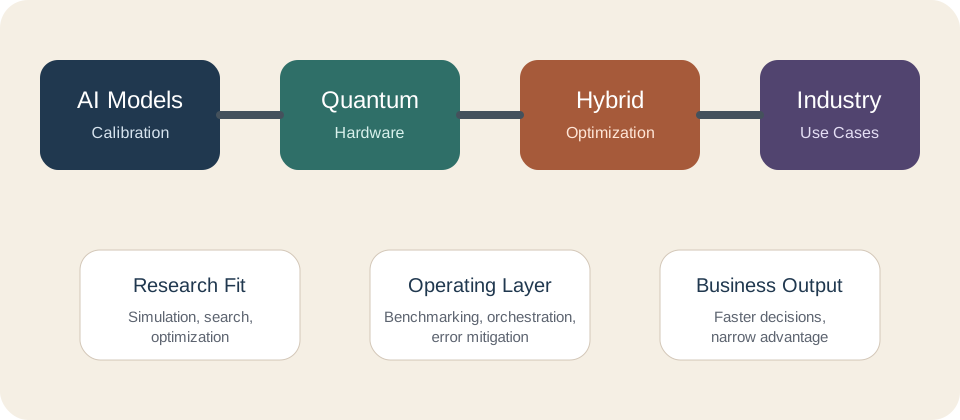
Quantum hardware remains difficult to operate at scale. Systems are noisy, fragile, and highly sensitive to how problems are encoded. AI can help by improving calibration, error mitigation, scheduling, simulation, and experiment design. In practical terms, that means AI can reduce some of the friction that has historically made quantum workflows too specialized for broader adoption.
The reverse relationship also matters. Quantum techniques may eventually help with optimization, sampling, and simulation problems that matter in industries such as drug discovery, portfolio analysis, and logistics. Much like the broader discussion around how quantum computing could reshape AI by 2026, the real opportunity lies in targeted use cases rather than sweeping claims about replacing classical infrastructure.
That practical framing is important because the conversation sits close to larger themes in AI trends for 2026. Frontier infrastructure matters, but it matters most when technical progress can be tied to a specific workflow, measurable improvement, and credible delivery path.
How AI Improves Quantum Workflows
For most enterprises, AI-driven quantum computing will become relevant through tooling rather than through direct work on quantum physics. AI is already useful in several practical areas:
- Hardware calibration: machine learning models can help tune fragile quantum devices faster and detect patterns in hardware drift.
- Error mitigation: AI can support strategies for reducing noise and improving the reliability of quantum outputs.
- Circuit optimization: AI-assisted compilers can help translate problems into more efficient quantum instructions.
- Experiment prioritization: AI can help research teams decide which parameter sets or simulations are most worth running.
- Workflow orchestration: hybrid systems can route tasks between classical and quantum resources more intelligently.
This matters because many near-term gains will come from hybrid systems. Most organizations are not choosing between AI and quantum computing. They are exploring where classical AI, high-performance computing, and quantum resources can work together. That same operating logic also appears in more mature discussions of AI-assisted decision-making, where the value comes from better orchestration rather than from a single magical model.
Industries Most Likely to Feel Early Impact
Pharmaceuticals and Materials Science
Simulation-heavy fields are among the most discussed early candidates for AI-driven quantum computing. Molecular modeling, materials discovery, and reaction-path analysis are computationally expensive problems, and even incremental improvements can have large commercial value. In practice, enterprises should expect progress to come in narrow research workflows before it shows up as broad operational transformation.
Financial Services
Finance is often mentioned because portfolio optimization, derivatives modeling, scenario analysis, and fraud-related pattern detection all involve complex mathematical structures. The realistic near-term view is that financial institutions will continue testing specialized hybrid approaches rather than moving core systems wholesale onto quantum platforms. AI remains important here because it helps teams decide when a quantum routine is useful and when classical methods are still better.
Logistics and Supply Chain
Routing, scheduling, capacity planning, and inventory optimization are natural areas of interest. These are also areas where AI is already well established. Quantum computing could become meaningful when optimization problems are unusually complex and time-sensitive, but the value will depend on whether hybrid systems can outperform strong classical baselines in production.
Energy, Manufacturing, and Engineering
Grid optimization, materials design, manufacturing simulation, and process control could all benefit from better optimization and modeling. Leaders in these industries should treat AI-driven quantum computing as a strategic capability to monitor, pilot, and benchmark rather than a guaranteed near-term replacement for existing analytics stacks.

The sectors above also connect to broader debates around AI and the future of work. As specialized tooling becomes more usable, the biggest change may be how technical teams, operators, and decision-makers collaborate around faster modeling and planning rather than around fully autonomous systems.
What Is Still Limiting Adoption
The technology remains constrained by hardware noise, limited scale, tooling maturity, cost, and a shortage of teams that can connect quantum experimentation to real business problems. These are not minor issues. They are the reason responsible planning matters more than hype.
Executives should also be careful with inflated claims. Many industry forecasts describe large disruption potential, but real deployment still depends on measurable workload fit, data quality, engineering talent, and integration with existing systems. This is where disciplined evaluation matters more than trend-chasing. The same discipline appears in wider conversations about AI safety and risk, where the core issue is not whether a tool is impressive but whether it is reliable enough for the context in which it is used.
Platforms and Vendors to Watch
The most credible ecosystem players are those building real hardware, cloud access layers, developer tooling, and hybrid orchestration systems. For most teams, the relevant question is not which platform sounds most futuristic. It is which environment supports reproducible experimentation, integration with existing data science workflows, and clear governance.
- IBM Quantum: a major enterprise-facing platform with cloud access, developer tooling, and active research partnerships.
- Google Quantum AI: influential in research and hardware progress, especially for teams tracking long-term technical direction.
- Microsoft Azure Quantum: relevant for organizations that want quantum experimentation within a broader cloud and enterprise tooling environment.
- Quantinuum: a notable player in hardware and software, especially for commercial quantum workflow development.
- D-Wave: often discussed for quantum annealing and optimization-oriented use cases rather than general gate-based computing.
These platforms should be evaluated with the same discipline leaders use in other frontier technology decisions. The conversation also connects to AI governance and global policy, because access models, compute concentration, and technical standards will influence how quickly advanced systems move from research to regulated enterprise use.
How Leaders Should Prepare in 2026
A sensible 2026 strategy starts with targeted learning, not sweeping transformation. Organizations should identify a small number of optimization or simulation problems that are already expensive under classical methods, then test whether hybrid AI and quantum approaches produce better results, faster insight, or more defensible decision support.
That preparation should include clear governance. Teams need to know which workloads justify experimentation, how results will be benchmarked, how vendor claims will be validated, and what technical or security constraints apply to cloud-based quantum environments.
It is also important to prepare talent and operating models. Quantum adoption will not be driven by physicists alone. Progress depends on product leaders, researchers, ML engineers, infrastructure teams, and domain specialists working together around narrow, measurable use cases.

Conclusion
AI-driven quantum computing could become a meaningful source of industry disruption, but the most credible opportunities remain selective and domain-specific. In 2026, the strongest organizations will not be the ones making the boldest claims. They will be the ones building disciplined hybrid experimentation programs, validating results against strong classical baselines, and focusing on where the technology can create real operational advantage.
For founders, technical managers, and policy leaders, the right posture is practical optimism. The field is worth serious attention, but it still demands caution, benchmarking, and clear governance. That combination of ambition and discipline is what will separate useful adoption from expensive noise.
