
Autonomous AI agents are no longer limited to chatbot interfaces or simple workflow triggers. In 2026, enterprises are using agentic systems to monitor events, route work, reconcile information across tools, and execute multi-step operational tasks with far less manual coordination than traditional automation required.
For COOs, operations leaders, and enterprise IT teams, the real question is not whether autonomous AI agents are interesting. It is where they are mature enough to improve enterprise operations today, where they still need tight human oversight, and how teams should deploy them without creating new operational risk.
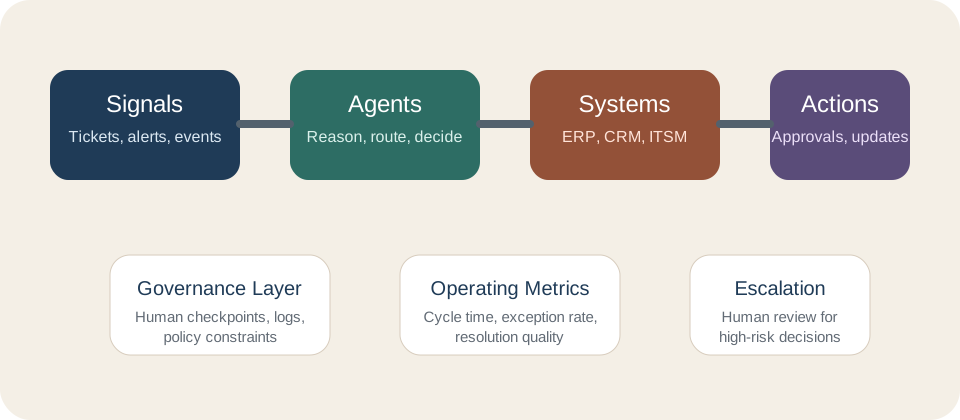
What Autonomous AI Agents Actually Change in Enterprise Operations
Traditional automation usually follows pre-defined rules. Autonomous AI agents go further by interpreting context, choosing actions across tools, and adapting when workflows branch or fail. That is why they are increasingly discussed as part of a broader move toward agentic AI in enterprise decision-making, rather than as a small extension of chatbot technology.
In practice, the shift is operational. Instead of handing a user one answer, an agent may monitor a queue, collect missing information, decide whether a case meets policy requirements, update systems of record, and escalate only the exceptions that need human judgment.
Where Autonomous AI Agents Are Creating Real Value
IT and Service Operations
IT teams are using autonomous AI agents for ticket triage, incident classification, knowledge retrieval, and coordinated response workflows. The strongest use cases are repetitive but high-volume tasks where context gathering consumes more time than the final action itself.
Finance and Back-Office Workflows
In finance operations, agents can help with invoice review, exception routing, reconciliation support, procurement checks, and policy validation. They are especially useful when tasks require moving across email, ERP records, spreadsheets, and approval systems.
Customer and Revenue Operations
Revenue teams are testing agent-driven lead routing, contract operations support, renewal risk monitoring, and customer-service handoff automation. These workflows benefit when agents can summarize account context quickly and keep humans focused on complex interactions.
Operational Monitoring and Coordination
Operations teams can use autonomous AI agents to watch dashboards, detect anomalies, trigger standard operating procedures, and coordinate follow-up actions across systems. The payoff is not just speed. It is more consistent execution under pressure.
These use cases overlap with broader enterprise shifts in AI and the future of work, especially as teams redesign operating models around humans supervising higher-value exceptions rather than processing every routine step manually.

Why the Enterprise Interest Is Rising in 2026
The timing is not accidental. Foundation models are better at reasoning over operational context, enterprise tooling is exposing more APIs, and teams now have more experience with what failed in first-generation automation. That combination makes it easier to move from isolated copilots to agents that execute bounded tasks.
It also aligns with wider pressure on enterprises to improve operating leverage. Much like other AI trends for 2026, the adoption curve is being driven by a search for measurable efficiency, better responsiveness, and tighter coordination across fragmented systems.
Where Autonomous AI Agents Still Fail
Autonomous agents are not reliable simply because they can take actions. They still fail when context is incomplete, policies are ambiguous, source systems are inconsistent, or the workflow requires judgment that has not been properly encoded.
Common failure modes include incorrect routing, brittle tool integration, poor exception handling, overconfident summarization, and actions taken without sufficient human review. This is why deployment should be framed as an operational risk and control problem, not just a software feature rollout. The same concerns sit inside broader enterprise discussions of AI safety and risk.
An Enterprise Playbook for Deployment
A practical deployment plan starts with narrow workflows and explicit controls.
- Choose one bounded workflow: start where process steps are clear, repetitive, and measurable.
- Define the action boundary: specify what the agent may decide, what requires approval, and what must remain human-led.
- Instrument the workflow: track resolution time, exception rate, rework, human override rate, and outcome quality.
- Design escalation rules: ambiguous, high-risk, or policy-sensitive cases should route to people automatically.
- Review integration risk: test every system action against permissions, audit requirements, and rollback paths.
- Scale only after proof: expand to adjacent workflows only when the first one is stable and measurable.
This is also where governance matters. Leaders should align deployment with internal controls, audit expectations, and enterprise policy frameworks, especially if agents are working across regulated or high-sensitivity systems. That is one reason the topic increasingly intersects with AI governance and global policy rather than sitting inside product experimentation alone.

What Good Looks Like for Enterprise Teams
A strong autonomous AI agent program is not defined by how many agents are deployed. It is defined by whether they improve enterprise operations in a measurable, governable way. That means lower exception-handling costs, faster response cycles, clearer escalation, and stronger control over where human judgment remains necessary.
For teams evaluating enterprise AI agents in 2026, the goal should be disciplined adoption. Build around real operating problems, connect agents to trustworthy systems of record, and treat governance as part of the operating model rather than as an afterthought.
Conclusion
Autonomous AI agents are reshaping enterprise operations because they can coordinate work, not just converse about it. Their value comes from bridging observation, decision support, and execution across complex business systems.
For COOs, operations leaders, and IT teams, the most credible path forward is neither hype nor hesitation. It is a practical playbook: start small, instrument everything, keep humans in the loop where risk demands it, and scale only when the operational evidence is clear.
