
Agentic AI is not just another AI trend — it represents a fundamental shift from reactive tools to autonomous decision-making systems. Rather than just responding to prompts, these systems can plan, act, adapt, and complete multi-step tasks with very little human supervision.
Think of it as hiring a proactive digital assistant rather than using a calculator. Agentic AI doesn’t just answer questions — it executes goals.
In 2026, teams no longer ask, “How can AI assist us?” They ask, “Which workflows can AI fully own?” This shift changes how developers build software and how businesses operate at scale — moving from simple automation to true delegation.
In this guide, we break down what agentic AI really means, how it works technically, and how both developers and organizations can prepare for this new operating model.
What Is Agentic AI? (Foundations)
If you think of a standard chatbot as a calculator—it only gives you an answer when you ask a direct question—then agentic AI is a full-blown project manager. You don’t just ask it questions; you give it a high-level goal, and it figures out the step-by-step plan to get there.
Agentic AI refers to systems that automate decision-making and execution. They:
- perceive context or data,
- reason and plan steps,
- act autonomously (via tools and APIs),
- monitor results and self-correct,
- pursue goals without constant human prompts.
This shift from reactive responses to proactive, goal-driven work is the core of what is agentic AI.
Unlike traditional AI that waits for instructions, agentic systems operate continuously and proactively. Think of the difference this way:
Traditional AI → “Tell me what to do.”
Agentic AI → “Here’s the goal. I’ll handle it.”
This shift from reactive tools to autonomous agents is what makes agentic AI transformative for 2026 and beyond.
How Agentic AI Works (Simple Architecture)
Most agentic systems follow a loop:
Perceive → Plan → Act → Evaluate → Repeat
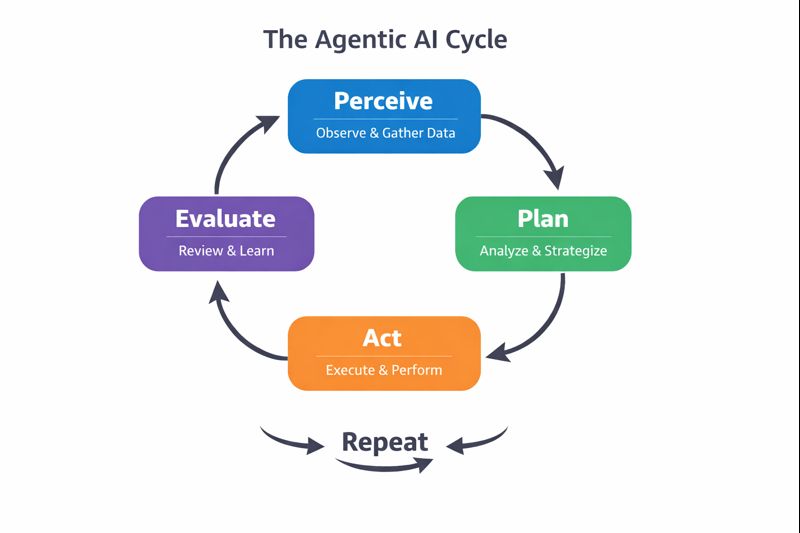
Alt text: Agentic AI lifecycle diagram explaining how autonomous AI agents perceive data, plan actions, execute tasks, evaluate outcomes, and repeat the loop.
Typical architecture:
- Goal input (user or system defined).
- LLM reasoning engine.
- Task planner.
- Tool/API connectors.
- Memory store.
- Feedback and monitoring.
Example workflow:
User goal: “Generate weekly marketing report and email leadership”
Agent actions:
• Fetch analytics data.
• Analyze performance.
• Create summary.
• Generate charts.
• Send email automatically.
No manual steps required.
Simple Pseudo-Code
Example Agent Pseudo-Code.
while goal_not_completed:
state = observe_environment()
plan = generate_plan(state, goal)
action = choose_best_action(plan)
result = execute(action)
learn_from(result)
This loop illustrates continuous agentic progression: the system observes, plans, acts, and learns. It distinguishes agentic AI from traditional models that return one answer and stop.
The Four Pillars of Agentic AI
Four key capabilities separate these autonomous AI systems from their predecessors. Once you grasp these, you’ll understand their true potential.
- Autonomy: This is the big one. It’s the ability to operate independently without constant human supervision. An agent can self-initiate actions to move closer to its objectives.
- Memory: Agents maintain context over time, learning from past interactions and outcomes. This short-term and long-term memory allows them to make smarter decisions and avoid repeating mistakes.
- Decision-Making: They have a reasoning engine that lets them analyze a situation, weigh potential actions, and choose the best path forward to achieve their goal.
- Tool Use: This is crucial. AI agents can interact with the digital world by using tools, primarily through APIs. This lets them browse websites, access databases, send emails, or connect with other software—just like a human would.
This simple steps breaks down the powerful workflow of an AI agent, from goal to action.
As the steps shows, agentic AI isn’t a single response; it’s a continuous loop of planning and execution, all driven by an initial objective.
As these agents become more sophisticated, they’ll start managing even more complex tasks by coordinating with each other. You can learn more about how this works by exploring our guide on multi-agent AI systems.
Real-World Examples of Agentic AI in Action
The idea of autonomous AI can feel abstract, so let’s ground it in what’s happening today. Agentic AI isn’t a far-off concept; early versions are already working in tools businesses and developers use daily. These examples show how agents are moving beyond offering suggestions to taking real, concrete actions.
The big shift here is from assisting a human to acting on their behalf. You might even be surprised to find you’re already interacting with these systems. You can learn more about the hidden AI tools you use daily to see just how common this technology is becoming.
Real Business Use Cases
Practical Business Use Cases in 2026:
Customer Support
Agents resolve tickets, issue refunds, update CRM records, and follow up automatically.
Marketing
Agents research keywords, create content drafts, schedule posts, and analyze performance weekly.
Finance
Agents reconcile transactions, detect anomalies, and prepare reports without manual spreadsheets.
HR
Agents screen resumes, schedule interviews, and manage onboarding tasks.
Operations
Agents monitor systems and fix issues before humans even notice problems.
The common pattern: fewer repetitive tasks, more human focus on strategy.
AI Copilots Evolving into Autonomous Teammates
Today’s AI assistants, like GitHub Copilot, are fantastic at suggesting code snippets. But the next step—agentic copilots—takes this further. Instead of just offering a suggestion, you can give an agent a high-level goal, like, “Refactor the user authentication module for better performance.”
The agent then kicks off a series of actions on its own:
- Analyze: It dives into the existing codebase to map out its structure and dependencies.
- Plan: It formulates a multi-step refactoring plan, figuring out which files to change and in what order.
- Execute: The agent writes the new code, creates new tests to ensure functionality, and runs them.
- Submit: Once all tests pass, it opens a pull request, complete with a summary of its work, ready for human review.
This is a perfect example of agentic AI for developers. The human sets the strategy, and the agent handles the tactical work.
Today’s emerging agentic systems are being piloted in IDE environments and enterprise tooling — for example, autonomous refactoring frameworks and agent-based QA automation prototypes that plan, test, and optimize code changes with minimal human intervention.
Intelligent Workflow and Business Automation
Beyond writing code, AI agents automation is reshaping how businesses operate. Take inventory management. A traditional script might reorder a product when stock hits a certain number. An agentic system approaches this with more intelligence.
An AI agent tasked with “maintaining optimal inventory levels” won’t just follow a rigid rule. It will analyze sales trends, check supplier lead times, look for upcoming promotions, and even factor in seasonal demand before deciding when and how much to reorder. This is agentic AI for business in its purest form, turning a static chore into a dynamic process that boosts efficiency and cuts costs.
The Rise of AI Commerce Agents
One of the most exciting areas is commerce. Imagine handing off your weekly grocery shopping to an AI commerce agent. You wouldn’t just give it a list; you’d give it goals and guardrails:
- Goal: “Buy ingredients for this week’s meal plan.”
- Constraint 1: “Keep it under a $150 budget.”
- Constraint 2: “Get organic produce where possible.”
- Constraint 3: “Schedule delivery for Friday evening.”
The agent would then autonomously browse stores, compare prices, check delivery slots, apply coupons, and handle the entire checkout. These autonomous AI systems are a fundamental change, moving from tools that help us shop to agents that shop for us.
How Agentic AI Is Reshaping Software Development
For developers, the job is quickly changing from writing every line of code to orchestrating small teams of AI agents. This is a complete overhaul of how we build and maintain software. Autonomous AI systems are becoming proactive collaborators.
This evolution is powered by agent frameworks. Tools like LangChain, AutoGen, and CrewAI provide the scaffolding to build complex multi-agent systems. Instead of one model, you can assemble a crew of specialized agents that work together—one for research, another for coding, and a third for QA.
The New Role: Developer as Orchestrator
The developer is becoming an architect and conductor, ensuring AI agents have the right tools, goals, and context. This promises huge productivity gains. A senior developer can delegate initial bug investigation to an agent, freeing them up for higher-value architectural decisions.
The market reflects this shift. The agentic AI market is projected to hit USD 9.89 billion by 2026, growing at a 42.14% CAGR to USD 57.42 billion by 2031. You can dig into the financial impact of this trend for more details.
Actionable Example: Building a Monitoring Agent
Let’s make AI agents automation concrete. Imagine you need an agent to monitor your API for errors, log bugs, and update the team.
- Define the Goal: You give the primary agent a clear objective: “Continuously monitor
api.yourcompany.com/status. If it returns a 5xx error, create a high-priority bug ticket in Jira and post a summary to the#api-alertsSlack channel.” - Provide the Tools (APIs): You equip the agent with access to three essential tools:
- An HTTP client to make web requests.
- The Jira API with an authentication token.
- The Slack API with permissions to post messages.
- Set the Agent to Work: Using a framework like AutoGen, you configure the “monitoring agent” to run on a schedule.
- Observe Autonomous Action: The agent executes the plan without human intervention. It calls the Jira API to create a ticket and uses the Slack API to send a message: “🚨 Alert: A 5xx error was detected on the main API. A Jira ticket has been created: [Link to ticket].”
This is how agentic AI for developers turns a manual, reactive process into an automated, proactive one. For more, check out our guide on the best AI tools for developers.
The Transformation of Business and AI Commerce
For business leaders, agentic AI is the start of a new way of doing business. The conversation is shifting from optimizing existing processes to deploying autonomous systems that manage entire functions. This leap from helpful tools to active participants is what makes agentic AI for business potent and transformative.
At the heart of this change is AI commerce, a world where AI agents will soon handle transactions for both companies and consumers.
The New Customer Is an AI
Imagine your next customer isn’t a person but an AI agent with a specific goal. This idea, known as agentic shopping, is where people delegate buying decisions to their personal AI commerce agents.
Someone might tell their agent: “Restock my pantry for two weeks, stay under $200, stick to organic brands, and get the fastest delivery.” The agent would then spring into action:
- Analyze needs based on past consumption.
- Compare products and prices across dozens of retailers instantly.
- Execute the purchase, picking the best mix from the right vendors.
- Arrange delivery without any more user input.
This shift means businesses need a new playbook. Your SEO and ad strategies must be built for the logic of an AI agent, not just human emotion. The big question for marketers is: “Is my product data structured and clear enough for an AI agent to choose it?” This new reality is a huge part of the emerging AI commerce wars.
Automating Operations at Scale
Beyond customer-facing tasks, autonomous AI systems will overhaul internal operations. Companies will deploy agents to manage entire workflows.
Think about supply chain management. An agent could be given the goal of “ensuring zero stockouts for our top-selling products.” It would proactively monitor sales data, track shipments, analyze weather patterns, and even negotiate with backup suppliers if it predicts a problem.
As developers and businesses get their heads around Agentic AI, exploring real-world applications like a Web3 AI quest shows how much AI is already changing marketing and customer engagement.
Google vs. OpenAI: Competing Strategies in the Agentic Future
The race to dominate the agentic AI landscape is heating up, with two giants taking very different paths. Understanding their strategies is key to anticipating the future of the market.
- Google’s Strategy: Infrastructure and Rails. Google is building the underlying “rails” for an agent-driven economy. Think of their efforts with Google Search, Maps, and Shopping. They are creating a deeply integrated ecosystem where third-party agents can plug in and operate. Their goal is to be the essential infrastructure provider, the platform on which the new world of agentic shopping runs.
- OpenAI’s Strategy: The Conversational Interface. OpenAI, on the other hand, is focused on owning the primary user interface. They want ChatGPT and their other models to be the single entry point through which users delegate tasks to agents. Their strategy is to be the conversational layer that sits on top of all other services, the trusted assistant you talk to, which then orchestrates actions across the web.
This strategic split is creating a fascinating dynamic. To see a deeper analysis of how this competition will shape the future of online retail, check out our in-depth article on the 👉 AI Commerce Wars.
Analysts predict exponential growth in autonomous AI platforms as enterprises invest in agentic solutions for efficiency gains and competitive advantage.
Navigating The Risks and Governance Of Agentic AI
As exciting as agentic AI is, diving in without a plan is a recipe for disaster. With this power comes a new level of responsibility. These autonomous AI systems introduce new classes of risk that demand proactive governance from day one.
The most immediate danger is over-automation. When you hand critical functions to agents, a tiny error in logic could cascade into a catastrophic failure—think accidentally ordering a year’s worth of inventory.
Every agentic deployment should begin with a governance plan that includes permissions, risk thresholds, and audit controls.
Another major hurdle is AI hallucinations, but with much higher stakes. When a chatbot hallucinates, it gives you bad information. When an agent hallucinates, it can take costly, real-world actions based on flawed reasoning, like an AI commerce agent inventing a supplier’s discount.
This forces tough questions about accountability:
- Who is responsible when an agent messes up? The developer, the company, or the user?
- How do we stop AI-driven fraud? Malicious actors could deploy agents to exploit vulnerabilities.
- How do we guarantee compliance? An agent could inadvertently violate regulations like GDPR. You can learn more about how new AI regulatory guidelines are shaping innovation to get a sense of this changing landscape.
Trust is the foundation of the agentic economy. It must be designed into every system from the start with robust governance, strict permission controls, and a human-in-the-loop for critical decisions.
Organizations must address:
- Incorrect decisions without human review.
- Runaway automation loops.
- Security and data exposure.
- Hallucinated actions.
- Compliance violations.
- Lack of audit trails.
Best practices include:
- Human-in-the-loop approvals.
- Action limits and guardrails.
- Logging every decision.
- Sandboxed tool permissions.
- Continuous monitoring.
Agentic AI should not mean uncontrolled AI. It should mean supervised autonomy.
What Developers Should Do Now: An Action Plan
Knowing what agentic AI is is one thing. Preparing for it is another. Here are the practical steps to take so you’re not left playing catch-up in 2026.
- Master an Agent Framework: Pick one of the big names—like LangChain, AutoGen, or CrewAI—and build something. A simple project, like an agent that scrapes a website for price drops and emails you an alert, will teach you more than a week of reading documentation.
- Become an API Design Expert: Agents are useless without tools, and your APIs are their tools. Design APIs that are simple for an LLM to understand and use. That means crystal-clear documentation, logical endpoints, and machine-readable error handling.
- Experiment Constantly: Find a repetitive task in your workflow and throw a simple agent at it. This could be summarizing daily bug reports or managing your calendar. These small wins build momentum and practical knowledge about AI agents automation.
To build agentic systems, developers should focus on:
- API integrations.
- Workflow orchestration.
- Tool calling.
- Memory systems.
- Observability/logging.
- Prompt engineering.
- Evaluation frameworks
The skill shift is clear: less “model tuning,” more “system design.”
You’re not building smarter prompts — you’re building reliable digital workers.
What Business Leaders Should Do Now: A Strategic Roadmap
As a decision-maker, your focus is on strategy, governance, and creating an environment where agentic AI for business can succeed. The moves you make now will directly impact your company’s competitive footing. The AI agents market is expected to grow with a 49.6% CAGR, hitting USD 182.97 billion by 2033. You can dig into more detailed market growth insights to grasp this shift.
- Initiate Pilot Programs: Don’t try to boil the ocean. Identify two or three high-impact use cases (e.g., customer service, supply chain logistics) and launch targeted pilot programs to get hard data on the impact on your bottom line.
- Establish a Governance Framework Early: Before deploying agents at scale, you must have clear rules. Define permissions, set hard spending limits for token usage, and establish a “human-in-the-loop” protocol for critical decisions.
- Build Strategic Partnerships: You don’t have to build everything yourself. Partner with AI innovators that live and breathe agentic technology. These partnerships can shorten your adoption curve and give you access to expertise you can’t hire fast enough. Your entire AI commerce strategy might depend on it.
The 2026 Outlook: What to Expect
By 2026, agentic AI will no longer be an emerging technology; it will be a core component of modern software and business strategy.
- Developers will operate as “AI orchestrators,” managing teams of specialized agents that handle the bulk of coding, testing, and deployment.
- Businesses will see the first true AI commerce agents become mainstream, forcing a complete rethinking of marketing, sales, and customer relationships.
- Hyper-personalization will become the norm, with agents tailoring experiences and products to individual user needs in real-time.
- Operational efficiency will see a step-change as autonomous AI systems move from handling single tasks to managing entire end-to-end business processes.
The transition won’t be without challenges, but the direction is clear. The companies and professionals who start building skills and strategies today will be the ones who lead the agentic revolution of tomorrow.
Actionable Takeaways & Next Steps
- For Developers: Complete one simple agent project this quarter — e.g., automate daily monitoring tasks.
- For Business Leaders: Choose one high-cost, repetitive function this quarter and scope an agentic pilot.
- Marketers: Structure product data to be machine-readable for agent consumption.
- Stay Informed: The landscape of AI trends is changing fast. Dedicate time to staying current on new models and frameworks.
- Explore Tools: Familiarize yourself with the ecosystem of available generative AI tools that can accelerate your agent development.
Key Takeaways
- Agentic AI moves from assistance to autonomy.
- Agents can plan and execute multi-step workflows.
- Businesses gain time and cost efficiency.
- Developers must design orchestration systems.
- Governance and monitoring are critical.
- 2026 will see widespread enterprise adoption.
Companies that learn to delegate work to AI agents early will have a significant competitive advantage.
Ready to build the next generation of AI applications? At RichlyAI, we provide the tools, insights, and resources to help you create, discover, and build with advanced artificial intelligence. Start bringing your ideas to life today by visiting us at RichlyAI.
