
AI in medicine is no longer experimental — it’s operational. Hospitals already rely on algorithms to read scans, predict patient deterioration, and support clinical decisions in real time.
But as adoption accelerates, so do the risks: misdiagnosis, hidden bias, opaque “black-box” recommendations, and sensitive patient data exposure. In healthcare, even small AI errors can have life-or-death consequences.
That’s why regulators are stepping in. The year 2026 marks a turning point, where loose best practices are being replaced by enforceable standards from bodies like the U.S. Food and Drug Administration and European regulators.
These new rules aren’t a roadblock. They’re a blueprint for building safer, more trustworthy AI. This guide explains what’s changing, how regulation is reshaping innovation, and how builders can turn compliance into a competitive advantage.
Why AI Regulation Matters Now
The use of artificial intelligence in healthcare has surged. AI algorithms now assist in everything from reading medical scans to predicting patient deterioration. But this rapid adoption comes with significant risks. An AI model trained on biased data can perpetuate health disparities, a “black box” algorithm can make recommendations without explanation, and the vast datasets required for training create new privacy vulnerabilities.
These aren’t theoretical risks. They are real-world failures that have already exposed patients and providers to harm. As AI adoption accelerates, regulators are stepping in to close the gap between innovation and safety.
The year 2026 marks a pivotal shift, as global authorities such as the U.S. Food and Drug Administration (FDA) and European regulators move beyond recommendations and begin enforcing mandatory standards.
As reported by Reuters, these agencies have introduced shared “good practice” principles for AI in drug development, signaling a growing international consensus that innovation must move forward, but patient safety must come first (source: https://www.reuters.com/legal/litigation/drugmakers-turn-ai-speed-trials-regulatory-submissions-2026-01-26/).
For developers, hospitals, and patients alike, the rules of the road are no longer optional — they are enforceable.

Alt text: Healthcare professionals review AI data on a tablet in a hospital hallway, symbolizing the implementation of AI safety protocols in clinical settings.
What Are the New AI Regulatory Guidelines?
Think of the new 2026 AI rules less as a dense legal document and more as a safety blueprint for building clinical tools. The framework is built on a few core pillars designed to protect patients and build trust with clinicians.
Here’s a plain-English summary of the key requirements:
- Safety and Efficacy Requirements: High-risk AI tools must undergo rigorous validation, much like a new medical device, to prove they are both safe and effective before they can be used on patients.
- Transparency and Explainability: The “black box” era is over. Developers must create systems that can explain why they made a specific recommendation. A clinician needs to understand the AI’s logic to verify its conclusion.
- Validation and Testing: AI models must be tested on diverse datasets that represent the real-world patient populations they will serve. This includes mandatory audits to check for and mitigate algorithmic bias.
- Accountability: The rules establish a clear chain of responsibility. If an AI tool makes an error, it’s clear who is accountable—the developer, the hospital deploying it, or the clinician using it.
- Patient Data Protection: Strict privacy-by-design principles are now required. Patient data must be secured and anonymized throughout the AI’s entire lifecycle, from training to deployment.
- Audit Trails: All significant actions taken by an AI system must be logged. This creates a detailed record for reviewing incidents, improving the model, and providing regulatory oversight.

Alt text: Two professionals analyze a complex “REGULATORY BLUEPRINT” on a large computer monitor, representing the detailed planning required by new AI guidelines.
Key Changes Compared to Previous Years
The big question is: “What’s different now?” The core shift is from voluntary recommendations to mandatory, enforceable standards.
Here are the key changes:
- Stricter Approval Pathways: Getting an AI diagnostic tool approved now resembles the process for a new medical device. This requires clinical validation and continuous post-market surveillance to ensure the tool remains safe and effective over time.
- Mandatory Risk Assessments: Previously, a risk assessment was a good practice. Now, it is a required pre-market step for high-risk AI tools. Developers must formally document potential failure modes and create detailed mitigation plans.
- Model Explainability as a Requirement: It’s no longer enough for an AI to be accurate; it must be interpretable. For example, an AI that flags a skin lesion as potentially cancerous must also highlight the specific visual features (e.g., irregular border, color variation) that led to its conclusion. This allows a dermatologist to verify the finding with their own expertise.
- Codified Human Oversight: Vague concepts of “human oversight” have been replaced with concrete “human-in-the-loop” requirements. For critical decisions, a clinician must actively review and approve the AI’s recommendation before any action is taken.
- Proactive Data Governance: The focus has shifted to proactive data management. Developers must prove their training data is diverse, representative, and free from biases before they build their model, not as an afterthought. You can explore more on this in our guide to building ethical AI in our guide to making responsible decisions.
In short, the shift is clear: what used to be optional guidance is now mandatory compliance. Healthcare AI is moving from “build fast and iterate later” to “prove safety first, then deploy.” Speed still matters — but trust now matters more.
How Regulations Affect Healthcare Startups & Innovators
For startups, the 2026 guidelines present both challenges and opportunities. The path to market is now clearer but more demanding, requiring greater upfront investment in compliance. The new mantra is “move carefully and build trust.”
Practical Impact on a Startup Workflow
Imagine a startup, “EchoAnalytics,” building an AI to detect early signs of heart disease from ultrasound images. Here’s how their development process changes under the new rules:
- Phase 1: Secure Diverse Data: Before writing any code, they must partner with multiple hospitals to source a demographically diverse and anonymized dataset of echo-cardiograms. This process is time-consuming but essential for mitigating bias.
- Phase 2: Build an Interpretable Model: They choose a model architecture that is inherently explainable. When their AI flags a potential issue, it must also generate a visual overlay on the ultrasound, highlighting the specific anatomical anomalies that triggered the alert for the cardiologist to review.
- Phase 3: Conduct a Formal Risk Assessment: They hire a third-party consultant to conduct a risk assessment, documenting potential failures (e.g., misinterpreting image artifacts) and detailing their mitigation strategies.
- Phase 4: Run a Clinical Validation Trial: EchoAnalytics partners with a research hospital to run a formal clinical trial, comparing their AI’s performance against expert human cardiologists to gather efficacy data for regulatory submission.
While this process is longer and more expensive, it results in a product that hospitals can trust and adopt with confidence.

Alt text: Two startup founders using smartphones and a laptop at a table with a “Startup COMPLIANCE” sign, indicating the new focus on regulatory adherence.
The regulations create a level playing field. Clear standards remove ambiguity, making it easier for prepared startups to build trust with hospitals and attract investment. For more insights, check out our articles on business and innovation in the AI space.
Impact on Hospitals, Providers, and Patients
These new guidelines have a direct impact on the entire healthcare ecosystem.
- For Hospitals and Providers: They can now procure and deploy AI tools with greater confidence. A regulatory seal of approval means a tool has been vetted for safety, efficacy, and fairness, reducing the hospital’s liability and implementation risk. The trade-off is a slower deployment cycle for new technologies.
- For Patients: The primary benefit is safer, more reliable care. Mandatory bias audits mean a diagnostic tool is more likely to work effectively for everyone, regardless of their demographic background. Clear accountability frameworks also provide recourse if an AI tool contributes to a negative outcome, fostering greater trust in the system.
Ultimately, the regulations ensure that technology serves clinical judgment, not the other way around, leading to better and more equitable patient outcomes. A global health care outlook on Deloitte.com highlights this trend toward value-based, tech-enabled care.
Opportunities Hidden Inside Regulation
At first glance, regulation looks like friction. In reality, it creates leverage. In a risk-averse industry like healthcare, trust is the ultimate competitive advantage. Compliance signals safety, reliability, and accountability — exactly what hospitals and procurement teams are looking for.
In a risk-averse field like healthcare, trust is the ultimate currency. Companies that embrace the 2026 guidelines can use their compliance as a key differentiator. When a hospital’s procurement team evaluates two AI solutions, the one with documented regulatory adherence and a clear safety profile is the obvious choice.
This creates a market for certified, enterprise-ready AI. Hospitals want solutions they can trust out of the box. A regulatory seal of approval dramatically shortens the sales cycle and builds the foundation for strong, long-term partnerships. The companies that master this “compliance-as-a-feature” strategy will be the ones that lead the market.
Compliance Checklist for Builders
For founders and developers, compliance can’t be an afterthought. It must be built into the product from day one, just like security or performance. Here is a practical, step-by-step checklist to guide your process.
- Document Everything, Always.
- Action: From the start, maintain a “data diary” that tracks the source, characteristics, and preprocessing steps for all your training data. For each model version, create a “model card” detailing its performance, limitations, and intended use case. This creates an audit trail for regulators.
- Conduct a Pre-Development Bias Audit.
- Action: Before training your final model, analyze your dataset for demographic imbalances. Use statistical tools to identify potential sources of bias and actively work to mitigate them by sourcing additional data or using algorithmic fairness techniques.
- Design for Explainability from the Ground Up.
- Action: Build features directly into your user interface that show clinicians the “why” behind an AI recommendation. For an image-based tool, this could be a heatmap. For a risk score, it could be a list of the top contributing factors.
- Implement Privacy-by-Design.
- Action: Conduct a Data Protection Impact Assessment (DPIA) early in your development cycle. Adopt principles like data minimization (only collecting necessary data) and use privacy-preserving technologies like federated learning where feasible. For more, see our articles on AI security and privacy.
- Map Out Human-in-the-Loop Workflows.
- Action: Work with clinicians to identify critical decision points. Design your software to require active human confirmation before a high-stakes AI recommendation is executed. This ensures accountability and keeps clinicians in control.
- Plan for Post-Market Surveillance.
- Action: Build a system to monitor your AI’s real-world performance after deployment. This includes collecting feedback, tracking adverse events, and periodically re-validating the model’s accuracy to detect performance drift.
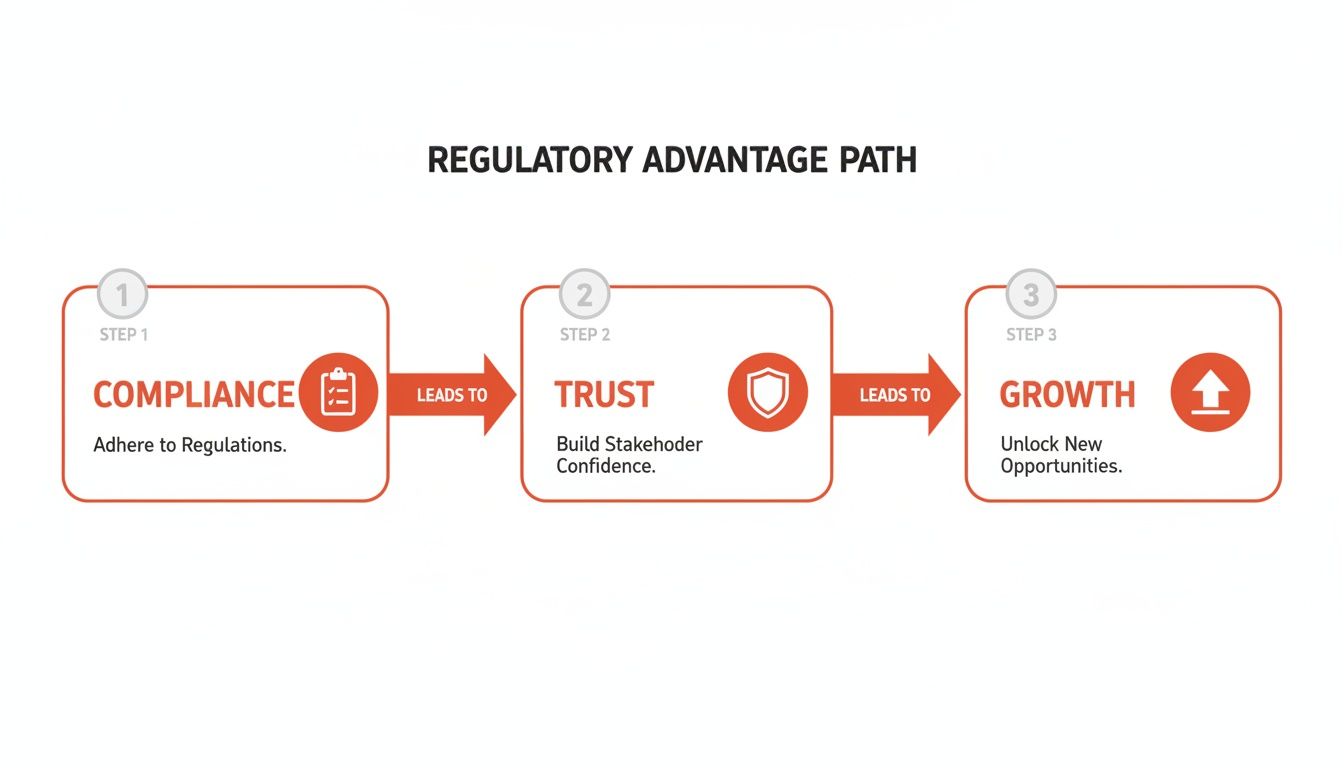
Alt text: A diagram illustrating the regulatory advantage path, showing how compliance leads to trust, which in turn fuels market growth and adoption.
Global Outlook: Where Healthcare AI Is Heading
The 2026 guidelines signal a global shift toward a more mature, responsible era of healthcare AI. The “move fast and break things” approach is being replaced by “regulatory-first” innovation, where safety and ethics are core design principles.
We can expect a slower but stronger adoption curve. The AI tools that reach the clinic will be more robust, reliable, and equitable, building confidence among providers and patients. This creates a positive feedback loop: greater trust leads to wider adoption, which generates high-quality data for the next generation of safer, more effective AI.
According to a report on the state of health AI at bvp.com, this trust-driven environment is already attracting significant investment, particularly for companies that can demonstrate a clear compliance strategy. The future of healthcare AI isn’t about replacing clinicians; it’s about empowering them with tools they can depend on to deliver better care for everyone. For a broader view, explore our articles on AI trends for 2026.
Strategic Takeaway
The AI gold rush in healthcare is over. The trust era has begun.
In 2026, the winners won’t be the teams that ship fastest. They’ll be the teams that ship safely, transparently, and responsibly. Regulation is no longer a hurdle to clear — it’s the foundation that makes large-scale adoption possible.
For innovators, compliance is strategy. For hospitals, it’s protection. For patients, it’s trust.
The companies that design with safety and accountability from day one won’t just survive this regulatory shift — they will define the future of healthcare AI.
Actionable Takeaways
- Audit Your Data First: Before building anything, analyze your datasets for potential bias and document your data governance strategy.
- Integrate Explainability Now: Make sure your product roadmap includes features that show users why the AI made a decision.
- Create a Compliance “Go-Bag”: Start assembling your documentation now—model cards, risk assessments, and validation reports—so you’re ready for regulatory scrutiny.
- Treat Compliance as a Feature: Frame your regulatory adherence as a key benefit when talking to investors and hospital customers. It’s a powerful symbol of quality and trust.
- Plan for Post-Market Monitoring: Build systems to track your AI’s real-world performance from day one.
Tools & Resources
- Google’s Model Cards: A framework for transparent model reporting. [Link to Model Card Toolkit on TensorFlow]
- IBM’s AI Fairness 360: An open-source toolkit to help detect and mitigate bias in machine learning models. [Link to AI Fairness 360 on GitHub]
- SHAP (SHapley Additive exPlanations): A popular Python library for explaining the output of any machine learning model. [Link to SHAP on GitHub]
- U.S. FDA’s AI/ML Action Plan: Provides insight into the FDA’s current thinking on AI regulation in medical devices. [Link to official FDA page]
Further Reading
- On AI Ethics: Explore our guide on building ethical AI in our guide to making responsible decisions.
- On Industry Trends: Stay updated with the latest Top AI Trends for 2026: Strategic Predictions Every Tech Leader Should Know.
- On Innovation Strategy: Read more about business and innovation in the AI space.
- How to Use AI in Education: A Practical Guide for Educators
- AI for Teachers: A Practical Guide to Transforming Your Classroom
