
When we talk about ethical AI in daily decisions, we’re talking about being mindful of the technology we use every day. It’s about looking at the automated suggestions we get—from what movie to watch next to which job ads pop up in our feed—and remembering they come from algorithms that might have their own hidden biases. The goal is to switch from passively accepting what AI gives you to actively and critically engaging with it. This guide gives you the actionable steps to do just that.
How AI Shapes Your Daily Life Without You Noticing

Alt text: An abstract image showing interconnected digital nodes and data streams, representing the unseen influence of AI in daily life.
Artificial intelligence works silently in the background of our lives. It’s the invisible force guiding many of the small choices we make, often without us even realising it.
Consider the last time you used a GPS app to get to an appointment. It didn’t just pull up a static map. In real-time, it analysed traffic jams, predicted potential hold-ups, and crunched the numbers to find you the absolute fastest route. That’s AI at work. This kind of subtle assistance is everywhere, from the “Daily Mix” your music app creates to the products online shops recommend. While these features are incredibly convenient, their predictive power is exactly where the need for ethical thinking comes into play.
The Unseen Decisions and Their Impact
Here’s the catch: these AI systems are making decisions for you based on data patterns. If that data is skewed or incomplete, the results can be far from perfect. For example, a news feed algorithm might accidentally create a “filter bubble,” only showing you stories that confirm what you already believe and cutting you off from different viewpoints.
In another scenario, an online retailer’s algorithm might display higher-priced items to people whose data suggests they live in more affluent postcodes. This isn’t necessarily a sinister plot; it’s just an algorithm doing what it was told—maximise sales—without any human ethical common sense. This is precisely why understanding ethical AI in daily decisions is more than just a topic for tech experts; it’s a vital skill for navigating modern life.
At its heart, using AI ethically means remembering that every recommendation is a product of data and code, not an objective fact. It encourages us to take a breath and ask, “Why is this being shown to me?” before we hit ‘buy’ or ‘agree’.
Developing this critical mindset is the first step toward taking back control. If you’re curious about how AI actually understands and processes information to make these suggestions, learning about concepts like natural language processing can simplify life with AI pulls back the curtain on how it all works.
Practical Example: Taking Control of Your Social Media Feed
Your social media feed is a prime example of AI’s influence. An AI constantly watches how you interact with content—what you like, who you follow, and even how long you linger on a video. It then builds a feed designed to keep you scrolling.
- Positive Outcome: You discover a fantastic local band you’d never have heard of, simply because you liked a similar artist last week.
- Potential Ethical Pitfall: The algorithm learns that you react to emotionally charged political news, so it starts showing you more and more extreme content, which can lead to polarisation and anxiety.
Your Actionable Step: You can intentionally shape your own online experience.
- Seek Out Different Perspectives: Deliberately follow accounts or pages that offer viewpoints different from your own.
- Use “See Less” Features: Most platforms have a feature (often in a “…” menu on a post) that lets you tell the algorithm “Show me less of this.” Use it actively on content you find unhelpful or polarising.
- Curate Your “Likes”: Be mindful of what you “like” and share, as this is the primary signal you send to the AI.
This turns you from a passive consumer into an active curator of your digital environment.
Decoding the Principles of Ethical AI
To make smart, ethical choices about AI every day, you don’t need to be a coder. You just need to grasp a few core principles that act as your guide. Think of them like the foundation of a house—if they aren’t solid, the whole structure is at risk. These concepts are the bedrock of responsible AI, giving you a mental checklist you can use to quickly size up any AI tool you encounter.
The Three Pillars of Trustworthy AI
When it comes to ethical AI, it really boils down to three key ideas: Fairness, Accountability, and Transparency. They all work together to build a system you can actually trust.
- Fairness: At its heart, this is about fighting bias. A fair AI system won’t create or amplify unfair disadvantages for any group of people, regardless of their background, gender, or race.
- Accountability: This simply means that when an AI messes up, someone is responsible. There have to be clear lines of ownership so mistakes can be fixed and people affected have a way to get things sorted.
- Transparency: Sometimes called “explainability,” this is the idea that we should be able to understand how an AI gets to its answers. It’s like asking the AI to show its work on a maths problem instead of just spitting out the solution.
This infographic shows how these three pillars support the entire structure of ethical AI.
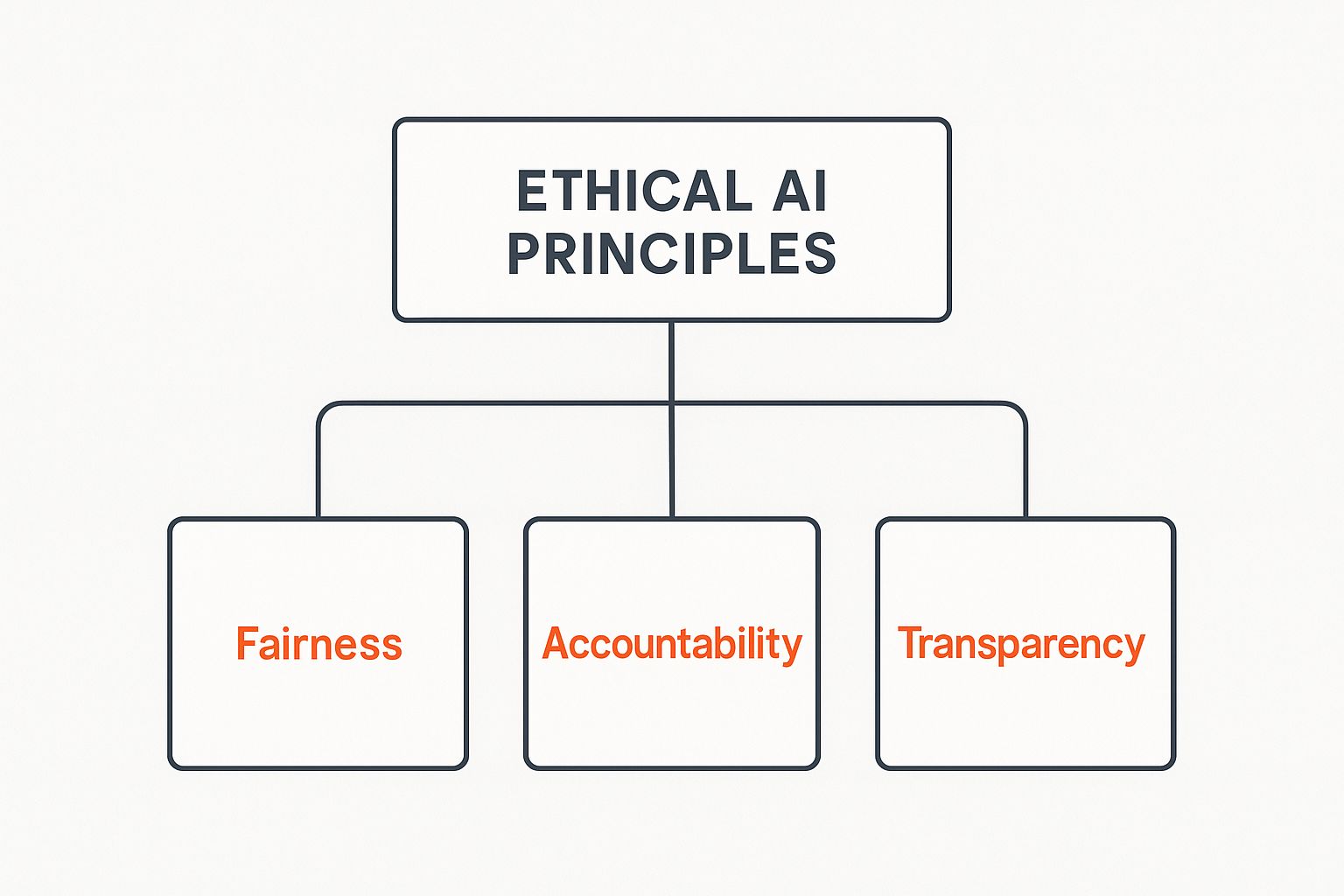
Alt text: An infographic showing a hierarchy diagram with ‘Ethical AI Principles’ at the top, branching down to ‘Fairness’, ‘Accountability’, and ‘Transparency’.
As you can see, each principle is a distinct but vital part of a responsible AI framework. If one is missing, the system is incomplete and could even be harmful.
Bringing the Principles to Life
It’s one thing to talk about these ideas, but it’s another to see how they play out in the real world. The table below breaks down each core principle, showing you what it means for you, how it looks in a real scenario, and what red flags to look out for.
Core Principles of Ethical AI in Practice
| Principle | What It Means for You | A Practical Example | Red Flag to Watch For |
|---|---|---|---|
| Fairness | The AI treats all groups equitably, without perpetuating harmful stereotypes or biases. | A hiring tool reviews CVs based on skills and experience, ignoring demographic data like names or postcodes that could hint at background. | The AI consistently favours candidates from a specific gender or ethnic group, suggesting its training data was skewed. |
| Accountability | There is a clear person or team responsible for the AI’s actions and outcomes. | If an AI-driven medical diagnostic tool gives a wrong analysis, a specific medical review board is designated to investigate and correct the error. | When an AI makes a mistake, the company blames “the algorithm” and offers no clear path to fix the problem or compensate those affected. |
| Transparency | You can understand, at a high level, how the AI makes its decisions. | A bank’s loan-denial AI provides the top three reasons for its decision (e.g., credit score, debt-to-income ratio) to the applicant. | A tool is described as a “black box” or its creators are secretive about the data it was trained on or how it works. |
By keeping these principles in mind, you can start to ask the right questions and spot potential problems before they cause real harm.
Practical Example: Accountability in the Workplace
Accountability gets really important when things go wrong. If an AI scheduling tool at a hospital creates a rota that leaves the emergency ward critically understaffed, who’s on the hook? The software developer? The hospital that bought the tool? The manager who clicked “approve”?
Without clear accountability, these questions just lead to finger-pointing while the problem gets worse. A properly designed ethical AI system always has clear lines of human oversight.
Your Actionable Step: If your company adopts an AI tool, ask this question: “Who is the designated human owner responsible for this tool’s decisions, and what is our process for appealing an automated outcome?” Pushing for a clear answer establishes a culture of accountability. For a closer look, you might be interested in our guide on the ethical use of AI in the workplace, which gets into the nuts and bolts of building these structures.
Putting Ethical AI to Work in Your Career

Alt text: A diverse team of professionals in a modern office collaborating around a computer, symbolising the integration of AI into career decisions.
Artificial intelligence has officially landed on everyone’s desktop. As professionals, we’re now using AI to make decisions that affect our colleagues, customers, and communities. Knowing how to apply ethical AI in daily decisions is now a core professional skill. It doesn’t matter if you’re in marketing, HR, or finance—you have a responsibility to understand and thoughtfully guide the AI tools at your disposal.
Spotting Ethical Pitfalls in Day-to-Day Business
AI tools are fantastic for boosting efficiency, but if we’re not careful, they can quietly introduce serious ethical issues. Let’s walk through a realistic situation you might encounter.
Scenario: AI-Powered Resume Screening
An HR team, swamped with applications, uses an AI tool to shortlist candidates. The algorithm is set to favour applicants with continuous work histories, believing it’s a good proxy for reliability.
- The Ethical Pitfall: The AI starts to automatically screen out perfectly qualified candidates who’ve taken career breaks for parenting, caregiving, or health reasons. The system ends up creating a biased hiring process that filters out diverse talent before a human even sees their resume.
A Step-by-Step Guide to Evaluating a New AI Tool at Work
Whenever a new AI tool is introduced, don’t just take its output at face value. Become a critical user who knows which questions to ask.
- Question the Data Source: Ask the vendor or your IT department, “What data was this AI trained on?” If the dataset was narrow (e.g., trained only on resumes from one industry or demographic), its recommendations will be biased.
- Demand Transparency: Ask for a high-level explanation of how the tool reaches its conclusions. If a vendor calls their tool a “black box,” that’s a massive red flag. A trustworthy provider should be able to explain its logic.
- Implement Human Oversight: Insist that the AI is used to assist, not replace, human judgment. The AI can create a shortlist, but a person must always have the final say. This “human-in-the-loop” model is non-negotiable for accountability.
- Establish a Feedback Channel: Set up a straightforward way for your team to flag strange outputs or suspected bias. If that resume screener seems to be rejecting qualified women repeatedly, you need a system to catch that pattern and fix it fast.
By actively engaging with the AI tools you use, you shift from being a passive operator to an ethical guardian. Your role is to ensure the technology serves your team’s goals without causing unintended harm.
This proactive mindset is becoming vital. For those who want to specialize in this area, our guide on how to transition into an AI ethics consultant role offers a deeper look at the skills needed.
Actionable Takeaways
- Always Ask “Why”: When an AI tool gives you a recommendation, challenge it. Ask what factors led to that conclusion to uncover potential biases.
- Prioritize Human-in-the-Loop Systems: Advocate for workflows where AI assists human decision-makers rather than replacing them, especially in sensitive areas like hiring.
- Check the Training Data: Before adopting a new AI tool, inquire about its training data. Look for vendors who are transparent about how they mitigate bias.
Tools and Resources
- IBM AI Fairness 360: An open-source toolkit that helps developers check for and mitigate unwanted bias in machine learning models.
- Google’s What-If Tool: An interactive visual interface designed to help you understand a black-box classification or regression model.
Further Reading
- Read about the EU AI Act, one of the first major regulatory frameworks for artificial intelligence, to understand the future of AI governance.
Ethical AI in Your Personal Health and Wellness

Alt text: A person is looking at a smartwatch displaying health metrics, with a soft-focus background of a peaceful natural environment.
It’s one thing for an algorithm to suggest a film; it’s another when AI starts giving you advice about your health. The need for careful, ethical AI in daily decisions becomes absolutely critical when our physical and mental wellbeing is at stake.
AI is now woven into personal wellness technology, from fitness apps that create personalized workout plans to mental health chatbots. While these tools promise a future of tailored healthcare, they also handle our most sensitive information. That makes trust and transparency completely non-negotiable. Before you hand over your health data to an algorithm, you need to ask: Does the app protect my privacy? Is its advice built on solid science, or a narrow dataset that doesn’t reflect my body, culture, or lifestyle?
How to Vet a Health and Wellness App in 3 Steps
Let’s walk through how you can check out any new health app. This simple framework helps you see past slick marketing and get to the ethical core of the technology.
- Dig Into the Data Privacy Policy: This is your first and most important stop. A good app will have a clear, easy-to-find privacy policy. Look for specifics on whether your data is anonymised, if it gets sold to third parties (like advertisers or insurance firms), and how long they keep it. A big red flag: Vague language like “we may share data with trusted partners” without telling you exactly who those partners are.
- Look for Evidence-Based Advice: Where is the app getting its information? A trustworthy app will be transparent about its sources, mentioning registered dietitians, clinical studies, or established health organisations. A big red flag: Making claims that sound too good to be true or offering zero scientific backing for its nutrition advice.
- Probe for Hidden Bias: Historically, many health datasets have over-represented certain demographics. Ask yourself: does this app’s idea of a “perfect” diet consider my cultural foods, my allergies, or my specific health conditions? A big red flag: A rigid, one-size-fits-all approach that ignores human diversity.
Asking these questions helps you decide which tools are genuinely helpful. It’s also smart to get a professional take. For instance, reading a cardiologist’s comprehensive guide to smartwatch ECGs can give you a clearer picture of what these devices can—and can’t—do.
The Bigger Picture: Ethics in Health AI
The challenge of ethical AI in healthcare goes far beyond our phones. As healthcare systems integrate AI, the need for proper oversight is huge. The growing use of AI in Nigerian healthcare highlights both the massive potential and the serious ethical questions that need to be addressed. As we explored in harnessing AI innovations to transform healthcare delivery in Nigeria, balancing progress with patient safety is the central challenge.
Ultimately, ethical AI in wellness isn’t about rejecting technology. It’s about demanding better technology—tools that are transparent, secure, and built on a foundation of inclusivity and scientific rigour.
Actionable Takeaways
- Always Read the Privacy Policy: Before you download, spend five minutes with the privacy policy. Know what you’re agreeing to.
- Question One-Size-Fits-All Advice: Be wary of any AI that spits out generic advice without asking about your unique health profile, background, and lifestyle.
- Look for Transparency: Choose apps that are upfront about where their data comes from and the experts they consult.
Your Step-by-Step Framework for Evaluating Any AI Tool
Navigating the world of AI isn’t just about knowing what a tool can do. It’s about becoming a critical judge of the technology we invite into our lives. With a solid framework, you can shift from being a passive user to an empowered decision-maker, ensuring that your approach to ethical AI in daily decisions is both intentional and smart. Use this checklist to vet any new AI tool.
Step 1: Pinpoint the AI’s Goal and Data Sources
The quality and diversity of an AI’s training data directly shape how fair and accurate its outputs are. Your first task is to get a handle on these basics.
- What problem is this AI built to solve? A clear purpose helps you decide if its behaviour is appropriate.
- Where did its training data come from? Was it sourced ethically and does it reflect the real world, or was it pulled from a narrow, biased corner of the internet? A responsible developer will be transparent about this.
- Does the AI keep learning from my inputs? Knowing this is crucial to understanding its potential to evolve—or develop new blind spots.
For example, when looking at AI writing assistants, check if the developers are open about their datasets. You can explore a few options in our overview of free AI tools for content-creation.
Step 2: Look for Transparency and Clear Explanations
You shouldn’t need a PhD to understand how an AI tool works. Responsible developers explain their technology in plain language. Look for a “Trust Centre,” “AI Principles,” or a detailed FAQ section on the company’s website. A trustworthy tool won’t hide behind confusing jargon.
A company that is open about its AI’s capabilities and its limitations is demonstrating accountability. A “black box” approach, where the inner workings are a complete secret, should always be treated with caution.
Step 3: Investigate How It Handles Fairness and Bias
No AI is perfect. What sets an ethical tool apart is how hard its creators work to find and fix biases. A responsible company will be upfront about how it audits its algorithms for fairness.
- Practical Test: Use the tool to challenge its potential biases. For example, ask an AI image generator for a “picture of a doctor” or “a picture of a CEO.” If it overwhelmingly returns images of one gender or race, you’ve just uncovered a bias in its training data.
- Look for Feedback Channels: Does the company give users a way to report biased or harmful outputs? A clear feedback loop shows they’re serious about getting it right.
Step 4: Review Your Privacy Controls
Finally, understand how an AI tool handles your personal information. You have a right to know how your data is being used, stored, and protected. Look at the company’s privacy policy, like this example from Parakeet-AI’s Privacy Policy, to see how commitments are spelled out. Find clear answers to questions like: Can you delete your data? Can you opt out of your data being used for future training? A clear, user-friendly privacy policy is a non-negotiable sign of respect.
Actionable Takeaways
- Ask About the Data: Before you dive in, spend two minutes trying to find out what data a new AI was trained on.
- Demand Plain Language: Give your business to companies that explain how their AI works in simple, understandable terms.
- Check for a Bias Reporting Channel: Look for a button or contact form to report strange or unfair results. It shows they’re listening.
- Read the Privacy Policy First: Make it a habit. Check out the data privacy controls before you sign up.
Tools and Resources
- The Alan Turing Institute’s “Understanding artificial intelligence”: A brilliant resource for non-technical explanations of key AI concepts.
- AI Incident Database: A collection of real-world examples where AI systems have caused problems, offering valuable lessons on what can go wrong.
Your Action Plan for Championing Ethical AI
You have the theory. Now, let’s put it into practice. Integrating ethical AI into your daily life doesn’t require a computer science degree—it all starts with a few intentional actions. This is your plan to turn awareness into real impact. The idea is to shift from being a passive user to an active participant who nudges companies to build better, fairer, and more transparent systems.
Step 1: Audit Your Digital Footprint Today
Let’s get a handle on the data you’re already sharing. So many apps on your phone are constantly gathering information, which is then used to train the very AI models that shape your online world. A quick audit can make a world of difference.
- Review App Permissions: On your phone, go to Settings > Privacy. Look at which apps have access to your location, contacts, and microphone. If an app doesn’t absolutely need that permission to do its job, turn it off.
- Check Your Ad Preferences: Go to your ad settings on Google and your primary social media platform. You can see what the algorithm thinks it knows about you and remove any interests that are wrong or that you’d rather keep private.
- Opt Out of Data Sharing: Whenever you sign up for a new service, look for the checkbox asking for permission to share your data for “marketing” or “research.” Ticking “no” is a simple win for your privacy.
Step 2: Champion Transparency and Accountability
Never underestimate your voice. As a consumer and employee, you have the power to drive change.
Practical Example: Imagine your team at work is considering a new AI project management tool. Before signing up, you can ask their sales rep a pointed question:
“Could you share documentation on how your algorithm prioritises tasks? We’d also like to know what steps you take to mitigate potential bias against certain work styles.”
That simple question pushes the vendor to be transparent and signals that accountability is a deal-breaker for you as a customer. When enough of us do this, it becomes a major factor in the market.
Actionable Takeaways
- Perform a 15-Minute App Audit: Set a timer for 15 minutes and go through the privacy settings on your most-used social media and shopping apps.
- Ask One Hard Question: The next time you evaluate an AI tool, ask one specific question about its training data or how it ensures fairness.
- Choose Transparent Brands: When you have a choice, lean towards companies that are upfront about their AI principles and data policies.
- Report Bias When You See It: If you notice an app’s recommendations seem unfair, use the feedback feature to report it. It helps developers spot problems they might have missed.
Tools and Resources
- Mozilla’s *Privacy Not Included: A brilliant buyer’s guide that reviews the privacy and security of popular connected gadgets.
- The Algorithmic Justice League: An organization doing incredible work to highlight AI harms and biases. They have great resources to help you become a more informed advocate.
Further Reading
- If you’re interested in the regulatory side, read up on the NIST AI Risk Management Framework. It’s a comprehensive guideline that helps organisations design and manage trustworthy AI systems.
Your Questions About Ethical AI, Answered
To help you put these ideas into practice, let’s tackle some of the most common questions people have about making ethical AI choices day-to-day. Think of this as a practical guide for the real-world challenges you’re likely to encounter.
What Is the Single Most Important Thing I Can Do to Use AI Ethically?
If you do only one thing, it should be this: actively question the AI’s output. Never take what an AI tells you at face value. Build a habit of healthy scepticism.
Before you follow AI-driven advice, get into the habit of asking a few simple questions:
- What kind of data was this probably trained on?
- Is there a hidden bias here that could affect me or someone else?
- What’s the worst that could happen if this AI is wrong?
By checking the information and thinking about the context, you shift from being a passive consumer to an active, responsible partner. This simple habit is the bedrock of using ethical AI in daily decisions.
How Can I Spot Hidden AI Bias in My Everyday Tools?
Spotting bias is mostly about pattern recognition. If a job-hunting tool keeps suggesting roles stereotypically linked to your gender, that’s a red flag. If your news feed only serves up articles that confirm what you already believe, you’re looking at a filter bubble.
Practical Example: Test an Image Generator
- Go to an AI image generator.
- Enter a neutral prompt like “a picture of a doctor” or “a picture of a CEO.”
- Analyze the results. If the images overwhelmingly show one gender or race, you’ve just found a massive bias baked into its training data.
Making a note of these patterns doesn’t just help you see the problem; it helps you report it and choose better tools that don’t reinforce harmful stereotypes.
Are There Any Ethical AI Certifications I Should Look For?
Right now, there isn’t one single, globally accepted “Ethical AI” badge like you’d find for organic food. The field is moving too fast. That said, some organisations are starting to align with solid frameworks, like the principles outlined in the EU’s AI Act.
When you’re checking out a new AI product, look for a “Trust Centre” or an “AI Principles” page on the company’s website. The good ones are open about the frameworks they use, how they handle your data, and what you can do if you disagree with an AI-generated decision. The focus should be on demonstrated transparency and accountability, not just a logo on a box.
Ready to put these principles into action with tools that make a real difference? RichlyAI provides a powerful suite of AI solutions designed with transparency in mind, helping you create content, automate tasks, and innovate responsibly. Explore how our platform can support your ethical AI journey.
Get started for free with RichlyAI today
