
Stuck in a creative rut? Imagine having a partner who can brainstorm millions of ideas in seconds, spot patterns you’d miss, and even build a prototype before you finish your coffee. That’s the power of AI for creative problem solving. It’s not about replacing your creativity—it’s about supercharging it.
Your New Partner in Creative Problem Solving
This guide cuts through the hype to give you an actionable framework for weaving AI into your daily workflow. The goal is to turn AI from a simple tool into a genuine collaborator, helping you tackle bigger challenges and innovate faster than ever.

Alt Text: A stylized image showing a person and a robot collaborating on a creative project, symbolizing the partnership between human and artificial intelligence in problem-solving.
Think of AI as a creative catalyst. It provides the raw fuel—data, patterns, and endless ideas—while your expertise and intuition steer it toward a real breakthrough. Instead of getting bogged down in routine tasks, you can focus on the strategic, uniquely human parts of the creative process.
Shifting From Problem Solving to Problem Finding
For decades, professional value was tied to efficient problem-solving. You were given a clear challenge, and your job was to find the solution. The thing is, AI is becoming incredibly good at that. It can analyze massive datasets and recommend optimal solutions for well-defined problems in minutes.
This shift means the real opportunity now lies in problem finding. This is the skill of identifying the right challenges to tackle in the first place—a process that relies on context, empathy, and intuition, qualities AI currently lacks.
The most valuable person in any organization will be the one who asks the questions nobody else thought to ask. It’s about spotting opportunities, noticing what’s missing, and asking “what if?” when everyone else is asking “how?”
By handling the “how,” AI frees up your mental bandwidth to focus on the more critical “what if” and “why.” If you’re new to this, our guide on how to start using AI without any experience is a great place to begin. This elevates your role from a pure creator to a creative director, guiding a powerful assistant to bring your vision to life at an unprecedented scale.
How AI Models Fuel Creative Breakthroughs
You don’t need a computer science degree to use AI effectively, but knowing your tools is essential. A painter knows the difference between a broad brush and a fine-tipped one; likewise, you need to know which AI model to use for your specific creative task.
Let’s break down the core AI models that will power your creative work.
Large Language Models: Your Infinite Idea Generator
At the heart of today’s AI revolution are Large Language Models (LLMs). Think of an LLM as a research assistant that has read nearly the entire internet. It can connect disparate concepts, brainstorm ideas from countless angles, and reframe problems in seconds.
Trained on vast amounts of text and code, LLMs learn to recognize patterns, context, and nuance. When you provide a prompt, an LLM predicts the most probable sequence of words to follow, generating coherent and often surprisingly insightful responses. This makes them perfect for divergent thinking—the initial, messy phase of idea generation.
Practical Example: A Step-by-Step Brainstorming Session
A marketing team needs a campaign for a new eco-friendly water bottle but feels stuck. Here’s how they use an LLM to break through the block:
- Initial Prompt (Vague): “Brainstorm campaign slogans for our new eco-friendly water bottle.” The results are generic: “Hydrate Sustainably,” “The Bottle for a Better Planet.”
- Reframing Prompt (Specific): “Act as a marketing strategist specializing in Gen Z. Our target audience is tired of corporate greenwashing. Reframe our problem. Instead of a ‘slogan,’ what is a more authentic way to connect? Generate 5 alternative campaign concepts.”
- AI Output (Actionable): The LLM now suggests strategies, not just slogans: a user-generated content campaign on TikTok showing the bottle in real life, a partnership with micro-influencers to document their sustainability journey, or a “hydration challenge” focused on wellness.
- Action: The team now has distinct, actionable campaign strategies to explore, moving them far beyond a simple slogan and into more innovative territory.
This is how an LLM becomes a strategic partner for ai for creative problem solving.
Generative Adversarial Networks: Your AI Art Studio
While LLMs are the wordsmiths, Generative Adversarial Networks (GANs) are the artists. A GAN consists of two neural networks in a creative duel: a Generator that creates new images and a Discriminator that judges whether they are real or AI-made. This competition forces the Generator to produce increasingly realistic and novel visuals. It’s like an art apprentice relentlessly trying to fool a master until their work is indistinguishable from the original. To learn more, check out our guide on understanding generative AI in Nigeria.
Reinforcement Learning: Your Strategy Optimizer
Reinforcement Learning (RL) is an AI model that learns through trial and error. It receives “rewards” for actions that bring it closer to a specific goal, much like training a dog with treats. Over thousands of simulations, it discovers the optimal strategy. In business, RL can optimize a supply chain, find the most efficient factory layout, or perfect an advertising bid strategy. It’s less about dreaming up new ideas and more about refining an existing one to perfection.
This technology is being adopted globally. In Southeast Asia, for example, almost 90% of youth use AI daily, often through tools that simplify complex tasks. Read more on how young people in the region are adopting AI.
By understanding which AI model to use—an LLM for ideas, a GAN for visuals, or RL for optimization—you can select the right tool for your creative challenge and achieve better results, faster.
Actionable Takeaways
- Reframe Your Problems with LLMs: When stuck, ask an LLM to reframe your challenge from different perspectives (e.g., “from the point of view of a skeptical customer” or “as a 10-year-old”).
- Visualize Ideas Instantly with GANs: Use tools like Midjourney to create quick mood boards or product mockups, making abstract concepts tangible.
- Optimize Complex Solutions with RL: If you have a process with many variables (like a marketing funnel), consider how RL could test thousands of variations to find the optimal path.
Tools & Resources
- LLMs: ChatGPT, Claude, Google Gemini
- GANs/Diffusion Models: Midjourney, Stable Diffusion, DALL-E 3
Further Reading
- Explore our deep dive into prompt engineering to master the art of communicating with these AI models.
A Practical Workflow for AI-Powered Problem Solving
Knowing the theory is one thing, but putting AI to work is where the magic happens. The real power of AI for creative problem solving comes from a structured, repeatable process. This 5-step framework turns AI into a co-pilot for your team, enhancing your expertise at every stage.
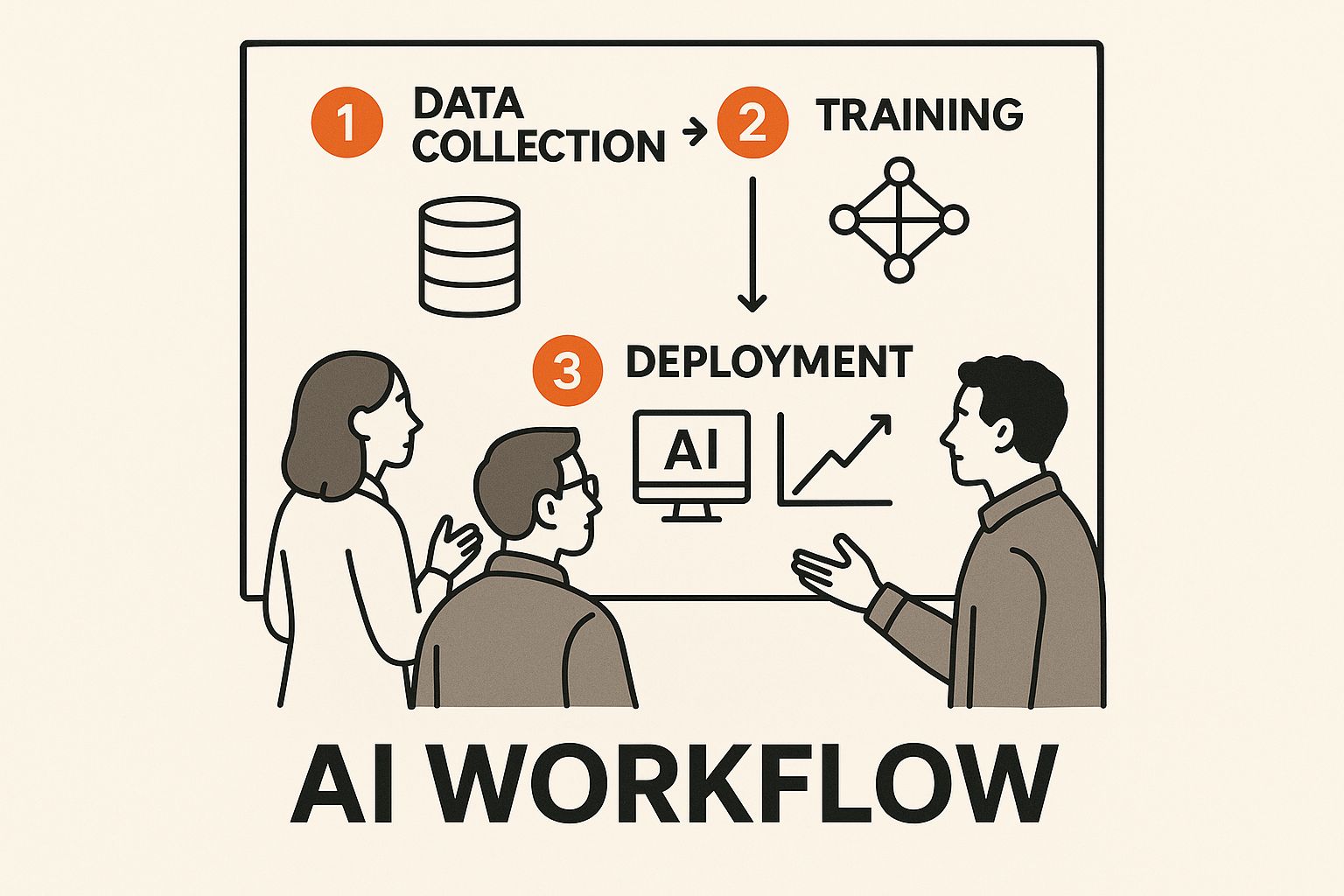
Alt Text: An infographic showing a small team collaborating around a whiteboard, with icons representing a 5-step AI workflow for creative problem solving.
Step 1: Define the Real Problem
The quality of your solution depends entirely on the quality of your problem definition. We often rush to solve the surface-level issue without questioning our assumptions. Use an LLM as a sparring partner to challenge your initial problem statement.
Here’s a step-by-step guide to refining your problem:
- State the Initial Problem: “How can we reduce customer churn by 10% this quarter?”
- Craft an AI Prompt to Challenge It: “Act as a seasoned business strategist. I want to reduce customer churn. My first idea is to offer discounts to customers who try to cancel. Challenge this assumption. Give me five alternative ways to frame this problem that get to the root cause, not just the symptom.”
- Analyze the AI’s Reframing: The AI might push you toward proactive solutions by reframing the problem as: “How can we overhaul our onboarding to prove our value within the first 7 days?” or “What are the biggest friction points in our product that are causing users to give up?”
- Select the Better Problem: You’re now solving a much more meaningful—and valuable—problem.
Step 2: Generate Divergent Ideas
With a solid problem statement, it’s time to go wide. The goal is to generate a massive volume of potential solutions, using AI to brainstorm hundreds of possibilities in the time it would normally take to come up with a dozen. At this stage, it’s about quantity over quality.
Let the AI handle the sheer volume of idea generation. This frees up your team to do what humans do best: spot patterns, connect seemingly unrelated concepts, and identify the most promising ideas.
Actionable Prompts for Idea Generation:
- SCAMPER Method: “Apply the SCAMPER framework (Substitute, Combine, Adapt, Modify, Put to another use, Eliminate, Reverse) to our current product [describe product] to generate 10 new feature ideas.”
- Analogy Thinking: “Generate solutions for [my problem] by drawing analogies from unrelated fields like biology, city planning, or professional sports.”
- Role-Playing: “Brainstorm solutions from the perspective of a skeptical new user, a futuristic designer, and a budget-focused CFO.” To master this, explore prompt engineering.
Step 3: Develop and Prototype
You have a shortlist of strong ideas. Now, make them tangible. AI can dramatically shorten the time it takes to move from an abstract concept to a prototype your team can react to. The goal is to create low-fidelity mockups, compelling copy, or visual concepts in minutes, not weeks.
Here’s a step-by-step prototyping workflow:
- Flesh out the Idea with an LLM: Start with a concept: “a smart water bottle that gamifies hydration.” Ask an LLM to write a detailed one-page product description, including key features, target audience, and a unique selling proposition.
- Create a Visual with an Image Generator: Feed that description into DALL-E 3 or Midjourney with a prompt like: “A sleek, minimalist smart water bottle with a glowing LED ring at its base, shown in a modern lifestyle setting. Professional product photography, hyper-realistic.”
- Generate a Voice with an LLM: With the visuals ready, return to the LLM. “Generate three sample Instagram posts and a landing page headline for this new smart water bottle concept.”
In under an hour, you’ve gone from a simple idea to a rich, multi-faceted prototype ready for feedback.
Step 4: Simulate and Test
Before you invest time and money, use AI to stress-test your idea. A powerful technique is to have the AI “red team” your solution by adopting critical user personas. This helps you find weak spots early.
How to run a simulation:
- Craft a Persona Prompt: “Act as a cynical, time-poor user who is skeptical of new gadgets.”
- Present Your Concept: “Review the following product concept [paste your product description]. What are your biggest objections? What makes you roll your eyes? What would absolutely prevent you from even trying it?”
- Gather Insights: This “pre-mortem” helps you anticipate criticism and build a much stronger solution.
Step 5: Iterate and Refine
Armed with simulated feedback and your team’s expert review, enter a rapid refinement loop. Use AI to help you iterate on the feedback. Ask it to suggest feature tweaks, rewrite marketing copy to overcome objections, or generate new visual concepts. This cycle of generating, prototyping, testing, and refining—with AI as your partner—helps you arrive at a robust solution much faster.
AI Tools for Each Stage of Creative Problem Solving
Choosing the right tool for the job is crucial. Think of them as specialized assistants.
| Workflow Stage | Objective | Recommended AI Tools | Example Use Case |
|---|---|---|---|
| 1. Define Problem | Challenge assumptions and reframe the initial question. | ChatGPT, Claude, Perplexity | Using an “Act as a…” prompt to have the AI critique your problem statement from an expert’s perspective. |
| 2. Generate Ideas | Produce a high volume of diverse and unconventional solutions. | ChatGPT, Claude, Gemini | Asking the AI to apply creativity frameworks like SCAMPER or brainstorm solutions by drawing analogies from unrelated industries. |
| 3. Develop & Prototype | Quickly create low-fidelity mockups, visuals, and copy. | Midjourney, DALL-E 3, ChatGPT | Feeding a detailed product description into an image generator to create realistic product mockups in seconds. |
| 4. Simulate & Test | Anticipate real-world reactions and identify weaknesses. | ChatGPT, Claude | Role-playing with the AI as different user personas (the skeptic, the enthusiast) to critique a concept before launch. |
| 5. Iterate & Refine | Make targeted improvements based on feedback and insights. | ChatGPT, Grammarly, Midjourney | Providing the AI with feedback and asking it to rewrite copy or suggest feature modifications to address specific concerns. |
See How Companies Innovate with AI
Frameworks are great, but the real test is seeing AI for creative problem solving in action. Let’s look at realistic examples of how companies are using these tools to achieve real results. These stories share a common thread: AI acts as a creative partner, speeding up the journey from a rough idea to a brilliant solution.
Sustainable Packaging Design
A consumer goods company was under pressure to make its packaging more sustainable. Their initial ideas—using less plastic—were either too expensive or didn’t protect the product. Stuck, they turned to AI, treating it not as a simple generator but as an expert in materials science.
The Step-by-Step Process:
- The First Prompt: “Generate ideas for sustainable packaging for liquid soap.” The AI returned predictable options: recycled plastic, glass, cardboard.
- A Smarter Prompt: The team added constraints and a creative persona: “Act as a biomimicry expert. Design a soap container inspired by nature’s most efficient structures, like an eggshell or a seed pod. The material must be compostable, lightweight, and rigid for shipping. Brainstorm 10 concepts.”
- From Text to Tangible: The AI returned fascinating concepts, including a design based on the interlocking structure of pineapple skin. The team immediately used an image generator to create realistic 3D mockups.
- The Human Touch: The visual mockups were a game-changer. Human designers instantly spotted strengths and flaws, sparking a rapid feedback loop where they refined the design with the AI for manufacturing and usability.
The result was an innovative, interlocking fiber-based container that cut material use by 30%. The AI provided the unconventional starting point that the human experts needed to build upon.
Speeding Up Software Prototyping
A software team was overwhelmed by user feature requests. Their slow development process meant that by the time a feature was built, user needs had already changed. They integrated an AI coding assistant into their workflow, not to write production-ready code, but to build prototypes at lightning speed.
The AI became a ‘pair programmer’ for every developer, handling repetitive, boilerplate code and allowing the human engineer to focus on core logic and user experience.
Here’s how they did it:
- A developer described a new feature in plain English to the AI assistant.
- The AI generated the basic code structure in minutes.
- The developer refined the code, focusing on user experience and complex logic.
- A testable prototype was ready in an afternoon instead of a fortnight.
This AI-assisted prototyping allowed the team to test three times as many new features without increasing headcount, shifting their mindset from slow and perfect to fast and iterative. This approach is being adopted globally, with companies tailoring AI to local markets, as explored in this report on AI’s potential in Southeast Asia from BCG. For more strategies, see our guide on how SMEs in Africa can use AI for growth.
Actionable Takeaways
- Direct the AI: Give your prompts a role (“act as a structural engineer”), clear constraints, and a specific goal.
- Prototype Visually: Use AI image generators to turn text into something your team can see and discuss. A picture is more powerful than a document.
- Focus on Speed, Not Perfection: Use AI coding assistants to create functional prototypes quickly. The goal is rapid learning.
- Create a Feedback Loop: Use AI output as the starting line. Your team’s expertise is needed to critique, refine, and perfect the concepts.
Tools & Resources
- AI Assistants: GitHub Copilot, Amazon CodeWhisperer
- Concept Visualizers: Midjourney, Vizcom
Common Pitfalls and How to Avoid Them
Integrating AI into your creative workflow is powerful but comes with a learning curve. To truly master AI for creative problem solving, you must navigate common traps that can lead to mediocre results.

Alt Text: A person looking thoughtfully at a complex maze, representing the strategic challenges and pitfalls of using AI for creative problem solving.
The Trap of Generic Outputs
The most common complaint about AI-generated content is that it’s bland. This is almost always a result of a vague prompt. Think of your prompt as a creative brief: provide rich context, clear constraints, and a specific point of view.
How to move from a weak to a strong prompt:
- Weak Prompt: “Write a social media post about our new running shoes.” (This will produce a generic, forgettable caption).
- Strong Prompt: “Act as a copywriter for a rebellious sportswear brand targeting urban runners who value style and performance. Write three Instagram captions for our new ‘Eclipse’ running shoe. The tone must be edgy and motivational. Mention the glow-in-the-dark sole and its lightweight feel. End with a call to action to ‘Own the night.'”
The detailed prompt directs the AI toward a specific, much more original outcome.
The Danger of Over-Reliance
It’s tempting to accept the AI’s first output and call it a day. This is a mistake. AI models lack human judgment, intuition, and real-world context. They can’t tell you if an idea aligns with your brand’s values or will connect emotionally with your audience. That’s your job.
Your role isn’t to accept the AI’s first answer. It’s to curate, question, and refine its output, blending machine speed with human expertise. Think of yourself as an editor, not an operator.
Navigating Ethical and Legal Grey Areas
As you use AI more, you’ll encounter ethical questions around data privacy, intellectual property, and algorithmic bias. Using AI-generated content without understanding its origins can create legal and reputational risks. Stay informed and use these tools responsibly. Our guide on ethical AI in daily decisions is a great place to start.
Actionable Takeaways
- Be the Director: Provide your prompts with specific context, constraints, and a desired tone to steer the AI toward a unique output.
- Use AI as a Starting Point: Treat AI output as a first draft or a brainstorming partner, never the finished product.
- Question Everything: Ask yourself: Does this solve the problem? Does it align with my goals? Does this feel authentic?
- Stay Ethically Aware: Understand the data policies of your tools and watch for potential biases in the AI’s suggestions.
Tools and Resources
- AI Content Detectors: A tool like GPTZero can help you see if your text sounds too robotic, reminding you to add your human touch.
- Prompting Guides: Resources like Promptingguide.ai offer advanced techniques for getting better results from AI models.
Tying AI-Powered Creativity to Your Bottom Line
Innovation for its own sake is a dead end. The true value of AI for creative problem solving emerges when you connect imaginative ideas directly to business goals. It’s the bridge between a great brainstorm and real market value.
By letting AI handle routine analysis and first-draft generation, you free up your team for deep, strategic thinking. This isn’t just about efficiency; it’s about shifting focus to high-impact work that moves the needle.
From Creative Concepts to Commercial Wins
Integrating AI into your creative process is a strategic move that fuels growth. It slashes time-to-market, allows you to test bold ideas with less risk, and can even uncover hidden revenue streams in your data. This speed creates a powerful ripple effect. Imagine your marketing team identifying a niche audience and generating a dozen personalized campaign concepts to test—all before lunch.
The economic implications are massive. By 2030, AI could contribute nearly $1 trillion in value across ASEAN countries alone. This growth comes from AI’s ability to optimize old processes and create entirely new opportunities. You can find the full analysis in this report on AI’s future economic impact.
The business case for AI in creativity isn’t about doing the same things faster. It’s about discovering entirely new things to do, creating a sustainable advantage that is difficult to copy.
AI-powered creativity helps you make smarter, data-backed decisions that translate directly into market share, operational efficiency, and a healthier bottom line.
Got Questions? We’ve Got Answers
Diving into AI naturally brings up questions. Here are answers to the most common ones.
Will AI Make My Creative Job Obsolete?
No. Think of AI as a powerful new team member, not a replacement. The most effective work comes from a human-AI partnership. The AI excels at speed and scale, but you provide the strategic thinking, emotional context, and critical judgment.
The role is shifting from sole creator to creative director. Your job is to guide the AI, curating its output and blending its speed with your intuition and expertise.
Professionals who learn to work with AI will have a massive advantage. The goal isn’t to compete against the machine but to collaborate with it to create better work, faster.
What are the Best AI Tools for a Beginner?
Start with a powerful Large Language Model (LLM). They are the Swiss Army knife for creative thinking.
- For Ideas & Words: Begin with a flexible LLM like ChatGPT, Claude, or Google’s Gemini. They are user-friendly and can handle most non-visual creative challenges.
- For Visualizing Ideas: To bring concepts to life, use image generators like Midjourney or DALL-E 3. They can turn text descriptions into concept art, product mockups, or storyboards.
My advice: Pick one or two tools and get comfortable with them. Master their strengths before expanding your toolkit. All these AI tools are available on RichlyAI Hub.
How Can I Make Sure My AI-Generated Ideas Are Actually Original?
Originality comes from your process, not the tool. The AI provides the raw material; you are the sculptor. True originality in AI for creative problem solving comes from the quality of your prompts and how you curate and combine the results.
Here’s a quick step-by-step example:
- Generic AI Output: You ask for “taglines for a new coffee brand” and get something bland like “Awaken Your Senses.”
- Add Your Unique Angle: Now, inject your insight. “Our brand is inspired by Nigerian folklore. Generate taglines that connect the energy of coffee to the mythical stories of Sango, the god of thunder.”
- Combine and Refine: The AI now offers far more interesting concepts. You can pick two, merge them, and polish the final version with your creative flair to create something truly unique.
Never treat the first AI output as the final product. The more specific, weird, and personal your prompts are, the more original your results will be.
- How to Write a Literature Review: A Step-by-Step Guide for Researchers
- 12 Top Money Making Apps That Actually Pay in 2025
- How to Create an Anonymous Link on WhatsApp: A Step-by-Step Guide
- How to Draw Snail: Easy Step-by-Step Guide
- Top 12 AI Chatting App Solutions to Use in 2025
- WAEC Past Questions and Answers: Your Ultimate Study Guide
- Artificial Intelligence In Nigeria
- Future-Proof Your Career (Part 2): Outsmart AI, Master New Skills & Land Your Dream Job in 2030!
- Future-Proof Your Career: How to Thrive in the Age of AI and Automation!
- Unveiling Richly Artificial Intelligence (Richly AI): Your Perfect Content and Image Generator!
- Catering to Diverse Industries: How Richly AI Transforms Content Creation for All
- Driving Engagement and Brand Awareness with Richly AI: The Ultimate Content Solution
- Boosting Customer Satisfaction with Richly AI: Creating Memorable Experiences
- Exploring the Exciting Possibilities of Leveraging Richly AI for Personal Purposes
- Unlocking Creativity with RichlyAI: Nigeria’s Generative AI Revolution
Ready to unlock your creative potential? RichlyAI provides a complete suite of AI tools to help you brainstorm, prototype, and innovate faster. Sign up for a free plan and start turning your biggest creative challenges into your greatest successes.
