
A literature review is more than a summary of papers; it’s the foundation of your research. It tells the story of the scholarly conversation on your topic, identifies what’s missing, and makes the case for why your work matters. Getting it right starts with a sharp, well-defined research question. This isn’t just a formality; it’s the map that guides every decision you make. A vague question leads to a vague review. A clear question leads to a powerful, focused analysis.
Step 1: Define Your Research Scope and Question

Alt text: A researcher sitting at a desk, surrounded by books and a laptop, thoughtfully defining the scope of their research question.
Before you search for a single article, you must define the boundaries of your investigation. The biggest mistake researchers make is choosing a scope that’s too broad. A topic like “social media effects” is a black hole; you could read for a lifetime and never cover it all. The goal is to narrow your focus until it’s manageable but still has enough research to review.
How to Go From a Broad Topic to a Focused Question
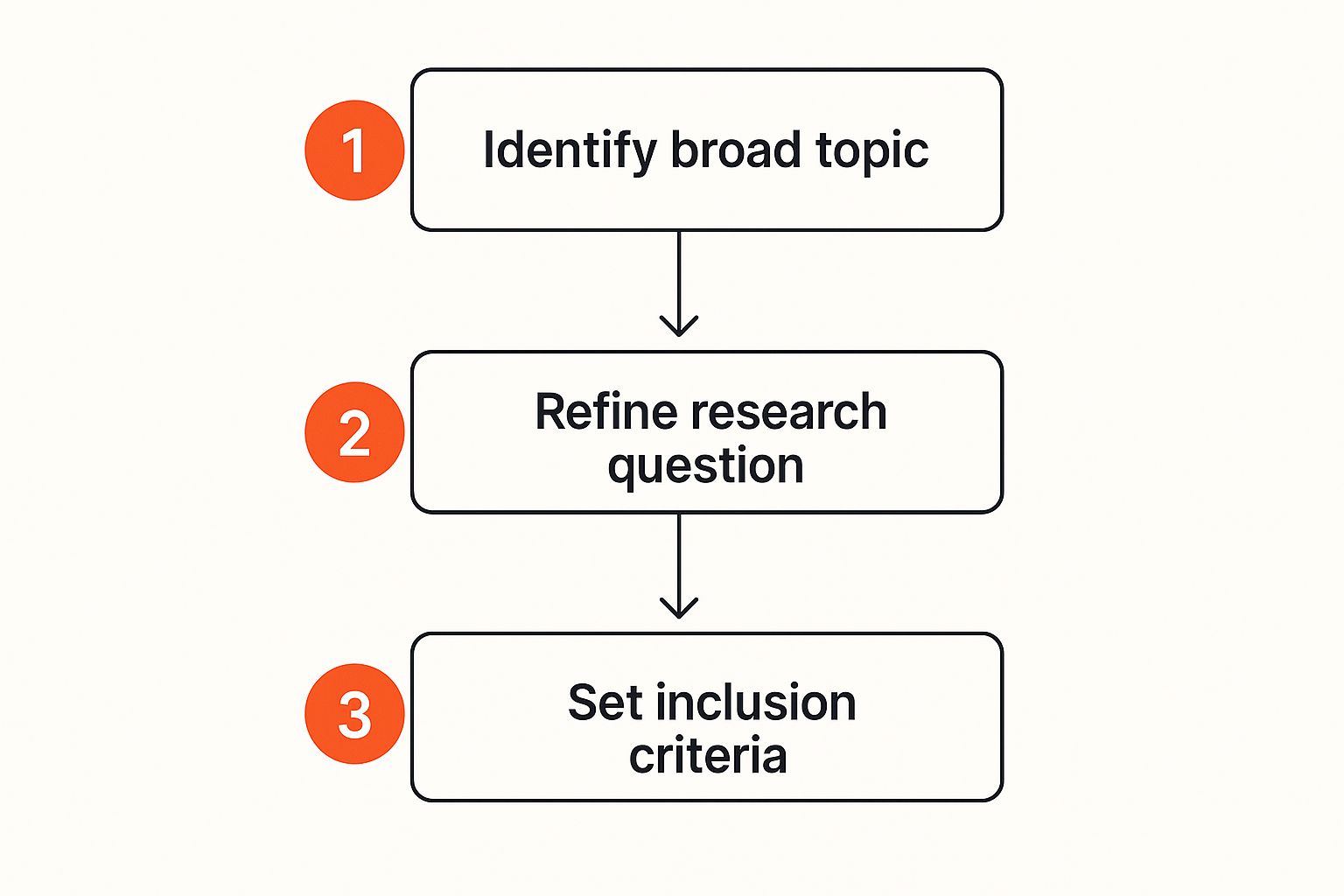
Refining your topic into a research question is a step-by-step process. You start wide and systematically narrow your focus until you have something clear, specific, and answerable. This process also gives you the exact keywords you’ll need for your database searches.
Here’s a practical example of how to do it:
- Start with a broad interest: The impact of technology on education. (This is too big to be useful.)
- Narrow it down: The impact of social media on students. (Better, but “students” and “social media” are still very broad.)
- Get more specific: How does social media use affect academic performance? (Closer, but we can make it even sharper.)
- Finalize a focused research question: “To what extent does daily Instagram use affect the academic performance (measured by GPA) of undergraduate engineering students in Nigeria?”
Now that is a question you can work with. It’s specific, measurable, and has a clear context. Your core concepts are “Instagram use,” “academic performance,” and “undergraduate engineering students in Nigeria.” This clarity is the bedrock of a strong literature review.
How to Establish Clear Inclusion and Exclusion Criteria
With your question locked in, you need to set the ground rules for your search. These are your inclusion and exclusion criteria, and they act as a filter to keep your search focused and prevent you from drowning in irrelevant papers. Decide on these rules before you start searching to avoid confirmation bias—the temptation to only pick studies that support what you already think.
Actionable Insight: Think of your inclusion and exclusion criteria as the gatekeeper for your research. They aren’t there to limit you; they’re there to protect your time and ensure every source you analyze directly contributes to answering your question.
Here are the most common criteria to define:
- Publication Date Range: Example: “Only include studies published between 2015 and the present day to focus on recent trends.”
- Geographical Location: Example: “Limit the search to studies conducted in sub-Saharan Africa to ensure contextual relevance.”
- Study Methodology: Example: “Include only quantitative empirical studies and exclude theoretical essays, editorials, or opinion pieces.”
- Population Group: Example: “Focus exclusively on ‘undergraduate students’ and exclude studies on high school or postgraduate populations.”
Nailing down these parameters from the start saves an incredible amount of time and sets you up for a coherent, insightful review.
Step 2: Conduct a Systematic Literature Search
You’ve defined your question and criteria. Now it’s time for the treasure hunt: finding your sources. This isn’t just about plugging keywords into a search bar; it’s a methodical, documented process that ensures your review is comprehensive and transparent. The goal isn’t just to find articles but to document how you found them, making your work replicable—a hallmark of strong academic research.
Alt text: A flowchart showing the systematic process of a literature search, starting from defining keywords to screening and selecting final articles.
How to Use Search Operators for Precise Results
To get the best results from academic databases like Google Scholar, Scopus, or JSTOR, you need to speak their language. Boolean operators—AND, OR, NOT—are your best friends for this.
- AND narrows your search.
"academic performance" AND "Instagram"shows results containing both terms. - OR broadens your search.
"undergraduate" OR "university students"shows results containing either term. - NOT excludes terms.
"social media" NOT "Twitter"filters out irrelevant contexts.
Practical Example of a Search String:
Based on our research question, a powerful search string would look like this:
("academic performance" OR "GPA" OR "grades") AND ("Instagram" OR "social media") AND ("undergraduate" OR "university students") AND "Nigeria"
Alt text: A screenshot from the Google Scholar search interface showing an advanced search query using Boolean operators and quotation marks for precise results.
This combination of operators and exact-phrase quotation marks is a game-changer for improving the quality of your results.
Actionable Tip: Keep a simple search log in a spreadsheet. For each search, record the date, the database used, the exact search string (with all operators), and the number of results returned. This small habit makes your process transparent and organized.
How to Look Beyond Keywords
A thorough search doesn’t stop with keywords. Two other techniques are essential to ensure you haven’t missed any cornerstone studies: citation chaining and using AI as a research assistant.
- Follow the Citation Trail (Citation Chaining): Once you find a highly relevant “seed” paper, do the following:
- Go Backwards (Backward Chaining): Examine its reference list to find the foundational studies it was built upon.
- Go Forwards (Forward Chaining): Use a feature like Google Scholar’s “Cited by” link to find all the newer papers that have referenced your seed paper, bringing your search up to the present.
- Use AI as a Research Assistant: AI tools can be brilliant for brainstorming alternative keywords or summarizing an abstract to check for relevance. For example, you could prompt an AI: “Suggest synonyms and related concepts for ‘academic performance’ in the context of university students.” If you’re new to this, we have a great guide on how to use ChatGPT to support your research.
Step 3: Synthesize Sources by Finding Patterns

Alt text: Two researchers collaborating at a desk, analyzing papers and using sticky notes to organize their thoughts for a literature review.
Gathering papers is just the start. The real work is shifting from summarizing what others have said to synthesizing their ideas. This means connecting the dots to build a coherent, analytical narrative that says something new. A summary reports: “Author A found this.” Synthesis connects: “While Author A and Author B both investigated X, their differing methodologies led to conflicting results, revealing a critical gap.” Your job is to build that second kind of argument.
How to Critically Appraise Each Source
Before you can synthesize, you must appraise each source individually. Not all published research is equal. A critical appraisal helps you assess a study’s strengths, weaknesses, and its real contribution. As you read, get in the habit of asking these questions:
- What is the core argument? Can I state the main point in one sentence?
- Is the methodology sound? Was the method a good fit for the research question?
- Are the findings credible? Do the conclusions logically follow from the evidence?
- How does this fit in? Does this paper support, challenge, or add a new angle to other studies I’ve read?
Practical Tool: Critical Appraisal Checklist
Use a simple table to evaluate each source systematically.
| Evaluation Criteria | Guiding Questions | Your Assessment (Low/Med/High) |
|---|---|---|
| Authority & Credibility | Who are the authors? What are their credentials? Is the journal peer-reviewed? | |
| Objectivity & Bias | Is the language neutral? Are limitations acknowledged? | |
| Methodological Rigor | Is the method clearly explained and appropriate? Is the sample size adequate? | |
| Relevance & Currency | How directly does this source address my research question? Is it up-to-date? | |
| Contribution to Field | Does this study add something new? Does it confirm, refute, or extend previous work? |
How to Use a Synthesis Matrix to Find Patterns
One of the most effective tools for synthesis is the synthesis matrix. It’s a table you create in a spreadsheet to organize key takeaways from your sources. Its magic is helping you visually map what different authors say about specific themes, making it easy to spot patterns, contradictions, and gaps.
Practical Example: Synthesis Matrix
For a research question on the impact of remote work on employee well-being in Nigeria, your matrix might look like this:
| Source (Author, Year) | Main Argument | Methodology | Theme 1: Work-Life Balance | Theme 2: Social Isolation |
|---|---|---|---|---|
| Adekunle (2022) | Remote work improves flexibility but increases work hours. | Survey of 500 tech workers | Positive impact on flexibility, but negative on boundaries. | Significant increase in reported loneliness. |
| Okonkwo (2023) | Hybrid models are optimal for maintaining team cohesion. | Qualitative interviews with 25 managers | Hybrid work allows for better separation of work/home. | Less isolation compared to fully remote teams. |
| Bello & Eze (2021) | The right technology is key to mitigating isolation. | Case study of one Lagos-based company | N/A (Focus was on tech, not balance). | Found that use of collaborative tools reduced feelings of isolation. |
Instantly, you can see a conversation emerging. Adekunle and Okonkwo present different views on work-life balance, while Bello & Eze introduce technology as a crucial factor in social isolation. This matrix transforms messy notes into a powerful analytical tool. This structured approach is fundamental to how to improve your writing skills for academic work.
Step 4: Write Your Narrative
You’ve done the analysis; now it’s time to transform it into a compelling narrative. The structure of your review is the skeleton that holds your argument together. Simply listing summaries one after another is the fastest way to lose your reader. You need an intentional structure that tells a story.
How to Choose Your Organizational Structure
The best structure depends on your research question and the scholarly conversation. Your goal is to pick a framework that best highlights the themes and gaps you’ve uncovered.
Here are three common and effective structures:
- Thematic: This is often the most powerful approach. You organize the review around key themes or concepts, dedicating each section to a specific theme. It’s excellent for showing connections and contradictions across studies.
- Chronological: This structure presents the literature as it developed over time. It’s a great choice if you want to show how a concept has evolved. Be careful it doesn’t become a simple timeline.
- Methodological: This structure groups studies by their research methods (e.g., quantitative vs. qualitative). This is useful if the methodology itself is a central point of debate in the field.
Actionable Insight: A strong structure makes your argument visible. It shows the reader how you are interpreting the literature, guiding them from established knowledge towards the specific gap your research aims to address.
How to Write a Strong Introduction and Conclusion
Your introduction is the gateway to your review. It must grab the reader, set the context, and provide a clear roadmap.
A 3-Step Introduction:
- Establish the Topic’s Importance: Briefly explain why this research area matters.
- Define the Scope: State your inclusion criteria and the boundaries of your review.
- Provide a Roadmap: Briefly outline the structure of your review (e.g., “This review will first examine…, then discuss…, and finally explore…”).
Your conclusion must do more than restate what you’ve said. It should synthesize the main findings, highlight the critical gap in the literature you’ve identified, and clearly position your own research as the logical next step.
How to Shift from Passive Summary to Active Synthesis
This is the most critical part of writing: developing your analytical voice. You are not a reporter; you are an analyst making an argument.
Practical Example: Summary vs. Synthesis
- Passive Summary (Avoid): “Smith (2020) conducted a study on employee motivation and found that financial incentives increased productivity by 15%. Jones (2021) also studied motivation and found that team autonomy was a more significant factor.”
- This is a “laundry list” that just reports findings.
- Active Synthesis (Use): “While Smith’s (2020) findings highlight the role of financial incentives, they stand in contrast to more recent work by Jones (2021), which suggests that team autonomy is a more powerful motivator. This divergence indicates a critical debate in the field regarding the primary drivers of employee motivation and points to a gap in understanding how these factors interact.”
- This puts the sources in conversation, identifies a conflict, and builds an argument.
Getting your phrasing right can be tricky, but this is an area where modern tools can help. You can learn useful techniques by reading about AI for content creation.
Step 5: Refine and Edit Your Review
Alt text: A close-up of a document being edited, with red pen marks indicating revisions for clarity, flow, and citation accuracy.
The final push separates a good review from a great one. It’s about honing your argument, ensuring your voice is clear, and making a powerful case for your research. This is your chance to spot and fix common pitfalls before anyone else does.
Common Pitfalls to Avoid
- The “Laundry List” Review: Simply summarizing one study after another without connecting them. Your job is to analyze, not just describe.
- Losing Your Voice: Letting the authors’ voices overpower your own. Your analytical perspective should drive the narrative; the literature is your evidence.
- Over-relying on Direct Quotes: Too many quotes suggest you haven’t fully synthesized the material. Paraphrasing demonstrates a deeper understanding.
Your Step-by-Step Editing Checklist
Use a structured checklist to turn editing from an overwhelming task into manageable steps.
- Check for a ‘Golden Thread’: Read your introduction, then your conclusion. Does the argument you set up at the start get resolved at the end? This thread must run through the entire piece.
- Assess the Logical Flow: Read only the first sentence of each paragraph aloud. Do they form a coherent, flowing narrative? If not, work on your structure and transitions.
- Strengthen Your Synthesis: Hunt for paragraphs that only discuss a single source. Rewrite them to put that source in conversation with others, showing agreements, disagreements, or connections.
- Verify Citation Accuracy: Meticulously check every in-text citation against your reference list. Ensure names and dates match perfectly.
- Format for Readability: Break up long paragraphs. Use subheadings as signposts to guide your reader through your argument. Good formatting makes your ideas easier to follow.
Actionable Insight: Revising isn’t about finding fault. It’s an act of clarification—ensuring the brilliant analysis in your head is communicated with absolute precision on the page. You can find more expert tips and strategies for writing literature reviews.
Actionable Takeaways
- Read with a critical eye. For every source, question its argument, methodology, and conclusions. Don’t just accept findings at face value.
- Build a synthesis matrix as you go. Don’t wait until you’ve finished all your reading. Start populating a table from day one to stay organized.
- Focus on themes, not just authors. Your matrix columns should be structured around the key concepts and debates in your field.
- Look for the connections. Actively hunt for agreements, disagreements, and gaps between sources. Your original analysis lives in these connections.
- Edit in passes. Do one pass for argument, another for grammar, and a final one for citations.
- Get a fresh pair of eyes. Ask a colleague or supervisor to read your draft to spot gaps in logic you may have missed.
Tools and Resources
- Reference Managers: Zotero, Mendeley (Essential for organizing sources and citations).
- Note-Taking & Synthesis: Google Sheets, Notion, Obsidian (For creating synthesis matrices and mapping ideas).
- Writing Assistants: Grammarly, Hemingway Editor (For polishing prose and improving clarity).
- Further Reading: Check out our article on free AI tools for content creation for more resources.
Frequently Asked Questions
When you’re deep in the weeds of a literature review, a few common questions always seem to pop up. Let’s tackle some of the ones I hear most often from researchers.
How many sources do I need?
There is no magic number. The right number depends on the scope of your project. A doctoral dissertation might require over 100 sources, while an undergraduate paper may only need 15–20. Focus on thoroughness and relevance, not an arbitrary count. A review with 30 perfectly chosen papers is far better than one with 80 irrelevant ones.
What’s the difference between a literature review and an annotated bibliography?
An annotated bibliography is a list of separate entries. Each entry includes a citation and a short paragraph summarizing and evaluating the source. A literature review is a single, cohesive essay. It weaves sources together into a narrative to tell a story about the scholarly conversation, highlighting themes, debates, and gaps.
Is it okay to use old sources?
Yes, and sometimes you must. Foundational or “seminal” studies are the bedrock of your field. Citing them shows you understand the history of your topic. However, the majority of your sources should be recent (typically from the last 5 to 10 years) to demonstrate that your research engages with the current scholarly discussion. For a deeper dive, here is some further reading on how to write a literature review.
Unlock your research potential with RichlyAI. Generate clear summaries, refine your arguments, and polish your writing in a fraction of the time. Get started for free at RichlyAI Hub and make your next literature review your best one yet.
