
If you want to get serious about improving your writing, you have to start by reading differently. All the great writers I know are also voracious readers, but they don’t just read for pleasure. They’re constantly deconstructing what they read, figuring out what makes a piece of writing tick—and what makes it fall flat.
This means you need to shift your mindset. Stop being a passive consumer of words and become an active analyst of the craft.
Build a Strong Foundation by Reading Like a Writer
The journey to becoming a better writer doesn’t begin with a blinking cursor on a blank page. It starts with a book, a news article, or a blog post in your hands. The real secret is to stop reading just for the story or the facts and start reading to understand the mechanics behind the message.
Think of it like a skilled mechanic. They don’t just enjoy driving a well-made car; they pop the bonnet to understand how the engine works, what makes it so powerful and efficient. As a writer, you need to get under the surface of the text in the same way.
From Passive Reader to Active Writer
Most of us read passively every day. We skim headlines, absorb the plot of a story, or get the gist of an email without ever stopping to think about how it was all put together. Reading like a writer is a much more deliberate, analytical process. It’s about dissecting a piece of writing to uncover the author’s specific techniques.
Practical Example: Imagine reading a compelling article on a site like Legit.ng.
- Passive approach: You read the headline, get the main facts of the story, and move on.
- Active approach: You notice the author started with a powerful, emotional quote. You ask: Why? Ah, it grabs your attention immediately and sets a human tone before diving into the facts. You see how they use short, punchy sentences in one paragraph to create a sense of urgency, and then longer, more detailed sentences in the next to explain the background.
This kind of active analysis is crucial, but unfortunately, it’s not a common practice. Research shows a worrying gap among students in Nigeria, where only 29% engage in this kind of ‘reading-to-write’ exercise once a term. Even worse, a mere 18% make it a weekly habit. This lack of consistent analysis has a direct, and often negative, impact on writing ability.
The table below shows exactly how to make this shift in your own reading.
From Passive Reader to Active Writer
| Passive Reading Habit | Active ‘Reading to Write’ Strategy | Impact on Your Writing |
|---|---|---|
| Reading just for the plot or main idea. | Identifying the core argument and how it’s supported with evidence or narrative. | You learn to structure your own arguments more logically and persuasively. |
| Noticing a sentence you like. | Highlighting a powerful sentence and asking why it works (e.g., word choice, rhythm, imagery). | You build a toolkit of stylistic devices to use in your own sentences. |
| Finishing a chapter and moving on. | Pausing to think about the chapter’s pacing and how suspense or interest was maintained. | You learn to control the flow and pacing of your work to keep readers engaged. |
| Simply consuming information. | Analysing the author’s tone and voice, and how they establish credibility or an emotional connection. | You develop a more versatile and intentional voice in your own writing. |
Making this transition from a passive to an active reader is what separates aspiring writers from those who actually improve.
Practical Steps for Active Analysis
You don’t need a special textbook to start. Just pick up something you’re already reading. Here is a step-by-step guide to get you started:
- Choose Your Text: Pick a short article, a blog post, or even a marketing email that caught your eye.
- Read It Once: First, read it normally to understand the message.
- Read It a Second Time with a Pen: This time, actively mark it up. Underline strong verbs, circle powerful adjectives, and put a box around sentences that are particularly clear or persuasive.
- Take Notes: In a notebook, write down why you think those choices were effective. Your notes might look something like this:
- Example Note 1: “The author builds suspense in this paragraph by ending it with an unanswered question. I could try that in my next project report to make the stakeholders eager for the next section.”
- Example Note 2: “This email sounds so professional because it avoids contractions and uses formal transition words like ‘consequently’ and ‘furthermore.’ I’ll use this as a template for client communication.”
“The difference between an amateur and a professional is in their habits. An amateur has amateur habits. A professional has professional habits. We can never free ourselves from habit. But we can replace bad habits with good ones.” – Steven Pressfield, The War of Art
Consistency is everything. Making this a regular, even daily, habit is where the real progress happens.
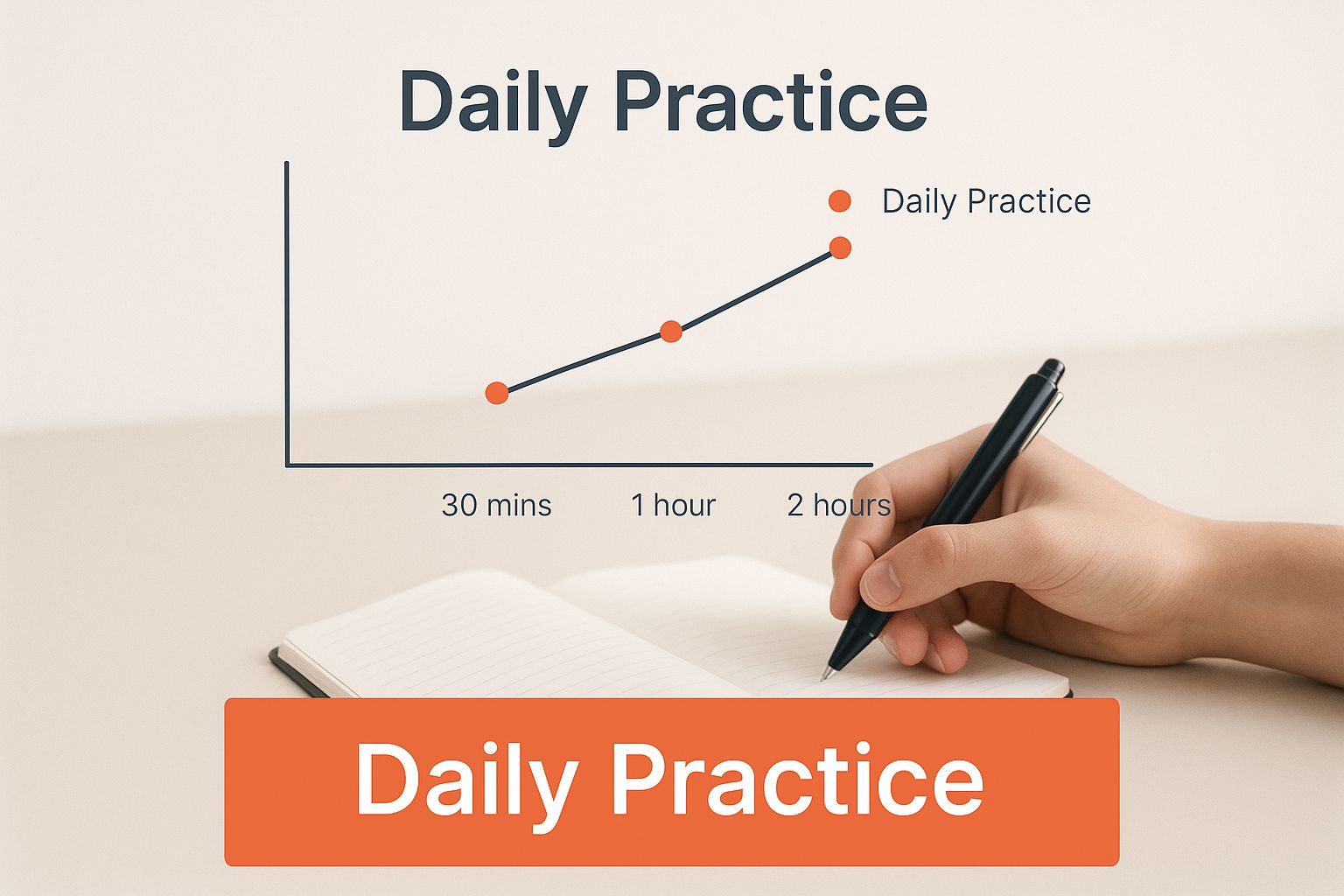
As the image suggests, small, daily efforts are far more powerful than one big cramming session. When you integrate this analytical approach into your everyday reading, you start building a mental library of writing techniques you can pull from whenever you need them.
This process is a fundamental skill, and it’s also something modern tools can help with. If you’re curious about how technology can support this, you might be interested in unlocking your creativity with Nigeria’s generative AI revolution.
Master Different Writing Styles for Any Situation
A truly skilled writer is a bit of a chameleon. They don’t just have one “good” writing voice; they can adapt their communication style to fit any context, audience, or purpose. This is where real mastery lies—in the ability to effortlessly switch from a formal business proposal to a punchy, clever social media caption.
Think of it this way: your writing’s purpose should always dictate its style. What are you trying to achieve? Are you aiming to persuade, inform, entertain, or instruct? Each of these goals demands a unique approach to tone, vocabulary, and sentence structure.
From Persuasive Emails to Captivating Stories
Let’s make this practical with a side-by-side example. Imagine you’re writing about a new software launch.
Example 1: A Persuasive Email to a Potential Client
- Subject: A new way to streamline your team’s workflow
- Tone: Formal, direct, and respectful.
- Content: “Dear Mr. Adebayo, I am writing to introduce our new project management software, which is designed to reduce reporting time by up to 40%. Would you be available for a brief 15-minute demo next week to explore how this could benefit your team?”
- Goal: To be clear, highlight value, and secure a meeting.
Example 2: A Captivating Blog Post about the Same Launch
- Title: Say Goodbye to Spreadsheet Headaches: How We Built the Tool That Gave Us Our Weekends Back
- Tone: Personal, descriptive, and emotional.
- Content: “It all started with a late Friday night and a sea of endless spreadsheets. We knew there had to be a better way. That’s when the idea struck us—a tool so intuitive, it feels less like software and more like a smart assistant…”
- Goal: To connect with the reader’s pain points and tell an engaging story.
The real secret isn’t just about writing well. It’s about deeply understanding who you’re writing for and what you want them to feel or do as a result. This awareness is the bedrock of versatile writing.
Practical Exercises to Stretch Your Skills
You don’t build this kind of flexibility by accident. It takes deliberate practice. Here are two actionable exercises you can do this week:
-
The Audience Switch-Up (Step-by-Step):
- Step 1: Pick a topic you know well (e.g., how to make jollof rice).
- Step 2: Write a short paragraph explaining it to a fellow Nigerian who understands the context. Example: “First, you make a rich tomato and pepper base, then fry it in oil until the stew separates…”
- Step 3: Now, rewrite that same explanation for a foreign friend who has never heard of it. Example: “The foundation of this dish is a vibrant, savoury puree made from blended tomatoes, red bell peppers, and a hint of spicy scotch bonnet. You cook this sauce down until its flavour deepens and the oils begin to rise…”
This forces you to be more descriptive and avoid assumptions.
Transform a Dry Report: Find a straightforward, fact-based news blurb. Your challenge is to rewrite it as an engaging, human-interest story. Hunt for the emotional core or the “character” hidden in the facts and pull that to the front.
This focus on stylistic variety is something we learn from a young age. In fact, an analysis of Nigerian primary school materials revealed a curriculum intentionally balanced between different writing forms: essay writing made up 57%, letter writing 22%, and other specific formats 21%. This early emphasis shows how crucial it is to develop competence across various styles. You can discover more about these educational findings and see how they underscore the importance of versatile skill-building.
Make Writing a Part of Your Daily Rhythm

If you want to see real, lasting improvement in your writing, it’s all about consistency. Forget the marathon, all-night writing sessions; they’re overwhelming and rarely sustainable. The real secret is to weave small, potent writing exercises into the fabric of your everyday life.
Think of them as “micro-habits.” These are quick, simple tasks that build your writing muscle memory and confidence without throwing your entire schedule into chaos. The aim is to make writing feel as natural as checking your email.
Build Your Skills With Daily Micro-Habits
You don’t need to write a masterpiece every day. You just need to get words down. Here are three actionable habits you can start today, with examples:
-
The 15-Minute Morning “Brain Dump”: Before checking your phone, open a notebook and write for 15 minutes. Don’t censor yourself.
- Example: “Okay the traffic yesterday was unbelievable, I need to remember to leave earlier. The meeting with the client went okay but I need to follow up on the invoice. What am I going to write for the blog this week? Maybe something about…” It doesn’t have to be perfect; it just has to happen. This warms up your writing muscles.
-
One-Sentence Storytelling: Look at the first person you see on your commute. Invent a one-sentence backstory for them.
- Example: “The woman in the blue headwrap was on her way to sign the biggest contract of her career, though no one on the bus knew it.” This is a powerful exercise for practicing concise, impactful storytelling.
-
The Podcast Summary: After listening to a podcast, boil down its core message into one well-crafted paragraph.
- Example: “In this episode, the host argued that financial literacy isn’t about earning more, but about building disciplined habits. The key takeaway was to automate savings, no matter how small, to create long-term wealth without relying on willpower.” This practices synthesis and clarity.
This idea of mixing writing with other activities is incredibly powerful. An experimental study in Nigeria found that adolescents who paired writing assignments with reading drills developed significantly better reading competence. You can dig into the full research on these literacy findings to see just how strong that connection is.
A Sample Weekly Schedule for Building Momentum
Having a loose structure helps habits stick. Here’s a step-by-step weekly guide to build momentum:
- Monday (Professional Practice): Find a work email you sent. Rewrite it to be 25% shorter while keeping the same meaning.
- Tuesday (Vocabulary Building): Learn one new “power verb” (e.g., “articulate,” “bolster,” “innovate”). Use it in three different sentences throughout the day.
- Wednesday (Descriptive Writing): Pick an object on your desk. Spend 10 minutes describing it using all five senses.
- Thursday (Summarisation): Read one interesting news article. Write a one-paragraph summary of its key points.
- Friday (Persuasive Practice): Write a short, two-sentence social media post arguing for your favourite local restaurant.
- Saturday (Creative Storytelling): Find a random photo on your phone and write a short story (just a few paragraphs) inspired by it.
- Sunday (Reflection): Journal for 15 minutes about your week, focusing on one thing you learned and one challenge you faced.
The cumulative effect of these small, daily actions is immense. A tiny 1% improvement each day compounds into a massive gain over a year. It’s all about stacking small wins to build momentum and transform your skills over time.
This consistent, daily effort is how you turn theory into tangible skill. For Nigerian businesses looking to make similar iterative improvements, exploring how to use free generative AI tools for creative solutions can provide a similar path to growth.
Sharpen Your Work with Smart Editing and Feedback
Think of your first draft as a block of marble—the raw material is there, but the real art comes from chipping away the excess. The transformation from good to great writing happens in the editing room, and it goes far beyond a simple spell-check.
One of the oldest tricks in the book is still one of the best: read your work aloud. It’s amazing what you’ll catch. Your ears will pick up on awkward phrasing, clunky sentences, and spots where the rhythm just feels off—things your eyes easily miss.
Your Self-Editing Checklist: A Step-by-Step Guide
Don’t try to fix everything at once. Use a multi-pass approach to edit methodically.
- Pass 1: The “Big Picture” Edit. Read through only for clarity and flow. Does your argument make sense? Is the structure logical? Move entire paragraphs if you need to.
- Pass 2: The “Clutter” Edit. Now, hunt for unnecessary words.
- Passive Voice: Search for “was” and “is.” Change “The report was written by the team” to “The team wrote the report.” It’s more direct.
- Filler Words: Use Ctrl+F to find and destroy words like ‘very,’ ‘really,’ ‘just,’ and ‘that’.
- Before: “He was really very happy that he could just finish the project.” (12 words)
- After: “He was happy he could finish the project.” (8 words)
- Pass 3: The “Read Aloud” Edit. Read your text out loud to catch awkward phrasing and clunky sentences. If you stumble while saying it, your reader will stumble while reading it.
Editing isn’t just about correcting errors. It’s about closing the gap between the idea in your head and the words on the page. The goal is to make your message as clear and powerful as it can possibly be.
Getting Feedback That Actually Helps
At a certain point, you become blind to your own mistakes. That’s when a fresh pair of eyes becomes invaluable. But don’t just ask, “What do you think?” Be specific to get actionable advice.
Practical Examples of What to Ask:
- Instead of “Is it good?” ask, “Can you tell me in one sentence what the main point of this piece is?” This tests if your core message is clear.
- Instead of “Did you like it?” ask, “Where did you get bored or find your attention drifting?” This is gold for finding weak spots.
- Instead of “Is anything confusing?” ask, “Was there any sentence you had to read twice?” This pinpoints specific sentences that need rewriting.
Learning how to take this kind of feedback onboard is a skill in itself. For that final polish, you might also want to brush up on some essential proofreading tips. As tools evolve, it’s also wise to understand the ethical use of AI in the workplace, ensuring technology supports your writing process responsibly.
Bring in an AI Co-pilot to Sharpen Your Writing Skills

Let’s get one thing straight: modern AI tools aren’t here to steal your job or your voice. Think of them as a co-pilot, a creative partner that can help you elevate your work. Tools like RichlyAI, with their clean dashboards, are designed to put these powerful capabilities right at your fingertips.
Instead of treating AI like a crutch, view it as a powerful learning aid. The real magic happens when you see AI not just for fixing typos, but for smashing through creative blocks and discovering new ways to say what you mean.
Go Beyond Basic Grammar and Spelling
Sure, catching a misplaced comma is helpful, but that’s barely scratching the surface of what AI can do. Treat it like a brainstorming partner that never gets tired. Here are actionable ways to use AI as a learning tool:
- Beating the Blank Page: Staring at a blinking cursor is the worst.
- Actionable Prompt: “I need to write a blog post about the benefits of remote work for Nigerian companies. Give me five different outlines for this topic, with one focusing on cost savings, another on employee wellness, and a third on accessing a wider talent pool.”
- Crafting Killer Headlines: After you write a headline, prompt the AI:
- Actionable Prompt: “My headline is ‘The Benefits of Good Writing’. Give me ten alternative headlines that are more engaging and use stronger, more active verbs.”
- Making Complex Ideas Simple: Got a paragraph full of jargon?
- Actionable Prompt: “Rewrite this paragraph about ‘synergistic value-chain integration’ for a 12-year-old. Use an analogy to explain the concept.”
Expert Tip: The best way to use AI isn’t to ask for a final answer. Ask for options. When you analyse its suggestions for tone, style, and structure, you’re actively training your own creative instincts. You learn to spot what makes a piece of writing truly effective.
This simple shift in mindset turns a proofreading tool into a dynamic writing coach.
Use AI as Your Sparring Partner
Think of your AI tool as a way to pressure-test your ideas before they go live. Here’s a step-by-step way to do it:
- Write Your Argument: Draft a persuasive email or a section of a report where you’re making a case.
- Prompt the AI for a Counterargument: Use a prompt like, “Act as a skeptical client. Read the email below and list three potential objections or weaknesses in my argument.”
- Refine Your Draft: The AI’s feedback will often be brutally honest and incredibly useful. It highlights gaps in your logic or weak points you would have missed. Use this feedback to strengthen your original draft before you send it.
This back-and-forth speeds up the learning process. You’re not just passively accepting edits; you’re in a dialogue with the technology. If this approach sounds interesting, our guide on how to start using AI without any experience is a great place to start.
You can also pair AI writing assistants with other tools, like dictation software for writers, to get your thoughts down much faster, freeing up more time for refining and editing.
Answering Your Top Questions About Becoming a Better Writer
As you start working on your writing, you’ll naturally run into some common questions. I’ve heard these time and again from writers here in Nigeria, so let’s tackle the big ones with some real-world, practical advice.
How Long Does It Really Take to See Improvement?
There’s no magic number, but it’s faster than you think if you focus on consistency. Just 20-30 minutes of focused daily practice can lead to noticeable improvements in clarity and confidence within a few months.
Actionable Insight: Don’t aim for “hours of practice.” Aim to complete one small writing task per day, like rewriting one email or journaling one page. The goal is to build a sustainable habit, not to burn out.
What’s the Single Best Exercise for Improving My Writing?
If I had to pick just one, it would be copywork. It’s an old-school technique that works wonders. Here’s a step-by-step guide:
- Find a Passage You Admire: Choose a paragraph from a writer you respect—it could be from a novel, a news article, or a blog.
- Copy It by Hand: Take out a pen and paper and copy the paragraph word-for-word.
- Analyze It: As you write, ask yourself: Why did they choose that specific verb? How does the sentence structure create a certain rhythm? Why is this so effective?
This simple act forces you to slow down and internalise what makes great writing work. You’re tracing the master’s blueprint to understand the craft from the inside.
The goal isn’t just to mimic, but to absorb. By deconstructing great prose, you build a mental library of techniques you can adapt into your own unique voice.
Can I Get Good at Writing If English Isn’t My First Language?
Absolutely. Some of the most brilliant authors in history wrote in a second language. The secret is immersion.
Actionable Steps:
- Change Your Phone’s Language to English: This small change forces you to interact with English daily.
- Listen to English-Language Podcasts on Your Commute: Focus on topics you enjoy. You’ll absorb sentence structure and vocabulary naturally.
- Write One Social Media Comment in English Every Day: It’s a low-stakes way to practice expressing your thoughts clearly and concisely.
In the beginning, don’t obsess over perfect grammar. Focus on clear communication. For more advanced strategies, you might find a comprehensive guide on improving writing ability useful.
Putting effort into your writing is also a fantastic career move. In a world where AI and automation are on the rise, clear, human communication becomes a superpower. You can learn how to future-proof your career and learn how to thrive in the age of AI.
Ready to take your writing to the next level with a powerful AI assistant? RichlyAI gives you the tools to brainstorm ideas, refine your drafts, and break through creative blocks. Sign up for a free plan today and see how our platform can support your journey to becoming a better writer.
