
So, you’re ready to dive into the world of digital marketing? That’s a smart move — but let’s be honest, it’s not just about “going online.” Most businesses today struggle with visibility, fierce competition, tight budgets, and the overwhelming number of platforms they’re expected to master. Many brands post content consistently but still fail to attract the right audience. Others spend money on ads without seeing real results. And some simply don’t know where to start.
This is exactly where digital marketing becomes a game-changer — not because it’s trendy, but because it gives you the tools to reach the right people, at the right time, with a message that actually matters. Whether you’re trying to build brand awareness, convert visitors into customers, or nurture long-term loyalty, digital marketing makes it possible without needing a massive marketing team or a millionaire budget.
At its core, digital marketing is the strategic use of online channels — like social media, search engines, email, and content — to position your business in front of the people who need you most. Done right, it helps you cut through the noise, communicate your value clearly, and turn attention into meaningful business growth.
Your First Steps Into Digital Marketing
Let’s start with an analogy. Think of old-school traditional marketing as a massive billboard on a busy highway. It costs a fortune, and while thousands of people might drive past it, you have no real way of knowing if any of them are actually interested in what you’re selling. You’re essentially shouting into a void and hoping for the best.
Digital marketing flips that entire model on its head. It’s more like having a one-on-one conversation. Instead of that one expensive billboard, you could run a highly specific Facebook ad that only appears to people who have already shown an interest in products just like yours. It’s smarter, more direct, and a much better use of your money.
The core idea for any beginner is this: digital marketing helps you find, connect with, and build relationships with your ideal customers right where they hang out—online. It truly levels the playing field, allowing a small start-up in Lagos to compete effectively with a multinational corporation.
This shift is particularly transformative in Nigeria, where the digital scene is booming. The growth is fuelled by a massive youth population and ever-increasing internet access. With a median age of just 18 years and over 36% of the population online, young, tech-savvy consumers are your primary audience.
What’s more, mobile is king here. Over 70% of Nigerians now own internet-ready smartphones, which means “mobile-first” isn’t just a buzzword; it’s an absolute necessity for any successful strategy.
What Does Digital Marketing Include?
Alright, so what are these “channels” I keep mentioning? Digital marketing isn’t a single activity. Think of it more like a well-stocked toolbox, where each tool is designed for a specific job.
Here’s a quick look at the core components you’ll get familiar with on your journey:
-
Search Engine Optimisation (SEO): This is the craft of getting your website to show up higher on search engines like Google. When someone searches for “best jollof rice in Abuja,” a good SEO strategy is what helps your restaurant pop up right at the top of the results page.
-
Content Marketing: This is all about creating and sharing genuinely useful content—like blog posts, how-to videos, or downloadable guides—to attract an audience and build trust. It’s not about the hard sell; it’s about becoming a go-to resource by helping people solve their problems.
-
Social Media Marketing (SMM): This involves using platforms like Instagram, Facebook, and X (formerly Twitter) to build a loyal community, chat with your customers, and showcase your products or services.
-
Email Marketing: This is one of the most personal and effective ways to nurture the relationships you’ve built. By collecting email addresses, you can send valuable updates, special offers, and helpful content directly to your audience’s inboxes.
One of the very first practical things you’ll need to do is make sure search engines can actually find your website. A great resource explains how to submit your website to search engines. Getting this foundational step right is non-negotiable, as it’s the bedrock for all the SEO work you’ll do later on.
To help you get a clearer picture, I’ve put together a simple table that breaks down these core channels at a glance.
Core Digital Marketing Channels at a Glance
| Channel | What It Is | Primary Goal | Practical Example for a Beginner |
|---|---|---|---|
| SEO | Optimising your site for search engines. | Attract free, organic traffic from search results. | Renaming your product page from “Our Shoes” to “Handmade Leather Shoes in Lagos” to match what people search for. |
| Content Marketing | Creating valuable blog posts, videos, etc. | Build trust, authority, and brand awareness. | A wedding photographer creating a blog post titled “Top 5 Outdoor Wedding Venues in Abuja.” |
| Social Media | Using platforms like Instagram or Facebook. | Engage with a community and drive brand loyalty. | A local bakery posting a behind-the-scenes video of them decorating a cake and asking followers what flavor they’d like to see next. |
| Email Marketing | Sending direct messages to a list of subscribers. | Nurture leads and drive repeat business. | Offering a 10% discount code to new website visitors in exchange for their email, then sending them weekly style tips. |
Think of these channels as interconnected. Your great content can be shared on social media, which in turn can drive people to your website where they sign up for your email list. It all works together.
7. A Closer Look at Your Core Marketing Channels
Alright, now that you’ve got the big picture, let’s get our hands dirty and explore the actual paths you’ll take to connect with your customers. Think of digital marketing channels like the different roads in Lagos. Some are fast expressways, others are bustling local streets. Each one gets you to a different place and serves a unique purpose.
Choosing the right road—or channel—is the key to getting where you want to go without getting stuck in traffic.
For anyone just starting, the sheer number of options can feel like looking at a map of Nigeria for the first time. But don’t worry. Most truly successful marketing plans are built on just a handful of powerful, core channels. Let’s break down the most important ones, using real-world examples you might see every day.
This image shows how all these different channels come together to create one unified strategy, reaching people on the devices they use constantly.
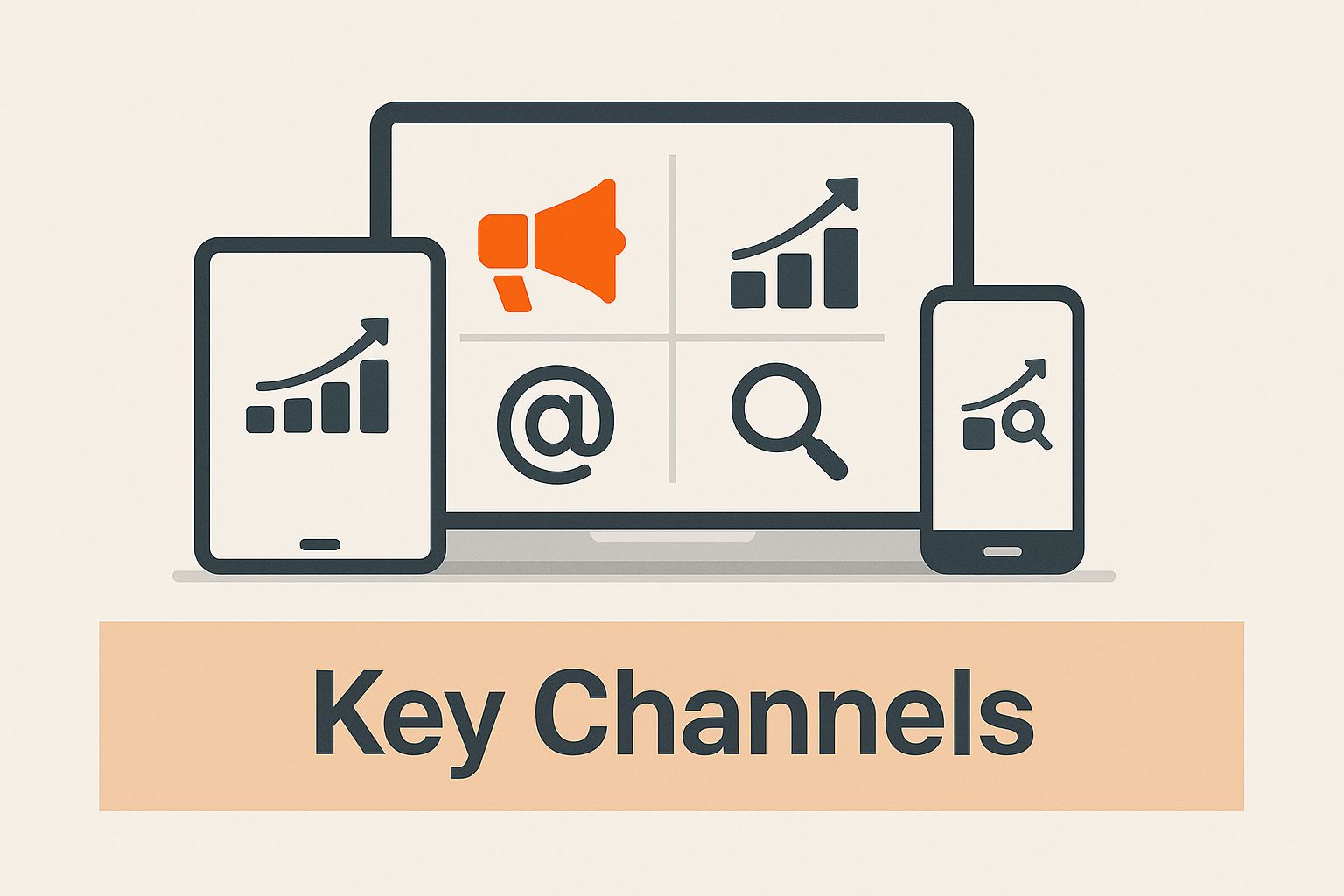
The main idea here is that these channels don’t work in isolation. They’re all part of a larger conversation happening across phones, laptops, and tablets.
Search Engine Optimisation (SEO)
Imagine you run a small boutique in Ikeja that sells beautiful, custom-made Ankara bags. When someone in Lagos types “Ankara bags near me” into Google, you absolutely want your shop to pop up first.
That, right there, is the magic of SEO. SEO is the art and science of making your website more appealing to search engines like Google.
It’s not about tricking the system. It’s about genuinely helping people find what they’re looking for. A practical first step is to include relevant keywords naturally in your website’s text. For example, make sure your homepage clearly states “Custom Ankara Bags in Ikeja, Lagos” instead of just “Welcome to Our Store.” When you do this, Google sees you as a reliable source and will gladly recommend your site to its users—for free.
Content Marketing
If SEO is the destination, then content marketing is the fuel that gets you there. This is all about creating and sharing valuable things like blog posts, videos, or how-to guides to attract and keep your ideal audience interested.
You’re not just shouting “Buy my stuff!” Instead, you’re offering real value first.
- Here’s how it works: A fintech company like PiggyVest doesn’t just advertise “save money with us.” They write helpful articles on “How to Budget on a Small Salary” or create social media posts about “5 Smart Investment Tips for Young Nigerians.” This builds trust and makes them the go-to expert. So, when someone is finally ready to start saving, PiggyVest is the first name that comes to mind.
The golden rule of content marketing is simple: stop selling and start helping. When you consistently solve your audience’s problems, they naturally become your customers and biggest fans.
Social Media Marketing (SMM)
This is probably the channel you’re most familiar with personally. Social Media Marketing (SMM) means using platforms like Instagram, Facebook, X (what used to be Twitter), and LinkedIn to build your brand and chat with your community.
It’s so much more than just posting pretty pictures. It’s about starting and joining conversations.
Actionable Example: A food blogger in Port Harcourt could use Instagram Reels to show a step-by-step recipe for fisherman’s soup. The post caption would ask, “What’s your secret ingredient for a perfect pot of fisherman’s soup? Let me know in the comments!” This directly encourages engagement and community building. Meanwhile, a B2B consultant in Abuja might use LinkedIn to share sharp industry analysis to connect with potential corporate clients. The trick is to show up where your ideal customers are already spending their time.
To keep it all manageable, it’s a good idea to plan your posts ahead. Our guide on creating a social media content calendar is the perfect place to learn how to do just that.
Email Marketing and Pay-Per-Click (PPC)
These next two channels give you a much more direct line to your audience.
-
Email Marketing: Think of this as your VIP access. When someone gives you their email, they’re inviting you into their personal inbox. E-commerce giant Jumia, for example, uses email brilliantly to let customers know about flash sales and recommend products based on what they’ve viewed before. Your first step: Add a simple “Join Our Newsletter” form to your website, offering a 10% discount on their first purchase in exchange for their email address.
-
Pay-Per-Click (PPC): This is exactly what it sounds like—you pay for ads on search engines or social media, but only when someone actually clicks on them. It’s a fantastic way to get noticed quickly. Practical example: A travel agency could run a Google Ad targeting people searching for “flights to Calabar,” ensuring their offer appears at the top of the results page, especially during peak travel seasons like December.
And these aren’t just theories; they get real results. Data shows that Nigerian businesses using a smart mix of these channels are seeing 25-40% higher conversion rates. It’s clear that diving into digital is paying off in a big way for local companies.
How to Build Your First Marketing Strategy
Diving into digital marketing without a plan is a bit like trying to drive from Lagos to Abuja without a map. Sure, you might get there eventually, but you’ll burn through a lot of time and fuel in the process. A solid strategy is your roadmap; it guides every decision and makes sure your hard work actually pays off.
Success in digital marketing isn’t about being on every single platform. It’s about being on the right platforms, with a clear message, for the right people. Let’s walk through how to build that plan, step by step.
Start with Who, Not What: A Step-by-Step Guide
The most common mistake beginners make is obsessing over their product first. You have to flip that script. Start with your customer. You need to know exactly who you’re talking to before you can figure out what to say or where to say it. This is where creating a buyer persona is a game-changer.
A buyer persona is just a simple, semi-fictional profile of your ideal customer. Here’s a step-by-step guide to creating one for a local Lagos fashion brand selling stylish workwear for young professional women.
Step 1: Gather Basic Information
- Give them a name: Funke
- Estimate their age: 26
- Define their job: Junior Accountant at a bank in VI
Step 2: Define Their Goals
- What do they want to achieve? Wants to look professional and confident at work without emptying her bank account.
Step 3: Understand Their Challenges
- What problems do they face? She finds it hard to find work clothes that are trendy, affordable, and good quality. She’s busy, so she does most of her shopping online with her phone.
Step 4: Pinpoint Their Online Hangouts
- Where do they spend their time online? Spends her free time scrolling Instagram for style inspiration and follows Nigerian fashion influencers.
See the difference? Now, instead of marketing to “women in Lagos,” you’re talking directly to Funke. This simple shift makes every other decision so much easier.
Set Goals You Can Actually Achieve
Okay, you know who you’re talking to. Now what do you want them to do? Vague goals like “get more sales” or “grow my brand” are useless because you can’t measure them. This is where the S.M.A.R.T. goal framework comes in handy.
Your goals should be:
- Specific
- Measurable
- Achievable
- Relevant
- Time-bound
Instead of saying, “I want more followers,” a S.M.A.R.T. goal sounds like this: “I will gain 200 new, genuine Instagram followers from my target audience in the next 30 days by posting one high-quality Reel daily.”
That goal is crystal clear. You know exactly what success looks like and when you expect to hit it. For anyone starting from scratch, figuring out how to build a presence is a critical first step. You can find some excellent advice on how to start an online business which covers these foundational concepts in much more detail.
Choose Your Battleground Wisely
With your persona and goals locked in, the final piece is choosing your marketing channels. Let’s go back to Funke. Where would you go to reach her? A complex, B2B-style article on LinkedIn would completely miss the mark. But a visually stunning post on Instagram? That’s a bullseye.
Here’s a simple way to think about it:
- For B2C (Business-to-Consumer) brands (like fashion, food, or retail): Platforms like Instagram and Facebook are usually your best bet. They are highly visual and built for community.
- For B2B (Business-to-Business) brands (like software, consulting, or corporate services): LinkedIn and SEO-focused content (like a blog) are far more effective. This is where professionals go looking for solutions.
The foundation of any great digital strategy often starts with understanding what your audience is actually searching for. Getting to grips with this ultimate guide to keyword research will give you the power to find those search terms, letting you create content that directly answers your customers’ questions.
Don’t try to be everywhere at once. Pick one or two channels where your ideal customer is most active and focus all your energy on mastering them. Once you build momentum, you can think about expanding.
Your Starter Kit: 4 Essential (and Mostly Free) Tools
Diving into digital marketing doesn’t mean you need to empty your wallet on fancy software. In fact, some of the most powerful tools out there are either completely free or have very generous free plans to get you started.
Think of these as your essential toolkit. They’re the first things you should set up to build a solid online presence without breaking the bank. Each one is user-friendly and designed to give you a professional edge right from day one.
Understand Your Audience With Google Analytics
Imagine your website is your digital shop. Google Analytics is the friendly greeter at the door who also happens to take meticulous notes. It tells you who’s visiting, where they came from, what they looked at, and how long they stuck around. It’s an absolutely essential tool for figuring out what’s working, and it’s completely free.
Getting set up is straightforward. Once your website is live, you create a Google Analytics account and add a small snippet of tracking code to your site.
Your First Steps with Google Analytics:
- Focus on the ‘Audience Overview’ report: This is your quick snapshot. How many people (Users) are visiting your site?
- Check the ‘Acquisition’ report: This tells you how people found you. Was it a Google search, a link from Facebook, or a direct visit? This helps you see which of your marketing channels is driving the most traffic.
- Look at ‘Behaviour > Site Content’: This report is gold. It reveals your most popular pages. Actionable Insight: If you see your “About Us” page gets lots of visits, consider adding a call-to-action button or a newsletter signup form there to capture that interest.
Create Stunning Visuals With Canva
You don’t need a design degree to create eye-catching visuals for your social media, blog posts, or ads. Canva is a game-changer here. It’s a free-to-use online design platform that makes creating professional graphics feel as simple as dragging and dropping.
With a massive library of templates, you can produce high-quality designs in minutes, not hours.
The big idea for beginners is that great design is no longer out of reach. With a tool like Canva, even a one-person team can create visuals that stand shoulder-to-shoulder with big company designs. It truly levels the playing field.
Launch Your First Email Campaign With Mailchimp
Email marketing consistently delivers one of the best returns on your effort because you’re talking directly to people who have asked to hear from you. For anyone starting out, Mailchimp is a fantastic choice. Its free plan lets you build an email list of up to 500 subscribers and send 1,000 emails per month.
Actionable First Campaign Idea:
- Collect 10-20 emails from friends, family, and early supporters.
- Design a simple “Welcome” email in Mailchimp.
- In the email, thank them for their support, briefly introduce your brand’s story, and offer them an exclusive “Friends & Family” discount code as a thank you. This helps you learn the platform with a friendly audience.
Save Time With Social Media Schedulers
Posting consistently on social media is crucial for growth, but it can quickly become a full-time job. This is where scheduling tools are a lifesaver. Platforms like Buffer offer brilliant free plans that allow you to plan and schedule your posts in advance for networks like Instagram, Facebook, and X (formerly Twitter).
By batching your content creation and scheduling it in one session, you free yourself up to focus on everything else. As you get more comfortable, you can explore other powerful social media scheduling tools that can help you streamline things even further.
Creating Content That Truly Connects
If you think of your marketing strategy as a car, then your content is the fuel that makes it go. Without it, you’re not going anywhere. Quality content is so much more than just words on a page; it’s how you build trust, solve problems for your audience, and gently show them why your brand is the right choice.
For someone just starting out, the whole idea of “creating content” can feel like a massive, intimidating task. You’re not trying to write a novel. It’s simply about sharing what you know in a way that genuinely helps people.
Think about it: a single, helpful blog post or a clear how-to video can build more lasting goodwill than a thousand flashy ads ever could. Let’s break down how you can get started.
Finding Ideas Your Audience Cares About
The very best content ideas come from one simple activity: listening. Your main goal is to figure out the exact problems and questions your ideal customer is dealing with. Once you understand their struggles, you can create content that offers the perfect answer.
Here’s a simple, step-by-step way to find an endless stream of content ideas:
- Think Like Your Customer: Put yourself in their shoes. Go back to your buyer persona (like Funke from the last section). What would she actually type into Google? If you sell clothes, she might be searching for “how to style a blazer for work” or “best office shoes for women in Lagos.” These are your first blog post titles.
- Explore Online Communities: Spend 30 minutes on forums like Nairaland or browse relevant Facebook groups. Search for keywords related to your business (e.g., “real estate investment”) and look for threads with many replies. The questions people ask again and again are absolute goldmines for content ideas.
- Use Free Tools: A great tool like AnswerThePublic lets you type in a keyword (like “skincare”) and instantly shows you hundreds of real questions people are searching for, such as “what skincare is good for oily skin.” Pick one question and make it the title of your next piece of content.
When you base your content on real-world problems, you guarantee it will be valuable to the people you want to reach.
The real secret to great content is empathy. Put yourself in your audience’s shoes and create the resource you wish you’d had when you were in their position. For any beginner in digital marketing, this is the key to building a loyal following.
Choosing The Right Content Format
Okay, so you have a great idea. Now what? You need to pick the best format to bring it to life. Different formats are suited for different platforms and goals.
- Blog Posts & Articles: Fantastic for detailed explanations and SEO. Use when: You want to answer a “how-to” question like, “How to Prepare Egusi Soup: A Step-by-Step Guide.”
- Videos: Incredibly engaging for showing instead of just telling. Use when: You want to do a product demo, like showing how your stain remover works on a real-life spill.
- Infographics: Perfect for data or complex processes. Use when: You want to share “5 Key Statistics About Lagos’s Tech Scene” in a visually appealing, shareable format.
- Social Media Updates: Short, punchy posts for fast consumption. Use when: You want to announce a flash sale or ask your audience a quick question to boost engagement.
If you want to go deeper, check out this comprehensive guide to content creation for beginners
The Power Of Social Media Content In Nigeria
Speaking of social media, you simply can’t ignore its role in Nigeria. As of January 2025, there were about 38.7 million social media users in the country. Here’s the truly mind-blowing part: a massive 66.9% of these users discover new brands on social platforms, and an incredible 98.2% use them to research products before buying. Those are the highest rates in the entire world.
This data, from Datareportal.com’s report on Nigeria’s digital landscape, tells us one thing loud and clear: for a beginner, social media isn’t just a “nice-to-have.” It’s absolutely essential.
To make this whole process a bit easier, many smart marketers are now using modern tools to help out. You can learn more about using AI for content creation in our detailed guide. It explores how technology can help you brainstorm ideas and draft content much faster, freeing you up to focus on strategy and making real connections.
Common Questions for Aspiring Marketers
Taking the plunge into a new career always kicks up a lot of questions. And when it comes to digital marketing, a few key worries seem to pop up for every newcomer. This section is designed to tackle those head-on, giving you straightforward, practical advice to cut through the confusion.
Think of this as your personal Q&A session. We’re going to demystify everything from budgeting to measuring results, so you can walk away with a clear head and a solid plan.
How Much Money Do I Need to Start Digital Marketing?
This is easily the biggest question on every beginner’s mind, and the answer is surprisingly liberating: you can get started with almost no money.
There’s a massive myth out there that you need a huge war chest to make a dent. The truth? Your most precious resource at the beginning isn’t cash—it’s your time and effort.
Actionable Zero-Budget Step-by-Step Plan:
- Week 1: SEO Foundation. Write one helpful blog post answering a common customer question. Title it properly (e.g., “How to Keep Natural Hair Moisturized in a Dry Climate”).
- Week 2: Social Media Setup. Create a business profile on Instagram. Share your blog post and create three more simple posts (a quote, a behind-the-scenes photo, a question to your audience).
- Week 3: Community Engagement. Spend 15 minutes each day finding 5 other accounts in your niche. Leave a genuine, thoughtful comment on their posts. Don’t sell, just connect.
- Week 4: Review. Use the platform’s free analytics to see which of your posts got the most likes or comments. This tells you what content to create more of next month.
Once you see what’s working, you can strategically reinvest your profits. For example, you could boost your most popular post with as little as ₦2,000 on Facebook to reach a wider audience. The key is to start lean, learn fast, and then scale your spending intelligently.
Which Digital Marketing Channel Is Best for a Beginner?
While there’s no magic “best” channel for everyone, a fantastic starting point for most newcomers is a powerful duo: Content Marketing and Social Media Marketing. They’re a perfect match.
Think of it like this: your content gives you something valuable to talk about, and social media gives you the stage and the audience to talk to.
The smartest thing a beginner can do is master one or two channels first, instead of trying to be everywhere at once. Spreading yourself too thin is a classic mistake that leads to burnout and mediocre results. Get good at one thing, build momentum, and then expand.
Here’s a quick way to choose:
- Is your business highly visual? (e.g., fashion, food, art). Start with Instagram. Its visual-first nature is tailor-made for showing off products.
- Do you offer a professional service? (e.g., consulting, finance, B2B software). Your best bet is almost certainly LinkedIn, the central hub for professional networking.
Your content creates the value, and your chosen social channel delivers it to the right people. This focused approach will help you build real expertise and a loyal following much more quickly.
How Do I Know If My Digital Marketing Is Working?
You have to measure your efforts. It’s not optional. If you aren’t tracking your results, you’re just throwing things at the wall and hoping something sticks. To avoid getting lost in a sea of data, a beginner should focus on just a handful of key performance indicators (KPIs) for each channel.
Essential Metrics to Check Every Week:
| Channel | Key Metrics to Watch | What It Tells You & What to Do |
|---|---|---|
| Website (Google Analytics) | Users: The number of unique people visiting your site. | If it’s going up: Great, your reach is growing! If it’s flat: Time to promote your site more on social media. |
| Session Duration: How long people stay on average. | If it’s low (under 1 min): Your content might not match what visitors expected. Try making your headlines clearer. | |
| Social Media | Engagement Rate: Likes, comments, and shares. | If it’s high on a specific post: Your audience loves that topic! Make more content like it. |
| Follower Growth: The rate of new followers. | If it’s slow: You might need to be more active in engaging with other accounts to increase your visibility. | |
| Paid Ads (PPC) | Conversion Rate: The percentage of people who take the action you want. | If it’s low: Your ad’s message might not match the landing page. Ensure they are aligned. |
By checking these simple numbers weekly, you’ll quickly spot what’s resonating with your audience and what needs a rethink. It turns marketing from guesswork into a process of continuous improvement.
Do I Really Need a Website to Get Started?
A website is the ultimate goal—your brand’s home base online. But is it absolutely essential to get started? No.
Plenty of successful Nigerian businesses have launched and thrive purely on social media platforms like Instagram, Facebook, and even WhatsApp Business. These platforms let you showcase products, talk directly to customers, and handle sales with a very low barrier to entry.
However, owning a website gives you something priceless: control. You own your customer list, you aren’t at the mercy of an algorithm change, and it becomes a powerful asset for long-term growth through SEO.
Here’s our simple step-by-step advice:
- Start where your customers are. Build a strong, active presence on the right social media channel (e.g., an Instagram Shop).
- Grow your business and build your community there first. Make sales, get testimonials.
- Then, build a simple, professional website once you have some momentum and revenue coming in. This becomes your central hub.
How Can I Make My Business Stand Out?
In today’s crowded digital world, the surest way to stand out is to be uniquely helpful. Stop just selling, and start solving problems. Create content that educates, entertains, or inspires your specific audience. That’s how you build a brand that people actually trust and remember.
Practical Example: A skincare brand in Nigeria could create a blog series on “Managing Oily Skin in a Humid Climate.” This provides real, tailored value and builds far more trust than just another picture of a product. An even better idea would be to create a short video for Instagram Reels demonstrating a “3-Step Morning Routine for Oily Skin” using their products.
You can also get a serious edge by using modern tools. Technology like AI can help you manage customer questions much more efficiently. For instance, learning how to use AI chatbots in Nigeria can give you 24/7 customer support, a huge advantage for any small business trying to punch above its weight.
At the end of the day, your unique voice, your expertise, and your genuine desire to help your customers are what will truly set you apart.
Ready to put these ideas into action? RichlyAI gives you the tools to create amazing content, automate your social media, and build intelligent chatbots with just a few clicks. Stop guessing and start creating with the power of AI. Sign up for a free plan on RichlyAI today and see how easy it can be to grow your brand.
