
Online learning in Nigeria has become a game-changer for career growth. It’s no longer just a passing trend but a solid, practical way for millions to pick up in-demand skills right from where they are. This is how people are levelling up and getting ahead in a tough job market, completely changing the game for personal and professional development nationwide.
The Digital Classroom Revolution in Nigeria
Think about someone like Aisha, a fresh graduate in Abuja finding it hard to land a job. She decided to sign up for an online data analytics bootcamp. Just six months later, she had a solid portfolio, a professional certificate to her name, and a fantastic job in tech—all achieved from her own home. Her story isn’t a one-off; it’s the new normal for countless Nigerians.
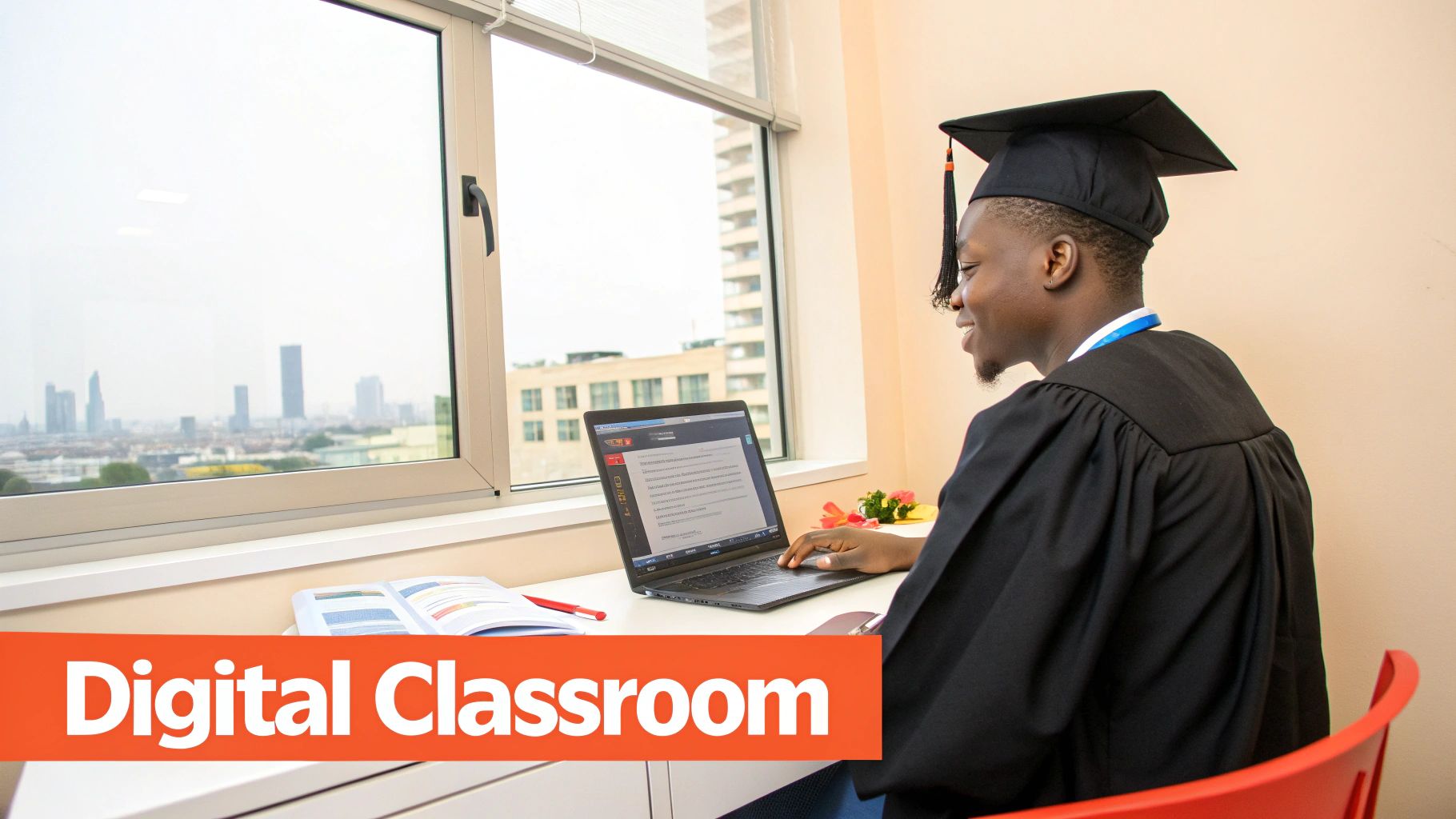
alt text: A young Nigerian student engaged in online learning on a laptop.
The online learning scene in Nigeria has grown far beyond the old correspondence courses. What we have now is a rich and vibrant ecosystem, with something for almost every ambition or learning need you can imagine.
What Online Learning Looks Like Today
When we talk about “online learning” now, it covers a huge range of educational options. It’s not just about getting a university degree anymore. The focus has shifted to gaining specific, practical skills that make you job-ready in a short amount of time.
Here’s a snapshot of what today’s digital classroom offers:
- Global Certification Platforms: Big names like Coursera and edX bring courses from world-class universities right to your screen, giving you credentials that are respected everywhere.
- Local Tech Bootcamps: We have our own powerhouses like AltSchool Africa, which offer intense, focused training in areas like software development and product design.
- Secondary School Exam Preparation: Platforms such as uLesson and Pass.ng have become indispensable for students gearing up for major exams like WAEC and JAMB.
- Professional Upskilling: With sites like Udemy, working professionals can learn anything from digital marketing to project management, usually at a much lower cost than traditional programmes.
The numbers speak for themselves. By 2022, online education platforms in Nigeria had already attracted over 1 million users. This isn’t just a niche market; it’s a massive shift happening right in the middle of Africa’s largest primary education system. It clearly shows how eager people are for digital learning, even with the challenges we face.
At its core, this digital shift is all about one thing: access. It demolishes the barriers of distance and cost, making it possible for a motivated person in a remote village to learn the same things as someone in Lagos or Abuja.
The main point is that online education is a powerful and flexible path to success. Whether you’re trying to master one of the top 10 IT skills in demand for 2025 or just need help passing an exam, the resources you need are literally just a click away.
Why Online Learning Is a Game Changer for Nigerians
The move towards digital education in Nigeria is so much more than a trend. For many, it’s a profound shift in what’s possible for their careers and personal growth. The real magic of online learning is how it systematically dismantles the old roadblocks in traditional education, making knowledge more accessible than ever before.

alt text: A Nigerian professional smiling while participating in an online course from her home office.
This isn’t just about convenience; it’s about creating practical solutions that fit the realities of life in Nigeria today. It’s about unlocking potential in every corner of the country.
Unmatched Flexibility for a Busy Life
Let’s be honest, life is demanding. A traditional university schedule is rigid, which is a non-starter for most working professionals or anyone juggling family responsibilities. Online learning throws that old model out the window, offering true flexibility.
Practical Example: A banker in Port Harcourt wants to earn an MBA to climb the corporate ladder. Fighting traffic for evening classes after a long day is impractical. With an online programme, she follows this schedule:
- Morning (6 AM – 7 AM): Reviews yesterday’s notes before work.
- Lunch Break (1 PM – 2 PM): Watches a 30-minute recorded lecture on her phone.
- Evening (9 PM – 11 PM): Works on assignments after the kids are asleep.
- Weekends: Dedicates Saturday mornings to group projects via Zoom.
Online learning puts you in control of your schedule. It adapts to your life, not the other way around, making education a feasible goal alongside your existing responsibilities.
Suddenly, you no longer have to press pause on your career or income to gain new qualifications. You can do both at the same time, which is a massive advantage in our competitive economy.
Making Education Accessible Everywhere
For decades, your location has dictated your access to quality education in Nigeria. The best institutions are often clustered in a few major cities. This forces ambitious people from other states to either relocate at a huge cost or settle for whatever is available locally.
Online learning completely flattens this barrier.
A brilliant young mind in a small town in Taraba State can now enrol in a top-tier software development course run by an institute in Lagos or even one overseas. They get the exact same curriculum and expert instructors as someone in a big city, all without having to leave their community. This is democratisation in action—your talent and drive become what matter most, not your postcode.
A More Affordable Path to Skills
Now, let’s talk about the money. The costs associated with a traditional university degree—tuition, accommodation, transport, books—can be staggering. Online learning offers a far more affordable alternative.
For instance, earning a specialised certificate in digital marketing from a platform like Coursera can cost just a fraction of a single semester’s fee at a typical university. When you remove the costs of daily commutes and hostel fees from the equation, the financial burden shrinks dramatically. This opens the door for so many more people to upskill.
Many platforms also provide flexible payment plans or financial aid, lowering the barrier to entry even further. To see a detailed cost comparison, check out our guide to distance learning universities in Nigeria.
An Endless Aisle of Courses
Finally, the sheer variety of courses available online is almost overwhelming, in the best way possible. A traditional university can only offer so many specialisations. Online platforms, on the other hand, are like a global library of skills.
You can find courses on anything from blockchain technology and artificial intelligence to sustainable agriculture and creative writing. These are skills that might not even be taught at a local university but are in high demand in the global job market. This incredible selection allows you to build a unique skill set that truly makes you stand out from the crowd.
Actionable Takeaways
- Audit Your Schedule: Look at your week and find two or three pockets of time (like late nights or early mornings) where you could realistically fit in 60-90 minutes of study.
- Compare the Costs: Pick a traditional course you’re interested in. Research its total cost and then find an online equivalent. The savings will likely surprise you.
- Explore Niche Skills: Spend an hour browsing a platform like Udemy or edX for courses in a passion area you can’t pursue locally.
- Map Your Goals: Connect one of the benefits above to a personal challenge. For example, if your problem is “no time for classes,” the solution is “Flexibility.”
Tools and Resources
- Coursera: Great for courses and full degree programmes from top international universities.
- Udemy: A massive marketplace with courses on almost any professional or personal skill you can imagine.
- edX: Founded by Harvard and MIT, it offers high-calibre, university-level courses.
Further Reading
- World Bank: Education Overview
- VillageReach: Peer-to-Peer Learning Initiatives
Overcoming the Hurdles of E-Learning in Nigeria
While the promise of online learning is exciting, let’s be realistic. To truly succeed, you need a solid game plan for the unique challenges that come with digital education in Nigeria. This isn’t just about listing problems; it’s about giving you a toolkit of proven strategies to navigate them like a pro.
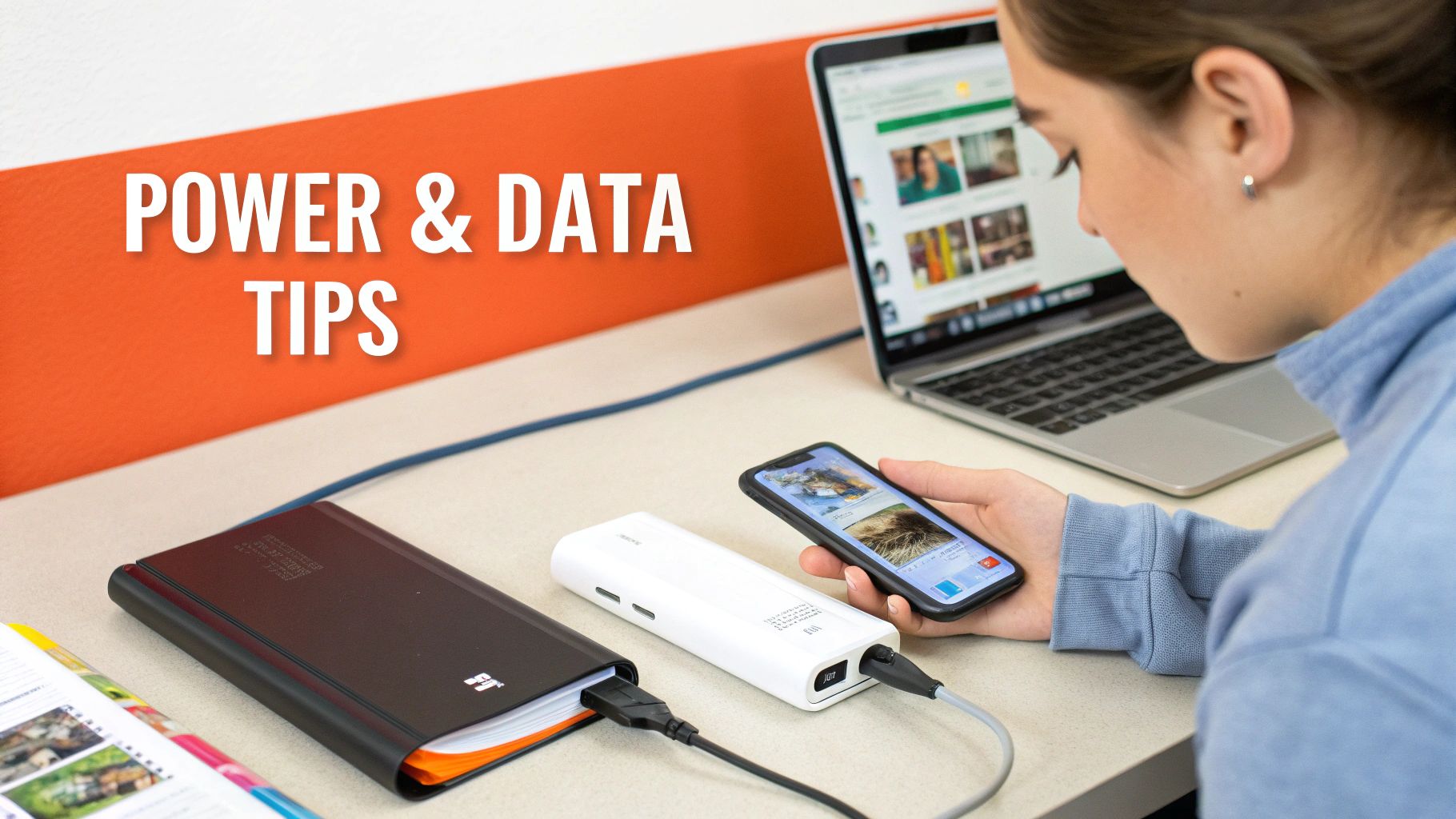
alt text: A student works on a laptop next to a power bank, illustrating a practical solution to power issues.
For most Nigerian students, the three biggest roadblocks are the high cost of data, an unreliable power supply, and shaky internet connectivity. Let’s break down each one and look at practical solutions you can start using today.
Tackling High Data Costs
Data is the lifeblood of online learning, and the costs can pile up fast, especially with video-heavy courses. Trying to stream every lecture live just isn’t a sustainable plan for most of us. The real secret is to switch your mindset from streaming to downloading.
The single most effective way to manage your data costs is to download all your course materials during off-peak hours for offline viewing. This one habit can easily slash your data expenses by over 50%.
Think about it: nearly every network provider in Nigeria offers special “night-time” data plans. These give you a massive amount of data for a fraction of the usual price, typically usable between midnight and the early morning.
How To Make Night-Time Data Plans Work for You
Here’s a simple, step-by-step routine to make this a core part of your studies:
- Get a Night Plan: First things first, check with your mobile provider (like MTN, Glo, or Airtel) for their latest night-time data deals. Subscribe to a bundle that covers what you expect to download for the week.
- Schedule Your Downloads: Before heading to bed, line up all the video lectures, PDFs, and other big files you’ll need for the next few days. Almost all learning platforms and web browsers let you download content.
- Use a Download Manager: This is a lifesaver. Install a download manager app on your laptop or phone. It helps schedule your downloads and, most importantly, can resume them if the connection drops, so you don’t have to start all over again.
- Organise Your Files: Create a folder for each course on your device. As soon as your files are downloaded, move them into the right folder, organised by week or module. This makes finding what you need for offline study a breeze.
By making this “download-first” approach a habit, you turn a major financial headache into a simple, weekly task.
Navigating Power and Connectivity Issues
We’ve all been there—the power goes out during a live class, or the internet signal disappears just before a deadline. The key is to build a resilient study setup that doesn’t crumble the moment the connection or power flickers.
When it comes to power, having a backup isn’t just nice; it’s essential.
- High-Capacity Power Banks: A quality power bank of 20,000mAh or more is a must-have. It can keep your smartphone and tablet powered for days, giving you constant access to your downloaded materials.
- Affordable Mini-Inverters: If you work mainly on a laptop, a small inverter connected to a deep-cycle battery is an absolute game-changer. This setup can give you several hours of reliable power for focused study sessions.
For connectivity, the goal is to be less dependent on a live connection. Your offline download strategy is the first line of defence. Your second is having a backup internet source. A portable MiFi device with a SIM from a different network than your phone is a great option. If one network is down, you can just switch to the other.
It’s also worth remembering that a big part of the challenge is staying motivated on your own. Looking into effective strategies for student engagement in online learning can provide great ideas for keeping yourself on track. When you prepare for these issues ahead of time, what could have been a major frustration becomes just a minor hiccup.
Below is a quick summary of the common challenges and the practical solutions we’ve discussed.
Table: Common E-Learning Challenges and Practical Solutions
| Challenge | Impact on Learning | Practical Solution |
|---|---|---|
| High Data Costs | Limits access to video content and live classes, adding financial stress. | Use night-time data plans to download all materials for offline viewing. This drastically reduces data consumption. |
| Unreliable Power Supply | Interrupts study sessions, causes missed deadlines, and prevents access to devices. | Invest in a high-capacity power bank (20,000mAh+) for mobile devices and a mini-inverter for laptops. |
| Poor Internet Connectivity | Disrupts live lectures, makes downloading slow, and causes frustration. | Prioritise a “download-first” strategy. Use a MiFi device with a backup SIM from a different provider. |
| Self-Discipline & Motivation | It’s easy to fall behind without the structure of a physical classroom. | Set a fixed study schedule, find a study partner, and actively participate in online forums to stay engaged. |
By proactively addressing these areas, you create a much smoother and more effective learning environment for yourself.
Finding the Right Online Learning Platform for You
With a whole world of options at your fingertips, picking the right platform for online learning in Nigeria can feel a bit like navigating a busy Lagos market. It’s overwhelming. This section is your guide to cut through that noise and find a platform that actually fits what you want to achieve, whether that’s for your career or personal growth. We’ll look at the global giants and the powerful local players built specifically for us.
And believe me, the choices are growing for a reason. The Nigerian EdTech market is on a rocket ship, expected to pull in over $400 million in revenue by 2025. This is largely fuelled by our massive youth population—a staggering 64% of Nigerians are under 25. This huge demand has put Nigeria at the forefront of education technology in Africa, with our own startups making up 34% of the top 50 EdTech companies on the continent. You can get the full picture on these trends in this detailed market forecast.
What this boom means for you is more choice. And more specialisation. So, let’s figure out which one is right for you.
Global Platforms with International Recognition
If you’re chasing university-backed credentials and certificates that are recognised all over the world, the big international platforms are usually your best bet. They offer courses from institutions people everywhere respect, giving you a serious competitive edge.
- Coursera: This is where you go for serious academic learning. Coursera partners with top-tier universities like Stanford and Imperial College London to offer everything from individual courses to full online degrees. It’s perfect for professionals looking to add a prestigious qualification to their CV without leaving Nigeria.
- Udemy: Think of Udemy as a massive skills marketplace. It’s packed with thousands of affordable, practical courses on just about anything—from digital marketing and graphic design to public speaking. It’s a fantastic place to quickly pick up a specific job skill or just explore a new hobby.
- edX: Founded by Harvard and MIT, edX keeps its focus on high-quality, university-level courses, especially in science, technology, engineering, and maths (STEM). If you’re after deep, foundational knowledge in a technical field, edX is an excellent place to start.
These platforms are brilliant, no doubt. But they are built for a global audience. For solutions that truly understand the Nigerian context, our homegrown platforms often hit the mark much better.
Local Platforms Built for Nigerian Needs
Nigerian innovators have been busy creating platforms that tackle our specific challenges and opportunities head-on. Whether it’s preparing for local exams or landing a tech job in our market, there’s a platform for it.
- AltSchool Africa: Focused squarely on closing the tech talent gap, AltSchool Africa offers intensive programmes in software engineering, product management, and data science. It’s built for anyone who wants a career in Nigeria’s booming tech scene, complete with mentorship and job support.
- uLesson: This is an absolute lifesaver for secondary school students. uLesson provides a complete curriculum for the subjects you need for WAEC, NECO, and JAMB. They use really engaging animated videos that make learning feel less like a chore.
- Tutor.ng: This platform is all about connection. Tutor.ng links learners with Nigerian tutors for one-on-one or group sessions in a huge range of subjects. It’s a great option if you need personalised help with school subjects, professional skills, or even local languages.
Practical Example: Take Tunde, a recent secondary school leaver in Ibadan getting ready for his JAMB exams. Sure, Coursera has advanced physics courses, but they aren’t designed for the JAMB syllabus. Tunde’s best move is uLesson, because its content is specifically created to match the Nigerian curriculum. It gives him the focused prep he needs to ace his exams.
As you explore all the platforms out there, digging into an in-depth online course platform comparison can be incredibly helpful in making sure you choose the best one for your learning journey.
How to Choose Your Ideal Platform
So how do you decide? It really boils down to three things: your goal, your budget, and how you like to learn. Here’s a simple way to narrow it down.
- Define Your Primary Goal: Get specific. Is your aim to pass an exam like WAEC? Learn a skill to get a job, like data analysis? Or earn a formal certificate from a top university? Your goal is your most important filter.
- Set a Realistic Budget: Figure out what you can comfortably spend. Platforms like Udemy often have courses for less than ₦10,000, while a specialised bootcamp from AltSchool Africa is a bigger financial commitment. Don’t forget that many global platforms offer financial aid too.
- Assess Your Learning Style: Are you someone who needs the structure and deadlines of a Coursera course to stay motivated? Or do you prefer to learn at your own pace on Udemy? Maybe you need the interactive, syllabus-focused lessons of uLesson. Be honest with yourself.
- Create a Shortlist and Test: Based on your answers, pick two or three platforms. Before you pay for anything, sign up for a free trial or watch some of their introductory videos. Get a feel for the platform and the teaching style to see if it clicks with you.
Choosing the right platform is the first big step on your online learning path. For an even more detailed look, you can explore our complete guide on the best online courses in Nigeria to see more options.
Actionable Takeaways
- Clarify Your ‘Why’: Write down one specific, measurable goal. For example, “Land a junior developer role in six months.”
- Match Goal to Platform Type: If your goal is a tech career, start with AltSchool. If it’s exam prep, check uLesson. For a global certificate, browse Coursera.
- Budget First: Decide on your maximum spend before you start looking. It will save you from getting overwhelmed by options you can’t afford.
- Try Before You Buy: Never pay for a course without exploring the platform first. Watch the free lessons or do a trial to make sure it’s a good fit.
Tools and Resources
- Coursera: For university-backed certifications and online degrees.
- AltSchool Africa: For intensive tech skills training tailored to the African market.
- uLesson: For Nigerian secondary school curriculum and exam preparation.
Further Reading
- Forbes: The Future Of Online Learning
- TechCabal: Reports on Nigerian EdTech Startups
The Future of EdTech and Digital Skills in Nigeria
The world of online learning in Nigeria isn’t just growing; it’s evolving at a breakneck pace. We’re seeing a fundamental shift away from simple video lectures towards a much smarter, more integrated way of learning. The next wave is all about practical, job-ready skills you can pick up from anywhere, powered by technology that truly understands you as a learner.
One of the biggest game-changers on the horizon is Artificial Intelligence (AI). AI is moving beyond gimmicky chatbots and is starting to deliver genuinely personalised learning. Imagine a platform that watches you tackle a coding challenge, notices you’re struggling with a specific concept like ‘for loops’, and instantly pulls up a short, targeted video tutorial to help you get it right. This isn’t science fiction; it’s the beginning of adaptive learning, and it makes every minute of study time count. You can dive deeper into the future impact of AI on education to see just how powerful this is becoming.
Key Trends Shaping Tomorrow’s Learning
Beyond AI, a few other trends are really defining the future. For starters, mobile-first learning isn’t just a nice-to-have anymore—it’s an absolute must. With smartphones in nearly every pocket, Nigerian EdTech platforms are designing apps that are light, sip data, and even work offline. This simple change is a massive step in making quality education available to everyone, regardless of their internet connection.
At the same time, we’re seeing traditional universities finally start to embrace a blended learning model. This is the sweet spot that combines the convenience of online classes with the irreplaceable value of in-person tutorials and hands-on lab work.
“The future isn’t about choosing between online and traditional education. It’s about blending them to create a more flexible, effective, and accessible system for everyone. The Nigerian learner of tomorrow will expect this hybrid model as standard.”
The Rise of Online Vocational Training
Another seismic shift is the explosion in demand for practical, hands-on skills taught online. While a university degree will always have its place, people are increasingly looking for training that leads directly to a job or a business opportunity.
This is where online vocational training comes in. We’re talking about high-demand skills like:
- Digital marketing and managing social media for businesses
- Advanced tailoring and fashion design using digital pattern-making tools
- Modern farming techniques taught through accessible video modules
- Technical skills like solar panel installation and maintenance
This focus on digital vocational training is exactly what’s needed to equip Nigerians with the marketable skills the modern economy demands. In fact, Nigeria’s online learning market is on track to hit around $115 million in revenue by 2025, and it’s not slowing down. This boom is fueled by more people getting online with smartphones, opening the door for platforms to offer everything from professional upskilling to formal degree courses. You can check out the full breakdown in the latest market report from Statista.
To help you figure out where you fit in, this decision tree below is a great starting point for matching your personal goals to the right kind of platform.
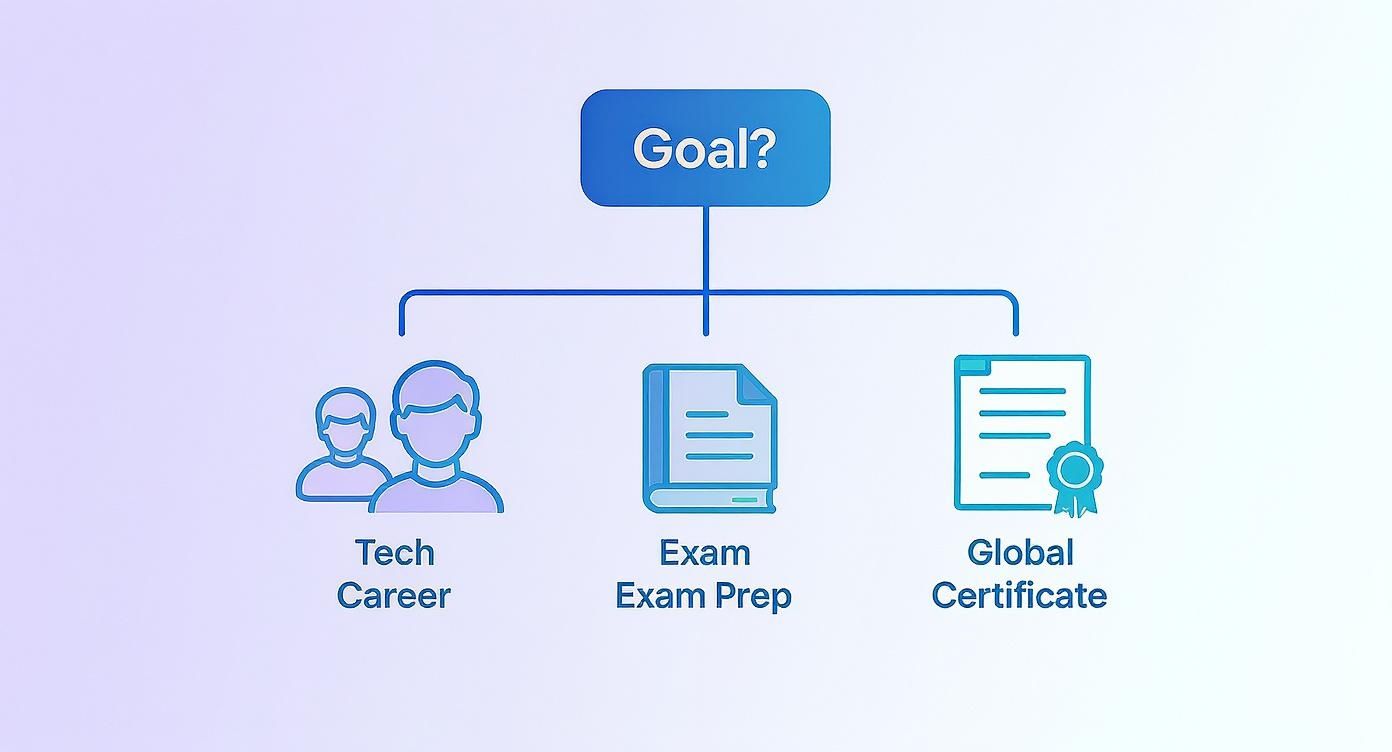
alt text: Infographic about online learning in nigeria showing a decision tree for learners.
As you can see, the best learning journey always starts with knowing exactly where you want to go.
Actionable Takeaways
- Explore AI-Powered Tools: Give a learning app that uses AI a try. See for yourself how personalised feedback can cut down your learning time.
- Prioritise Mobile-First Platforms: When you’re choosing a course, make sure the platform has a solid, data-friendly mobile app. Learning on the go is a huge advantage.
- Investigate Vocational Courses: Look past the usual academic subjects. Check out online courses for practical skills that employers are desperate for right now.
- Future-Proof Your Skills: Pick one big trend—like AI or green energy—and find a short online course to get a handle on the basics. It’s a small investment with a big potential payoff.
Tools and Resources
- Google Digital Skills for Africa: A fantastic resource for free courses in digital marketing and other critical business skills.
- FutureLearn: Partners with top universities to offer courses in forward-thinking fields and professional development.
- Jobberman Nigeria: Provides soft skills training specifically designed for what Nigerian employers are looking for.
Further Reading
- World Economic Forum: The Future of Jobs Report
- UNESCO: Artificial Intelligence in Education
Your Action Plan for Starting Online Learning Today
All the theory is great, but it’s taking action that actually gets you somewhere. Let’s boil everything down into a simple, practical plan to get you moving from reading this article to actually learning. Getting started with online learning in Nigeria feels a lot less daunting when you break it down into small, concrete steps you can take this week.
Forget about feeling overwhelmed by all the options out there. Your mission right now is to start small and build up some momentum. The goal isn’t to have your entire learning path mapped out perfectly, but just to take that first crucial step.
Your Three-Step Launch Plan
Follow these steps to get going immediately. This isn’t about some grand, long-term strategy; it’s about doing something tangible in the next seven days to kickstart your journey.
- Define One Clear Learning Objective: Drop the vague goals like “learn tech skills.” You need to be specific. Your objective should sound more like this: “Complete the first module of a free Python course on Coursera” or “Learn how to set up a basic Facebook ad campaign on Udemy.” A precise goal gives you a clear target to hit.
- Audit Your Schedule for Two Study Blocks: Seriously, open your calendar right now. Find two 90-minute slots in your week that you can protect. Maybe it’s early in the morning before the house wakes up, during your lunch break, or late at night. Block them out and treat them like you would any important meeting.
- Create One Trial Account This Week: Based on the goal you just set, pick one platform we’ve talked about and sign up. Go for a free trial or find a completely free course. The key here is do not pay for anything yet. Just get in there, explore the dashboard, watch an intro video, and get a feel for how it works. This simple act breaks the ice.
Taking small, consistent steps is far more powerful than waiting for the “perfect” time to start. Your goal this week is simply to begin, not to finish.
Essential Resources for Nigerian Learners
To really set you up for success, here is a handpicked list of tools and communities that can help you tackle some of the common hurdles for online students in Nigeria. These resources can help you save money, find support, and stay on track.
- Scholarship Databases: Check out websites like Scholarships for Development (Scholars4Dev). They list a ton of scholarships, many of which are specifically for online courses and degrees.
- Student Communities: Find your people! Join Nigerian student groups on platforms like Discord or search for dedicated Facebook Groups. These are brilliant places to ask questions, share notes, and even find a study partner to keep you accountable.
- Mobile Data Comparison: Use the official sites for providers like MTN and Airtel to directly compare their night-time data plans. These are often a lifesaver for downloading bulky course materials without breaking the bank.
- AI Learning Assistants: As you get into your studies, it’s worth exploring how to use AI for Nigerian students to improve your learning efficiency. These tools are fantastic for summarising long texts or breaking down complex topics.
By following this simple plan, you can shift from thinking about learning to actually doing it—starting today.
Got Questions? Here Are Some Quick Answers
Embarking on any new learning path is bound to bring up a few questions. Let’s tackle some of the most common ones that pop up for people diving into online education in Nigeria. Think of this as your quick-start guide to the practical side of things.
Do Nigerian Employers Actually Value Online Certificates?
Absolutely, but there’s a catch. Relevance is king. These days, Nigerian employers care a lot more about what you can do than where you learned it. A solid certificate in data analytics from Coursera, paired with a portfolio of real projects you’ve completed, can easily outshine a traditional degree that lacks practical application.
Practical Example: A hiring manager in a Lagos tech company is looking at two CVs. One has a traditional degree but vague skills. The other has an online certificate from a platform like edX and a GitHub link with 3 completed data analysis projects. The second candidate, who can show their skills, is far more likely to get the interview. The certificate isn’t just a piece of paper; it’s proof that you took the initiative to gain specific, in-demand knowledge.
How Do I Know if an Online Course Is Legit and Accredited?
This is a smart question to ask. Here’s a step-by-step way to verify a course:
- For Nigerian University Degrees: Go directly to the National Universities Commission (NUC) official website. Use their search function to see if the institution and its distance learning programme are on the approved list. Do not rely on the university’s claims alone.
- For International Platforms: Look at who offers the course. On platforms like Coursera or edX, credibility comes from the partner university (e.g., University of Michigan, Imperial College London). Check the university’s official website to confirm the partnership.
- For Skills-Focused Platforms: For platforms like Learn or Udemy or AltSchool Africa, their “accreditation” is their industry reputation. Look for testimonials, alumni success stories on LinkedIn, and reviews on independent sites.
What’s the Easiest Way to Pay for International Courses from Nigeria?
Navigating international payments from Nigeria can feel like a puzzle sometimes, but it’s definitely solvable. A few reliable options have emerged that make it much easier.
- Virtual Dollar Cards: This is usually the smoothest route. Fintech apps like Payday or Grey let you create a virtual dollar card, which you can fund with Naira. You can then use this card to pay for subscriptions on almost any international site without a hitch.
- Direct Bank Cards: Some dollar cards issued by Nigerian banks still work for international payments, but it can be hit-or-miss. Your best bet is to give your bank a quick call to confirm before you try to make a payment.
Whatever method you choose, just make sure it’s secure and gives you a clear transaction record for your own peace of mind.
Ready to create compelling content, generate stunning visuals, or build your own AI tools? RichlyAI provides a complete suite of AI-powered solutions to help you achieve your goals faster. Start exploring what’s possible by visiting RichlyAI Hub and sign up for a free plan today.
