
The technology sector is advancing at an unprecedented pace, and staying ahead requires a clear understanding of where the industry is headed. For professionals aiming to future-proof their careers, pinpointing the specific competencies that will be most valuable is crucial. This article provides a direct, no-fluff guide to the top 10 IT skills in demand for 2025, curated to help you make strategic career decisions.
We will move beyond basic definitions to explore what makes each skill indispensable. You will discover practical applications, the specific tools and platforms driving their adoption, and actionable steps to start developing these capabilities today. Whether you are a software developer, an aspiring data scientist, a cybersecurity analyst, or an entrepreneur in Nigeria’s burgeoning tech scene, this breakdown is designed to give you a competitive edge.
From the complex architectures of cloud computing and the predictive power of machine learning to the foundational principles of cybersecurity and the innovative potential of quantum computing, each section offers a clear roadmap. We will examine why these skills matter, who is hiring for them, and how you can position yourself to meet the market’s needs, ensuring your expertise remains relevant and highly sought-after.
1. Artificial Intelligence (AI) and Machine Learning
AI and Machine Learning (ML) are no longer futuristic concepts; they are foundational technologies powering today’s most innovative solutions. This field enables computers to learn from data, recognise patterns, and make decisions with minimal human intervention. As organisations seek to automate operations and gain a competitive edge, professionals skilled in AI and ML are indispensable. This is easily one of the top 10 IT skills in demand for 2025.
Alt text: A futuristic brain-like network of nodes and connections, representing the complexity of Artificial Intelligence and Machine Learning.
Practical Example: Building a Simple Spam Classifier
A common use case for ML is email spam detection. Here’s a simplified process:
- Collect Data: Gather a dataset of thousands of emails, each labeled as ‘spam’ or ‘not spam’.
- Preprocess Text: Use Python with libraries like NLTK or Scikit-learn to convert email text into numerical vectors (a process called vectorization). This involves removing common words (like “the”, “a”) and counting word frequencies.
- Train a Model: Feed these vectors into a classification algorithm like Naive Bayes or a Support Vector Machine (SVM). The model learns the patterns of words commonly associated with spam.
- Deploy: Once trained, the model can predict whether new, unseen emails are spam with high accuracy.
To effectively leverage artificial intelligence in your career, understanding the Top 10 Best AI for Programming in 2025 is essential for boosting productivity.
Actionable Takeaways
- Master the Fundamentals: Begin with Python and its core libraries: NumPy, Pandas, and Scikit-learn.
- Deepen Your Knowledge: Dive into deep learning frameworks like TensorFlow and PyTorch. A solid grasp of statistics and linear algebra is crucial.
- Build a Portfolio: Apply your skills on platforms like Kaggle. Create a portfolio showing an ML project from data cleaning to model deployment. You can find more comprehensive resources and tutorials on machine learning from RichlyAI.
Tools & Resources
- Libraries: Scikit-learn, TensorFlow, PyTorch
- Platforms: Kaggle (for datasets), Google Colab (for free GPU access)
- Further Reading: Hands-On Machine Learning with Scikit-Learn, Keras & TensorFlow by Aurélien Géron
2. Cybersecurity
Cybersecurity is the practice of defending systems, networks, and data from malicious digital attacks. As cyber threats grow in sophistication, organizations are urgently seeking professionals who can safeguard their digital assets. This makes cybersecurity expertise one of the most critical and top 10 IT skills in demand for 2025.

Alt text: A digital lock and key on a circuit board, symbolising the protection of data and systems in cybersecurity.
Practical Example: Running a Network Vulnerability Scan
As a security analyst, you might use a tool like Nmap to check for open ports on your company’s servers.
- Installation: Install Nmap on a Linux-based system (
sudo apt-get install nmap). - Basic Scan: Run a command like
nmap -sV -p- <target_IP_address>to scan all 65,535 TCP ports on a specific server. The-sVflag attempts to determine the version of the service running on each open port. - Analysis: Review the output. If you see an outdated version of a service (e.g., an old Apache web server), you’ve identified a potential vulnerability that needs patching.
- Reporting: Document the finding and recommend an action (e.g., “Upgrade Apache on server 10.1.1.5 to the latest version to mitigate CVE-2023-XXXX”).
Understanding the role of cybersecurity awareness in office technology is the first step in building a resilient organizational defense.
Actionable Takeaways
- Earn Foundational Certifications: Start with globally recognised certifications like CompTIA Security+, Certified Ethical Hacker (CEH), or CISSP to validate your skills.
- Build a Home Lab: Set up a safe, isolated virtual environment using VirtualBox. This allows you to practice penetration testing and analyze malware without risk.
- Learn to Code and Network: Develop scripting skills in Python or Bash to automate tasks. A deep understanding of networking (TCP/IP, firewalls, DNS) is essential.
- Engage with the Community: Participate in Capture The Flag (CTF) competitions on platforms like Hack The Box to sharpen your skills.
Tools & Resources
- Scanners: Nmap, Wireshark, Burp Suite
- Platforms: Hack The Box, TryHackMe
- Further Reading: The Web Application Hacker’s Handbook by Dafydd Stuttard
3. Cloud Computing (AWS, Azure, Google Cloud)
Cloud computing has fundamentally changed how businesses operate, offering on-demand computing resources over the internet. This skill involves managing servers, storage, databases, and networking in the cloud. As organizations prioritize agility and cost-efficiency, professionals skilled in cloud platforms like Amazon Web Services (AWS), Microsoft Azure, and Google Cloud are critical. This makes cloud expertise one of the most vital of the top 10 IT skills in demand for 2025.
The pie chart below illustrates the current market dominance of the top three providers.
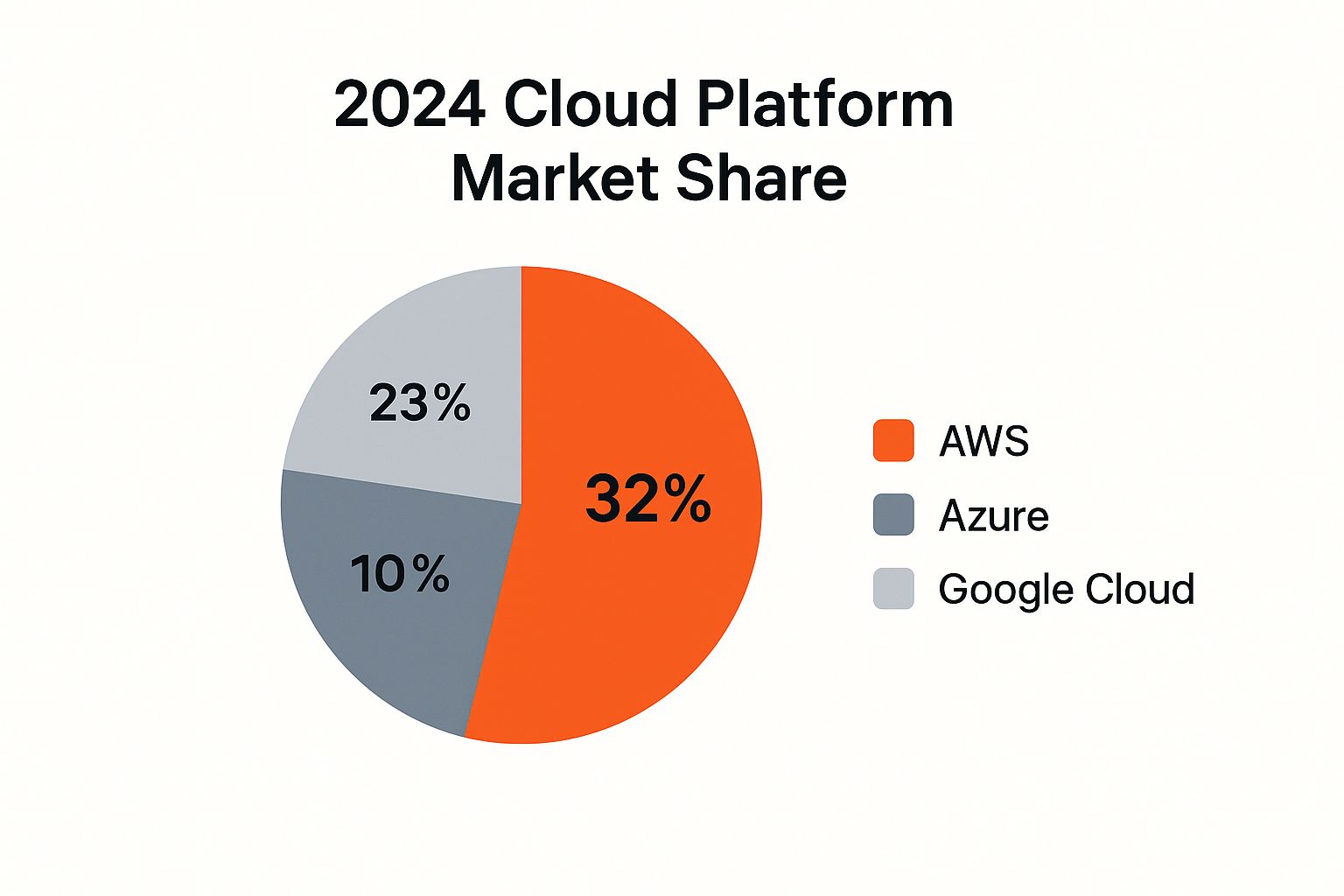
Alt text: A pie chart illustrating the 2024 cloud platform market share. AWS leads with 32%, followed by Azure at 23%, and Google Cloud at 10%.
Practical Example: Deploying a Static Website on AWS S3
You can host a simple website on AWS for pennies a month without needing a server.
- Create an S3 Bucket: In the AWS Console, create a new S3 bucket. Give it a globally unique name (e.g.,
my-portfolio-website-2025). - Configure for Hosting: In the bucket’s properties, enable “Static website hosting.”
- Set Public Access: Edit the bucket policy to allow public read access so visitors can view your site.
- Upload Files: Upload your website’s files (
index.html,styles.css, etc.) to the bucket. - Access Your Site: Use the endpoint URL provided by S3 to view your live website.
Actionable Takeaways
- Choose a Platform and Get Certified: Focus on one platform first. Obtain a certification like AWS Certified Cloud Practitioner or Microsoft Certified: Azure Fundamentals.
- Practice with Real Projects: Use the free tiers offered by providers to gain hands-on experience without incurring costs. Deploy a simple web application or a database.
- Learn Infrastructure as Code (IaC): Master tools like Terraform or AWS CloudFormation. IaC allows you to manage infrastructure through code, a crucial skill for automation.
Tools & Resources
- IaC Tools: Terraform, AWS CloudFormation, Ansible
- Platforms: AWS Free Tier, Azure Free Account, Google Cloud Free Tier
- Further Reading: AWS Well-Architected Framework documentation
4. DevOps and Site Reliability Engineering (SRE)
DevOps combines software development (Dev) and IT operations (Ops) to shorten the development lifecycle. SRE applies software engineering principles to operations, focusing on creating scalable and reliable systems. In today’s fast-paced digital landscape, these skills are critical for organizations looking to innovate rapidly and maintain stable services, making them a clear entry on the list of top 10 IT skills in demand for 2025.
Practical Example: Setting Up a CI/CD Pipeline with GitHub Actions
Automate the deployment of a simple web app whenever you push code.
- Create a Workflow File: In your project’s repository, create a directory
.github/workflows/and add a YAML file (e.g.,deploy.yml). - Define the Trigger: In the YAML file, specify that the workflow should run on a
pushto themainbranch. - Define Jobs: Create a ‘build’ job that checks out your code, installs dependencies (e.g.,
npm install), and runs tests. - Create a Deploy Job: Add a ‘deploy’ job that depends on the ‘build’ job passing. This job could use a script to securely copy the built files to your web server (e.g., using
scp). - Commit and Push: Once you push this workflow file, GitHub Actions will automatically run these steps on every subsequent push to
main.
Actionable Takeaways
- Master Foundational Tools: Start with version control (Git), scripting (Python/Bash), and Linux system administration.
- Learn Containerization: Gain proficiency in Docker for creating containers and Kubernetes for managing them at scale.
- Embrace CI/CD and IaC: Learn tools like Terraform or Ansible. Set up CI/CD pipelines using platforms like Jenkins or GitHub Actions.
Tools & Resources
- CI/CD: Jenkins, GitLab CI, GitHub Actions
- Containers: Docker, Kubernetes
- IaC: Terraform, Ansible
- Further Reading: The Phoenix Project by Gene Kim, Kevin Behr, and George Spafford
5. Data Science and Analytics
Data Science and Analytics have become the bedrock of modern business strategy, transforming raw data into actionable insights. This discipline involves using scientific methods to extract knowledge from structured and unstructured data. As organizations become increasingly data-driven, professionals who can collect, analyze, and interpret large datasets are crucial, making this skill one of the top 10 IT skills in demand for 2025.
Alt text: A visually engaging dashboard with various charts and graphs, representing data analytics and business intelligence.
Practical Example: Analyzing Sales Data with SQL and Python
A business wants to find its top 5 best-selling products for the last quarter.
- Query the Database: Use SQL to extract the relevant data:
SELECT product_name, SUM(quantity) as total_sold FROM sales WHERE sale_date >= '2024-10-01' GROUP BY product_name ORDER BY total_sold DESC LIMIT 5; - Import into Python: Export the query result as a CSV and load it into a Python script using the Pandas library.
- Visualize the Results: Use a library like Matplotlib or Seaborn to create a bar chart showing the top 5 products and their sales volumes.
- Communicate Insights: Present the chart with a clear takeaway: “Our Q4 strategy should focus marketing efforts on Product A and B, as they account for 60% of top-seller revenue.”
Actionable Takeaways
- Master Core Programming and Databases: Start with Python or R. Develop strong SQL skills for efficient data querying.
- Learn Data Visualisation and Storytelling: Become proficient with tools like Tableau, Power BI, or Python’s Matplotlib. The ability to tell a clear story with data is key.
- Build an End-to-End Portfolio: Apply your skills to real-world projects. Showcase a project from data collection and cleaning to model building and insight communication. Explore career paths in this guide on data science jobs from RichlyAI.
Tools & Resources
- Languages: Python (with Pandas, Matplotlib), R, SQL
- BI Tools: Tableau, Microsoft Power BI
- Notebooks: Jupyter Notebook, Google Colab
- Further Reading: Storytelling with Data by Cole Nussbaumer Knaflic
6. Full-Stack Development
Full-stack development is the art of building a complete web application, handling everything from the user-facing front-end to the server-side back-end. This skill set transforms a developer into a versatile problem-solver. As companies, especially startups, aim for lean teams, full-stack developers who can oversee a project from conception to deployment are in extremely high demand, making this one of the top 10 IT skills in demand for 2025.
Alt text: A developer’s screen showing both front-end user interface code and back-end server logic, symbolising the dual nature of Full-Stack Development.
Practical Example: Building a Simple To-Do List App (MERN Stack)
- Back-end (Node.js/Express): Create a simple API with endpoints to:
GET /todos(fetch all tasks)POST /todos(add a new task)DELETE /todos/:id(remove a task)
Connect this API to a MongoDB database to store the tasks.
- Front-end (React): Build a user interface with a form to add new tasks and a list to display existing tasks. Use the
fetchAPI oraxiosto make calls to your back-end API. - Integration: Run both the front-end and back-end servers. The React app will now communicate with the Node.js server to manage the to-do list data.
For those looking to stay competitive, exploring the best framework for web applications in 2025 is a must for shaping future skills.
Actionable Takeaways
- Master JavaScript: Gain a deep understanding of JavaScript, as it runs on the front-end (browser) and back-end (Node.js).
- Choose a Stack and Build: Select a popular stack like MERN (MongoDB, Express.js, React, Node.js) and build complete projects.
- Understand Web Architecture: Learn HTTP, RESTful APIs, and database management. Know when to use a SQL (PostgreSQL) vs. a NoSQL (MongoDB) database. Find more details on what it takes to land modern web developer jobs on RichlyAI.
Tools & Resources
- Stacks: MERN, MEAN, LAMP
- Frameworks: React, Angular, Vue.js (front-end); Express.js, Django (back-end)
- Databases: MongoDB, PostgreSQL
- Further Reading: The Odin Project (free full-stack curriculum)
7. Blockchain and Cryptocurrency Development
Blockchain technology has evolved far beyond cryptocurrency, establishing itself as a force for creating secure, transparent, and decentralized systems. This field involves building distributed ledgers, smart contracts, and decentralized applications (dApps). As industries from finance to supply chain seek to enhance security, demand for blockchain developers is surging, making it one of the top 10 IT skills in demand for 2025.
Practical Example: Writing a Simple “Hello World” Smart Contract
You can write and deploy a basic smart contract on the Ethereum network using Solidity.
- Set Up: Use an online IDE like Remix.
- Write the Contract:
// SPDX-License-Identifier: MIT
pragma solidity ^0.8.0;

contract HelloWorld {
    string public greet = "Hello World!";
}
This simple contract stores a public string variable named
greet. - Compile: Use the Remix compiler to compile the Solidity code into bytecode.
- Deploy: Deploy the contract to a test network (like Sepolia) using a wallet like MetaMask. Once deployed, you can call the
greetfunction to retrieve the “Hello World!” message from the blockchain.
Actionable Takeaways
- Understand the Foundations: Before coding, grasp decentralization, consensus mechanisms (Proof-of-Work vs. Proof-of-Stake), and cryptography basics.
- Learn a Core Language: Start with Solidity, the primary language for writing smart contracts on the Ethereum blockchain.
- Practice and Deploy: Build and test smart contracts on testnets like Sepolia. Focus on security best practices and gas optimization.
Tools & Resources
- Languages: Solidity, Rust
- IDEs: Remix, Hardhat, Truffle
- Blockchains: Ethereum, Solana
- Further Reading: Mastering Ethereum by Andreas M. Antonopoulos and Gavin Wood
8. Internet of Things (IoT) Development
IoT development connects physical devices to the internet, enabling them to collect, exchange, and act on data. This field transforms regular objects into “smart” devices. As industries aim for greater efficiency and automation, professionals skilled in building these systems are in high demand, making this one of the top 10 IT skills in demand for 2025.
Alt text: A network of interconnected smart devices like cars, homes, and wearables, illustrating the vast reach of the Internet of Things.
Practical Example: Building a Temperature Monitor with a Raspberry Pi
- Hardware Setup: Connect a temperature sensor (like a DHT11) to the GPIO pins of a Raspberry Pi.
- Write the Code: Write a Python script on the Raspberry Pi that reads the temperature and humidity data from the sensor every 5 minutes.
- Send Data to the Cloud: Use a lightweight protocol like MQTT to publish the sensor data to a cloud service like AWS IoT Core.
- Visualize: In the AWS console, you can create a simple dashboard or set up an alert (e.g., send an email if the temperature exceeds a certain threshold).
Actionable Takeaways
- Master the Fundamentals: Begin with development boards like Arduino and Raspberry Pi. Learn embedded programming languages like C/C++ or Python.
- Deepen Your Knowledge: Study IoT networking protocols (MQTT) and wireless standards (Wi-Fi, Bluetooth). Explore cloud platforms like AWS IoT or Azure IoT Hub.
- Build a Portfolio: Create practical projects like a home weather station or a smart irrigation system. Showcasing your ability to integrate sensors and manage connectivity is crucial.
Tools & Resources
- Hardware: Raspberry Pi, Arduino, ESP32
- Protocols: MQTT, CoAP
- Cloud Platforms: AWS IoT Core, Azure IoT Hub
- Further Reading: Official Raspberry Pi and Arduino documentation projects
9. User Experience (UX) and User Interface (UI) Design
In a world saturated with digital products, a seamless user experience is a core business requirement. UX/UI Design are disciplines focused on creating intuitive, accessible, and engaging digital interactions. As companies compete for user attention, professionals who can design products that are both beautiful and easy to use are in high demand, making this a feature on the list of top 10 IT skills in demand for 2025.
Alt text: A person interacting with a fluid and intuitive interface on a transparent screen, showing wireframes and design elements.
Practical Example: Redesigning a Login Form
A simple login form can be improved with UX principles.
- Research: Observe users trying to log in. Do they forget their passwords often? Is the “Sign Up” link hard to find?
- Wireframe: Based on research, sketch a new layout. Add a prominent “Forgot Password?” link. Allow users to log in with Google or Facebook (social login) to reduce friction. Add a “Show/Hide Password” toggle.
- Prototype: Use a tool like Figma to create an interactive prototype of the new design.
- Test: Ask a few people to test your prototype. Did the changes make the login process faster and less frustrating? Iterate based on their feedback.
Actionable Takeaways
- Master the Tools: Gain fluency in industry-standard design and prototyping tools like Figma, Sketch, and Adobe XD.
- Build a Process-Driven Portfolio: Your portfolio should showcase your entire thinking process: user research, wireframes, user flows, and usability test results.
- Understand the Fundamentals: Study core design principles, color theory, and typography. Learn about user psychology and accessibility (WCAG). Explore remote graphic design jobs on RichlyAI for insights into industry expectations.
Tools & Resources
- Design Tools: Figma, Sketch, Adobe XD
- User Research: UserTesting.com, Maze
- Further Reading: Don’t Make Me Think by Steve Krug; Nielsen Norman Group articles
10. Quantum Computing
Quantum Computing represents a revolutionary shift from classical computing, leveraging quantum mechanics to process information in new ways. It uses quantum bits (qubits), which can exist in multiple states simultaneously, allowing for calculations at speeds exponentially faster than supercomputers. This makes it one of the most forward-looking of the top 10 IT skills in demand for 2025.
Alt text: A visually abstract representation of a qubit with glowing, interconnected particles and light trails, symbolising the complex principles of quantum superposition and entanglement.
Practical Example: Creating a Bell State with Qiskit
A Bell state is a fundamental example of quantum entanglement, where two qubits are linked.
- Install Qiskit:
pip install qiskit - Write the Code: In Python, create a simple quantum circuit:
from qiskit import QuantumCircuit # Create a circuit with 2 qubits and 2 classical bits qc = QuantumCircuit(2, 2) # Apply a Hadamard gate to the first qubit to put it in superposition qc.h(0) # Apply a CNOT gate to entangle the two qubits qc.cx(0, 1) # Measure the qubits qc.measure([0,1], [0,1]) - Simulate: Use Qiskit’s simulator to run the circuit thousands of times. You’ll observe that the measurement results are always either
00or11, never01or10—demonstrating entanglement.
Actionable Takeaways
- Build Foundational Knowledge: Start with a strong grasp of linear algebra, probability, and complex numbers.
- Learn Quantum Programming: Familiarize yourself with frameworks like IBM’s Qiskit or Google’s Cirq.
- Practice with Simulators: Begin by running your code on quantum simulators. Then, leverage cloud platforms like IBM Quantum, which offer free access to real quantum hardware.
Tools & Resources
- Frameworks: IBM Qiskit, Google Cirq
- Platforms: IBM Quantum Experience, Microsoft Azure Quantum
- Further Reading: The Qiskit textbook (online and free)
Top 10 IT Skills Demand Comparison 2025
| Technology | Implementation Complexity 🔄 | Resource Requirements ⚡ | Expected Outcomes 📊 | Ideal Use Cases 💡 | Key Advantages ⭐ |
|---|---|---|---|---|---|
| Artificial Intelligence (AI) & ML | High: Requires strong math and continuous learning | High: Computational power and data | Advanced automation, predictive analytics, innovation | Automation, pattern recognition, NLP, computer vision | Industry-wide applicability, strong career growth |
| Cybersecurity | Medium-High: Broad knowledge, constant updates | Medium: Tools, labs, and certifications | Protection against cyber threats, risk mitigation | Network security, incident response, compliance | Critical need, job stability, diverse specializations |
| Cloud Computing (AWS, Azure, GCP) | Medium-High: Broad platforms, evolving services | Medium-High: Cloud infrastructure and certifications | Scalable, flexible resources, cost optimization | Infrastructure management, scalable apps, hybrid cloud | High demand, multiple career paths, cutting-edge tech |
| DevOps & Site Reliability Eng. | Medium-High: Multi-domain knowledge, automation focus | Medium: Tools for CI/CD, containers, monitoring | Faster deployments, reliable systems | Software delivery, infrastructure automation | Bridges dev & ops, enhances efficiency, strong job market |
| Data Science & Analytics | Medium-High: Strong stats and coding skills required | Medium: Data access and analysis tools | Data-driven decisions, business insights | Business analytics, forecasting, strategy | Versatile skills, high impact on strategy, growing field |
| Full-Stack Development | Medium: Broad tech stack, rapid changes | Medium: Development tools and cloud hosting | Complete web applications | Web development, startups, end-to-end projects | Versatility, project ownership, career flexibility |
| Blockchain & Cryptocurrency Dev. | High: Specialized, complex programming paradigms | Medium-High: Blockchain nodes, security expertise | Decentralized apps, secure transactions | Cryptocurrencies, smart contracts, supply chain | High growth potential, premium compensation, innovation |
| Internet of Things (IoT) Dev. | High: Multi-disciplinary (hardware & software) | Medium-High: Devices, sensors, cloud connectivity | Connected devices, real-world automation | Smart homes, industrial automation, healthcare | Real-world impact, cross-industry, hardware-software integration |
| UX/UI Design | Medium: Requires creativity and usability focus | Low-Medium: Design tools and user research | Intuitive, accessible user experiences | Web/mobile apps, product design | Direct user impact, creative-analytical blend, growth |
| Quantum Computing | Very High: Advanced physics and math required | High: Limited hardware access, simulators | Potential exponential speedups for complex problems | Cryptography, drug discovery, optimization | Cutting-edge, transformative potential, high compensation |
Final Thoughts
The technological landscape is advancing at an unprecedented pace, and the skills that define a successful IT professional are evolving right along with it. As we’ve explored the top 10 IT skills in demand for 2025, a clear narrative emerges: the future belongs to those who embrace continuous learning, specialisation, and a multidisciplinary approach to problem-solving. It’s no longer enough to be proficient in just one area; the most valuable professionals will be those who can bridge the gaps between different domains.
From the predictive power of Artificial Intelligence and Machine Learning to the defensive fortress of Cybersecurity, and the scalable infrastructure of Cloud Computing, these skills are not isolated pillars. They are interconnected threads weaving a new digital fabric. A DevOps engineer, for instance, is far more effective with a solid understanding of cybersecurity principles, just as a Data Scientist’s insights become more powerful when deployed on a robust cloud platform.
Synthesising Your Skill Development Strategy
The journey to mastering these competencies can seem daunting, but it is an achievable and incredibly rewarding endeavour. The key is to move from passive learning to active application. Don’t just read about AI; build a small machine learning model. Don’t just study cloud architecture; deploy a personal project on AWS or Azure. This hands-on experience is what transforms theoretical knowledge into practical, career-defining expertise.
The convergence of these skills is where true innovation lies. Imagine combining IoT data collection with AI-driven analytics, all secured by cutting-edge cybersecurity protocols and delivered through a seamless UX/UI. This is the kind of integrated thinking that will solve the complex challenges of tomorrow and position you as an indispensable asset in the Nigerian and global tech ecosystem.
Actionable Takeaways for Your 2025 Career Plan
To truly capitalise on the insights from this article, here are your immediate next steps:
- Conduct a Personal Skill Audit: Honestly assess your current skill set against the ten areas we’ve discussed. Identify one primary skill to deepen and one secondary skill to start exploring.
- Create a Project-Based Learning Plan: Choose a small, manageable project that forces you to use a new skill. For example, build a simple blockchain application or design a mobile app interface in Figma.
- Engage with the Community: Join local tech hubs in Lagos or Abuja, participate in online forums like Stack Overflow, or contribute to an open-source project on GitHub. Networking and collaboration are powerful learning accelerators.
- Schedule Your Learning: Dedicate specific, non-negotiable time blocks in your calendar each week for skill development. Consistency is more important than intensity.
Looking ahead to 2025, the demand for tech talent will only intensify. By strategically investing in these high-growth areas, you are not just preparing for the future; you are actively building it. The opportunities are immense for those with the foresight and determination to master the technologies that will shape our world.
Ready to supercharge your productivity and leverage the power of AI in your daily tasks? RichlyAI offers a suite of intelligent tools designed to help you write, code, and create more efficiently, aligning perfectly with the AI skills needed for 2025. Explore how our platform can become your AI-powered partner in building your future-proof career at RichlyAI.
