
Nigeria’s digital economy isn’t just growing; it’s exploding. This boom is creating a massive demand for skilled web developers, placing it firmly among the most promising and lucrative career paths in the country’s tech sector. This isn’t just about building simple websites anymore. It’s about engineering the digital backbone for businesses across finance, e-commerce, and countless other industries.
Getting to Grips With the Web Developer Job Market
The tech scene in Nigeria is buzzing. Seriously. As more businesses establish their online presence and internet access becomes more widespread, the need for professionals who can build and maintain a solid digital footprint has gone through the roof. This has made web development a highly sought-after and well-paid skill.
From nimble fintech startups in Lagos to established e-commerce giants, companies everywhere are on the hunt for talent. This isn’t just a fleeting trend; it’s a fundamental shift in how Nigerian businesses operate in the modern world.
What Does a Web Developer Actually Do?
A web developer’s role is surprisingly diverse, but the work usually falls into a few key categories. One day you might be crafting a slick, responsive website for a local brand, and the next you could be maintaining a complex, data-intensive web application for a financial services company.
Here’s a step-by-step look at a typical workflow for building a new feature:
- Receive the Brief: You’ll collaborate with UI/UX designers and project managers to understand the goal. For example, building a new “user profile” page.
- Front-End Development: You translate the design mockups into code using HTML for structure, CSS for styling, and JavaScript to handle user interactions like editing a profile picture.
- Back-End Development: You write the server-side code (e.g., in Node.js) to securely fetch user data from the database and save any changes they make.
- Testing & Bug Fixing: You test the feature across different browsers and devices, identify bugs (like a “Save” button not working on mobile), and fix them.
- Deployment: You push your code to the live server, making the new feature available to all users.
- Ongoing Maintenance: You monitor the feature’s performance and release updates as needed.
What Can You Expect to Earn in Nigeria?
Let’s talk money, because it’s one of the most compelling reasons to get into web development. The pay reflects just how valuable these technical skills have become. With the digital economy expanding, data shows that web developers in Nigeria pull in an average annual salary of about NGN 3,960,000. That makes it one of the highest-paying technical roles in the country. To get a better sense of how this compares to other roles, have a look at the data from Nexford University.
Here’s a quick look at how developer salaries stack up against other tech jobs in Nigeria.
Average Annual Tech Salaries in Nigeria
| Technical Role | Average Annual Salary (NGN) |
|---|---|
| Web Developer | NGN 3,960,000 |
| IT Support Specialist | NGN 2,400,000 |
| Data Analyst | NGN 3,600,000 |
| UI/UX Designer | NGN 3,000,000 |
| Cybersecurity Analyst | NGN 4,200,000 |
As you can see, web development holds its own with a very competitive salary, reinforcing its status as a top career choice.
Of course, your exact salary will depend on your experience level, where you’re based, and your specific skill set. Here’s a rough idea of the career path:
- Entry-Level Developer (0-2 years): You’ll be building a solid foundation and earning a respectable starting salary right out of the gate.
- Mid-Level Developer (2-5 years): Once you have some real-world experience under your belt, your earning potential jumps significantly as you tackle more complex projects.
- Senior Developer (5+ years): At this level, you’re a leader and a top-tier problem-solver. Your salary will reflect that deep expertise.
The opportunities aren’t just limited to Nigeria. Many local developers are landing high-paying international remote jobs in Nigeria, which often come with even better salaries and benefits.
This thriving job market offers a clear and rewarding career ladder. If you commit to continuously honing your skills and racking up experience, you can steadily climb in both responsibility and income. It’s solid proof that a career in web development is a stable and financially rewarding choice in Nigeria today.
Building Your Job-Ready Technical Skillset

To land one of the great web developer roles out there, you need more than a casual acquaintance with code. You need a practical, in-demand technical skillset that lines up with what companies are actually looking for. It’s all about building a toolkit that solves real business problems.
This isn’t just about listing technologies on your CV. You need to dig deeper and really get why certain tools are used and how they all connect to build a website that works well and people want to use.
The Non-Negotiable Front-End Foundation
Every single web developer, no matter their specialisation, has to master the core front-end trio. These are the absolute fundamentals of everything you see and interact with on the internet.
- HTML (HyperText Markup Language): Think of this as the skeleton of a webpage. Practical Example: Using
<nav>,<main>, and<footer>tags not only structures your page but also tells screen readers and search engines what each section is for, improving accessibility and SEO. - CSS (Cascading Style Sheets): If HTML is the skeleton, CSS provides the style—the colours, fonts, layouts, and animations. Actionable Insight: Don’t just learn CSS properties; master layout systems. Create a simple portfolio grid using CSS Grid to understand how it handles two-dimensional layouts, a skill every employer wants.
- JavaScript (JS): This is where the magic happens. JavaScript brings your pages to life, handling everything from simple form checks to incredibly complex and dynamic user interfaces. Practical Example: Build a simple “To-Do List” application. This will force you to manipulate the DOM (adding/removing items), handle user input, and manage state—core JS skills.
Honestly, without a firm grip on these three, trying to move on to more advanced tools is like trying to run before you can walk. They are the bedrock of your entire career.
Choosing Your JavaScript Framework
Once you’re comfortable writing plain (“vanilla”) JavaScript, your next move is to pick up a framework. Frameworks give you a structured way to build things and come with a lot of pre-written code, which massively speeds up your development time. In the tech scene, a couple of major players stand out.
React vs. Vue: A Practical Look
| Aspect | React.js | Vue.js |
|---|---|---|
| Popularity | The dominant force both locally and globally. It has a huge ecosystem and job market. | Growing fast. It’s loved for being straightforward with fantastic documentation. |
| Use Case | Perfect for building complex, interactive single-page applications (SPAs) and dynamic UIs. | Great for projects you need to get up and running quickly. The learning curve is much gentler. |
| Example | A massive e-commerce site like Jumia, with countless interactive parts. | A snappy, responsive dashboard or a marketing landing page that needs some dynamic flair. |
For most job seekers, learning React is the smartest move simply because so many companies use it. That said, Vue is a brilliant alternative because it’s so easy to get started with, especially if your goal is to become productive fast.
Venturing into the Back-End
If you’re aiming for those full-stack developer jobs, you’ll need to know what’s going on behind the scenes. Back-end development is all about the server, managing databases, handling user logins, and running the core logic of an application.
Two powerful options are particularly relevant in the local market:
- Node.js with Express: Since it uses JavaScript, Node.js lets you use the same language for both the front-end and the back-end. Practical Example: Build a simple API endpoint with Express that serves a JSON object of user data. Then, use the
fetchAPI on your front-end to call this endpoint and display the data. This connects the two worlds. - Python with Django: Django’s “batteries-included” approach means you can build things at lightning speed. It’s secure, it scales well, and it powers some major platforms. Practical Example: Use Django’s built-in admin panel to quickly create a management interface for a blog. This demonstrates a key strength of the framework without writing much code.
Which one you choose often comes down to the project. Node.js is king for applications with lots of simultaneous connections, while Django is a champion for building complex, data-driven sites quickly. Picking up these skills can also open up your own business opportunities, giving you the technical know-how for figuring out how to start an online business.
A crucial, often-overlooked part of modern development is deployment. As you build your skills, it’s incredibly wise to learn about cloud platforms. Understanding services that help with building and scaling web apps with Azure App Service can give you a serious edge. It shows employers you’re not just a coder—you can think about the entire lifecycle of an application.
Building a job-ready skillset is a continuous journey of learning and doing. By focusing on these core areas—the front-end fundamentals, a popular framework, and key back-end technologies—you’ll position yourself as a top-tier candidate for the best web developer jobs available.
Crafting a Portfolio That Gets You Noticed

Let’s be clear: your portfolio is your single most important sales tool in the hunt for web developer jobs. It’s more than a gallery of your work; it’s where you prove you can solve real-world problems and deliver genuine value.
Simply listing projects just won’t cut it. You need to frame each piece as a story of problem-solving. It’s the difference between saying “I built a website” and “I developed a responsive e-commerce platform that tackled the client’s drop in mobile sales.” A great portfolio doesn’t just show what you did; it sells what you can do for a future employer.
The Anatomy of a Winning Project Showcase
When a hiring manager or a senior developer looks at your portfolio, they’re looking for clues. They want to see your technical skills, understand how you think, and figure out if you’d be a good fit for their team. Every project you include should be a deliberate choice aimed at answering their unasked questions.
Think about showcasing a diverse range of skills. Instead of showing three nearly identical brochure sites, aim for variety to highlight your versatility. A well-rounded portfolio could include:
- A Full-Stack E-commerce Site: This is a heavy hitter. It proves you can handle both the front-end user experience and the back-end logic—things like user authentication, managing products, and integrating payment gateways. It’s a complex project that signals serious capability.
- A Dynamic Single-Page Application (SPA): Building something with React or Vue shows you’re comfortable with modern JavaScript frameworks. This could be a project management dashboard, a real-time chat app, or even a slick weather app that pulls data from an external API.
- A Pixel-Perfect Responsive Landing Page: This one is all about your core front-end chops. It’s your chance to show you have a sharp eye for design and can flawlessly translate a UI mock-up into clean, accessible HTML and CSS that looks perfect on any device.
And for every single project, you absolutely must provide a live link. Let them interact with your work directly. This is non-negotiable.
Telling the Story Behind the Code
Just dropping a project title and a screenshot is a huge missed opportunity. You have to give it context. For every project, write a short, easy-to-scan case study that explains the “why” and “how” behind your work. This is what turns a simple list into a compelling narrative.
Your project description should be a mini-story that hits a few key points.
Project Case Study Breakdown
| Section | What to Include | Practical Example |
|---|---|---|
| The Problem | State the challenge or goal in a sentence or two. | “A local bakery needed an online presence to take custom cake orders and show off their daily menu. They were losing business to competitors who were already online.” |
| My Solution | Explain your approach and the key features you built to solve the problem. | “I built a responsive site using React and Node.js. It features an intuitive order form with a date picker, a dynamic gallery managed from a custom admin panel, and an integrated contact form.” |
| Tech Stack | List the technologies you used and—this is crucial—explain why you chose them. | “I went with React for its component-based structure, which made the UI easy to manage. For the back-end, Node.js with Express gave me a fast, lightweight server to handle order submissions.” |
| Lessons Learned | Share a specific challenge you ran into and how you figured it out. | “Getting the real-time order validation right was tricky. I ended up using the Formik library to manage form state, which made the user experience much smoother and cut down on errors.” |
This structure proves you’re not just a coder; you’re a thoughtful problem-solver. That’s a trait every development team is looking for.
Don’t forget, your portfolio website is itself a project. It must be well-designed, perfectly responsive, and completely bug-free. It’s the very first demonstration of your skills. A slow, clunky, or broken portfolio is an instant red flag.
Your GitHub Profile Is Your Public Résumé
After a recruiter checks out your live projects, their next stop is almost always your GitHub profile. This is where they go to inspect your actual code, your development habits, and your ability to write clean, professional software. A messy or empty GitHub can be just as damaging as a weak portfolio.
Here’s a step-by-step guide to making your GitHub profile professional:
- Pin Your Top Repositories: Go to your profile, click “Customize your pins,” and select your best 3-5 projects. These should be the same ones you feature in your portfolio.
- Write Clean, Commented Code: In your code, use consistent formatting, give variables meaningful names (e.g.,
userProfileinstead ofx), and add comments to explain complex logic like// This function calculates the total price including tax. - Create Detailed README.md Files: For each pinned project, create a
README.mdfile. It should explain what the project does, how to run it locally (npm installthennpm start), and include screenshots or GIFs of the final product. - Maintain a Consistent Commit History: That green “contribution graph” matters. Make small, regular commits with clear messages (e.g., “feat: add user login form” instead of “update”). This shows you’re actively coding and learning.
By curating both your project showcase and your GitHub, you create a powerful, one-two punch that validates your skills and makes you a standout candidate for those top web developer jobs.
How to Find and Apply for Opportunities
Alright, so you’ve sharpened your skills and your portfolio is looking impressive. What’s next? The real hunt begins: finding and landing a web developer role that’s right for you. It’s about more than just blasting your CV out into the void; it’s about being strategic.
The Nigerian tech scene is buzzing with energy and opportunities. From mainstream job boards to tight-knit developer circles, your next big break could be anywhere. The trick is to combine smart digital searching with genuine, real-world connections.
Effective Job Search Channels for Web Developers
To avoid getting lost in a sea of irrelevant listings, it’s best to focus your energy where tech recruiters are actually looking. Here’s a breakdown of the most effective channels and how to make them work for you.
| Channel | Best For | Actionable Tip |
|---|---|---|
| Building a professional brand and connecting directly with recruiters at Nigerian tech companies. | Go beyond just having a profile. Actively engage with posts from companies you admire, join groups like “Nigerian Developers Community,” and send personalised connection requests to hiring managers. Example: “Hi [Name], I saw your post about [Company]’s new feature. As a React developer, I was really impressed by [specific detail]. I’m currently looking for new roles and would love to connect.” | |
| Nigerian Job Boards | Finding local roles in key tech hubs like Lagos and Abuja. | Set up targeted alerts on sites like Jobberman, MyJobMag, and HotNigerianJobs for terms like “front-end developer” or “full-stack developer.” This ensures you’re one of the first to see new openings. |
| Developer-Specific Platforms | Discovering remote or specialised roles that aren’t advertised elsewhere. | Make it a habit to regularly check sites that cater specifically to tech talent. Exploring various web developer job listings can uncover hidden gems from both local and international companies hiring in Nigeria. |
| Tech Meetups & Events | Tapping into the unadvertised job market through direct networking. | Attend local tech events in Lagos or Abuja. Your goal is to have one meaningful conversation. Ask a senior developer what they’re working on. This can lead to an interview for a role that never gets posted publicly. |
By combining these channels, you create a powerful, multi-pronged approach that significantly increases your chances of finding the right fit.
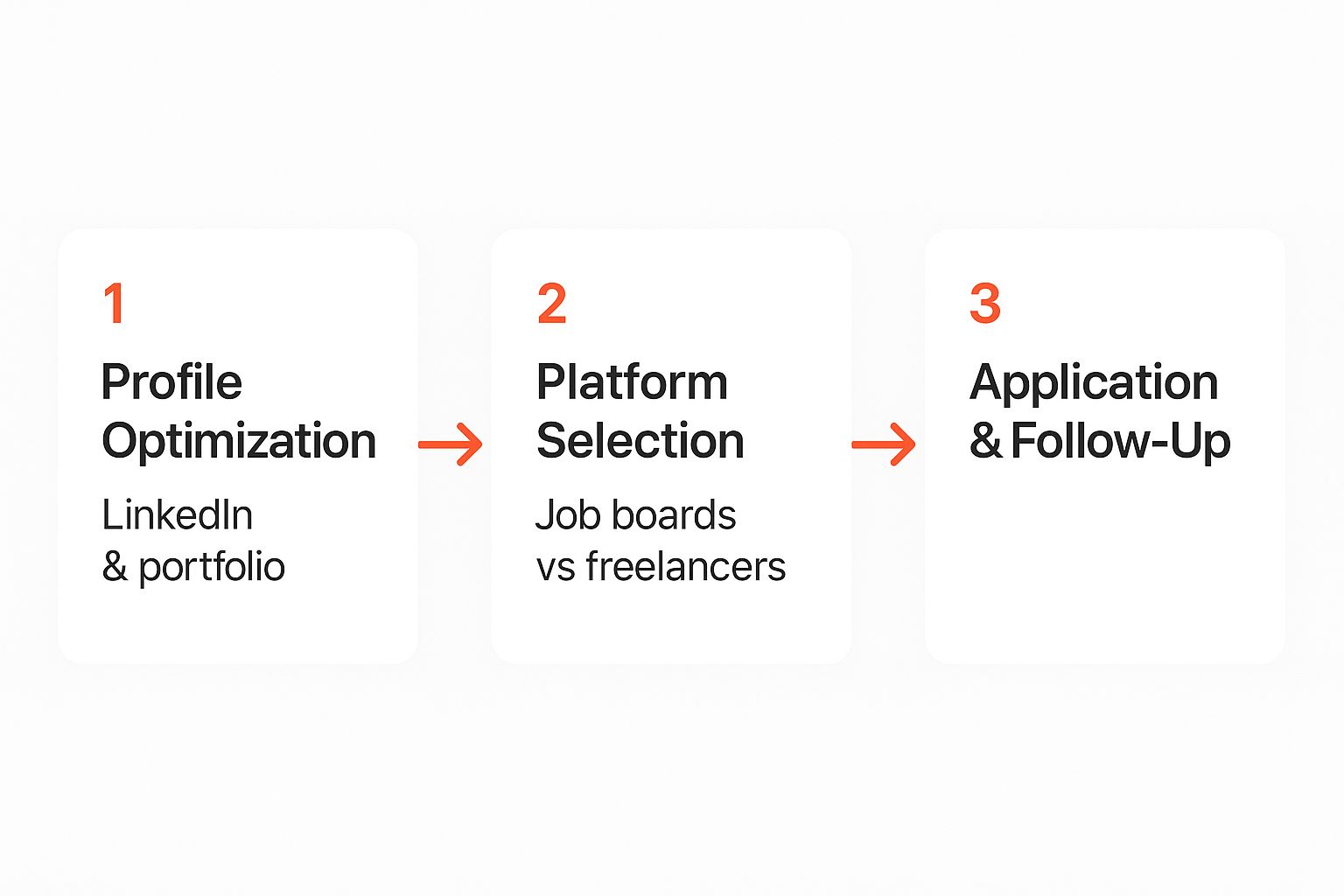
Beyond the Job Boards: Networking and Unadvertised Roles
Here’s a secret that experienced developers know well: many of the best jobs are never advertised. They get filled through referrals, word-of-mouth, and professional networks. This is where networking, both online and in person, becomes your most valuable tool.
A quick chat over coffee at a tech meetup could be more fruitful than a hundred online applications. These events are goldmines for meeting the very people who make hiring decisions.
A “no” today doesn’t always mean a “no” forever. It can often mean “not right now.” If you build a genuine connection with a recruiter or hiring manager, following up professionally a few weeks later can put you first in line for the next opening.
Crafting an Application That Gets Noticed
When you do find that perfect role, your application has to cut through the noise. Here is a step-by-step guide to make your application stand out:
- Optimize Your CV for ATS: Many companies use Applicant Tracking Systems (ATS) to filter CVs. Use a clean, single-column layout with standard fonts. Forget fancy graphics.
- Tailor with Keywords: Scour the job description for key terms (“React.js,” “API integration,” “agile methodology”) and weave them naturally into your CV’s skills and experience sections. This shows the ATS—and the hiring manager—that you’re a match.
- Write a Specific Cover Letter: A generic “To Whom It May Concern” is a red flag. Find the hiring manager’s name on LinkedIn. In your letter, mention a specific project the company worked on that excites you. This small effort shows you’re genuinely interested.
Understanding the local market dynamics is also crucial, especially in major hubs. You can get a feel for this by looking into related fields, such as the trends in human resources jobs in Abuja.
The demand for skilled developers in Nigeria is undeniable. Full-Stack Developers, for instance, are in high demand, with salaries ranging from NGN 200,000 to over NGN 1,500,000 per month, all depending on experience. The opportunities are there for those who know how to strategically find and pursue them.
Mastering the Web Developer Interview

The interview is the final hurdle in your journey to securing great web developer jobs. This is where everything comes together—your skills, your portfolio, and your personality—to prove you’re the right person for the role. Think of it as a two-sided coin: one side tests your technical chops, while the other assesses how you’ll fit into the company’s culture.
Getting through this stage isn’t just about having the right answers. It’s about demonstrating your thought process, communicating clearly, and showing you’re a problem-solver who can work well with a team. Let’s break down how to conquer both the technical and behavioural sides of the interview.
Demystifying the Technical Interview
The technical interview can feel like the scariest part, but it’s really just a conversation about how you solve problems with code. The interviewer isn’t looking for a perfect, instant answer. They’re far more interested in seeing how you think.
One of the most valuable things you can do is to think out loud. As you work through a problem, talk about the different approaches you’re considering. Explain why you’re choosing one over another and what trade-offs you’re making. This turns what could be a silent, stressful test into a collaborative problem-solving session.
Here is a step-by-step approach for live coding challenges:
- Clarify the Problem: Before writing any code, repeat the problem back in your own words. Example: “So, you want me to write a function that takes an array of numbers and returns the second-largest number?”
- Discuss Your Approach: Talk through your plan. Example: “My initial thought is to sort the array in descending order and then just pick the element at index 1. However, sorting might be slow if the array is huge. A better way might be to iterate through the array once, keeping track of the two largest numbers I’ve seen so far.”
- Write the Code: Implement your chosen solution, explaining your code as you write it.
- Test with Examples: Walk through an example case, including edge cases. Example: “Let’s test this with
[1, 5, 2, 9, 8]. The largest is 9, second-largest is 8. Now, what if the array has duplicates, like[9, 9, 8]? My logic should handle that correctly.”
A classic mistake is jumping straight into the code. Before you write a single line, pause. Ask clarifying questions to make sure you’ve completely understood the problem. It shows you’re thoughtful and deliberate—hallmarks of a great developer.
Preparing for Behavioural Questions with the STAR Method
While your technical skills get you in the door, it’s often the behavioural questions that determine if you’re a good cultural fit. This is your chance to prove you’re a team player, you can handle pressure, and you’re genuinely passionate about your work. The best way to prepare for this is with the STAR method.
The STAR method gives you a simple but powerful framework for answering questions about your past experiences. It stands for:
- Situation: Briefly set the scene. What was the project or challenge?
- Task: What was your specific goal or responsibility in that situation?
- Action: What specific steps did you take to handle the task? This is where you detail your personal contribution.
- Result: What was the outcome of your actions? Use numbers whenever you can (e.g., “we cut page load time by 30%” or “user engagement went up by 15%“).
Putting STAR into Practice
So, how does this work in a real interview? Let’s say the interviewer asks, “Tell me about a time you faced a difficult technical challenge.” Here’s how you could frame your answer using the STAR method.
Example of the STAR Method in Action
- Situation: “On my last e-commerce project, we realised after launch that our product filtering feature was painfully slow. This was causing a high bounce rate on our main category pages.”
- Task: “My job was to pinpoint the bottleneck and refactor the front-end code to make the filtering feel instant, ultimately improving the user experience.”
- Action: “I used the browser’s developer tools to profile the component and found that our filtering logic was re-rendering the entire product list with every single change. I re-architected the component using memoization with React’s
useMemohook, ensuring that only the necessary parts of the UI updated.” - Result: “By making that change, we slashed the filtering execution time by over 80%. The user experience became much smoother, and we saw a measurable drop in the page’s bounce rate within the first week.”
This kind of structured storytelling is far more memorable and impactful than a generic answer. For those who want more personalised advice on these conversations, you can always consult with experts in career coaching and interview prep. It can also be helpful to use modern tools to refine your narrative; many developers are now using free AI tools for content creation to help draft and polish project descriptions for their portfolios and interviews.
By preparing for both the technical and behavioural aspects, you can turn the interview from a daunting test into a genuine opportunity to shine.
Got Questions About Landing a Web Developer Job? Let’s Get Them Answered
If you’re trying to break into the Nigerian tech scene, you’ve probably got a head full of questions. That’s completely normal. Getting straight answers is the best way to cut through the noise and focus on what really matters in your job hunt for web developer jobs.
Let’s dive into some of the most common things aspiring developers ask.
Is a University Degree a Must-Have?
Honestly? Not really. While a Computer Science degree gives you a great theoretical background, the Nigerian tech industry has shifted its focus. It’s now all about what you can do, not just what you’ve studied.
Actionable Insight: Instead of focusing on a degree, spend 3-6 months building 3 solid portfolio projects. For example: a responsive landing page, a to-do app with JavaScript, and a simple blog built with React. This practical experience is far more valuable to most employers than a degree certificate alone.
Should I Go for Front-End, Back-End, or Full-Stack?
For newcomers, front-end development (think HTML, CSS, and JavaScript) is often the path of least resistance. You get to see the results of your code visually, which makes the learning process feel incredibly rewarding, and you can build a portfolio of impressive-looking projects pretty quickly.
But here’s the reality: full-stack developers, the ones who can handle both the client-side and server-side of an application, are in massive demand across Nigeria. This versatility almost always translates into better job offers and a wider range of opportunities. My advice? Follow what genuinely interests you, but make an effort to get a basic grasp of the full stack. It will give you a serious edge over the competition.
Key Takeaway: A well-tended GitHub profile is no longer a “nice-to-have”—it’s your modern-day CV. It’s a direct window for employers to see how you code, how you think, and how consistently you work. If you’re not making regular commits, you’re missing a huge opportunity to prove your skills.
What Kind of Salary Can I Realistically Expect in Nigeria?
This is the million-naira question, isn’t it? Salary figures can be all over the place, depending heavily on your experience, specific skills, and even your city.
For example, PayScale suggests the average pay for a web developer in Nigeria is around NGN 793,357 a year. But that number tells a broad story. Interestingly, their data also shows that entry-level developers with under a year of experience can actually earn a higher average of about NGN 1,030,000. It just goes to show how much demand there is for fresh talent.
Which JavaScript Frameworks Should I Learn?
If you want to open the most doors, the answer is clear: React.js. It’s the undisputed king in the Nigerian tech world right now. Its huge ecosystem, active community, and widespread use by everyone from startups to major corporations make it the most strategic framework to master.
Practical Learning Path:
- Master vanilla JavaScript first.
- Follow the official React tutorial to build the tic-tac-toe game.
- Rebuild one of your earlier vanilla JS projects (like the to-do app) using React. This solidifies your understanding of concepts like components and state.
That being said, don’t sleep on Vue.js. It’s gaining a lot of traction because it’s famously easy to pick up and has fantastic documentation. It’s a great alternative. And while you won’t see as many new projects starting with it, knowing Angular is still a valuable skill, especially if you’re targeting large companies that have legacy applications built with it.
And once you’ve built those skills, you’ll need to market them. If that’s something on your mind, you might find our guide to digital marketing for beginners useful.
Ready to accelerate your projects and bring your ideas to life faster? The RichlyAI Hub offers powerful AI-driven tools, from code generation to content creation, designed to boost your productivity. Sign up for a free plan and discover how our advanced models can help you build, write, and create more efficiently. Start exploring today with RichlyAI.
