
If you’ve been asking yourself, “Is there really a demand for nurses in Abuja?”, the short answer is a resounding yes. The city’s healthcare scene is buzzing with activity and constantly looking for qualified professionals like you. Your skills are not just wanted; they are genuinely needed. This guide will provide actionable steps and practical examples to help you secure your next role. You can explore and learn more from our job opportunities category.
Decoding the Abuja Nursing Job Market
As Nigeria’s Federal Capital Territory (FCT), Abuja is experiencing rapid population growth, and its healthcare infrastructure is racing to keep up. This boom is the engine driving the demand for skilled nurses in all sorts of environments. You’ll quickly discover that job openings aren’t confined to just hospitals; they’re spread across the entire healthcare landscape.
This creates a rich and varied job market where nurses, regardless of their specialisation or experience level, can find a role that fits. Before you dive in, it’s always a good idea to have a solid grasp of the career path. For a thorough overview, this complete guide to becoming a nurse is a fantastic resource that lays out all the essential steps.
To give you a clearer picture, here’s a quick snapshot of what you can expect from the nursing job market in Abuja.
Abuja Nursing Job Market at a Glance
| Key Aspect | Details |
|---|---|
| Key Employers | National Hospital Abuja, Cedarcrest Hospitals, NGOs, private clinics. |
| High-Demand Roles | General Nurse, Midwife, Paediatric Nurse, ICU Nurse, Theatre Nurse. |
| Salary Range | NGN 75,000 – NGN 150,000 per month, varies by experience. |
| Job Availability | High, with over 50 active listings on major job boards as of August 2025. |
This table should help you see the opportunities at a glance, but let’s break down where you should be focusing your search.
Where the Jobs Are
The opportunities are everywhere, spanning both the public and private sectors. Knowing where to direct your energy is the first real step to an effective job hunt.
Here’s where the action is:
- Major Government Hospitals: Powerhouses like the National Hospital Abuja and the various general hospitals are always major employers. They have a constant need for nurses across almost every department you can think of.
- Leading Private Hospitals: Places like Cedarcrest Hospitals, Nizamiye Hospital, and Zankli Medical Centre are well-regarded for offering competitive packages and roles, often in highly specialised areas.
- Clinics and Diagnostic Centres: Don’t overlook the smaller players. Specialised clinics and diagnostic centres often have openings for nurses with specific skills in fields like fertility, primary care, or medical imaging.
- Non-Governmental Organisations (NGOs): Many local and international NGOs run community and public health programmes out of Abuja, and they rely on skilled nurses to get the job done.
The demand isn’t just talk. A quick search on any major job board proves it. For example, as of August 2025, platforms like Indeed Nigeria consistently show over 50 active listings for nursing jobs right here in the FCT. These aren’t just one type of role either; they range from graduate nurse positions to senior roles in critical care and oncology. Salaries typically start around NGN 75,000 and can go up to NGN 150,000 or more per month, depending heavily on your experience and the institution.
Actionable Insight: Don’t put all your eggs in one basket. The nurses who find the best roles are the ones who explore every avenue—government, private, and non-profit—to find the perfect match for their skills and career ambitions.
It’s also worth noting how technology is changing the game in healthcare. If you’re curious about the bigger picture, our article on harnessing AI innovations to transform healthcare delivery in Nigeria offers some fascinating insights into how the industry is evolving.
Finding Genuine Nursing Vacancies in Abuja
When you’re looking for a nursing job vacancy in Abuja, knowing where to search is absolutely crucial. A scattergun approach, where you just apply to anything and everything, rarely works. What you really need is a focused, step-by-step strategy that covers multiple channels, so you don’t miss out on the best opportunities.
Mastering Your Online Job Search: A Step-by-Step Guide
To avoid drowning in a sea of irrelevant job posts, you have to get smart with your search terms and alerts. Here’s a practical, step-by-step approach.
- Step 1: Set Up Specific Job Alerts. Go to major portals like MyJobMag and Jobberman. Instead of a generic alert for “nursing jobs,” get specific. Set up several targeted alerts that narrow down the field.
- Practical Example: Create separate alerts for terms like ‘Registered Nurse Abuja’, ‘Midwife FCT’, or even ‘Paediatric Nurse Gwarinpa’. This simple trick ensures only the most relevant openings land in your inbox, saving you a ton of time.
- Step 2: Optimise Your LinkedIn Profile. LinkedIn is a goldmine, but only if you use it right. Think of your profile as your living, breathing CV. For some great tips on making your profile stand out, check out these ten ChatGPT prompt ideas for job seekers on LinkedIn. They can help you write a professional summary and skills section that really grabs a recruiter’s attention.
- Step 3: Go Directly to the Source. Some of the best roles are filled before they’re ever advertised. Being proactive is how you find those hidden gems. The big hospitals and healthcare groups often post vacancies on their own websites first.
Going Straight to the Source
Get into the habit of checking the “Careers” or “Vacancies” page of major hospital websites every week. It shows real initiative and means you’ll be one of the first to know when a new position opens up.
Actionable Checklist: Hospitals to Check Directly
- National Hospital Abuja (Careers Page)
- Cedarcrest Hospitals (Vacancies Section)
- Nizamiye Hospital (Join Us Page)
- Zankli Medical Centre (Opportunities Page)
Expert Tip: Create a weekly calendar reminder every Friday morning to check these four sites. This consistent, proactive effort takes less than 15 minutes but can put you ahead of 90% of other applicants.
The journey from spotting an opening to getting that final offer letter follows a pretty clear path. This flow chart breaks down the key stages you’ll go through.
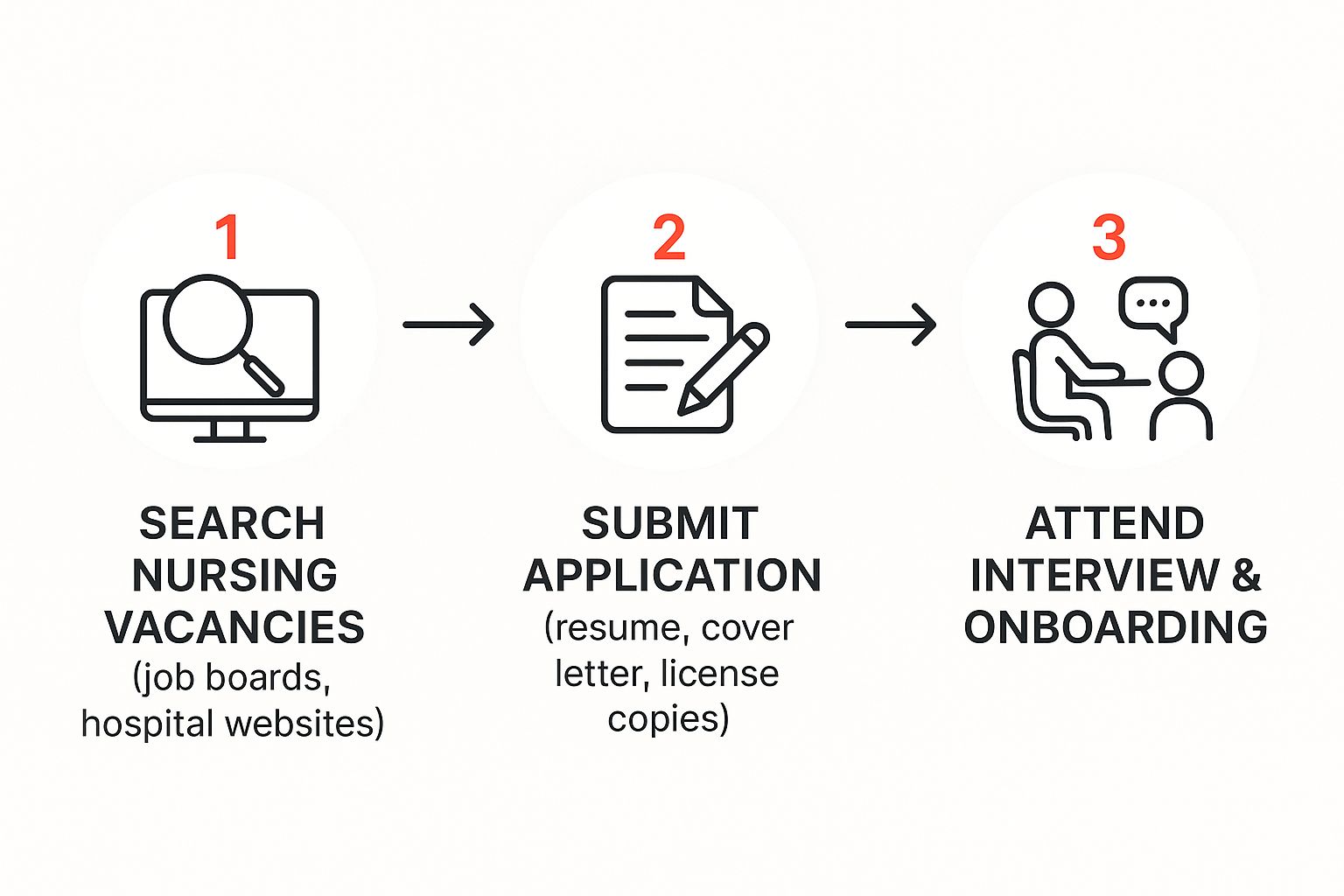
As you can see, a successful job hunt is about more than just searching. It demands a standout application and a strong interview performance. By blending broad searches on job sites with targeted checks at top hospitals, you’ll build a powerful strategy that dramatically boosts your chances of landing that perfect nursing job vacancy in Abuja.
What Hospitals in Abuja Are Really Looking For
If you want to land a nursing job vacancy in Abuja, it pays to know what hiring managers are truly desperate for. While general nursing skills are the foundation, the city’s top hospitals are often hunting for specialists who can step into very specific, high-pressure roles.
Knowing which specialisms are in high demand gives you a massive advantage. It helps you tailor your CV and highlight the experience that makes recruiters stop scrolling. As a fast-growing capital city, Abuja has a pressing need for expert care in critical areas like surgery and maternal health. This makes certain skills incredibly valuable.
The Most Sought-After Specialisms in Abuja
When a hospital posts a job opening, they’re usually trying to solve a specific problem or fill a critical gap on their team. Looking at recent hiring trends, a few roles pop up again and again, all requiring specialised training.
Here are the specialisms that are consistently in high demand across Abuja:
- Theatre Nurse: Absolutely essential for any hospital with surgical departments. Theatre nurses are the backbone of the operating room—they prep the theatre, assist surgeons, and care for patients immediately after surgery. They are crucial for patient safety and efficient surgical procedures.
- Accident & Emergency (A&E) Nurse: A&E nurses are on the front line, often the first person a patient in crisis sees. You need to be sharp, resilient, and able to think on your feet. From minor cuts to life-threatening trauma, A&E nurses handle it all, making them indispensable in a bustling city like Abuja.
- Paediatric Midwife: With a growing population, the demand for skilled professionals in maternal and child health is always high. Paediatric Midwives offer specialised care to both mother and baby throughout pregnancy, labour, and the crucial postnatal period.
Actionable Advice: If your background is in A&E, theatre nursing, or midwifery, make that experience front and centre on your CV. For example, your professional summary should start with “Highly skilled Theatre Nurse with 5+ years of experience…” Recruiters actively scan for these keywords first.
The Non-Negotiables: Qualifications and Experience
No matter how specialised you are, there are some fundamental requirements you simply must have. Think of these as the entry ticket—without them, your application won’t even get a second look.
First and foremost is your valid and current practising license from the Nursing and Midwifery Council of Nigeria (NMCN). This is non-negotiable. Beyond that, most specialised roles will demand a post-basic qualification in that field.
Practical Example: To be a serious candidate for a theatre nurse position at a hospital like Cedarcrest, you’ll need to have completed a perioperative nursing programme in addition to your general nursing degree.
Clinical experience is the other huge factor. Most hospitals will look for at least two to three years of direct, hands-on experience in your specialty. Data from the first half of 2025 showed that major hospitals like the British Community Hospital and Cedarcrest Hospitals were consistently hiring for Intake Nurses, A&E Nurses, and Theatre Nurses—all roles that require proven expertise. This just highlights the city’s need for professionals who can hit the ground running in critical care.
To get a feel for what’s out there right now, you can explore the nursing jobs available in Abuja on MyJobMag.
Making Your Application Impossible to Ignore
In a competitive market like Abuja, sending out a generic CV is like whispering in a crowded room—it just won’t get heard. To land a top nursing job vacancy in Abuja, your application needs to do more than just list your qualifications; it has to tell a story of your impact as a healthcare professional.
Think of your CV as your personal marketing document. It must be sharp, focused, and meticulously tailored for every single role you apply for.
Fine-Tuning Your CV for Abuja Hospitals
Let’s get straight to the point. The very first thing a Nigerian hiring manager or recruiter scans for is your professional registration. Don’t make them hunt for it. Your NMCN registration and valid practising license should be impossible to miss, placed right at the top of your CV, directly under your name and contact details.
Next, it’s time to shift your mindset from listing duties to showcasing achievements. Anyone can write down what they were supposed to do. What sets you apart is the result of your work. This simple change is a game-changer.
Let’s look at a practical example:
- Before: “Monitored patient vitals in the ICU.”
- After: “Managed and stabilised up to four critically ill patients per shift in a high-pressure ICU, resulting in a 15% reduction in response time for critical alerts.”
The difference is night and day, right? The second version paints a clear picture of competence and impact by using hard numbers. It proves you don’t just perform your duties—you excel and improve patient outcomes.
Actionable Insight: For every bullet point on your CV, ask yourself, “So what?” and try to add a number. Did you reduce wait times? Improve patient satisfaction scores? Train junior nurses? Quantify it.
This principle is crucial across all nursing roles. For instance, when creating a compelling CNA resume, the focus remains the same: demonstrate your value and impact to stand out from other applicants.
To make this even easier, here’s a quick checklist to run through before you hit ‘send’ on any application.
CV Optimization Checklist for Abuja Nursing Jobs
| CV Section | Actionable Tip | Practical Example |
|---|---|---|
| Contact Info | Place NMCN registration & license number directly under your name. | Jane Doe, RN |
| Professional Summary | Customise it for the specific hospital/clinic, mentioning a key skill from the job description. | “Compassionate Paediatric Nurse with 4 years of experience, seeking to apply expertise in neonatal care at the National Hospital’s renowned children’s ward.” |
| Work Experience | Use the “After” format: Action Verb + Quantifiable Result. | “Implemented a new patient charting system that reduced documentation errors by 20%.” |
| Skills | List both hard skills (e.g., IV cannulation, EMR software) and soft skills (e.g., patient advocacy). | Hard: Tracheostomy Care, Ventilator Management. Soft: Conflict Resolution, Empathetic Communication. |
| Formatting | Use clear headings, bullet points, and bold text for key achievements. Keep it to 2 pages max. | Use a clean template. Bold key metrics like “reduced medication errors by 15%”. |
Writing a Cover Letter That Actually Gets Read
Your cover letter is your chance to make a direct connection. Please, don’t just rehash your CV.
Actionable Step: Research the hospital. Find one specific thing you admire.
- Practical Example: “I was particularly impressed by Cedarcrest Hospitals’ recent investment in a state-of-the-art orthopaedic surgery unit. My background as a theatre nurse, especially my experience assisting in over 50 knee replacement surgeries, aligns perfectly with this new direction.”
This demonstrates that you’ve done your research and are genuinely invested in becoming part of their team, not just any team.
Finally, never underestimate the power of your digital footprint. Your LinkedIn profile should be a professional reflection of your CV, acting as a dynamic portfolio of your career. Recruiters often check it after reviewing your initial application. Being proactive about your professional development is also a major plus. Understanding how the field is evolving can set you apart; for some excellent insights, consider exploring how to future-proof your career in the age of AI and automation.
Exploring Opportunities with NGOs and International Bodies

When you’re searching for a nursing job vacancy in Abuja, don’t just limit your search to hospital wards. Abuja is a major hub for non-governmental organisations (NGOs) and international bodies like the United Nations (UN) and the World Health Organization (WHO), who are always looking for skilled healthcare professionals.
These roles often revolve around public health, community outreach, health education, and policy-making. It’s a chance to make an impact on healthcare from a much wider perspective.
The NGO and International Agency Landscape
Landing a role with an international organisation can be a game-changer for your career. You’ll find yourself working on large-scale projects that tackle some of Nigeria’s biggest public health issues.
So, what kind of roles are we talking about?
- Public Health Nurse: Your focus here is on community-wide health campaigns, vaccination drives, and preventing the spread of disease.
- Programme Nurse: You’ll be managing specific health projects, perhaps focused on critical areas like HIV/AIDS, malaria prevention, or maternal health.
- Monitoring & Evaluation Officer: This is where your clinical knowledge meets data. You’ll be tracking the real-world impact and effectiveness of health programmes.
Expert Tip: To transition into these roles, highlight administrative skills on your CV. For example, if you managed ward inventory, describe it as “supply chain management for a 20-bed unit.” If you trained junior nurses, list it as “capacity building and mentorship.”
Where to Find These Vacancies
You won’t typically find these openings on standard job boards. You need to know where to look. Here’s a step-by-step guide:
- Bookmark Specialised Job Sites: Make ReliefWeb and Devex your first stop. These are the go-to platforms for humanitarian and development jobs.
- Check Official Career Pages: Go straight to the source. Regularly visit the career portals of the UN, WHO, and other major NGOs with offices in Abuja (e.g., Doctors Without Borders, Save the Children).
- Set Specific Alerts: On these sites, set up alerts for “Nurse Nigeria” or “Health Officer Abuja” to get notified of new openings.
A quick look at these portals reveals thousands of nursing roles linked to the United Nations, with a good number right here in Abuja. It’s worth exploring the current United Nations opportunities in Abuja to see what’s out there right now.
Working in these environments means you’ll be handling sensitive information and collaborating with diverse teams, so a strong ethical compass is non-negotiable. The principles discussed in articles about the ethical use of AI in the workplace are just as relevant here, as they all come down to building trust and ensuring accountability.
Navigating the Interview and Offer Stage
Getting that interview call for a nursing job vacancy in Abuja is a huge milestone. Now it’s time to prepare. The interview and offer stage is where you seal the deal, and it all comes down to preparation, confidence, and smart strategy.
Many hospitals now use video interviews for initial screenings. It’s crucial to treat it as seriously as an in-person meeting. It’s worth learning how to prepare for a video interview and win the job, because it’s not just about what you say, but also about getting the tech right and presenting yourself professionally.
Answering Common Interview Questions: The STAR Method
Be prepared for questions that test your real-world clinical judgment. Nigerian hospitals want to hear about your experience, not just textbook knowledge. You’ll likely get situational questions. The best way to tackle these is with the STAR method.
- Situation: Set the scene. (e.g., “During a night shift in the A&E department…”)
- Task: What was your specific responsibility? (e.g., “…my task was to manage a patient presenting with acute respiratory distress while also overseeing the care of three other stable patients.”)
- Action: Describe the steps you took. (e.g., “I immediately administered oxygen, initiated continuous vital sign monitoring, and alerted the on-call doctor, clearly communicating the patient’s status using the SBAR technique.”)
- Result: Explain the positive outcome. (e.g., “The patient was stabilised within 10 minutes and successfully transferred to the ICU. The other patients’ care remained uninterrupted due to efficient delegation to my junior colleague.”)
Using this framework stops you from rambling and helps you deliver a concise, impactful story that showcases your skills.
Actionable Insight: Don’t just give generic answers. Before your interview, think of three specific stories from your career that demonstrate problem-solving, teamwork, and patient advocacy. Practice telling them using the STAR method.
Asking Questions and Negotiating the Offer
An interview is a two-way conversation. Come prepared with your own questions to show you’re a serious candidate.
Practical Questions to Ask Interviewers:
- What is the nurse-to-patient ratio on this ward typically like?
- What opportunities do you provide for professional development, such as post-basic training sponsorship?
- Can you describe the team culture here? How do nurses collaborate with doctors and other staff?
When that offer finally comes through—congratulations! Don’t feel pressured to accept immediately. This is where negotiation begins.
Step-by-Step Negotiation Guide:
- Say Thank You: Express gratitude for the offer.
- Research: Check current salary benchmarks for your role and experience in Abuja.
- State Your Case: Politely reference your specific skills, years of experience, and market data. Example: “Thank you so much for the offer. Based on my 5 years of ICU experience and my research on similar roles in Abuja, I was hoping for a salary closer to [specific number].”
- Consider the Whole Package: Discuss health insurance, annual leave, and professional development allowances. Your goal is to land a role with terms that truly reflect your worth.
Got Questions About Nursing Jobs in Abuja? We’ve Got Answers

As you get ready to hit “apply,” you probably have a few lingering questions. It’s completely normal. Let’s clear up some of the most common queries I hear from nurses looking to build a career in Abuja.
What Is the Average Nurse Salary in Abuja?
Salaries for a nursing job vacancy in Abuja can vary quite a bit. It really boils down to the type of facility, your years of experience, and your specialisation.
- Entry-Level (Registered Nurse): NGN 75,000 – NGN 150,000 per month.
- Experienced/Specialist (e.g., ICU Nurse, Senior Midwife): Can range from NGN 180,000 to NGN 300,000+ per month, especially in top private hospitals or international NGOs.
Is My NMCN Licence Really a Must-Have for Every Job?
Yes, absolutely. A current, valid licence from the Nursing and Midwifery Council of Nigeria (NMCN) is non-negotiable.
Actionable Step: Before applying, log into the NMCN portal to verify your license status and expiry date. If it’s expiring within the next 6 months, start the renewal process now to avoid delays in your job search.
Can I Find a Nursing Job in Abuja Without Experience?
You certainly can, but you need a specific strategy. Many hospitals offer internship or graduate trainee programmes.
Actionable Advice for New Graduates:
- Target Graduate Programmes: Actively search for “Graduate Nurse Trainee Abuja” or “Nursing Internship Abuja.”
- Create a “Skills-Based” CV: Since you lack work history, lead with a strong “Clinical Skills” section.
- Practical Example for CV: Instead of work experience, create a detailed “Clinical Placement Experience” section. Describe the wards you worked on and the skills you gained, such as “Administered medications under supervision in a 30-bed surgical ward at Garki Hospital.”
It’s also worth noting that the healthcare field is constantly evolving. As technology becomes more integrated into our daily work, showing that you’re comfortable with new systems can be a real advantage. This is especially true as Nigeria embraces RichlyAI tech and other innovations across different sectors. Being tech-savvy is a skill in itself!
Ready to create standout application materials that get you noticed? With RichlyAI, you can generate compelling CV summaries, cover letters, and professional social media updates in seconds. Stop staring at a blank page and start crafting applications that land you interviews. Sign up for your free plan and explore the possibilities with RichlyAI.
