
The future of AI in education isn’t a far-off concept—it’s happening now, fundamentally changing how we learn, teach, and manage schools. The biggest shift is from a one-size-fits-all model to learning journeys uniquely tailored for each student. At the same time, AI is freeing educators from the mountain of administrative work that bogs them down, allowing them to spend less time on paperwork and more time doing what they do best: mentoring and providing crucial human support.
The Coming Revolution in Learning
Artificial intelligence is set to reshape the very foundation of education. Imagine every school gaining three invaluable new team members: a tireless personal tutor for every student, a hyper-efficient administrative assistant for every teacher, and a sharp curriculum analyst for the institution. That, in a nutshell, is the promise of AI.
The infographic below gives a great visual of this change, showing how AI is building a more dynamic and responsive learning environment.
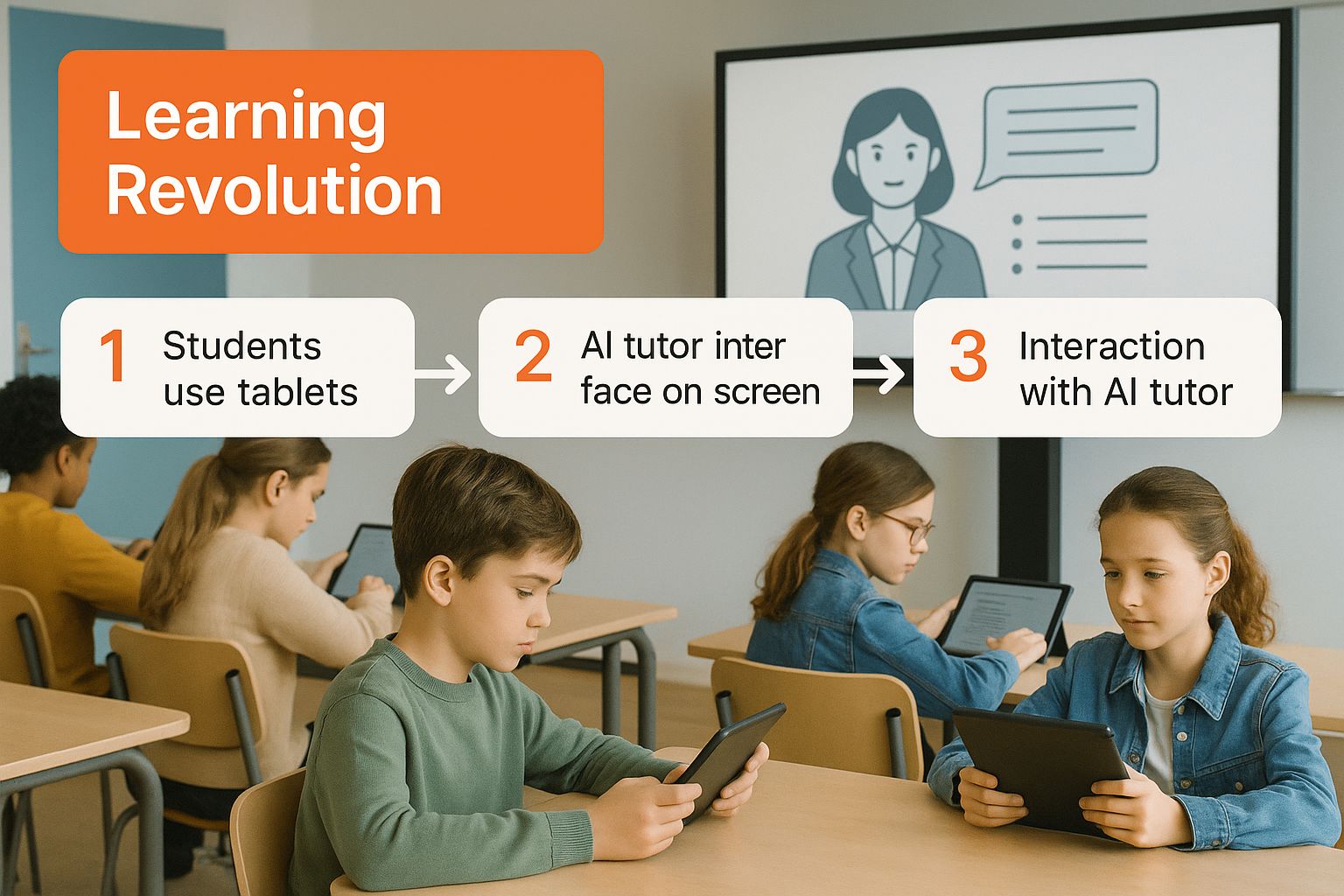
alt text: An infographic detailing AI’s impact on education, with icons for personalized learning, administrative automation, and enhanced content creation.
What this shows is technology evolving from a simple add-on to a core part of the educational fabric. The real takeaway is that learning is becoming more adaptive and individualized than ever before.
A New Era of Personalised Education
For centuries, the classroom has followed a one-to-many model. AI is turning that on its head, making a one-to-one learning dynamic possible at scale. This goes far beyond digital worksheets; we’re talking about intelligent systems that understand how each student learns, where they struggle, and when they’re ready for a challenge.
AI acts as an educational co-pilot. It guides students through tricky subjects at their own pace, while giving educators real-time data to step in and help. It’s brilliant at spotting small knowledge gaps before they become major roadblocks.
This isn’t a niche idea—it’s backed by serious investment. Globally, spending on AI in education is expected to leap from $8 billion in 2025 to $32 billion by 2030. The Asia-Pacific region is at the forefront of this wave, with a compound annual growth rate of around 48%. The results speak for themselves: early studies show that students using AI-powered learning tools scored, on average, 21% higher on standardized math tests.
Empowering Educators and Institutions
For teachers, AI is a chance to reclaim their time. When tasks like grading, routine lesson planning, and parent communications are automated, educators are free to focus on what matters—mentoring, sparking curiosity, and nurturing critical thinking. You can dive deeper into this subject by reading about the transformative power of artificial intelligence in modern innovation.
To pull it all together, here’s a quick overview of how AI will make its mark.
AI’s Core Impact Areas in Education at a Glance
| Area of Impact | What It Means for Students | What It Means for Educators |
|---|---|---|
| Personalised Learning | Custom learning paths and content that adapt to individual pace and style. | Data-driven insights to understand and address specific student needs. |
| Administrative Automation | Faster feedback on assignments and quizzes. | Less time spent on grading, scheduling, and reporting; more time for teaching. |
| Enhanced Content Creation | Access to dynamic, interactive, and endlessly customisable learning materials. | AI-powered tools to help design engaging lesson plans and assessments. |
| Intelligent Tutoring | 24/7 support and guidance on difficult subjects, available on demand. | A powerful assistant to reinforce concepts taught in the classroom. |
Ultimately, this move towards an AI-integrated approach is about building a smarter, fairer, and more effective system for everyone. It’s about creating a future where every student has the support and resources they need to thrive.
How AI Creates Personalised Learning Paths
One of AI’s most exciting promises is its potential to give every student a one-on-one learning experience. This isn’t about replacing teachers but about giving them a powerful assistant that tunes into the unique needs of each learner. At the heart of this shift are adaptive learning platforms.
These platforms use algorithms to monitor a student’s performance in real-time. As a student works through tasks, the AI collects data, looking for what they’ve mastered and pinpointing the exact concepts where they’re getting stuck.
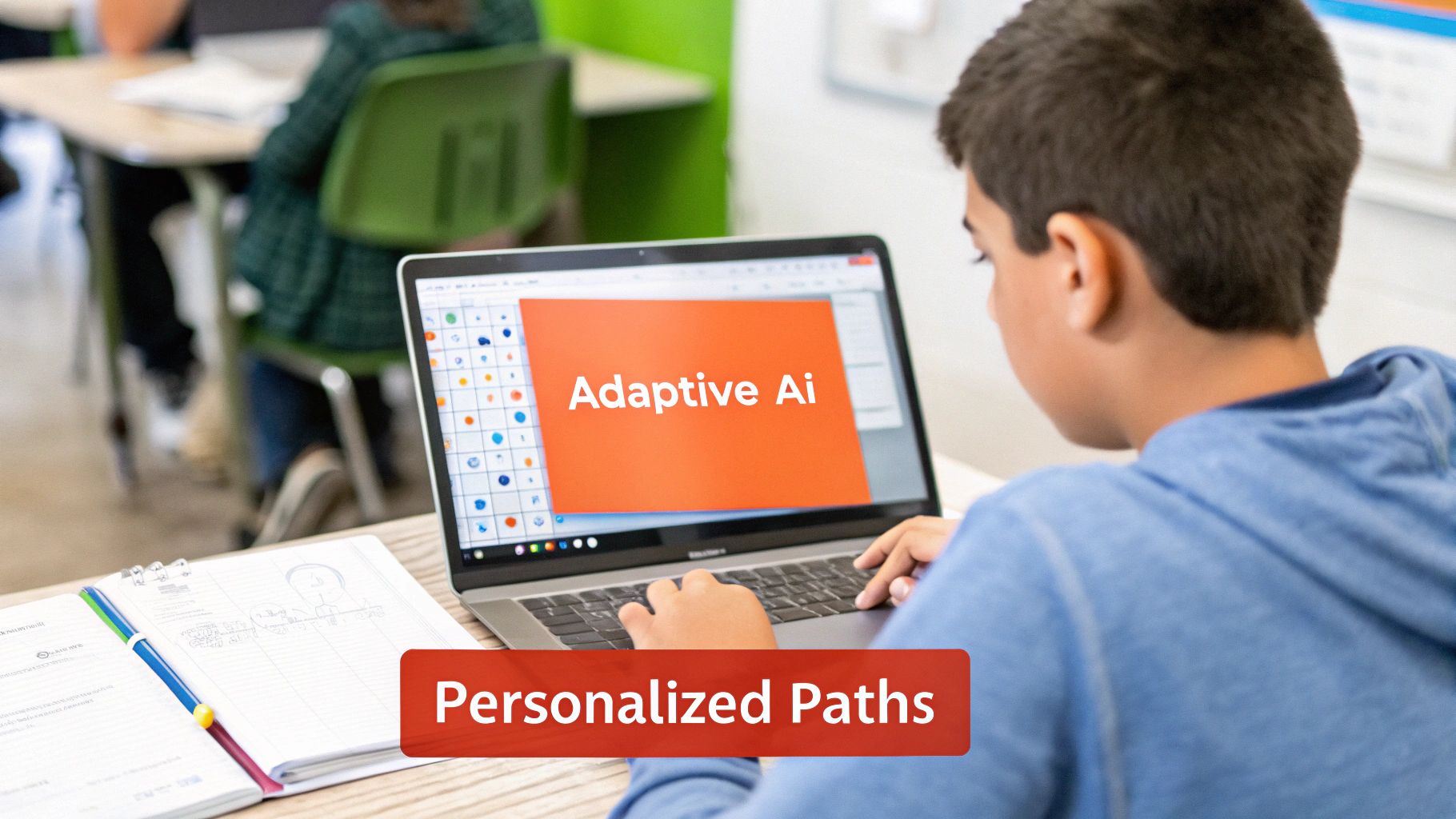
alt text: An animated graphic showing a central AI brain branching out to individual student profiles, each with a unique learning path illustrated by different icons and progress bars.
This constant cycle of assessment and feedback lets the system build a personal learning journey. Instead of marching every student down the same path, the AI adjusts the material on the fly, serving up lessons and resources that are just right for that individual.
What Does Adaptive Learning Look Like in the Classroom?
Here’s a practical example of how an AI-powered tutor helps a student struggling with algebra:
- Find the Gap: The AI scans the student’s assignment and notices a pattern of mistakes with negative exponents, revealing a specific knowledge gap.
- Deliver a Micro-Lesson: Instead of assigning the whole chapter again, the AI delivers a short, targeted micro-lesson—perhaps a quick video or an interactive model—focused only on negative exponents.
- Adjust on the Fly: As the student works through new problems, the AI adjusts the difficulty. If they grasp it quickly, the questions get harder. If they’re still unsure, the system offers more hints.
- Mastery Before Moving On: The student doesn’t move ahead until the AI confirms they’ve mastered the skill. This mastery-based approach prevents small misunderstandings from becoming major roadblocks.
This process ensures students get the support they need, right when they need it.
“The key question moving forward is: How can AI help us build more customised learning pathways for students while preserving the essential role of human educators? Finding that balance will define the future of AI in education.”
This approach is making a huge difference in regions with unique educational hurdles. In Southeast Asia, AI platforms help tackle problems like overcrowded classrooms by using student data to tailor the curriculum and pace for each learner, delivering support at a previously impossible scale.
The Technology Fuelling the Change
The “magic” behind these platforms is machine learning, a branch of AI where systems learn from data instead of being explicitly programmed. Algorithms sift through data from thousands of students to spot patterns in how we learn. For a deeper dive, check out our guide on how machine learning works by learning from experience.
Actionable Takeaways
- Try a free tool: Experiment with an adaptive learning platform like Khan Academy to see personalized pacing in action. Use its teacher dashboards to identify class-wide knowledge gaps.
- Focus on ‘why’: When using an AI tutor, encourage students to understand why they made a mistake, not just find the right answer.
- Pilot a program: School administrators can pilot an adaptive learning platform in a single subject to collect data on its impact before a school-wide rollout.
Tools & Resources
- Khan Academy: A non-profit offering free, personalized learning resources across a huge range of subjects.
- DreamBox Learning: An adaptive platform with a sharp focus on mathematics that adjusts in real time to student performance.
- Quizlet: Uses AI to generate custom study plans and practice tests based on a student’s goals and progress.
Further Reading
- Explore our post on how automation transforms everyday tasks to see how similar ideas are used in other fields.
- See our guide on the ethical considerations of AI to understand the importance of responsible implementation.
Freeing Teachers from Admin to Do What They Do Best
Ask any teacher, and they’ll tell you: the sheer volume of administrative work is overwhelming. This is where AI is already making a practical difference—not by replacing teachers, but by taking repetitive tasks off their plates.
Think of AI as the ultimate teaching assistant. It handles time-draining duties so educators can focus on what truly matters: mentoring students, leading discussions, and offering one-on-one support. It’s a shift from administrator back to educator.
alt text: A teacher at a desk looking relieved, with a dashboard on their screen showing automated grading, scheduling, and student progress reports handled by an AI.
When teachers aren’t buried in paperwork, they have more energy for the human connections that no algorithm can replicate.
Turning Hours of Lesson Planning into Minutes
Creating fresh, engaging lesson plans is incredibly time-intensive. AI can slash this preparation time dramatically. Here’s a step-by-step example:
- Open an AI tool: Go to a generative AI like ChatGPT or Gemini.
- Write a specific prompt: Give the AI clear instructions. For example: “Create a 45-minute lesson plan for a Year 9 history class on the causes of World War I. Include a warm-up activity, a primary source analysis exercise, a small group discussion prompt, and a five-question exit ticket.”
- Refine the output: In seconds, the AI delivers a structured plan. It’s not the final version, but it’s a fantastic starting point. The teacher can then use their professional judgment to tweak and perfect it, saving hours.
Smarter, Faster Marking and Feedback
Marking is another notorious time-eater. AI tools are perfectly suited to automate the grading of multiple-choice quizzes and fill-in-the-blank questions, giving students instant feedback. But what about essays? While AI can’t judge an argument like a human, it can still help by:
- Flagging potential plagiarism: Instantly cross-referencing submissions against online sources.
- Checking grammar and structure: Giving feedback on writing mechanics so the teacher can focus on ideas.
- Identifying key themes: Highlighting whether a student has addressed all parts of the essay prompt.
This kind of automation turns a weekend-long marking marathon into a manageable task. We explore similar efficiency gains in our article on how automation transforms everyday tasks.
Simplifying Communication and Uncovering Insights
AI can help draft routine progress reports, summarize a student’s performance data, or translate messages for families. Beyond communication, AI can analyze classroom data to spot trends a busy teacher might miss, empowering them to step in early and make data-driven decisions.
Actionable Takeaways
- Brainstorm with AI: Use a tool like RichlyAI or ChatGPT or Gemini as a creative partner to get ideas for your next lesson.
- Explore your LMS: Many Learning Management Systems already have AI-powered auto-grading features for quizzes. See what yours can do.
- Draft parent emails: Ask an AI to generate a clear, professional draft for class-wide updates that you can quickly personalize.
Tools & Resources
- MagicSchool AI: A platform built for teachers with tools for everything from lesson planning to writing report card comments.
- Gradescope: A tool that uses AI to streamline marking for a huge range of assignments.
- Curipod: A resource for creating interactive, AI-generated lesson plans and activities from simple prompts.
Enhancing Accessibility and Inclusivity with AI
One of AI’s most powerful promises is its ability to dismantle long-standing barriers, creating a learning environment where every student can thrive. AI-powered tools offer practical, real-time support that makes learning accessible to all. This isn’t a nice-to-have; it’s a profound shift toward genuine inclusivity.
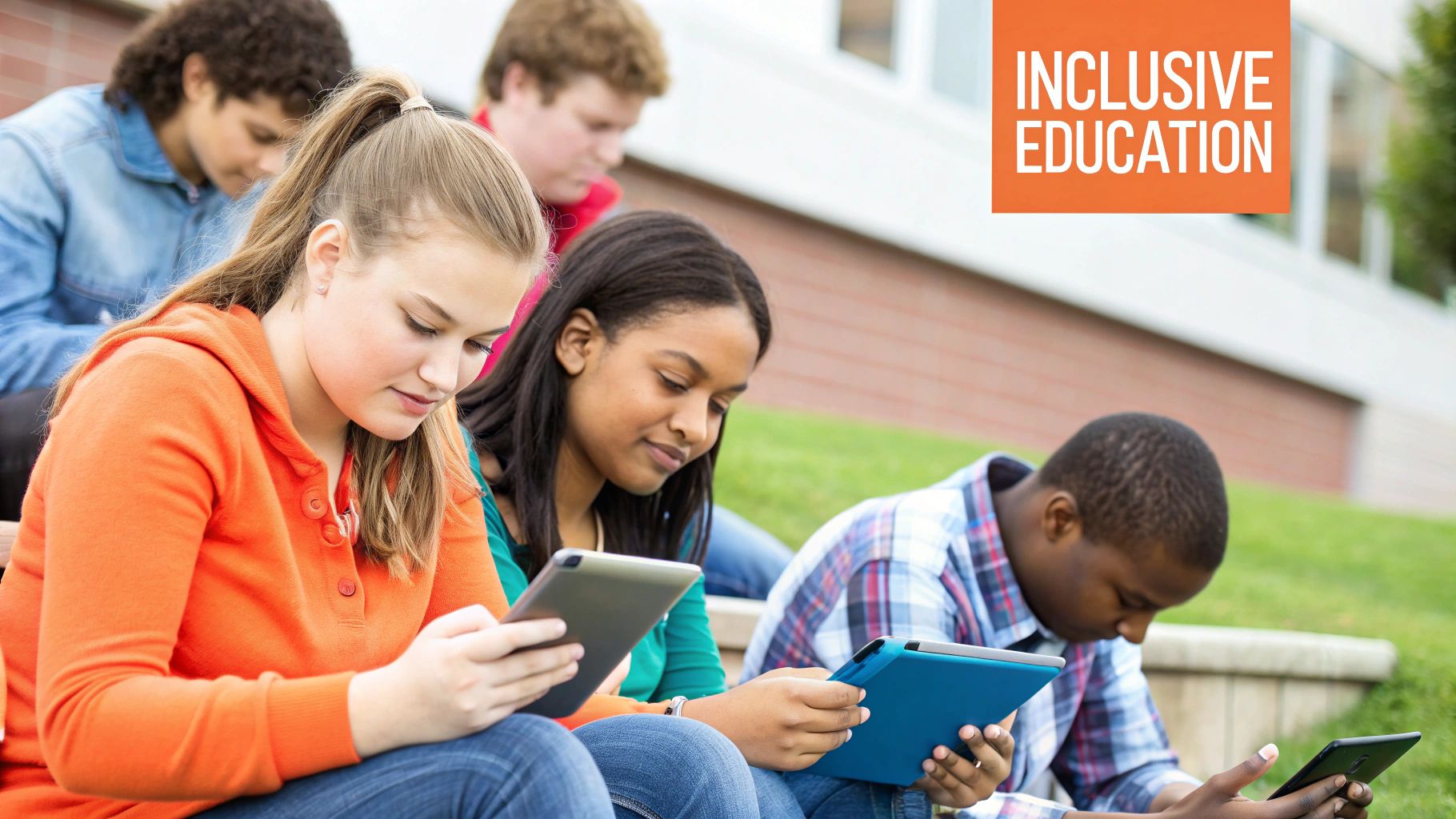
alt text: A diverse group of students using various devices with accessibility features enabled, such as screen readers and real-time captioning, in a collaborative learning environment.
The core idea is simple: technology should adapt to the student, not the other way around.
Dismantling Communication Barriers
For students who are deaf, hard of hearing, or learning in a second language, the classic lecture format can be a hurdle. AI offers an immediate solution. Here’s how real-time transcription works in a lecture hall:
- Audio Capture: The lecturer’s voice is picked up by a microphone connected to an AI service.
- Real-Time Transcription: The AI instantly converts the spoken words into written text.
- Display: This text appears as live captions on the student’s personal device, so they can read what’s being said as it happens.
This same technology can simultaneously translate the lecture, breaking down linguistic walls for international students.
AI-driven tools offer a scalable solution to the global education crisis. They enable remote, adaptive learning even in resource-limited settings and overcome language barriers through real-time translation.
This is critical when we look at global educational disparities. For instance, in Southeast Asia, 18 million children and teenagers are out of school, according to UNESCO’s report on educational access. AI offers a realistic path forward by tackling these challenges with scalable platforms.
Customising the Learning Interface
Beyond communication, AI gives students the power to mold their digital learning environment. This is a game-changer for learners with visual impairments or reading disabilities like dyslexia. AI-driven interfaces let students instantly tweak settings like font sizes and color contrasts. Text-to-speech tools can read digital textbooks aloud, while speech-to-text software allows students to dictate essays. These are essential tools that unlock learning.
Actionable Takeaways
- Explore built-in tools: Investigate accessibility features already in your school’s software, like Microsoft’s Immersive Reader or Apple’s VoiceOver.
- Trial a transcription service: Use a free tool like Otter.ai during a meeting or lecture to see the power of real-time transcription for yourself.
- Encourage customization: Urge students to use browser extensions that let them change webpage fonts and colors to find what works best for them.
Tools & Resources
- Microsoft Immersive Reader: A free tool built into many Microsoft products that uses proven techniques to improve reading for people of all abilities.
- Google’s Live Transcribe: An app that provides real-time speech-to-text transcription on your phone.
- Read&Write by Texthelp: A popular toolbar that helps with reading, writing, and studying with features like text-to-speech and word prediction.
Navigating the Challenges and Ethical Considerations
To realize AI’s promise, we must address the risks of student data privacy, hidden biases, and the digital divide. Facing these issues head-on is the only way to build a future where AI genuinely serves every student. Getting this right is about striking a careful balance between seizing opportunities and building solid guardrails.
alt text: A diagram showing a balance scale, with ‘AI Benefits’ on one side and ‘Ethical Risks’ (like data privacy and bias) on the other, representing the need for careful consideration.
Protecting Student Data in an AI-Driven World
Adaptive learning tools work by collecting vast amounts of data. This creates a massive responsibility. The critical questions for any school are: Who owns this data? How is it protected? What is it being used for? Partnering with AI vendors who have transparent data policies is essential.
The sophistication with which data is being used is changing rapidly. The conversation must shift from simply collecting data to establishing transparent policies for its ethical use and protection.
The Hidden Danger of Algorithmic Bias
An AI is only as fair as the data it was trained on. If that data carries existing societal biases, the AI will learn and amplify them. This is called algorithmic bias. For example, an AI tool trained primarily on data from affluent students might unfairly flag students from lower-income areas as “less likely to succeed,” creating a devastating self-fulfilling prophecy. Educators must scrutinize AI tools for potential bias, and vendors must be transparent about how their algorithms are built. For a better handle on the wider implications, dig deeper with our guide to ethical AI in daily decisions.
The Human Element and the Digital Divide
Over-reliance on AI risks weakening critical thinking skills. The goal is for AI to be a helpful co-pilot, not an oracle that stifles independent thought. Furthermore, the future impact of AI on education could worsen the digital divide. Students without reliable internet or devices at home will be left behind. Ensuring equitable access is an ethical imperative.
Ethical AI Implementation Framework
This framework provides a practical approach for navigating these complexities.
| Ethical Principle | Potential Risk | Actionable Mitigation Strategy |
|---|---|---|
| Data Privacy & Security | Unauthorised access or misuse of student data. | Partner only with vendors compliant with privacy regulations (like GDPR). Establish a clear data governance policy. |
| Fairness & Equity | Algorithmic bias unfairly disadvantages certain student groups. | Mandate “bias audits” for all new AI tools. Train staff to challenge unfair AI-driven recommendations. |
| Transparency | “Black box” algorithms make it impossible to understand AI decisions. | Require vendors to explain how their algorithms work. Establish human review for high-stakes decisions. |
| Accountability | Lack of clear responsibility when an AI tool makes a harmful error. | Create an AI ethics committee and designate a role responsible for AI governance. |
| Human Oversight | Over-reliance on AI diminishes critical thinking and educator autonomy. | Implement professional development focused on using AI as a supportive tool, not a replacement for human judgment. |
Actionable Takeaways
- Create an AI Ethics Committee: Form a group with teachers, administrators, and parents to review and approve new AI tools.
- Demand a “Bias Statement”: Ask vendors for a document detailing how they’ve worked to reduce algorithmic bias.
- Prioritize teacher training: Run sessions that focus not just on how to use the tools, but on when and why, stressing human oversight.
- Conduct an access audit: Survey students to understand their access to devices and internet at home to create a fair AI strategy.
Tools & Resources
- AI for Education: An organization offering resources and training to help educators use AI responsibly.
- The Algorithmic Justice League: A group dedicated to exposing and correcting bias in AI systems.
- Common Sense Media: Provides trusted reviews for educational apps, often with detailed info on data privacy.
Your Action Plan for Embracing AI in Education
Moving from theory to practice requires a clear plan. The key is to start small, build confidence, and expand on what’s working.
First Steps for Teachers
Start with free, easy-to-use tools that solve an everyday problem. Here is a step-by-step process for using AI in lesson planning:
- Define Your Goal: Be specific. Example: “A 45-minute lesson plan for Year 10 biology on cellular respiration.”
- Add Specifics: Flesh it out with key elements: “Include a warm-up activity, a diagram labelling exercise, and three quiz questions.”
- Prompt the AI: Put this detailed request into a tool like ChatGPT. For best results, see our guide on how to use ChatGPT effectively.
- Refine and Personalise: The AI provides a solid starting point. Use your professional judgment to tweak the content, inject your teaching style, and make it a perfect fit for your students.
A Roadmap for School Leaders
For administrators, strategic implementation is key. A pilot program is the smartest way to test an AI platform before a school-wide rollout.
The most successful AI adoptions are led by a clear vision. Start by identifying a specific, measurable goal, such as improving math scores in a particular year group, and then find the right tool to help you achieve it.
Pick one adaptive learning platform and try it in a few classrooms. Over a term, you can gather real data on student engagement, get feedback from teachers, and track performance. This evidence-based approach removes guesswork.
Guidance for Parents and Guardians
Parents play a huge role in teaching children how to use these tools responsibly. Frame AI as a learning assistant, not a magic answer box. Talk openly about its weaknesses, like its tendency to “hallucinate” (make things up). A great exercise is to fact-check an AI’s output with your child using a reliable source, teaching critical thinking and the need for human oversight.
Actionable Takeaways
- Teachers: Set aside 30 minutes this week to experiment with one AI lesson planning tool like MagicSchool AI.
- Administrators: Identify one academic area for improvement and research two relevant adaptive learning platforms.
- Parents: Ask your child to show you an AI tool they’re using. Discuss its benefits and limitations.
Tools & Resources
- Khanmigo: An AI-powered tutor and teaching assistant from Khan Academy for personalized student support.
- Curipod: A platform for creating interactive, AI-generated lesson plans and classroom activities.
- AI for Education: An organization offering excellent resources and professional development to help teachers use AI safely and effectively.
Frequently Asked Questions About AI in Education
As AI becomes more common, it’s natural to have questions. Let’s tackle the most common ones.
Will AI Replace Teachers in the Classroom?
No. AI is a powerful teaching assistant, not a replacement. Its strength lies in automating tedious tasks, freeing teachers to focus on the irreplaceable human side of their work: mentoring, guiding discussions, nurturing creativity, and providing personal support.
How Is My Child’s Data Kept Safe?
Data privacy is a top priority. Reputable educational AI tools must comply with strict data protection laws. Schools are responsible for partnering only with companies that are transparent about how they handle student data.
Before bringing any new technology into the classroom, schools must do their homework. They need to confirm that the tool has solid security measures in place to keep sensitive student data confidential and ensure it’s used only for its intended educational purpose.
What Is the Easiest Way to Start Using AI?
Start small by picking one specific, everyday task. A great way to begin is by using a free AI tool for lesson prep. Here’s a simple process:
- Pinpoint a need: You’re looking for fresh ideas for a history lesson.
- Use a simple prompt: Open a free AI tool and type, “Give me five creative warm-up activities for a Year 9 class studying the Industrial Revolution.”
- Review and adapt: The AI will generate a list in moments. Use your professional judgment to pick the best idea and tweak it for your students.
This simple process lets you bring AI into your workflow without any fuss.
How Does Algorithmic Bias Affect Students?
Algorithmic bias is a serious issue where an AI system produces unfair results due to biased training data. In a school setting, this could lead to an AI tool penalizing students from certain backgrounds. To prevent this, educators must thoroughly check any potential AI tools for fairness and transparency before they are used with students.
Ready to see how AI can streamline your own work? RichlyAI offers a suite of powerful tools to generate high-quality text, create engaging visuals, and automate repetitive tasks, giving you more time to focus on what matters. Explore the possibilities and sign up for a free plan at RichlyAI.
