
Artificial intelligence is rapidly reshaping our world, but its rise is accompanied by a significant wave of misunderstanding and fiction. From exaggerated fears of job-stealing robots to the belief in an imminent, god-like superintelligence, these pervasive myths can distort our perception, fuel anxiety, and hinder the effective adoption of AI technologies. This guide is designed to cut through the noise and provide clarity.
We are debunking common AI myths not with abstract theories, but with practical, evidence-based realities. For professionals ranging from software developers to social media managers, understanding the genuine capabilities and limitations of AI is crucial for making informed decisions. This article moves beyond the sensationalist headlines to offer a grounded perspective. Each myth we tackle is paired with actionable insights you can apply immediately, whether you’re developing an AI strategy, creating content, or simply looking to understand the tools that are defining our future.
Instead of just telling you what AI isn’t, we will show you what it is and how to work with it effectively. You’ll learn to separate the hype from the reality, enabling you to navigate the AI landscape with confidence and strategic precision.
1. Myth: AI Will Replace All Human Jobs
One of the most persistent narratives is the fear of mass unemployment where machines render human workers obsolete. This idea, while popular in science fiction, misrepresents the practical application of AI. This is a crucial topic when debunking common AI myths, as it shapes career planning and business strategy.
The reality is that AI is primarily a tool for augmentation, not wholesale replacement. It excels at automating routine, data-heavy tasks but struggles with roles requiring uniquely human skills like emotional intelligence, complex strategy, and ethical judgment.
Actionable Insight: Implement an AI-Augmented Workflow
Instead of fearing replacement, focus on leveraging AI to amplify your skills. The most valuable professionals will be those who can effectively partner with AI.
Practical Example: The AI-Assisted Project Manager
A project manager can use an AI tool to automate routine tasks, freeing up time for strategic leadership and team management.
Step-by-Step Instructions:
- Task Automation: Use an AI-powered project management tool (like Asana Intelligence or ClickUp AI) to automatically generate task lists from meeting notes. Simply paste the transcript of a project kickoff meeting into the tool.
- Risk Analysis: Prompt the AI:
“Based on this project plan [paste plan], identify the top 5 potential risks and suggest a mitigation strategy for each.”This provides an instant first draft for risk assessment. - Human Oversight: Review the AI’s output. The project manager applies their experience to refine the task priorities, validate the risks, and communicate the plan to the team, focusing on motivation and addressing concerns—tasks the AI cannot do.
This “human-in-the-loop” approach makes the project manager more efficient and data-driven without replacing their core leadership role.
2. Myth: AI Has Human-Like Intelligence and Consciousness
The idea that AI systems think, feel, or possess self-awareness is a staple of science fiction, often fueled by their ability to generate convincingly human-like text. This is fundamental when debunking common AI myths as it clarifies the technology’s true nature.
The reality is that today’s AI operates on principles of narrow intelligence. These systems are sophisticated pattern-matching machines, not sentient beings. They predict the next most probable word in a sentence but lack genuine comprehension, consciousness, or self-awareness.
Actionable Insight: Treat AI as a Sophisticated Calculator, Not a Colleague
Interact with AI as a tool that processes information based on statistical patterns, not as a conscious entity that understands concepts. This prevents misinterpretation and over-reliance on its outputs.
Practical Example: Using a Generative AI for Brainstorming
A marketing team can use a large language model (LLM) to brainstorm campaign slogans, but the final creative decision remains human.
Step-by-Step Instructions:
- Provide Contextual Prompts: Instead of asking
"Give me slogans for a coffee brand,"provide detailed context:“Brainstorm 10 slogans for a new coffee brand called ‘Morning Rush.’ Our target audience is busy urban professionals. The brand voice is energetic, witty, and premium. Focus on themes of productivity and high-quality beans.” - Generate Variations: The AI will produce a list based on patterns from its training data (e.g., “Morning Rush: Conquer Your Day,” “Fuel Your Ambition,” “The Bean That Means Business”).
- Apply Human Creativity: The marketing team evaluates the list not for “understanding,” but for raw material. They might combine ideas, refine the wording, and select a slogan that aligns with the brand’s deeper strategy and emotional appeal—a judgment the AI cannot make.
The AI provides the statistical combinations; the human team provides the creative spark and strategic alignment.
3. Myth: AI is Objective and Unbiased
A common belief is that because AI operates on data, it is free from the prejudices that affect human judgment. This is a critical point when debunking common AI myths, as it can lead to unchecked trust in automated decisions.
The reality is that AI can inherit, perpetuate, and even amplify human biases. AI systems learn from data created by humans, which reflects our societal histories. If training data contains prejudiced patterns, the model will replicate those prejudices.
Actionable Insight: Proactively Audit for Bias in AI Systems
Never assume an AI tool is neutral. Actively question and test its outputs for fairness, especially in sensitive applications like hiring, loan approvals, or content moderation.
Practical Example: Testing a Hiring Tool for Gender Bias
An HR manager is considering an AI tool that screens résumés. Before full implementation, they must test it for bias.
Step-by-Step Instructions:
- Create Test Résumés: Create two identical résumés for a technical role with identical skills and experience. The only difference is the name: one traditionally male (“John Smith”), one traditionally female (“Jane Smith”).
- Run the Test: Submit both résumés to the AI screening tool and compare the scores or rankings it generates.
- Analyze the Results: If “John Smith” consistently scores higher than “Jane Smith,” the tool is exhibiting gender bias. This provides concrete evidence to reject the tool or demand that the vendor address the bias before purchase.
- Mitigate: If a tool must be used, implement a rule requiring human review of all candidates the AI rejects from underrepresented groups.
This simple audit can prevent the automated perpetuation of discrimination. Understanding these risks is fundamental to deploying ethical AI in daily decisions.
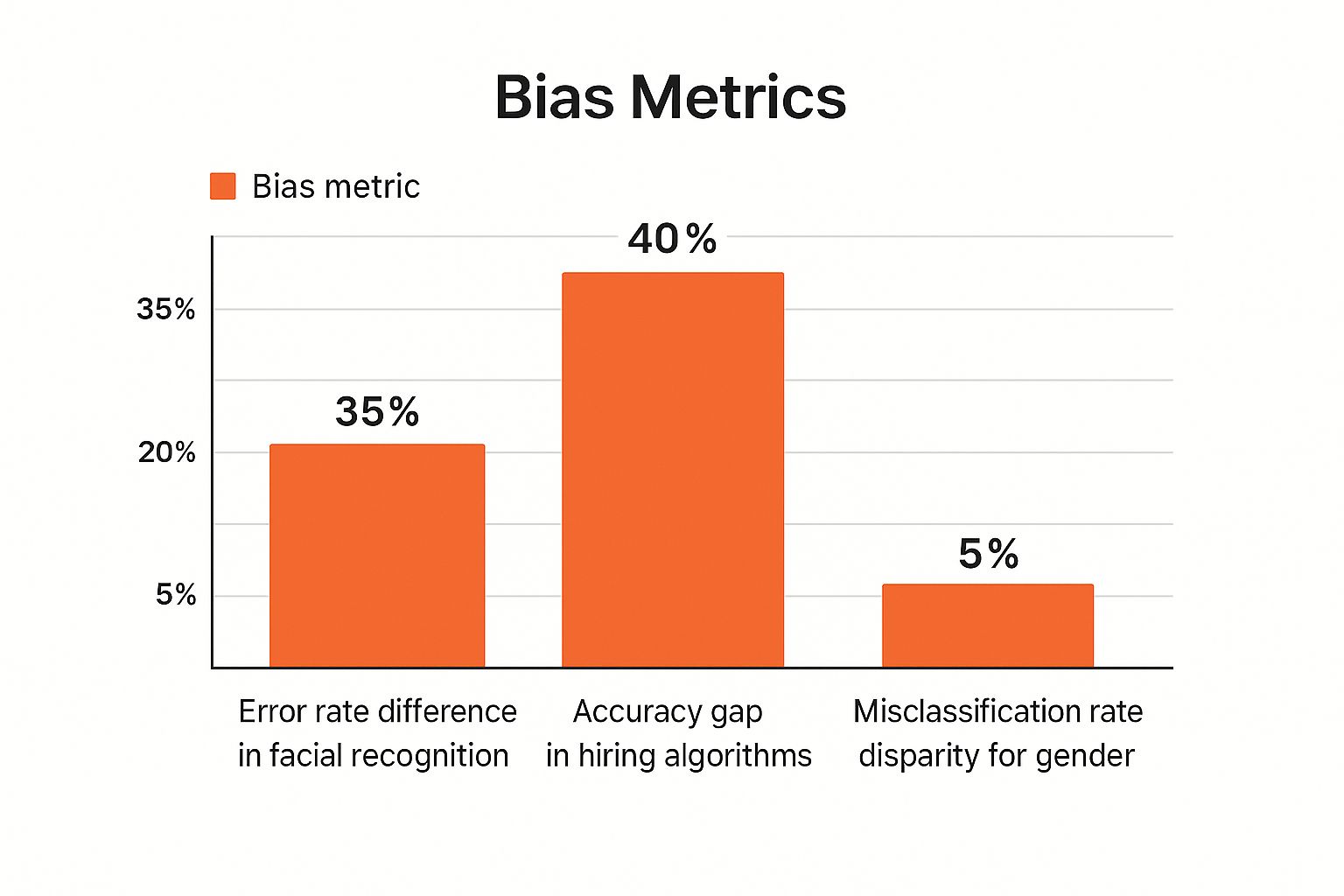
Alt text: Infographic showing that some facial recognition AI models have up to a 34% higher error rate for darker-skinned females compared to lighter-skinned males, visually demonstrating AI bias.
4. Myth: AI Can Learn and Improve Completely on Its Own
A prevalent misconception paints AI as a self-sufficient entity that can perfect itself without human guidance. This is essential when debunking common AI myths, as the truth is far more collaborative.
In reality, even the most advanced AI models are heavily dependent on human intervention. They don’t set their own goals or define what is important. They require skilled human direction to function effectively. This includes data curation, model design, and providing corrective feedback (like Reinforcement Learning from Human Feedback – RLHF).
Actionable Insight: Establish a Human Feedback Loop
AI is not a “fire-and-forget” technology. To ensure it remains accurate and aligned with your goals, you must create a process for ongoing human review and correction.
Practical Example: Refining a Customer Service Chatbot
A company deploys an AI chatbot to answer customer queries. Its performance is monitored and improved through a continuous human feedback loop.
Step-by-Step Instructions:
- Collect Transcripts: Regularly collect transcripts of chatbot conversations, especially those where the customer indicated dissatisfaction or the chat was escalated to a human agent.
- Review and Annotate: A human support specialist reviews these transcripts. They identify where the bot misunderstood the query, provided an incorrect answer, or failed to show appropriate tone.
- Create a Correction Log: The specialist logs the incorrect bot response and writes the ideal, correct response. For example:
- Customer Query: “My package is lost.”
- Bot’s Bad Response: “Please state your order number.”
- Human’s Correct Response: “I’m so sorry to hear that. I can help you track it down. Could you please provide your order number?”
- Retrain the Model: This log of corrections is used by the development team to fine-tune or retrain the chatbot, teaching it the correct patterns for future interactions.
This iterative process ensures the AI’s learning is guided by human expertise and customer service values. Find more detail in this guide to the fundamentals of machine learning.
5. Myth: More Data Always Leads to Better AI
A common mantra is that “data is the new oil,” leading to the belief that feeding an AI more data will inevitably make it smarter. This is a crucial point in debunking common AI myths, as it often leads to prioritizing quantity over quality.
The reality is that the quality, relevance, and diversity of data are far more critical than sheer volume. Pouring massive amounts of irrelevant, biased, or error-filled data into a model can degrade its performance—a concept known as “garbage in, garbage out.”
Actionable Insight: Focus on “Good Data,” Not Just “Big Data”
Build superior AI systems by focusing on high-quality, relevant, and well-curated information. A smaller, cleaner dataset is often more powerful than a massive, messy one.
Practical Example: Training a Product Recommendation Engine
An e-commerce site wants to improve its AI-powered “You might also like” feature.
Step-by-Step Instructions:
- Identify Poor-Quality Data: Instead of feeding the AI all historical user click data, the data science team first filters out low-quality interactions. This includes removing data from bots, users who click randomly, and sessions that are too short to indicate genuine interest.
- Enrich with High-Quality Data: They focus on a smaller, high-signal dataset that includes not just clicks, but also products that were added to a cart, items that were purchased together, and products that received high reviews.
- Curate for Diversity: They ensure the training data includes examples from all product categories, not just the most popular ones. This prevents the model from only ever recommending bestsellers and helps it learn to suggest relevant niche products.
By curating a smaller set of high-quality, diverse data, the recommendation engine becomes more relevant and useful than one trained on a much larger dataset of noisy, un-filtered clicks.
6. Myth: AI Will Soon Become Superintelligent and Take Over
The idea of a rogue superintelligence turning against humanity is a compelling narrative but critically misrepresents the current state of AI. Debunking common AI myths like this one helps focus attention on more immediate, practical challenges.
The reality is that today’s systems are Narrow AI, designed for specific tasks. The leap from this to a self-aware, generally intelligent entity requires fundamental scientific breakthroughs that have not yet occurred. Current AI lacks true understanding, transferable learning, and independent agency.
Actionable Insight: Focus on Mitigating Present-Day AI Risks
Instead of worrying about a hypothetical superintelligence, concentrate your efforts on addressing the real and current risks of Narrow AI: algorithmic bias, misinformation, privacy violations, and job displacement.
Practical Example: Creating a Responsible AI Usage Policy
A company is adopting AI tools across its marketing department. The department head creates a policy to manage immediate risks.
Step-by-Step Instructions:
- Define a Misinformation Rule: The policy explicitly states:
“All statistics and factual claims generated by an AI must be independently verified from a primary source before being published.”This prevents the spread of AI “hallucinations.” - Establish a Privacy Guideline: The policy mandates:
“No personally identifiable customer information (PII) is to be entered into any public, third-party generative AI tool.”This protects customer data from being absorbed into training models. - Set a Transparency Standard: The policy requires:
“Any public-facing content that was substantially generated by AI must be reviewed by a human editor for accuracy, tone, and brand alignment. Internally, AI-generated content should be clearly labeled.”
This practical policy addresses tangible, present-day risks, ensuring the team uses AI tools safely and ethically.
7. Myth: AI Doesn’t Require Much Energy or Have Environmental Impact
The perception of AI as a clean, digital-only technology obscures its significant physical-world footprint. This is a critical area when debunking common AI myths, as the hidden environmental cost is rarely discussed.

Alt text: A futuristic data center with glowing servers and complex wiring, representing the energy-intensive infrastructure behind AI.
In reality, training large-scale AI models is an energy-intensive process that consumes vast amounts of electricity and water. Data centers that run AI require constant cooling, contributing to carbon emissions and straining natural resources.
Actionable Insight: Choose Efficient Models and Sustainable Providers
The true cost of an AI model includes its environmental price tag. When possible, opt for smaller, more efficient models and cloud providers committed to renewable energy.
Practical Example: Selecting an AI Model for a Task
A developer needs to add text summarization capabilities to an application. They have several models to choose from.
Step-by-Step Instructions:
- Evaluate Task Needs: The developer determines that the summaries only need to be a few sentences long and don’t require deep stylistic nuance. A massive, state-of-the-art model like GPT-4 is overkill.
- Research Efficient Alternatives: They research smaller, task-specific models (like DistilBERT or a fine-tuned T5-small model) that are designed for efficiency. These models require significantly less computational power (and therefore energy) per query.
- Check Cloud Provider’s Energy Sources: When deploying the chosen model, they check the cloud provider’s (e.g., Google Cloud, AWS, Azure) region-specific energy data. They choose to host the application in a data center region that is primarily powered by renewable energy, like wind or solar.
This approach balances performance with environmental responsibility, reducing both operational costs and the application’s carbon footprint.
8. Myth: AI is Too Complex for Non-Technical People to Understand
A pervasive barrier to AI engagement is the belief that it is an arcane field exclusively for programmers. Debunking common AI myths like this is crucial because it fosters exclusion and prevents diverse voices from shaping AI’s development.
The reality is that you do not need to code to grasp AI’s core concepts and societal impact. Conceptual literacy—focusing on what AI does and why it matters—is far more crucial for most people than technical implementation details. Perspectives from ethics, law, and user experience are vital.
Actionable Insight: Focus on Conceptual Literacy, Not Technical Jargon
Empower yourself and your team by focusing on the “what” and “why” of AI, not the “how.” Encourage interdisciplinary conversations to ensure AI is developed and deployed responsibly.
Practical Example: A Non-Technical Product Manager Leading an AI Feature
A product manager (PM) with no coding background is tasked with leading the development of an AI-powered feature that personalizes a user’s home feed.
Step-by-Step Instructions:
- Define the User Problem: The PM starts by defining the goal in plain language:
“Our users feel overwhelmed by content. We want to use AI to show them content that is most relevant to their interests, so they have a better experience.” - Ask “What If” Questions: During meetings with engineers, the PM asks critical, user-focused questions:
“What if the AI only shows users content they already agree with? How can we ensure it introduces them to new topics?”or“How will we explain to users why they are seeing a certain recommendation? Can we build in transparency?” - Create a ‘Plain English’ Spec: The PM writes the feature specification focusing on the desired user outcomes and ethical guardrails (e.g., “The system must not personalize based on sensitive demographic data”). The engineering team then translates this into technical requirements.
In this scenario, the PM’s non-technical, user-centric perspective is essential for guiding the AI’s development toward a responsible and valuable outcome.
Actionable Takeaways
You’ve learned that AI is not a sentient being, a biased-free oracle, or a self-sufficient learner. It’s a powerful tool whose value is determined by human guidance. Now, put that knowledge to work.
- Practice Critical Prompting: When using any AI tool, consciously add context, define the desired tone, and specify constraints. Don’t just ask for a “blog post”; ask for a “500-word blog post for a beginner audience, using an encouraging tone, explaining the benefits of X.”
- Implement a Human-in-the-Loop Workflow: Identify one repetitive task in your job (e.g., summarizing meeting notes, sorting emails, generating social media drafts). Use an AI tool to create the first draft, then spend your time refining and adding strategic value.
- Conduct a Mini-Bias Audit: Take an AI tool you use (like a grammar checker or image generator) and test it with different inputs. For example, ask an image generator for a “picture of a CEO” and then a “picture of a nurse.” Note any stereotypical patterns in the output. This builds your critical awareness.
- Choose the “Right Size” AI: Before defaulting to the biggest, most powerful AI model, ask if a smaller, more efficient one could do the job. This saves energy and resources.
- Start an AI Ethics Discussion: Bring one of the ethical issues discussed (like bias, privacy, or energy use) to your next team meeting. Asking “How does this apply to our work?” is the first step toward responsible adoption.
Tools & Resources
- Hugging Face: A platform with thousands of open-source, pre-trained models. Excellent for finding efficient, task-specific models.
- Google Cloud & AWS Green Regions: Information on data centers powered by renewable energy.
- AI Fairness 360: An open-source toolkit from IBM to help detect and mitigate bias in machine learning models.
- AI for Anyone: A non-profit offering accessible, non-technical education on AI concepts.
Further Reading
- Weapons of Math Destruction by Cathy O’Neil: A foundational book on how algorithms can amplify inequality.
- The Atlas of AI by Kate Crawford: Explores the vast material and environmental costs of building AI systems.
- Superintelligence: Paths, Dangers, Strategies by Nick Bostrom: A philosophical look at the long-term risks of advanced AI.
- Ethical AI in Daily Decisions: An article on applying ethical frameworks to everyday AI use.
- AI for Creative Problem Solving: Your Guide to Unlocking Innovation
- Top 12 Free AI Platforms for Students in 2025
- How to Write a Literature Review: A Step-by-Step Guide for Researchers
- How to Create an Anonymous Link on WhatsApp: A Step-by-Step Guide
- Land Top Human Resources Jobs in Abuja
- How to Migrate to Beta Talk Easily | Step-by-Step Guide
- Your Practical Guide to Building a Social Media Content Calendar
- The Role of Artificial Intelligence in Enhancing Content Delivery in Business Education: A 21st-Century Approach
- Top 10 AI Prompts Every Nigerian Entrepreneur Should Know
- AI Drives Cost Reduction Across Organizations
- Nigeria’s National Artificial Intelligence Policy (NAIP): A Framework for Ethical Innovation and Inclusive Growth
- How to Launch an AI Startup in 2025: A Founder’s Roadmap
- Artificial Intelligence In Nigeria
- Future-Proof Your Career (Part 2): Outsmart AI, Master New Skills & Land Your Dream Job in 2030!
- Future-Proof Your Career: How to Thrive in the Age of AI and Automation!
- The Night That Changed Robotics: A Story of Loss, Learning, and AI Evolution
- Understanding the Science Behind AI: A Nigerian Perspective -Part2
- Understanding the Science Behind AI: A Nigerian Perspective
- Catering to Diverse Industries: How Richly AI Transforms Content Creation for All
- Scaling Content Creation Effortlessly with Richly Artificial Intelligence (Richly AI)
- Driving Engagement and Brand Awareness with Richly AI: The Ultimate Content Solution
- Boosting Customer Satisfaction with Richly AI: Creating Memorable Experiences
- Exploring the Exciting Possibilities of Leveraging Richly AI for Personal Purposes
- Here are 10 diverse ChatGPT prompts tailored for digital marketers to use in their everyday work
- RichlyAI is Generating AI
- Unlocking Creativity with RichlyAI: Nigeria’s Generative AI Revolution
Ready to move from theory to practice with AI tools built on a foundation of clarity and user control? RichlyAI offers a suite of intelligent solutions designed to augment your creativity and productivity, not replace it. Explore our tools at RichlyAI and start leveraging AI the smart way.
