
Artificial Intelligence (AI) in Nigeria is no longer a futuristic concept—it’s a practical tool businesses are actively using to solve real-world problems. This isn’t just a fleeting trend; it’s a fundamental shift. A young, tech-savvy population, improving digital infrastructure, and the urgent need for greater efficiency in a competitive market are driving this change.
This guide provides actionable steps and realistic examples to help you integrate AI into your Nigerian business, cut through the noise, and achieve measurable results.
Understanding the Nigerian AI Landscape Today
Think of the current state of AI adoption in Nigeria as a bustling Lagos market. On one side, you have established players like major banks using sophisticated AI for fraud detection. On the other, you have nimble startups leveraging AI to disrupt sectors from agriculture to healthcare with innovative solutions.

alt text: A modern office in Lagos with diverse professionals collaborating around a screen displaying AI analytics.
This growth is fueled by powerful, home-grown forces. By 2025, an incredible 93% of Nigerian companies had integrated AI into their operations, placing the nation firmly at the forefront of AI adoption in Africa.
Key Drivers Fuelling AI Growth
Several distinct factors are accelerating AI integration across Nigerian industries. Understanding these drivers helps you position your business to ride this wave of innovation.
| Driver | Impact on Adoption | Actionable Insight |
|---|---|---|
| A Young, Tech-Savvy Population | With a median age of just over 18, Nigeria has a massive pool of digital natives who expect tech-driven services. | Design your products and services with AI-powered features (like chatbots or personalization) to meet the expectations of this demographic. |
| Mobile-First Economy | High mobile phone penetration allows businesses to deliver AI services directly into customers’ hands. | Prioritize mobile-friendly AI tools. Implement an AI chatbot for WhatsApp or use AI to personalize push notifications in your mobile app. |
| Growing Digital Infrastructure | Investments in fibre optic cables and data centres are making cloud-based AI tools more accessible and affordable. | You no longer need massive on-site servers. Start experimenting with affordable, cloud-based AI platforms for marketing, sales, or operations. |
| Economic Diversification Push | A national drive to build a non-oil economy puts technology, especially AI, at the heart of future growth. | Align your AI strategy with national growth sectors (FinTech, AgriTech, creative industries) to potentially access grants and partnerships. |
These elements create an environment where AI is becoming essential for competitiveness and growth.
Where AI is Making the Biggest Impact
While AI is appearing everywhere, a few sectors are leading the charge by using it to solve their most pressing problems.
In financial services, banks use machine learning to analyze millions of transactions in real-time. This allows them to spot and flag potential fraud instantly, saving millions of Naira and protecting customers.
In e-commerce, companies use AI recommendation engines to create personalized shopping experiences. By analyzing browsing and purchase history, these systems suggest products customers are likely to buy, significantly boosting sales.
To see more specific examples, explore our guide on the top AI innovations transforming Nigeria in 2025. These applications show that AI has moved from a “nice-to-have” to a core part of modern business strategy in Nigeria.
How Nigerian Industries Are Winning with AI
The true story of AI is not in theory but in its on-the-ground application. Across Nigeria, businesses are using AI to solve practical problems and are seeing tangible results. These examples are not just success stories; they are a blueprint for how you can use this technology to tackle uniquely Nigerian challenges.

alt text: A team of Nigerian agricultural scientists analysing data on a tablet in a lush, green field.
FinTech: Securing Transactions in Lagos
The Problem: A major Lagos-based payment processor was struggling to keep up with sophisticated online fraud. Their manual review process and rigid, rule-based systems were too slow to catch new fraud tactics, leading to financial losses and eroding customer trust.
The AI Solution: They implemented a machine learning model that analyzes transaction data in real-time. The model scrutinizes hundreds of variables—transaction size, location, time of day, and user behavior history—to identify and flag suspicious activity instantly.
The Outcome: The AI system cut fraudulent transactions by over 40% within six months. It reduced fraud detection time from hours to mere seconds, freeing up human experts to focus on complex investigations instead of getting bogged down by false alarms. This is a clear example of using AI for risk management.
AgriTech: Boosting Yields in Kaduna
The Problem: Smallholder farmers in Kaduna faced uncertainty every season. Guessing the right time to plant, irrigate, and harvest led to inconsistent yields, wasted resources, and lost income.
The AI Solution: An innovative AgriTech startup built an AI platform that analyzes satellite imagery and local weather data to provide farmers with predictive, actionable advice via simple SMS alerts.
How It Works for the Farmer:
- Data Gathering: The AI collects satellite data on soil moisture and crop health.
- Predictive Analysis: It combines this data with weather forecasts to determine optimal times for planting, irrigation, and harvesting.
- Simple Alerts: A farmer receives a clear SMS, such as: “Conditions are ideal to plant maize in your area within the next 3 days.”
- Resource Optimization: The system also provides recommendations on fertilizer application to reduce waste and improve soil health.
This targeted advice helped local farmers increase crop yields by an average of 20-30%. It’s a powerful demonstration of how AI can empower small businesses and drive grassroots economic growth. For more on this, check out how SMEs in Africa can use AI for growth.
E-commerce: Enhancing the Customer Experience
The Problem: A leading Nigerian e-commerce platform’s customer service team was overwhelmed with repetitive queries like “Where’s my order?” and “What’s your return policy?” This led to long response times, frustrated customers, and agent burnout.
The AI Solution: They deployed an AI-powered chatbot on their website and mobile app. Trained on thousands of past customer conversations, the bot could instantly answer the most common questions 24/7. For complex issues, the bot seamlessly handed the conversation over to a human agent with the full chat history.
The Outcome: The platform saw a 60% reduction in its customer service ticket backlog in under three months. Human agents could now focus on resolving complex issues, which significantly boosted customer satisfaction scores. These case studies prove that AI adoption in Nigeria is a versatile tool for businesses of all sizes to solve their most significant challenges.
AI in Nigerian Marketing: A Deep Dive
For many Nigerian businesses, marketing is the most accessible entry point to AI. It’s a field where you can conduct small experiments and see tangible results quickly, making it the perfect testing ground to prove AI’s value without a massive upfront investment.
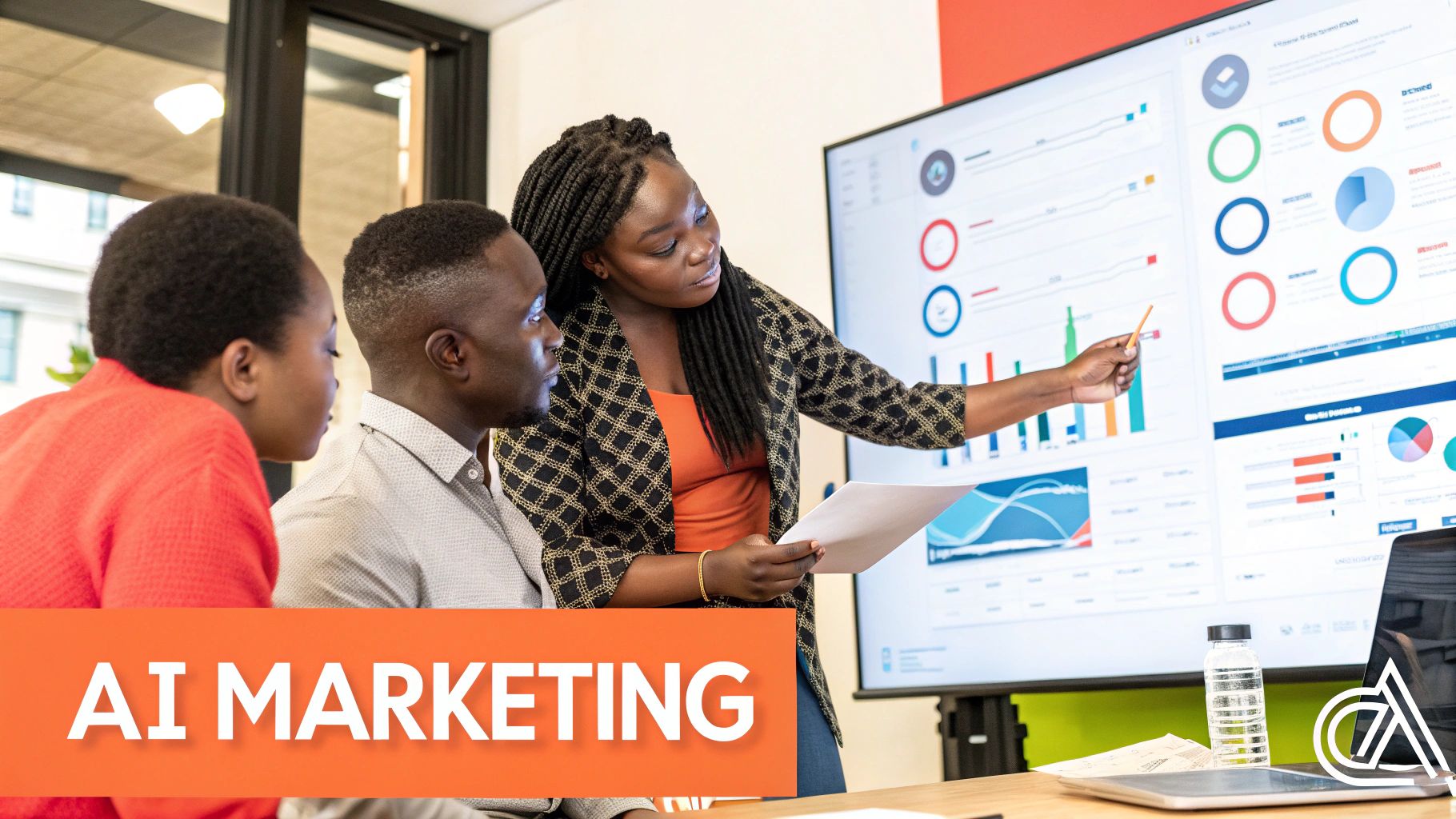
alt text: A Nigerian marketing team collaborating in a modern office, using a large screen to analyse AI-driven campaign data.
This is about more than automation; it’s about fundamentally rethinking how brands understand and communicate with their customers. AI adoption in Nigeria is rewriting the marketing playbook, from drafting ad copy that resonates with local nuances to predicting campaign success before spending a single Naira.
From Manual Effort to Automated Insight
Previously, marketers relied on intuition and time-consuming manual analysis. Today, AI empowers them to make data-driven decisions at a speed and scale that was once unimaginable. By 2025, a projected 83% of Nigerian marketers will use AI tools in their daily work for content generation, customer analytics, and social media sentiment analysis. You can discover more insights about AI’s role in Nigerian marketing to understand this trend better.
This shift frees up your team to focus on high-level strategy and creativity while AI handles the heavy lifting of data analysis.
Practical AI Marketing Tactics You Can Use Today
Here’s how Nigerian marketers are using specific AI tools to solve everyday challenges.
- Generative AI for Localised Content: Tools like Jasper or the models within RichlyAI can create ad copy that speaks directly to Nigeria’s diverse audiences.
- Practical Example: An e-commerce brand can use an AI tool to generate three Instagram captions for a new product: one in formal English, one using Lagos slang, and another in Nigerian Pidgin. They can then A/B test these captions to see which one drives the most engagement. Our guide on using AI for content creation provides more actionable steps.
- Predictive Analytics for Campaign Forecasting: Instead of launching a campaign and hoping for the best, teams use AI to analyze historical data to predict which customer segments are most likely to convert. This allows them to allocate their ad budget more effectively from the start.
- Sentiment Analysis for Brand Monitoring: AI tools can scan platforms like X (formerly Twitter) and Nairaland in real-time to monitor brand mentions. If a new product launch starts receiving negative comments, the marketing team gets an instant alert, enabling them to manage the situation proactively.
Building an Integrated AI Marketing Strategy: A Step-by-Step Example
Using individual AI tools is a good start, but integrating them into a cohesive strategy unlocks their true power. Here’s a realistic process a marketing manager at a Nigerian fashion brand might follow:
- Identify a Pain Point: The manager observes that the team spends too much time writing product descriptions. They introduce an AI writing assistant to generate first drafts, immediately cutting writing time by 50%.
- Add a Customer Insight Tool: Next, they implement an AI analytics tool to analyze website traffic. The tool reveals a key insight: their most valuable customers typically shop between 9 PM and 11 PM.
- Automate with Insight: Armed with this knowledge, the manager sets up an AI-powered email campaign. It automatically sends personalized discount codes to customers who abandon their shopping carts, timed to arrive during the 9 PM to 11 PM peak shopping window.
- Measure, Refine, and Scale: This simple automated campaign results in a 15% increase in recovered sales. With this hard data, the manager can now make a compelling case to invest in a more comprehensive AI marketing suite that integrates content, analytics, and CRM.
This incremental approach demonstrates the value of AI at each step, building momentum and internal support without requiring a large initial investment. It transforms marketing from a cost center into a predictable, data-driven revenue engine.
Navigating the Real Challenges of AI Implementation
While the success stories are inspiring, the path to AI adoption is rarely smooth. Implementing AI is a significant operational shift that comes with predictable roadblocks. Addressing these challenges with a clear strategy is crucial for success.
For Nigerian businesses, three major hurdles stand out: the digital skills gap, unreliable infrastructure, and poor data quality. These are solvable problems if you approach them systematically.
Bridging the Digital Skills Gap
The most advanced AI tool is useless without skilled people to operate it. There is a significant gap between the demand for AI talent and the available supply in Nigeria. Instead of waiting for the perfect hire, a more sustainable approach is to build talent from within.
Targeted upskilling programs not only solve the immediate skills shortage but also foster a loyal team and a culture of continuous learning.
This infographic outlines a clear, three-step process for tackling the most common AI implementation challenges.
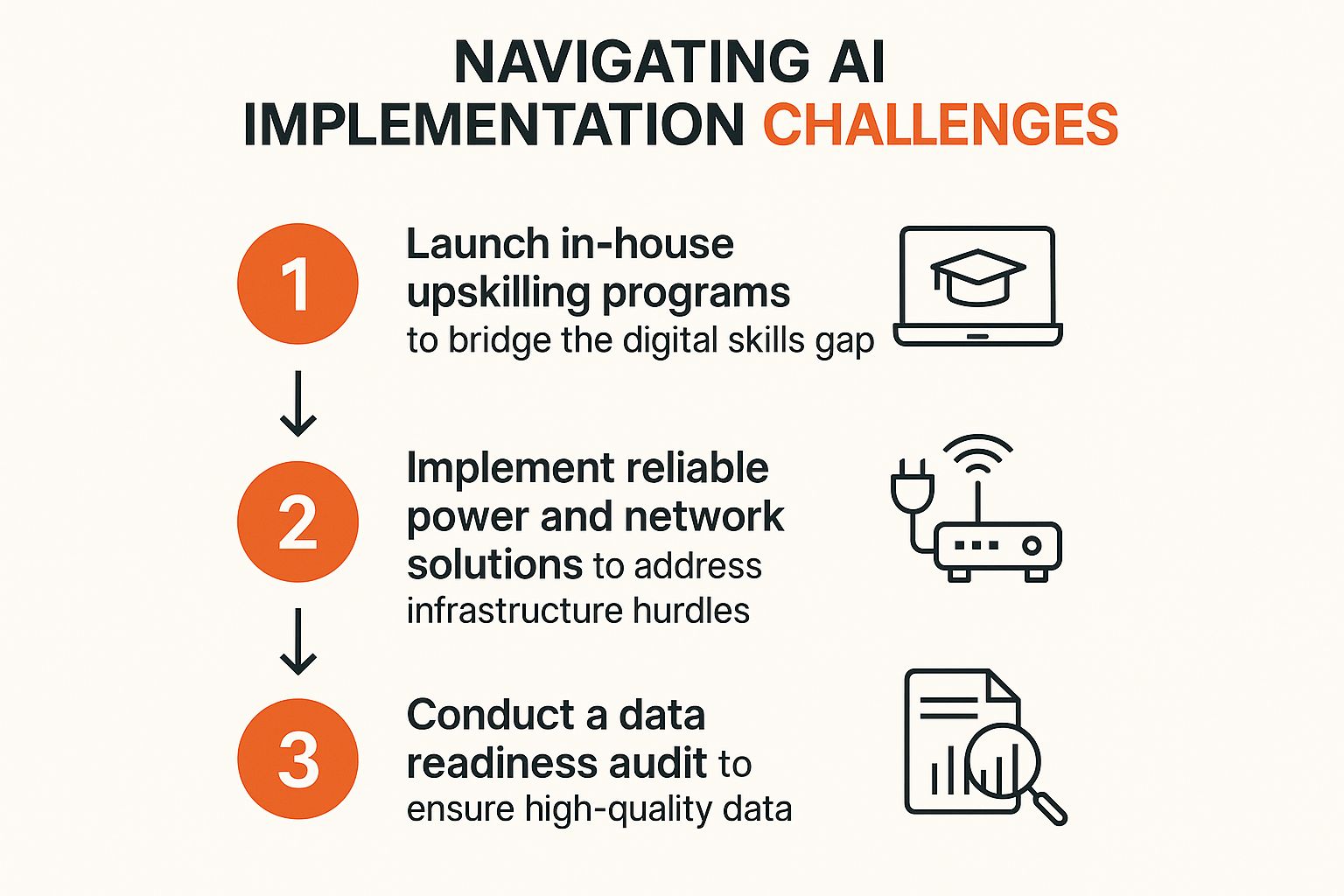
alt text: Infographic titled ‘Navigating AI Implementation Challenges’ showing three sequential steps: 1. Launch in-house upskilling programs. 2. Implement reliable power and network solutions. 3. Conduct a data readiness audit.
The path forward is logical: start with your people, secure your infrastructure, and then organize your data.
Tackling Infrastructure and Data Hurdles
Fundamental issues like inconsistent power and patchy internet can derail AI projects, especially those reliant on cloud services. Just as critically, an AI system is only as good as the data you feed it—a concept known as “garbage in, garbage out.”
Many organizations invest in powerful AI tools only to discover their data is messy, incomplete, or siloed in disconnected systems. Before spending any money on AI software, conduct a data readiness assessment. This step ensures you have the fuel to run the engine you’re building.
Your Actionable Playbook for Overcoming Obstacles
This table breaks down common hurdles into actionable solutions, providing a clear path forward.
| Challenge | What It Looks Like | Your Actionable Solution |
|---|---|---|
| The Skills Gap | You can’t find or afford experienced AI talent. Your current team feels unprepared for new technologies. | Action: Launch in-house training programs. Partner with local tech hubs or online platforms to create customized upskilling paths for your employees. Start small with free courses on platforms like Coursera or edX. |
| Infrastructure | Unreliable power and internet connectivity interrupt cloud-based AI operations. | Action: Invest in backup power (inverters, generators) and consider a dedicated internet service provider. For critical operations, explore hybrid cloud models that allow for some on-premises processing. |
| Poor Data Quality | Your data is incomplete, inconsistent, or stored in isolated spreadsheets across different departments. | Action: Conduct a thorough data readiness audit. Start a “data cleaning” project to fix errors and establish a central data repository (like a simple data warehouse) to unify your information. |
| Weak Data Governance | There are no clear rules on data ownership, access, or usage, creating compliance and privacy risks. | Action: Develop a straightforward data governance policy. Assign data ownership roles and implement access controls to ensure the ethical use of AI in the workplace. |
Building Your AI Adoption Strategy Step-by-Step
A successful plan for AI adoption in Nigeria starts not with technology, but with a solid, practical strategy. This step-by-step roadmap will help you achieve real results by focusing on solving business problems.
Step 1: Pinpoint Business Problems AI Can Solve
First, ask: “What are our biggest operational headaches?” Identify the repetitive, time-consuming tasks that drain your team’s energy or the bottlenecks hindering your growth. Frame the problem with a clear, measurable goal.
- Bad Goal: “We want to use AI in customer service.”
- Good Goal: “We want to use an AI chatbot to reduce customer response time by 50%.”
Step 2: Launch a Small, High-Impact Pilot Project
Resist the urge to launch a massive, company-wide overhaul. Start with a small, focused pilot project to prove AI’s value quickly and with minimal risk. This builds momentum and gets stakeholders excited.
A great pilot project is:
- Specific: Tackles one well-defined problem.
- Measurable: Its impact can be tracked with numbers (e.g., hours saved, sales increased).
- Achievable: Can be completed within a reasonable timeframe (e.g., 30-90 days).
- Relevant: A successful outcome clearly demonstrates the value of AI to the entire organization.
Practical Example: A Pilot Project for a Logistics Company
A Lagos-based delivery company is losing money on fuel due to inefficient routes. Their pilot project is to use an AI route optimization tool for one delivery zone for one month. The goal is to cut fuel consumption by 15% in that zone. If successful, they have a solid case for a full rollout.
Step 3: Assemble Your Team and Bridge Skill Gaps
Your first AI team doesn’t need to be PhDs. Start with a small group of enthusiastic employees: someone from the department experiencing the problem, a tech-savvy individual, and a manager to champion the project.
Simultaneously, identify skill gaps and invest in training. Online courses or local tech hub workshops can upskill your team, turning them into internal experts who understand both the technology and your business. For beginners, there are excellent guides on how to start using AI without any experience.
Step 4: Get Your Data House in Order
AI is powered by data. Its output quality is directly dependent on its input quality. Before implementing any tool, ensure your data is clean, organized, and accessible. This may mean consolidating scattered spreadsheets into a single source of truth.
Start with a quick data audit. Ask: Is our customer information accurate? Are sales figures consistent across all reports? If not, a data-cleaning project becomes your top priority.
Step 5: Select the Right Tech Stack
With a clear problem, a pilot project, a team, and clean data, you’re ready to choose your tools. Don’t be swayed by the most complex or expensive platforms. Start with user-friendly tools that solve your specific problem.
- For Customer Service: Explore no-code AI chatbot builders.
- For Marketing: Look at AI-powered content creation or social media analytics tools.
- For Operations: Consider AI-enhanced software for inventory management or route planning.
Many tools offer free trials or affordable monthly plans, allowing you to test before you commit.
Step 6: Measure, Learn, and Scale
Once your pilot is live, obsessively track the metrics you defined in Step 1. At the end of the trial, analyze the results. Did you achieve your goal? What worked well? What failed?
Use these learnings to refine your approach. A successful pilot provides the data you need to justify expanding the solution to other parts of the business. An unsuccessful one provides valuable lessons for your next attempt. This “measure, learn, scale” cycle is the engine of successful AI adoption.
What’s Next? AI and Government Policy in Nigeria
The future of AI in Nigeria will be shaped by the interplay between technological innovation and government policy. As AI becomes more integral to the economy, official policy is shifting from passive observation to active engagement, aiming to guide growth while mitigating risks.
For businesses, aligning your AI strategy with national priorities can unlock significant advantages.
Tying into the National AI Strategy
The Nigerian government is finalizing its National AI Strategy, a blueprint for AI development in key sectors like agriculture, healthcare, and finance. This document signals where government investment and support are likely to be directed. The strategy emphasizes building local capacity and ensuring AI solutions are tailored to Nigerian realities. This means projects that use local data to solve local problems will likely receive backing.
A Practical Example of Policy Alignment
Imagine you run an AgriTech startup with an AI model that detects crop diseases from drone imagery. Here’s how you can align with national policy:
- Research: You review the draft National AI Strategy and note its strong emphasis on improving food security.
- Positioning: You frame your tool not just as a “disease detection app,” but as a solution to help achieve the national goal of boosting agricultural yields by 25%.
- Partnership: You can now approach the Ministry of Agriculture or development banks, demonstrating precisely how your project supports their stated objectives.
- Opportunity: This strategic alignment makes your startup a prime candidate for government grants, pilot programs, and public-private partnerships.
Getting Ethics and Data Governance Right
The conversation around responsible AI is growing. The government is focused on ensuring AI is used ethically, with a focus on:
- Data Privacy: Ensuring your AI systems comply with data protection regulations like the Nigeria Data Protection Act (NDPA).
- Algorithmic Fairness: Actively working to identify and remove biases from your models to prevent unfair or discriminatory outcomes.
- Transparency: Being clear about how your AI systems make decisions, especially when they impact people’s lives.
Building your AI on an ethical foundation is not just about compliance; it’s about building a trustworthy brand that customers and regulators will support long-term.
Actionable Takeaways
- Start Small with a Pilot Project: Don’t try to boil the ocean. Identify one specific, high-impact problem and launch a 30-90 day pilot project to prove AI’s value with minimal risk.
- Focus on Problems, Not Technology: Begin by asking “What is our biggest business challenge?” not “What cool AI tool can we use?” Match the technology to the problem.
- Upskill Your Existing Team: Instead of competing for expensive talent, invest in training your current employees. They already understand your business context.
- Clean Your Data First: AI is only as good as the data it’s trained on. A data audit and cleaning project is a critical, non-negotiable first step before you invest in any AI tool.
- Align with National Strategy: Keep an eye on Nigeria’s National AI Strategy. Aligning your projects with national priorities in sectors like AgriTech and FinTech can unlock funding and partnership opportunities.
Tools and Resources
- AI Writing Assistants: Jasper, RichlyAI
- No-Code Chatbot Builders: Tidio, Intercom
- AI Analytics: Google Analytics (with AI features), Mixpanel
- Online Learning: Coursera, edX, and local tech hubs like Co-Creation Hub (CcHUB) for AI/ML courses.
Further Reading
- Top AI innovations transforming Nigeria in 2025
- 12 Top Money Making Apps That Actually Pay in 2025
- How SMEs in Africa can use AI for growth
- Ethical use of AI in the workplace
- AI for Creative Problem Solving: Your Guide to Unlocking Innovation
- How to Draw Snail: Easy Step-by-Step Guide
- Top 12 AI Chatting App Solutions to Use in 2025
- How to Make Money with AI: Proven Strategies to Earn Today
- How to Find a Nursing Job Vacancy in Abuja
- Your Practical Guide to Building an AI Chatbot App
- Nigeria’s National Centre for Artificial Intelligence and Robotics (NCAIR) website for policy updates.
- Land Top Human Resources Jobs in Abuja
- How to Migrate to Beta Talk Easily | Step-by-Step Guide
- Your Practical Guide to Building a Social Media Content Calendar
- The Role of Artificial Intelligence in Enhancing Content Delivery in Business Education: A 21st-Century Approach
- Top 10 AI Prompts Every Nigerian Entrepreneur Should Know
- AI Drives Cost Reduction Across Organizations
- Nigeria’s National Artificial Intelligence Policy (NAIP): A Framework for Ethical Innovation and Inclusive Growth
- How to Launch an AI Startup in 2025: A Founder’s Roadmap
- Artificial Intelligence In Nigeria
- Generative AI in Nigeria: Free Tools & Creative Solutions for Businesses | RichlyAI
- Premium ChatGPT Prompts for IT Professionals
- Future-Proof Your Career: How to Thrive in the Age of AI and Automation!
- Understanding the Science Behind AI: A Nigerian Perspective -Part2
- Understanding the Science Behind AI: A Nigerian Perspective
- Scaling Content Creation Effortlessly with Richly Artificial Intelligence (Richly AI)
- Here are 10 diverse ChatGPT prompts tailored for digital marketers to use in their everyday work
- What Generative AI is NOT
- RichlyAI is Generating AI
Ready to put AI to work for your business? RichlyAI offers a complete suite of tools to help you create great content, automate marketing, and build custom chatbots—all from one simple platform. Start exploring what’s possible today at RichlyAI Hub.
