
The idea of making money with AI isn’t some far-off dream anymore—it’s happening right now. The most straightforward way to get started? Take something you’re already good at and use AI tools to do it better, faster, and more efficiently. This approach lets you deliver seriously high-value work, whether it’s supercharging your content creation or providing insightful data analysis.
Your Path to Earning With AI
The buzz around artificial intelligence has officially moved from the lab to our laptops. This guide is all about cutting through the noise and showing you exactly how to start generating real income with AI. We’re talking practical, actionable strategies, not just hype. The core technologies, like large language models, are powering a whole new wave of services and products you can build a business around today.
This infographic breaks down three of the most popular and effective ways people are cashing in on AI.
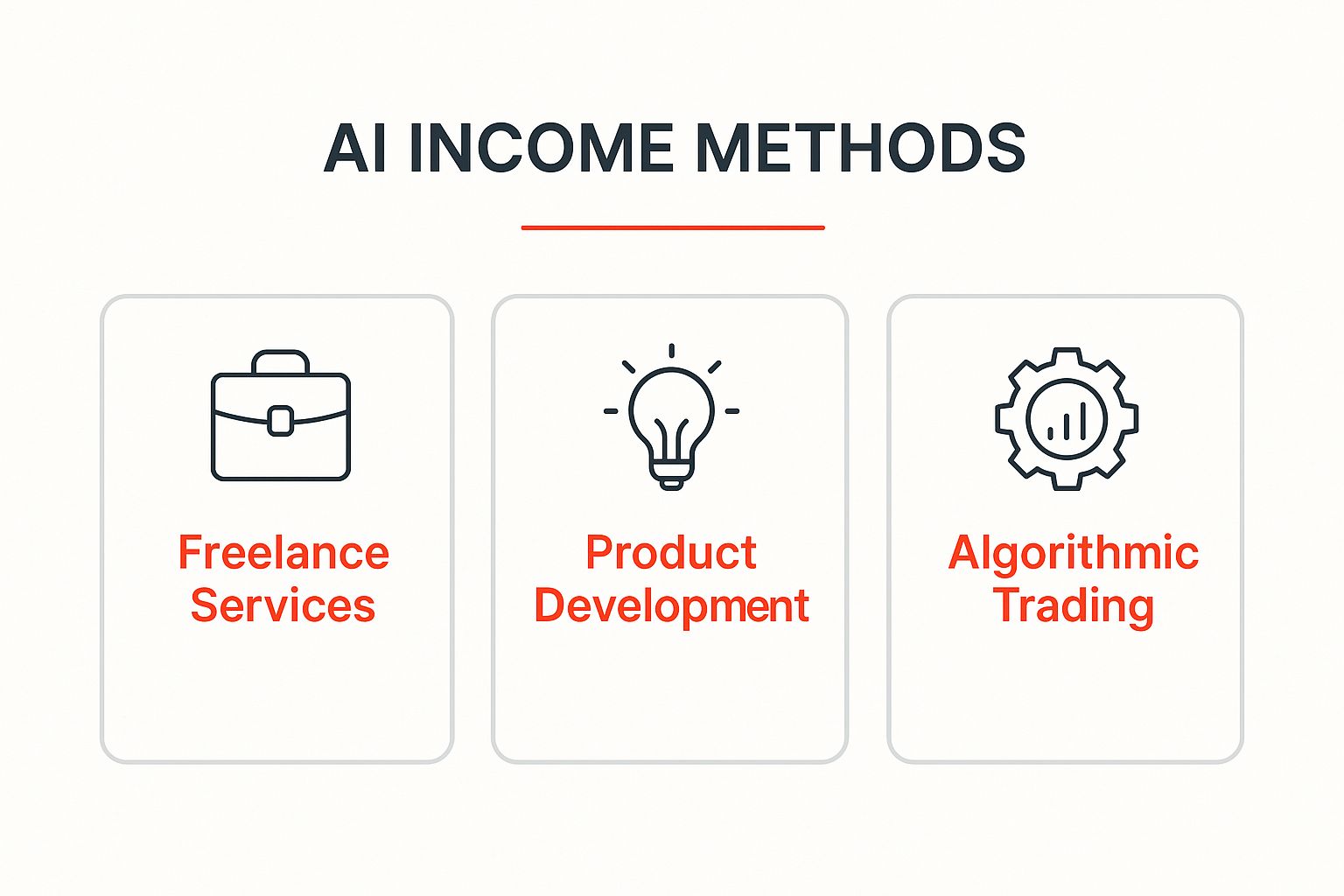
As you can see, there’s a path for everyone. You can start providing immediate value through freelance services or play the long game by building your own AI-driven products. The trick is to start where your current skills can get the biggest boost from AI.
Identifying Your Starting Point
The impact AI is having on business is huge and impossible to ignore. Just look at Southeast Asia’s digital economy, where profits have skyrocketed from US$4 billion in 2022 to an estimated US$11 billion in 2024—a massive jump fuelled by AI adoption. In e-commerce, for example, AI-powered recommendation engines have been shown to increase conversion rates by as much as 30%. This isn’t theoretical; it’s proof that applying AI delivers real financial returns.
This guide will help you find the best entry point for your own background and ambitions. We’ll walk through several proven paths:
- AI-Powered Freelancing: Enhance your creative or technical services to deliver more value.
- AI Content Creation: Start automated content channels, like niche blogs or YouTube channels.
- AI Product Development: Create and sell specialised AI tools or high-value prompt packs.
Don’t worry if you feel like you’re starting from scratch. We’ve put together a detailed guide on How to Start Using AI Without Any Experience that offers a clear, step-by-step roadmap for absolute beginners.
The best strategy is to blend what you already know with the incredible capabilities of modern AI. You don’t need to become a world-class AI developer overnight. Instead, focus on becoming an expert at using AI to solve a very specific problem for a specific audience.
Top AI Monetization Strategies at a Glance
To help you decide which path is right for you, here’s a quick summary of the most common strategies. This table outlines what you can realistically expect in terms of income, the skills you’ll need, and what it might cost to get started.
| Strategy | Potential Income | Skill Level Required | Upfront Cost |
|---|---|---|---|
| AI-Enhanced Freelancing | £500 – £5,000+ per month | Low to Medium | Low (Tool subscriptions) |
| AI-Powered Content Creation | £100 – £10,000+ per month | Low | Low (Hosting, domains) |
| Selling AI Prompts | £50 – £2,000+ per month | Low to Medium | Very Low |
| Building an AI SaaS Product | £1,000 – £100,000+ per month | High | High (Development costs) |
| AI Consulting Services | £2,000 – £20,000+ per project | High | Low (Marketing costs) |
As you can see, the options range from low-effort side hustles to full-blown tech startups. The key is aligning your choice with your personal resources, skills, and long-term goals.
Ultimately, your journey to making money with AI comes down to picking a direction and staying consistent. For a deeper look into specific strategies and what’s happening in the industry, it’s always smart to consult expert resources; you can find fantastic insights from the Buddypro blog. Our goal is to demystify this process and give you the confidence to turn your curiosity into real, tangible earnings.
Sell High-Value AI-Powered Services

If you’re looking for one of the most direct ways to generate revenue with AI, offering services is it. You don’t have to spend months building a complex product from the ground up. Instead, you can focus your energy on mastering a couple of powerful AI tools to elevate the skills you already have and deliver incredible value to your clients.
Think of it less as AI replacing your expertise and more as amplifying it. I’ve seen freelance writers completely transform their businesses this way. One person I know went from just writing articles to offering AI-enhanced content strategy. By using tools like SurferSEO, they could suddenly provide clients with data-backed content outlines practically guaranteed to rank. Their effective hourly rate easily doubled, if not tripled.
Find Your Niche and Master the Tools
The real secret is to sidestep generic offerings. Don’t just be another “AI writer” or “AI consultant.” Instead, position yourself as the go-to expert for a very specific, high-value problem. The market is crying out for specialised skills, creating a massive opening for anyone who can solve tangible business challenges.
Here are a few in-demand services you could build a profitable business around today:
- AI-Powered SEO Audits: Use tools like Semrush or Alli AI to conduct deep-dive competitor analyses, pinpoint content gaps, and create clear technical SEO roadmaps for businesses. You can sell this as a one-off project or, even better, a recurring monthly retainer.
- Intelligent Social Media Management: This goes way beyond just scheduling posts. With AI, you can analyse the absolute best times to post, generate fresh creative concepts for visuals, write captions that grab attention, and even script out short-form videos.
- AI-Enhanced Graphic Design: Create packages for social media campaigns, blog post visuals, or ad creatives. Tools like Midjourney or Adobe Firefly allow you to produce stunning, original visuals in a tiny fraction of the time it would take to do it manually.
The global shift towards AI isn’t just a fleeting trend; it’s a fundamental change in how work gets done. This has a huge economic impact, especially in growing markets. A great example is seeing how empowering generative AI solutions in Nigeria can spur growth across different industries.
Build Your Service Playbook
To really succeed, you need a repeatable process. This is what I call a “service playbook”—your personal, step-by-step method for delivering consistent, top-tier results every single time. It’s what separates the amateurs from the pros.
Let’s quickly map out a playbook for an “AI-Powered Content Optimisation“ service.
Step-by-Step Guide: Content Optimisation Service
- Client Onboarding: Kick things off with a detailed questionnaire. You need to understand their target audience, primary keywords, and what they’re trying to achieve with their content.
- AI-Driven Competitor Analysis: Fire up an SEO tool to dissect the top-ranking articles for the client’s main keyword. Pinpoint common headings, questions being answered, and crucial semantic keywords.
- Create a Data-Driven Outline: Use SurferSEO’s Content Editor or a similar tool to generate a comprehensive outline based on your analysis. This should specify the ideal word count, headings, and key terms to include.
- Drafting and Enhancement: Write the first draft yourself (or work with one the client provides). Next, use a tool like RichlyAI to refine the writing, check the tone of voice, and improve readability.
- Final Human Review & Delivery: This is critical. Perform a final manual edit to add your unique human insight, storytelling flair, and brand personality. Deliver the finished piece with a short report highlighting the improvements.
Following a structured process like this instantly shows clients you’re a professional, not just someone messing about with shiny new tools. It justifies a higher price and, from my experience, leads to much happier, long-term clients.
Package and Price Your Services
Once your playbook is solid, it’s time to package your services. Whether you’re selling on platforms like Upwork and Fiverr or reaching out directly on LinkedIn, you need to be clear about what you offer. My advice? Stop selling your time by the hour. Create tiered packages with crystal-clear deliverables instead.
| Package Tier | Services Included | Ideal Client | Price Point |
|---|---|---|---|
| Starter | SEO Audit for 1 Page + Basic Optimisation Report | Small blogs, solopreneurs | £250 |
| Pro | Full Content Optimisation for 3 Articles + Competitor Gap Analysis | Growing businesses | £750 |
| Premium | Monthly Retainer for 5 Optimised Articles + AI Content Strategy | Established companies | £1,500/mo |
This model gives clients clarity and gives you a predictable income. As you build your portfolio and gather testimonials, you can raise your prices with confidence.
The demand for these skills isn’t slowing down. The World Economic Forum predicts that AI and related fields could create eleven million new jobs in Southeast Asia alone by 2030. This boom, set to add nearly $1 trillion to the region’s GDP, shows just how massive the global need is for professionals who can skillfully apply AI. The opportunity is right there for the taking.
Build an Income with AI Content Creation

We’ve always known that content is king for building a brand and making money, but the sheer effort involved has always been the biggest roadblock. It’s a grind. AI is completely changing that reality, letting solo creators and small teams churn out high-quality content at a scale that used to require a whole department.
This shift opens up some genuinely exciting ways to earn a living with AI. We’re talking about everything from hyper-niche blogs and automated social media accounts to the increasingly popular faceless YouTube channels. You can now assemble an entire content engine using tools that are surprisingly affordable and easy to learn.
Launch a Faceless YouTube Channel
The concept of a “faceless” YouTube channel is a game-changer for many. You get to tap into YouTube’s enormous audience and its powerful monetisation engine without ever having to step in front of a camera. The best part? You can systematise nearly the entire workflow with AI.
Here’s a step-by-step guide for creating a channel about fascinating historical events:
-
Crafting the Script: Start with a tool like ChatGPT or Jasper. Give it a detailed prompt: “Write a 1,500-word YouTube video script about Australia’s Great Emu War of 1932. Use an engaging, witty, and slightly humorous tone. Structure it with an introduction, the main story, and a concluding summary. Ensure all historical facts are accurate.” The AI provides a strong draft that you then edit to add your unique voice and double-check key facts.
-
Generating the Voiceover: Copy the final script and paste it into a text-to-speech platform like ElevenLabs or Play.ht. These tools offer incredibly realistic voices. Select a voice that fits the “history storyteller” vibe for your channel and download the final MP3 audio file.
-
Creating the Visuals: Use an image generator like Midjourney or Canva’s AI tools to create visuals. For example, prompt Midjourney with: “An epic, cinematic illustration of Australian soldiers in 1930s-style uniforms facing off against a horde of emus, dramatic lighting, detailed.” Generate a series of images to cover the key points in your script.
-
Editing and Assembling: Import your voiceover audio, generated images, and any relevant stock video clips into a video editor like Descript or CapCut. Arrange the visuals to match the narration. Use the editor’s AI features, like automatic silence removal, to clean up the final video.
Using this system, you could realistically produce several high-quality videos every single week—a pace that would be exhausting to do manually. Of course, brushing up on general content creation tips is always a good idea; AI amplifies good strategy, it doesn’t replace it.
Develop a Profitable Niche Blog
The same logic works wonders for blogging. The key is to pick a niche you actually find interesting, something like “sustainable living for city dwellers” or “building a smart home on a budget.” A tight focus makes it so much easier to attract a loyal audience and, eventually, to monetise.
Your AI-assisted blogging workflow might look something like this:
- Brainstorming Ideas: Use an AI tool to generate hundreds of potential article topics in minutes.
- Drafting Content: Get the AI to create detailed outlines and even full first drafts for your posts.
- Generating Images: Create completely custom, royalty-free images for your blog with AI, so you never have to pay for stock photos again.
The real power here isn’t just about speed, it’s about consistency. An AI-powered workflow means you can hit a regular publishing schedule without fail. That consistency is exactly what search engines love to see, helping you build authority and grow your readership faster.
Monetising Your AI-Generated Content
Making the content is only half the battle. Now you need to turn all that hard work into a proper income stream. Luckily, the classic monetisation strategies work just as well, if not better, for AI-generated content. If you want to go deeper on this, our guide on scaling content creation effortlessly with Richly AI has some advanced tactics.
Here’s a breakdown of the most effective ways to make money with the content you create:
| Monetisation Method | Description | Best For |
|---|---|---|
| Affiliate Marketing | You recommend products in your content and earn a cut from any sales. For that history channel, you could link to relevant books, documentaries, or even history-themed games. | Niche blogs, YouTube |
| YouTube Partner Programme | Once you hit 1,000 subscribers and 4,000 watch hours, you can earn money from ads played on your videos. This is the bread and butter for many creators. | YouTube channels |
| Selling Digital Products | Create your own product to sell, like a “Weird History Facts” e-book or a pack of the AI art prompts you used to create your channel’s visuals. | All content platforms |
| Sponsorships | As your audience grows, brands will pay you to feature them in your content. This becomes a major income source for established channels and blogs. | Established channels/blogs |
By combining a smart, AI-driven creation process with a clear monetisation plan, you’re not just making content—you’re building a valuable digital asset that can pay you back for years to come. The most important thing is to simply start, be consistent, and listen to what your audience responds to.
Create and Sell Your Own AI Products
Offering services is a brilliant way to get your foot in the door with AI, but the real game-changer is when you shift from selling your time to selling scalable assets. This is where you build something once and sell it over and over. Creating and selling your own AI-powered digital products is how you build an income stream that can earn for you even when you’re not at your desk.
The magic here is in the scalability. With a service, your income is tied directly to the hours you can work. But a digital product? It can be sold to one person or ten thousand people with almost no extra effort for each sale. You’re building an asset that works for you.
From Niche Problem to No-Code Solution
The best AI products don’t try to solve everything for everyone. They solve a very specific problem for a very specific group of people. So, your first job isn’t to learn to code; it’s to listen. Keep your ears open for the frustrations and bottlenecks you see in different industries. What tedious tasks do people constantly complain about? Where are they haemorrhaging time and energy?
Once you’ve pinpointed a genuine pain point, then you can start brainstorming an AI solution. You don’t need a team of developers or a massive budget to get started. Thanks to the explosion of no-code platforms, building a simple but effective AI tool is more accessible than ever.
Here’s an actionable step-by-step guide to building a no-code AI tool:
- Identify a Niche Problem: Let’s take a practical example: many Etsy sellers struggle to write compelling product descriptions that grab attention and rank in Etsy’s search. This is a perfect, specific problem.
- Design the Solution: Plan a simple web tool. It needs one input field for a user to describe their product (e.g., “handmade ceramic mug, blue glaze, holds 12oz”) and a button that says “Generate Description.”
- Build with No-Code: Use a platform like Bubble to build the user interface. You don’t need to write code; you’ll drag and drop elements.
- Integrate AI: Connect your Bubble app to an AI model like OpenAI’s GPT-4 via an API. You’ll set it up so that when a user clicks the button, their product details are sent to the AI with a pre-written prompt like, “Write a charming and descriptive Etsy product description for the following item: [user input]. Include keywords for SEO and a friendly tone.”
- Launch on a Marketplace: List your finished tool on marketplaces like Gumroad or AppSumo. These platforms have a built-in audience of entrepreneurs actively looking for tools to make their lives easier.
This approach massively lowers the barrier to entry for creating what’s known as a software-as-a-service (SaaS) product—a model that has historically been one of the most profitable online.
Develop and Sell Custom GPTs
One of the most immediate and exciting opportunities right now is creating custom GPTs. In essence, these are versions of ChatGPT that you can train with specific data and instructions to handle specialised tasks with incredible accuracy. The best part? You can list these custom GPTs on OpenAI’s GPT Store, giving you a direct route to making money from your creation.
Think of them as highly specialised AI assistants. Instead of a general-purpose chatbot, you could create:
- A “Marketing Copy Generator” for e-commerce stores, trained on a diet of high-converting ad copy and product descriptions.
- A “Legal Clause Drafter” for small business owners, fed with standard legal templates to help them generate basic contract clauses.
- A “Grant Proposal Writer” for non-profits, instructed on the specific formats and language that funders are looking for.
The secret to a successful custom GPT lies in its unique knowledge base and finely-tuned instructions. The more specialised and genuinely useful it is, the more likely people will be to pay for access.
Building a truly valuable AI product isn’t just about the technology itself. It’s about deeply understanding a user’s workflow and creating a tool that fits into it perfectly, saving them time, money, or creative energy.
Create and Sell Expert Prompt Packs
Another product with huge potential is the expert prompt pack. As more people dive into AI tools like image generator Midjourney or text generator RichlyAI, they quickly discover a fundamental truth: the quality of the output depends almost entirely on the quality of the input—the prompt.
Let’s face it, most people aren’t great at writing effective prompts. This is where you can come in. By becoming an expert in “prompt engineering” for a specific tool, you can create and sell curated collections of prompts designed to get very specific, high-quality results.
Step-by-Step Guide: Create a Real Estate Prompt Pack
- Identify the Problem: Real estate agents need high-quality, eye-catching photos for their listings but often have to work with dull or completely empty rooms. Traditional virtual staging is expensive and slow.
- Develop the Product: Create an expert Midjourney prompt pack called “Virtual Staging Pro.” This will be a digital PDF document.
- Craft the Prompts: Spend time engineering and testing dozens of prompts. Categorize them logically in the PDF by room type (“modern minimalist living room,” “cozy rustic kitchen”) and style. For each prompt, include the text and a sample image it generated. An example prompt might be: “photorealistic interior shot of a bright, airy living room with a modern Scandinavian design, neutral color palette, large windows with natural light, minimalist furniture, wide-angle lens –ar 16:9 –style raw”
- Package and Sell: Design a professional-looking PDF. Package it as an instant digital download and create a listing on a platform like Etsy or Gumroad. Use keywords like “Midjourney Prompts,” “Real Estate Marketing,” and “Virtual Staging AI” in your listing to attract your target audience.
This model requires very little technical skill but heavily rewards creativity and niche expertise. You’re not selling the AI; you’re selling the key that unlocks its true power. It’s a fantastic way to build a digital asset that can generate passive income for years to come.
Market and Scale Your AI Business
So you’ve built a brilliant AI-powered service or a slick digital product. That’s a massive win, but it’s really only half the battle. Now comes the hard part: getting it in front of paying customers and turning your idea into a real, revenue-generating business. This is where smart marketing and a solid scaling plan make all the difference.
Successfully selling your AI offering means connecting with the right audience. The good news? You can use the very technology you’re selling to supercharge your marketing. This creates a fantastic feedback loop—AI doesn’t just power your product; it drives its growth.
Use AI to Amplify Your Marketing
Don’t just sell AI; make it your secret weapon for marketing. Think of modern AI tools as your tireless marketing assistant, helping you craft campaigns that genuinely resonate without needing a huge budget.
A great starting point is your advertising. Use an AI writer to churn out dozens of ad copy variations for platforms like Facebook or Google. You can rapidly test different hooks, emotional angles, and calls-to-action to see what sticks. AI can also analyse existing data to help you pinpoint your ideal customer profile, making sure your ads land in front of the people most likely to convert.
But it doesn’t stop at ads. You can put AI to work for:
- Email Marketing: Draft compelling email sequences to nurture leads and turn curious prospects into paying customers.
- Social Media Content: Generate a stream of ideas, captions, and even images for your social channels to build a community around your brand.
- Customer Insights: Sift through customer feedback and reviews to spot patterns and get a crystal-clear picture of what your audience actually wants.
To get started, it helps to know which tools are best for which job.
AI Marketing Tool Comparison
Here’s a quick comparison of popular AI tools that can help you market your new service or product. Each has its own strengths, so choosing the right one depends on your specific needs.
| Tool | Primary Function | Best For | Starting Price |
|---|---|---|---|
| Jasper | AI Content Creation | Writing high-quality blog posts, ad copy, and social media content quickly. | $39/month |
| Copy.ai | Marketing Copy Generation | Generating short-form copy like headlines, product descriptions, and email subject lines. | Free plan available |
| Surfer SEO | SEO Content Optimisation | Analysing top-ranking content and providing data-driven recommendations to improve your search visibility. | $69/month |
| Flick | Social Media Management | Brainstorming, writing, scheduling, and analysing social media content, especially for Instagram. | £11/month |
Choosing the right tool from the start can save you a ton of time and help you create more effective campaigns, letting you focus on the bigger picture.
Build Your Personal Brand to Attract Inbound Leads
One of the most powerful ways to sell an AI service is by becoming a recognised authority in your field. Building a strong personal brand on platforms like LinkedIn or X (formerly Twitter) can turn you into a magnet for inbound leads, where potential clients start coming to you.
Here’s an actionable approach:
- Choose Your Platform: Focus on one or two platforms where your target clients hang out. For B2B services, LinkedIn is often best.
- Define Your Niche: Don’t be a generalist. Be “the AI for e-commerce guy” or “the AI for legal tech woman.”
- Share Actionable Value: Consistently post content that helps your audience. Share quick tips, tutorials, case studies of your work, and analysis of industry news. For example, post a short video showing how you used Midjourney to create stunning ad creative for a client.
- Engage Meaningfully: Don’t just post and ghost. Reply to comments, ask questions, and participate in conversations in relevant groups. This builds community and trust.
The real secret is to give away value freely. Don’t just shout about your services. Educate your audience on the possibilities of AI. When they’re ready to invest, you’ll be the first person they think of.
This approach works globally, especially in tech-forward hubs. For example, Singapore is pouring billions into its AI ecosystem as part of its National AI Strategy 2.0. The government’s S$1.6 billion commitment, plus another $26 billion in corporate tech investments, highlights the immense global drive to monetise AI. This creates a fertile ground for skilled individuals everywhere to build their brands and businesses.
Scale Your AI Business Effectively
Growth is exciting, but scaling too fast or without a plan can break your business. As more clients and customers come in, you need a strategy to handle the increased workload without letting quality slip. It’s all about knowing when to hire, what to automate, and when to adjust your pricing.
To scale properly, it’s vital to understand strategies like how to Master Product-Led Growth, which uses the product itself as the main driver for customer acquisition. This is particularly effective for AI products where a fantastic user experience can be your most powerful marketing asset.
Here’s a real-world example. A freelance writer I know started offering AI-powered SEO consulting. At first, it was just her, using her LinkedIn presence to land her first five clients. As demand snowballed, she documented every single step of her process.
- When to Hire: Once she hit ten regular clients, she was completely swamped. She hired a virtual assistant to handle admin like invoicing and scheduling, which freed her up to focus purely on client work.
- How to Automate: She used AI tools to automate her initial client audits and reporting, which slashed her delivery time by 40%.
- When to Raise Prices: After collecting a dozen glowing testimonials and building a portfolio of proven results, she confidently doubled her prices for all new clients. The social proof justified the higher fee, allowing her to earn more while working with fewer, higher-value clients.
This deliberate, step-by-step approach allowed her to scale her AI consultancy from nothing to a consistent, five-figure monthly income in under a year. For a deeper dive into those crucial early stages, check out our guide on how to launch an AI startup in 2025, which offers a founder’s roadmap. Remember, scaling isn’t just about getting bigger; it’s about getting smarter.
Common Questions About Making Money with AI

As you start exploring how to make money with AI, you’re bound to have questions. It’s a field that moves incredibly fast, and it’s natural to wonder what’s real and what’s just hype. Let’s dig into some of the most common queries I hear and get you some straight answers.
Can I Really Make Money with AI Without Coding Skills?
Absolutely. The old myth that you need to be a developer to profit from AI is exactly that—a myth. Thanks to a huge wave of no-code platforms and user-friendly AI tools, the doors are wide open for everyone.
You can build a genuinely profitable business by offering services that simply use existing AI. For example, you could provide:
- AI-driven content creation: Use tools like Jasper or our own RichlyAI to produce top-tier articles and marketing copy for businesses.
- Data-backed SEO analysis: Offer clients powerful insights by using platforms like SurferSEO.
- Unique graphic design: Create stunning visuals for social media campaigns and branding projects with tools like Midjourney.
The key skill here isn’t coding. It’s your ability to creatively apply these powerful tools to solve real-world business problems.
What Is the Fastest Way to Start Earning with AI?
Hands down, offering a service is the quickest path to getting paid. When you sell an AI-powered service—think “AI-enhanced copywriting” or “automated social media content”—the barrier to entry is almost non-existent.
Here’s an actionable plan to get your first client in a week:
- Define Your Service: Pick one specific service, e.g., “AI-Generated Blog Post Images.”
- Create a Simple Portfolio: Use Midjourney to create 5-10 stunning images for a hypothetical blog. Put them in a simple PDF or Google Doc.
- Find Potential Clients: Search for blogs in a niche you like (e.g., “vegan food blogs”).
- Craft a Pitch: Send a direct, personal email: “Hi [Name], I love your blog! I noticed you use stock photos. I specialize in creating unique, AI-generated images that can make your posts stand out. Here are a few examples I made. Could I create a custom image for your next post for just £20?”
- List on Gigs Sites: Post your service on platforms like Upwork or Fiverr.
This approach requires very little upfront investment, allowing you to generate income while you build a solid portfolio and collect glowing testimonials.
Are AI Side Hustles Sustainable in the Long Term?
They certainly can be, but sustainability in the world of AI demands one thing above all else: a commitment to continuous learning. This space is evolving at a breakneck pace. A strategy that works wonders today might be outdated in six months.
To build a business that lasts, you have to embrace being a lifelong learner. That means keeping an eye on new tools, constantly sharpening your skills, and being ready to pivot your services as the market shifts.
The businesses that truly endure will be those that masterfully blend AI’s raw efficiency with irreplaceable human qualities like creativity, strategic insight, and deep industry knowledge. A great way to do this is to future-proof your career and thrive in the age of AI and automation by becoming a go-to expert in a specific niche.
How Much Can I Realistically Expect to Earn?
Honestly, your potential earnings can vary wildly. It really boils down to the path you choose, how well you market your services, and the sheer effort you put in.
A freelancer offering AI services might start by earning a few hundred pounds per month, but that can easily scale to several thousand as you build a steady client base. If you go the content creator route (like a YouTuber or blogger), the income is often slower to build but can become substantial through ads and affiliate sales. Selling digital products, like AI prompt packs, takes more initial work but has the potential for fantastic passive income down the road.
A realistic goal for many is to build a meaningful side income within 3-6 months and have a shot at a full-time income within a year of focused, consistent work.
Ready to turn these ideas into action? RichlyAI gives you an all-in-one platform to create high-quality text, stunning images, and even custom chatbots. Start automating your work and building new income streams today. Explore the possibilities at RichlyAI.
