
Picture this: a small business owner in Lagos gets a loan approved in minutes, not weeks. A farmer up in Kano can predict their crop yields with incredible accuracy. This isn’t some far-off future; this is what’s happening right now with Artificial Intelligence in Nigeria.
This guide cuts through the hype to show you what AI actually looks like on the ground. We’ll focus on practical applications, actionable steps you can take, and the real-world tools driving Nigeria’s tech revolution.
Understanding Nigeria’s AI Revolution
Artificial Intelligence, or AI, has quickly gone from a buzzword to a real tool that’s shaping Nigeria’s economy. Forget the sci-fi images of robots. We’re talking about smart systems designed to tackle uniquely Nigerian challenges.
At its heart, AI is about teaching machines to learn, reason, and make decisions in a way that mimics human intelligence. If you’re new to the concept, our simple explanation of AI for Nigerians is a perfect place to start.
So, why is this happening now? A few key things have come together:
- A Young, Tech-Focused Population: Nigeria has one of the youngest populations in the world. This means we have a huge number of people who grew up with technology and are hungry to create and use the next big thing.
- A Bustling Startup Scene: Lagos, in particular, has become a hotbed of innovation. Startups are popping up everywhere, using AI to solve local problems in finance, healthcare, and more.
- More People Online: As internet and smartphone use grows, we’re creating massive amounts of data. This data is the lifeblood of AI—it’s what these systems use to learn and become smarter.
Why AI Matters for Nigeria’s Future
The real power of AI in Nigeria lies in its ability to solve problems that have held us back. Take banking, for example. Traditional banks often require a long credit history, which automatically leaves out millions of hardworking Nigerians.
AI-driven fintechs are changing that. They can look at other information, like mobile money transactions or even phone usage patterns, to determine if someone is a good candidate for a loan. Suddenly, people who were completely locked out of the financial system now have access to capital. That’s a game-changer.
To really see the bigger picture, it helps to understand what Artificial Intelligence in business entails. It connects the dots between the technology and how it drives real economic growth.
At its core, AI is about making things work better and creating opportunities that didn’t exist before. For Nigeria, it’s a clear path toward a more diverse economy, more productive industries, and a future where more people can participate and succeed.
Throughout this guide, we’ll explore exactly how this is all unfolding. We’ll look at everything from how AI is being used in finance and farming to the government policies and private companies pushing this revolution forward. This isn’t a future trend; it’s happening right now, reshaping our country from the ground up.
Actionable Takeaways
- Identify an AI Opportunity: Think about a common Nigerian problem you face (e.g., traffic, finding reliable artisans). How could a smart system that learns from data help solve it?
- Explore a Fintech App: Download an app like Carbon or FairMoney. Go through the onboarding process to see firsthand how they use data to make quick decisions.
- Follow Nigerian Tech News: Start following publications like TechCabal or Benjamin Dada to understand the real-world business problems being solved with AI today.
Tools and Resources
- Introductory AI Course: Check out Coursera’s “AI For Everyone” by Andrew Ng. It’s a non-technical course that clearly explains AI’s business and societal impact.
- Nigerian Tech Blogs: Add TechCabal.com and BenjaminDada.com to your reading list for daily insights.
Further Reading
- What is AI? A Simple Explanation for Nigerians: A great starting point if the concept is new to you.
- Nigeria’s National AI Strategy: Skim the executive summary of the national strategy to see the government’s long-term vision.
How AI Is Solving Real-World Nigerian Problems
In Nigeria, Artificial Intelligence is no longer just a buzzword found in tech articles. It’s out of the lab and in the real world, tackling uniquely Nigerian problems head-on. Innovators across the country are using AI as a practical tool, not a novelty, to create real value in everything from finance to farming.
The pace of adoption is staggering. Recent data shows that an incredible 93% of Nigerian firms have already brought AI into their operations. This isn’t being driven by large, slow-moving corporations, but by nimble startups and fintechs building solutions for everyday challenges.
This is what that innovation looks like on the ground—a vibrant ecosystem of collaboration and problem-solving.
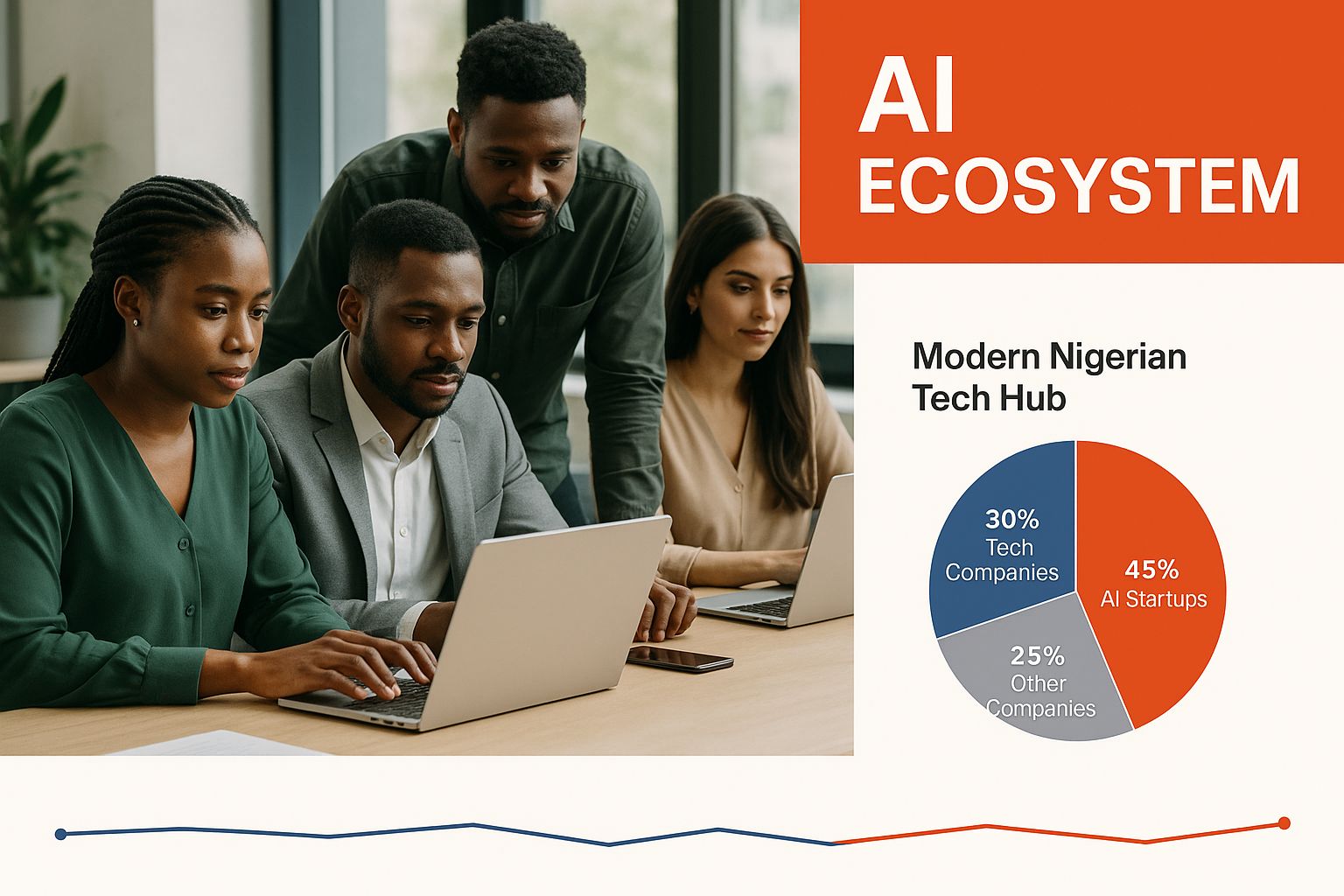
This scene captures the energy you’ll find in tech hubs across Lagos, Abuja, and beyond. These are the spaces where the future of Nigerian AI is being built today.
Transforming Finance With Data-Driven Decisions
Nowhere is AI’s impact more obvious than in financial technology, or fintech. For millions of Nigerians, getting a simple loan has always been a major hurdle, mostly because they lack the formal credit history traditional banks demand. Fintech innovators saw this gap and jumped right in.
Companies like Carbon, Renmoney, and FairMoney didn’t just tweak old systems; they built entirely new AI-powered credit scoring models from scratch. Instead of relying on dusty credit bureau data, their algorithms look at alternative, locally relevant information.
Think about it. These AI models analyse a person’s digital footprint—things like mobile money transactions, how consistently they pay their utility bills, and even their app usage patterns—to build a much fairer picture of their financial reliability.
This simple shift has been revolutionary. A small business owner in Aba or an artisan in Ibadan, who was previously invisible to the big banks, can now get a loan approved in minutes, right from their phone.
So, how does it actually work? It’s a clever, multi-step process.
- Data Collection: With the user’s permission, the app gathers non-traditional data. This could be transaction history from a linked bank account (via BVN), how often someone buys airtime, or their bill payment record.
- Feature Engineering: The AI then starts looking for patterns. For instance, consistent DSTV payments might signal reliability, while frequent, small-scale bank transfers could point to a steady business income.
- Risk Assessment: The machine learning model crunches thousands of these data points to generate a dynamic credit score. It predicts the likelihood of repayment far more accurately than old methods could for this population.
- Instant Decision: Based on that score, the system automatically decides whether to approve the loan and sets the terms. The whole thing happens in just a few minutes.
Boosting Food Security Through Smart Agriculture
Agriculture is the lifeblood of Nigeria’s economy, but so many of our farmers are still at the mercy of unpredictable weather and pests. AI is starting to bring a new level of precision and insight to the farm.
AgriTech startups are now deploying drones and analysing satellite imagery to give farmers the data they need to make better decisions. These aren’t futuristic concepts; they’re practical tools providing real-time information on:
- Crop Health: AI algorithms can scan drone images to spot the early signs of disease or pests, allowing a farmer to intervene long before a whole crop is wiped out.
- Irrigation Needs: By looking at soil moisture data from satellites, AI can tell a farmer exactly when and how much to water their fields. This conserves a precious resource and boosts growth.
- Yield Prediction: Machine learning models can forecast harvest yields with impressive accuracy, helping farmers plan better and negotiate better prices for their produce.
Practical Example: How a Farmer Uses AI
A maize farmer partners with an AgriTech company. Here’s their new weekly routine:
- A drone flies over their farm, capturing high-resolution images.
- The images are uploaded to the cloud, where an AI model analyzes them for signs of nutrient deficiency (e.g., yellowing leaves) or pest infestation.
- The farmer receives a notification on their phone with a color-coded map of their farm, highlighting specific areas that need attention.
- The alert includes a recommendation: “Apply nitrogen-based fertilizer to the northeast corner of Plot B within 48 hours.” This targeted action saves money and prevents crop loss.
Enhancing Healthcare Delivery
The healthcare sector is also seeing real benefits. With a tough doctor-to-patient ratio, AI is helping to fill crucial gaps in diagnostics and patient care, particularly in rural communities. New AI tools are being developed to analyse medical images like X-rays and scans, spotting diseases like tuberculosis or pneumonia faster and sometimes more accurately than the human eye. To dig deeper into this, you can learn more about how AI innovations are transforming healthcare delivery in Nigeria.
AI Applications Across Nigerian Sectors
| Industry | Specific AI Application | Example Company/Initiative | Impact |
|---|---|---|---|
| Fintech | AI-driven credit scoring | Carbon, FairMoney | Increased financial inclusion for unbanked populations |
| Agriculture | Drone-based crop monitoring | Zenvus, ThriveAgric | Improved crop yields and reduced resource wastage |
| Healthcare | AI-powered medical diagnostics | Ubenwa (infant cry analysis) | Early detection of diseases and wider access to care |
| Logistics | Route optimisation algorithms | Kobo360, GIG Logistics | More efficient deliveries and reduced operational costs |
| E-commerce | Personalised product recommendations | Jumia, Konga | Enhanced customer experience and increased sales |
As you can see, AI isn’t just one thing; it’s a versatile tool being applied in very specific ways to solve very real problems across the board.
Actionable Takeaways
- For Business Owners: Identify the most repetitive, data-heavy task in your business. Research if there’s an existing AI tool that can automate it.
- For Farmers: Look up Nigerian AgriTech startups like Zenvus or ThriveAgric. See what services they offer and if a pilot program could work for your farm.
- For Aspiring Techies: Pick one sector from the table above that interests you. Spend an hour researching the top 3 companies using AI in that space.
- For Everyone: Notice the personalized ads or movie recommendations you see. This is AI in action. Think critically about the data it’s using to make those suggestions.
Tools and Resources
- Fintech Apps: Download Carbon or FairMoney from your app store to see AI-driven lending firsthand.
- AgriTech Platforms: Explore the websites of Zenvus and ThriveAgric to understand their offerings.
- AI Communities: Join the mailing list for Data Science Nigeria (DSN) to stay updated on local innovations.
Further Reading
- PwC’s analysis of AI in Nigeria: A detailed report on the economic impact and adoption rates.
- Harnessing AI in Healthcare: An article on specific healthcare innovations in Nigeria.
Exploring Government and Private Sector AI Initiatives
The explosion of AI in Nigeria isn’t some happy accident. It’s the direct result of a powerful partnership between the government and a vibrant private sector, both working to lay the groundwork for the country’s technological future. You can feel the energy.
While startups are on the ground building incredible solutions, the government is busy creating a structured environment to help them succeed. It’s this synergy—this push and pull between top-down strategy and bottom-up innovation—that is really driving the entire ecosystem forward.
The Government’s Strategic Blueprint for AI
The Nigerian government has made it clear that AI is a national priority. Instead of just letting innovation happen in scattered pockets, they’ve developed a real roadmap to guide development and make sure the benefits are felt across the board.
A huge part of this has been creating key support structures. The government launched programmes like the Nigeria Artificial Intelligence Research Scheme (NAIRS) and the National Centre for Artificial Intelligence and Robotics (NCAIR). These aren’t just empty acronyms; they are providing vital funding, infrastructure, and real-world technical support to AI projects nationwide. For a closer look at the data, PwC’s analysis of AI in Nigeria offers some great insights.
This proactive stance led to the landmark unveiling of Nigeria’s National AI Strategy, a comprehensive plan to harness AI for economic growth and social good.
The National AI Strategy isn’t just another policy document gathering dust on a shelf. It’s a practical blueprint with clear goals aimed at developing local talent, fostering research, and positioning Nigeria as a competitive tech hub in Africa.
This strategy sends a powerful signal to investors and innovators: Nigeria is serious about building a sustainable AI future. To get the full picture, you might want to read our deep dive on Nigeria’s National AI Strategy and its vision for innovation.
Private Sector: The Engine of Innovation
While the government provides the framework, it’s the private sector that truly brings AI to life. From the buzzing tech hubs in Yaba to individual startups across the country, these companies are the real engines of innovation, building the practical solutions that solve everyday problems for Nigerians.
What’s so exciting is that these innovators aren’t just copy-pasting foreign technology. They are building AI that is specifically tailored for the Nigerian context because they understand our local data, our languages, and our unique challenges better than anyone else.
Practical Example: How a Nigerian Startup Gets Support
Let’s walk through a realistic scenario. Imagine a startup called “CropSense” that wants to use AI to help farmers identify crop diseases with their smartphones.
- Idea and Prototype: A small team of Nigerian developers and agronomists builds a basic prototype. They use open-source machine learning models and train them on a small dataset of local crop photos they’ve collected.
- Getting Help from NCAIR: The CropSense team applies to the National Centre for Artificial Intelligence and Robotics (NCAIR), presenting their business plan and working prototype.
- Receiving Resources: NCAIR is impressed and accepts them into its incubation programme. This unlocks a world of resources:
- Seed Funding: A grant that allows them to hire another developer and expand their data collection efforts.
- Computing Power: Access to high-performance servers for training more complex AI models—something that would be incredibly expensive for an early-stage startup.
- Mentorship: Connections to seasoned AI professionals and business leaders who can guide them on how to scale the company.
- Scaling and Impact: With this support, CropSense refines its algorithm, launches its app, and partners with farming cooperatives. They’re now making a direct impact on food security.
This simple example shows how the pieces fit together. The government provides the fertile ground, and the startups plant the seeds of innovation.
Actionable Takeaways
- Monitor Government Grants: If you’re an AI entrepreneur, follow NCAIR and the Ministry of Communications on social media. Set up alerts for terms like “AI grant” or “tech incubation.”
- Engage with Tech Hubs: Don’t just follow them online. Attend one event at a hub like Co-creation Hub (CcHUB) or Ventures Platform in the next three months.
- Align with National Goals: When creating a pitch for your AI idea, explicitly state which goal from the National AI Strategy it supports (e.g., “Our solution directly addresses the strategy’s goal of improving food security”).
- Leverage Local Data: Your biggest advantage is your local knowledge. Start a project that uses a uniquely Nigerian dataset, like analyzing sentiment in Pidgin English tweets.
Tools and Resources
- Government Agencies: Bookmark the official websites for the National Centre for Artificial Intelligence and Robotics (NCAIR) and the National Information Technology Development Agency (NITDA).
- Venture Capital Firms: Follow firms like TLcom Capital and Ventures Platform to understand what investors are looking for.
- Tech News: Subscribe to newsletters from TechCabal and Benjamin Dada for breaking news on funding and new government programs.
Further Reading
- Nigeria’s National AI Strategy and its vision for innovation: A deep dive into the official government blueprint.
- Reports from Local Venture Capital Firms: Publications from firms like TLcom Capital often have great analysis on which sectors are attracting the most investment.
Unlocking AI’s Economic Potential in Nigeria
So, what does the rise of Artificial Intelligence really mean for Nigeria’s economy? It’s our best shot at diversifying from oil and building new, sustainable paths to prosperity. AI isn’t just a tech buzzword; it’s a practical economic engine that’s starting to reshape our most important industries.
https://www.youtube.com/embed/iSF0FGdfOFY
The numbers behind this shift are staggering. A major whitepaper from Microsoft, Lagos Business School, and PwC Nigeria frames AI as a cornerstone for the country’s economic future. Globally, AI is projected to inject about $15.7 trillion into the economy by 2030, and Nigeria is in a great position to claim a significant piece of that pie. You can understand how AI is a blueprint for Nigeria’s future.
But this isn’t just about big, abstract numbers. It’s about creating a more resilient and diverse economy, one where our massive youth population becomes our single greatest advantage in a global digital marketplace.
From Oil Dependence to Digital Diversification
For decades, Nigeria’s economic health has been tied to the unpredictable price of crude oil. AI gives us a real opportunity to break that cycle. By embedding intelligence into other crucial sectors, we can create value in places where it was once difficult to find.
- Smarter Logistics: AI-powered logistics platforms are optimising delivery routes, predicting traffic jams, and managing warehouse stock. The result? Lower costs for businesses and happier customers.
- Personalised Education: An AI tutor can adapt to how each student learns, offering custom exercises and help exactly when it’s needed, helping bridge educational divides.
- Accessible Healthcare: AI tools can analyse medical images or patient data to detect diseases earlier, a game-changer for rural communities with few specialists.
AI acts as a great equaliser. It gives small businesses access to powerful tools once reserved for large corporations, allowing them to compete, innovate, and create jobs on a much larger scale. This is how we build a truly inclusive, AI-powered economy.
A Real-World Example: Building an AI-Powered Supply Chain
Picture a medium-sized company in Lagos that makes packaged food for distribution across the country. Before AI, their logistics were a chaotic mix of phone calls, manual spreadsheets, and frustrating, unexpected delays on the road.
Here’s how they could turn things around with AI:
- Adopt a Logistics Platform: They sign up with a service like Kobo360, which uses AI to match them with a network of reliable truck drivers.
- Route Optimisation: When they need to ship an order to Abuja, the AI doesn’t just find the shortest route. It analyses real-time traffic, checks road conditions, and even considers weather patterns to map out the most efficient journey, saving both fuel and time.
- Predictive Analytics: The platform’s AI crunches sales data to predict demand, helping the company know when it’s time to restock its northern warehouses before they run low.
- The Bottom Line: Within a few months, the company sees a 25% reduction in delivery times and a 15% drop in fuel costs. Their products are consistently on store shelves, which boosts sales and keeps their customers happy.
This is a perfect illustration of how generative AI solutions can transform industries by making complicated operations smarter and far more efficient.
Actionable Takeaways
- Conduct a “Bottleneck Audit”: Spend one hour this week mapping out a key process in your business. Identify the single biggest point of inefficiency. That’s your prime target for an AI solution.
- Explore No-Code AI Tools: You don’t need to be a developer. Research “no-code AI platforms” for tasks like customer service chatbots or data analysis. Sign up for a free trial.
- Start a Data-Hygiene Habit: Begin organizing your business data (e.g., sales records, customer contacts) in a clean, consistent spreadsheet. Good data is the foundation of all AI.
- Upskill Your Team: Encourage your team members to take a free introductory course on data literacy or AI fundamentals. A knowledgeable team can spot more opportunities.
Tools and Resources
- Logistics Platforms: Check out Kobo360 and GIG Logistics for AI-driven shipping solutions.
- Open-Source AI Libraries: For technical teams, TensorFlow and PyTorch are the industry standards for building custom models.
- AI Communities: Engage with Data Science Nigeria (DSN) to find local talent and expert advice.
Further Reading
- PwC Nigeria Reports: Keep an eye on publications from PwC Nigeria for in-depth analysis of AI’s economic impact on specific Nigerian sectors.
- Lagos Business School (LBS) Insights: LBS regularly publishes high-quality research on the role of technology in African business.
Navigating the Toughest Challenges in AI Adoption
Becoming an AI-first nation is an ambitious goal, but it’s not a straight path. While the potential is enormous, businesses and developers across Nigeria are bumping up against some very real, everyday hurdles. It’s easy to talk about generic difficulties, but the real key is understanding—and overcoming—the challenges that are uniquely Nigerian.
These aren’t just minor roadblocks. They’re foundational issues that demand clever workarounds and a ton of resilience. Let’s break down the three biggest challenges innovators face and how they’re creatively navigating them.
Overcoming Data Fragmentation and Quality Issues
Think of high-quality, organised data as the fuel for any AI model. In Nigeria, that fuel is often scattered everywhere, inconsistent, or just plain missing. This is data fragmentation, and it’s a massive barrier to progress.
A fintech startup trying to build a new credit scoring model runs into this problem immediately. To get a clear picture, they need to pull data from multiple sources—bank records, mobile money transactions, government IDs. But they find a mess: names are spelled differently, addresses don’t match, and huge chunks of records are incomplete.
An AI model can’t learn effectively from messy data. If the input is unreliable, the output—like a loan decision—will also be unreliable. This leads to poor business outcomes and can even introduce harmful biases.
How to Overcome It (Step-by-Step):
- Define a Standard: Before collecting any data, create a strict template for how information should be entered (e.g., all names in “Last Name, First Name” format).
- Use Data Cleaning Tools: Employ Python libraries like Pandas to write scripts that automatically find and fix inconsistencies, like standardizing “Lagos” and “LOS” to a single format.
- Implement Validation Rules: Build checks into your data entry forms. For example, a phone number field should only accept 11 digits and reject any text.
- Enrich Your Data: Where data is missing, use external sources to fill the gaps. For example, you could use a local address verification API to complete partial addresses.
Dealing with Infrastructure Deficiencies
Another huge hurdle is infrastructure. We all know the reality of an unstable power supply and patchy internet. These issues directly threaten cloud-based AI solutions, which need to be online constantly to work properly.
Picture a logistics company using an AI model to optimise its delivery routes in real-time. If the internet connection at their main office drops, the entire system goes blind. It can no longer process new orders or adjust routes, leading to delays and driving up costs.
This is where clever Nigerian developers are building hybrid and edge computing solutions.
How to Overcome It (Step-by-Step):
- Build Offline-First: Design your application so its core functions work without an internet connection. This is called edge computing—the processing happens on the device itself (e.g., a driver’s smartphone).
- Use Lightweight Models: Train smaller, more efficient AI models (like those from TensorFlow Lite) that can run on low-power devices without needing a constant cloud connection.
- Synchronise When Possible: The app should store data locally and then automatically sync with the central server whenever a stable internet connection is detected.
- Have a Backup Power Source: For critical systems, invest in reliable inverters or generators to ensure your local servers never go down.
Bridging the Critical Talent and Ethical Gap
Perhaps the most urgent challenge is the human one. There’s a serious shortage of experienced AI professionals. This talent gap makes it difficult for companies to build and maintain advanced AI systems. Beyond just finding people, there’s the growing need to ensure AI is implemented responsibly to avoid reinforcing societal biases. Digging into resources that cover critical aspects of bias, fairness, and explainability in machine learning is no longer optional. Promoting the ethical use of AI in the workplace is crucial for building systems we can all trust.
Actionable Takeaways
- Prioritise Data Cleaning: Dedicate 80% of your initial project time to cleaning and structuring your data. Use tools like OpenRefine or write Python scripts. It’s the most critical step.
- Design for Resilience: When planning an AI project, ask, “What happens when the internet goes out?” Build an offline-first strategy from day one.
- Invest in Local Talent: Don’t just look for senior experts. Partner with organizations like DSN to hire promising junior talent and invest in their training.
- Start with a Small Problem: Pick one specific, high-impact business problem and apply AI to that first. A successful small project is better than a failed grand vision.
Tools and Resources
- Data Cleaning: Pandas (Python library), OpenRefine (a free, powerful tool for cleaning messy data).
- Edge AI Frameworks: TensorFlow Lite and PyTorch Mobile for building AI models that run on phones.
- Talent Development: Engage with Data Science Nigeria (DSN) and local university tech hubs to find and nurture talent.
Further Reading
- AI and Ethics Guidelines: Read Google’s AI Principles or Microsoft’s Responsible AI Standard. They provide excellent frameworks for ethical development.
- Reports on African Tech Infrastructure: Look for analyses from publications like TechCabal on the state of internet and power to inform your strategy.
How You Can Get Involved in Nigerian AI
Reading about Nigeria’s AI progress is one thing, but actually being a part of it is where the real excitement begins. This section is your personal launchpad, designed to turn curiosity into action. It doesn’t matter if you’re a student, a developer, or an investor—there are clear pathways for you to plug in.
The Nigerian AI scene is built on community and collaboration. Getting involved isn’t about having all the answers; it’s about joining conversations, lending your skills, and connecting with the people driving this change.
Join a Community and Start Networking
The single best thing you can do is join a community. These groups are the heartbeat of the ecosystem, hosting everything from networking events and training bootcamps to collaborative projects.
- Data Science Nigeria (DSN): This non-profit is the central hub for AI talent development in the country. They host hackathons, bootcamps, and provide tons of free training.
- Local Tech Hubs: Places like Co-creation Hub (CcHUB) in Lagos or Ventures Platform in Abuja are physical epicenters of innovation. Showing up to their events is a brilliant way to meet founders, developers, and investors.
Upskill with Practical Training
In a field that moves as fast as AI, hands-on learning is what sets you apart. A degree is great, but what truly matters is your ability to build things that solve real-world problems.
Practical Example: Your First AI Project (Step-by-Step)
Let’s build a simple sentiment analysis model for Nollywood movie reviews.
- Learn the Basics (1 Week): Take an introductory Python for data science course on freeCodeCamp or Coursera. Focus on learning the Pandas library for data manipulation.
- Find and Clean Your Data (1 Week): Scrape 100-200 movie reviews from a popular Nigerian blog or forum. This will be messy. Use your Pandas skills to clean the text (remove punctuation, convert to lowercase). This is a critical real-world skill.
- Build and Train a Basic Model (1 Day): Use the Scikit-learn library in Python to build a simple classification model. Train it to recognize whether a review is positive, negative, or neutral based on the words used.
- Share Your Work (1 Hour): Create a GitHub account, upload your code in a Jupyter Notebook, and write a clear
README.mdfile explaining what your project does, how you built it, and what you learned. This is your new CV.
Your goal isn’t just to absorb theory; it’s to create tangible things. In the Nigerian tech scene, a GitHub profile with three solid, locally relevant projects is a CV that speaks for itself.
Actionable Takeaways
- Join the DSN Community Today: Go to the Data Science Nigeria website and sign up for their newsletter and follow them on social media.
- Attend One Tech Meetup This Month: Use Meetup.com or Eventbrite to find a tech or AI-focused event in your city. Your goal: listen and meet one new person.
- Start Your First Project This Weekend: Don’t wait. Pick a simple problem (like the Nollywood review analyzer) and start step one. The momentum will carry you forward.
- Curate Your Professional Network: Find 5 key figures in the Nigerian AI community on LinkedIn and send them a connection request with a brief, polite note about what you’re learning.
Tools and Resources
- Learning Platforms: freeCodeCamp, Coursera, Udacity are excellent for foundational courses.
- Community Hubs: Data Science Nigeria (DSN) is your go-to for community and structured learning.
- Code Repositories: A GitHub account is non-negotiable for anyone serious about a tech career.
Further Reading
- Nigeria’s National AI Strategy: Read the executive summary to understand where future opportunities might arise.
- TechCabal and Benjamin Dada: Follow these publications for daily news and sharp analysis of the Nigerian tech and AI scene.
Got Questions About AI in Nigeria? We’ve Got Answers.
As AI becomes a bigger part of our world, a lot of questions pop up, especially about what’s happening right here in Nigeria. Let’s clear up some of the most common ones.
Which Nigerian Industries Use AI the Most?
Hands down, the financial services sector is leading the charge, particularly in fintech. Banks and financial startups are using AI heavily for everything from data-driven credit scoring and spotting fraud to offering personalised banking services to millions of customers.
But it’s not just about finance. AgriTech is another area where AI is really starting to shine. Farmers are using it for things like monitoring crop health, predicting harvest yields, and sorting out complex supply chains. We’re also seeing major growth in healthcare and e-commerce, where AI is helping with medical diagnostics and improving how people shop online.
What’s the Biggest Hurdle for AI Growth in Nigeria?
While things like spotty internet and unreliable power are definitely a headache, the single biggest roadblock is the talent gap. There’s a massive demand for skilled people—data scientists, machine learning engineers, you name it—but we just don’t have enough of them yet.
This skills shortage makes it tough for companies to build and grow sophisticated AI solutions.
While educational programmes and community-led training are doing great work to close this gap, the lack of experienced talent remains the main thing slowing down the Nigerian AI ecosystem.
How Can I Start a Career in AI in Nigeria?
Getting into AI here is more doable than you might think. What really matters is practical, hands-on experience—that often speaks louder than just theory.
Here’s a simple roadmap to get you started:
- Build a Solid Foundation: Start with the basics. Get comfortable with Python, statistics, and key data analysis tools like Pandas using online courses.
- Join the Community: Don’t go it alone. Get involved with local groups like Data Science Nigeria (DSN). It’s the best way to network, learn from others, and work on real projects.
- Gain Practical Experience: Build a portfolio of 2-3 small, locally relevant projects on GitHub. This is more valuable than a certificate when applying for jobs.
- Find Your Niche: Think about specialising. For example, developing expertise in Natural Language Processing (NLP) for Nigerian languages like Pidgin or Yoruba could make you an incredibly valuable asset in the local job market.
Ready to create compelling content, generate code, or build custom chatbots with the power of AI? RichlyAI provides a complete suite of tools to automate your workflow and boost your productivity. Start creating for free with RichlyAI today!
