
From Lagos to Abuja, Nigerian students are navigating an increasingly competitive academic landscape. The pressure to excel in exams like JAMB, WAEC, and Post-UTME, coupled with the demands of university coursework, is immense. But what if you had a smart, tireless assistant to help you study more effectively, write better essays, and even prepare for your future career? This is the reality of Artificial Intelligence in education today.
This guide moves beyond the buzzwords to provide a practical, step-by-step breakdown of the top AI for Nigerian students: top use cases. We will explore specific tools, actionable strategies, and real-world examples to help you harness the power of AI, transforming how you learn, research, and prepare for success.
You will learn not just what these tools are, but exactly how to integrate them into your daily study routine for a tangible academic advantage. Forget generic advice; this article is designed to be your go-to resource for applying AI in a way that directly addresses the challenges faced by students across Nigeria. Let’s dive into the 8 key applications that can revolutionise your educational journey and give you a significant edge.
1. AI-Powered Language Learning and English Proficiency
For many Nigerian students, improving English proficiency is a gateway to global opportunities and acing exams like TOEFL or IELTS. While English is Nigeria’s official language, mastering academic tone and pronunciation for international standards can be tough. AI language tools act as your personal 24/7 digital tutor, using speech recognition and Natural Language Processing (NLP) to provide instant, targeted feedback on your writing and speech.
Image alt text: A student uses language learning software on a laptop, demonstrating one of the top use cases of AI for Nigerian students.
Practical Example: Correcting a Common Pronunciation Error
Many Nigerian English speakers pronounce “three” as “tree”. An AI app like ELSA Speak can detect this.
- You say: “I have tree books.”
- ELSA Speak’s feedback: “Your pronunciation of ‘three’ sounds like ‘tree’. Let’s practice the ‘th’ sound. Place your tongue between your teeth and gently blow air.”
The app then provides targeted exercises to help you master the sound. This adaptive learning is what makes AI so powerful.
Actionable Takeaway
Use AI to bridge the gap between Nigerian English and the international standards required for exams and global communication. The goal isn’t to erase your accent but to master clarity and standard pronunciation for specific contexts.
How to Get Started: Step-by-Step
- Refine Your Writing: Install Grammarly in your browser and word processor. Go beyond spelling and grammar; use its “Tone” feature to ensure your essays sound academic and your emails sound professional.
- Practice Pronunciation Daily: Dedicate 15 minutes a day to an app like ELSA Speak. Focus on its real-time feedback to correct specific sounds and improve your intonation.
- Simulate Real Conversations: Use the voice mode in ChatGPT or Google Assistant. Give it a prompt like: “Act as a university admissions officer and interview me for a scholarship.” This builds conversational fluency and confidence.
Tools & Resources
- Grammarly: For improving writing clarity, tone, and grammar.
- ELSA Speak: For pronunciation and accent coaching.
- Duolingo: For building vocabulary and foundational language skills.
2. Personalized Study Assistance and Homework Help
Struggling with complex topics like Further Mathematics or Organic Chemistry after class is common, especially in large lecture halls where one-on-one time is scarce. AI educational assistants act as on-demand tutors, providing instant, step-by-step explanations for difficult homework problems and concepts. They break down roadblocks the moment you hit them, preventing you from falling behind.

Image alt text: A Nigerian student gets homework help using an AI tutor app on a tablet, a key use case of AI for students.
Practical Example: Solving a Physics Problem
You’re stuck on a JAMB physics problem about projectile motion.
- Snap a photo: Use Socratic by Google to take a picture of the problem.
- Get a breakdown: Instead of just giving the answer, Socratic identifies the core concept (projectile motion) and breaks it down:
- It shows the relevant formulas:
v = u + at,s = ut + ½at². - It links to a short YouTube video explaining the concept visually.
- It provides a step-by-step walkthrough of how to apply the formulas to your specific problem.
This helps you learn the method, not just the answer.
- It shows the relevant formulas:
Actionable Takeaway
Use AI not as a cheat sheet, but as a tutor to explain the “why” behind the answer. Focus on understanding the step-by-step process so you can solve similar problems on your own during an exam.
How to Get Started: Step-by-Step
- Solve Math Problems Instantly: When stuck on a math or physics equation, use Photomath. Snap a picture to see the detailed steps. Don’t just copy it; try to replicate the process on a similar problem.
- Understand Complex Concepts: For non-math subjects, use Socratic by Google. Ask it a question from your homework, like “What were the main causes of the Aba Women’s Riots of 1929?” to get curated explanations and resources.
- Create Custom Practice Quizzes: Ask an AI like ChatGPT to act as your personal tutor. Prompt it with: “I am studying for my WAEC Biology exam. Create a 10-question multiple-choice quiz on the topic of cell division, and provide a detailed explanation for each answer.”
- You can learn more about how to use ChatGPT effectively on richlyai.com.
Tools & Resources
- Photomath: For step-by-step math problem-solving.
- Socratic by Google: For conceptual explanations across various subjects.
- ChatGPT / Google Bard: For generating practice questions and explaining concepts.
3. AI-Enhanced Research and Academic Writing
Writing a final year project, a term paper, or even a simple essay is a major hurdle. The process—from brainstorming a topic to formatting citations and avoiding plagiarism—is complex. AI research assistants streamline this entire workflow, helping you find sources, organize notes, and refine your writing, so you can focus on developing strong, original arguments.
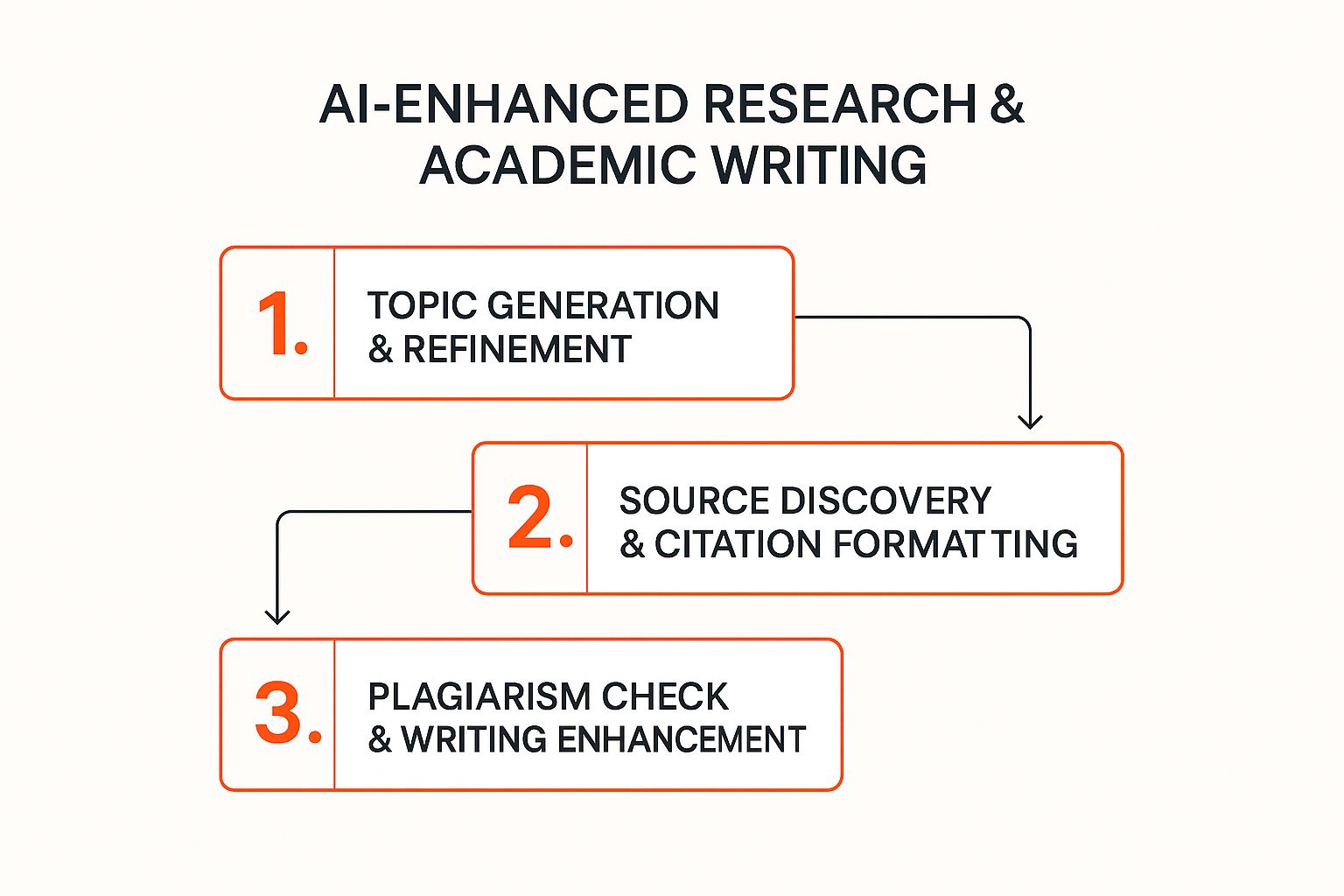
Image alt text: An infographic shows a 3-step process for AI-enhanced academic writing: Topic Generation, Source Discovery, and Writing Enhancement, a top AI use case for students.
Practical Example: Building a Literature Review Outline
For your final year project on “The Impact of Fintech on Financial Inclusion in Nigeria,” you need to structure your literature review.
- Open an AI tool: Use ChatGPT or Notion AI.
- Give a specific prompt: “Generate a detailed outline for a literature review on ‘The Impact of Fintech on Financial Inclusion in Nigeria.’ Include sections for the definition of key terms, theoretical framework, empirical studies in Africa, the Nigerian context, and research gaps.”
- Receive a structured outline: The AI will produce a logical structure, like:
- 1.0 Introduction
- 2.0 Conceptual Framework (defining Fintech, Financial Inclusion)
- 3.0 Review of Empirical Literature (studies on mobile money, digital lending)
- 4.0 The Nigerian Fintech Landscape (key players, regulatory challenges)
- 5.0 Identified Gaps in the Literature
- 6.0 Conclusion
This gives you a clear roadmap to follow, saving hours of work.
Actionable Takeaway
Use AI to handle the structural and repetitive parts of academic writing (like outlining and citation formatting). This frees up your mental energy to focus on critical analysis and developing your unique argument.
How to Get Started: Step-by-Step
- Brainstorm and Outline: Use ChatGPT to generate research questions and create a detailed outline for your paper. This provides a solid structure before you start writing.
- Automate Citation Management: Install the Zotero or Mendeley browser extension. As you find academic papers on Google Scholar, click the extension button to save the source and automatically generate citations in APA, MLA, or any other format.
- Refine Your Writing: Write your draft and then paste paragraphs into Grammarly or Hemingway Editor. Focus on the suggestions for clarity, conciseness, and academic tone to make your writing stronger.
- Check for Unintentional Plagiarism: Before submitting, run your paper through a plagiarism checker to ensure you have properly cited all your sources. For guidance on structuring key sections, you can learn more about how to write a literature review.
Tools & Resources
- Zotero / Mendeley: For reference management and automated citations.
- Grammarly / Hemingway App: For improving writing quality.
- Notion AI / ChatGPT: For brainstorming, outlining, and summarization.
4. Exam Preparation and Practice Test Generation
Preparing for high-stakes exams like JAMB, WAEC, or Post-UTME often means endlessly reviewing past questions. AI revolutionizes this by creating dynamic, personalized practice tests that adapt to your performance, identify your weak spots, and provide detailed feedback, making your study sessions far more efficient.
Image alt text: A student reviews progress on an AI exam prep app, highlighting a practical AI use case for Nigerian students.
Practical Example: A Personalized JAMB Study Session
You are using an AI-powered app like uLesson to prepare for the JAMB UTME.
- Take a diagnostic test: The app assesses your knowledge in Physics, Chemistry, Math, and English.
- Analyze the results: The AI identifies that you are strong in Algebra but consistently fail questions related to Optics in Physics.
- Receive a custom plan: Instead of generic practice, the app creates a targeted learning path. It suggests watching a 10-minute video explaining Snell’s Law, followed by a 15-question quiz focused solely on Optics.
As you improve, the questions get harder, ensuring you achieve mastery.
Actionable Takeaway
Stop studying blindly. Use AI to diagnose your specific weaknesses and focus your limited study time where it will have the most impact. The goal is to turn your weak areas into strengths before exam day.
How to Get Started: Step-by-Step
- Choose a Nigerian-Focused Platform: Sign up for an AI learning tool like uLesson, Gradely, or PrepClass, which are designed with the WAEC and JAMB curriculum in mind.
- Take a Diagnostic Test: Complete an initial assessment to let the AI map your current knowledge and identify your weak subjects or topics.
- Follow the Personalized Plan: Dedicate study sessions to the topics the AI highlights. Pay close attention to the detailed explanations for questions you get wrong. For more insights on this approach, learn how to use AI to score high in JAMB and other exams.
- Simulate Exam Conditions: Regularly take full-length, timed mock exams on the platform. This builds your knowledge, stamina, and time-management skills for the actual exam.
Tools & Resources
- uLesson / Gradely: Nigerian-focused adaptive learning platforms.
- MySchool Nigeria: Offers CBT practice tests and resources.
- Khan Academy: Provides personalized practice for math and science concepts.
5. Career Guidance and Skills Assessment
Choosing a career path is one of the biggest decisions a student makes. AI-powered career guidance platforms offer a data-driven alternative to traditional counseling. They analyze your interests, skills, and personality to suggest suitable careers, identify skill gaps, and recommend courses that align with the demands of the Nigerian job market.
Image alt text: A student uses an AI career assessment tool on a tablet, demonstrating AI for career guidance.
Practical Example: Discovering a Career Path
A university student enjoys statistics and problem-solving but isn’t sure what career to pursue.
- Take an assessment: The student uses a platform like LinkedIn’s Career Explorer or Jobberman’s assessment tool.
- AI analysis: The AI analyzes their skills (e.g., “Statistical Analysis,” “Python”) and interests.
- Get personalized recommendations: The platform suggests emerging career paths like “Data Analyst,” “Business Intelligence Analyst,” or “Financial Analyst.” It goes further by showing:
- Current job openings for these roles in Lagos and Abuja.
- The specific skills required for those jobs (e.g., “SQL,” “Power BI”).
- Links to online courses on Coursera or Udemy to learn those skills.
Actionable Takeaway
Use AI to make informed career decisions based on data, not just on popular opinion. Align your skills with real, in-demand jobs in the Nigerian market to improve your employability after graduation.
How to Get Started: Step-by-Step
- Complete a Career Assessment: Use a free tool from Jobberman or LinkedIn to get an objective profile of your strengths and potential career matches.
- Optimize Your LinkedIn Profile: Fill out your LinkedIn profile completely, including skills and course projects. LinkedIn’s AI will then suggest relevant jobs, connections, and online courses to boost your profile.
- Identify and Fill Skill Gaps: Based on the AI’s recommendations, find relevant courses on platforms like Coursera, Udacity, or ALX Africa to learn the skills needed for your target career.
- Practice for Interviews with AI: Use tools that offer AI interview prep strategies to get feedback on your answers, speaking pace, and confidence before a real job interview.
Tools & Resources
- LinkedIn Career Explorer: For exploring career paths and identifying skill gaps.
- Jobberman (Nigeria): Offers local job market insights and assessments.
- Coursera / edX: For online courses and professional certifications.
6. Automated Note-Taking and Lecture Transcription
In a fast-paced lecture, it’s nearly impossible to write down everything the professor says. AI transcription tools act as your personal scribe, converting recorded audio from lectures into accurate, searchable text. This lets you focus on understanding the concepts in class, confident that you have a perfect record to review later.
Image alt text: A smartphone screen shows audio being transcribed into text, a helpful AI use case for Nigerian students.
Practical Example: Revising for an Exam
You recorded a two-hour lecture on “Nigerian Constitutional Law.” Manually finding the professor’s explanation of the “doctrine of covering the field” would take ages.
- Record the lecture: Use your phone’s voice memo app.
- Transcribe with AI: Upload the audio file to a service like Otter.ai or WhisperBot.
- Search the transcript: In the generated text, simply search (Ctrl+F) for the phrase “covering the field.” You instantly jump to the exact moment it was discussed, complete with a timestamp to listen to the original audio if needed.
Actionable Takeaway
Stop passively re-listening to long lecture recordings. Use AI to create searchable transcripts so you can instantly find and review the exact information you need, saving hours of study time.
How to Get Started: Step-by-Step
- Record High-Quality Audio: Always ask for permission to record. Place your phone or recording device near the speaker to ensure the audio is clear.
- Transcribe the Lecture: Upload the audio file to a transcription service like Otter.ai (which offers a generous free tier) or another tool to automatically transcribe M4A to text.
- Review and Summarize: The transcript won’t be perfect. Quickly read through it to correct any errors. Then, copy and paste the entire transcript into an AI like ChatGPT and prompt it: “Summarize the key points and define the main terms from this lecture transcript.”
- Organize Your Notes: Save the transcript and its summary in a digital notebook like OneNote or Notion, tagged with the course code and lecture date for easy retrieval.
Tools & Resources
- Otter.ai: For live transcription and audio recording notes.
- Google Recorder (on Pixel phones): Offers excellent offline transcription.
- Microsoft Word (Online version): Includes a free audio transcription feature.
7. AI-Powered Time Management and Study Planning
Juggling multiple courses, assignments, and personal life—often with unpredictable interruptions like traffic or power cuts—is a major challenge. AI time management tools act as smart personal assistants, creating flexible and realistic study schedules that adapt to your life, helping you stay productive and avoid burnout.
Image alt text: A student’s desk with a laptop showing an organized digital calendar, an example of AI-powered study planning.
Practical Example: Planning a Busy Week
You have three assignment deadlines, two tests, and a group meeting next week.
- Input your tasks: Add all your deadlines and appointments into an app like Todoist or Motion.
- Let AI create the schedule: Instead of you manually slotting everything, the AI analyzes the deadlines, estimates the time needed for each task, and builds a complete schedule for you.
- Adapt to changes: If an unexpected power outage means you can’t study on Tuesday afternoon, simply tell the app. The AI will automatically reschedule that study block to the next available slot without derailing your entire week.
Actionable Takeaway
Let AI handle the logistics of scheduling. By offloading the mental work of planning and re-planning, you can focus your energy on actually completing your tasks.
How to Get Started: Step-by-Step
- Choose a Smart Planner: Use an app like Todoist, Motion, or Reclaim.ai. Connect it to your Google Calendar.
- Enter All Your Commitments: Add every class, assignment deadline, and personal appointment. Be specific. Instead of “Study for PHY 101,” write “Solve 10 PHY 101 practice problems (Est. 2 hours).”
- Let the AI Organize Your Day: Allow the tool to automatically schedule your study blocks around your fixed appointments.
- Review and Adjust Daily: At the start of each day, review the plan the AI has created. Drag and drop tasks if you need to make manual adjustments.
Tools & Resources
- Todoist: A powerful task manager with smart scheduling features.
- Motion / Reclaim.ai: AI-powered calendar assistants that automatically schedule your tasks.
- Google Calendar: Use its “Goals” feature to automatically schedule time for recurring habits like “Study.”
8. Educational Content Creation and Study Materials Generation
Manually creating study aids like flashcards, summaries, and mind maps from dense textbooks is incredibly time-consuming. AI tools can automate this process, transforming your lecture notes and reading materials into personalized, easy-to-digest study resources in minutes, tailored to your preferred learning style.
Image alt text: A glowing mind map on a tablet screen represents AI-generated study materials for Nigerian students.
Practical Example: Mastering Key Concepts with Flashcards
You have a 30-page PDF chapter on “The Nigerian Legal System” to study for a test.
- Upload the material: Copy the text from the PDF.
- Generate flashcards automatically: Paste the text into Quizlet’s AI feature or prompt ChatGPT with: “Create a set of 20 flashcards (term and definition) based on the following text about the Nigerian Legal System.”
- Start studying immediately: The AI will extract key terms like “Common Law,” “Sharia Law,” “Judicial Precedent” and their definitions, creating a ready-to-use study set in seconds.
Actionable Takeaway
Stop spending hours creating study materials and spend that time actually using them. Use AI to instantly convert your course content into active recall tools like flashcards and quizzes.
How to Get Started: Step-by-Step
- Generate Summaries: Copy text from a long article or your notes and paste it into ChatGPT or RichlyAI. Prompt it: “Summarize this text into five key bullet points for a university student.”
- Create Automatic Flashcards: Use Quizlet’s AI functions to turn your notes or any document into a digital flashcard deck.
- Visualize with Mind Maps: Paste your summary into a tool like Mindomo or Xmind and use its AI feature to generate a mind map. This is great for visual learners to see how concepts connect.
- Verify and Refine: Always double-check AI-generated content against your original source material for accuracy. Add your own notes and examples to deepen your understanding. For more ideas on using these platforms, explore some of the best free AI tools for content creation available.
Tools & Resources
- Quizlet: For AI-powered flashcard and quiz generation.
- ChatGPT / Claude.ai: For summarizing text and generating questions.
- Mindomo / Xmind: For AI-assisted mind mapping.
Top 8 AI Use Cases for Nigerian Students Comparison
| AI Application | Implementation Complexity 🔄 | Resource Requirements ⚡ | Expected Outcomes 📊 | Ideal Use Cases 💡 | Key Advantages ⭐ |
|---|---|---|---|---|---|
| AI-Powered Language Learning and English Proficiency | Moderate – advanced NLP and speech recognition | Requires stable internet and devices | Improved English proficiency and communication | Nigerian students preparing for WAEC, JAMB, IELTS, TOEFL | Personalized feedback, flexible 24/7 learning, cost-effective |
| Personalized Study Assistance and Homework Help | Moderate – subject-specific AI tutoring | Internet access, device for interaction | Better homework understanding and problem solving | WAEC, NECO, JAMB prep in science, math, social studies | Instant doubt resolution, step-by-step explanations, broad subject coverage |
| AI-Enhanced Research and Academic Writing | High – multi-functional AI with citation and plagiarism tools | Devices with internet, possible subscription | Higher quality research papers and academic writing | Undergraduate/postgraduate research and academic writing | Saves research time, improves writing quality, plagiarism detection |
| Exam Preparation and Practice Test Generation | Moderate – adaptive test algorithms | Internet access, device for tests | Improved exam readiness and performance | Nigerian standardized exams: JAMB, WAEC, NECO, professional certs | Unlimited practice tests, performance analytics, exam simulation |
| Career Guidance and Skills Assessment | Moderate – data-driven personality and market analysis | Access to up-to-date job market data and devices | Clear career paths and skill gaps identified | Students exploring career options aligned with Nigerian job market | Objective assessments, job market insights, personalized recommendations |
| Automated Note-Taking and Lecture Transcription | Moderate – real-time transcription and summarization | Good audio quality devices, internet for cloud tools | Accurate, searchable digital lecture notes | University students needing lecture transcription and note organization | Saves time, aids hearing-impaired students, searchable notes |
| AI-Powered Time Management and Study Planning | Low to moderate – scheduling and tracking AI | Devices with calendar/apps integration | Optimized study schedules and productivity | Students balancing multiple subjects, activities, and commitments | Personalized plans, procrastination reduction, progress visualization |
| Educational Content Creation and Study Material Generation | Moderate – content transformation and generation AI | Devices, good source materials | Custom study aids matched to learning styles | Students needing flashcards, mind maps, summaries | Time-saving, supports visual/interactive learning styles, customizable |
Your Next Steps: Integrating AI into Your Study Routine
We’ve covered eight powerful applications of AI for Nigerian Students, moving from theory to practical, actionable steps. From using AI to ace your JAMB exams to planning your future career, these tools are available right now to give you an academic edge.
The key takeaway is this: AI is not about finding shortcuts or replacing hard work. It’s about working smarter. By automating tedious tasks like creating flashcards, scheduling your week, or transcribing lectures, you free up your most valuable resource: your time and mental energy. This allows you to focus on what really matters—critical thinking, understanding complex concepts, and developing original ideas.
Actionable Takeaways to Implement Now
Ready to start? Don’t try to do everything at once. Pick one area where you struggle the most and apply an AI solution this week.
- If you struggle with exam prep: Use an app like uLesson to take one diagnostic test and focus on your weakest topic for the next three days.
- If writing essays takes too long: Use ChatGPT to generate an outline for your next assignment before you write a single word.
- If you feel disorganized: Connect your calendar to Todoist and let it schedule your study tasks for the next week.
- If you can’t keep up with lectures: Record your next class and use Otter.ai to create a searchable transcript.
- If you’re unsure about your career: Spend 30 minutes completing a skills assessment on LinkedIn and review the career paths it suggests.
The Future-Ready Nigerian Student
Mastering these AI tools does more than just improve your grades. It equips you with the digital literacy and productivity skills essential for the modern workplace. In a world where AI is becoming a standard tool in every industry, learning how to leverage it effectively as a student makes you a more competitive and valuable graduate. You’re not just learning to be a better student; you’re learning to be a future-ready professional.
Ready to put these strategies into action with a powerful, all-in-one platform? RichlyAI consolidates many of the tools discussed, offering advanced AI for writing, research, and content creation tailored for academic and professional success. Start transforming your study habits today by exploring the specialised tools at RichlyAI.
