
Think of a standard AI as a brilliant specialist—a master of one trade. Now, imagine an entire team of these experts, each with their own unique skill, all working together on a complex project. That’s the leap we’re making with multi-agent AI systems.
Instead of relying on a single AI to tackle a problem, these systems deploy multiple autonomous “agents” that communicate, coordinate, and even negotiate with each other. They work in concert to achieve goals far beyond what any single agent could handle alone, marking a shift from a solo digital helper to a collaborative digital workforce.
Multi-Agent AI Systems Explained
– Multi-agent AI systems use multiple autonomous AI agents that collaborate to solve complex tasks
– Each agent has a specialized role (planning, execution, monitoring, decision-making)
– These systems outperform single-agent AI in dynamic, real-world environments
– Businesses already use them for logistics, fraud detection, research, and automation
– Multi-agent AI represents the future of scalable, enterprise-grade artificial intelligence
From Single Assistant to Collaborative AI Workforce
Asking one person to single-handedly design, manufacture, and market a new product is a recipe for failure. It’s just too much for one individual. A lone AI, no matter how powerful, runs into the same bottleneck when faced with complex, interconnected business challenges. This is precisely the problem multi-agent AI systems were built to solve.
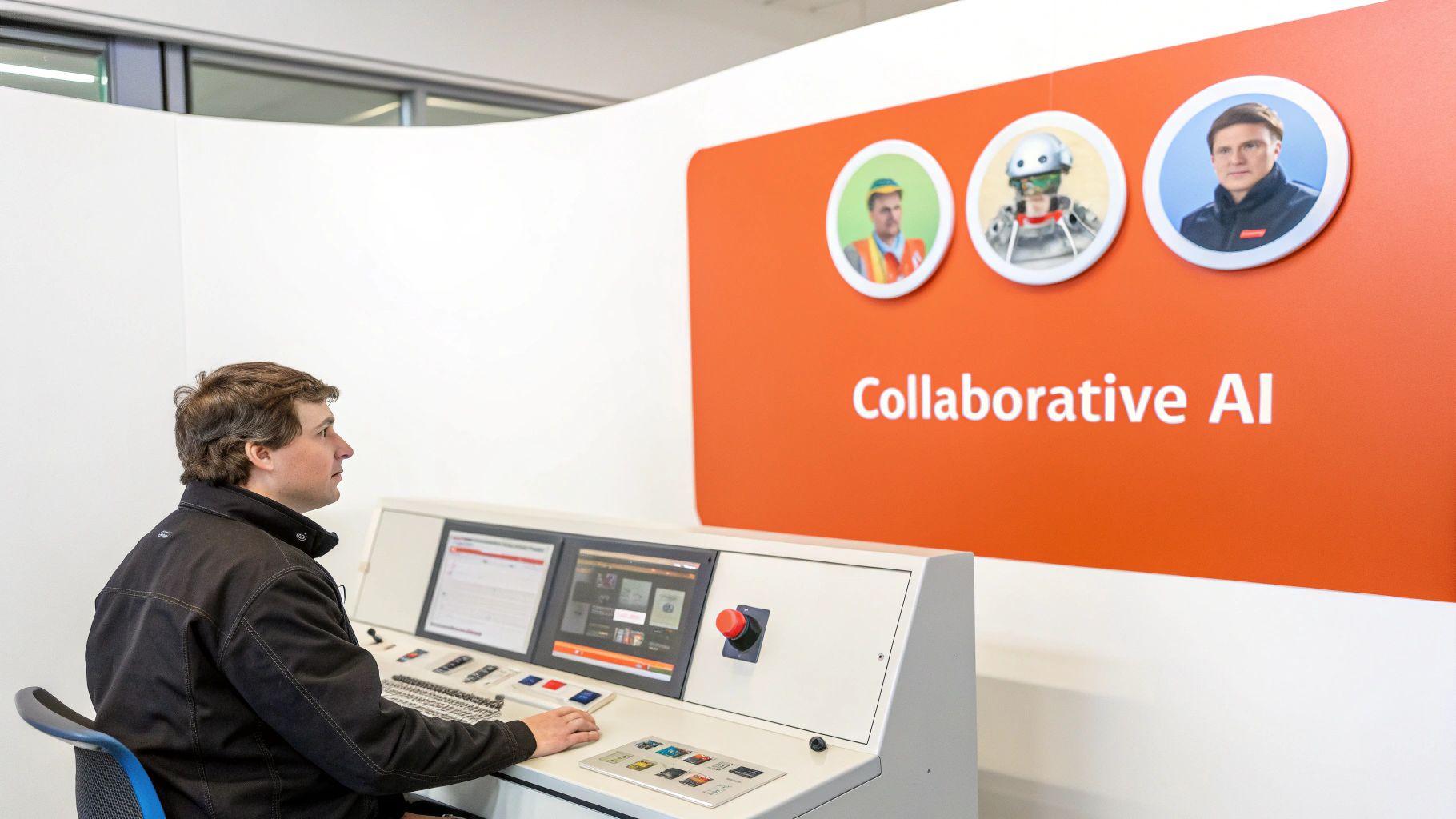
Alt text: A man at a futuristic control panel views a ‘Collaborative AI’ display featuring profiles of a factory worker, a robotic arm, and a design engineer, symbolizing multi-agent coordination.
We’re moving past the era of the solitary AI assistant and into a new phase of digital teamwork. The magic isn’t just in having several AIs running at once; it’s about creating a living network where specialized agents collaborate dynamically to get the job done.
To see just how different this approach is, let’s quickly compare the two paradigms.
Single-Agent vs Multi-Agent AI At a Glance
| Characteristic | Single-Agent AI | Multi-Agent AI |
|---|---|---|
| Structure | A single, monolithic model or program. | A collection of autonomous, interacting agents. |
| Decision-Making | Centralized. One “brain” makes all decisions. | Decentralized. Each agent makes its own decisions. |
| Problem Scope | Best for well-defined, singular tasks (e.g., image recognition). | Ideal for complex, dynamic, and distributed problems. |
| Scalability | Can be difficult to scale for multifaceted problems. | Highly scalable and robust; can add or remove agents. |
| Real-World Analogy | A lone specialist, like a chess master. | An expert team, like a hospital’s surgical staff. |
This table makes the fundamental distinction clear: we’re shifting from a top-down, centralized intelligence to a bottom-up, distributed one.
What Makes Multi-Agent Systems Different
Let’s bring this to life with a real-world example: managing a supply chain. A single AI might be tasked with optimizing inventory in one warehouse. That’s helpful, but it’s a siloed view.
In a multi-agent system, you’d have a dedicated team:
- An Inventory Agent monitors stock levels in real-time.
- A Logistics Agent tracks shipments and calculates delivery ETAs.
- A Forecasting Agent analyzes market trends to predict future demand.
When the Forecasting Agent flags an unexpected spike in demand, it doesn’t just sit on that information. It immediately notifies the other agents. The Logistics Agent instantly works on rerouting incoming trucks, while the Inventory Agent adjusts stock orders on the fly. They communicate and adapt together, creating a system that’s incredibly resilient and responsive—something a single, monolithic AI would struggle to achieve.
A multi-agent system is not just a collection of agents but a society of agents that interact, cooperate, and sometimes compete to solve problems. This collaborative intelligence is what unlocks their true potential.
This isn’t just a theoretical concept; it’s a tangible industry trend. Recent analyses confirm that businesses are moving away from simple assistants and toward multi-agent systems designed to autonomously run complex enterprise workflows, from detecting financial fraud to coordinating intricate scientific research. You can read more about how AI trends are redefining enterprise workflows to see this shift in action.
With this foundation, it becomes obvious why we need more than one AI to solve the next generation of problems—the kinds of challenges that were once far too complex for machines to handle.
How AI Agent Teams Collaborate
For a multi-agent system to work—and not just descend into digital chaos—it needs a solid organizational structure. This isn’t so different from a successful company. You can’t just toss a group of brilliant people into a room and expect magic to happen; you need defined roles, a shared workspace, and clear lines of communication. The exact same principles hold true for teams of AI agents.
At its heart, the architecture of any multi-agent system is built on three essential pillars:
- Individual Agents: These are the specialists, the “employees” of the system. Each agent is its own autonomous program, equipped with distinct skills, knowledge, and goals. One agent might be a data analysis guru, while another is a coding prodigy.
- The Environment: This is the shared digital workspace where all the action happens. Think of it as the office, the factory floor, or the virtual world where agents can interact, access common data, and get their work done.
- Communication Protocols: This is the common language—the set of rules agents use to talk to each other. It’s the equivalent of a company’s email and messaging platform, making sure information flows smoothly and actions are properly coordinated.
These three components are the basic blueprint. But the real magic comes from how these agents are organized to work together. Just as businesses have different management philosophies, multi-agent systems use various organizational models, each tailored to solve different kinds of problems.
How Multi-Agent AI Systems Are Built in Practice
In real-world implementations, multi-agent AI systems are orchestrated using agent coordination frameworks rather than a single monolithic model.
A typical setup includes:
– A coordinator or manager agent that assigns tasks and evaluates outcomes
– Specialized worker agents responsible for research, execution, validation, or decision-making
– Shared memory or state management, allowing agents to retain context and learn from previous actions
– External tools and APIs, such as databases, search engines, CRMs, or internal business systems
Popular frameworks used to build multi-agent systems include LangGraph, AutoGen, CrewAI, and emerging agent orchestration patterns from OpenAI. These frameworks allow developers and businesses to design AI workflows where agents communicate, negotiate, and adapt dynamically.
The result is an AI system that behaves less like a chatbot—and more like a coordinated digital workforce.
Hierarchical Structure: A Top-Down Approach
One of the most common models you’ll see is the hierarchical structure. The easiest way to picture this is a traditional corporate org chart. There’s a “manager” agent at the top that receives a complex goal and immediately starts breaking it down into smaller, bite-sized sub-tasks.
This manager then delegates these tasks to specialized “subordinate” agents. The subordinates get to work, execute their specific duties, and report their results back up the chain. The manager’s job is to oversee the entire workflow, stitch all the individual results together, and make sure the team hits its final objective.
Practical Example: A Hierarchical Marketing Campaign
ACampaign Manageragent gets a high-level goal: “Launch a social media campaign for our new product.” It immediately breaks this down and delegates:
- It tells the
Content Creatoragent to generate compelling post copy and images.- It assigns the
Audience Analystagent to pinpoint the ideal customer demographic on each platform.- It tasks the
Scheduleragent with publishing all the content at the most impactful times.Each subordinate agent is laser-focused on its piece of the puzzle, reporting back to the
Campaign Manager, which orchestrates the entire effort.
What to do with this: Use a hierarchical model when your project can be broken down into clear, independent steps. It provides strong control and makes it easy to track progress, making it ideal for automating well-defined business processes.
Decentralized Structure: A Bottom-Up Collaboration
On the other end of the spectrum is the decentralized (or heterarchical) structure, which operates with no central boss. Imagine a team of freelancers collaborating on a project. Every agent is a peer, communicating directly with others to coordinate their actions and make decisions as a group.
This model is incredibly adaptable and resilient. With no single point of failure, the system can keep chugging along even if one agent goes offline. Agents negotiate with each other, share information, and self-organize to solve problems on the fly.
A great real-world analogy is a fleet of autonomous delivery drones navigating a dense city. There’s no air traffic controller dictating every move. Instead, each drone talks to its neighbors, sharing its location and intended flight path. They collectively negotiate routes in real-time to avoid collisions and find the quickest delivery paths, adapting instantly to new obstacles like a sudden construction crane. This bottom-up coordination makes the entire system robust and remarkably efficient.
What to do with this: Opt for a decentralized structure when dealing with unpredictable or dynamic environments where flexibility is more important than top-down control. This approach excels in robotics, network management, and real-time resource allocation.
The Power of Teamwork: Communication and Coordination
A team of brilliant experts is only as good as its ability to communicate. The same exact principle holds true for multi-agent AI systems. Without clear, efficient coordination, a group of powerful agents quickly dissolves into a chaotic mess. The strategies they use to talk to each other are the secret sauce that unlocks true collaboration.
These communication methods can be as simple as a direct order or as complex as a group-wide negotiation, much like human teamwork. The right approach depends entirely on the problem the agent team is trying to solve.
The flow below shows how a single agent sees its environment, communicates with others, and acts to reach a shared goal.
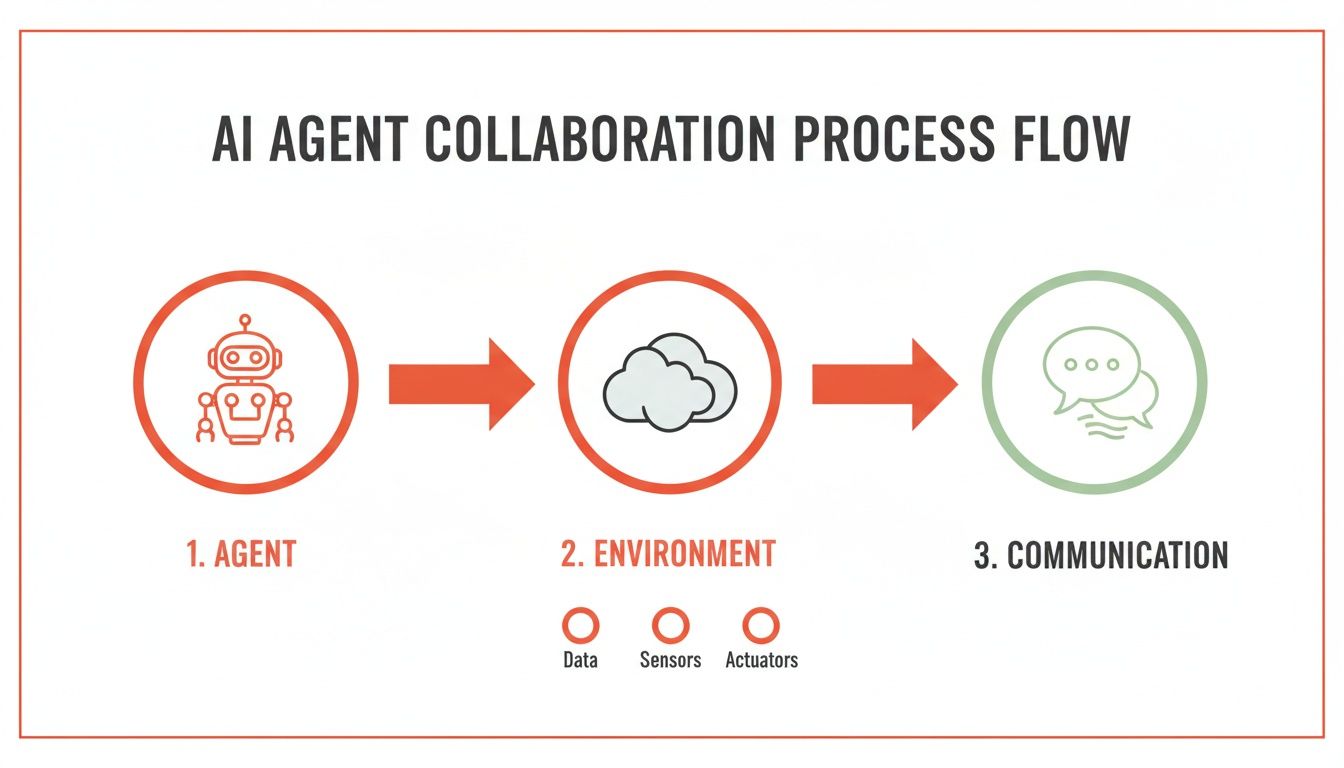
Alt text: A flowchart illustrates the AI agent collaboration process. An ‘Agent’ perceives the ‘Environment’, ‘Communicates’ with other agents, and then ‘Acts’, creating a feedback loop.
This loop—perceive, communicate, act—is the fundamental heartbeat of any multi-agent system.
Core Communication Strategies for AI Agents
To see how this works in the real world, let’s explore the most common communication patterns. We’ll use a running example to make it concrete: a multi-agent system designed to manage a smart power grid and prevent blackouts.
- Direct Messaging: This is the AI equivalent of sending a text. One agent sends a specific instruction or piece of data directly to another. In our smart grid, a
Generator Agentmight ping aDistributor Agentwith a simple message: “My current output is 500 megawatts.” It’s fast, simple, and perfect for routine updates. - Blackboard Systems: Think of a shared project whiteboard where everyone can see updates and grab tasks. A blackboard system is a central, shared memory space. Agents post information, and other agents can read it and react. Our
Distributor Agentcould post “City-wide demand forecast: 550 megawatts at 8:00 PM” to the blackboard. This lets multiple agents—like those controlling battery storage—see the update and prepare without needing a direct message. - Negotiation: Just like in business, AI agents can negotiate to resolve conflicts or allocate scarce resources. This involves a back-and-forth exchange of offers and counteroffers until they strike a deal. If demand spikes, multiple
Consumer Agents(representing factories) might need more power. They can negotiate with theDistributor Agent, offering to pay higher rates for priority access to stabilize the grid. - Consensus: When a group decision is critical, agents use consensus protocols to agree on a single course of action. It’s like a team taking a vote. If a major storm threatens the power grid, multiple
Sensor Agentsmight report conflicting data. The system could kick off a consensus round where agents “vote” on the most likely impact, allowing theGrid Management Agentto make one unified, defensive decision.
Practical Steps for Implementing Agent Communication
While these ideas might seem abstract, putting them into practice follows a clear path. If you were building our smart grid system, the communication setup would look something like this:
- Define the Agent Language: First, establish a clear, unambiguous message format, often using JSON or XML. This ensures every agent speaks the same language. For instance, a message might always include
sender_id,receiver_id,action_type, andpayload. - Choose a Communication Protocol: Next, decide how agents will talk. Will it be directly (peer-to-peer), or through a central message broker (like a blackboard)? A broker can simplify the logic but also creates a single point of failure.
- Code the Interaction Logic: Now you program each agent’s behavior. The
Generator Agentneeds logic to send output updates. TheConsumer Agentneeds logic to start negotiating when its power needs aren’t met. Getting the prompts right for these interactions is key, a skill we cover in our guide to advanced prompt engineering techniques. - Implement Coordination Strategy: Finally, build the big-picture coordination plan. For our grid, this could be a hybrid model. Routine updates use direct messaging, but critical events trigger a system-wide consensus protocol to prevent blackouts.
By mixing and matching these strategies, you can transform a collection of individual bots into a remarkably intelligent and cohesive team.
A Typical Multi-Agent System Architecture
At a high level, most multi-agent AI systems follow a shared architectural pattern:
1. A manager agent receives the objective and breaks it into sub-tasks
2. Specialized agents execute individual tasks independently
3. Agents communicate through messages or shared memory
4. Results are validated, refined, and merged into a final output
This architecture enables parallel problem-solving, resilience to failure, and continuous improvement—key advantages over single-agent AI systems.
Want to experiment with AI agents without writing code?
Explore how RichlyAI helps businesses design intelligent AI workflows using practical, real-world tools.
Real-World Examples of Multi-Agent AI Systems
Theory is one thing, but seeing multi-agent AI systems out in the wild is where their power really clicks. These collaborative systems are moving from abstract concepts to real-world solutions, already being put to work in major industries to solve messy, dynamic problems.
Let’s break down a couple of detailed examples to see the tangible impact they’re having on how businesses operate.
Transforming Global Supply Chains and Logistics
The logistics industry is a perfect playground for multi-agent AI. Managing a global supply chain involves an incredible number of moving parts—inventory, shipping, customs, and last-mile delivery—that all have to sync up perfectly. A single hiccup can trigger a cascade of costly delays.
Here’s how a team of specialized AI agents can conduct this complex orchestra:
- Inventory Agent: Its one and only job is to watch stock levels across multiple warehouses. It uses predictive analytics to see demand coming and automatically reorders products to keep shelves from going empty.
- Shipping Agent: This agent is the lookout, tracking all active shipments. It monitors everything from weather patterns to port congestion, constantly predicting potential delays before they happen.
- Routing Agent: The moment the Shipping Agent flags a probable delay, the Routing Agent jumps into action. It instantly calculates alternative routes and pings different carriers to find the fastest, most cost-effective workaround.
- Last-Mile Agent: This specialist focuses entirely on the final leg of the journey—from the local hub to the customer’s doorstep. It coordinates with local couriers and optimizes delivery routes in real time.
What to do with this: If your business relies on complex logistics, consider how a multi-agent approach could create a more resilient and self-correcting supply chain. Start by identifying the most critical, independent functions (like inventory vs. routing) and explore how dedicated agents could automate and coordinate them. A recent report shows multi-robot coordination is a massive driver in this space, capturing 34.6% of the AI agent market. You can discover more insights about the AI agents market to get the full picture of this trend.

Alt text: Two men in a modern warehouse. One man is looking at a computer screen displaying complex logistics data, showing human oversight of an automated system.
Detecting Sophisticated Financial Fraud Rings
Financial fraud isn’t a solo act anymore; it’s often run by organized, coordinated rings. A single AI model looking for isolated red flags can easily miss the bigger picture. This is exactly where a multi-agent AI system shines, acting like a digital detective squad.
Think of a fraud detection system set up like this:
- Transaction Monitor Agent: This agent is on the front line, scanning millions of transactions a second for anything that looks out of place—like an unusually large purchase from a brand-new location.
- Behavioral Analyst Agent: When the first agent raises a flag, this specialist digs deeper. It pulls up the user’s history. Does this purchase fit their normal spending habits? Are they using a familiar device?
- Cross-Referencing Agent: This agent looks for outside connections. It checks if the flagged account shares any details—like an IP address or device ID—with other accounts tied to known fraud cases.
- Coordinator Agent: The “lead detective” pulls all the findings together. If the evidence points to a coordinated attack, it can instantly block the transaction and alert a human security team for follow-up.
What to do with this: This team-based approach allows financial institutions to connect the dots between seemingly random events, spotting and stopping complex fraud rings with far greater success. The results speak for themselves: businesses have reported cutting their fraud-related losses by up to 30% after putting systems like this in place. For anyone exploring this area, our guide on AI tools for business automation provides more on related technologies.
By dividing the labor among specialized agents, the system can analyze problems from multiple angles at once. This creates a holistic view that is far more powerful than what a single, monolithic AI could ever achieve.
Getting Your Hands Dirty: How to Build a Simple Multi-Agent System
Moving from theory to a working model with multi-agent AI is more achievable than you might think. Thanks to a growing number of open-source frameworks, you don’t need a massive R&D budget to start assembling your own team of AI agents. Tools like Microsoft’s AutoGen and the increasingly popular CrewAI give you the scaffolding you need to define agents, set their roles, and get them talking to each other.
This section is a practical, step-by-step walkthrough for building a simple but effective multi-agent system. We’ll put together a “Research Team” with two specialized agents designed to collaborate on a single, clear goal.

Alt text: A desk setup with a laptop. On-screen cards for a ‘RESEARCHER’ and a ‘WRITER’ agent are shown next to the text ‘BUILD YOUR TEAM’, illustrating the concept of assembling an AI agent team.
This kind of setup is a classic workflow: one agent gathers the raw materials, and another crafts them into a finished product.
Step 1: Define the Agents and Their Roles
First, assemble your team. A well-designed multi-agent system gives every agent a specific, distinct purpose. If roles overlap too much, you’ll end up with confusion and wasted effort.
For this project, we’ll define two clear-cut roles:
- The Researcher: This agent’s only job is to scour the web and pull in raw information on a given topic. It’s built for searching and extracting data, nothing more.
- The Writer: This agent’s task is to take whatever the Researcher finds and spin it into a well-structured, easy-to-read summary. Its strengths are synthesis, language, and formatting.
This clean division of labor is a cornerstone of effective multi-agent design.
Step 2: Set Up the Environment and the Goal
With our agents defined, we need to give them a shared workspace and a mission. We’ll use a framework like CrewAI, which makes this part surprisingly straightforward. The setup involves installing a few libraries and spelling out the final objective.
Our shared goal will be: “Create a summary of the latest trends in multi-agent AI systems.”
This objective is specific enough to keep the agents on track but broad enough that they actually need to work together.
Step 3: Code the Collaboration Workflow
Now it’s time to write the code that brings our team to life. The most important part is creating a clear handoff, where the output from one agent becomes the input for the next. This simple, sequential workflow is a common and powerful pattern for multi-agent systems.
Here’s a simplified Python snippet using the CrewAI framework that shows how it all fits together:
# Import necessary libraries
from crewai import Agent, Task, Crew

# 1. Define the agents with their roles and goals
researcher = Agent(
  role='Senior AI Research Analyst',
  goal='Uncover the latest trends in multi-agent AI systems',
  backstory='You are an expert at finding and synthesizing cutting-edge AI research.'
)

writer = Agent(
  role='Professional Tech Content Writer',
  goal='Write a clear and concise summary of the research findings',
  backstory='You excel at transforming complex technical data into engaging narratives.'
)

# 2. Create tasks for each agent
research_task = Task(
  description='Find and compile key trends in multi-agent AI for 2024.',
  agent=researcher
)

write_task = Task(
  description='Summarize the compiled trends into a 3-paragraph blog post section.',
  agent=writer
)

# 3. Assemble the crew and kick off the process
research_crew = Crew(
  agents=[researcher, writer],
  tasks=[research_task, write_task],
  verbose=2
)

result = research_crew.kickoff()
print(result)
In the code, we first give each agent its persona. Next, we create specific tasks and assign them. Finally, we assemble the Crew and kickoff() the process. The framework takes care of the communication behind the scenes, automatically passing the research_task output to the write_task. This elegant structure lets you build a working prototype in minutes.
Popular Frameworks for Building Multi-Agent AI
Getting started is easier when you have the right tools. There are several powerful frameworks available that provide the building blocks for creating your own multi-agent systems, each with its own strengths.
| Framework | Key Feature | Best For | Learning Curve |
|---|---|---|---|
| OpenAI (Agents API) | Native agent orchestration, tool use, and agent handoffs. | Production-grade multi-agent systems tightly integrated with OpenAI models and tools. | Low to Medium |
| CrewAI | Role-based agent design and intuitive task orchestration. | Rapidly prototyping collaborative agent teams with clear workflows. | Low |
| AutoGen | Highly customizable and conversational agent interactions. | Complex research projects and dynamic, multi-turn conversations. | Medium |
| LangChain | A broad toolkit for building LLM applications, with agent components. | Developers who need a modular, flexible framework for complex apps. | Medium to High |
| LlamaIndex | Data-centric framework for building context-aware applications. | Creating agents that need to reason over large, private datasets. | Medium |
Note: Many third-party multi-agent frameworks build on top of OpenAI models, using them as the core reasoning engine.
What to do with this: Choose the right framework for your goal. For a straightforward, collaborative team like our example, CrewAI is a fantastic starting point. For more complex, research-oriented tasks, AutoGen or LangChain might offer more flexibility. Our curated list of top AI tools for developers is another good resource to check out.
Future Trends in Collaborative AI
What we’ve seen so far in multi-agent AI is really just the opening act. The next chapter is about moving beyond systems that just follow instructions to teams of agents that can strategize, learn, and tackle complex problems on their own. The entire field is buzzing with new investment and research, signaling that these systems are about to become a much bigger part of our daily work.
The market numbers back this up in a big way. The agentic AI market is already valued at USD 7.29 billion for 2025, but it’s projected to explode to USD 139.19 billion by 2034. Multi-agent systems are a huge driver of this, with their own growth projected at a staggering 46.30% compound annual growth rate. You can see the full agentic AI market research for a detailed breakdown.
The Rise of Self-Learning Teams
One of the most exciting frontiers is multi-agent reinforcement learning (MARL). Think of it like a rookie sports team learning to play together. They don’t just memorize a playbook; they practice, run drills, and learn from trial and error. Over time, they start to anticipate each other’s moves and adapt to what the other team is doing.
MARL is the same idea but for AI. It allows a group of agents to learn cooperative strategies on the fly, without a human having to explicitly code every possible scenario. This is an absolute game-changer for tasks in messy, unpredictable environments.
- Coordinating fleets of autonomous vehicles in the middle of chaotic city traffic.
- Managing teams of rescue robots in a disaster zone where the situation is constantly changing.
- Optimizing high-frequency trading strategies in volatile financial markets.
The Fusion of AI and IoT
Another massive trend is the deep-seated merger between multi-agent systems and the Internet of Things (IoT). Picture a smart factory where every sensor, machine, and assembly line robot is its own autonomous agent.
A Maintenance Agent on a critical machine could detect early signs of wear and tear, then directly negotiate downtime with the Production Scheduler Agent to minimize disruption. At the same time, it could automatically order a replacement part from a Supplier Agent. This creates a self-managing, self-optimizing ecosystem that runs with incredible efficiency and minimal human oversight.
We’re not just automating isolated tasks anymore; we’re building truly intelligent ecosystems. From smart cities that dynamically manage traffic flow and energy grids to hospitals where agents coordinate patient care from admission to discharge, the potential impact is immense.
Of course, this leap forward brings new challenges, especially around ethical governance and security. As these autonomous teams become more powerful, making sure they operate safely, fairly, and transparently is a critical hurdle we have to clear. This evolution is also creating entirely new job roles, making it a fascinating time to explore potential careers in artificial intelligence.
Wrapping Up: Your Questions Answered and Next Steps
As we close out this deep dive, it’s natural to have a few questions lingering. Let’s tackle some of the most common ones to help solidify these concepts and give you clear actions to take next.
What Is the Main Difference Between a Multi-Agent System and a Distributed System?
It really boils down to one word: autonomy.
Think of a standard distributed system like an assembly line. Each component is a cog in a larger machine, performing a specific, pre-programmed task when told to by a central controller. It executes commands, but it doesn’t think.
A multi-agent system, on the other hand, is like a highly skilled team of specialists. Each agent is an intelligent entity with its own goals. They don’t just wait for orders; they perceive their environment, reason about their next move, and act proactively to get things done, often coordinating with their teammates along the way.
Are Multi-Agent AI Systems Secure?
That’s one of the most critical design questions, and the short answer is: they have to be built that way from the ground up. Because each agent acts on its own, they can create security challenges you wouldn’t find in a single, monolithic piece of software. A robust security posture is non-negotiable.
Protecting the system means thinking in layers. The most common measures include:
- Strong Authentication: Making sure every agent is who it says it is, preventing rogue actors from sneaking into the network.
- Encrypted Communication: Scrambling the messages sent between agents to keep them safe from eavesdroppers or anyone trying to tamper with the data.
- Strict Permissions: Applying the “principle of least privilege.” This means each agent only has access to the exact information and tools it needs to do its job, and nothing more. If one agent is compromised, the damage is contained.
How Do You Train AI Agents to Cooperate?
One of the most effective techniques is called Multi-Agent Reinforcement Learning (MARL). It sounds complicated, but the concept is actually quite intuitive.
Imagine training a new sports team. You don’t just teach each player their individual skills in isolation. You put them in a scrimmage—a simulated game environment—where they learn through trial and error.
MARL works the same way. Agents are placed in a shared simulation where they receive rewards not just for their own success, but for actions that help the entire team achieve its objective. Over thousands or millions of trials, this shared incentive structure naturally guides them to develop complex cooperative strategies, just like a team learning to pass, defend, and score together.
Frequently Asked Questions About Multi-Agent AI Systems
What is the difference between multi-agent AI and autonomous agents?
Autonomous agents operate independently, while multi-agent AI systems consist of multiple autonomous agents that collaborate, coordinate, and share context to achieve a common goal.
Are multi-agent AI systems expensive to build?
Not necessarily. With modern frameworks and cloud-based AI models, organizations can start small and scale gradually based on complexity and business needs.
Can small businesses use multi-agent AI?
Yes. Small businesses increasingly use multi-agent systems for marketing automation, customer support workflows, research, and operational planning without requiring large AI teams.
Actionable Takeaways
- Identify a Repetitive Workflow: Look for a multi-step business process (like content creation or sales outreach) that could be broken down and assigned to specialized AI agents.
- Experiment with a Framework: Install a beginner-friendly framework like CrewAI and run the sample “Research Team” code from this article. Modify the roles and goals to fit your workflow.
- Define Clear Roles and Goals: Before building, write down a “job description” for each agent. A clear division of labor is the key to a successful multi-agent system.
- Start with a Sequential Workflow: Your first project should have a simple, linear handoff: Agent A completes its task, and its output becomes the input for Agent B.
- Explore Pre-Built Agent Tools: Look for existing platforms that use multi-agent systems for specific tasks like marketing or coding to understand what’s possible.
Tools and Resources
- OpenAI (Agents & Swarm patterns):** Native support for building multi-agent systems using coordinated AI agents that can delegate tasks, share context, and interact with tools in production environments.
- AutoGen: A powerful framework from Microsoft for building conversational and task-oriented multi-agent applications.
- CrewAI: An intuitive, role-based framework designed for quickly assembling collaborative agent teams.
- LangChain: A comprehensive toolkit for developers building language model applications, including advanced agent orchestration capabilities.
- LlamaIndex: A data-focused framework for creating agents that reason over private, structured, or domain-specific information.
Ready to explore the power of AI for your own projects? RichlyAI provides the tools and resources you need to build, discover, and implement advanced AI solutions. Whether you’re a developer, a marketer, or a business owner, our platform makes sophisticated AI accessible. Start creating with our free plan at RichlyAI.
The Future Belongs to Collaborative AI
Multi-agent AI systems are redefining how intelligent systems are built—moving from isolated assistants to coordinated digital teams capable of handling complex, evolving challenges.
As businesses demand smarter automation and deeper intelligence, multi-agent AI will become the foundation of enterprise AI solutions.
