
Picture this: you’re done with endless scrolling and opening a dozen tabs just to find what you need. Instead, you just ask, “Find me a waterproof hiking jacket that’s breathable, under $150, and comes in a dark green.” A second later, you get a perfect, curated list with a ‘buy now’ button right there on the screen.
This isn’t science fiction. This is the new reality of AI & shopping — Google’s AI buy button innovation. It’s a fundamental change that turns a simple search into a direct shopping experience, and your business needs to be ready for it.
In this model, success is measured less by traffic volume and more by whether your product is selected by the AI at the moment of intent.
Some of these AI-powered shopping experiences are currently rolling out gradually, region by region, and may appear differently depending on location, product category, and merchant participation.
The New Era of AI-Driven Conversational Shopping
The path from finding a product to actually buying it has always been a bit broken. You’d search on Google, click through a bunch of links, compare prices on different sites, and then finally deal with a retailer’s checkout page. It works, but it’s clunky.
That whole multi-step dance is quickly becoming a thing of the past. Google is leading the charge toward a unified, conversational experience where the entire shopping journey—from discovery to purchase—happens in one place.
This is more than just a new button. It’s a complete reimagining of e-commerce. By embedding “buy” buttons directly into AI-powered search results, Google is basically collapsing the sales funnel. The mission is simple: eliminate friction and connect motivated buyers with the right products the moment they find them.
From Keywords to Conversations
At the heart of this shift is the move away from clunky, keyword-based searches toward natural, human conversation. Instead of forcing our brains to think like a machine (“men’s waterproof jacket sale”), we can now talk to the search engine like a personal shopping assistant.
Practical Example:
A user searching for a camera for an upcoming trip no longer types “mirrorless camera sale.” Instead, they ask Gemini, “I’m going on a hiking trip to the mountains and need a lightweight, weather-sealed camera that’s good for landscapes and under $1000.” The AI understands the context (hiking, landscapes) and constraints (lightweight, weather-sealed, price) to provide a tailored recommendation with a direct buy button.
This leap forward is powered by sophisticated AI models like Gemini, which are designed to understand complex, nuanced requests. The AI can process context, your intent, and multiple product features all at once to serve up incredibly relevant suggestions.
As a result, the search results page is evolving from a boring list of blue links into an interactive, dynamic shopping consultant. You can explore a variety of AI-driven applications and their impact by reviewing our comprehensive guides on AI.
Here’s a look at what this new AI-powered shopping interface actually looks like.
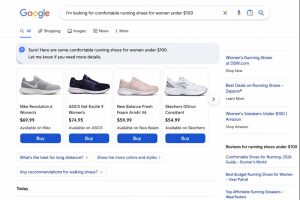
alt text: A screenshot showing Google’s new AI-powered shopping interface with a conversational query and product results featuring buy buttons.
In this interface, conversational queries return AI-curated product cards with direct purchase options, collapsing discovery, comparison, and checkout into a single flow.
As you can see, a simple, natural language question brings up interactive product cards, each with its own ‘buy’ button, making the path to purchase incredibly direct.
To really grasp how big of a change this is, it helps to compare the old journey with the new one.
Traditional Search Versus AI Conversational Commerce
| Feature | Traditional Search Journey | AI-Powered Shopping Journey |
|---|---|---|
| Discovery | User types keywords (e.g., “blue running shoes”). | User asks a question (e.g., “Find me blue running shoes for trail running with good ankle support.”). |
| Interaction | Clicks through multiple website links to compare. | Receives a curated list of products directly in the search results. |
| Comparison | Opens several tabs to check prices, reviews, and specs. | Compares options side-by-side within a single, dynamic interface. |
| Purchase | Navigates to a retailer’s site to add to cart and check out. | Clicks a ‘buy’ button directly in the search results, often with a simplified checkout process. |
| Friction | High friction, with many steps and opportunities to abandon the search. | Low friction, with a direct and seamless path from discovery to purchase. |
This table highlights the core difference: the old way was a fragmented, multi-step process, while the new AI-driven approach is an integrated, streamlined conversation.
An Open Standard for a Connected Ecosystem
To pull this off, Google isn’t going it alone. They’re rolling out a new open commerce standard with backing from heavy hitters like Shopify, Walmart, and Target.
Think of this protocol as a universal language. It allows Google’s AI to talk directly and securely with a retailer’s systems to get real-time inventory, pricing, and product details. This collaboration is firing the starting gun on a new era of AI-driven shopping experiences that will benefit everyone involved.
How Google’s AI Buy Button Actually Works
At its heart, Google’s new AI buy button is all about one thing: turning a clunky, multi-step shopping trip into a single, smooth conversation. To really get how it works, you need to look under the hood at the three pieces making it all possible: conversational AI, a massive product database, and a new way for everyone to share data.
When you ask a detailed question like, “Find me a pair of durable hiking boots for rocky trails under $200,” you’re doing more than just typing keywords. You’re giving the AI context, setting boundaries, and showing your intent. Google’s AI, running on models like Gemini, is smart enough to parse that natural language and understand exactly what you’re after.
It’s the difference between asking a librarian for a specific book title versus describing the kind of story you’re in the mood to read.
The Shopping Graph Powerhouse
The AI doesn’t just pull answers out of thin air. It’s plugged into the Shopping Graph, a gigantic, ever-changing database that acts as its brain for all things commerce. Think of it as a tireless personal shopper that can chat with you naturally, moving way beyond stiff, robotic keywords.
Fueled by over 50 billion product listings and refreshed with 2 billion updates every single hour, the Shopping Graph gives the AI instant access to a world of products, reviews, prices, and inventory levels. It’s a beast.
This colossal data hub lets the AI cross-reference your specific needs against billions of data points in real-time. It then synthesizes the perfect recommendation that actually matches what you asked for. That deep integration is what makes the whole experience feel so seamless and intelligent.
This infographic breaks down just how simple the user’s journey becomes in this new conversational model.
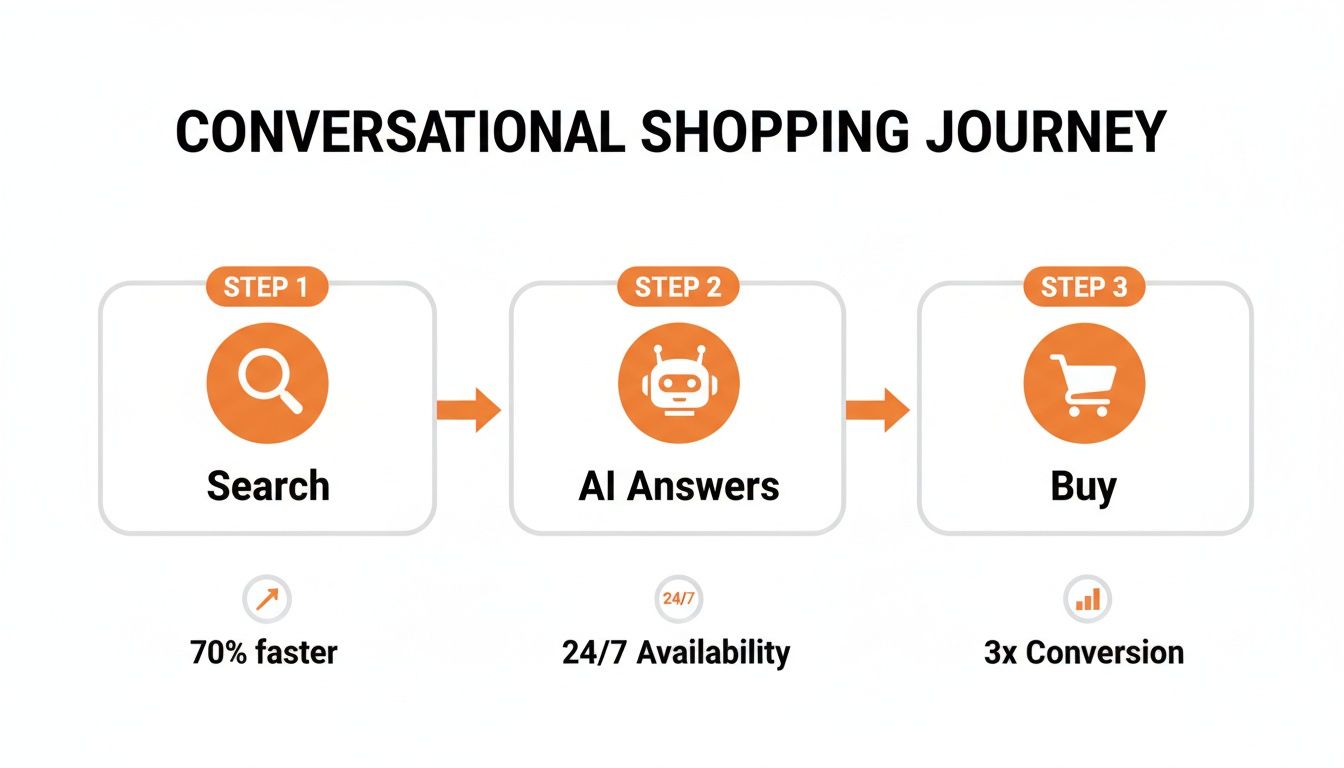
alt text: Infographic outlining a 3-step conversational AI shopping journey: Search, AI Answers, Buy, emphasizing speed and conversion.
As you can see, the AI cuts out all the usual steps, creating a direct path from search to purchase.
The Open Commerce Standard Bridge
The last piece of the puzzle is making sure the data the AI uses is actually accurate and, more importantly, actionable. This is where a new open commerce standard, or Universal Commerce Protocol (UCP), comes into play. You can think of it as a universal translator that lets different retail systems talk to each other flawlessly.
This standard, built with partners like Shopify and Walmart, creates a secure and reliable bridge between Google’s AI and a retailer’s backend systems. It’s the key that allows the AI to:
- Confirm Real-Time Inventory: No more finding the perfect item only to see it’s sold out. The AI checks that a product is actually in stock before it even shows you a “buy” button.
- Verify Current Pricing: It pulls the most up-to-date price, including any last-minute sales or promotions, so there are no surprises.
- Facilitate a Secure Checkout: It safely passes all the necessary info to complete the purchase right then and there, without you ever having to leave the search results.
Without this standard, the AI could only make an educated guess. But with it, the AI operates with certainty, delivering a shopping experience you can trust. This kind of direct integration is similar to the personalized interactions businesses everywhere are trying to build—a topic we explore more in our guide on AI chatbots in Nigeria. The entire process zips from a simple question to a completed sale with incredible speed.
The Ripple Effect Across the Digital Commerce Ecosystem
Google’s AI “buy button” isn’t just another feature drop. It’s a seismic shift that will send ripples across the entire digital commerce landscape, fundamentally rewriting the rules for how shoppers find products and how retailers find customers. A new set of winners and losers is about to be decided.
For shoppers, the appeal is instant. The whole process becomes incredibly convenient and deeply personal. Instead of wading through a sea of blue links, you get a single, smart recommendation and a direct line to checkout, saving a ton of time and mental energy.
But that convenience comes with a few strings attached. As AI takes over more of the shopping journey, we could see a “filter bubble” effect, where the system only shows you what it thinks you want to see. This might stifle the discovery of new or niche brands that don’t fit the AI’s neat predictive boxes. It also puts data privacy front and center, as the AI needs to learn an awful lot about your habits to get its suggestions right.
A Double-Edged Sword for Retailers
For e-commerce businesses, this new reality is a classic double-edged sword. On one hand, it’s a golden ticket to reach high-intent buyers at the exact moment of decision. When a shopper asks the AI for a recommendation and your product gets the nod, you’re connecting with someone who is literally ready to buy, right now.
On the other hand, it dramatically increases your reliance on Google. Instead of competing on the open web, businesses are now vying for a top spot in an AI-curated showcase. Visibility is no longer just about your website’s authority; it’s about how well Google’s AI understands and trusts your product data. This calls for a whole new game plan.
The game is no longer just about traditional SEO and ranking for keywords. It’s about optimizing product data feeds for AI interpretation and earning a spot in a highly selective, AI-generated summary.
Shifting Focus from Clicks to Data Feeds
This new world completely flips marketing priorities on their head. The focus shifts away from driving clicks to a website and toward feeding Google the richest, most structured product data you can possibly create. In a way, the AI becomes your new primary customer, and you have to “sell” your product to it first.
Here’s what that looks like in practice:
- The Old Way: A retailer writes a blog post titled “The 5 Best Waterproof Hiking Boots” to rank for that keyword and pull in traffic.
- The New Way: That same retailer obsesses over enriching their product data feed in the Google Merchant Center. They add new attributes like “ideal for rocky trails,” “high ankle support,” and answers to common questions so the AI has everything it needs to confidently recommend their boots.
Success now hinges on making your products perfectly legible and appealing to an algorithm. That means detailed, conversational descriptions, comprehensive schema markup, and ensuring your inventory and pricing data are absolutely flawless.
To help merchants adapt, Google is rolling out dozens of new data attributes in its Merchant Center. These go far beyond basic keywords to include details like compatible accessories, product substitutes, and answers to common questions—all designed to give the AI the context it craves.
Opportunities Versus Risks for E-commerce Businesses
Navigating this change means weighing the significant upsides against some very real risks. Businesses need to understand both sides of the coin to build a winning strategy.
The table below breaks down the core trade-offs for businesses adapting to Google’s new AI-driven shopping features.
| Area of Impact | Key Opportunity | Potential Risk |
|---|---|---|
| Customer Acquisition | Access high-intent buyers directly within AI-generated search results, shortening the sales cycle. | Reduced organic website traffic as more transactions occur directly on the search page. |
| Competition | Smaller brands with superior product data can compete with larger retailers in AI recommendations. | Increased competition within a curated space, making it harder to stand out if your data isn’t optimized. |
| Brand Control | Present products and offers directly through AI, including branded “Business Agents” for chat. | Less control over the user experience, which is now mediated by Google’s interface. |
| Data & Analytics | Gain insights into conversational queries and customer needs that lead to purchases. | Dependence on Google’s platform for performance data and customer interaction analytics. |
Ultimately, this evolution marks a critical turning point for e-commerce. The businesses that treat their product data as a primary marketing asset—and not an afterthought—are the ones that will be positioned to thrive in this new, AI-driven world.
How to Get Your Business Ready for Conversational Commerce
Theory is one thing, but an action plan is far better. As Google’s AI buy button starts rewriting the playbook for online shopping, your success will hinge less on old-school SEO and more on a single, critical asset: pristine product data.
The goal is simple. You need to make it effortless for Google’s AI to understand, trust, and ultimately recommend your products. This isn’t just about tweaking a few keywords; it’s about structuring your data so an AI can have a real conversation about your products with a potential buyer.
Here’s your step-by-step guide to get ready.
Step 1: Audit and Massively Enrich Your Product Data Feed
Your first job is to conduct a root-and-branch audit of your product listings and elevate them way beyond the basics. If your data feed is sparse, you’re practically invisible to an AI shopping assistant.
- Select Your Top 10 Products: Start with a manageable batch. Open your product listings in your e-commerce platform (like Shopify or BigCommerce).
- Rewrite Titles for Humans & AI: Change a generic title like “Men’s Boots” to a hyper-descriptive one like “Men’s Waterproof Leather Hiking Boots for All-Terrain Trails.” Include key features a user would search for.
- Enrich Descriptions: Write product descriptions that answer the questions a customer is already thinking. Instead of “Waterproof,” write “Features a GORE-TEX lining to keep your feet completely dry in heavy rain and shallow streams.”
- Fill Every Attribute Field: Go through your Google Merchant Center feed. Fill out everything—color, size, material, gender, age group, and any other specific detail you can provide. Don’t leave any field blank.
- Upgrade Your Visuals: Ensure you have multiple high-resolution images for each product. Show it from every angle, in use, and include close-ups that highlight key features.
Step 2: Implement Comprehensive Product Schema
While your product feed tells Google about your inventory, structured data (or schema markup) on your website tells Google what every piece of information on your product page actually means.
- Go to your product page template in your e-commerce platform’s theme editor.
- Check for
ProductSchema: Look for code snippets that includeitemscope itemtype="http://schema.org/Product". Many modern themes have this built-in, but it may be incomplete. - Validate Your Pages: Copy a product page URL and paste it into Google’s Rich Results Test tool. The tool will show you if your
Productschema is detected and if there are any errors or warnings. - Fix Errors: Common missing fields include
review,aggregateRating, andsku. Work with a developer or use a platform app/plugin to add any missing schema properties to ensure your price, availability, and ratings are clearly visible to AI.
alt text: A laptop displaying product data dashboards on a desk with binders and an open book, symbolizing the importance of structured product data.
Step 3: Optimize for Conversational Keywords
The move to voice and text-based AI assistants means your whole approach to keywords has to change. People don’t talk in choppy search terms; they ask full, natural questions.
- Brainstorm Customer Questions: Think of 5-10 real questions customers might ask about your products. Instead of “best running shoes,” think “what are the best running shoes for flat feet?“
- Create an FAQ Section: Add a Frequently Asked Questions section to your key product pages. Use the exact questions from your brainstorm as the headings (e.g., H3 tags).
- Write Comprehensive Answers: Answer each question clearly and concisely. This content is prime material for Google’s AI to pull into its conversational search results.
- Incorporate Questions into Content: Weave these long-tail, question-based phrases into your product descriptions, FAQ pages, and blog posts. This kind of deep audience understanding is critical for any modern business, including those figuring out how small and medium enterprises can use AI for growth.
Step 4: Integrate with Supported Platforms
To make all of this seamless AI shopping possible, Google has created a new open commerce standard called the Universal Commerce Protocol (UCP). To be part of the conversation, your e-commerce platform has to be integrated.
If your platform isn’t part of this ecosystem, you risk being completely cut out of this frictionless shopping channel. Check with your provider today about their roadmap for UCP integration.
Major players like Shopify are already working directly with Google to develop this standard. Ensure your platform is on board and that you’ve enabled every relevant integration with Google Merchant Center.
Step 5: Double Down on Your Customer Reviews
Customer reviews are an incredibly potent data source for AI. They provide essential social proof and are packed with the natural, conversational language that AI models are trained on.
Get proactive about encouraging customers to leave descriptive feedback. Don’t just ask for a star rating; prompt them with specific questions in your post-purchase emails, like, “What did you love most about the fit?” or “How did this product solve your problem?” This feedback is gold—it enriches your product’s data profile and makes it a much stronger candidate for AI-powered recommendations.
Use This Checklist
- Ensure Google Merchant Center feeds are complete and error-free
- Add rich attributes (use cases, fit, compatibility, FAQs)
- Use structured data/schema consistently
- Maintain real-time inventory and pricing accuracy
- Treat product data as a core marketing asset, not a backend task
Taking the Guesswork Out of Shopping with AI Virtual Try-On
Google’s AI ambitions go far beyond just text and buy buttons. The real magic is in creating powerful, visual experiences that build a customer’s confidence long before they ever click “purchase.” One of the biggest hurdles in buying clothes online has always been the nagging uncertainty about fit and appearance. The AI-powered virtual try-on feature hits this problem head-on.
This tech uses sophisticated AI models to show shoppers how an item of clothing will actually look on a wide range of real people. It’s a huge leap beyond the flat, static product photos we’re all used to, offering a dynamic and personalized preview that finally starts to bridge the gap between browsing online and stepping into a physical fitting room.

alt text: A person holds a tablet showing a smiling woman trying on an orange jacket virtually, with ‘VIRTUAL TRY-ON’ text overlay.
As you can see, this technology lets a user visualize an item on a model that reflects their own body type, which immediately builds trust and makes the purchase feel less like a gamble.
How Virtual Try-On Builds Real Confidence
At its heart, Google’s virtual try-on uses a cutting-edge diffusion model—similar to the technology powering some of the best AI image generators—to realistically drape a piece of clothing onto different body shapes. This isn’t just slapping a 2D image onto a model. The AI painstakingly simulates how fabric would actually fold, stretch, and cast shadows on a real person, taking into account the garment’s specific material and cut.
You can learn more about how these different models work by checking out our guide on the best AI image generators.
The whole process is powered by the immense dataset of Google’s Shopping Graph, which ensures the virtual representations are remarkably true-to-life. For businesses, this is a massive win. By giving customers a much clearer idea of how an item will look on them, it directly tackles the number one reason for returns: bad fit.
This technology solves one of the oldest problems in e-commerce—’Will this actually look good on me?’—by providing a visual answer before the customer commits to buying.
Lilian Rincon, Google Shopping’s Vice President, has celebrated this technology for its ability to boost conversions by giving shoppers a precise look at the product. You can learn more about how Google’s AI is reshaping shopping experiences at Business of Fashion.
Practical Steps to Get Ready for Visual AI
If you want to take advantage of features like virtual try-on, your product data needs to be visually rich and packed with detail. Here’s what you can do to get your catalog in shape:
- Provide High-Resolution, Multi-Angle Imagery: The AI needs clean, top-quality images of your products from several different angles, preferably on a neutral background. Think of these images as the raw material the model uses to generate the try-on experience.
- Detail Material and Fit Attributes: Go deeper than basic size charts. Use structured data to specify the fabric composition (e.g., 90% cotton, 10% spandex), the fit type (e.g., slim, relaxed, oversized), and the item’s exact dimensions. The more context you feed the AI, the more accurately it can render your product.
- Keep Your Feed Flawless: Make sure every single product variant—size, color, and so on—is correctly mapped in your Google Merchant Center feed. Any mismatch or error can make your products ineligible for these advanced visual features.
By enriching your product listings with this level of detail, you’re not just preparing for Google’s AI tools; you’re also improving the shopping experience on your own website. It’s a powerful example of how AI is enhancing the entire customer journey, from the first moment of discovery to the final decision to buy.
Actionable Takeaways
- Audit Your Top 10 Products Now: Don’t wait. Review and rewrite your product titles and descriptions to be conversational and answer customer questions directly. Fill in every single data attribute.
- Validate Your Product Schema: Use Google’s Rich Results Test tool to check your product pages. If schema is missing or broken, make it your #1 technical priority to fix it.
- Create a Product FAQ: Brainstorm 5-10 real questions customers ask about your key products and add an FAQ section to those pages. This is low-hanging fruit for conversational search.
- Check Your Platform’s Integration Status: Contact your e-commerce platform (Shopify, BigCommerce, etc.) and ask about their support for Google’s Universal Commerce Protocol (UCP).
- Automate Your Review Requests: Set up an automated post-purchase email that specifically asks customers descriptive questions to get richer, more useful review content.
Tools & Resources
- Google’s Rich Results Test: The essential tool for validating your website’s structured data (schema). Test your site here.
- Schema.org: The official home for all structured data types. The
Productschema documentation is your reference manual. View Product Schema. - Google Merchant Center: The hub for your product data feed. Get familiar with all the available attributes. Go to Merchant Center.
- The Verge – Google’s new AI shopping standard: The source article that details the announcement of the open commerce standard and buy buttons in Gemini. Read on The Verge.
- The Top 12 AI Tools for Developers to Watch in 2026
Ready to get your business ahead of the curve in this new age of conversational commerce? RichlyAI offers the tools and expertise you need to optimize your entire digital storefront, from generating top-tier product descriptions to training custom AI chatbots that can guide your customers. Learn how RichlyAI can help you adapt and thrive.
