
AI cyber defense isn’t just about adding a new tool to your security stack. It’s a fundamental shift in strategy, using artificial intelligence and machine learning to find threats, predict what attackers will do next, and shut down attacks faster than any human team possibly could. This is how we move from a reactive, signature-based defense to a proactive, predictive one—absolutely essential for fighting today’s hyper-sophisticated threats.
As cybercriminals increasingly use artificial intelligence to automate phishing, malware creation, and vulnerability discovery, traditional security tools alone are no longer sufficient. Modern organizations now require AI-driven cyber defense systems that can detect threats in real time, adapt to evolving attack patterns, and respond faster than human-only teams. This guide breaks down the most effective AI cyber defense tools and best practices businesses should adopt to stay resilient in an AI-powered threat landscape.
At RichlyAI, we work closely with businesses adopting AI responsibly, and one recurring lesson is that AI-powered cyber defense succeeds only when paired with strong security fundamentals.
The New Battlefield of AI Cyber Defense
Think of traditional security like a castle guard with a photo album of known enemies. It’s great at stopping threats it’s seen before, but it’s completely blind to a new face in the crowd. This old, rule-based model is breaking down in an era of automated, AI-driven attacks that can change their digital fingerprints in a blink. The sheer volume and speed of modern cyberattacks have swamped human-only security teams, creating a massive gap in our defenses.
This is where AI cyber defense steps in. It’s not just another buzzword; it’s the only practical way forward. Instead of relying on static rules, AI systems learn the unique rhythm and pulse of your network. They spot the subtle deviations that signal an attack is underway and can neutralize threats in real time. This guide will demystify the core tools you need and give you a proven roadmap for putting them to work.
Why AI is a Non-Negotiable Security Layer
The market’s explosive growth tells the story. Valued at nearly USD 29.64 billion in 2025, the global artificial intelligence in cybersecurity market is projected to skyrocket to USD 167.77 billion by 2035. This isn’t just hype; it underscores the critical role AI now plays in any modern defense strategy.
This conceptual image highlights the sheer complexity of modern network security that AI is built to handle.
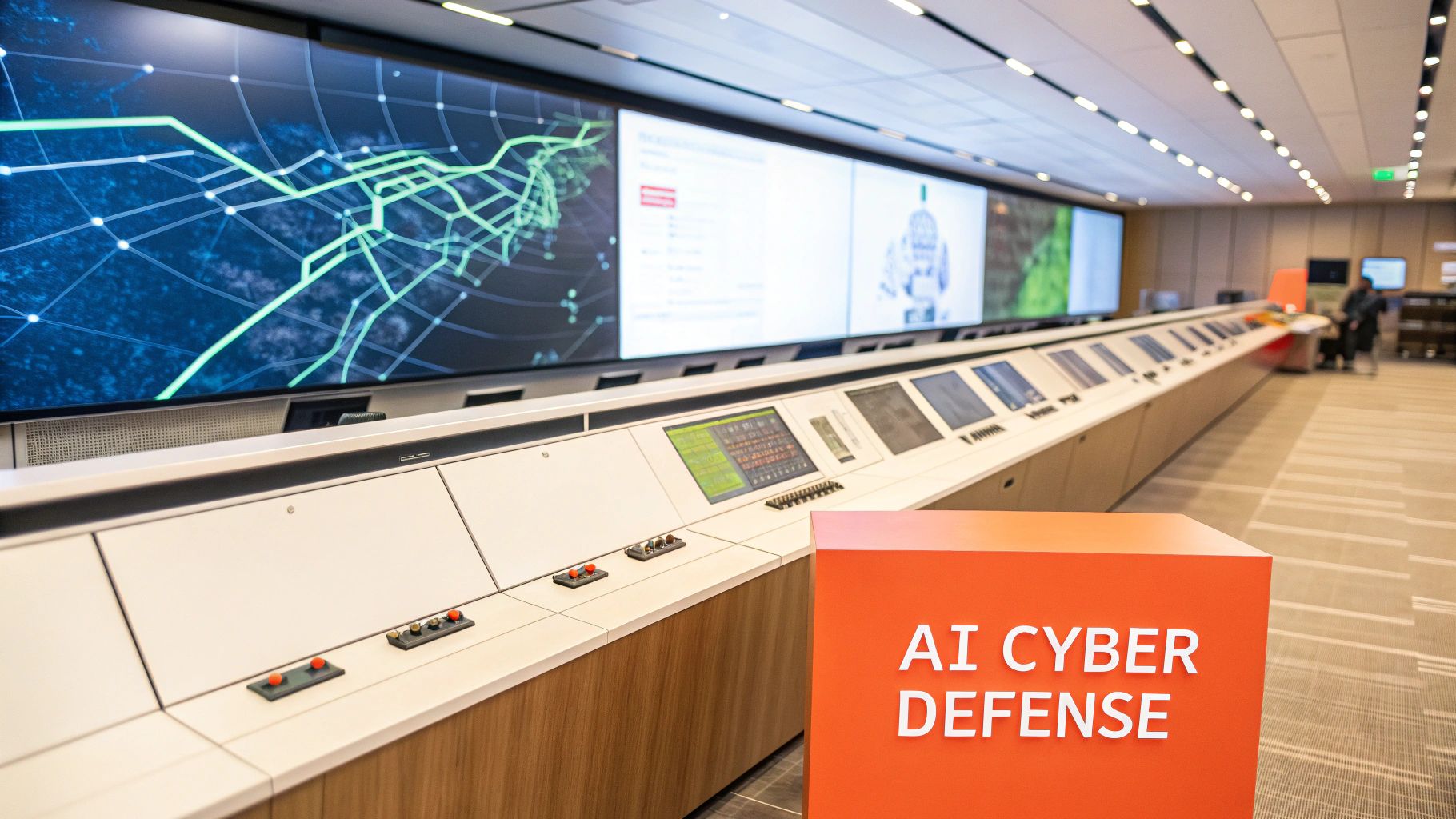
Alt text: A modern control room with a long console, large screens displaying network maps, and a lit sign that reads ‘AI CYBER DEFENSE’.
This visualizes the shift from teams of people staring at screens to an AI-driven command center, where intelligent systems are the ones sifting through endless data streams to protect our digital assets.
Shifting from Reaction to Prediction
The most profound change AI brings to security is the move from reaction to prediction. Instead of just waiting for an alarm to go off, AI models can see the faint signs of an attack and act before it fully launches. Here’s how you can put this principle into action:
- Actionable Step 1: Establish a Baseline. Deploy a User and Entity Behavior Analytics (UEBA) tool. Let it run in listening mode for 2-4 weeks. Its job is to learn the normal patterns for every user, device, and application on your network. This is your foundation.
- Actionable Step 2: Configure Anomaly Alerts. Once the baseline is set, configure the system to flag specific suspicious deviations. Start with high-impact scenarios: an employee suddenly accessing sensitive files at 3 AM from an unknown location, or a server that never connects to the internet suddenly trying to.
- Actionable Step 3: Automate Low-Risk Responses. Connect your UEBA tool to a SOAR platform. Create a simple, automated playbook: if a user account shows anomalous login behavior, automatically trigger a multi-factor authentication (MFA) re-verification request. This contains a potential threat without human intervention.
This isn’t science fiction. National labs in the U.S. are using AI to simulate cyberattacks and speed up defenses with tools like “Aloha,” showing how AI is reshaping cybersecurity. This proactive approach is no longer just a good idea—it’s the new foundation of a resilient security posture.
Understanding How AI Thinks About Threats
To get the most out of AI cyber defense, you need to understand how these tools “think.” It’s not about a conscious mind, but something far more practical: incredibly sophisticated pattern recognition.
At its core, AI in security is about teaching a machine to tell the difference between normal, everyday activity and the subtle red flags that signal a threat. We do this by training the AI on colossal amounts of data—network traffic logs, user login patterns, file access records—until it builds a rock-solid model of what’s normal for your specific environment. Anything that strays from this established baseline gets flagged. This is the magic that allows security to move beyond chasing known malware signatures and start hunting for suspicious behaviors.

Alt text: A man looks at a laptop displaying a complex neural network diagram with text that reads ‘HOW AI THINKS’ overlaid on the image.
Supervised Learning: Teaching AI with Labeled Examples
The most direct way to train an AI is through supervised learning. Think of it like teaching a new spam filter. You feed the algorithm a massive dataset of emails you’ve already labeled as either “spam” or “not spam.” The AI then analyzes every example to spot the common threads in malicious emails—sketchy links, urgent language, weird sender addresses—and learns to recognize these patterns on its own.
- Practical Example: To improve your phishing detection, you can create a custom supervised learning model.
- Collect Data: Export 10,000 emails from your company’s inboxes.
- Label Data: Have your security team manually label each one as either
phishingorlegitimate. - Train the Model: Feed this labeled dataset into a machine learning framework like TensorFlow or PyTorch. The model will learn the specific characteristics of phishing emails targeting your employees.
- Deploy: Integrate the trained model with your email gateway to block new, similar threats with higher accuracy.
Unsupervised Learning: Finding the Unknown Unknowns
But what about the threats you’ve never seen before? That’s where unsupervised learning shines. Imagine a detective dropped into a new city with no leads. Their job is to watch, observe, and identify any unusual behavior that doesn’t fit the normal rhythm.
An AI using this method does the same with your network data. It’s not given labeled examples. Instead, it sifts through everything and starts grouping similar activities. When an account suddenly logs in from a strange country at 3 AM, that activity doesn’t fit into any “normal” cluster, and the AI immediately flags it as a potential threat. This is a game-changer for spotting insider threats and novel attacks.
By simulating countless attack scenarios, AI can train defensive models to recognize and counter threats at speeds impossible for human teams. This is the core of proactive cyber defense.
To dive deeper into how these models work, check out our comprehensive guide to machine learning.
Reinforcement Learning: Learning from Trial and Error
Finally, there’s reinforcement learning. This is like training a security agent through pure trial and error. The AI, or “agent,” takes actions inside a simulated environment. It gets rewards for good outcomes (like blocking an attack) and penalties for bad ones (like letting malicious traffic slip through).
- Practical Example: Training an AI to manage firewall rules dynamically.
- Environment: Create a simulated replica of your network traffic.
- Agent: The AI agent’s goal is to create firewall rules that maximize legitimate traffic while minimizing malicious traffic.
- Actions: The AI can
allow,block, orflagspecific IP addresses or traffic types. - Rewards: It gets +10 points for blocking a known bad IP, -100 points for blocking a critical business application, and +1 for allowing safe traffic.
- Learning: After millions of simulation cycles, the AI learns the optimal policy for dynamically adjusting firewall rules in real-time in response to changing threat patterns.
Your Arsenal of AI-Powered Cybersecurity Tools
Moving from theory to practice means arming your security team with the right AI tools. You’re building a layered, intelligent defense—an integrated arsenal where each weapon is designed to stop a specific type of threat. Let’s break down the core categories of AI cyber defense tools essential for any modern Security Operations Center (SOC).
User and Entity Behavior Analytics (UEBA): The Digital Sentry
Imagine a security guard who knows the daily routine of every person in your building—when they arrive, which doors they use, what rooms they access. User and Entity Behavior Analytics (UEBA) is that guard for your digital environment. UEBA platforms use machine learning to build a baseline of normal behavior for every user and device on your network. Once that baseline is solid, the system instantly flags anything out of the ordinary.
- Practical Example: A marketing manager, Jane, normally works from 9 AM to 5 PM, accessing files on a shared drive. One night at 2 AM, her credentials are used to access the company’s financial database and start downloading massive amounts of data.
- Baseline: The UEBA tool knows Jane never works at this hour and has never touched the finance server.
- Anomaly Detection: The system flags several deviations at once: an unusual login time, access to restricted data, and abnormally high data exfiltration.
- Alert & Action: It fires a high-priority alert to the security team and, if connected to a SOAR, could automatically suspend Jane’s account pending investigation. Without UEBA, this might have gone unnoticed until the damage was done.
Best For:
Detects subtle behavioral anomalies that traditional rule-based systems miss.
Key Strength:
Automates and orchestrates incident response workflows across disparate security systems, enabling faster containment of threats while ensuring consistent, repeatable response actions.
Limitation:
Requires an initial learning period and continuous tuning to reduce false positives
Security Orchestration, Automation, and Response (SOAR): The SOC’s Nervous System
If UEBA is the lookout, then a Security Orchestration, Automation, and Response (SOAR) platform is the central nervous system that executes the response. SOAR platforms connect your entire security stack—firewalls, endpoint protection, SIEMs—into one coordinated system. SOAR uses AI to automate repetitive tasks through “playbooks,” freeing up human analysts for complex investigations. For a deeper look at how AI can filter out malicious communications, check out our review of Abnormal Security’s AI capabilities.
- Step-by-Step SOAR Playbook for Phishing:
- Trigger: An employee reports a suspicious email using a “Report Phishing” button.
- Automation: The SOAR platform automatically extracts the email’s headers, links, and attachments.
- Enrichment: It sends the links to a sandbox environment (like VirusTotal) for detonation and checks the sender’s IP against threat intelligence feeds.
- Decision: If the indicators are malicious, the playbook automatically searches all user inboxes for similar emails and quarantines them.
- Remediation: It then blocks the sender’s domain on the email gateway and creates a ticket for the security team to review the findings.
Best For:
Organizations with Security Operations Centers (SOCs) managing high alert volumes across multiple security tools and platforms, especially those aiming to reduce incident response time and analyst fatigue.
Key Strength:
Automates and orchestrates incident response workflows across disparate security systems, enabling faster containment of threats while ensuring consistent, repeatable response actions.
Limitation:
Effectiveness depends heavily on well-defined playbooks and integrations; poorly designed workflows can automate incorrect responses at scale if not carefully governed.
Network Threat Analytics (NTA): The Traffic Analyst
While UEBA watches users, Network Threat Analytics (NTA) tools focus on the data flowing through your network. They use AI to analyze traffic patterns in real time, sniffing out malicious activity that might otherwise be invisible, like command-and-control communication or attackers moving laterally. NTA is critical for finding the “unknown unknowns.”
- Practical Example: An NTA tool observes that a compromised IoT camera on your network, which normally only sends small video packets, suddenly starts communicating with an unknown external IP address using an encrypted channel at regular 15-minute intervals. This behavior matches the pattern of a command-and-control (C2) beacon. The NTA flags this, allowing the security team to isolate the camera before it can be used in a larger attack.
Best For:
Organizations seeking deep visibility into network traffic to detect lateral movement, command-and-control communications, and stealthy attacks that bypass endpoint defenses.
Key Strength:
Uses AI and machine learning to analyze network behavior patterns in real time, enabling early detection of anomalous activity that signature-based tools often miss.
Limitation:
High network complexity and encrypted traffic can reduce visibility, requiring complementary tools and skilled analysis to interpret alerts accurately.
As detailed in this Axios report on national cyber defense strategies, national labs are using similar AI techniques to simulate and defend against sophisticated network attacks, proving the value of this approach at the highest levels.
Comparing Key AI Cyber Defense Tool Categories
Choosing the right tool depends entirely on your organization’s specific risks. Use this table to understand where each tool category shines and identify the best fit for your needs.
| Tool Category | Primary Function | Best For Detecting | Example Tools |
|---|---|---|---|
| UEBA | Establishes baselines of user/device behavior to spot anomalies. | Insider threats, compromised credentials, and privileged account abuse. | Varonis, Securonix |
| SOAR | Automates and orchestrates responses across different security tools. | Phishing attacks, routine malware infections, and policy enforcement. | Splunk SOAR, Palo Alto Networks Cortex XSOAR |
| NTA | Analyzes network traffic patterns to find hidden threats. | Lateral movement, command-and-control (C2) traffic, and zero-day exploits. | Darktrace, Vectra AI |
The most effective AI cyber defense strategy doesn’t rely on a single tool. It integrates UEBA, NTA, and SOAR to create a comprehensive system that can detect, analyze, and respond to threats with both speed and intelligence.
Actionable Takeaways
- Start with Visibility: If your biggest worry is insider threats or compromised accounts, start by evaluating UEBA solutions.
- Automate to Accelerate: If your security team is drowning in alerts, a SOAR platform is your top priority to automate responses and cut down on manual work.
- Find Hidden Threats: For organizations with complex networks, an NTA tool provides crucial visibility into east-west traffic that other tools often miss.
- Run a Pilot Program: Before a full-scale deployment, test a tool on a small segment of your network. This lets you fine-tune its rules and measure its effectiveness in your environment.
How to Implement AI Cyber Defense Step-By-Step
Bringing AI into your security stack might feel like a huge project, but a clear plan makes it manageable. This isn’t about flipping a switch; it’s a deliberate journey. Each step builds on the last, ensuring you pick the right tools for the right problems.
1. Audit Your Current Defenses
Before shopping for AI tools, look inward. What problem are you trying to solve? Get your team together and ask the tough questions: Where are our blind spots? What alerts are burying our analysts? Where are we too slow to react? If you’re constantly fighting to spot compromised employee accounts, a UEBA tool should be at the top of your list.
2. Define Clear Success Metrics
How will you know if the investment is paying off? You have to define success before you start. You need concrete, measurable Key Performance Indicators (KPIs).
Good success metrics look like this:
- Mean Time to Detect (MTTD): Set a goal to cut the average time it takes to find a threat by a specific amount, like 50%.
- Alert Fatigue Reduction: Aim for a hard number, like a 75% reduction in low-priority or false-positive alerts that need manual review.
- Incident Response Time: Measure the entire window from detection to containment and make it your mission to shrink it.
3. Select the Right Vendor
Now it’s time to look at vendors. Focus on which tool solves your specific problem best. During a demo, make them show you how their platform would have handled a real incident your team has faced. That’s how you separate useful tools from vaporware. The number of organizations doing security assessments on AI tools has jumped from just 37% to 64% recently, which shows everyone is waking up to the new risks and rewards. Discover more insights about these cybersecurity trends.
4. Launch a Focused Pilot Program
Never roll out a new AI tool across your entire organization at once. Start small with a controlled pilot program. Pick one segment of your network—maybe a single department or a specific app environment—and test the tool in a live, but contained, setting.
A pilot program is your sandbox. It’s where you fine-tune the AI’s sensitivity, customize its rules, and work out any integration kinks without risking major business disruption. A successful pilot builds confidence and creates internal champions for a full rollout.
The infographic below shows how different AI tools like UEBA, SOAR, and NTA work together in a smart security workflow.
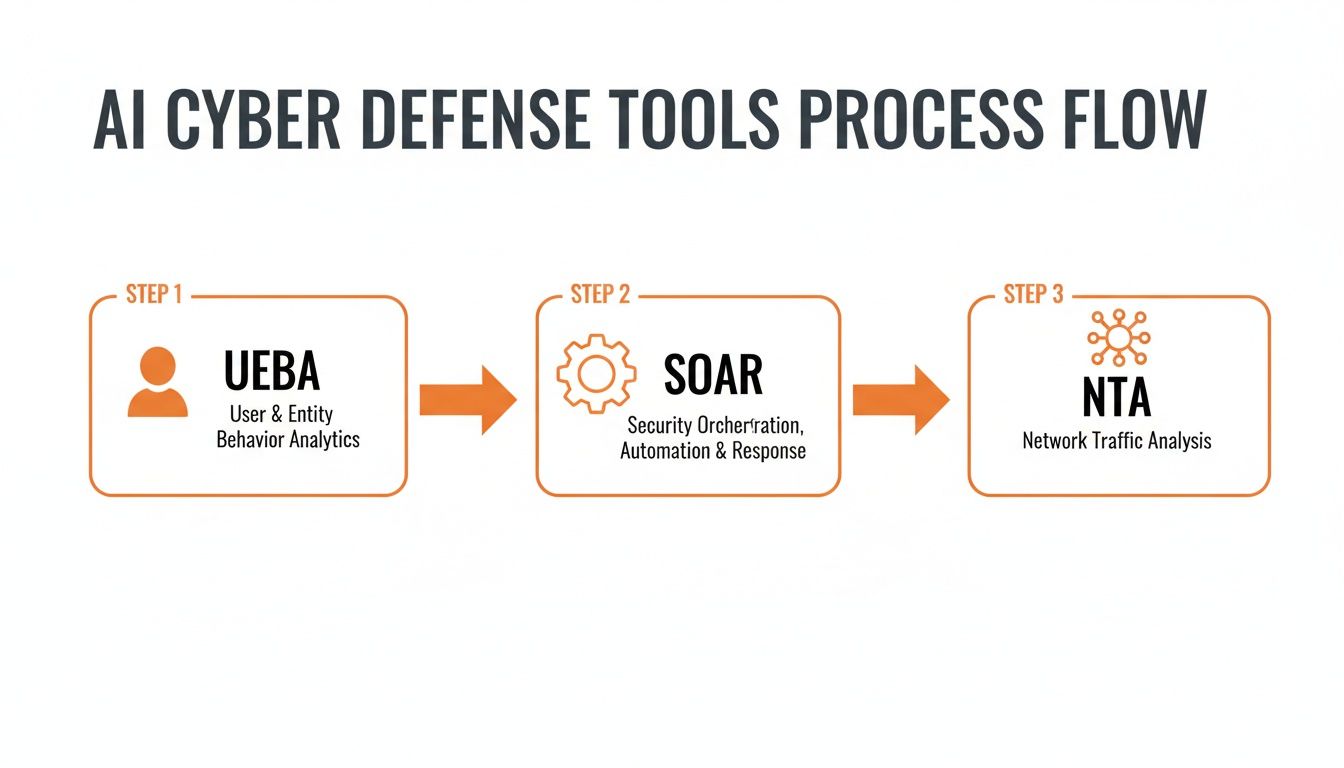
Alt text: A flow chart illustrating the AI cyber defense process, starting with data sources, flowing into AI analysis tools like UEBA and NTA, and leading to automated responses via a SOAR platform.
This visual helps clarify that AI defense isn’t about one magic tool. It’s about layering different specialized tools that each handle a piece of the threat detection and response puzzle.
5. Integrate with Your Existing Stack
An AI tool in a silo is useless. Its real power is unlocked through integration with your existing Security Information and Event Management (SIEM), firewalls, and endpoint protection. When connected, your NTA tool spotting weird network traffic can automatically fire that data to your SIEM, adding context that helps your analysts make faster, smarter decisions.
6. Train and Empower Your Team
Finally, AI is a tool, not a replacement for your people. Your security team needs to understand how to read AI-generated alerts, manage automated playbooks, and—most importantly—give the system feedback. This “human-in-the-loop” model is the gold standard for AI cyber defense. It combines the speed of machine learning with the critical thinking of your seasoned analysts. Encourage your team to question, validate, and tweak the AI. That’s how you turn them from alert responders into genuine threat hunters.
Best Practices for Managing Your AI Security Operations
Getting an AI security tool running isn’t the finish line; it’s the starting pistol. The real wins come from how you manage, tune, and weave these systems into your day-to-day security operations. The goal is to build a symbiotic relationship between your human analysts and their new AI counterparts, so the AI evolves into a reliable partner that gets sharper over time.
For organizations operating in emerging markets like Nigeria, aligning AI cyber defense strategies with national AI governance frameworks is equally important to ensure ethical, secure, and compliant deployment.
Embrace the Human-in-the-Loop Model
One of the most important practices in AI cyber defense is sticking to a Human-in-the-Loop (HITL) model. This rejects the idea of a fully autonomous AI making critical security decisions in a vacuum. It positions your analysts as expert overseers who validate, correct, and guide the AI’s findings. An AI might spot a statistical anomaly, but only a human analyst knows if it’s a genuine threat or just approved server maintenance. This partnership is key to preventing automated mistakes and building trust.
Fine-Tune Your Models to Crush Alert Fatigue
Out of the box, AI security tools can be noisy, burying your team in low-priority notifications. This leads to alert fatigue, where analysts start tuning out the noise and might miss a real threat. The answer is continuous fine-tuning. Sit down with your team to adjust the AI’s sensitivity thresholds based on your organization’s risk appetite. The objective is to train the AI to only escalate the most credible, high-impact threats.
The most effective AI systems aren’t the ones that generate the most alerts, but the ones that generate the right alerts. This precision is achieved through a continuous feedback loop between the technology and the team.
Build a Continuous Retraining Feedback Loop
An AI model isn’t static. Its accuracy degrades if it isn’t retrained with fresh data. You need a simple feedback loop where your analysts’ daily work directly makes the model smarter.
- Here’s how to implement it:
- AI Generates an Alert: The system flags an employee’s login from an unusual country.
- Analyst Investigates: The security analyst confirms the employee is traveling for a conference, making the login legitimate.
- Analyst Provides Feedback: The analyst marks the alert as a “false positive” right inside the tool, adding a note like “approved business travel.”
- AI Learns: This labeled data point is fed back into the AI’s next training cycle. The model learns to associate similar future events with legitimate activity, reducing false positives over time.
This simple process turns analysts from passive recipients into active trainers. As you refine your models, consider the ethical implications of data use. For more on this, explore our guide on incorporating ethical AI in daily decisions.
Actionable Takeaways
- Establish an HITL Policy: Create clear rules defining when a human must approve automated actions, especially high-stakes ones like isolating a critical server.
- Schedule Regular Tuning Sessions: Hold bi-weekly or monthly meetings with your security team to review the AI’s performance, look at key alerts, and tweak sensitivity settings as needed.
- Implement a Feedback Mechanism: Make sure your AI tool has a dead-simple, one-click way for analysts to label alerts as “true positive,” “false positive,” or “benign activity.”
- Monitor Model Drift: Keep an eye on your AI’s accuracy over time. If you see the false positive rate starting to creep up, it’s a clear signal that the model needs to be retrained with new data.
Why AI Alone Is Not Enough
While AI significantly enhances threat detection and response, it does not replace foundational cybersecurity practices. Poor access controls, unpatched systems, weak passwords, and lack of employee training remain among the most common causes of breaches. AI cyber defense works best when layered on top of proven security fundamentals such as zero-trust architecture, multi-factor authentication, and continuous security awareness training. Organizations that neglect these basics risk over-relying on AI while leaving critical vulnerabilities exposed.
Frequently Asked Questions About AI in Cyber Defense
Stepping into the world of AI-powered security always brings up practical questions. Let’s tackle some of the most common ones.
Can AI in Cybersecurity Operate Fully Autonomously?
While the idea of a “hands-off” AI defense is tempting, it’s rarely the best approach. The gold standard is a “human-in-the-loop” model. The AI does the heavy lifting—sifting through data, flagging events, and taking initial containment steps. But when it comes to a critical decision, like taking a production server offline, a human analyst makes the final call. This combines the speed of AI with irreplaceable human intuition, preventing a false positive from causing a costly outage.
A great example of this is how U.S. national labs use AI tools like “Aloha” to simulate cyberattacks. The AI runs thousands of scenarios to find weak spots, but it’s the human experts who interpret those findings to make the actual defenses stronger.
How Much Data Does an AI Security Tool Need to Be Effective?
This depends on the tool. A UEBA platform needs several weeks of your network data to build a reliable baseline of “normal.” In contrast, many malware detection models come pre-trained on massive, generalized datasets. The key isn’t just the quantity of data, but the quality.
When vetting vendors, ask how their models perform in environments with limited or “noisy” data. Their answer will reveal how robust their algorithms are and whether they’ll work in your specific, messy reality.
What Is the Biggest Challenge When Implementing AI Security Tools?
Hands down, the single biggest hurdle is managing alert fatigue. An untuned AI can be like a smoke detector that goes off every time you make toast—it floods your team with so many false positives that they start ignoring everything.
The solution is a disciplined, phased rollout.
- Start with a Pilot: Test the tool on a small, controlled segment of your network to fine-tune its sensitivity.
- Create Playbooks: Use your SOAR capabilities to build automated responses for routine, low-risk alerts. Let the machine handle the noise.
- Establish Feedback Loops: Create a simple process for analysts to flag false positives. This feedback continuously trains the model, making it smarter over time.
This methodical approach ensures your team’s attention stays focused on the threats that actually matter. For more on this topic, explore our other articles on security and privacy.
Actionable Takeaways & Resources
Here’s your immediate game plan. Pick one and get started today.
- Identify Your #1 Blind Spot: Is it insider threats? Phishing? Pinpoint one nagging problem and research a single AI tool built to solve it.
- Schedule Two Demos: Contact one UEBA vendor and one NTA vendor. Ask them to show you exactly how their platform would have detected a real security incident your team recently handled.
- Draft a One-Page Pilot Proposal: Choose one high-impact use case (e.g., protecting a critical server) and define one clear success metric (e.g., “Reduce false positive alerts from this server by 50%”).
- Audit Your Data Quality: Spend one hour mapping the essential data sources an AI tool would need (logs, network traffic). Is the data clean and accessible?
Tools & Resources
- Threat Intelligence Feeds: Feedly Cyber Security, AlienVault OTX
- Machine Learning Frameworks: TensorFlow, PyTorch, scikit-learn
- Open Source Security Tools: Snort (Intrusion Detection), OSSEC (Host-based Intrusion Detection)
Further Reading
- NIST AI Risk Management Framework: A comprehensive guide for managing risks associated with AI.
- MITRE ATT&CK Framework: A globally-accessible knowledge base of adversary tactics and techniques based on real-world observations.
- The Rise of AI in Cybersecurity – Axios
