
Artificial intelligence has dominated headlines, boardrooms, and product roadmaps—but alongside rapid adoption, skepticism is rising. From overpromised capabilities to unclear returns on investment, critics are increasingly questioning whether today’s AI delivers real value or simply fuels hype.
This guide is for the curious, technical-minded reader who wants results fast. We’ll cut through the marketing noise and give you a clear, actionable framework for telling the difference between genuine, measurable value and just another expensive, trend-driven distraction.
Confronting the Unspoken Problem of AI Hype
Let’s be direct: The AI world is flooded with promises that fall flat. We’ve all seen it: productivity tools that somehow create more work, or massive corporate investments that deliver unclear results. A tangible sense of disillusionment is creeping in.
This isn’t just quiet grumbling; it’s a visible movement. You see it in social media trends like “Microslop,” a term capturing the widespread frustration with AI features being shoehorned into products without clear user benefit. This points to a deeper issue: the frantic race to integrate AI is overshadowing the fundamental need to solve actual customer problems.

{: alt=”Three diverse colleagues collaborate in a modern office meeting with a ‘Beyond the Hype’ sign.”}
The Growing Chorus of Skepticism
It’s not just users. Industry insiders are raising the alarm against “FOMO-driven adoption”—the corporate fear of being left behind. As tech critic Ed Zitron notes, the boom-and-bust cycle teaches us that excitement can often mask a lack of substance. When companies pour millions into AI without a concrete strategy, they end up with underused software and disappointed teams.
The backlash isn’t anti-AI. It’s anti-hype. It’s a rational response to a market saturated with bold claims but light on verifiable results. Many frustrations are born from real experiences, a topic you can explore by debunking common AI myths in our other guide.
“The core of the AI backlash isn’t a rejection of the technology itself, but a rejection of the narrative that every problem requires an AI solution. It’s a demand for proof, not just potential.”
Think of this guide as your practical roadmap. We’re here to validate those concerns and give you the tools to look past the slick marketing and find what actually works.
A Framework for Finding Real Value
Stop thinking about adopting AI and start thinking about solving problems with the right tools. This means asking critical questions before you commit.
- What specific, measurable problem does this actually solve? Don’t settle for “improves efficiency.” Demand concrete outcomes, like “cuts our weekly report generation time by 3 hours.”
- What is the total cost of implementation? Factor in subscription fees, employee training time, integration headaches, and potential workflow disruptions.
- How will we measure success? Define key performance indicators (KPIs) before you start. Success should be visible in your data, not just a gut feeling.
This critical perspective empowers you to make investments that truly move the needle.
Decoding the AI Adoption Paradox
On the surface, the numbers look incredible. Headlines tout the unstoppable momentum of AI adoption. But talk to the teams on the ground, and you’ll hear a different story—one of confusion, frustration, and a struggle to see tangible benefits. This gap is the AI adoption paradox.
At its core, this paradox is fueled by FOMO-driven adoption. Companies pour money into AI not because they have a clear problem, but because they’re terrified of being left behind. This leads to expensive, underused tools and disappointed stakeholders when the promised revolution never arrives.
The data hints at this disconnect. We’ve seen explosive growth, with 78% of organizations reporting AI use in at least one business function as of 2025—a massive leap from just 55% in 2023. And while early adopters report a promising 3.7x return for every dollar spent on generative AI, the fact that only 92% plan to invest more tells a deeper story. That remaining 8% represents a growing cohort pausing to ask if the investment is paying off.
Moving Beyond Surface-Level Metrics
High adoption rates can be deceiving. They often mask a shallow rollout where buying a subscription is counted as a win. This is where AI backlash takes root—when promised productivity gains are nowhere to be found, and all that’s left is an expensive line item.
To get a true picture, question the surface-level metrics.
- Instead of asking: “Are we using AI?”
- You should be asking: “How is AI measurably improving a specific workflow, and what is the quantifiable impact on our bottom line?”
This simple change moves the focus from a checkbox activity to a results-driven strategy. Successful AI adoption isn’t just a technical challenge; it’s deeply tied to cultural and operational realities, a dynamic seen when examining AI adoption in Nigeria.
Practical Example: The Misleading “Adoption” Metric
Imagine a marketing team subscribes to a powerful AI content generation platform. The adoption metric is perfect: 100% of the team has access. Six months later, an internal review shows a different picture.
- Low Engagement: Only 20% of the team uses the tool more than once a week. The majority say it’s faster to stick with their old methods because they never received proper training on how to integrate it into their workflow.
- No Clear ROI: The content being produced isn’t tracked against performance metrics. No one can say if the AI-generated blog posts are driving more traffic or leads than the ones written by the team.
- Workflow Disruption: The tool doesn’t integrate with their existing project management software. This creates a manual step to move content from the AI platform into their content calendar, adding friction.
In this common scenario, the company pays for a tool that doesn’t deliver value. The adoption statistic is misleading, and the team’s frustration feeds directly into the AI backlash. The problem wasn’t the technology, but the absence of a strategy for integrating it and a clear definition of what success should look like.
Your Practical Framework to Separate Hype from Value
To sidestep the growing AI backlash, you need a repeatable process for cutting through the marketing fluff. This isn’t about finding the “best” AI; it’s about finding the right AI for a specific, measurable problem you actually have. AI delivers the most value when applied to narrow, well-defined tasks with clear goals, reliable data, and measurable outcomes.
This four-stage framework is your practical filter. It takes you from a vague interest in “doing something with AI” to a data-driven decision, ensuring every tool has a clear purpose and a tangible path to a positive return.
This visual shows the flawed journey many businesses take, leading directly to disillusionment.
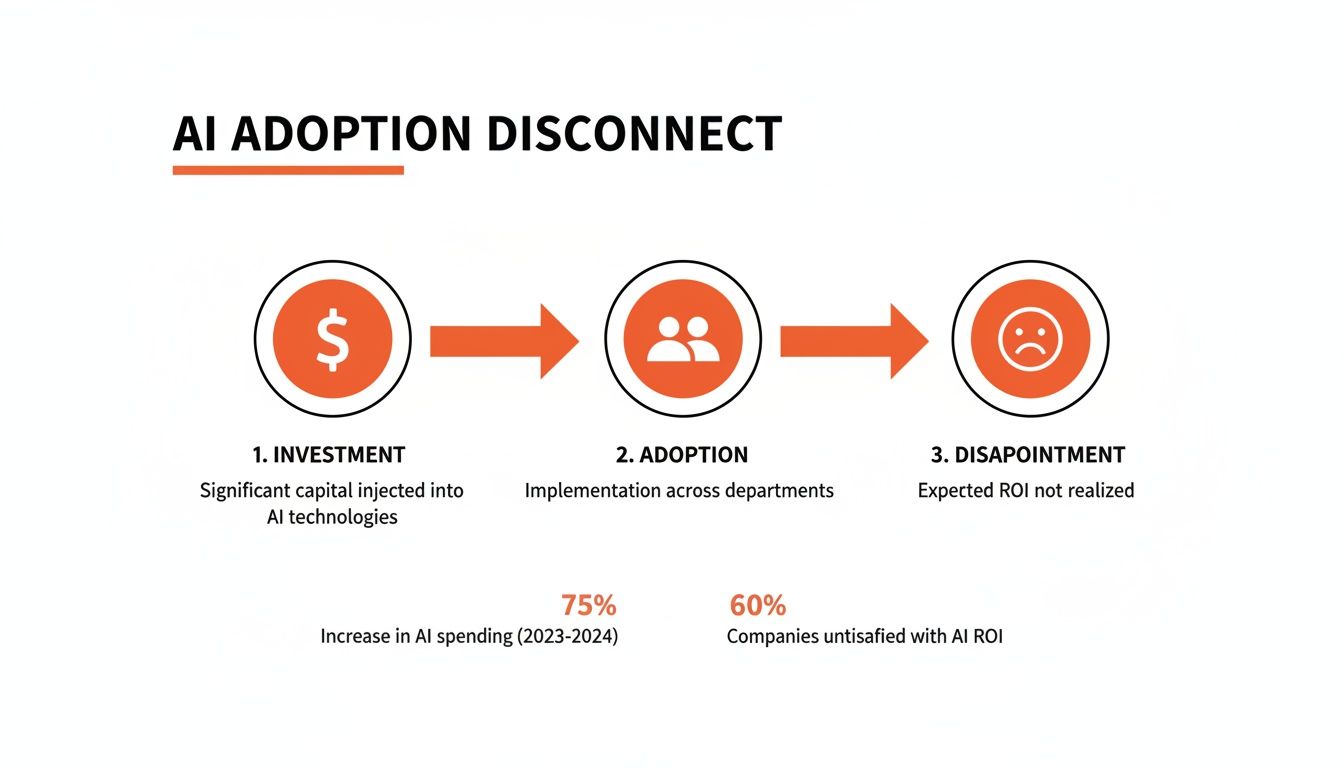
{: alt=”Infographic showing the AI adoption disconnect: investment, adoption, and subsequent disappointment with ROI.”}
The leap from investment to adoption often fails because critical evaluation steps are skipped. Here’s how to do it right.
Stage 1: Problem-Solution Fit
Before looking at demos, start with your internal pain points. An AI tool should solve a problem you already have.
How to do it:
- Survey your team: Ask, “What’s the most repetitive, low-value task we do every week?”
- Get specific: Is it manually pulling numbers for sales reports, drafting 50 versions of a social media post, or answering the same five customer questions?
- Prioritize: A tool that frees up 10 hours a week from a mission-critical workflow is a need. A tool that adds a slick graphic to an internal report is a nice-to-have. Focus on the needs.
Stage 2: True Cost of Ownership
The sticker price is just the start. The real cost includes all resources needed to make it work.
How to do it:
- Calculate Integration Cost: Estimate the developer or IT hours required to connect the tool to your existing systems (CRM, project management software).
- Calculate Training Cost: Multiply the hours needed for training by the hourly cost of each employee involved. This is the cost of lost productivity during the learning curve.
- Assign Maintenance Responsibility: Who is on the hook for managing this long-term? Define the role and estimate the time commitment.
Stage 3: Defining Measurable Impact
If you can’t measure a tool’s impact, you can’t justify its cost. Define your key performance indicators (KPIs) before you spend a dime.
How to do it:
- Set a Baseline: Measure your current performance. How long does the task take now? What is the current cost? What is the current conversion rate?
- Define a Target: Set a specific, measurable goal. For example:
- Time Saved: Reduce time spent on
[Task Name]by 40% in Q3. - Cost Reduction: Decrease our monthly spend on
[External Service]by $500. - Revenue Growth: Increase qualified leads from
[Channel]by 15%.
- Time Saved: Reduce time spent on
Stage 4: Scalability and Sustainability
Think about the long haul. A tool that works for a five-person team might fail a fifty-person department. Assess vendor risk—tying core operations to a shaky startup is dangerous. Looking at various AI tools for business automation can give you a sense of stable players.
How to do it:
- Check the Pricing Model: Does it scale fairly, or will success make it prohibitively expensive?
- Define an Exit Strategy: If the vendor goes under, how hard is it to get your data and processes out?
- Vet the Vendor: Look at their funding, customer reviews, and product roadmap. You want a partner, not a temporary experiment.
In practice, many organizations discover that AI tools perform well in controlled demos but struggle in real-world environments. Data quality issues, edge cases, compliance requirements, and workflow complexity often limit impact, leading teams to pause or abandon AI initiatives altogether.
Why AI Value Varies by Global Region
The push for AI adoption sounds like a single global race, but it’s a series of regional sprints. A tool that delivers incredible value in one market can fall flat in another. This disconnect is a big reason for the growing AI backlash—fueled by a one-size-fits-all story that ignores critical local differences.
To separate hype from value, you have to understand these variations. Government regulations, digital infrastructure, and cultural norms drastically change how AI gets built, deployed, and accepted.
North America vs. Europe: A Tale of Two Priorities
In North America, the approach is about speed and aggressive adoption. Market competition is the main driver. It’s a “move fast and break things” culture that puts innovation first.
Europe, on the other hand, operates with a heavier emphasis on regulation and data privacy. The General Data Protection Regulation (GDPR) shapes the entire AI development process. Building your AI on a privacy-first framework isn’t a feature—it’s the price of admission.
This creates a split in how “value” is defined:
- North American Focus: Is the AI delivering a competitive advantage and driving growth, fast?
- European Focus: Does the AI respect strict data protection laws while delivering value ethically?
The Mobile-First Reality in Asia and Beyond
In huge swathes of Asia and Africa, the AI landscape is molded by the dominance of mobile devices. For hundreds of millions of people, a smartphone is their only gateway to the internet.
This means AI solutions designed for beefy desktop computers might be useless. Success demands a mobile-first mindset. AI applications need to be lightweight, optimized for lower bandwidth, and woven into the platforms people already use. We dive deeper into this in our guide where you can learn more about how SMEs in Africa can use AI for growth.
A global AI strategy that doesn’t account for regional infrastructure, legal frameworks, and user behavior isn’t a strategy at all—it’s a recipe for wasted investment.
The data drives this home. While North America leads with 62% of companies embracing AI, a closer look shows Singapore is the most prepared country for AI adoption, and 70% of the top 10 prepared nations are European. This suggests Europe’s focus on building strong regulatory foundations may position it for more sustainable success. You can find more details in this report on global AI adoption statistics.
Actionable Takeaways
- Audit Your Target Market: Before deploying an AI solution internationally, dig into local data privacy laws (like GDPR in Europe or PIPEDA in Canada) and consumer attitudes toward AI.
- Prioritize Mobile Optimization: If you’re targeting markets in Asia, Africa, or Latin America, your AI tools must be flawless on a smartphone. It’s non-negotiable.
- Adapt Your Value Proposition: In Europe, lead with privacy. In North America, talk about speed. In mobile-first markets, highlight ease of use.
The Economic Disconnect Fueling the Backlash
Why does a technology that’s supposed to add trillions to the global economy often feel underwhelming? This gap between staggering forecasts and tangible benefits is a core driver of the AI backlash. Executives see mind-boggling numbers, while their teams struggle to justify the investment.
On one side, you have breathtaking projections. PWC estimates that AI could pour up to $15.7 trillion into the global economy by 2030.
But this optimism collides with a messier reality. While majorities in countries like China (83%) see AI products as helpful, that confidence plummets in Western markets like the United States (39%). You can dig into more of this data in this report about AI statistics. This split reveals a tension: market valuations are priced for a decade of future potential, but businesses must answer for quarterly results.
Understanding the Productivity J-Curve
This disconnect is explained by the productivity J-curve. When a powerful new technology lands, productivity often takes an initial dip as organizations wrestle with the costs of getting it up and running.
This first phase is about investment in areas that don’t produce instant returns:
- Training and Reskilling: Employees have to learn new systems, which slows things down.
- Integration and Infrastructure: Connecting new AI tools with old legacy systems is complicated.
- Process Re-engineering: To get the most out of AI, businesses need to rethink their operations.
It’s only after this period of disruption that productivity starts to climb, eventually soaring past the original baseline. The problem? The hype cycle lives on the glorious upswing, while most businesses are slogging through the frustrating initial dip.
Valuations Based on Potential, Not Profit
Another factor fueling skepticism is that most economic buzz is tied to stock market valuations, not real-world profits. Investors are placing massive bets on what AI could become, pouring billions into companies that might not be profitable for years.
“The current AI market is a classic example of valuing the promise over the proof. This drives innovation but also creates unrealistic short-term expectations for businesses that need to see a return on investment now, not in 2030.”
This pressure forces AI companies to market a grand, futuristic vision rather than the concrete value they can deliver today. For a business leader trying to justify a purchase, this gap between a vendor’s promises and a tool’s actual capabilities is a major source of frustration, feeding directly into the AI backlash.
Building Trust by Communicating AI Value Authentically
In a market drowning in hype, trust is the only currency that matters. The current AI backlash is a direct response to a mountain of broken promises. To cut through the noise, you have to stop selling potential and start demonstrating proven value. This means building a communication strategy grounded in honesty, transparency, and results.
Ditch the grand language about “transformation” and focus on specific, tangible outcomes. Your customers have been burned by tools that promised to reinvent their workflow but only delivered more complexity. They don’t want possibilities; they demand proof.
Lead with evidence. Be direct about what your AI can—and, just as importantly, cannot—do. It’s the only path to building a loyal user base.

{: alt=”A man in a blazer speaks at a conference with ‘BUILD TRUST’ on a screen behind him.”}
Under-Promise and Over-Deliver: A Practical Example
The simplest way to earn trust is to consistently beat expectations. The industry standard is to promise the moon and deliver a rock. Flip that script.
How to do it:
- Be conservative in your claims: If your AI writing tool can generate a high-quality blog post draft in 10 minutes, promise it in 15.
- Be aggressive in your execution: Ensure the user experience is smooth and the output is consistently high-quality.
- Create advocates: A customer who is told a tool will save them 5 hours a week and finds it saves them 7 becomes a die-hard advocate. A customer promised 20 hours of savings who only gets 10 feels cheated, even if the result is fantastic.
This philosophy should extend to your product roadmap. It’s far better to announce a feature when it’s polished and ready than to build excitement for something months away.
Showcase Case Studies with Real Numbers
Vague quotes like “This tool changed our business!” are meaningless. You need detailed case studies that feature quantifiable results.
How to create a data-driven case study (step-by-step):
- State the Problem Clearly: Define the specific business pain point. “The marketing team was spending 15 hours every week manually drafting social media posts.”
- Detail the Solution: Explain exactly how your AI tool was implemented. Skip the jargon and focus on the practical application.
- Present Quantifiable Results: Use hard numbers to show the “after” state. “After implementing our AI, the team cut that task down to just 3 hours per week—a 12-hour savings.”
- Calculate the ROI: Translate those numbers into a clear business impact. “This 80% reduction in time freed up the equivalent of a part-time employee, allowing the team to launch two new campaigns per month.” Understanding your content marketing return on investment is crucial here.
Acknowledge Limitations Openly
One of the most powerful trust-building moves is to be transparent about your AI’s limitations. No AI is perfect. Admitting this doesn’t make your product look weak; it makes your company look honest.
Be upfront in your documentation and FAQs. For instance, an AI writing assistant might state: “Our tool is fantastic for generating first drafts but should not be used for final legal or medical advice without a human expert’s review.” This sets proper expectations and prevents misuse, protecting your brand’s reputation.
Actionable Takeaways, Tools & Resources
- Next Actions:
- Audit your marketing language. Swap vague promises like “boosts productivity” for specific claims like “cuts report generation time by an average of 45%.”
- Create one data-driven case study this quarter using the four-step process above.
- Add a “Limitations and Best Practices” section to your help docs.
- Tools/Resources:
- llms.txt: A community-driven list of large language models.
- Hugging Face: A platform with open-source models, datasets, and tools.
- Further Reading:
- The Guardian: Ed Zitron on big tech backlash
- PWC: Sizing the prize – AI’s economic impact
- 7 Examples of Everyday AI — Hidden Tools You Use Daily in 2026
- Prompts for Customer Services
What the AI Backlash Means for Businesses
The growing backlash against AI is not a rejection of the technology—it is a correction. As expectations normalize, businesses are shifting from experimentation to execution.
Organizations that focus on practical use cases, strong data foundations, human oversight, and clear ROI are continuing to see value from AI. Those pursuing AI without strategy or operational readiness are far more likely to be disappointed.
A Few Final Questions on Navigating AI Hype
Here are direct responses to common hurdles when trying to cut through the noise.
How Do I Convince Leadership to Be Cautious Instead of Chasing Trends?
Shift the conversation from speculative hype to proven ROI. Propose a small, low-risk pilot project.
How to pitch it (step-by-step):
- Identify a Pain Point: Find one specific, measurable problem, like the data entry that eats up 10 hours of your finance team’s time weekly.
- Define a Clear KPI: Set a goal you can’t argue with. “Let’s see if we can reduce manual data entry time by 50% within one quarter.”
- Propose a Pilot: Present a plan with a fixed, small budget and a clear timeline. This is a controlled test, not a massive platform purchase.
- Report the Results: If it works, you have hard data to justify a larger investment. If it fails, it was a cheap lesson, not a catastrophic one.
Is the AI Backlash a Sign That AI Is a Bubble About to Burst?
It’s less of a bubble bursting and more of a much-needed market correction. The core technology has incredible potential, but the first wave of hype outran its ability to create practical value for most businesses.
Think of this backlash as a healthy, maturing force. It’s pushing the industry beyond flashy demos to build products that solve real problems. The companies that survive will be the ones that deliver tangible, measurable results.
As an Employee, How Can I Identify AI Tools That Will Actually Help My Career?
Apply the same critical framework to your own work. Before adopting the next hot AI tool, step back and look at it through a practical lens.
Your career is your own business. Every new tool you adopt is an investment of your time. Choose ones that deliver a clear return, not just another layer of complexity.
Ask yourself these questions:
- What specific, time-sucking task does this automate? If it doesn’t solve a real problem you have, it’s a distraction.
- Is the time I’ll save greater than the time I’ll spend learning it? A tool with a steep learning curve needs a massive payoff to be worth it.
- Does this tool free me up to focus on my uniquely human skills? The best AI tools handle repetitive work, freeing you for strategic thinking, creative problem-solving, and building relationships—skills AI can’t replace.
The backlash against AI does not signal failure—it signals maturity. As hype fades, real value becomes easier to identify. The future of AI belongs to solutions that are transparent, practical, and designed to solve real problems rather than chase trends.
Ready to move past the hype and find AI that delivers real results? RichlyAI offers a powerful suite of tools designed for practical application, from content creation to automation. Explore how our platform can solve your specific business challenges and provide measurable value from day one. Start your free plan at RichlyAI.

This article hits nail on the head when talking about AI’s messy hype-reality gap, emphasizing the need for tailored solutions and clear integration strategies, which reminds me that when hunting for practical, easy-to-adopt AI or free online tools to complement workflows without extra friction, there are reliable platforms out there to explore.
free online tool mytoolhub