
Artificial intelligence isn’t some far-off, science-fiction idea anymore; it’s a real-world tool that most of us interact with every single day, often without even realising it. At its core, AI is about creating machines that can simulate human intelligence—systems programmed to think, learn from past experiences, and find solutions to problems. It’s the technology that curates your social media feed and the brain behind your GPS navigation.
What Exactly Is Artificial Intelligence?

Let’s break down this complex topic with a simple analogy. Think of it like teaching a digital assistant to sort different kinds of fruit. You start by showing it thousands of pictures, carefully labelling each one as an ‘apple’, ‘orange’, or ‘banana’. The assistant pores over these examples, learning to recognise the unique characteristics—like colour, shape, and texture—that define each fruit.
Soon enough, you can show it a brand-new picture it has never seen before, and it instantly tells you, “That’s an apple.” This is precisely how AI works in a nutshell. It’s a system that learns from data to make smart decisions or predictions on its own. The goal isn’t to build a conscious mind, but to develop incredibly specialised tools that can tackle tasks that have always required human brainpower.
The Two Main Flavours of AI
When you hear people talk about artificial intelligence, they’re almost always referring to one of two different categories. Grasping the distinction between them is crucial for understanding how AI works today and what the future might hold. For anyone new to this world, we have a guide that explains how to start using AI without any experience.
Here are the two primary types of AI you’ll come across:
- Narrow AI (or Weak AI): This is the specialist. It’s built and trained to do one specific thing incredibly well.
- Practical Example: The spam filter in your email inbox is a perfect example of Narrow AI. It is exceptionally good at identifying and blocking junk mail but it cannot compose an email for you or organize your calendar. Other examples include voice assistants like Siri, the facial recognition that unlocks your phone, or the recommendation algorithm on Netflix.
- General AI (or Strong AI): This is the all-purpose, human-like intelligence you see in the movies. A true Artificial General Intelligence (AGI) would be able to understand, learn, and apply its knowledge to solve any problem, just like a person can. For now, AGI is still purely theoretical and remains a long-term ambition for scientists and researchers.
It’s important to remember that the vast majority of AI systems in use today—well over 99%—are forms of Narrow AI. These are powerful, practical tools designed to bring speed and accuracy to very specific jobs.
Ultimately, the artificial intelligence we have at our fingertips today is all about creating highly skilled assistants that enhance what humans can do. By sifting through enormous amounts of data, these systems can identify patterns we might miss, automate tedious work, and deliver the insights we need to make smarter, faster decisions.
The Journey of Intelligent Machines
The idea of intelligent machines didn’t just pop into existence recently; it’s the culmination of a long, and at times, bumpy journey. The story really kicks off in the summer of 1956 at the Dartmouth Workshop. It was there that a small group of pioneering scientists gathered, coined the term “artificial intelligence,” and shared a bold vision: to create machines that could genuinely think.
This initial spark of excitement led to what’s known as the first “AI summer.” Researchers were filled with optimism, predicting that machines with human-like intelligence were only a couple of decades away. Early programs showed off some truly impressive skills for the era, like solving algebra word problems and proving logical theorems, which only fuelled more investment and belief in AI’s bright future.
From AI Winters to a Data-Driven Spring
But the road ahead was far from smooth. The sheer difficulty of creating true intelligence was vastly underestimated, and the computing power of the day just wasn’t up to the task. As progress began to slow and the big promises went unfulfilled, funding started to dry up, leading to periods famously known as “AI winters.” During these lean times, the whole field was met with a lot of doubt and a lack of interest.
Even with these setbacks, dedicated researchers kept plugging away behind the scenes. A crucial turning point came with the rise of machine learning in the 1980s and 90s. Instead of trying to hand-code rules for every possible scenario, scientists started building systems that could learn from data all on their own.
This shift in thinking was a game-changer. It moved AI from being about programming rigid logic to being about learning from patterns. This laid the foundation for the incredibly powerful systems we rely on today.
The real explosion came when two essential ingredients appeared: the vast oceans of data generated by the internet and computers that were exponentially more powerful. This created the perfect storm for machine learning models, especially neural networks, to truly take off. It’s why understanding the role of artificial intelligence in enhancing content delivery is now so vital in areas like modern business education.
The Modern AI Boom and Global Growth
We’re now living through an AI summer like no other, built on decades of persistence. Breakthroughs that were once just theoretical ideas in a lab now power the technology we use every single day, from our search engines to our voice assistants. And this boom isn’t just happening in one part of the world; it’s a global movement, with incredible momentum building across Asia.
The AI market in the Asia-Pacific region is set for massive growth. It’s expected to jump from USD 66.38 billion in 2024 to a staggering USD 1,365.32 billion by 2033. This incredible surge is being driven by rapid digitalisation and strong government backing, positioning the region as a future hotspot for AI innovation. You can dive deeper into the data on this incredible Asia-Pacific AI market growth.
The journey from a small workshop to a globe-spanning industry really shows just how far intelligent machines have come.
The Core Engines Driving Modern AI
To really get what makes artificial intelligence tick, we need to pop the bonnet and look inside. While “AI” is a massive field, the incredible things it does today are mostly powered by a handful of core technologies. These are the engines that turn raw data into intelligent action, and understanding them is a lot more straightforward than you might think.
At the heart of it all are three main pillars: Machine Learning (ML), Deep Learning, and Natural Language Processing (NLP). Think of them as a team of specialists. Each has a unique skill set, but they often work together to build the smart systems we rely on every day. Let’s break down what each one does with some real-world examples.
Machine Learning: The Pattern Spotter
Machine Learning is the bedrock of most modern AI. Its main job is to learn from data without someone having to write explicit, step-by-step instructions for every task. Imagine you’re teaching a child to identify cats by showing them thousands of pictures. Eventually, they just get it—they start recognising patterns and can point out a cat in a new photo they’ve never seen before. That’s ML in a nutshell.
Practical Example: The spam filter in your email inbox. Instead of being programmed with a rigid list of “spammy words,” an ML model is fed millions of emails already labelled as “spam” or “not spam.” By sifting through all this data, it learns the common traits of junk mail—things like weird links, urgent phrasing, or unusual sender details—and automatically filters your messages. It’s a process of constant learning; the more data it sees, the sharper it gets.
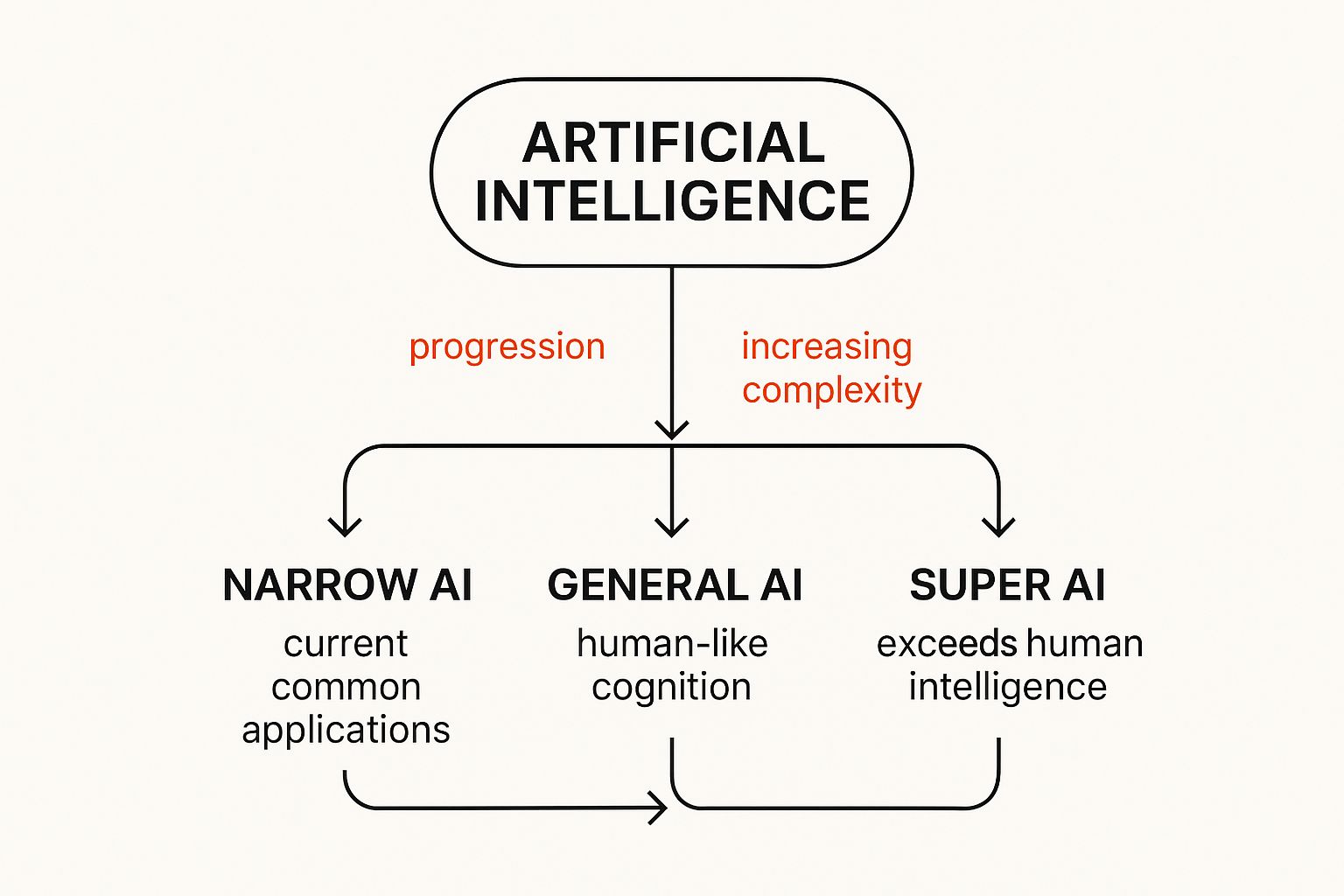
This image helps put things in perspective, showing how today’s AI is considered “Narrow AI”—brilliant at specific tasks, but a long way from the more general, human-like intelligence often seen in science fiction.
Deep Learning: The Advanced Detective
Deep Learning is a more powerful, specialised type of machine learning. If ML is the student learning from flashcards, Deep Learning is the seasoned detective connecting subtle clues and building a complex, layered case. It uses a structure inspired by the human brain, called an artificial neural network, which lets it find incredibly complex patterns in huge amounts of data.
Practical Example: You see Deep Learning at work every time your phone’s photo app suggests tagging a friend in a new picture. Here’s a simplified look at how it happens:
- Input: The process starts when the system looks at the pixels of the image.
- Hidden Layers: The image data is passed through many layers in the neural network. Each layer is a specialist. The first might spot basic things like edges and colours. The next might identify shapes like eyes and noses. Later layers put it all together to recognise a complete face.
- Output: Finally, the last layer makes a confident prediction: “That looks like John.”
This layered analysis is what makes Deep Learning so good at tricky jobs like image recognition, navigating self-driving cars, and even helping doctors diagnose diseases from medical scans. It can grasp nuances that other methods would miss.
Natural Language Processing: The Skilled Interpreter
Natural Language Processing (NLP) is the part of AI that’s all about closing the communication gap between humans and computers. It’s the magic that allows machines to read, understand, and even generate human language. Think of NLP as a lightning-fast, multilingual interpreter who translates your words into a language a computer can act on.
Practical Example: Your daily chats with voice assistants like Siri or Google Assistant are pure NLP. When you ask, “What’s the weather like in Lagos today?”, a few things happen in an instant:
- Speech Recognition: First, it turns your spoken words into digital text.
- Intent Recognition: It quickly figures out your goal—you want a weather forecast.
- Entity Extraction: It plucks out the key details, or “entities,” like “Lagos” and “today.”
- Response Generation: Finally, it pulls the right data and crafts a natural-sounding reply to speak back to you.
To make the distinction even clearer, let’s compare these three powerhouses side-by-side.
Comparing the Core Artificial Intelligence Engines
This table breaks down the core concepts, common applications, and primary functions of Machine Learning, Deep Learning, and Natural Language Processing to help you easily distinguish between these key AI technologies.
| Technique | Core Concept | Everyday Example |
|---|---|---|
| Machine Learning (ML) | Algorithms learn from data to make predictions without being explicitly programmed. | Your email spam filter learning to identify and block junk mail. |
| Deep Learning | A subset of ML using multi-layered neural networks to analyse complex patterns. | Social media platforms automatically suggesting who to tag in your photos. |
| Natural Language Processing (NLP) | Enabling computers to understand, interpret, and generate human language. | Asking a voice assistant like Siri or Google for directions or information. |
Together, these three engines—ML, Deep Learning, and NLP—are the true force behind the AI we see all around us, turning abstract data into practical, real-world solutions that are becoming more integrated into our lives every day.
How Artificial Intelligence Is Transforming Industries

The true magic of artificial intelligence isn’t just in the theory; it’s in the real-world results we see every day. Across the globe, various industries are putting AI to work to solve stubborn problems, find new efficiencies, and create genuinely better experiences for people. Think of it as a silent partner operating behind the scenes, making complex systems simpler and far more effective.
From healthcare to finance, the impact of AI is already huge. It’s no longer a niche technology reserved for massive corporations; it’s becoming a fundamental tool for businesses of all sizes.
Revolutionising Healthcare with Precision
In medicine, AI is becoming a powerful assistant for doctors, helping them diagnose illnesses faster and with greater accuracy. Machine learning models, fed with millions of medical images like X-rays and MRIs, can learn to spot subtle signs of disease that the human eye might miss after a long day.
Let’s break it down with a practical scenario:
- The Challenge: A radiologist has to sift through hundreds of scans daily. It’s a demanding job where one tiny, overlooked detail could have massive consequences for a patient.
- The AI Solution: An AI system scans the images first, automatically highlighting any areas that look suspicious and flagging them for the radiologist’s expert review.
- The Actionable Insight: The AI doesn’t replace the doctor. It acts as a second set of eyes, guiding their expert attention to where it’s needed most. This means quicker diagnoses, a lower risk of human error, and more time for doctors to focus on patient care.
By analysing mountains of medical data, AI also helps create personalised treatments. It can predict which therapies are most likely to work for a specific person based on their unique health history and even their genetic makeup.
Securing Finance Against Fraud
The financial world processes billions of transactions every single day, which unfortunately makes it a prime target for fraud. Traditional security systems often struggle to keep pace with the sophisticated tactics criminals use. This is exactly where AI comes in, offering a layer of real-time protection.
Practical Example: An AI-powered fraud detection system monitors transactions as they happen. If you typically shop in Lagos, but a transaction suddenly appears in a different country for an unusually large amount, the system can instantly flag it as suspicious and send you an alert. This proactive defence shields both consumers and financial institutions from potentially huge losses.
This rapid adoption of AI is happening everywhere. In Southeast Asia, for example, 42% of organisations are already using agentic AI, and another 44% plan to jump on board within the next year. A massive 58% of these businesses name risk and fraud detection as a top use case, which shows just how vital AI has become for security.
Personalising the Retail Experience
When it comes to retail, AI is the engine powering the personalised shopping experiences we’ve all come to expect. The moment you start browsing an e-commerce site, AI algorithms get to work, trying to understand what you like.
Practical Example: You are shopping for a new pair of running shoes on an online store. The AI analyses your browsing habits (you clicked on trail running shoes), past purchases, and what similar shoppers have bought. Using this information, it shows you recommendations for waterproof socks and hydration packs. This doesn’t just make your journey smoother; it directly boosts sales. To see how AI is being used in practice, guides on how to make AI videos offer a great window into its marketing applications.
And these examples are just scratching the surface. From fine-tuning supply chains in manufacturing to creating custom learning paths in education, AI is reshaping our world by turning raw data into smart, actionable insights.
Making AI Work for You with RichlyAI Hub
Knowing the theory behind artificial intelligence is great, but the real magic happens when you can actually use it in your day-to-day work. That’s precisely what RichlyAI Hub is built for. It bridges the gap between complex AI concepts and practical tools you can use right now.
At its heart, RichlyAI Hub runs on Natural Language Processing (NLP) to power its content creation tools. This means you can go from a simple idea to a high-quality draft for a blog post or social media update in just a few minutes. At the same time, our Machine Learning (ML) algorithms are quietly working in the background, learning from how you use the platform to suggest better prompts and fine-tune the output to better suit your style.
Step-by-Step Guide: Create a Blog Post Outline in Minutes
Let’s walk through a practical example. Imagine you need to create a blog post outline from scratch. This process takes a basic idea and quickly gives you a solid structure to start writing.
- Choose Your Tool: First, log into the RichlyAI Hub dashboard and select the “Blog Post Outline Generator” tool.
- Give It a Clear Prompt: In the input box, describe your topic. For instance, type: “A blog post for small business owners in Nigeria on how to use AI for marketing.”
- Add Specifics for a Better Result: To get a more tailored outline, add a few key details. You might add: “Focus on practical, low-cost tools. Include sections on social media, email marketing, and customer service.” This helps the AI understand your exact needs.
- Generate and Refine: Click the “Generate” button. In seconds, the AI will produce a logical outline with headings, subheadings, and key talking points. You can then edit or expand upon this structure.
What you get back is a complete roadmap for your article, saving you a ton of brainstorming time. It’s a perfect example of how you can turn a general understanding of artificial intelligence into a real-world business advantage. To dig deeper into how AI is making waves, check out the transformative power of artificial intelligence in modern innovation.
AI Investment and Global Progress
The development of accessible tools like ours is only possible because of huge global investments in AI. Singapore, for instance, is fast becoming an AI hub in Southeast Asia. The country’s government and private sector investments are on track to top S$27 billion by 2025.
With a national strategy to become a top-three AI nation, Singapore’s per capita spending on AI hardware is about ten times that of the US. This kind of global push is what makes powerful AI available to everyone, not just massive tech companies.
To get the most out of these advancements, think about integrating content creation automation powered by AI into your workflow. When you use a platform like RichlyAI Hub, you’re plugging into a global wave of technology designed to help you work smarter and faster.
Getting Ready For The Future of AI

We’ve covered a lot of ground, and it’s clear that artificial intelligence is far more than just a tech trend. It’s a genuine force for change, actively reshaping how businesses work and how we tackle complex problems.
The key thing to remember is this: AI’s real power isn’t in replacing people, but in amplifying what we can do. Think of it as a collaborator. It can sift through mountains of data and handle repetitive jobs, freeing us up to focus on the things humans do best—strategy, creative thinking, and genuine innovation.
It’s this partnership between people and smart technology that unlocks real value. But jumping into AI requires a bit of strategy. It’s not about grabbing the latest shiny tool, but about pinpointing specific areas in your own work where intelligent automation can make a real, measurable impact.
Navigating The Big Questions
As AI weaves itself deeper into our everyday and professional lives, it naturally brings some important questions to the surface. Getting ready for what’s next means thinking through these issues now.
Here are the key areas you’ll want to keep on your radar:
- Data Privacy and Security: AI systems run on data. This makes protecting that data—both yours and your customers’—absolutely non-negotiable. Actionable Insight: Always use AI tools that are transparent about their data policies and ensure you have clear consent from customers before using their data for AI-driven personalisation.
- The Changing Shape of Work: There’s no doubt that AI will alter certain jobs. The smart move is to focus on upskilling your team, training them to work with AI tools so they can move into more strategic roles that require a human touch. Actionable Insight: Identify repetitive tasks in your business (like data entry or initial customer support responses) and explore how AI can automate them, freeing up employee time for higher-value work like client relationship building.
- Ethical Use: It’s vital to build and use AI responsibly. This means being aware of potential biases that can creep into algorithms and making sure your AI systems are fair for everyone. Actionable Insight: Regularly review the outputs of your AI systems. For example, if you use an AI for hiring, periodically check if it’s unintentionally favouring certain demographics and adjust the criteria accordingly.
The ultimate goal is to build a future where AI acts as a reliable co-pilot. It should arm your team with sharper insights, smooth out your operations, and uncover new opportunities you couldn’t see before.
For countries wanting to lay the right groundwork, national policy is crucial. You can see how this is taking shape locally by reading our article on Nigeria’s National Artificial Intelligence Policy, which sets out a plan for responsible innovation.
Your Partner On The AI Journey
At the end of the day, stepping into the future of AI is all about learning as you go. The field is always shifting, with new tools and techniques popping up constantly. The key is to stay curious and be open to trying new things.
Here at RichlyAI Hub, we’re here to be your guide. We offer the practical tools and clear-headed advice you need to turn AI’s massive potential into actual results. By breaking down the complexity and making the technology easier to use, we help you move forward with confidence.
Your AI Questions, Answered
As artificial intelligence pops up more and more in our daily lives, it’s totally normal to have questions. Let’s cut through the jargon and get straight to some clear, practical answers about what AI really means for you.
What’s The Real Difference Between AI and Machine Learning?
People often use these terms as if they’re the same thing, but there’s a key difference. The easiest way to think about it is to picture Artificial Intelligence (AI) as the whole, big idea—the entire field dedicated to making machines smart. It’s a broad concept, like the category ‘vehicles’.
Machine Learning (ML), on the other hand, is a specific method for achieving AI. It’s like saying a ‘car’ is one specific type of vehicle.
- Artificial Intelligence (AI) is the ultimate goal: building systems that can do things that typically require human smarts, like reasoning, problem-solving, or understanding a conversation.
- Machine Learning (ML) is a subset of AI where, instead of writing step-by-step instructions, we feed a system tons of data and let it figure out the patterns on its own.
So, every machine learning system is a form of AI, but not all AI relies on machine learning.
Will AI Actually Replace Human Jobs?
This is the big question on everyone’s mind, and the reality is a lot more complex than a simple ‘yes’ or ‘no’. While AI will certainly automate repetitive tasks, it’s far more likely to change jobs than to get rid of them completely. If you look back at history, new technologies have always reshaped the job market, creating new roles we couldn’t have even imagined.
The most probable future is one of partnership. AI will take on the heavy lifting—the data crunching and routine tasks—which frees up people to focus on what we do best: strategy, creative thinking, and complex problem-solving. It’s about augmentation, not replacement.
Practical Example: An AI tool might be able to draft a social media content calendar in seconds, but you still need a human marketing manager to review it, ensure it aligns with the brand’s voice, and make the final strategic decision on campaign timing and messaging.
How Can a Small Business Start Using AI Without a Huge Budget?
Jumping into artificial intelligence doesn’t have to mean emptying your bank account. There are tons of powerful and affordable AI tools out there built just for small businesses, offering practical solutions that can make an immediate impact. The trick is to start small and focus on solving one specific problem.
Here’s a simple step-by-step guide to get going:
- Pinpoint a Bottleneck: Where are you or your team losing the most time? Is it crafting social media updates, answering the same customer questions over and over, or creating simple marketing graphics? Identify one specific pain point.
- Find a Purpose-Built Tool: Look for accessible AI platforms that are designed for that one task. For content creation, a tool like RichlyAI Hub is a great start. For customer service, look into simple chatbot builders.
- Use the Free Trial: Almost every AI tool offers a free plan or a trial period. This is your chance to experiment and see if it actually saves you time or boosts your results before spending any money.
- Measure the Impact: After using the tool for a week, ask yourself: Did this save me time? Did it improve the quality of my work? If the answer is yes, it’s a worthwhile investment.
By zeroing in on a single, high-impact area, even the smallest business can start working smarter and competing on a bigger stage.
Ready to see how artificial intelligence can work for your business? With RichlyAI, you can start generating high-quality content, automating social media, and building custom chatbots in minutes. Discover a smarter way to work by exploring our tools.
