
The demand for data scientist jobs in Nigeria is absolutely booming. As more and more companies wake up to the fact that data is a goldmine for growth, the people who can turn that raw information into smart business decisions are becoming essential. This isn’t just a trend; it’s a fundamental shift, creating a wave of new opportunities, better pay, and the chance to work on really meaningful projects across almost every industry.
Why Data Scientists Are in High Demand in Nigeria
Think of a data scientist as a master chef for a business. They don’t work with flour and eggs; they work with raw data—things like customer purchase history, website clicks, and market trends. Their job is to mix, chop, and cook that data into something valuable: a powerful business strategy that helps the company grow and become more efficient. That unique skill is exactly why Nigerian companies are scrambling to hire them.
From the buzzy fintech startups in Lagos to the big healthcare providers in Abuja, gut feelings are no longer enough to run a business. Companies are now building dedicated teams that can dig into data, find hidden patterns, and even predict what’s going to happen next. This gives them a massive advantage over the competition and is directly fuelling the need for skilled data professionals.
The Real-World Impact on Business
This isn’t just theory; it has a tangible impact on how Nigerian businesses run day-to-day. Here are some practical examples of how data science drives results:
- E-commerce: A company uses browsing data to offer personalised recommendations. Actionable Insight: By analysing which products a user views and adds to their cart, a model can suggest similar items, leading to a 15% boost in sales.
- Banking: A bank builds a smart model that spots fraudulent transactions in real-time. Practical Example: The model flags a transaction that is unusually large and from a new location. An alert is sent instantly, saving the customer and the bank millions of Naira.
- Logistics: A delivery firm analyses traffic data to find the fastest delivery routes. Actionable Insight: By using GPS data, they can avoid rush-hour bottlenecks in cities like Lagos, cutting fuel costs and improving customer satisfaction with faster deliveries.
These are real-world wins that show up on the balance sheet. Every time a data project succeeds, it proves the value of data science, leading to even more investment and, you guessed it, more data scientist jobs.

A Quick Look at the Nigerian Data Scientist Job Market
To give you a fast, scannable overview of what to expect, here’s a summary of the key attributes of the data scientist job market in Nigeria.
| Attribute | What You Need to Know |
|---|---|
| Experience Level | High demand for mid-level professionals with 2 to 5 years of hands-on experience. |
| Top Industries | Fintech, E-commerce, Banking, Telecommunications, and Healthcare are leading the charge. |
| Key Skills in Demand | Proficiency in Python or R, SQL, machine learning, and data visualisation tools like Power BI. |
| Geographic Hotspots | Lagos is the undisputed hub, but Abuja and Port Harcourt are catching up quickly. |
| Salary Expectations | Competitive and rising, especially for candidates who can demonstrate clear business impact. |
This table shows a market that’s not just growing, but also maturing. Both big multinational companies and home-grown firms are fighting for the best talent.
A data-driven culture is no longer a “nice-to-have” for Nigerian businesses; it’s a core requirement for survival. Companies that don’t adapt risk being left in the dust by competitors who are using data to truly understand their customers and streamline their operations.
Another huge driver is the rise of artificial intelligence. Companies aren’t just looking for analysts anymore; they want experts who can build and deploy machine learning models. This is carving out specialised roles like AI Specialists and Machine Learning Engineers, which you can learn more about by exploring the latest developments in AI at RichlyAI.
This trend makes one thing clear: the need for advanced data skills is only going to grow stronger, making this an incredibly exciting and secure career to jump into right now.
Building Your Data Science Skill Stack

To land high-quality data scientist jobs, your CV needs to showcase more than a random list of technical buzzwords. What hiring managers really want to see is a well-rounded skill stack—a practical toolkit that proves you can turn raw data into real business value.
Think of it this way: your skills aren’t just separate items on a checklist. They’re interconnected tools. You need the right combination to tackle complex problems effectively. It all starts with the foundational languages that do the heavy lifting. Without a firm grasp of these, everything else falls apart.
The Technical Foundation
Every great data scientist builds their career on a solid technical bedrock. These are the non-negotiable skills that hiring managers in Nigeria scan for first. Get these right, and you’re in the game.
- Python or R: You really need to master one of these. Python is incredibly popular; its libraries like Pandas (for data wrangling) and Scikit-learn (for machine learning) are industry standards. Practical Example: A data scientist at a Lagos-based fintech would use Python to write a script that cleans customer data and then trains a model to predict loan defaults.
- SQL (Structured Query Language): Data lives in databases, and SQL is the key to getting it out. You’ll use it constantly to pull, filter, and combine information. Practical Example: To get the purchase history of your top 1,000 customers from the last quarter, you’d write a query like:
SELECT customer_id, product_name, purchase_date FROM sales WHERE purchase_date >= '2023-10-01' ORDER BY sale_amount DESC LIMIT 1000; - Data Visualisation Tools: Numbers on a spreadsheet are often confusing. Tools like Power BI or Tableau bring data to life. Actionable Insight: Instead of sending a static report, you could use Power BI to build an interactive dashboard for the sales team, allowing them to filter performance by region, product, or salesperson in real-time.
A strong technical foundation is your entry ticket. It’s what gets your CV noticed. With the U.S. Bureau of Labor Statistics projecting 36% growth for data scientist roles between 2023 and 2033, the demand for professionals with these core abilities is only going up.
This base is absolutely crucial. To build it properly, it pays to dive deep into data science fundamentals to ensure you understand the core principles before tackling more advanced topics.
Advanced and Specialised Skills
With the fundamentals locked down, you can start adding more specialised skills to your toolkit. This is where you really begin to stand out from the crowd.
The most valuable specialised skill right now is Machine Learning (ML). This isn’t just about memorising algorithms; it’s about knowing which model to apply to a specific business problem. Practical Example: You would use a regression model (like Linear Regression) to forecast next month’s sales, but a classification model (like Logistic Regression) to predict if a customer will churn (Yes/No). Our guide on machine learning concepts offers more practical examples to help build this intuition.
Another game-changer is experience with Big Data Technologies. As companies collect massive datasets, skills in tools like Apache Spark are essential. Practical Example: A data scientist at a telco might use Spark to analyse call detail records from millions of subscribers in near real-time, helping to identify network congestion points.
The Soft Skills That Seal the Deal
Here’s a secret many aspiring data scientists miss: technical skills might get you an interview, but soft skills get you the job and fuel your career growth. Don’t make the mistake of ignoring them.
These are the soft skills that truly make a difference:
- Business Acumen: You have to understand the ‘why’ behind the data. Actionable Tip: Before starting any project, ask “What business decision will this analysis support?” This connects your work to what the company actually cares about, like boosting revenue or cutting costs.
- Communication and Storytelling: Can you explain your complex findings to the CEO in a way they’ll understand? Actionable Tip: Structure your presentation like a story: start with the business problem (the challenge), explain your analysis (the journey), and end with a clear recommendation (the resolution).
- Problem-Solving: At its heart, data science is all about solving puzzles. It takes creativity and critical thinking to figure out what questions to ask and how to use data to find the answers.
Ultimately, the best data scientists aren’t just brilliant coders; they are strategic thinkers who can bridge the gap between complex data and smart business decisions. A balanced skill stack across all these areas is what will make you a top candidate for the best data scientist jobs in Nigeria and beyond.
Your Career Roadmap: From Analyst to Lead
Plotting a career in data science isn’t so different from planning a long journey. You need a map that shows the main routes and key destinations to get from A to B. For anyone looking at data scientist jobs, that journey usually starts with foundational roles and builds towards positions of strategic leadership.
Knowing what this career ladder looks like is crucial for planning your growth. It helps you figure out which skills to focus on next and what kind of responsibilities to aim for. Each step up involves a real shift in perspective—from analysing what has already happened to actively predicting and shaping what comes next.
The Starting Point: Data Analyst
For many, the first stop on this journey is the Data Analyst role. Think of a Data Analyst as a company’s historian. They are brilliant at digging into past data to explain what happened and, more importantly, why.
Practical Example: A Data Analyst at a Nigerian e-commerce platform is tasked with creating a monthly sales report. They would answer specific, backward-looking questions:
- “Which products sold best in Lagos versus Abuja?”
- “Did our Black Friday promotion lead to more customer sign-ups than last year?”
- “What was our website traffic like each day last quarter?”
Their toolkit is often filled with tools like SQL for pulling data and Power BI for creating dashboards that clearly summarise historical performance. Their work is descriptive, providing the solid, factual insights that businesses rely on for day-to-day decisions.
The Predictive Powerhouse: Data Scientist
The jump from Analyst to Data Scientist is a significant one. While the Analyst is focused on reporting what happened, the Data Scientist is busy building systems to predict what will happen—and how the business can influence it. They are the company’s fortune-tellers, armed with advanced statistics and machine learning.
Practical Example: A Data Scientist at that same e-commerce company would tackle a completely different set of problems. Instead of just reporting on past sales, they would:
- Build a recommendation engine to suggest products a customer is highly likely to buy next.
- Develop a predictive model to identify customers who are at high risk of churning (leaving the platform) in the next 30 days.
- Forecast future stock requirements for specific products based on seasonal trends and market data.
This role demands a much deeper skill set, including fluency in Python, a command of machine learning libraries, and a solid understanding of statistical modelling. It’s all about creating brand-new capabilities for the business, not just reporting on what’s already there.
This infographic shows a typical career progression for data scientist jobs, from entry-level analysis right through to senior-level strategy.
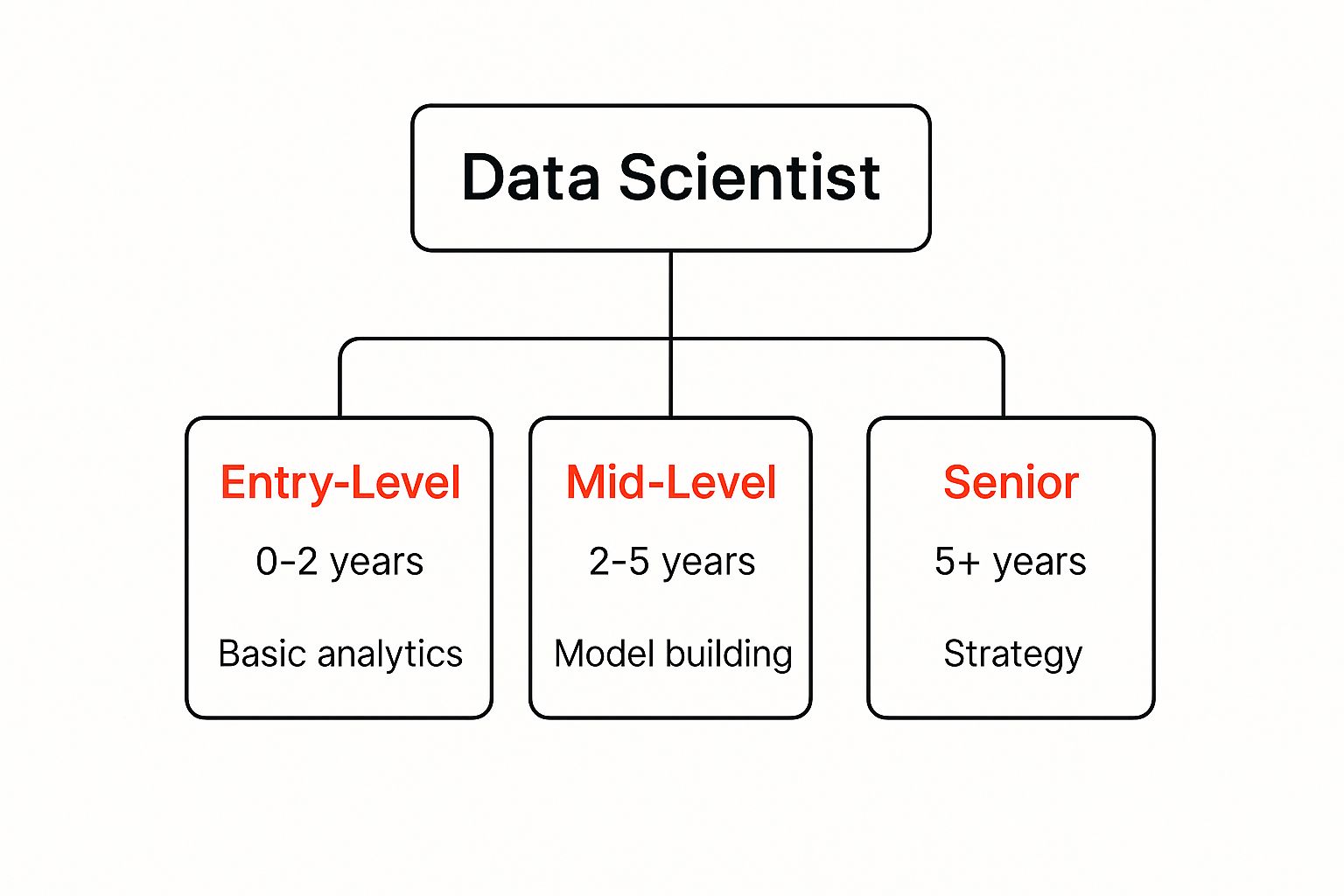
As the diagram shows, with more experience comes a shift in focus—from doing the analysis yourself to building complex models and eventually steering the company’s entire data strategy.
The Strategic Leader: Head of Data
At the top of the ladder, you’ll find leadership roles like Head of Data or Chief Data Officer. These leaders aren’t in the weeds coding every day. Their focus is on the bigger picture: strategy, team management, and driving business value. They are the architects of the company’s data vision.
A Head of Data doesn’t just manage projects; they build and mentor the team that makes data science possible. Their success is measured by the overall value the data team delivers to the business.
This top-tier role involves setting the data roadmap, fighting for budgets to get the best tools and tech, and making sure the work of analysts and scientists directly supports the company’s most important goals. They’re the translators, turning business problems into technical projects and then communicating the results back to the executive board in a language they understand.
The Nigerian job market truly reflects this full spectrum of roles. A look at recent listings reveals a healthy mix of data scientist jobs, from positions perfect for recent graduates to senior lead roles that require over five years of experience. What’s more, these opportunities are expanding geographically beyond Lagos into states like Kwara and Ogun, with many companies now offering remote and hybrid work to attract the best people. This variety shows just how much the data field has matured in Nigeria.
To get a feel for what’s out there, it’s worth taking a closer look at current data science vacancies in Nigeria and their specific requirements.
Accessing Global Opportunities with Remote Work
Gone are the days when a top-tier global career meant leaving Nigeria. Thanks to the boom in remote work, the traditional barriers have crumbled, creating a direct path for Nigerian data scientists to work with international companies. It’s now entirely possible to land high-paying data scientist jobs and earn a competitive salary in dollars, all without stepping outside your home.
This isn’t just a passing trend; it’s a massive shift in how the tech world functions. Companies across Europe, North America, and Asia are actively scouting for talent globally, and Nigerian professionals are very much on their radar. Tapping into this incredible opportunity, however, requires a smart strategy—it all starts with knowing where to look and how to position yourself for a global audience.
Where to Find International Remote Jobs
Don’t waste your time scrolling through generic job sites. To find the best remote roles, you have to go where international recruiters are actively searching. Here’s your action plan:
- Target Dedicated Remote Job Boards: Websites built exclusively for remote work are your best friends. They cut through the noise, connecting you directly with companies that are truly remote-first.
- Optimize Your LinkedIn Profile: Your LinkedIn profile is your international business card. Actionable Step: Go to your profile now and ensure your headline includes “Data Scientist.” In your “About” section and experience descriptions, use keywords for in-demand skills like “Cloud (AWS, Azure),” “Machine Learning,” and “Python.”
- Build an Active GitHub Portfolio: For any data scientist, a GitHub profile speaks louder than a CV. Actionable Step: Ensure every project has a well-documented README file. It should clearly explain the business problem, your methodology, the code, and the results with visualisations. This shows proof of your skills.
In today’s global talent market, your location is far less important than your ability to deliver results. A strong, project-driven portfolio is your ticket to these international data scientist jobs.
Mastering the Virtual Interview
Once you’ve caught their attention and landed an interview, the next hurdle is making a great impression across different time zones. A virtual interview demands a unique set of preparations.
Here’s a step-by-step guide to prepare:
- Confirm the Time Zone: Always confirm the interview schedule in both your local time (WAT) and the interviewer’s time zone. Use a world clock tool to double-check. Send a polite confirmation email a day ahead to show you’re organised.
- Test Your Tech: Check your internet connection, camera, and microphone at least 30 minutes before the call. A technical glitch can create a bad first impression.
- Prove Your Remote-Readiness: Be ready to give a specific example of how you’ve used tools like Slack, Jira, or Zoom to collaborate on a project. Emphasise your self-motivation and ability to manage your own time effectively.
The remote work scene for data science in Nigeria is picking up speed, fuelled by improved digital infrastructure and intense global demand. Specialised platforms have seen a big jump in remote data scientist roles open to Nigerian applicants, offering a chance to work on advanced analytics and AI projects for international firms. With over 100,000 Nigerians registered on some remote platforms, many in data-related roles, professionals are finding better pay and career progression than ever before.
Our detailed guide on securing international remote jobs in Nigeria has even more tips to help you prepare. To start your search right away, you can browse dedicated remote data science job listings and see what opportunities are out there.
A Step-by-Step Guide to Landing Your First Job

Knowing the skills and career paths is one thing, but actually getting your foot in the door is a different beast entirely. Let’s get tactical. This is your game plan for navigating the job hunt and landing one of the many rewarding data scientist jobs out there. The trick is to stop being a passive job seeker and become an active candidate who shows undeniable value.
It all starts with your CV and portfolio. Think of these as your opening act—they make the first impression, and they need to do more than just list what you know. They must tell a compelling story about what you can do for a business.
Step 1: Craft a CV That Gets Noticed
Hiring managers are busy. They might only give your CV a few seconds. To make your CV jump out of the pile, you have to talk about your impact in numbers. Don’t just say you “worked on a model”; rephrase it to show what that model achieved.
Key Insight: The best CVs don’t just list technical tasks; they translate them into business results. Always ask yourself, “So what?” What happened because of your work? Did it make money, save money, or make things run smoother?
Here’s a practical, before-and-after example for your CV:
-
Before: “Built a customer segmentation model.”
-
After: “Developed a customer segmentation model that boosted marketing campaign ROI by 25% by identifying and targeting high-value customer groups.”
-
Before: “Cleaned and analysed a dataset.”
-
After: “Engineered a data cleaning pipeline in Python that slashed data processing time by 40%, enabling faster report generation for the sales team.”
This simple change in language makes a world of difference. It positions you as a problem-solver who understands the bigger picture, not just a technician. That’s a quality every company wants when hiring for data scientist jobs.
Step 2: Build a Portfolio with Nigerian Datasets
Your portfolio is where you prove you can walk the walk. Using local, relevant datasets can make your projects especially compelling for employers in Nigeria.
Here are a few actionable project ideas using public Nigerian data:
- Analyse Lagos Traffic Patterns: Get traffic data from an open source and use it to build a dashboard that pinpoints congestion hotspots by time of day. You could even propose optimised delivery routes.
- Predict Agricultural Yields: Use data from agricultural agencies to build a model that forecasts yam or cassava yields in different states. This is incredibly valuable for agribusinesses.
- Explore Fintech Adoption: Analyse survey data to find the drivers of mobile money adoption across different demographics. This is great if you’re interested in fintech or how to start an online business.
For every project, document it clearly on GitHub. Follow this structure: 1) The Problem, 2) The Data Source, 3) Your Methodology & Tools, 4) Your Findings & Visualisations.
Step 3: Master the Interview Process
Data science interviews are known for being tough. You’ll likely go through several rounds. Here’s how to prepare for each stage:
1. Technical Coding Challenges
Expect a live coding session or a take-home assignment.
How to Prepare: Practice common data manipulation tasks on platforms like LeetCode or HackerRank. Focus on writing clean, efficient Python or SQL code. Be ready to explain your logic out loud.
2. Business Case Studies
You’ll get a broad problem like, “How would you reduce customer churn for a telecom company?”
How to Prepare: Use a structured approach.
* Clarify: Ask questions to understand the business goal. (“Is the goal to reduce churn by a specific percentage?”)
* Hypothesize: State your initial ideas. (“I believe churn might be related to poor network quality or high prices.”)
* Plan: Outline the data you’d need and the analysis you’d perform.
* Define Metrics: State how you would measure success (e.g., a reduction in the monthly churn rate).
3. Behavioural Questions
When they ask, “Tell me about a time you failed,” they’re testing your self-awareness and problem-solving skills. Use the STAR method to structure your answer.
- S (Situation): “In my previous project, we were tasked with building a sales forecasting model…”
- T (Task): “…and my role was to gather and clean the data.”
- A (Action): “Initially, my model was inaccurate. I realised I had overlooked seasonal trends. I went back, incorporated time-series features, and re-trained the model.”
- R (Result): “The revised model’s accuracy improved by 30%, leading to much more reliable sales forecasts for the next quarter.”
Using this framework shows you’re a structured thinker who can communicate your value clearly. It’s a simple but incredibly effective way to impress any hiring manager.
So, where do you go from here? We’ve walked through the entire landscape of data scientist roles in Nigeria, from the core skills you need to the salaries you can expect. The demand is real, the opportunities are growing, and you now have a clearer picture of the road ahead.
But knowing the path and walking it are two different things. Your success will come down to a few key actions. It’s about building a practical skillset, not just collecting certificates. It’s about creating a portfolio that tells a story and solves actual problems, proving your worth before you even get an interview. And finally, it’s about being smart with your job search, looking at both incredible local companies and the expanding world of remote work.
Your Next Step Is the Most Important One
Becoming a data scientist is a marathon, not a sprint. It takes patience, a commitment to always be learning, and a proactive attitude. Remember, every expert you look up to started from scratch, with nothing more than the desire to learn and the courage to take that first step.
Your journey from aspiring data enthusiast to professional data scientist doesn’t begin with a grand plan. It begins with a single, simple action. It’s time to stop reading and start doing.
This is your moment. Don’t fall into the trap of waiting for the “perfect” time or the “perfect” project idea. That day never comes. The only thing that matters is taking one small, concrete step today.
Here’s your actionable to-do list for today:
- Find a dataset that matters to you. Go to the National Bureau of Statistics website or Kaggle, find a Nigerian dataset (on fintech, agriculture, or public health), and just download it.
- Pick one tool and go deep. Forget trying to learn everything at once. Choose one library, like Pandas or Scikit-learn, and commit to learning its 5 most common functions.
- Start a small project. Don’t aim for a groundbreaking discovery. Your first goal is simple: load the data, clean one column, and create one basic chart. That’s it. That’s a win.
The future of data science in Nigeria is incredibly bright, and there’s a place for you in it. But that future doesn’t start next month or next year. It starts right now, with the very next thing you choose to do. That first project, that first line of code—that’s your career taking its first breath.
Frequently Asked Questions About Data Scientist Jobs
As you start looking for top data scientist jobs, especially here in Nigeria, a lot of questions are bound to pop up. It’s a fast-moving field, and it’s easy to feel a bit lost. This section is designed to give you straightforward answers to the questions we hear most often, clearing up any confusion and helping you move forward with confidence.
Do I Need a Master’s Degree to Get a Data Scientist Job in Nigeria?
This is a big one, and the answer is increasingly “no.” While a Master’s degree in a field like Statistics or Computer Science is definitely a plus and can open some doors, it’s not the dealbreaker it once was for many data scientist jobs in Nigeria.
Actionable Insight: Employers today care more about what you can do than what your degree says. A well-curated GitHub portfolio that shows you can solve real-world business problems is often more compelling than a traditional academic qualification. Likewise, professional certifications from respected platforms like Coursera or DataCamp can be a fantastic way to prove your skills, especially when you’re just starting out. The goal is to build tangible evidence that you can create value.
What Is a Realistic Entry-Level Data Scientist Salary?
Pinning down an exact figure for an entry-level data scientist job in Nigeria can be tricky because it depends on several things. Your location, the company you join, and your specific skillset all play a significant role in what you can expect to earn.
Here are the key factors that influence your pay cheque:
- Location: Economic hubs like Lagos and Abuja almost always offer higher salaries. This isn’t just because of the concentration of tech companies, but also to account for the higher cost of living.
- Company Type: Big multinational corporations and well-funded tech startups typically have more money to spend on data talent compared to smaller, local businesses.
- Skill Set: If you have specialised skills that are in high demand—think natural language processing (NLP) or experience with cloud platforms like AWS—you can command a much higher starting salary.
Actionable Tip: While the numbers are always changing, you can get a realistic range by actively searching for “entry-level data scientist” roles in Nigeria on sites like LinkedIn and MyJobMag. Note the salary ranges listed in the job descriptions to get an up-to-date baseline.
How Is a Data Analyst Different From a Data Scientist?
The easiest way to understand the difference is to think about the primary question each role answers.
A Data Analyst focuses on “What happened?” They are experts in descriptive analytics.
- Practical Example: An analyst would create a dashboard showing that sales in Q3 were 15% higher than in Q2. They use tools like SQL and Excel to report on past events.
A Data Scientist focuses on “What will happen?” and “What should we do?” They are experts in predictive and prescriptive analytics.
- Practical Example: A scientist would build a machine learning model to forecast that sales in Q4 will be 20% higher than Q3. They would also build a system that recommends specific products to customers to help achieve that forecast.
The analyst describes the past, providing crucial business intelligence. The scientist predicts the future, creating new business capabilities. Both roles are vital, but they operate on different points of the decision-making timeline.
What Kind of Projects Should I Have in My Portfolio?
Your portfolio is your chance to prove you can handle a project from end to end. The best projects solve a clear problem and demonstrate a range of skills.
Here’s a step-by-step guide for a portfolio project:
- Define a Problem: Don’t just analyse data randomly. Frame it as a question. For example, “Can we predict flight delays from Murtala Muhammed Airport based on time of day and airline?”
- Gather and Clean Data: Find a public dataset (e.g., from an airline data source or a public API). Document the steps you take to handle missing values and errors. This is a critical skill.
- Analyse and Model: Perform exploratory data analysis (EDA) to find initial patterns. Then, build a simple machine learning model to make a prediction.
- Visualize and Communicate: Create an interactive dashboard using a tool like Power BI or Tableau that clearly presents your findings. Write a blog post or a detailed GitHub README explaining your process and results. This showcases your communication skills, an often-overlooked but essential skill you can hone by learning how to improve your writing skills.
The goal is to show you’re not just a technician; you’re a problem-solver with business sense.
Ready to supercharge your productivity and creativity? RichlyAI offers a powerful suite of AI tools to help you generate high-quality text, code, images, and more in seconds. Whether you’re a marketer, developer, or student, our platform is designed to help you achieve your goals faster. Start creating for free at RichlyAI.
