
Writing an informal letter is like having a chat on paper with someone you know well. The main idea is to keep it relaxed and personal. You’re not trying to impress a boss or an official; you’re connecting with a person, so your language should be natural and easy-going.
What Makes an Informal Letter Different?
Think of it this way: an informal letter is the written equivalent of a friendly conversation. It’s a world away from a formal letter you might write for a job application. The goal isn’t professional—it’s personal.
In Nigeria, this style of writing is a huge part of our culture. It’s how you’d write to invite your auntie in the village to a naming ceremony, or to check on a friend from uni who just moved to Abuja. The warmth and personal touch you add make the letter special.
This concept map captures the essence of what an informal letter is all about.
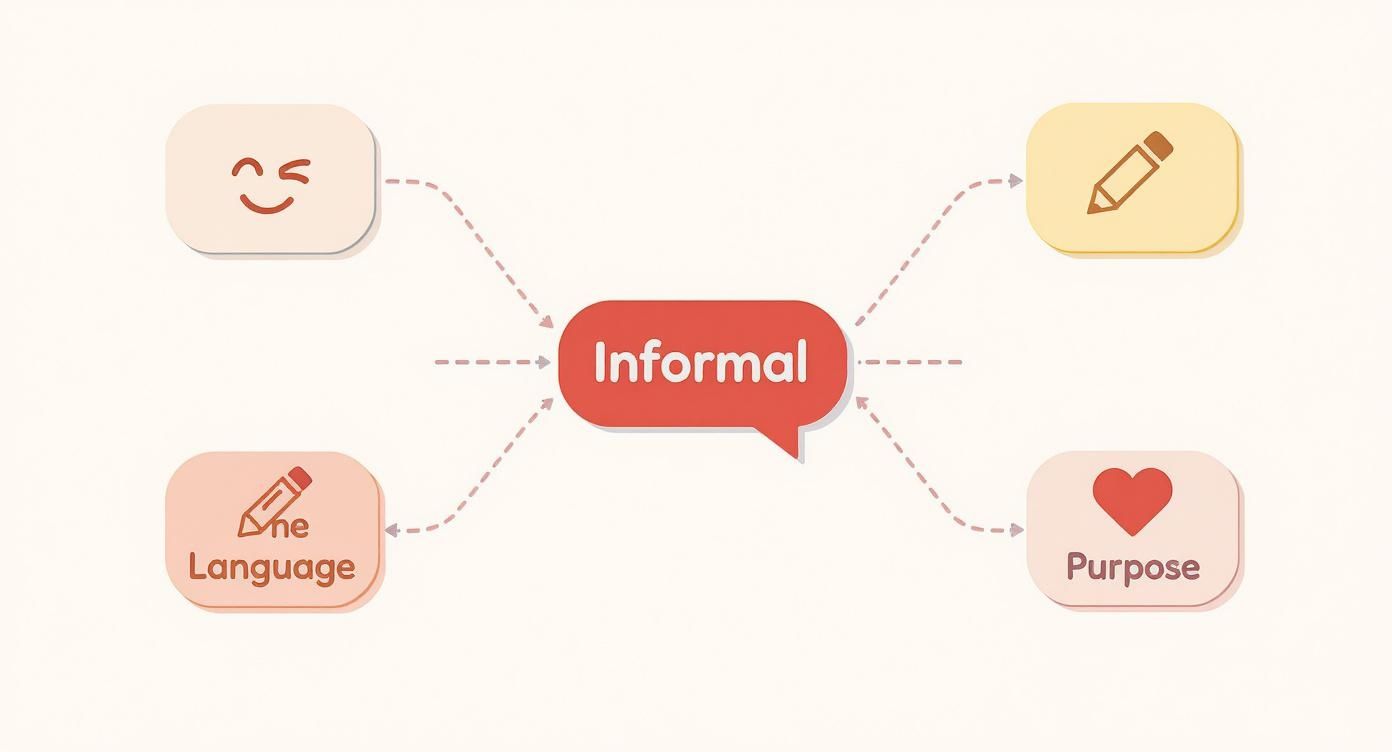
As you can see, everything flows from that central idea of being ‘informal’. It’s all about writing from the heart.
The Heart of Personal Connection
The best thing about informal letters is the freedom they give you. You can use contractions like “I’m” or “we’ll,” share an inside joke, or even throw in some Nigerian Pidgin if that’s how you and the recipient normally talk. This isn’t just okay; it’s what makes the letter feel genuine.
The core difference is intent. A formal letter aims to inform or persuade an institution, while an informal letter aims to connect with a person. One is about business; the other is about bonding.
Even with modern messaging apps, mastering this personal style of writing is a vital skill. In fact, some educational research shows that about 70% of Nigerian secondary school students say informal letters are the most common type of writing they do outside of schoolwork. This just goes to show how central it is to our everyday lives.
For students today, blending these timeless communication skills with modern tools is key. Exploring the top use cases for AI for Nigerian students can offer a fresh perspective on how to enhance these traditional abilities.
Formal vs. Informal Letter: A Quick Comparison
To put it all into perspective, here’s a quick breakdown of the main differences between the two styles. It’s a handy reference to make sure you’re hitting the right note.
| Feature | Informal Letter | Formal Letter |
|---|---|---|
| Audience | Friends, family, close acquaintances | Officials, employers, institutions |
| Tone | Relaxed, personal, and conversational | Respectful, professional, and serious |
| Language | Everyday language, slang, contractions | Standard, formal vocabulary, no slang |
| Structure | Flexible and casual | Strict format (addresses, date, salutation) |
| Purpose | To connect, share news, invite personally | To request, apply, complain, or inform officially |
Ultimately, choosing between formal and informal simply comes down to who you’re writing to and why. Getting it right is the first step to making sure your message is received exactly as you intended.
How to Structure an Informal Letter: A 4-Step Process
Every great informal letter, whether it’s a handwritten note or a quick email, has a simple, natural flow. This isn’t about following strict rules but about making your message feel like a real conversation. Follow these steps to make sure your letter is warm, clear, and easy to read.
Step 1: Write Your Address and the Date
First, put your address in the top right-hand corner of the page. You don’t need to add your name here—just the address will do. Right underneath it, write out the full date.
Actionable Example:
Room 204, Ribadu Hall,
Ahmadu Bello University,
Zaria, Kaduna State.
15th October 2023
This small detail is more important than you might think. It gives your friend or family member context for when you wrote the letter and where to send a reply.
Step 2: Choose a Warm Greeting (Salutation)
Now, move to the left side of the page and leave a bit of space below the date. This is where you say hello. Since we’re keeping things casual, your greeting should be warm and personal.
How to Do It:
- For close friends: “Dear Tunde,” works perfectly, or even a simple “Hi Tunde,”
- For family: “My Dearest Auntie,” or “Dearest Mama,” adds a lovely, personal touch.
- A good all-rounder: “Hello Chiamaka,” is always a safe bet.
Just go with whatever feels most natural for your relationship.
Step 3: Write the Main Message (Body)
This is where the real conversation happens. The body of the letter is your space to share news, ask questions, and connect. To keep it organized, structure it in three parts.
- The Opening: Ease into the conversation. Start by asking how they are or thanking them for their last letter. For example: “I hope this letter finds you well. How is everyone in the family?”
- The Middle: This is the core of your message. Share what you’ve been up to, tell them your news, or answer their questions. To make your stories more engaging, use descriptive language. You can learn more about using an adverbial phrase in your sentences to bring your writing to life.
- The Closing Paragraph: Wrap things up. Mention that you’re looking forward to their reply or send greetings to others. For example: “I have to go now, but I can’t wait to read your reply. Please send my love to Uncle.”
Step 4: Add the Closing and Your Signature
Finally, you’ll need a sign-off (complimentary close). Just like your greeting, this should match the warmth of your relationship. Place this on the right side of the page.
Practical Options:
- “Yours ever,”
- “With love,”
- “Warmly,”
- “Best wishes,”
After you’ve chosen your closing, sign your first name underneath it. No need for a stuffy, full signature here. And just like that, you’ve put together a perfectly structured informal letter.
Finding the Right Words for Your Message
We’ve all been there—staring at a blank page with no idea where to start. The secret to getting past it, especially with an informal letter, is to follow one simple rule: write like you talk.
Forget about sounding formal or academic. The goal here is to connect, not to impress a university lecturer.
Go ahead and use contractions like “it’s” and “you’re.” Throw in a question or two to make it feel like a chat. You could even share a funny story or a random thought. This is what turns a simple update into a piece of genuine connection.
Prompts to Get You Started
To get the creative juices flowing, think about why you’re writing. Each scenario calls for a slightly different approach.
- Sharing News with a Friend: Start with something like, “You won’t believe what happened at the market last week…” or “I finally have some exciting news about my NYSC posting…”
- Inviting a Relative: You could try, “We’re planning a small get-together for my graduation and I was really hoping you could come…” or “The family owambe is next month, and it just wouldn’t be the same without you.”
- Thanking Someone for a Gift: A great opening would be, “Thank you so much for the beautiful wrapper you sent. I’ve already planned the perfect style for it…”
Historically, this tradition of using letters to share local news and express goodwill has been a powerful way to strengthen bonds within Nigerian communities. It’s a practice that keeps relationships alive, no matter the distance.
Making Your Message Authentic
Real authenticity shines through in the details. Don’t just say you’ve been busy; talk about what’s been keeping you occupied. Mentioning familiar people, places, and shared experiences will make your letter truly hit home.
Your personality should come alive on the page. If you have a great sense of humour, let it show. If you’re writing to offer comfort, let your empathy come through in your words.
Mastering the right tone for different situations takes practice. You can learn a lot by exploring the art of writing various types of informal correspondence, such as thank you cards.
The more you write, the more natural it becomes. For more great advice on honing your personal style, have a look at our guide on how to improve your writing skills. At the end of the day, finding the right words isn’t about following a script—it’s about sharing a little piece of yourself.
See How It Works: A Complete Letter Example
Theory is one thing, but seeing how all the pieces fit together in a real letter is where it clicks. Let’s walk through a complete informal letter, bit by bit, to understand how it works in practice.
Imagine a recent graduate, David, writing from Lagos to his younger sister, Chinwe, who’s currently studying at the University of Nigeria, Nsukka (UNN).

Breaking Down the Letter
Let’s look at the different parts of David’s letter and why they work so well.
1. Address and Date (Top Right)
Flat 3B, Adeola Odeku Street,
Victoria Island,
Lagos.
25th October, 2023
This is a classic, clean setup. David puts his address first—without his name—and then the date right below it. It’s the standard convention and immediately tells Chinwe where and when he’s writing from.
2. The Greeting (Top Left)
My Dearest Chinwe,
Right away, the tone is set. “My Dearest” feels warm, personal, and genuinely affectionate. It makes a huge difference compared to a more standard “Dear Chinwe,” especially between close siblings.
3. The Body of the Letter
I hope this letter meets you well. How are your studies coming along? Lagos is as hectic as ever, but I’m slowly getting the hang of my new job. You won’t believe the traffic I faced on Monday—I nearly missed my morning meeting!
I wanted to check in and see how you’re preparing for your final exams. Remember what Dad always says about starting revision early. Don’t stress yourself out too much, though.
I’ll be visiting Enugu next month and I’ll be sure to bring that book you asked for. Please send my love to everyone at home.
The flow here is fantastic because it feels like a real conversation.
- It kicks off with a simple greeting and a question about her.
- He then shares a personal, relatable story about Lagos traffic—this makes the letter feel alive.
- Next, he shifts to a more serious topic (exams) but keeps it encouraging.
- Finally, he ends with a plan for the future and a greeting for the family. This mix of small talk, genuine concern, and future plans is what makes an informal letter so special.
4. The Closing and Signature (Bottom Right)
With all my love,
David
The sign-off, “With all my love,” is the perfect bookend to the affectionate greeting he started with. It’s warm and informal, followed by just his first name.
This kind of heartfelt tone is what makes written communication powerful. You can see a similar personal touch in a real-world appreciation letter. In the same way, even a short note like a happy new month message for my wife can carry that same personal, thoughtful weight.
Polishing Your Letter: Common Mistakes to Sidestep
You’ve poured your heart onto the page, but even the best informal letters can be tripped up by a few common mistakes. Before you seal that envelope, taking a few minutes to give it a once-over can make all the difference.
This isn’t about chasing perfection; it’s about making sure your personality and warmth come through without any distracting errors getting in the way.
Ditching the Stiff and Formal Tone
It’s surprisingly easy to fall back into a formal tone, especially if you’re used to writing emails for work. Remember who you’re writing to—this isn’t a job application. This is one of the biggest hurdles when you first learn how to write an informal letter.
So, drop the overly proper sign-offs. Stiff closings like “Yours faithfully” or “Yours sincerely” just don’t fit. Instead, go for something that feels genuine to your relationship, like “With love,” “Best wishes,” or even a simple “Talk soon.”
The goal is connection, not formality. If it sounds like something you’d never say out loud to the person, it probably doesn’t belong in your letter.
Remembering the Simple (But Important) Bits
When you’re caught up in sharing your news, it’s easy to forget the basic building blocks of a letter. The two most commonly missed items? The date and a return address. The date gives your letter context, and your address is a must if you’re hoping for a reply!
Another thing to watch out for is burying the lead. If the whole point of your letter is to invite your cousin to a party, don’t hide the invitation in the fourth paragraph. Make sure your main purpose is clear and easy to find.
Frequently Asked Questions
Still have a few questions? Let’s tackle some of the common ones that pop up when people sit down to write an informal letter.
Can I Write an Informal Letter as an Email?
Absolutely. An email is often the quickest way to send an informal letter. The conversational, warm tone translates perfectly.
While you can drop the physical address and date, keep the friendly greeting and sign-off. For instance, a subject line like “Just thinking of you!” followed by “Hi Mum,” works great. The goal is to keep that personal connection strong, no matter the medium.
Is There a Perfect Length for an Informal Letter?
Not at all. There’s no magic word count. The right length is whatever feels natural for your message and your relationship with the recipient.
A quick note to a friend might be a couple of short paragraphs. On the other hand, if you’re catching up with a cousin overseas, you might find yourself writing a much longer letter. Just focus on sharing what you want to share.
Is It Okay to Use Slang or Nigerian Pidgin?
Of course! You should if that’s how you and the recipient normally talk. Dropping in a “How you dey?” or other familiar slang is what makes your letter sound like you.
The golden rule is to write in a way that feels genuine to your relationship. If you’d say it to them in person, you can write it in your letter.
If you’re looking for ways to brainstorm, you can learn more about how to start using AI without any experience for a little creative boost.
Actionable Takeaways
- Follow the 4-Step Structure: Always include your address/date, a warm greeting, the body of your message, and a friendly closing.
- Write Like You Talk: Use contractions, slang, and a conversational tone to make your letter feel genuine and personal.
- Start with a Prompt: If you’re stuck, think about your reason for writing (sharing news, inviting, thanking) and use a targeted opening line.
- Don’t Forget the Basics: Double-check for your address and the date before sending, especially if you expect a reply.
- Review for Tone: Read your letter aloud. If it sounds too stiff or formal for the person you’re writing to, revise it to be more natural.
Tools and Resources
- Grammarly: A useful tool for catching typos and grammatical errors, even in informal writing.
- Thesaurus.com: Helps you find alternative words to make your descriptions more vivid and engaging.
- RichlyAI: An AI writing assistant that can help you brainstorm ideas, draft paragraphs, or overcome writer’s block.
Further Reading
- How to Improve Your Writing Skills: A guide to sharpening your overall writing abilities.
- The Art of Writing Thank You Cards: An external resource with tips on a specific type of informal correspondence.
- What is an Adverbial Phrase?: Learn how to add more detail and color to your sentences.
Ready to create compelling content faster than ever? With RichlyAI, you can generate everything from blog posts to social media updates and stunning images in just a few clicks. Streamline your workflow and unlock your creative potential by visiting RichlyAI Hub to start for free today.
