
An adverbial phrase is a group of words that functions as a single adverb. Its job is to add detail by answering the crucial questions of how, when, where, or why an action happens. Think of it as a tool to zoom in on the action, giving your reader the context they need to fully picture what you’re saying.
What Exactly Is an Adverbial Phrase?

alt text: A colorful diagram breaking down the components of an adverbial phrase, showing how a group of words can modify a verb.
An adverbial phrase doesn’t just add words; it adds layers of meaning. As a single unit, it modifies a verb, an adjective, or another adverb. So, instead of saying someone ran quickly, you can paint a richer picture by saying they ran with surprising speed.
This group of words works together to answer key questions in a sentence, giving you a level of depth that a single word often can’t. This can be tricky at first. In fact, studies show that around 68% of English language learners in Nigeria find it challenging to separate adverbial phrases from simple adverbs because of their more complex structure. If you’re tackling exams, you can find more great tips on GMAT grammar on Magoosh.com.
The Core Jobs of an Adverbial Phrase
To get a better grip on this, let’s break down the main jobs these phrases do. At their heart, they are information providers that make your sentences more specific and far more interesting. Here’s a quick table to show their main functions at a glance.
Adverbial Phrase Functions at a Glance
This table summarises the different roles an adverbial phrase can play, each answering a specific question to add more detail to your sentence.
| Function (What It Answers) | Practical Example Sentence |
|---|---|
| How? (Manner) | The team completed the project with great efficiency. |
| When? (Time) | We will meet after the lunch break. |
| Where? (Place) | She found her keys under the sofa. |
| Why? (Reason) | He studied all night to pass the examination. |
Actionable Insight: An adverbial phrase is your best tool for moving beyond basic descriptions. It elevates your writing from simply stating what happened to explaining the full circumstances around the action. When editing, look for single adverbs (like quickly) and see if an adverbial phrase (like with incredible speed) could provide more impact.
Once you start to recognise these core functions, you’ll see adverbial phrases everywhere. They are the building blocks for more dynamic and informative sentences, giving you the power to guide your reader’s understanding with precision.
How Are Adverbial Phrases Actually Built?
Adverbial phrases give sentences texture and detail. Think of them as simple building blocks you can add to a sentence to give it more flavor. Most of the time, they’re built from two key ingredients: prepositional phrases and infinitive phrases. Each adds a different kind of context.
A prepositional phrase is a group of words that starts with a preposition—like in, on, at, or with—and ends with a noun or pronoun. When that group of words answers how, when, or where, it’s an adverbial phrase.
An infinitive phrase always starts with “to” followed by a verb, like to meet or to finish. When one of these explains the why or purpose behind an action, it’s acting as an adverbial phrase.
How to Build a Sentence with Adverbial Phrases: Step-by-Step
Let’s use a step-by-step process to layer meaning onto a basic sentence.
- Start with a simple sentence: The manager spoke. (This is clear but lacks detail.)
- Add a prepositional phrase to show how: The manager spoke with confidence. (Now we know the manner of speaking.)
- Add an infinitive phrase to explain why: The manager spoke to motivate the team. (Now we understand the purpose.)
These structures are incredibly common. A 2022 study of Nigerian newspapers found that around 17% of all clauses contained adverbial phrases. Of those, a whopping 65% were prepositional phrases like “during the meeting.” You can find more real-world examples at Examples.com.
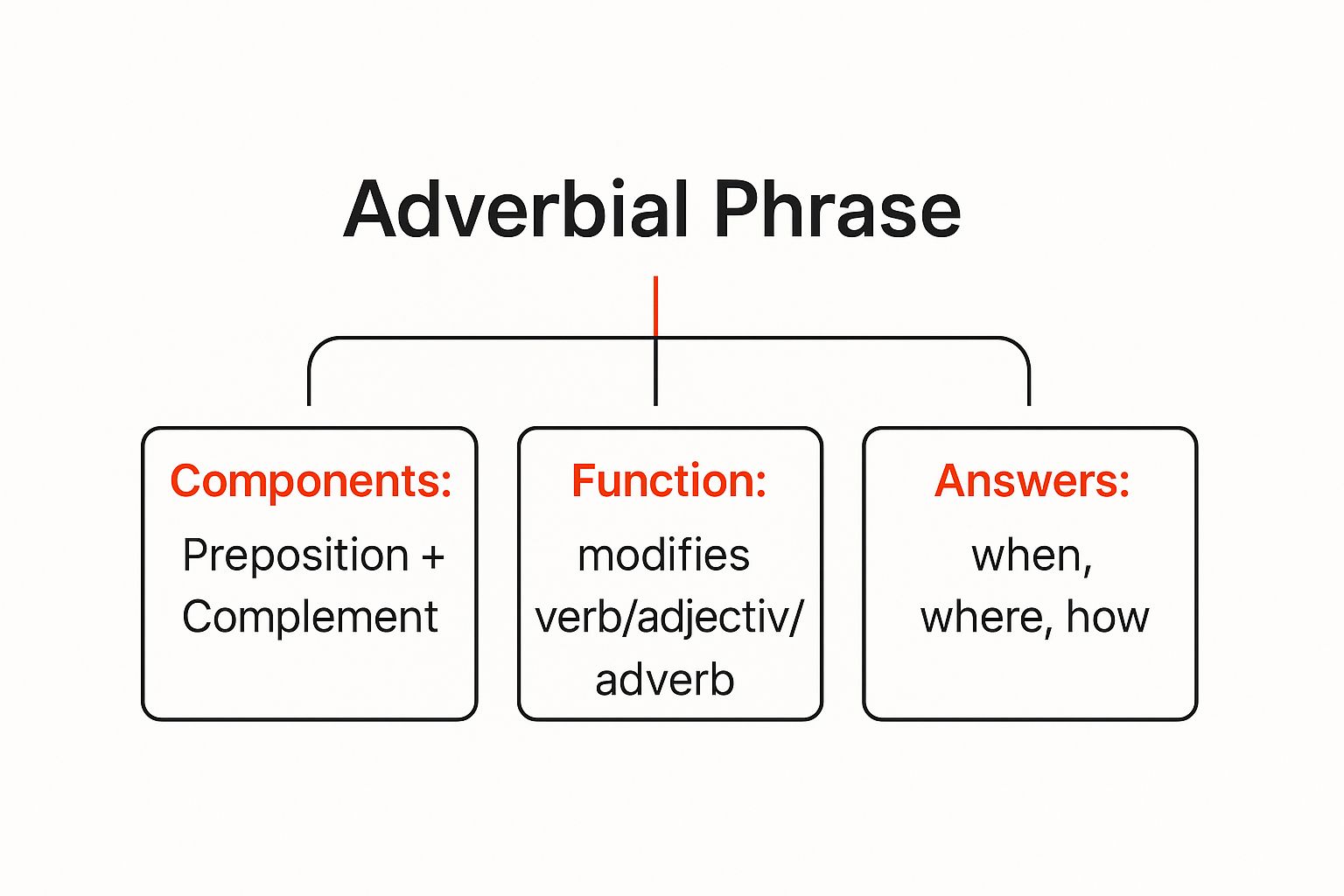
This visual breaks down the core components and function of a typical adverbial phrase.
alt text: An infographic explaining the structure of an adverbial phrase, with a preposition connecting to its object to modify a verb.
As the diagram shows, a preposition and its object team up to create a phrase that modifies other words, adding crucial detail. Once you get the hang of these basic patterns, you’ll start spotting adverbial phrases everywhere.
This skill is useful whether you’re writing a report or trying to get better results from AI. If you’re looking to sharpen your AI communication, our guide on how to use Chat GPT can help you craft more effective prompts.
Putting Adverbial Phrases into Practice

alt text: A person writing in a notebook, demonstrating the practical application of writing and grammar skills.
Knowing the definition of an adverbial phrase is one thing, but using it effectively is where the magic happens. The key is to wield them to add color, context, and clarity to your sentences. A great way to get a feel for this is to think about the classic questions they answer: How? Where? When? and Why?
To make this crystal clear, let’s break down the main types you’ll encounter. Each has a specific job, and seeing them side-by-side helps it all click.
Types of Adverbial Phrases with Examples
| Type of Phrase (Answers…) | Practical Example in a Sentence |
|---|---|
| Manner (How?) | The developer coded the new feature with extreme care. |
| Place (Where?) | We found the missing file inside the archived folder. |
| Time (When?) | The team will launch the campaign at the start of next month. |
| Reason (Why?) | She worked overtime to meet the project goals. |
Let’s look at each of these categories a little more closely.
Answering How with Phrases of Manner
Phrases of manner are all about the how. They describe the way an action is carried out, giving your writing a dose of personality.
- Practical Example: Instead of “She presented her findings,” write “She presented her findings in a confident voice.” This phrase shows her attitude.
Answering Where with Phrases of Place
Phrases of place tell us where something is happening. They are essential for grounding your reader and helping them visualize the scene.
- Practical Example: Instead of “They organized the meeting,” specify with “They organised the meeting at the head office.” This phrase pinpoints the location.
Answering When with Phrases of Time
Phrases of time specify when an action occurs. They are crucial for establishing a clear sequence of events.
- Practical Example: Instead of “He finished the report,” add urgency with “He finished the report long before the deadline.”
Answering Why with Phrases of Reason
Finally, phrases of reason get to the heart of the matter, explaining the why behind an action. They reveal motivation and purpose.
- Practical Example: Instead of “He started a blog,” explain his goal with “He started a blog to share his expertise.”
By understanding these distinct roles, you can intentionally choose the right adverbial phrase for the job. This kind of deliberate word choice is what transforms good writing into great writing. For writers looking to enhance this process, exploring AI for content creation can introduce new ways to refine sentences.
Using Adverbial Phrases to Improve Your Writing
Knowing what an adverbial phrase is is just the first hurdle. The real art lies in knowing where to place them to make your writing sing. When you get this right, you can control the rhythm of your sentences, add emphasis, and create a more engaging experience for your reader.
A powerful technique is to move an adverbial phrase to the beginning of a sentence. This is called a “fronted adverbial,” and it instantly grabs the reader’s attention.
Before and After: Strategic Placement
Let’s see this in action. A simple tweak can transform a sentence:
- Before: The team finished the project just before the deadline. (Standard)
- After: Just before the deadline, the team finished the project. (Creates urgency)
See the difference? The second version builds tension by leading with the time constraint. That comma after the phrase is essential—it tells the reader to pause, making the sentence flow smoothly.
Actionable Insight: An adverbial phrase isn’t just a grammatical label; it’s a powerful tool for controlling pace and emphasis. To create suspense or highlight a condition, move the adverbial phrase to the front of the sentence and add a comma.
Mastering these structures is a valuable skill. In fact, concepts like adverbial phrases were formally woven into Nigerian school curricula during the educational reforms of the 1970s. Data shows that questions on these phrases appeared in roughly 25% of WAEC English papers between 1985 and 2000.
But it’s not just about exams. Understanding how professional line editing can polish your prose shows you how to use these phrases for maximum effect. If you’re keen to build on this, explore sentence construction more broadly in our guide on how to improve writing skills.
How to Avoid Common Adverbial Phrase Mistakes

alt text: A red “X” marking a grammatical error on a page, illustrating the concept of avoiding common writing mistakes.
Even seasoned writers can get tripped up by adverbial phrases. The two biggest culprits are misplaced modifiers and dangling modifiers. Getting these wrong can make your sentences confusing or even unintentionally hilarious.
A misplaced modifier is an adverbial phrase that’s too far away from the word it’s supposed to be describing. This can completely warp the meaning.
- Practical Example of a Mistake: “She served sandwiches to the children on paper plates.”
- This sounds like the children are sitting on the plates. The phrase “on paper plates” is meant to tell us how the sandwiches were served.
How to Spot and Fix Misplaced Modifiers: Step-by-Step
Catching these errors takes a quick three-step check to ensure your adverbial phrase is next to the right word.
- Spot the Adverbial Phrase: In our example, that’s “on paper plates.” It answers how or where the sandwiches were served.
- Find its True Target: What, exactly, was on the paper plates? The sandwiches. The phrase should be modifying “served sandwiches.”
- Move It Closer: Rewrite the sentence to bring the phrase next to the word it’s describing.
- Corrected Version: “She served sandwiches on paper plates to the children.”
The other common pitfall is the dangling modifier, where the word being modified is completely missing. For instance: “Walking through the park, the trees were beautiful.” This implies the trees were taking a stroll.
- To fix it, add the subject back in: “Walking through the park, I thought the trees were beautiful.”
Getting these corrections right is a game-changer for any serious writing. For those tackling formal documents, knowing how to structure thoughts clearly is paramount. Dive deeper with our guide on how to write a research proposal.
Common Questions Answered
Let’s tackle some of the most common sticking points so you can use these phrases with complete confidence.
Can a Sentence Have More Than One Adverbial Phrase?
Absolutely. Stacking adverbial phrases is a fantastic way to add layers of detail. You can combine them to paint a clearer picture by answering when, where, and how all at once.
- Practical Example: “After the storm (when), she walked gingerly (how) along the slippery path (where).”
Adverbial Phrase vs Adverbial Clause: What’s the Difference?
The key difference is their structure. An adverbial phrase is a group of words that lacks its own subject and verb. An adverbial clause, however, is a mini-sentence because it contains both a subject and a verb.
- Phrase Example: in the morning (No subject, no verb.)
- Clause Example: when the sun rises (Subject: “sun,” Verb: “rises.”)
Actionable Insight: A clause has a subject-verb pair; a phrase does not. Spotting this is the key to telling them apart.
Is a Prepositional Phrase Adverbial or Adjectival?
A prepositional phrase can wear both hats. To figure out its role, ask: “What word is this phrase modifying?”
- If it modifies a verb, adjective, or adverb (answering how, when, where), it’s adverbial.
- If it modifies a noun or pronoun (answering which one), it’s adjectival.
- Adjectival: “The book on the table is mine.” (Describes the noun “book.”)
- Adverbial: “He placed the book on the table.” (Describes the verb “placed.”)
Getting this distinction right will sharpen your writing precision. In a similar way, knowing how to give clear instructions to technology is vital; you can dig deeper by reading our guide on what is an AI prompt.
Actionable Takeaways
- Identify the “Why”: When you write a sentence, check if adding a phrase that answers how, when, where, or why would make it clearer or more engaging.
- Front-load for Emphasis: To create urgency or highlight a condition, move an adverbial phrase to the beginning of the sentence and follow it with a comma. (e.g., “With seconds to spare, she submitted the report.”)
- Perform the “Closest Word” Check: When editing, find your adverbial phrases and ensure they are right next to the word they are describing to avoid misplaced modifiers.
- Upgrade Single Adverbs: Scan your draft for simple adverbs (like slowly or carefully) and see if a more descriptive adverbial phrase (with great deliberation) would add more texture.
Tools & Resources
- Grammarly: An excellent tool for catching misplaced modifiers and other grammatical errors in real-time.
- Hemingway Editor: Helps you identify complex sentences where adverbial phrases might be making your writing hard to read.
- RichlyAI: Our suite of AI tools can help you rephrase sentences, generate examples, and polish your grammar to perfection. Start for free at RichlyAI Hub.
