
Before you write a single word, understand the purpose of a research proposal. It’s not just an academic formality; it’s a persuasive argument designed to sell your research idea.
Your mission is to convince a panel of experts on three key points:
- Your research question is important and worth investigating.
- You have a rock-solid, practical plan to find the answers.
- You are the right person to see this project through to completion.
Essentially, your proposal is the blueprint for your entire study. A detailed plan shows you’ve considered every angle and are prepared for the work ahead. Without it, your ideas risk coming across as disorganized and unconvincing.
Anatomy of a Winning Research Proposal
Every compelling research proposal is built on a set of core components. Each one has a specific job to do, and understanding their individual roles is the key to building a document that flows logically and makes a powerful case.
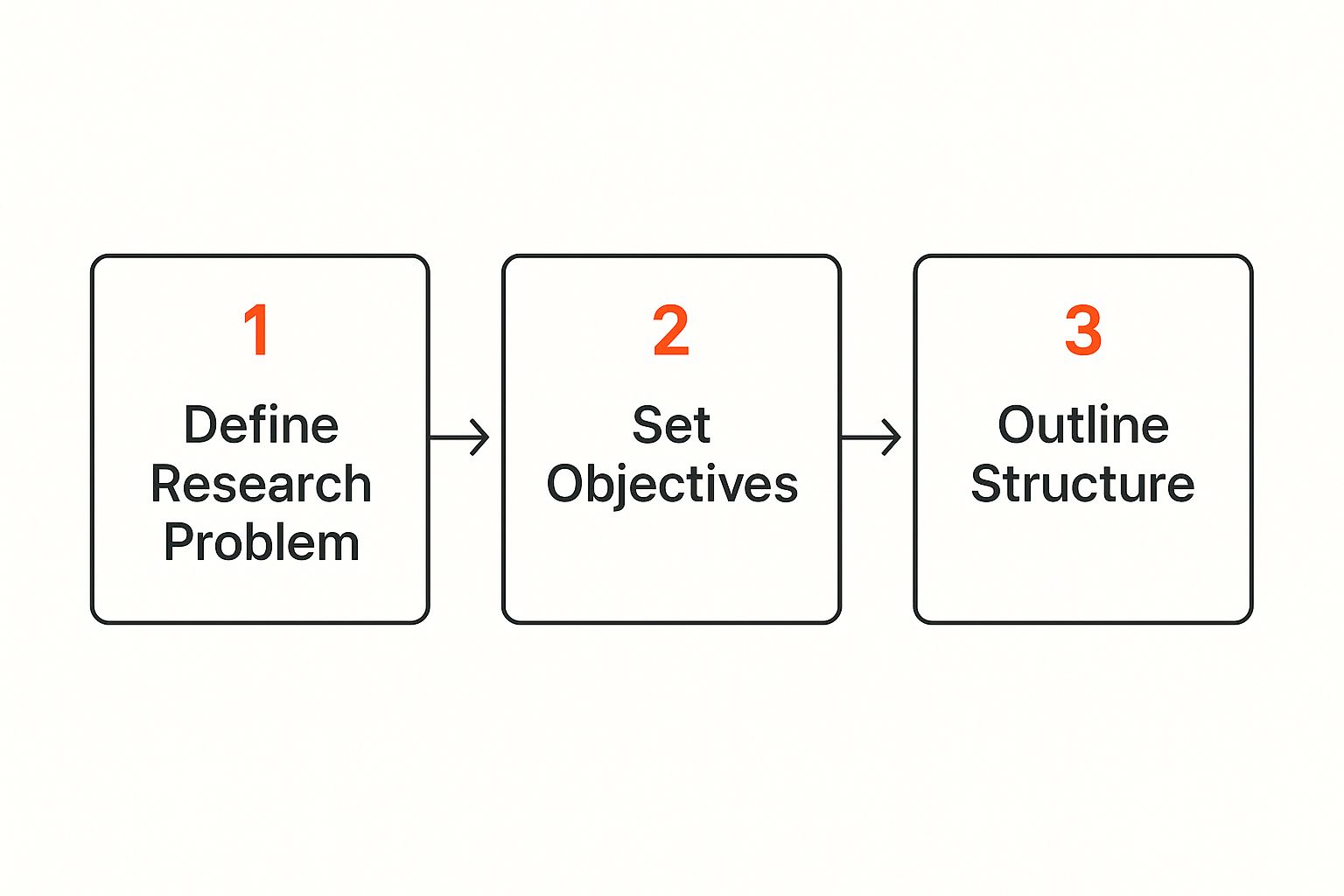
alt text: A flowchart showing the key components of a research proposal, starting with the title and abstract, then moving to the introduction, literature review, methodology, timeline, budget, and ethical considerations.
This visual breaks down the foundational flow, showing how everything starts with a clear problem and logically builds from there. A well-defined problem directly shapes your objectives, which in turn provides the entire framework for your proposal. For anyone struggling with that initial blank page, exploring how to use AI for content creation can be a great way to generate ideas and structure your early drafts.
What are the Key Building Blocks?
Let’s take a look at the essential sections you’ll need to include. Think of each one as a layer in your argument, building upon the last to create a complete and persuasive picture of your project. To help you get organized, here’s a quick overview of the core components and what each one needs to achieve.
Core Components of a Research Proposal
| Component | Primary Objective | Key Question It Answers |
|---|---|---|
| Title & Abstract | To grab attention and provide a concise summary of the entire project. | What is this research about in a nutshell? |
| Introduction | To establish the context, state the problem, and hook the reader. | Why does this research matter right now? |
| Literature Review | To show you’ve done your homework and identify the gap your study will fill. | What is already known, and what’s missing? |
| Methodology | To detail exactly how you will conduct the research. | What is your step-by-step plan for gathering and analyzing data? |
| Timeline & Budget | To prove the project is realistic and achievable with the resources requested. | Is your plan practical, and are the costs justified? |
| Ethical Considerations | To demonstrate a commitment to responsible and safe research practices. | How will you protect participants and handle data responsibly? |
Getting these sections right is fundamental. Each one must be clear, well-argued, and directly connected to the others. A strong methodology won’t save a weak introduction, and a brilliant idea will fall flat without a practical timeline. They all work together to build a case that your research is not just interesting, but essential.
Crafting a Powerful Introduction and Problem Statement
Think of your introduction as the most important few paragraphs in your entire proposal. This is your chance to hook the reader and convince them that your research isn’t just another academic exercise—it’s essential. A great introduction sets the scene, provides context, and answers the critical “So what?” question from the start.
This section isn’t just a summary of what you plan to do. It’s a compelling argument for why it needs to be done, and why it needs to be done now. You’re framing the significance of your work, making it clear that your study tackles a timely and important issue.

alt text: An illustration of a magnifying glass focusing on a specific problem within a larger context, symbolizing the process of defining a research problem.
Step-by-Step: From Broad Topic to Focused Problem
At the heart of any strong introduction is a sharp, well-defined problem statement. The secret to a winning proposal is funneling a broad interest into a specific, researchable gap. Here’s how you do it, step-by-step.
Let’s use a practical example: researching the impact of financial technology (FinTech) in Nigeria.
- Start with a Broad Interest: You’re fascinated by the booming FinTech scene. This is a great starting point, but it’s far too big for a single project.
- Initial Idea: “I want to research FinTech in Nigeria.”
- Narrow to a Sub-Topic: The FinTech world is massive. You could look at payment gateways, digital lending, or mobile banking. Let’s pick mobile banking.
- Refined Idea: “My research is about mobile banking in Nigeria.”
- Find a Specific Context or Population: The impact of mobile banking differs dramatically between urban and rural areas. Focusing on a specific group makes your project manageable and relevant.
- More Specific Idea: “I will study mobile banking adoption in rural Nigerian communities.”
- Pinpoint the Gap or Problem: This is the most crucial step. What’s the puzzle? You might notice that adoption rates among small business owners are surprisingly low, even though the technology is available. Now you have a problem.
- The Research Problem: “Despite the rapid expansion of mobile banking services aimed at fostering financial inclusion, there is a significant and poorly understood gap in adoption rates among rural entrepreneurs in Northern Nigeria, potentially hindering their business growth and economic integration.”
That final statement is a specific, compelling problem. It highlights a clear gap and hints at real-world consequences. This level of focus is essential when learning how to write a research proposal.
Structuring Your Introduction
To build an introduction that flows logically, follow this four-part structure:
- The Hook (The Big Picture): Open with a broad statement that establishes the general territory. For our example, you’d talk about the rise of FinTech as a major force for economic development in emerging markets like Nigeria.
- The Context (What We Already Know): Briefly touch on existing research. Mention the documented growth of mobile banking and its mission to boost financial inclusion.
- The Gap (The “But…”): This is your pivot. Use a transition like “However,” or “Despite these advancements,” to shift focus to the specific issue—the low adoption rates among rural entrepreneurs.
- The Solution (Your Research): State the purpose of your study clearly. This is your thesis statement, explaining how your work will address the gap. For example: “This study aims to investigate the socio-economic and technological barriers influencing mobile banking adoption among rural entrepreneurs in Northern Nigeria.”
A powerful problem statement is the bedrock of your entire proposal. It must be concise, compelling, and arguable. It doesn’t just state a fact; it presents a tension, a question, or a puzzle that desperately needs solving.
Following this blueprint guides your reader from a general understanding to the specific, critical question that only your research can answer. If you feel your persuasive writing could use a tune-up, our guide on how to improve writing skills offers solid strategies.
Designing a Rock-Solid Methodology
If your introduction is the hook, your methodology is the engine. This is where you pivot from the ‘what’ and ‘why’ to the all-important ‘how’. A vague or poorly thought-out methodology is the fastest ticket to rejection. Reviewers need to see a detailed, logical plan showing how you will get from your research question to your conclusion.

alt text: A diagram illustrating the research methodology process, including research design, population and sampling, data collection, and data analysis.
Step 1: Choose and Justify Your Research Design
Your first big decision is your overall approach—your research design. This choice must be the most effective way to answer your specific research question. You can’t just state your design; you must defend it.
Common research designs include:
- Experimental: Best for testing cause-and-effect by manipulating variables in a controlled setting.
- Survey: Ideal for gathering data on attitudes, opinions, or behaviors from a large group.
- Case Study: Allows for a deep, detailed examination of a single person, group, or event.
- Ethnographic: Involves immersing yourself in a community to understand its culture from the inside.
Practical Example: Justifying Your Design
- Weak: “This study will use a case study approach.”
- Strong: “A multiple case study approach was selected to provide a rich, in-depth investigation into the complex socio-cultural factors influencing mobile banking adoption. This qualitative design is necessary because it allows for an exploration of nuanced barriers—such as community trust and digital literacy—that a quantitative survey simply cannot capture.”
Step 2: Define Your Population and Sampling Strategy
You can’t study everyone, so you need to be clear about who your research applies to (your population) and how you’ll select a representative slice to study (your sample).
Precision is key. Instead of “small business owners,” get specific: “registered small and medium-sized enterprise (SME) owners in Kano and Kaduna states who have been in operation for at least two years.”
Next, explain your sampling method:
- Random Sampling: Everyone in the population has an equal chance of being selected.
- Stratified Sampling: Divide the population into subgroups (e.g., by industry) and take random samples from each.
- Convenience Sampling: Select participants because they are easy to reach (less rigorous).
- Purposive Sampling: Handpick participants with specific traits relevant to your study.
Practical Example: Justifying Your Sampling
“Purposive sampling will be used to ensure the inclusion of entrepreneurs from diverse sectors—including agriculture, retail, and services. This strategy will provide a comprehensive view of adoption barriers across different business types, which is essential for answering the research question.”
Step 3: Detail Data Collection and Analysis
This is the nuts and bolts. How, exactly, will you get your information? Be incredibly specific. If you’re conducting interviews, what kind? Structured, semi-structured, or unstructured? Include a draft of your interview guide or survey in an appendix to show you’re ready.
Your data analysis plan needs to be just as thorough.
- For quantitative data: Name the specific statistical tests (e.g., t-tests, regression analysis) and the software (e.g., SPSS, R) you will use.
- For qualitative data: Describe your approach to coding and identifying themes (e.g., thematic analysis, grounded theory). Mention software like NVivo that will help manage the process. You can even improve your data analysis by exploring concepts in prompt engineering.
Think of your methodology not just as a to-do list, but as a chain of logic. Every choice, from the overall design to a specific statistical test, must be a deliberate, justified step that gets you closer to answering your research question.
Actionable Takeaways
- Be Hyper-Specific: Name the exact design, sampling method, and analysis techniques you will use.
- Justify Everything: For every choice, explain why it’s the best fit for your research question.
- Draft Your Instruments: Create a preliminary survey or interview guide and include it as an appendix.
- Align with Your Question: Constantly ask: does this part of my methodology directly help answer my core research question?
Mastering the Literature Review
A great literature review is more than a summary of what others have said. Think of it as joining an ongoing conversation. Your job is to show you’ve been listening, you understand the main points of debate, and you’re about to say something new and important.
This section justifies the very existence of your research. Instead of just listing who said what, your aim is to synthesize what you’ve read. That means grouping sources by common themes, highlighting where scholars disagree, and showing how the conversation has unfolded.

alt text: An image of a bookshelf filled with academic books, representing the body of literature for a review.
Step-by-Step: From Summary to Synthesis
Avoid the common trap of writing an annotated bibliography, where you describe one paper after another. Instead, look for the central debates in your field.
Practical Example: Public Health in Nigeria
Let’s say your focus is on how community health worker programs affect vaccine uptake.
- Weak Approach (Summary): “Adebayo (2021) found that community health workers were effective. Okoro (2022) studied a similar intervention and also found positive results. However, Ibrahim (2020) found no significant effect.”
- Strong Approach (Synthesis): “The literature reveals a nuanced debate on the impact of community health worker interventions. One school of thought, championed by scholars like Adebayo (2021) and Okoro (2022), argues that local trust is the key driver of success. In contrast, another perspective, voiced by researchers like Ibrahim (2020), suggests that systemic issues like misinformation and supply chain problems can completely undermine these localized efforts.”
The second example frames the findings as competing arguments, which perfectly sets the stage for the gap your research will fill.
Identifying the Research Gap
This process of synthesis leads you to the research gap—the missing piece of the puzzle. A “gap” can be:
- A methodological weakness in past studies you intend to fix.
- A population or context that has been ignored (e.g., applying a theory tested in urban areas to rural communities).
- A theoretical conflict where old models don’t explain a new phenomenon.
Your literature review has one critical job: to lead the reader to the undeniable conclusion that your research is the logical next step. Every paragraph should build the case for why your study isn’t just interesting, but absolutely essential.
Building Your Conceptual Framework
Once you’ve mapped the literature and pinpointed your gap, build your conceptual or theoretical framework. This is the intellectual spine of your study. It lays out the key theories and variables you’ll work with and explains how they connect.
For example, you might use the “Technology Acceptance Model” as a framework for your FinTech study. You would explain the model’s core principles and argue why it’s the best lens for analyzing your specific problem. For a deeper dive, there are excellent guides on how to write a literature review that stands out.
Actionable Takeaways
- Think in Themes, Not Authors: Organize your review around the big debates in your field.
- Use Synthesis to Find Gaps: Your main goal is to show what’s missing or what’s still being argued about.
- Build a Framework: Use the literature to construct a solid conceptual framework to guide your project.
- Embrace Technology: Use reference management software like Zotero or Mendeley from day one to save time and keep citations flawless.
Mapping Out Your Timeline, Budget, and Ethics
You’ve built a solid methodology. Now it’s time to tackle the practical realities: deadlines, money, and responsibilities. This section proves you’re an organized researcher who has thought through the details. A well-laid-out timeline, a justified budget, and a thoughtful ethics statement build immense confidence.
Step 1: Create a Realistic Research Timeline
A common mistake is an overly optimistic timeline. Your research schedule is a project management roadmap. The best way to visualize this is with a Gantt chart. It’s a bar chart that maps out every phase of your project, showing duration and dependencies.
Practical Example: A Gantt Chart for a Six-Month Study
This chart for a qualitative study provides a clear overview of the next six months.
| Task | Month 1 | Month 2 | Month 3 | Month 4 | Month 5 | Month 6 |
|---|---|---|---|---|---|---|
| Literature Review | ■■■■■■■■ | ■■■■ | ||||
| IRB Submission | ■■■■■■■■ | ■■ | ||||
| Data Collection | ■■■■■■■■ | ■■■■ | ||||
| Data Analysis | ■■■■■■■■ | ■■■■ | ||||
| Writing Draft | ■■■■■■■■ | ■■■■ | ||||
| Final Revisions | ■■■■■■■■ |
This simple table shows your plan is logical, you’ve considered dependencies (like getting IRB approval before data collection), and you’ve allocated realistic time for each stage.
Step 2: Build a Justifiable Budget
Your budget is not a shopping list. Every expense must tie directly back to an activity in your methodology. Break it down into clear categories:
- Personnel: Hiring research assistants? Specify their roles, hourly rates, and total hours.
- Equipment: Need software for analysis or digital recorders for interviews? List them here.
- Travel: Detail fieldwork costs like transport, accommodation, and related expenses.
- Consumables: Cover smaller items like printing, stationery, or participant incentives (e.g., airtime vouchers).
Practical Example: Budget Justification
- Weak: “Miscellaneous – ₦50,000”
- Strong: “Participant Incentives: ₦50,000 (25 interviews x ₦2,000 airtime voucher per participant to compensate for their time and data usage, as per IRB guidelines).”
Every line item in your budget must answer the question, “Why is this absolutely necessary for my research?” Be specific, be clear, and defend every cost.
Step 3: Navigate Ethical Considerations
This section is your commitment to conduct research with integrity and protect your participants. For most academic research involving people, approval from an Institutional Review Board (IRB) or ethics committee is required.
Your proposal must address these core principles:
- Informed Consent: Describe how you’ll explain the study to participants. Draft a clear, jargon-free consent form covering the purpose, risks, and their right to withdraw.
- Confidentiality and Anonymity: Explain how you will protect identities. Will you use pseudonyms? How will you remove identifying details from transcripts?
- Data Security: Be specific about data handling. Where will it be stored (e.g., on an encrypted, password-protected computer)? Who will have access?
Actionable Takeaways
- Use a Gantt Chart: Create a visual timeline to map out your project and show dependencies.
- Justify Every Cost: Tie every budget item directly to a research activity and explain why it’s essential.
- Draft Your Consent Form Early: This forces you to think through participant rights and communicates your seriousness.
- Plan Your Data Security: Outline exactly how you will store, protect, and handle participant data.
Refining Your Proposal and Getting Feedback
A good draft is the raw material for a great proposal. This final stage is about polishing your work until it is clear, professional, and persuasive.
First, find your institution’s specific formatting guidelines. Check everything—font size, margins, citation style (APA, MLA, Chicago?). A proposal that follows the rules shows you’re detail-oriented. Next, hunt down and eliminate jargon. Write for clarity, as your review committee may include members from other disciplines.
Seeking and Using Constructive Feedback
Getting a fresh pair of eyes is essential. After staring at a document for weeks, you become blind to its flaws. But who you ask and how you ask are key.
Don’t just email your draft with a vague, “What do you think?” Guide your reviewers with specific questions.
Practical Example: How to Ask for Feedback
Instead of a general request, ask targeted questions like:
- “Is the problem statement on page 2 compelling? Does it clearly explain why this research is necessary?”
- “Look at the methodology in section 3. Does the plan for data collection seem feasible within the six-month timeline?”
- “Is the link between the literature review and my research gap crystal clear, or is the connection weak?”
Your proposal isn’t finished when you’re done writing it. It’s finished when someone else can understand it completely. Getting an outside perspective is the only real way to test that clarity.
The Final Polish
Once you’ve collected feedback, integrate the suggestions thoughtfully. This is also the perfect moment for a meticulous proofread. Use grammar and style checkers to catch errors. Some of the free AI tools for content creation offered by platforms like RichlyAI can be fantastic for this final sweep.
Finally, read the entire proposal out loud. It’s the best way to catch clunky sentences and passages that don’t flow naturally.
Actionable Takeaways
- Create a Formatting Checklist: Make a checklist of every formatting rule from your institution and tick each one off.
- Ask Targeted Questions: Guide your reviewers with specific questions to get actionable advice.
- Read It Aloud: This simple trick is your secret weapon against awkward phrasing.
- Use a Proofreading Tool: After your own review, run your document through a reliable grammar checker for a final polish.
Tools and Resources
- Grammarly: Excellent for catching grammatical mistakes and improving sentence structure.
- Zotero/Mendeley: Essential reference managers for organizing citations and formatting bibliographies.
- RichlyAI: Visit RichlyAI Hub. Its content tools can help with a final check on clarity and flow.
Further Reading
- Learn how to improve your writing with these AI for Content Creation tips.
- Explore insights on Writing Your First IRB Proposal from Columbia University.
Answering Your Lingering Research Proposal Questions
Even after you’ve mapped everything out, a few questions always seem to pop up. Let’s tackle some of the most common ones.
How Long Should a Research Proposal Actually Be?
There’s no single magic number. The length is dictated by the requirements of your university or funding body. As a general rule, a Master’s proposal is often 10-15 pages, while a PhD or major grant proposal can be 20-30 pages or more. Always find the official guidelines; they trump any general advice.
What’s the One Mistake I Absolutely Must Avoid?
A vague or unfocused research problem. If your central question is too broad, everything that follows—from the literature review to the methodology—will be unconvincing. It signals that the project hasn’t been properly thought through. A close second is a weak methodology. You need to convince the committee that you have a concrete, practical, and rigorous plan.
Remember, a proposal is a well-argued plan, not a contract etched in stone. Your research will almost certainly evolve. The real goal is to prove you have a viable, well-considered starting point.
How Can I Convince Reviewers My Research Matters?
This comes down to clearly showing the “gap” your work will fill. Use your literature review to paint a picture of what the field currently knows, then pinpoint exactly what’s missing.
Frame your contribution in two ways:
- Theoretically: How will your work challenge an existing theory or push the boundaries of knowledge?
- Practically: What are the real-world implications? Will it inform policy, improve a practice, or offer a solution to a tangible problem?
Show the review committee not just what you’re going to do, but why it will make a difference.
Ready to streamline your research and writing process? RichlyAI offers a suite of powerful tools to help you generate ideas, refine your arguments, and polish your final proposal. Explore what you can create at RichlyAI and take your academic writing to the next level.
