
Ever worked on a project and hit a wall? A problem so specific, so thorny, that no one on the immediate team knows how to move forward? That’s where a Subject Matter Expert (SME) comes in.
An SME isn’t just someone who’s read a lot of books on a topic. They are the go-to authority with deep, real-world experience in a particular field, process, or technology. Think of it this way: their knowledge isn’t just theoretical; it’s been tested, broken, and rebuilt in the trenches. This guide shows you how to identify, vet, and collaborate with them to accelerate your projects.
Defining the Role of a Subject Matter Expert
Let’s use an analogy. Imagine a high-end restaurant kitchen. A junior cook can follow a recipe to the letter, but the seasoned head chef understands why certain ingredients work together. They can taste a sauce and know instantly what it needs, troubleshoot a dish that’s going wrong, and even create something entirely new on the spot. That deep, intuitive grasp is what separates an expert from a practitioner.
This journey from beginner to expert is a clear progression. It starts with foundational knowledge, broadens with experience, and culminates in deep specialisation.
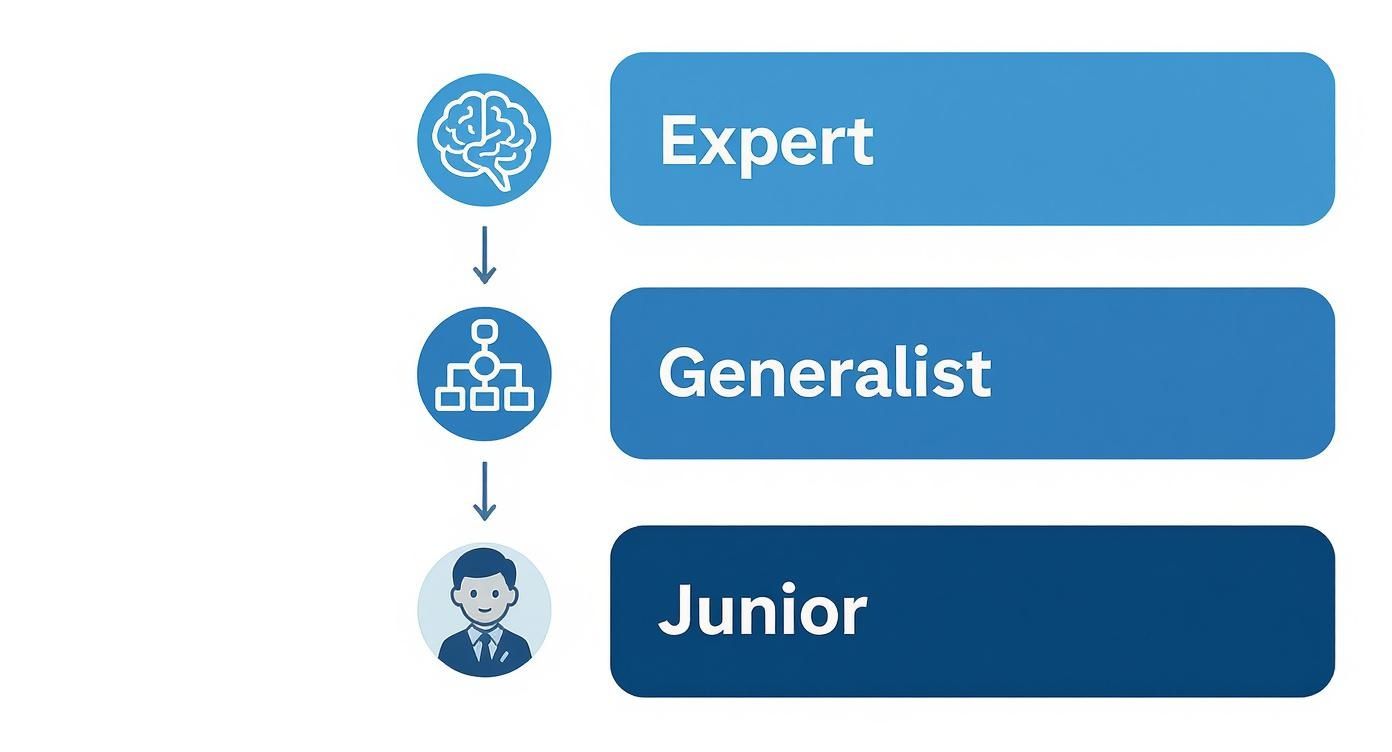
alt text: An infographic illustrating the progression from Junior to Generalist to Subject Matter Expert, with icons representing each stage of knowledge depth.
As you can see, the SME sits at the top of this pyramid. Their value isn’t just in what they know, but in their ability to apply that specialised knowledge to create significant impact.
Of course, knowing something and being able to explain it are two different skills. A key part of an SME’s role is translating complex concepts into clear, actionable advice. Strong communication is non-negotiable. If you’re looking to sharpen this skill, it’s worth exploring how to improve writing skills to better articulate expert insights.
A true expert doesn’t just give you the answers you’re looking for. They ask the right questions—the ones nobody else thought to ask. That foresight is what makes them indispensable.
To really nail down the unique value of an SME, it helps to see how they stack up against other roles you might find on a team.
SME vs Generalist vs Junior: A Practical Comparison
This table breaks down the distinct attributes of a Subject Matter Expert compared to a generalist and a junior team member, highlighting their different contributions to a project.
| Attribute | Subject Matter Expert (SME) | Generalist | Junior Team Member |
|---|---|---|---|
| Knowledge Depth | Profound, specialised, and hands-on in a single domain. | Broad understanding across multiple areas; less depth. | Foundational, theoretical knowledge; lacks experience. |
| Problem-Solving | Solves complex, non-standard problems with innovative solutions. | Handles common issues using established procedures. | Follows step-by-step guidance to resolve basic problems. |
| Strategic Impact | Guides critical decisions, mitigates risk, and drives innovation. | Supports project execution and connects different functions. | Executes assigned tasks and focuses on skill development. |
Each role is vital for a well-rounded team. The junior member handles the groundwork, the generalist keeps the different parts connected, and the SME provides the deep expertise needed to navigate complex challenges and ensure the project succeeds.
The Strategic Value SMEs Bring to a Project
Bringing a Subject Matter Expert onto a project is far more than a quick fix for a knowledge gap; it’s a strategic move that delivers real, measurable returns. Think of an SME as a project accelerator. They have the deep, practical experience to steer the team clear of the common traps and dead ends that can completely derail timelines and blow up budgets.
Their value lies in foresight. Because they’ve been there and done that, they can spot potential problems long before they become full-blown crises. This turns the entire project dynamic from reactive fire-fighting into proactive risk management. With their credible, battle-tested insights, the team can make decisions with confidence, ensuring the final result isn’t just finished, but genuinely accurate, effective, and built to the highest standard.

alt text: A group of professionals collaborate around a conference table. An SME points at a chart, demonstrating their role in guiding a project.
A Real-World Example in Action
Let’s put this into context. Imagine a fintech company is building a new mobile banking app. The development team is brilliant at coding and can build all the requested features. What they likely don’t know are the incredibly complex regulatory hoops they need to jump through for international payment processing.
This is where an SME in financial compliance becomes invaluable. They would spot these risks from day one. They could guide the team to build a secure and compliant system from the ground up, saving them from costly redesigns, legal headaches, and potential fines down the road. The SME’s involvement here could easily save months of work and, just as importantly, protect the company’s reputation.
An SME doesn’t just provide answers; they prevent the team from asking the wrong questions in the first place. Their foresight is the difference between launching on time and facing a crisis.
This kind of expert guidance helps ensure project goals are met efficiently and effectively. But it often goes further. Their deep knowledge can spark innovation, pushing the team to explore solutions they hadn’t even considered. This expertise also has a life beyond the project; many experts find ways to monetise their expertise through a business book or through consulting.
Plus, their presence lifts the entire team. Junior members get a masterclass in the subject, and even seasoned colleagues gain fresh perspectives. This creates a lasting ripple effect of skill development across the whole organisation. For example, an AI specialist can guide a team on the ethical use of AI in the workplace, embedding responsible practices that benefit the company long-term. This mentorship transforms their contribution from a one-off fix into a lasting asset.
What an SME Actually Does on a Project
A Subject Matter Expert isn’t just a walking encyclopedia you consult now and then. Think of them more like a project’s north star, actively guiding the team from start to finish. Their role is hands-on, weaving their expertise into every phase of the work, from the initial brainstorming sessions to the final launch.
Let’s make this real. Imagine an e-commerce company is building a brand-new, super-secure payment system. This is a high-stakes project, so they bring in a cybersecurity SME. Here’s what that expert’s involvement looks like.
Guiding a Project from Kick-off to Go-Live
Right from the get-go, in the planning phase, our SME isn’t just nodding along to ideas. They’re in the driver’s seat, mapping out the entire security architecture. They’ll define the exact protocols needed, flag potential compliance headaches with financial regulations, and establish the non-negotiable technical standards for the final product.
Once the project moves into the development phase, the SME shifts into a translator and guide. They take dense, complex compliance rules and break them down into plain English for the developers. This ensures security isn’t an afterthought but is baked into the code from day one. They might be found reviewing code, suggesting specific encryption tools, and offering on-the-spot feedback to patch up vulnerabilities before they even become a real problem.
An SME is the bridge between the technical nuts and bolts and the bigger business picture. They make sure the final product doesn’t just work—it’s also secure, compliant, and genuinely right for the job.
Finally, as we approach the validation and launch phase, the expert spearheads quality control. They’re the one designing and supervising penetration tests, running through a final checklist to confirm every security requirement is met, and ultimately giving the green light for the system to go live.
The Four Pillars of an SME’s Role
This example really brings to light the core duties that every true subject matter expert performs, no matter their specialism:
- Sharing Deep, Factual Insights: They don’t just give opinions; they provide evidence-based knowledge that shapes smart decisions and keeps the project on the right track.
- Checking and Validating Work: The SME is the quality gatekeeper. They meticulously review deliverables at each stage to ensure they hit the mark for accuracy, quality, and function.
- Mentoring the Team: Great SMEs don’t hoard their knowledge. They actively share it, helping to upskill the entire team and leaving everyone more capable in the process.
- Solving the Toughest Problems: When the team hits a wall with a tricky, unexpected issue, the SME is the go-to person to diagnose the problem and figure out a clever way forward.
This kind of deep involvement is essential in any field where the stakes are high, from agile tech companies to major government agencies. Their influence can even shape national policy. For instance, in 2013 alone, over 60% of the presentations at key National Guard leadership summits were delivered by SMEs. You can read the full report on SME contributions to strategic initiatives to see just how significant their impact is.
How to Identify and Vet a True Expert
Finding a genuine subject matter expert isn’t as simple as a quick search on LinkedIn. You need a solid process to tell the difference between deep, hands-on knowledge and a CV that just looks good on paper. A true expert’s value comes from their proven track record of solving real-world problems, not just talking a good game.
The first step is to look past the job titles and hunt for concrete proof. Don’t be dazzled by a fancy title; instead, look for a portfolio of successfully delivered projects similar to what you’re working on. Have they published articles, spoken at industry events, or contributed to well-regarded open-source projects? These are all signs of someone who is truly immersed in their field.
alt text: A magnifying glass focuses on the skills and experience section of a resume, symbolizing the process of vetting an expert.
A Practical Vetting Process
Once you’ve got a shortlist, the interview is your chance to separate the real experts from the pretenders. Here’s a step-by-step process to get straight to their problem-solving mindset.
- Define Your Need: Before you search, write a one-page brief detailing the specific problem you need to solve, the expertise required (e.g., “experience with GDPR compliance for SaaS”), and the expected outcome. This clarity prevents you from hiring someone with the wrong specialty.
- Dig into Their Portfolio: Pick a project they’ve listed and ask them to talk you through it. Go deep. Ask about the specific roadblocks they hit and, more importantly, what mistakes they made and what they learned. A real expert isn’t shy about discussing failures; they see them as learning opportunities.
- Give Them a Real-World Problem: Present a hypothetical but realistic challenge your team is grappling with. For instance: “Our new AI model is producing biased results for a certain demographic. What would be your first three steps to figure out why and fix it?” This shows you how they think on their feet.
- Ask for an Analogy: One of the clearest signs of deep understanding is the ability to explain something complex in simple terms. Ask them to break down a core concept in their field as if they were explaining it to a brand-new intern. A clear explanation demonstrates true mastery.
A candidate who can only recite textbook definitions has knowledge. An expert can turn that knowledge into a solution. Their ability to simplify complexity without losing the important details is the real litmus test.
This approach helps you find someone who not only has the technical skills but also the communication and critical thinking abilities your project demands. For anyone aspiring to become an expert themselves, particularly in a field like AI, it’s helpful to understand the landscape. Our guide on careers in artificial intelligence is a great place to start exploring the different roles and skills required.
Maximising Your Collaboration with an SME
So, you’ve found your Subject Matter Expert. That’s a huge win, but the work doesn’t stop there. Now, the real goal is to build a partnership that gets the absolute most out of their knowledge. This isn’t just about firing off questions whenever they pop into your head; it’s about creating a smart, structured process that respects their time and weaves their insights directly into the fabric of your project.
The first step? Set crystal-clear expectations from day one. An SME who knows exactly what’s expected of them—what they need to deliver, when, and how you’ll communicate—can give you focused, powerful contributions. This simple act helps you avoid scope creep and makes sure their brainpower is aimed at the right problems.

alt text: A diverse team collaborates around a whiteboard in a modern office, showing an SME actively involved in a project discussion.
A Practical Checklist for Productive SME Meetings
To make every minute with your SME count, you need to do your homework. A well-planned meeting isn’t just professional; it shows you value their time and gets you much better answers.
- Share an Agenda and Goals: Always send a clear agenda at least 24 hours beforehand. Be specific about the problems you’re trying to solve.
- Provide Context: Give them everything they need to get up to speed. This means sharing links to relevant documents, designs, or data so they can come prepared with real solutions, not just off-the-cuff thoughts.
- Frame Open-Ended Questions: The quality of your questions dictates the quality of their answers. Instead of asking “Is this correct?”, try something like, “What potential risks or blind spots do you see with this approach?”. This prompts them to think strategically.
- Define Next Steps: Never leave a meeting without a clear path forward. Summarise the key decisions and agree on who is doing what by when. This ensures their advice actually turns into action.
Bringing an SME on board is also a brilliant way to tackle skills gaps, which are a real headache in many technical fields. For instance, a recent survey found that 18% of small and medium-sized enterprises struggled with a shortage of IT experts. While this data isn’t specific to NG, it mirrors a global trend where deep expertise is a scarce resource. You can discover more about the research on skills shortages on europa.eu.
An SME who feels like a valued partner will offer proactive insights, not just reactive answers. Your goal is to foster an environment where they are empowered to challenge assumptions and guide strategy.
When you treat an SME like a core part of the team instead of an external resource, you build the kind of collaborative relationship that delivers fantastic results. This approach is especially vital in complex areas like tech governance. For example, our article on ethical AI in daily decisions dives into why expert guidance is non-negotiable for innovating responsibly.
Common Questions About Subject Matter Experts
Even when everyone agrees on how valuable a subject matter expert is, a few practical questions always seem to pop up. Let’s get straight to the point with some quick answers to the things teams usually ask.
How Much Should We Pay an SME?
There’s no single answer here, as an SME’s pay can swing wildly depending on their field, how many years they’ve been in the game, and just how tricky your project is. For instance, a freelance cybersecurity expert helping build a new fintech app is going to charge a lot more than a marketing SME advising a local shop.
A good starting point is to check out what similar experts are charging on platforms like Upwork or Toptal. But don’t just look at the rates; think about the value they deliver. The cost of hiring a top expert is often tiny compared to the cost of a major project failure they could help you avoid. It’s always best to negotiate based on the entire scope of the project, not just a simple hourly figure.
What Is the Difference Between a Consultant and an SME?
People often use these terms as if they mean the same thing, but there’s a real difference in practice. A consultant usually zeroes in on strategy and making processes better—they tell you how to do something more effectively. An SME, on the other hand, brings incredibly deep, specific knowledge about the what.
Practical Example: You’d bring in a management consultant to help you restructure your team’s entire workflow. But you’d hire a data science SME to look at the specific algorithm that workflow depends on and tell you if it’s sound.
Simply put, an SME tends to get their hands dirty with the technical details of a project, while a consultant typically works from a broader, more strategic viewpoint.
Can an Internal Employee Be an SME?
Yes, and you absolutely should! Your own employees can be your best SMEs. They don’t just have the expert knowledge you need; they already get your company’s culture, internal processes, and what you’re trying to achieve.
The trick is to make their role official. If you’re asking an employee to step up as the go-to expert, you have to adjust their regular workload to make space for it. This gives them the breathing room to provide thoughtful, high-quality guidance without getting completely overwhelmed. As businesses adopt more complex technologies, relying on these internal experts becomes crucial, a trend we’re seeing everywhere, especially in fields like artificial intelligence.
Actionable Takeaways
- Define Your Need First: Before searching for an SME, write a clear, one-page brief on the specific problem you need solved. This focuses your search and vetting process.
- Vet for Problem-Solving, Not Just Knowledge: During interviews, present a real-world problem your team faces. How they approach it is more telling than their resume.
- Prepare for Every Interaction: Create and share an agenda before every meeting with your SME. This respects their time and ensures you get actionable advice.
- Empower Internal Experts: Identify potential SMEs within your own team and formally give them the time and authority to contribute their expertise.
- Focus on Value, Not Just Cost: When hiring an external SME, weigh their fee against the potential cost of project delays, mistakes, or compliance issues they can help you prevent.
Tools & Resources
- Freelance Platforms: Find and hire external SMEs on sites like Upwork and Toptal.
- Project Management Tools: Use tools like Asana or Trello to create dedicated boards for SME collaboration, assign tasks for review, and track their feedback.
- Knowledge Base Software: Use Confluence or Notion to document SME insights, creating a lasting resource for the entire organization.
Further Reading
- Ethical Use of AI in the Workplace – Learn how SMEs guide responsible innovation.
- Careers in Artificial Intelligence – Explore the paths to becoming an SME in tech.
- SME Contributions to Strategic Initiatives (PDF Report) – A government report showing the high-level impact of SMEs.
- Research on Skills Shortages (Europa.eu) – Data on the growing demand for specialized expertise.
