
In 2026, the cybersecurity landscape is defined by speed and scale. Adversaries now deploy artificial intelligence to orchestrate sophisticated, automated attacks, making legacy, signature-based security measures dangerously slow and ineffective. To counter these threats, security teams must integrate AI-powered tools capable of analyzing massive data streams in real time, anticipating attacker movements, and automating responses before an alert escalates into a catastrophic breach.
AI-driven attacks are evolving faster than traditional defenses. Techniques such as automated phishing, AI-assisted vulnerability exploitation, and adaptive attack sequences have rendered static, rule-based security approaches insufficient for modern threat environments.
This shift is already evident at the highest levels of cyber defense. As reported by Axios, U.S. national laboratories — including the Pacific Northwest National Laboratory — are now using AI-driven tools such as the “Aloha” platform to simulate complex cyberattacks, allowing defenders to validate, stress-test, and accelerate defensive strategies proactively. This evolution underscores a critical reality: artificial intelligence is no longer a “nice-to-have,” but a foundational component of any modern security stack.
This guide is designed for CISOs, security architects, SOC leaders, and technical decision-makers navigating this transition. It provides a practical, analyst-led examination of the top AI tools for cyber defense in 2026, moving beyond marketing claims to deliver actionable insights that help organizations select the right platforms for their specific security challenges.
Inside, you will find a detailed breakdown of 12 leading solutions, ranging from CrowdStrike’s Falcon platform to Cisco’s Hypershield. While these tools often overlap in capability, they are most effective when deployed as part of a layered, defense-in-depth strategy rather than as standalone solutions.
For each platform, we examine:
Core Capabilities: The platform’s primary security function, such as EDR, XDR, SIEM, or SOAR.
Actionable Use Cases: Practical scenarios demonstrating real-world application.
Strengths and Limitations: A balanced assessment of where each tool excels and where trade-offs exist.
Implementation and Integrations: Key considerations for deployment and ecosystem compatibility.
Each entry includes screenshots and direct links, providing a clear, practical resource to help you evaluate, implement, and maximize the value of AI-driven security within your organization.
How We Selected These Tools
To ensure this analysis reflects real-world effectiveness rather than vendor hype, the tools featured in this article were selected based on the following criteria:
- Demonstrated use of AI or machine learning for threat detection and response.
- Ability to operate in real time or near real time.
- Coverage across modern attack surfaces, including endpoint, cloud, network, and identity.
- Integration with existing security stacks such as SIEM, SOAR, and cloud platforms.
- Adoption by enterprises, security teams, or regulated industries.
These criteria reflect the broader shift in cybersecurity toward real-time, adaptive defense built on machine learning and behavioral analytics. The goal is not to crown a single “best” tool, but to help readers understand which solutions are best suited for specific operational, architectural, and risk requirements.
1. CrowdStrike – Falcon Platform
Primary Focus: Endpoint Detection and Response (EDR/XDR).
CrowdStrike Falcon remains one of the most mature AI‑powered endpoint security platforms. It uses behavioral analytics and machine learning models to identify malicious activity without relying on known signatures.
Its core strength lies in its AI-powered threat graph, which analyzes trillions of real-time events to predict and stop sophisticated attacks before they execute. This makes it one of the top AI tools for cyber defense in 2026 for organizations seeking proactive, unified security.
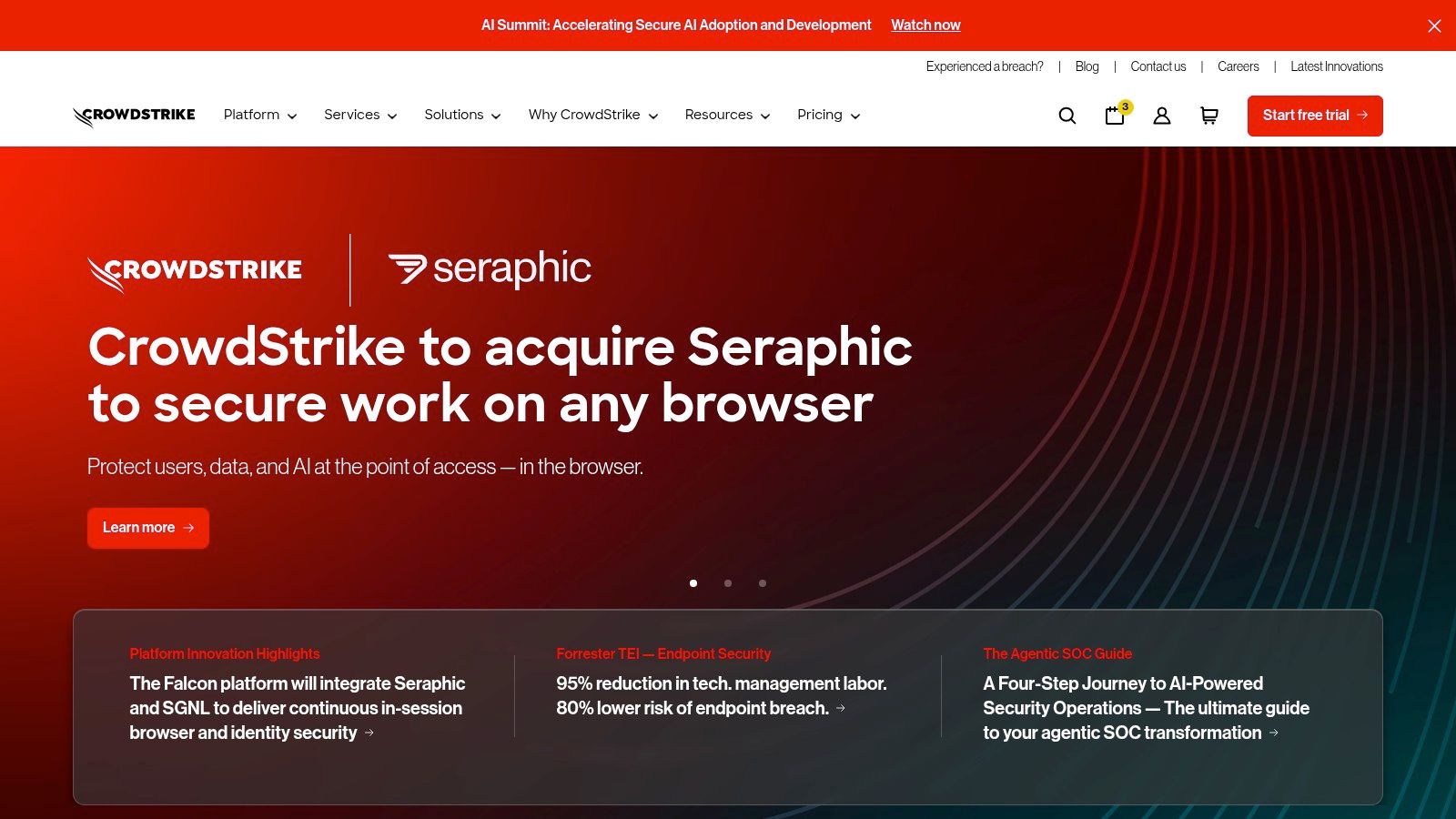
Alt text: CrowdStrike Falcon Platform’s unified console showcasing threat detection capabilities.
Unlike traditional solutions that rely heavily on signature-based detection, Falcon focuses on Indicators of Attack (IOAs), using machine learning to identify malicious behavior patterns. This approach is highly effective against zero-day exploits and fileless malware. The platform’s lightweight, single agent simplifies deployment across Windows, macOS, and Linux environments without impacting system performance, a significant advantage over competitors with bloated client software.
Key Strengths:
- Strong behavioral detection for unknown threats.
- Lightweight agent with minimal performance impact.
- Scales well for large enterprises.
- Falcon’s AI threat graph correlates endpoint, network, and identity signals to identify subtle attack patterns before execution.
Limitations:
- Premium pricing may be prohibitive for smaller teams.
- Most effective when fully integrated across the Falcon ecosystem.
Best For: Medium to large enterprises seeking advanced endpoint and XDR capabilities.
Key Features & Use Case
A key differentiator is CrowdStrike’s accessibility and transparent pricing. Teams can start a 15-day free trial and purchase licenses directly from the website on a per-device model, which is uncommon in the enterprise security space. This self-service approach empowers even small IT teams to deploy enterprise-grade EDR quickly.
- Practical Example: A mid-sized e-commerce company experiences a surge in attempted ransomware attacks. By deploying Falcon Complete (its MDR service), their security team offloads threat hunting and remediation to CrowdStrike’s experts. When a novel fileless malware variant bypasses traditional antivirus, Falcon’s AI model detects the malicious script execution in memory, isolates the affected endpoint automatically, and provides a full attack narrative within minutes, preventing data encryption and lateral movement.
Implementation and Strategy
For effective implementation, start by deploying the Falcon agent to a pilot group of critical assets to fine-tune detection policies. Leverage the platform’s extensive API to integrate threat intelligence feeds directly into your existing SIEM or SOAR tools for a unified security posture. By understanding these integration points, you can fully leverage the platform as part of a cohesive defense strategy.
- Actionable Takeaways:
- Start with a Pilot: Deploy the Falcon agent on a small, controlled group of endpoints to test policies before a full rollout.
- Integrate with SIEM/SOAR: Use the API to connect Falcon’s threat data with your central security dashboard for unified visibility.
- Evaluate Falcon Complete: If your team is lean, consider the MDR service to offload 24/7 threat hunting and response.
- Review IOA Detections: Train your team to understand Indicator of Attack (IOA) alerts, which focus on behavior rather than just signatures.
| Feature | Description | Target User |
|---|---|---|
| AI-Powered NGAV & EDR | Uses machine learning to detect and block malware and fileless attacks based on behavioral patterns. | SMB to Enterprise |
| Managed Threat Hunting | Offers 24/7 expert monitoring and threat hunting through the Falcon Complete (MDR) add-on. | Mid-Market & Enterprise |
| Identity Protection | Actively monitors identity-based threats and detects risky sign-ins and lateral movement in real time. | Enterprise |
| Transparent Pricing | Provides clear per-device pricing and an online checkout process for rapid acquisition and deployment. | SMB & Mid-Market |
Pros & Cons
- Pros:
- Fast Deployment: A single, lightweight agent deploys in minutes across diverse operating systems.
- Transparent Pricing: Offers clear per-endpoint pricing and online checkout, removing sales friction.
- Industry Recognition: Consistently ranked as a leader by Gartner and excels in MITRE ATT&CK evaluations.
- Cons:
- Cost at Scale: Per-device pricing can become expensive for organizations with very large numbers of endpoints.
- Modular Cost: Advanced features like identity protection and managed threat hunting are separate, costly add-ons.
Tools & Resources
- Website: https://www.crowdstrike.com
- Further Reading: For a deeper dive into integrating such tools, you can review some AI cyber defense best practices.
2. SentinelOne – Singularity Platform
Primary Focus: Autonomous endpoint protection.
SentinelOne emphasizes AI‑driven automation, enabling systems to detect, isolate, and remediate threats with minimal human intervention.
SentinelOne’s Singularity Platform offers an autonomous approach to endpoint, cloud, and identity security, making it a leading choice among the top AI tools for cyber defense in 2026. Its core advantage is its patented Storyline technology, which uses AI to contextualize all system events in real-time. This creates a full narrative of an attack, enabling fully automated detection, investigation, and even rollback remediation without human intervention.
Unlike solutions requiring constant cloud connectivity for analysis, SentinelOne’s AI models operate directly on the endpoint. This ensures real-time prevention and response capabilities even if the device is offline. The platform’s single-agent, single-codebase architecture simplifies management across Windows, macOS, Linux, and cloud workloads, offering a powerful, unified defense against sophisticated cyber threats.
Key Strengths:
- Autonomous response capabilities.
- Strong ransomware detection and rollback features.
- Clear incident timelines.
Limitations:
- Advanced features may require higher‑tier plans.
- Some advanced automation features may require experienced tuning for cloud-native workloads.
Best For: Security teams prioritizing rapid containment and automated response.
Key Features & Use Case
A key differentiator for SentinelOne is its transparent, tiered packaging and pricing for many of its products, which is accessible directly on its website. This empowers organizations, especially SMBs and mid-market companies, to evaluate and acquire advanced XDR capabilities with less friction than traditional enterprise sales cycles. The platform’s multi-tenant design also makes it a favorite for MSPs and MSSPs.
- Practical Example: A managed service provider (MSP) uses the Singularity platform to protect its diverse client base. When a novel malware strain is introduced via a phishing email at one client’s office, the on-agent AI immediately detects the malicious process execution. The platform autonomously kills the process, quarantines the file, and rolls back the system to its pre-attack state, all within seconds. The MSP receives a complete Storyline alert, detailing the attack’s origin and impact, allowing them to report the resolution to their client without needing to perform manual forensics.
Implementation and Strategy
For an effective rollout, deploy the SentinelOne agent in “Detect-Only” mode on a pilot group of non-critical endpoints. This allows you to observe the AI’s detection patterns and fine-tune policies without disrupting business operations. Once configured, switch to “Protect” mode for active prevention and remediation. Leverage the platform’s extensive API library to integrate alerts and response actions into your existing SOAR or SIEM for centralized visibility.
- Actionable Takeaways:
- Use Detect-Only Mode First: Deploy on a pilot group in a non-blocking mode to safely observe AI detections and tune policies.
- Automate with APIs: Integrate with your SOAR or ticketing system to automate incident creation and response workflows.
- Test the Rollback Feature: On a non-production machine, test the one-click remediation and rollback feature to understand its capabilities before you need it.
- Leverage Storyline: Train analysts to use the Storyline feature to quickly understand the full context of an attack without manual log correlation.
| Feature | Description | Target User |
|---|---|---|
| Autonomous EDR & EPP | On-agent AI provides real-time, autonomous prevention, detection, and one-click remediation or rollback. | SMB to Enterprise |
| Automated Investigation | Storyline technology automatically contextualizes threat data, reducing alert fatigue and investigation time. | Mid-Market & Enterprise |
| Identity Threat Detection | Offers modules to protect Active Directory and detect real-time identity-based threats and privilege escalation. | Enterprise |
| Published Package Tiers | Provides clear feature tiers (Core, Control, Complete) with publicly listed pricing examples for many SKUs. | SMB & Mid-Market |
Pros & Cons
- Pros:
- Autonomous Remediation: Capable of fully automated threat response, including system rollback, without human intervention.
- Clear Product Tiers: Published package pricing for SMB and mid-market tiers simplifies the procurement process.
- Broad Integrations: Offers a robust ecosystem marketplace for seamless integration with other security tools.
- Cons:
- Enterprise Pricing: Custom pricing for enterprise-level tiers requires direct sales contact.
- Contractual Variations: The final price can vary depending on the contract term and sales channel used for purchase.
Tools & Resources
- Website: https://www.sentinelone.com
3. Palo Alto Networks – Cortex (XDR / XSIAM)
Primary Focus: Extended detection and response (XDR).
Cortex XDR correlates data across endpoints, networks, and cloud environments, using AI models to identify attack patterns across multiple vectors.
Palo Alto Networks’ Cortex platform solidifies its position as a cornerstone of enterprise security operations by unifying data, analytics, and automation. Its evolution into Cortex XSIAM (Extended Security Intelligence and Automation Management) creates a SOC-focused platform that leverages AI to ingest vast amounts of data and streamline threat response. By embedding AI copilots across its entire portfolio, Cortex makes a compelling case as one of the top AI tools for cyber defense in 2026 for organizations needing a deeply integrated, enterprise-wide security fabric.
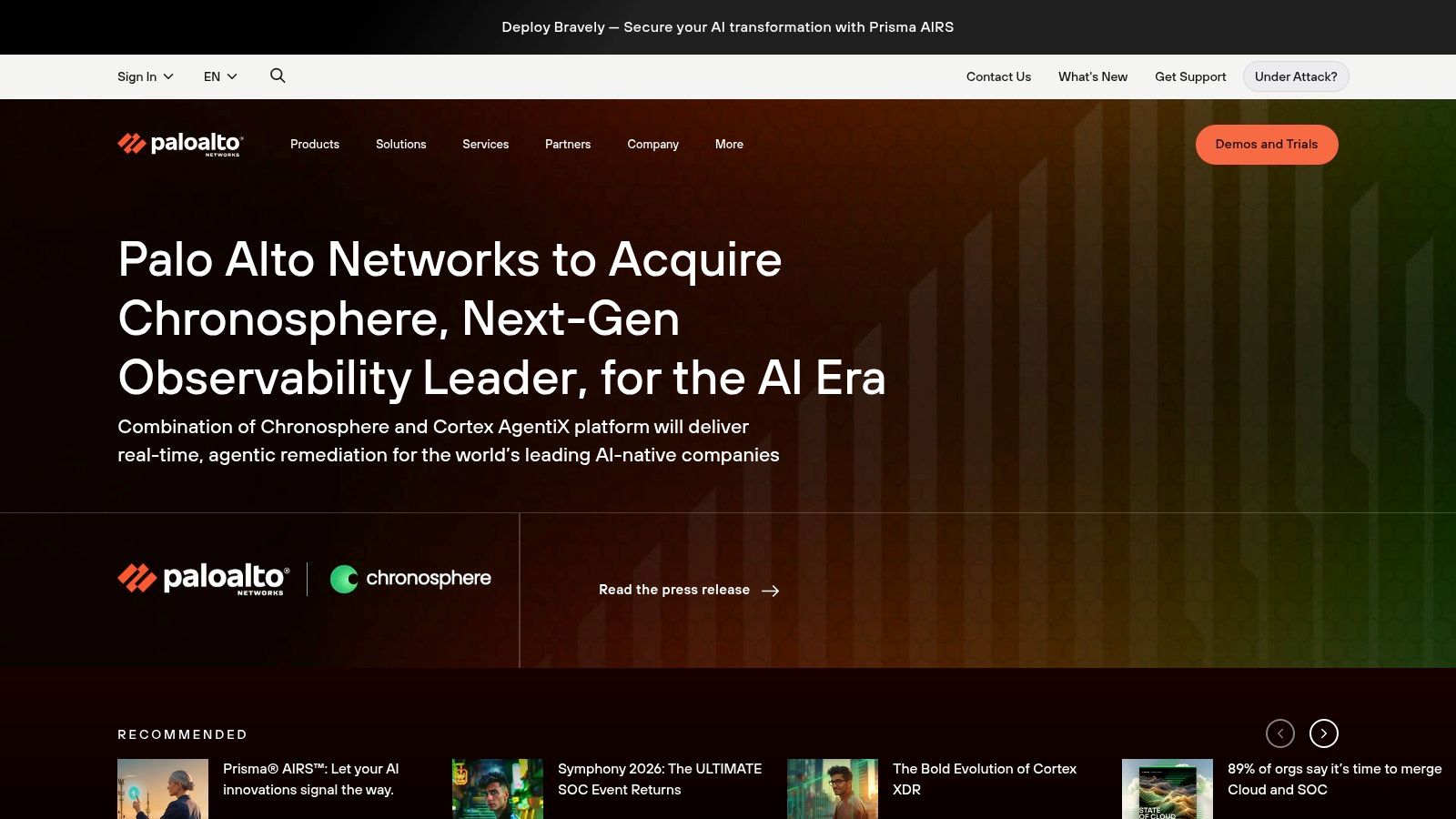
Alt text: Palo Alto Networks’ Cortex XSIAM dashboard displaying unified security analytics.
Unlike point solutions, Cortex XSIAM is designed to replace legacy SIEM tools by providing a data-centric foundation for security operations. The platform’s key innovation is the Cortex Copilot, a natural-language assistant that helps analysts investigate incidents, triage alerts, and execute response actions faster. This integration of AI assistance directly into network (Strata), cloud (Prisma), and SecOps (Cortex) workflows significantly reduces analyst toil and accelerates response times.
Key Strengths:
- Strong correlation across diverse data sources.
- Deep integration with Palo Alto’s security ecosystem.
Limitations:
- Best results achieved when using Palo Alto products.
Best For: Enterprises with multi‑layered security architectures.
Key Features & Use Case
A significant advantage is the platform’s extensive library of pre-built integrations and automated playbooks, allowing security teams to orchestrate complex response actions across disparate security tools. While pricing requires direct sales engagement, the company provides extensive buyer toolkits and resources on its website to help teams evaluate the complex portfolio.
Cortex XDR unifies endpoint, network, and cloud telemetry to detect complex threats spanning multiple attack surfaces.
- Practical Example: A large financial institution’s SOC is overwhelmed by alerts from its cloud and on-premise infrastructure. After migrating to Cortex XSIAM, an analyst uses the Cortex Copilot to investigate a suspicious alert. They type, “Show me all network connections from this user’s device to unusual geolocations in the last 24 hours.” The copilot instantly provides the data and suggests a playbook to isolate the endpoint and block the malicious IPs on the network firewall, which the analyst executes with a single click.
Implementation and Strategy
Effective implementation begins with identifying key data sources to integrate into the Cortex Data Lake. Start with high-priority logs from endpoints, firewalls, and critical cloud applications to build a solid analytics foundation. Leverage the pre-built playbooks to automate common response tasks, such as phishing incident remediation or malware containment, freeing up analyst time for more strategic threat hunting.
- Actionable Takeaways:
- Prioritize Data Sources: Start by ingesting logs from your most critical assets (e.g., domain controllers, key servers) into the Cortex Data Lake.
- Automate Common Tasks: Identify your top 3 most frequent, repetitive alerts (e.g., phishing reports) and automate their handling using pre-built playbooks.
- Train with Copilot: Encourage junior analysts to use the Cortex Copilot to learn query-building and investigation techniques.
- Map to Your Stack: If you already use Palo Alto Networks firewalls or cloud security, prioritize those native integrations for maximum visibility.
| Feature | Description | Target User |
|---|---|---|
| Cortex Copilot | AI-powered assistant for natural-language investigation, triage, and response across the portfolio. | SecOps Analysts |
| XSIAM Platform | An AI-driven data platform that unifies security analytics, automation, and response to replace SIEMs. | Mid-Market & Enterprise |
| Integrated Portfolio | Native integration across network (Strata), cloud (Prisma), and SecOps (Cortex) for unified visibility. | Enterprise |
| Extensive Playbook Library | Provides a large collection of pre-built automation playbooks and deep integrations with third-party tools. | SecOps Teams |
Pros & Cons
- Pros:
- Broad Portfolio: Offers a comprehensive, integrated security platform spanning network, cloud, and SOC.
- Embedded AI Copilots: Reduces analyst workload and speeds up incident response with natural-language assistance.
- Extensive Resources: Provides detailed content and buyer guides to help with evaluation and decision-making.
- Cons:
- Complex Portfolio: The breadth of products can make evaluation and initial deployment time-consuming.
- Opaque Pricing: Lacks public pricing, requiring direct engagement with the sales team for quotes.
Tools & Resources
- Website: https://www.paloaltonetworks.com
- Further Reading: You can find more discussions on these topics within resources covering security and privacy.
4. Microsoft – Security Copilot + Defender Suite
Primary Focus: Endpoint, identity, and cloud security.
Microsoft Defender leverages AI across endpoints, email, identity, and cloud workloads, particularly within Microsoft‑centric environments.
Security Copilot augments Defender by automatically triaging alerts, prioritizing high-impact incidents, and helping analysts respond faster.
Microsoft has deeply integrated generative AI into its security ecosystem with Security Copilot, a powerful assistant layered across its comprehensive Defender suite. This combination transforms the Security Operations Center (SOC) by using AI to summarize incidents, analyze impact, and provide guided response actions. Backed by Microsoft’s massive telemetry of trillions of daily signals, it offers unparalleled context, making it one of the top AI tools for cyber defense in 2026 for organizations embedded in the Microsoft 365 and Azure cloud environments.
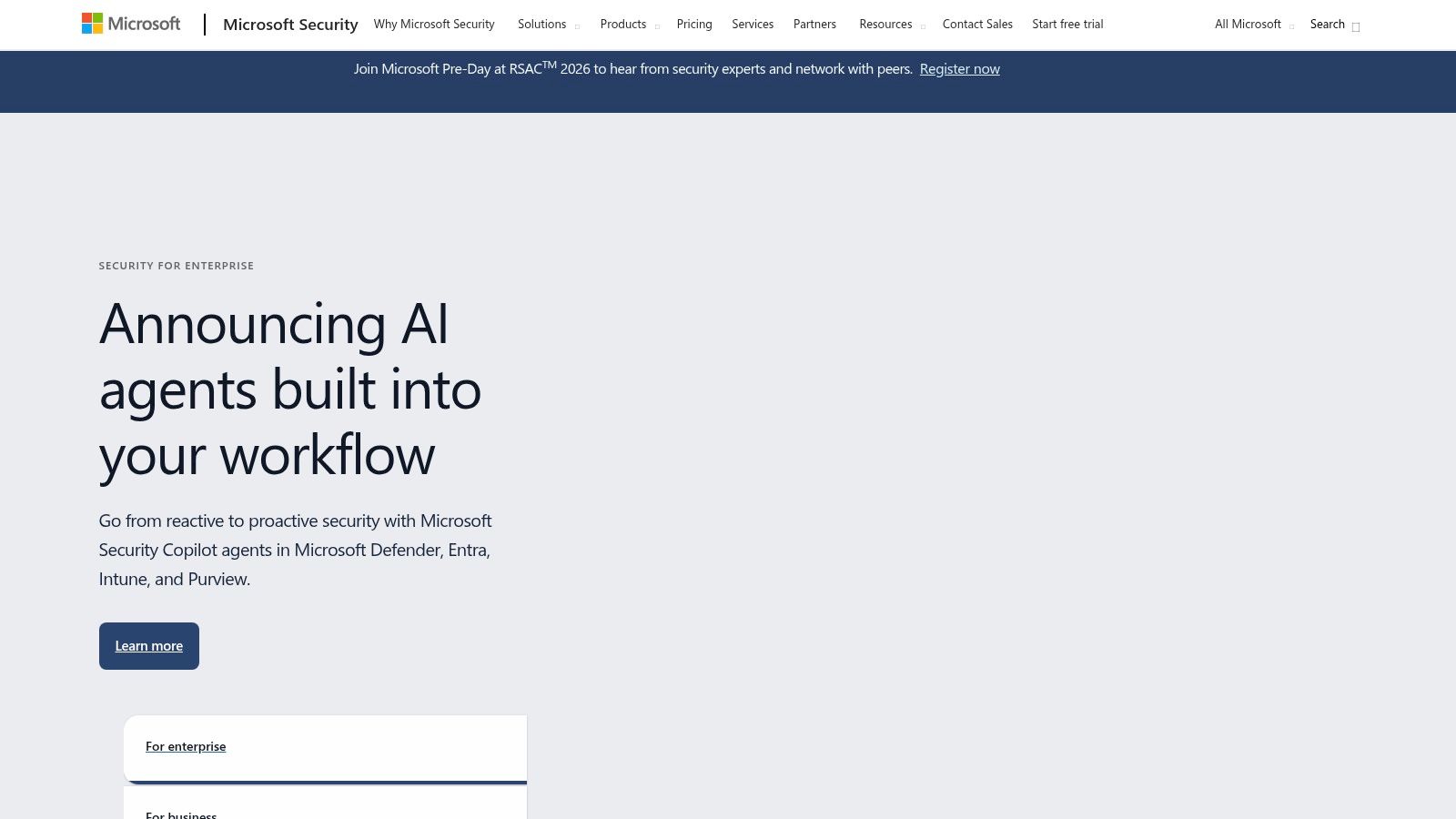
Alt text: Microsoft Security Copilot interface displaying an AI-generated incident summary and response plan.
Unlike standalone security platforms, Security Copilot’s strength is its native integration with Defender, Entra, Intune, and Purview. This allows it to correlate data across endpoints, identities, emails, and applications to provide a holistic view of an attack chain. Instead of analysts manually piecing together alerts from disparate systems, they can ask the AI assistant in natural language to investigate a user or script, drastically reducing investigation time.
Key Strengths:
- Native integration with Microsoft 365 and Azure.
- Centralized security visibility.
Limitations:
- Less flexible outside Microsoft ecosystems.
Best For: Organizations heavily invested in Microsoft infrastructure.
Key Features & Use Case
A significant differentiator is its flexible consumption model through Security Compute Units (SCUs), allowing organizations to pay for what they use. This is a departure from the rigid per-user or per-device licensing common in the industry, although it requires careful cost management. Bundled Defender suites also offer clear pathways for both SMBs and large enterprises to adopt these capabilities.
- Practical Example: A large financial institution’s SOC team is alerted to a multi-stage attack. Instead of manually correlating logs, the analyst asks Security Copilot, “Summarize the incident involving user ‘jsmith’ and provide a response plan.” The AI instantly generates a timeline showing initial phishing email compromise (Defender for Office 365), credential theft (Entra ID Protection), and lateral movement to a server (Defender for Endpoint), along with step-by-step remediation guidance.
Implementation and Strategy
For successful implementation, start by identifying key SOC workflows like incident triage and threat hunting that can benefit most from AI assistance. Integrate Security Copilot with your primary incident response playbooks to streamline analyst actions. It’s also crucial to monitor SCU consumption closely in the initial months to establish a predictable budget.
- Actionable Takeaways:
- Identify Key Workflows: Start by using Security Copilot for your most time-consuming tasks, like initial incident triage and summarization.
- Monitor SCU Consumption: Set up budget alerts for your Security Compute Unit (SCU) usage to avoid unexpected costs.
- Enable Full Suite Integration: Ensure Security Copilot is connected to all relevant Microsoft tools (Defender, Entra, Purview) for the most complete context.
- Create Prompt Templates: Develop a library of standard, effective prompts for your team to use for common investigation scenarios (e.g., “Investigate user [username] for suspicious sign-ins over the last 7 days”).
| Feature | Description | Target User |
|---|---|---|
| Generative AI Assistant | Provides natural language incident summarization, impact analysis, and guided response across the stack. | SOC Analysts & Engineers |
| Massive Telemetry Backing | Leverages tens of trillions of daily signals from Microsoft’s global infrastructure for threat intelligence. | Mid-Market & Enterprise |
| Deep Ecosystem Integration | Natively connects with Defender, Entra, Intune, and Purview for unified security visibility. | Enterprise |
| Flexible Consumption Model | Offered via consumption-based Security Compute Units (SCUs) and various bundled suite licenses. | SMB to Enterprise |
Pros & Cons
- Pros:
- Deep Integration: Unmatched synergy for organizations heavily invested in the Microsoft 365/Azure ecosystem.
- Multiple Bundles: Licensing options tailored for different customer sizes, from SMBs to large enterprises.
- Robust Partner Ecosystem: Extensive marketplace for third-party integrations and managed security services.
- Cons:
- Consumption Billing: The SCU model can lead to unpredictable costs if not governed carefully.
- Ecosystem Lock-In: The best value is realized when committed to the broader Microsoft security and cloud stack.
Tools & Resources
- Website: https://www.microsoft.com/security
- Further Reading: Understanding these emerging AI trends is critical for building a future-proof security posture. You can learn more by reviewing some of the latest AI trend predictions.
5. Google Cloud – Chronicle (Google Security Operations)
Primary Focus: Cloud-scale SIEM and threat analytics.
Google Cloud Chronicle, now part of Google Security Operations, is designed to address one of the biggest challenges in modern cybersecurity: processing and analyzing massive volumes of security telemetry in real time. Built on Google’s cloud infrastructure, Chronicle uses AI and machine learning to correlate signals across endpoints, networks, and cloud environments at global scale.
Chronicle leverages Google’s global cloud scale to process massive security logs without performance trade-offs.
Google Cloud’s Chronicle Security Operations is a modern, cloud-native platform that merges Security Information and Event Management (SIEM) with Security Orchestration, Automation, and Response (SOAR). Its standout feature is the deep integration of Gemini, Google’s generative AI, which transforms how security analysts investigate threats. This makes it one of the top AI tools for cyber defense in 2026 for teams looking to accelerate investigation and response using natural language.
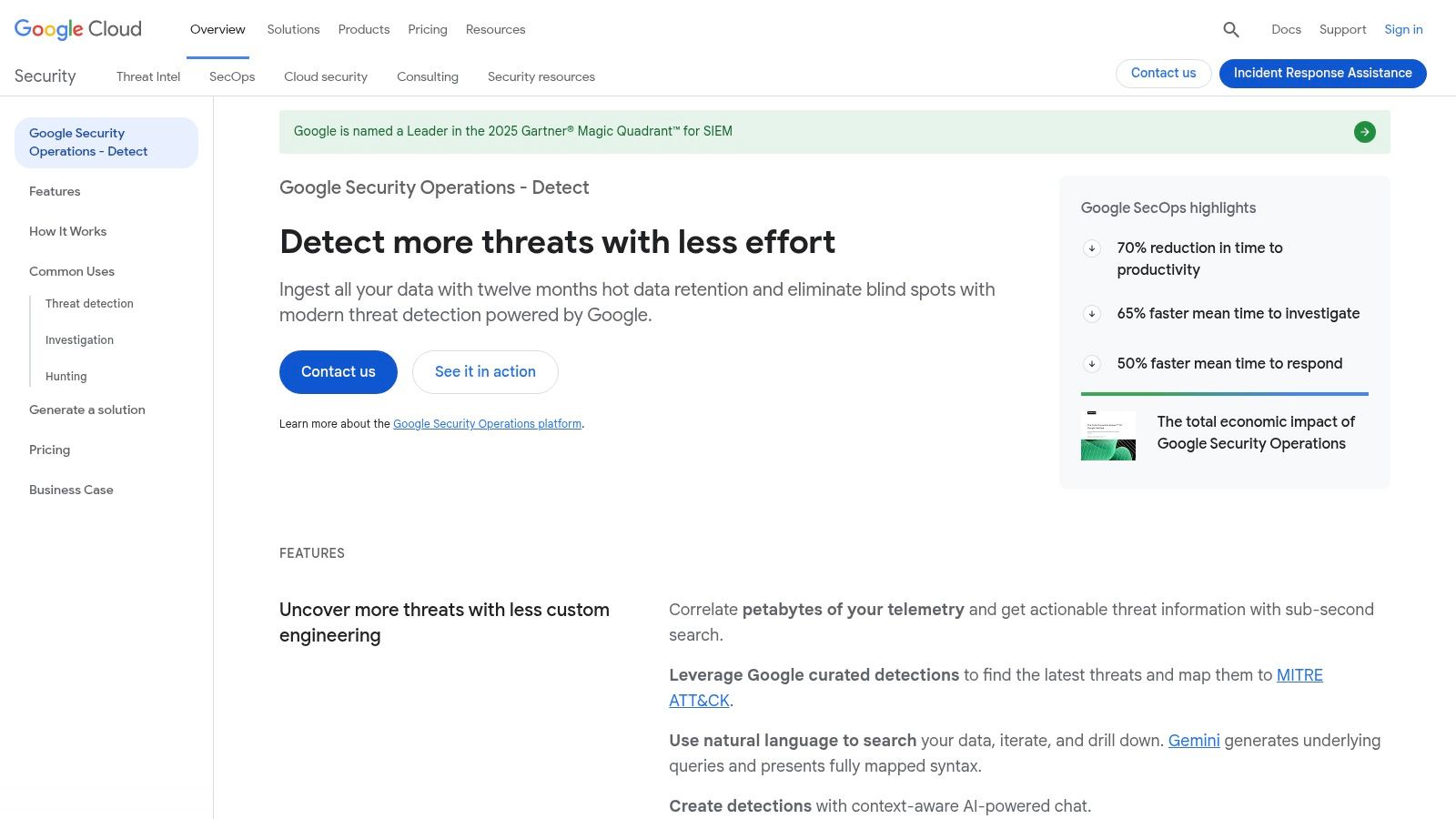
Alt text: Google Cloud’s Chronicle interface showing AI-powered security insights and threat timelines.
Unlike traditional SIEMs that struggle with data retention costs and complex query languages, Chronicle is built on Google’s planetary-scale infrastructure. It offers a default one-year hot data retention period, allowing teams to hunt for historical threats without performance degradation. The addition of Gemini allows analysts to ask questions in plain English, summarize complex incidents, and even auto-generate detection rules, drastically lowering the barrier to entry for junior analysts.
Key Strengths:
- Massive data ingestion and long-term log retention at low latency.
- AI-driven threat correlation and behavioral analytics.
- Strong integration with Google Cloud, Mandiant intelligence, and third-party security tools.
- Ideal for detecting advanced, low-and-slow attacks across distributed environments.
Limitations:
- Best suited for cloud-native or hybrid-cloud organizations.
- May require experienced security teams to fully leverage advanced analytics.
Best For: Large enterprises and cloud-first organizations that need high-scale security analytics and centralized visibility across complex environments.
Key Features & Use Case
A key differentiator is how Chronicle bundles value. Standard packages include the one-year data retention and Google-scale ingestion, while higher tiers add curated threat intelligence and detection rules directly from Mandiant. This integrated approach simplifies procurement and provides immediate access to elite threat research, helping teams stay ahead of emerging attack techniques.
- Practical Example: A financial services firm is investigating a potential insider threat. Instead of writing complex UDM queries, a junior analyst asks Chronicle’s AI assistant, “Show all data exfiltration activities by user ‘j.doe’ to personal cloud storage sites in the last 90 days.” Gemini instantly translates this into a formal query, executes it, and presents a summarized timeline of events, including file names and volumes. This reduces the investigation time from hours to minutes, allowing for rapid containment.
Implementation and Strategy
To effectively implement Chronicle, start by leveraging the free credits and proof-of-concept programs to test ingestion from your critical log sources like EDR, cloud providers, and identity systems. Use Gemini to help build initial detection rules based on your organization’s specific threat model. Integrate its SOAR capabilities with your existing ticketing and communication tools to automate response playbooks for common alerts like phishing or malware detection.
- Actionable Takeaways:
- Leverage 1-Year Retention: Plan historical threat hunts for past quarters, knowing you have fast access to a year of data.
- Use Gemini for Rule Creation: Describe a threat scenario in plain English (e.g., “A user downloads a large file then uploads it to an external site”) and ask Gemini to generate a detection rule.
- Ingest Mandiant Feeds: If your tier includes it, enable Mandiant’s threat intelligence feeds to get immediate, high-quality detections.
- Automate Phishing Response: Use the integrated SOAR to build a playbook that automatically analyzes suspicious emails and blocks malicious links.
| Feature | Description | Target User |
|---|---|---|
| Gemini in Security Ops | Generative AI assistant for natural language investigation, incident summarization, and detection writing. | All Security Teams |
| Unified SIEM & SOAR | Combines data analytics, threat detection, and automated response in a single cloud-native platform. | Mid-Market & Enterprise |
| Mandiant Threat Intel | Integrates elite, up-to-date threat intelligence and curated detection rules directly into the platform. | Enterprise |
| 1-Year Hot Data Retention | Includes 365 days of fast, searchable data retention by default, enabling deep historical threat hunting. | All Security Teams |
Pros & Cons
- Pros:
- Generative AI Investigation: Dramatically accelerates threat hunting and analysis with natural language queries.
- Bundled Value: Includes one year of hot data retention and optional Mandiant intelligence, offering strong ROI.
- Google-Scale Performance: Built on Google’s infrastructure for massive-scale data ingestion and sub-second searches.
- Cons:
- Sales-Assisted Pricing: Lacks transparent, self-service pricing, requiring engagement with sales for a quote.
- Platform Preference: Best suited for organizations already invested in or comfortable with the Google Cloud ecosystem.
Tools & Resources
6. Darktrace – ActiveAI Security Platform
Primary Focus: Network and behavioral anomaly detection.
Darktrace applies unsupervised machine learning to model normal behavior across networks, users, and devices. It is particularly known for detecting subtle anomalies that traditional tools often miss. Darktrace’s ActiveAI Security Platform operates on a fundamentally different principle from many security tools. It uses self-learning AI to build a dynamic understanding of an organization’s unique “pattern of life.” This behavioral baseline allows it to detect subtle deviations and novel threats across the entire digital estate, from email and cloud to networks and endpoints, making it a powerful choice among the top AI tools for cyber defense in 2026.
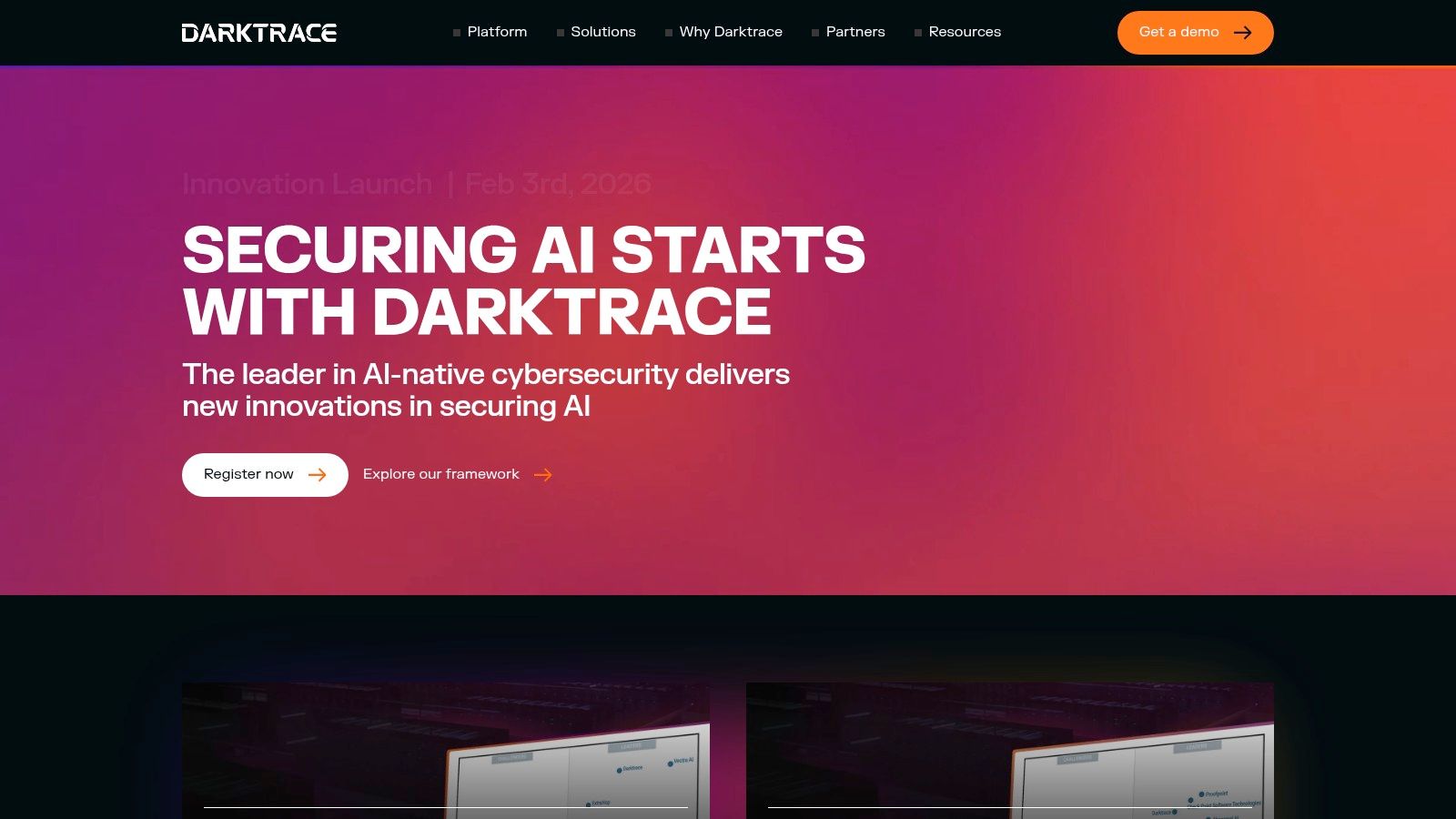
Alt text: Darktrace – ActiveAI Security Platform’s dashboard showing a visualization of network anomalies.
Key Strengths:
- Strong at identifying insider threats and lateral movement.
- Visual threat modeling for analysts.
Limitations:
- Requires tuning to reduce false positives.
- Interpretation of alerts can require experienced analysts.
- Anomaly detection may generate false positives if models aren’t tuned to the environment.
Best For: Organizations with complex networks looking for early‑stage anomaly detection.
Instead of relying on predefined rules or signatures, Darktrace identifies anomalous activities that signal a potential compromise, whether from an external attacker or an insider threat. Its most compelling feature is its autonomous response capability, which can take surgical, targeted actions to contain threats in real time without disrupting normal business operations. This API-first platform ensures rapid integration, particularly with critical tools like Microsoft 365.
Key Features & Use Case
A key differentiator for Darktrace is its ability to protect collaboration tools. As organizations increasingly rely on platforms like Microsoft Teams, Darktrace extends its behavioral analysis to detect data exfiltration, social engineering, and other malicious activities happening within these applications.
- Practical Example: A financial services firm is targeted by a sophisticated spear-phishing campaign. An attacker successfully compromises a user’s Microsoft 365 account and begins to subtly exfiltrate sensitive client data through Microsoft Teams. Darktrace’s AI, having learned the user’s normal collaboration patterns, flags the unusual file-sharing activity. Its autonomous response system temporarily restricts the user’s access to specific Teams channels, stopping the data leak within seconds while a security analyst investigates the alert.
Implementation and Strategy
Effective deployment begins by allowing the AI to learn for a baseline period, typically one to two weeks, in a passive monitoring mode. During this phase, focus on integrating key data sources via its API, starting with high-risk areas like email and core network traffic. To maximize value, security teams must build trust in the anomaly-based alerts and configure autonomous response policies gradually, starting with less critical assets.
- Actionable Takeaways:
- Allow a Learning Period: Let the AI run in a passive, non-blocking mode for at least two weeks to establish an accurate behavioral baseline.
- Start Autonomous Response Small: Enable autonomous response for a single, low-risk use case first (e.g., blocking connections to known malicious IPs) before expanding.
- Integrate with M365: Prioritize the API integration with Microsoft 365 to gain visibility into email and Teams activity.
- Review Anomaly Alerts Regularly: Schedule time to review the AI’s anomaly alerts with your team to fine-tune its understanding of your environment.
| Feature | Description | Target User |
|---|---|---|
| Self-Learning AI | Establishes a baseline of normal behavior to detect and respond to novel threats without signatures. | Mid-Market & Enterprise |
| Autonomous Response | Takes targeted, surgical actions in real time to neutralize threats across email, cloud, and network. | Enterprise |
| Full Digital Estate Cover | Provides unified visibility and protection for email, network (NDR), cloud, OT, identity, and endpoints. | Enterprise |
| API-First Integrations | Enables rapid, seamless integration with existing security stacks, including Microsoft 365 and SaaS apps. | Mid-Market & Enterprise |
Pros & Cons
- Pros:
- Detects Novel Threats: Highly effective at identifying zero-day attacks and insider threats that bypass traditional defenses.
- Broad Coverage: Extends protection to collaboration platforms like Microsoft Teams, a common blind spot.
- Rapid Deployment: API-first model allows for quick integration and setup, especially for cloud services.
- Cons:
- Opaque Pricing: Requires direct engagement with the sales team, as there is no public pricing information.
- Tuning Required: Anomaly-based alerting can require initial tuning and analyst validation to minimize false positives.
Tools & Resources
- Website: https://www.darktrace.com
- Further Reading: You can learn more about how AI and machine learning are reshaping cybersecurity defenses.
7. Vectra AI – NDR Platform
Primary Focus: Network Detection and Response (NDR).
Vectra AI focuses on detecting attacker behavior after initial compromise, using AI models to track command‑and‑control traffic and lateral movement.
Vectra excels at identifying attacker behavior after compromise, complementing perimeter defenses.
Vectra AI’s platform specializes in Network Detection and Response (NDR), using AI to uncover hidden threats moving laterally within hybrid cloud environments. Its core strength is its library of over 150 AI models that analyze network, identity, and cloud data to detect post-compromise attacker behaviors. This focus on what adversaries do after an initial breach makes it one of the top AI tools for cyber defense in 2026 for security teams needing deep visibility into attacker TTPs.
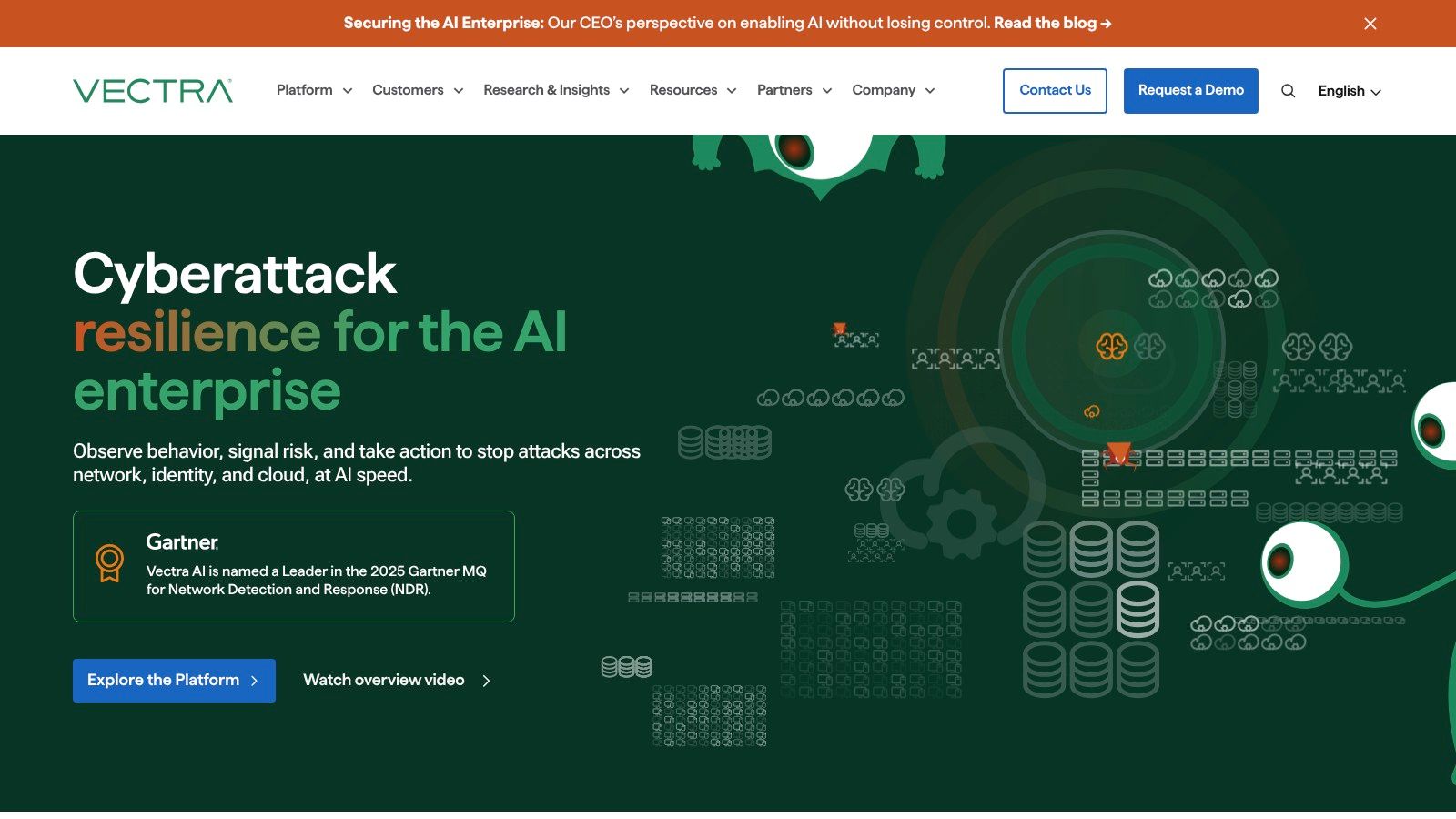
Alt text: Vectra AI’s NDR Platform dashboard highlighting active threat detections.
Unlike EDR tools that are endpoint-centric, Vectra provides a network-level view, exposing threats like reconnaissance, lateral movement, and command-and-control communications that might otherwise go unnoticed. The platform enriches security alerts with context, prioritizing the most urgent threats and significantly reducing alert fatigue for security operations center (SOC) analysts. This patented approach allows security teams to find the signal in the noise.
Key Strengths:
- Strong post‑breach detection.
- Effective prioritization of high‑risk threats.
Limitation:
- Requires integration with other tools for full coverage.
Best For: SOC teams looking to strengthen network‑level visibility.
Key Features & Use Case
A key differentiator for Vectra is its ability to optimize existing SIEM and SOAR workflows. By feeding high-fidelity, AI-vetted detections into tools like Splunk or Microsoft Sentinel, it reduces the volume of false positives and allows analysts to focus on genuine incidents. This integration transforms the SIEM from a simple log collector into a more intelligent threat detection hub.
- Practical Example: A large financial institution has a mature security stack, but their SOC is overwhelmed by alerts from their SIEM. After deploying Vectra, the platform identifies a compromised service account being used to access sensitive data stores, a behavior that was previously lost in a sea of log data. Vectra’s AI correlates the suspicious access patterns, prioritizes the threat, and forwards a single, high-context alert to their SOAR playbook, triggering an automated response to disable the account and isolate the involved systems.
Implementation and Strategy
For a successful implementation, begin by deploying Vectra sensors in key network segments, such as data centers and cloud VPCs, to establish a baseline of normal activity. Integrate Vectra’s output with your primary SIEM or SOAR platform to automate incident response workflows from day one. This strategic integration is crucial for maximizing the platform’s value.
- Actionable Takeaways:
- Deploy at Key Choke Points: Place Vectra sensors where they can see the most critical traffic, such as your core data center switch or primary cloud VPC.
- Integrate with Your SIEM Immediately: Connect Vectra to your SIEM/SOAR to forward high-fidelity alerts, reducing noise from other sources.
- Focus on High-Priority Detections: Train your analysts to prioritize Vectra’s correlated alerts, which represent the most significant threats.
- Hunt for Lateral Movement: Use the platform specifically to search for signs of east-west traffic between servers, a common blind spot.
| Feature | Description | Target User |
|---|---|---|
| AI-Driven NDR | Utilizes 150+ AI models to detect attacker behaviors across network, identity, and cloud environments. | Mid-Market & Enterprise |
| SIEM Optimization | Reduces alert fatigue by sending only high-fidelity, correlated threat signals to SIEM/SOAR tools. | Enterprise |
| Post-Compromise Focus | Specializes in identifying lateral movement, reconnaissance, and data exfiltration post-breach. | Mid-Market & Enterprise |
| Optional MDR Services | Provides access to Vectra’s expert analysts for managed detection, threat hunting, and response. | Mid-Market & Enterprise |
Pros & Cons
- Pros:
- Post-Compromise Visibility: Purpose-built for detecting lateral movement and insider threats that bypass perimeter defenses.
- Reduces False Positives: AI-driven analysis significantly optimizes SIEM workloads and focuses analyst attention.
- Flexible Deployment: Supports on-premises, cloud, and hybrid deployments with various purchasing models, including MSSP.
- Cons:
- Opaque Pricing: Pricing is not publicly listed and requires engaging in an enterprise sales cycle.
- Integration Dependent: Requires thoughtful integration with existing security tools like SIEM/SOAR to achieve maximum value.
Tools & Resources
- Website: https://www.vectra.ai
- Further Reading: The use of multiple intelligent systems working in tandem is a growing trend, and you can learn more about how multi-agent AI systems are explained and their impact on cybersecurity.
8. Elastic – Elastic Security (Serverless SIEM/XDR)
Primary Focus: SIEM and behavioral analytics.
Elastic Security uses machine learning to analyze large datasets and identify unusual patterns across logs, endpoints, and cloud workloads. Maximizing Elastic’s potential requires familiarity with search and query languages.
Elastic Security disrupts the traditional SIEM and XDR market with its serverless, consumption-based pricing model. This approach makes it a powerful and cost-effective solution for organizations that need to analyze massive volumes of security data without the high upfront costs of legacy systems. Its strength lies in combining high-speed analytics with a generative AI assistant, making it one of the top AI tools for cyber defense in 2026 for data-heavy security operations.
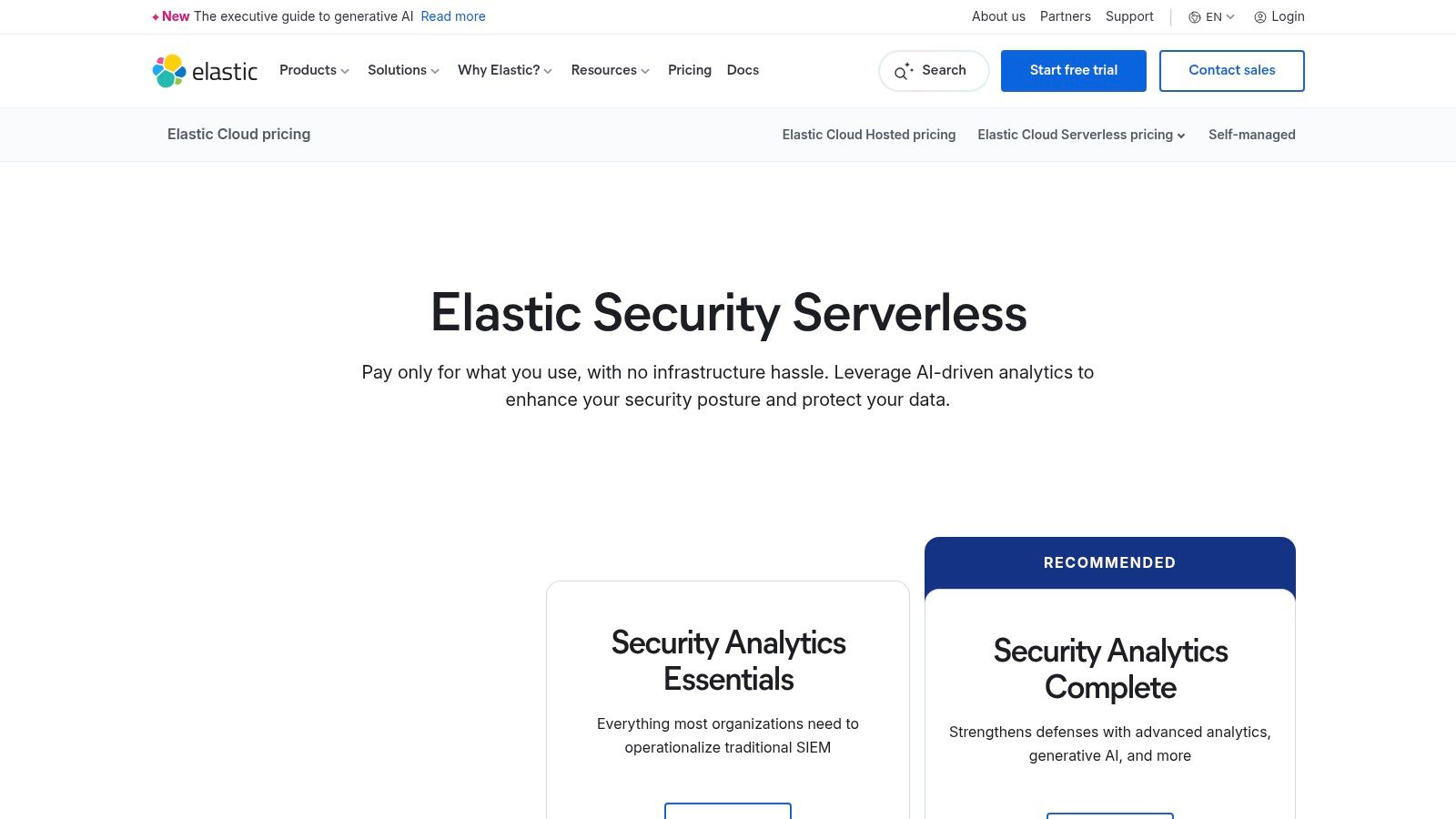
Alt text: Elastic Security’s serverless platform displaying threat intelligence and analytics.
Unlike competitors with fixed licensing tiers, Elastic’s serverless architecture allows security teams to pay only for the data they ingest and retain. This model is ideal for organizations with fluctuating data volumes, such as those scaling cloud operations or handling seasonal traffic spikes. The platform’s open nature also allows seamless integration with third-party EDR and cloud tools, providing a unified analytics layer across a diverse security stack.
Key Strengths:
- Flexible and highly customizable.
- Strong search and analytics capabilities.
Limitation:
-
Requires in‑house expertise to manage effectively.
Best For: Teams with strong engineering and analytics skills.
Key Features & Use Case
A major differentiator is Elastic’s generative AI assistant and the EASE AI SOC Engine, which automates threat detection rule creation, investigation queries, and incident summarization. This significantly reduces the manual workload on security analysts and accelerates response times. The transparent pricing calculator and free trial options remove entry barriers, allowing teams to evaluate the platform with their own data before committing.
- Practical Example: A cloud-native startup needs a SIEM to monitor its sprawling AWS and Google Cloud infrastructure but lacks the budget for a traditional solution. They adopt Elastic Security, ingesting terabytes of cloud logs and network flow data. When an attacker attempts to exploit a misconfigured serverless function, Elastic’s built-in detection rules fire an alert. An analyst uses the AI Assistant to instantly generate a query that correlates logs from multiple cloud services, identifying the attacker’s full TTP chain and enabling rapid containment.
Implementation and Strategy
To effectively implement Elastic Security, begin by identifying your highest-priority data sources, such as cloud provider logs, endpoint data, and network telemetry. Use the free trial to estimate your daily data ingest and retention needs, which will help you forecast costs accurately. For optimal results, integrate your existing endpoint protection solution to feed detection data directly into Elastic, creating a comprehensive XDR capability that unifies visibility across your entire environment.
- Actionable Takeaways:
- Use the Pricing Calculator: Before starting, use the online calculator to estimate your monthly costs based on expected data ingestion.
- Start with a Free Trial: Take advantage of the free trial to test data ingestion from your key sources and evaluate performance.
- Leverage AI for Queries: Train your analysts to use the AI Assistant to build complex queries, especially if they are new to the Elastic query language.
- Integrate Third-Party EDR: If you already have an EDR tool, integrate its alerts into Elastic Security to create a centralized XDR view without replacing your existing agents.
| Feature | Description | Target User |
|---|---|---|
| Serverless SIEM/XDR | Pay-as-you-go security analytics based on data ingest and retention, eliminating large fixed costs. | SMB to Enterprise |
| Generative AI Assistant | An AI-powered assistant to automate query generation, detection rule authoring, and alert investigation. | Security Analysts & Engineers |
| Optional XDR Add-ons | Provides optional endpoint and cloud workload protection agents for a fully integrated XDR experience. | Mid-Market & Enterprise |
| Transparent Pricing | Offers a public-facing calculator and free trial, allowing for clear cost estimation and easy evaluation. | SMB & Mid-Market |
Pros & Cons
- Pros:
- Clear, Low Entry Pricing: A pay‑what‑you‑use model makes powerful security analytics accessible to more organizations.
- High-Volume Data Handling: Well-suited for security analytics in environments with large and diverse data sources.
- Third-Party Friendly: Plays well with existing EDR and cloud tooling, acting as a powerful central analytics hub.
- Cons:
- Cost Management: Consumption-based costs require diligent monitoring to prevent unexpected budget overages.
- Dependent XDR: Full XDR functionality depends on purchasing add-ons or integrating third‑party endpoint tools.
Tools & Resources
9. Splunk – Enterprise Security
Primary Focus: Security analytics and orchestration.
Splunk applies machine learning to identify anomalies across massive data sets, supporting advanced threat detection and investigation. Splunk’s AI-driven correlation links related events into a unified investigation timeline, reducing manual effort.
Splunk Enterprise Security remains a cornerstone for analytics-driven security operations, functioning as a powerful SIEM and SOAR platform. Its strength is in transforming vast machine data into actionable security intelligence, leveraging AI and machine learning to detect advanced threats and streamline incident response. This makes it one of the top AI tools for cyber defense in 2026 for organizations needing a centralized, data-centric security hub.
Unlike platforms focused solely on endpoint data, Splunk ingests and correlates information from across the entire IT environment, from network devices to cloud applications. Its AI capabilities are increasingly embedded into SecOps workflows, with features like the Splunk AI Assistant helping analysts write complex queries, investigate incidents, and automate responses more efficiently. This comprehensive visibility and growing AI integration are key differentiators.
Key Strengths:
- Powerful analytics and dashboards.
- Broad ecosystem of integrations.
Limitations:
-
Licensing costs can scale quickly.
Best For: Large organizations handling high‑volume security data.
Key Features & Use Case
A significant advantage of Splunk is its flexible licensing. Teams can choose from ingest-based, workload-based, or predictive pricing models, allowing them to align costs with their specific data and compute patterns. This is a crucial distinction from competitors with rigid, volume-based pricing that can become prohibitively expensive.
- Practical Example: A large financial institution uses Splunk Enterprise Security to combat a sophisticated insider threat. The platform’s machine learning models detect anomalous user behavior by correlating failed login attempts, unusual data access patterns from a privileged account, and data exfiltration to a non-corporate cloud service. The system generates a high-fidelity alert, automates the suspension of the user account via a SOAR playbook, and provides the security team with a complete event timeline for forensic investigation, preventing a major data breach.
Implementation and Strategy
Effective implementation begins with identifying critical data sources and establishing a phased ingestion plan to control costs and complexity. Utilize the Splunkbase marketplace to find pre-built apps and add-ons for your existing security tools, which accelerates integration and time-to-value. A strategic approach involves leveraging the Splunk AI Assistant to train junior analysts, helping them build advanced search queries and understand complex correlation rules.
- Actionable Takeaways:
- Choose the Right Pricing Model: Analyze your data patterns—if you have high data volume but predictable queries, a workload model might be cheaper than ingest-based.
- Explore Splunkbase First: Before building custom integrations, check the Splunkbase marketplace for pre-built apps for your existing tools.
- Use the ML Toolkit: Experiment with the Splunk Machine Learning Toolkit (MLTK) on a specific dataset (e.g., VPN logs) to detect anomalies.
- Master the AI Assistant: Use the AI assistant to translate natural language questions into SPL queries, accelerating the learning curve for your team.
| Feature | Description | Target User |
|---|---|---|
| Flexible Pricing Models | Offers ingest, workload, and predictive licensing to align costs with data usage patterns. | Mid-Market & Enterprise |
| Mature SIEM & SOAR | Provides robust investigation, correlation, and automated response workflows within a single platform. | Enterprise |
| Extensive App Ecosystem | Supported by a vast marketplace of apps and integrations for seamless tool consolidation. | All Users |
| AI-Assisted SecOps | Embeds AI assistants into workflows to help analysts with query generation and incident investigation. | Mid-Market & Enterprise |
Pros & Cons
- Pros:
- Flexible Licensing: Multiple pricing models accommodate diverse data and computational needs.
- Vast Ecosystem: Extensive community support, a rich marketplace of apps, and broad integration capabilities.
- Enterprise-Ready: Proven scalability and established deployment practices for large, complex environments.
- Cons:
- Cost at Scale: Can become cost-intensive, particularly in high-ingest environments, despite flexible models.
- Deployment Complexity: May require specialized skills or professional services for optimal configuration and management.
Tools & Resources
- Website: https://www.splunk.com
10. IBM Security – QRadar Suite
Primary Focus: SIEM and threat correlation.
IBM QRadar integrates AI to help security teams correlate large volumes of logs, identify anomalies, and reduce alert fatigue. IBM QRadar is widely used in regulated sectors for its comprehensive log correlation and compliance reporting.
IBM’s QRadar Suite consolidates SIEM, SOAR, and EDR/XDR into a unified platform, but its standout feature for 2026 is the integration of a generative AI assistant powered by watsonx. This AI-driven component transforms security operations by automating alert summarization, proposing remediation steps, and translating natural language queries into actionable searches. This makes it one of the top AI tools for cyber defense in 2026 for enterprises needing to accelerate threat investigation and reduce analyst fatigue.
Alt text: The IBM Security QRadar Suite dashboard displaying AI-powered threat intelligence and automated response actions.
Unlike competitors that bolt on AI as an afterthought, QRadar’s watsonx integration is central to the workflow, designed to augment human analysts rather than replace them. This approach allows SOC teams to handle a higher volume of complex alerts with greater accuracy. The suite offers flexible deployment models (cloud, on-prem, hybrid) and is widely available through major US reseller channels like CDW, making procurement and implementation more straightforward for large organizations.
Key Strengths:
- Strong log correlation capabilities.
- Suitable for regulated industries.
Limitation:
- Setup and tuning can be complex.
Best For: Enterprises with mature SOC operations.
Key Features & Use Case
A key differentiator is the Gen-AI Investigation Assistant, which acts as a force multiplier for the SOC. It doesn’t just flag issues; it provides context, outlines the attack chain in plain English, and recommends specific actions based on an organization’s unique playbooks. This drastically cuts down triage and investigation time.
- Practical Example: A financial institution’s SOC is inundated with alerts from a multi-stage phishing campaign. Instead of manually correlating dozens of events, the analyst uses the QRadar AI assistant. They ask, “Summarize the attack related to user ‘j.doe’ and provide a mitigation plan.” The AI synthesizes logs, EDR alerts, and threat intelligence to produce a concise incident report, identifies the compromised credentials, and recommends a SOAR playbook to isolate the user’s devices and reset passwords, all within minutes.
Implementation and Strategy
For effective implementation, start by connecting primary data sources like EDR and cloud logs to train the AI assistant on your specific environment. Focus on customizing a few core SOAR playbooks that the AI can recommend and trigger, such as credential compromise or malware containment. This ensures the AI’s suggestions are immediately actionable and aligned with your internal security policies, maximizing its value from day one.
- Actionable Takeaways:
- Connect Critical Data Sources First: Prioritize integrating your EDR and identity provider (e.g., Azure AD/Entra) logs to give watsonx the most valuable data.
- Customize Core Playbooks: Identify your top 3 incident types and customize the corresponding SOAR playbooks so the AI assistant can recommend them accurately.
- Train Your Team on Natural Language Queries: Hold a session to practice asking the AI assistant different types of investigative questions.
- Leverage Reseller Expertise: If procuring through a channel partner like CDW, use their technical experts to assist with initial setup and tuning.
| Feature | Description | Target User |
|---|---|---|
| Gen-AI Investigation Assistant | Uses watsonx to summarize offenses, map attack chains, and recommend remediation actions in natural language. | Enterprise SOC Teams |
| Unified XDR, SIEM & SOAR | Consolidates endpoint detection, security information, and automated response into a single interface. | Mid-Market & Enterprise |
| Flexible Deployment & Licensing | Available as cloud-native, on-premises, hybrid, or managed service with entity/workload pricing. | Enterprise & Regulated |
| Broad Reseller Availability | Can be procured through major US channels with monthly SKUs, simplifying enterprise acquisition. | Enterprise |
Pros & Cons
- Pros:
- Powerful AI Augmentation: Drastically reduces investigation time and analyst workload with generative AI summaries.
- Enterprise-Ready: Strong support for regulated industries with flexible deployment and robust support options.
- Simplified Procurement: Easily available through large US resellers, often with flexible monthly SKUs.
- Cons:
- Complex Implementation: The suite’s comprehensive nature may require professional services for optimal setup and tuning.
- Opaque Pricing: Public list pricing is limited; costs vary significantly based on reseller, SKU, and deployment model.
Tools & Resources
- Website: https://www.ibm.com/security/qradar
11. Securonix – Unified Defense SIEM
Primary Focus: Next-generation SIEM with user and entity behavior analytics (UEBA).
Securonix positions itself as an AI-driven, cloud-native SIEM platform focused on advanced threat detection, insider risk, and identity-centric attacks. Its machine learning models analyze user, entity, and system behavior to identify anomalies that traditional rule-based SIEMs often miss.
By analyzing user and entity behavior, Securonix helps detect insider threats that evade traditional SIEM rules.
Its core strength lies in its powerful, AI-driven User and Entity Behavior Analytics (UEBA), which provides sophisticated insider threat and advanced persistent threat detection out of the box. This analytics-led approach makes it one of the top AI tools for cyber defense in 2026 for organizations needing to unify their security operations and leverage big data.
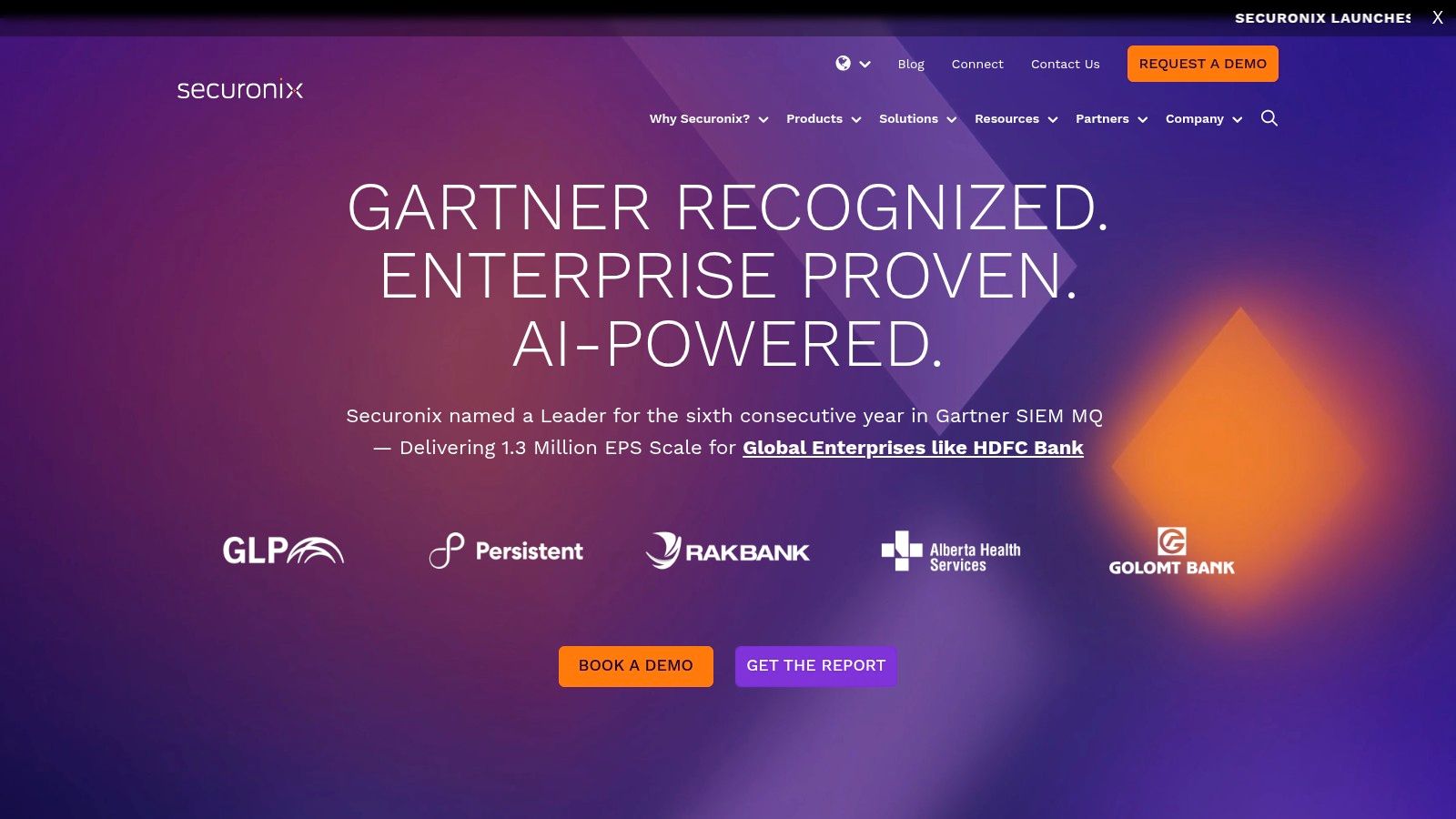
Alt text: Securonix Unified Defense SIEM dashboard displaying threat analytics.
Unlike competitors that often bolt on analytics as a separate module, Securonix integrates UEBA directly into its Threat Detection, Investigation, and Response (TDIR) workflows. Built on Snowflake, the platform offers immense scalability for log ingestion and long-term data retention without the performance bottlenecks of traditional SIEMs. This architecture is particularly beneficial for companies already invested in a cloud data lake strategy.
Key Strengths:
- Strong UEBA capabilities for insider threat detection.
- Risk-based alerting that reduces false positives.
- Cloud-native architecture with scalable analytics.
- Well-suited for compliance-driven environments.
Limitations:
- Initial deployment and tuning can be complex.
- Requires quality data sources to achieve optimal accuracy.
Best For: Enterprises and regulated organizations seeking deeper behavioral insights, insider threat detection, and identity-focused security monitoring.
Key Features & Use Case
A key differentiator for Securonix is its flexible procurement model and simplified pricing. The platform offers transparent GB/day pricing tiers and is available directly through the AWS Marketplace, allowing organizations to leverage existing enterprise cloud credits and simplify purchasing. This multi-tenant model is also well-suited for Managed Security Service Providers (MSSPs).
- Practical Example: A financial institution needs to detect sophisticated insider threats and credential misuse across its hybrid environment. They deploy Securonix, which uses its AI/ML models to baseline normal user behavior. The system automatically detects an accountant accessing sensitive servers outside of normal working hours from an unusual location, flags the anomalous activity, and triggers a SOAR playbook to temporarily disable the account and alert the security team, preventing a potential data breach.
Implementation and Strategy
For effective implementation, begin by identifying critical data sources and high-value assets to prioritize for log ingestion. Leverage the platform’s pre-built threat content and watchlists to accelerate initial threat detection capabilities. Integrating Securonix with existing identity and access management (IAM) tools will enrich its UEBA models, providing deeper context for more accurate anomaly detection and a stronger overall defense.
- Actionable Takeaways:
- Procure via AWS Marketplace: If you have an AWS enterprise agreement, purchase through the marketplace to simplify billing and potentially use existing credits.
- Focus on UEBA Use Cases: Prioritize insider threat and compromised credential detection during your initial rollout to leverage the platform’s core strength.
- Integrate with IAM: Connect Securonix to your identity provider to enrich user context and improve the accuracy of behavioral analytics.
- Leverage Pre-built Content: Start with the out-of-the-box threat content and detection rules before building complex custom analytics.
| Feature | Description | Target User |
|---|---|---|
| AI/ML-Driven UEBA | Provides advanced behavioral analytics to detect insider threats and compromised accounts. | Mid-Market & Enterprise |
| Unified TDIR & SOAR | Combines threat detection, investigation, and automated response workflows in a single platform. | Enterprise & MSSPs |
| Cloud Data Lake Architecture | Built on Snowflake, offering massive scalability for data ingestion, search, and analytics. | Organizations with Cloud Strategy |
| AWS Marketplace Availability | Simplifies procurement and billing for organizations with existing AWS enterprise agreements. | Mid-Market & Enterprise |
Pros & Cons
- Pros:
- Strong Behavioral Analytics: Industry-leading UEBA capabilities are core to the platform, not an add-on.
- Flexible Procurement: Multiple purchase routes, including AWS Marketplace, offer contracting flexibility.
- Scalable Architecture: Snowflake backend is ideal for organizations with large data volumes and cloud strategies.
- Cons:
- Learning Curve: Customizing SOAR playbooks and analytics rules can be complex for new users.
- Variable Pricing: Final costs for data storage and retention can vary significantly based on the chosen package.
Tools & Resources
- Website: https://www.securonix.com
12. Cisco – Hypershield
Primary Focus: AI-powered, distributed cloud and network security.
Cisco Hypershield represents a new approach to cyber defense by embedding AI-driven security controls directly into cloud and network fabrics. Rather than relying solely on centralized inspection points, Hypershield applies adaptive, policy-driven protection closer to workloads and applications.
Hypershield embeds AI-driven policy enforcement closer to cloud workloads, aligning with zero-trust principles.
It moves beyond traditional perimeter-based models to protect applications, devices, and data wherever they reside. Its core purpose is to automate and simplify segmentation at scale, making it one of the top AI tools for cyber defense in 2026 for organizations managing complex, distributed environments.
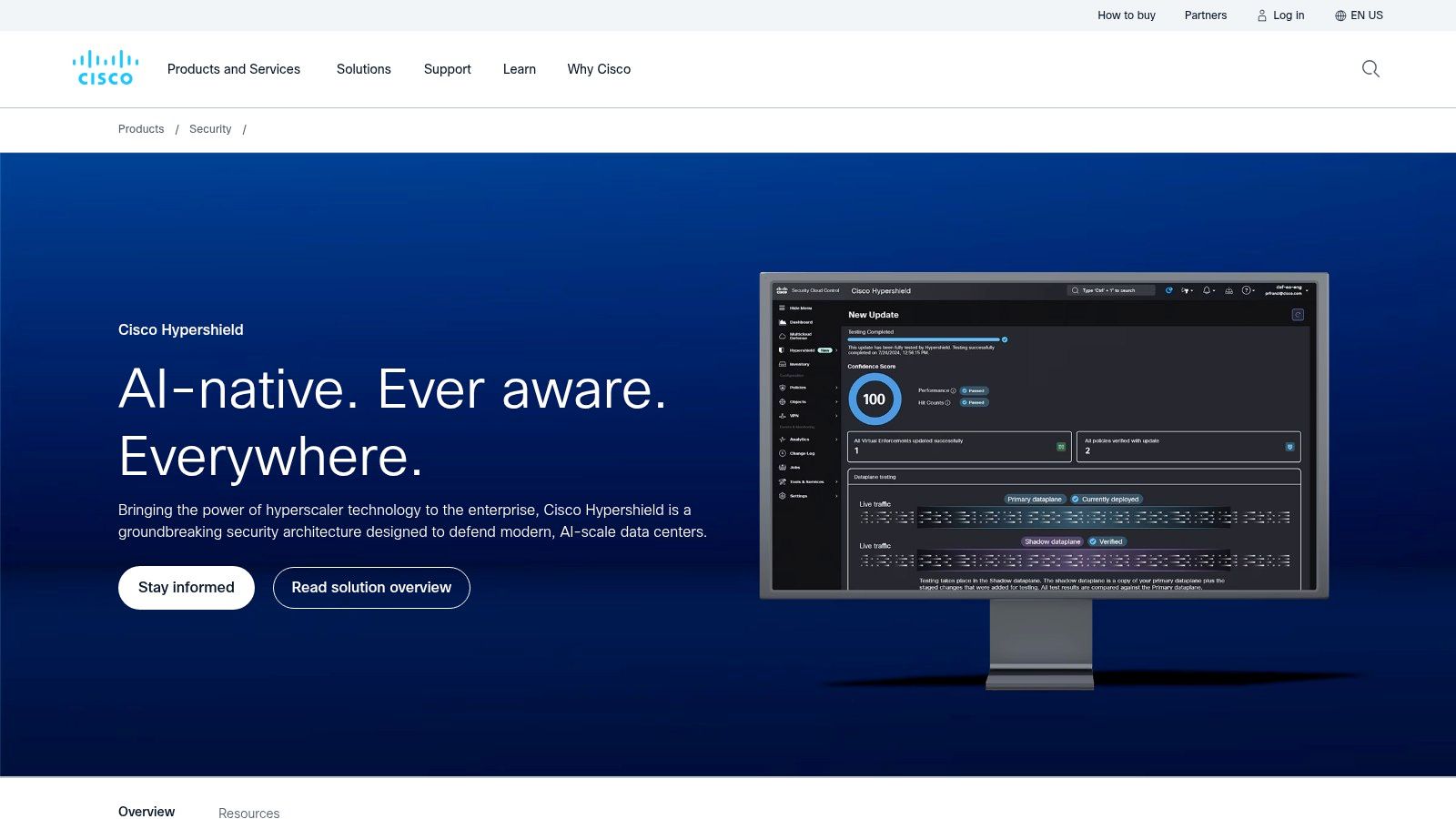
Alt text: Cisco – Hypershield’s architectural diagram showing its distributed security fabric.
Unlike solutions that bolt AI onto existing network firewalls, Hypershield embeds enforcement directly into the server and network infrastructure. It uses an AI-powered engine to autonomously learn application dependencies and generate micro-segmentation policies. This architecture is purpose-built to secure east-west traffic, a critical blind spot in many modern data centers where lateral movement by attackers often goes undetected.
Key Strengths:
- Distributed enforcement reduces attack surface and latency.
- AI-driven policy adaptation based on real-time threat signals.
- Strong alignment with zero-trust and cloud-native security models.
- Integrates with Cisco’s broader security ecosystem.
Limitations:
- Still evolving as a newer platform.
- Best value realized within Cisco-centric environments.
Best For: Organizations adopting zero-trust architectures and cloud-native infrastructure that require scalable, embedded security controls.
Key Features & Use Case
A standout feature is Hypershield’s dual data plane, which allows it to test and validate policy changes in a digital twin before pushing them live. This dramatically reduces the risk of misconfigurations that could cause application outages or create security gaps. This built-in safety net is crucial for maintaining operational uptime in mission-critical environments.
- Practical Example: A large financial institution needs to segment its legacy monolithic applications from its new containerized microservices running in a hybrid cloud. Using Hypershield, the security team deploys the enforcement points across their on-premises data center and public cloud instances. The AI engine observes traffic patterns, automatically recommends granular segmentation policies to isolate each service, and tests them in the shadow data plane. Once validated, the policies are enforced, preventing a breach in one service from spreading to the entire application ecosystem.
Implementation and Strategy
Effective implementation starts with identifying a critical application environment for a pilot project to showcase the autonomous segmentation capabilities. Integrating Hypershield with existing Cisco ACI or other networking infrastructure is key to creating a unified policy enforcement layer. A phased rollout, beginning with observation mode to learn traffic flows before moving to active enforcement, will ensure a smooth transition without disrupting business operations.
- Actionable Takeaways:
- Start with Observation Mode: Deploy Hypershield in a passive mode first to let the AI learn your application traffic patterns without enforcing any rules.
- Use the Digital Twin: Before deploying any AI-recommended policy, always validate it in the dual data plane (digital twin) to prevent application downtime.
- Pilot on a Single Application: Choose one critical but non-production application to test the full lifecycle of autonomous segmentation.
- Integrate with Cisco ACI: If you are a Cisco ACI customer, leverage the native integration to extend your existing network policies.
| Feature | Description | Target User |
|---|---|---|
| Autonomous Segmentation | AI engine observes traffic to automatically generate and maintain micro-segmentation policies. | Enterprise |
| Distributed Enforcement | Security enforcement is embedded in server software and network hardware for deep, granular control. | Large Enterprise |
| Dual Data Plane | Tests policy changes in a shadow environment before live deployment to prevent operational errors. | Enterprise |
| Unified Management | Provides a single point of control for security policy across hybrid clouds and data centers. | Mid-Market & Enterprise |
Pros & Cons
- Pros:
- Designed for AI-Scale: Architected to secure massive, complex, and highly distributed environments.
- Automates Segmentation: Dramatically reduces the manual effort and complexity of micro-segmentation.
- Strong Cisco Integration: Fits seamlessly into organizations already invested in the Cisco security and networking ecosystem.
- Cons:
- New Architecture: As a newer solution, it may require significant planning and proof-of-concept projects.
- Opaque Pricing: Pricing is not publicly available and requires direct engagement with Cisco’s enterprise sales team.
Tools & Resources
- Website: https://www.cisco.com/go/hypershield
Top 12 AI Cyber‑Defense Tools — 2026 Comparison
| Solution | Core AI & Features (✨) | Trust & Effectiveness (★ / 🏆) | Pricing & Value (💰) | Target Audience (👥) |
|---|---|---|---|---|
| CrowdStrike – Falcon Platform | ✨ AI AV/EDR & XDR, unified agent, threat hunting add-ons | ★★★★; MITRE & Gartner validation 🏆 | 💰 Clear per-device tiers; 15‑day trial (can scale costly) | 👥 SMB → Enterprise security teams |
| SentinelOne – Singularity Platform | ✨ Autonomous prevention/rollback, AI SOC assistant | ★★★★; published tier pricing & broad integrations 🏆 | 💰 Competitive per-endpoint; enterprise via sales | 👥 SMB/midmarket, MSPs/MSSPs |
| Palo Alto Networks – Cortex | ✨ XSIAM analytics + AI copilots across network/cloud/SecOps | ★★★★; broad portfolio & enterprise services 🏆 | 💰 Sales-quoted; complex licensing | 👥 Large enterprises, SOCs |
| Microsoft – Security Copilot + Defender Suite | ✨ Generative AI assistant integrated with Defender ecosystem | ★★★★; massive telemetry & partner ecosystem 🏆 | 💰 Consumption-based (SCUs) + bundle options; governance needed | 👥 Microsoft-centric orgs, enterprises |
| Google Cloud – Chronicle | ✨ Gemini-powered investigation, SIEM/SOAR, bundled retention | ★★★★; Google-scale ingestion & POC credits 🏆 | 💰 Ingestion-based, sales-assisted pricing | 👥 Cloud-native teams, Google Cloud users |
| Darktrace – ActiveAI Security Platform | ✨ Self-learning anomaly detection + autonomous response | ★★★; strong novel-threat detection (needs tuning) | 💰 Sales-led; no public list price | 👥 Org’s seeking anomaly/AI-native detection |
| Vectra AI – NDR Platform | ✨ 150+ AI models for NDR, identity & lateral movement detection | ★★★★; proven SIEM optimization & NDR focus 🏆 | 💰 Enterprise sales; optional MDR services | 👥 Network security teams, enterprises |
| Elastic – Elastic Security | ✨ Serverless SIEM/XDR, per‑GB ingest, Elastic AI Assistant | ★★★; pay-as-you-go for data-heavy use | 💰 Transparent per‑GB pricing; monitor consumption | 👥 Data-heavy orgs, analytics/security teams |
| Splunk – Enterprise Security | ✨ Flexible ingest/workload models, mature SIEM/SOAR, AI features | ★★★★; large ecosystem & enterprise maturity 🏆 | 💰 Variable (ingest/workload); can be costly at scale | 👥 Enterprises with complex compliance needs |
| IBM Security – QRadar Suite | ✨ watsonx Investigation Assistant; unified SIEM/SOAR/EDR | ★★★★; strong for regulated/enterprise environments 🏆 | 💰 Channel/SKU dependent; flexible deployments | 👥 Regulated enterprises, SOCs |
| Securonix – Unified Defense SIEM | ✨ UEBA, TDIR workflows, Snowflake data lake architecture | ★★★; strong behavioral analytics; MSSP-friendly | 💰 Simplified GB/day tiers; AWS Marketplace options | 👥 Snowflake users, MSSPs, cloud-first orgs |
| Cisco – Hypershield | ✨ AI-native segmentation & enforcement across network→workloads | ★★★; designed for AI-scale environments | 💰 Sales engagement; pilots recommended | 👥 Cisco networking/security customers, DC teams |
Choosing the Right AI Cyber Defense Tool
There is no single solution that fits every organization. When selecting AI cyber defense tools, organizations should:
- Assess their primary attack surfaces.
- Identify gaps in detection or response.
- Prioritize tools that integrate with existing systems.
- Pilot solutions before full deployment.
Combining multiple AI‑driven tools — such as EDR, NDR, and threat intelligence — often yields the strongest defense.
Putting AI to Work: Your Next Steps in Cyber Defense
The landscape of cyber warfare is being redrawn by algorithms. The shift from manual, human-led defense to AI-augmented security operations is no longer a future trend; it’s the 2026 reality. We’ve seen how platforms like CrowdStrike’s Falcon and SentinelOne’s Singularity leverage AI to deliver unprecedented speed in threat detection and response. Similarly, tools like Palo Alto Networks’ Cortex XSIAM and Microsoft’s Security Copilot are redefining the security analyst’s role, transforming it from a reactive investigator into a proactive threat hunter.
The core takeaway is this: AI is not a magic bullet, but a powerful force multiplier. Its true value isn’t just in spotting novel malware; it’s in its ability to process petabytes of data, correlate seemingly unrelated events, and automate the mundane tasks that lead to analyst burnout and security gaps. Whether it’s Darktrace’s self-learning approach or Cisco’s ambitious Hypershield, the common thread is the reduction of human toil and the acceleration of response times.
From List to Action: Implementing Your AI Defense Strategy
Navigating this list of top AI tools for cyber defense in 2026 can feel overwhelming, but your next steps can be methodical and strategic. The goal isn’t to adopt every new technology but to choose the one that seamlessly integrates with and elevates your existing security posture.
Here is a practical, step-by-step framework to guide your selection and implementation process:
- Map Your Gaps: Before scheduling a demo, assess your current security stack. Where are you strongest? Where are the recurring blind spots? If your EDR is solid but you struggle with cloud visibility, a tool like Vectra AI or Google Chronicle is a better fit than another endpoint solution.
- Define Your Primary Use Case: What is your goal? Reduce Mean Time to Respond (MTTR)? Automate Tier-1 analyst tasks? Secure a complex multi-cloud environment? A CISO aiming to consolidate their SIEM and SOAR might gravitate toward Splunk or IBM’s QRadar Suite, while a team focused on autonomous threat hunting may prefer Darktrace.
- Prioritize Integration: An AI tool that doesn’t connect to your existing infrastructure creates more work. Scrutinize API documentation and ask vendors for specific examples of integrations with your firewall, EDR, and cloud providers. If your organization is heavily invested in Microsoft, the native integration of Security Copilot offers a compelling advantage.
- Run a Real-World Proof of Concept (PoC): Don’t rely on canned demos. A true PoC should test the tool against your organization’s unique threat models and data. Simulate a common attack chain you’ve previously experienced and measure the AI tool’s performance. As national labs have demonstrated with AI-driven attack simulations, testing your defenses against realistic, AI-generated threats is critical for validating a tool’s effectiveness.
- Assess the Human Element: Consider the skills of your current team. A flexible platform like Elastic Security may have a steeper learning curve. Conversely, a solution with guided workflows and natural language processing might be faster for a less specialized team to adopt.
Ultimately, choosing the right AI-powered security tool is about finding the synergy between technology, operational needs, and your team’s capabilities. For enterprises looking to further strengthen their defenses, specialized AI Security Compliance services can provide invaluable guidance in navigating these complex adoption and regulatory challenges.
The era of predictive and autonomous cyber defense is here. By taking a deliberate, use-case-driven approach, you can harness the power of AI to not just respond to threats, but to anticipate and neutralize them before they can cause harm.
Actionable Takeaways
- Conduct a Gap Analysis: Before you shop for tools, identify the biggest weaknesses in your current security posture (e.g., alert fatigue, lack of cloud visibility).
- Define One Key Problem: Choose one primary problem to solve first, such as “reduce time to triage phishing alerts,” to focus your evaluation.
- Demand a Real-Data PoC: Insist that any vendor proof-of-concept uses your own anonymized data, not just their pre-packaged demos.
- Calculate Total Cost of Ownership (TCO): Factor in not just licensing, but also implementation time, training requirements, and potential integration costs.
- Prioritize API and Integration: A tool’s ability to connect with your existing stack (SIEM, EDR, ticketing system) is as important as its standalone features.
Final Thoughts
In 2026, AI is no longer optional in cyber defense. As attackers increasingly rely on automation and adaptive techniques, organizations must respond with intelligent systems capable of learning, correlating signals, and acting at speed.
The tools covered in this guide represent some of the most capable AI‑powered defenses available today. Choosing the right mix — aligned with your organization’s size, infrastructure, and risk profile — is key to staying resilient in an increasingly hostile digital landscape.
Further Reading & References
- Axios: U.S. national labs turn to AI to get ahead of hackers
- MITRE ATT&CK® Evaluations – For independent vendor performance data.
- AI Commerce Wars: Google vs. OpenAI & the Future of Agentic Shopping
- Top AI Video Tools for Creators in 2026: From Prompts to Production at Scale
Ready to streamline your research and content creation process beyond security? The powerful AI behind the tools we discussed is also revolutionizing how we work, write, and create. Explore RichlyAI to discover a suite of AI-powered tools designed to enhance your productivity and creativity. Check out RichlyAI to see how you can leverage cutting-edge AI in all aspects of your work.

Great guide on AI tools for cyber defense! It’s amazing how AI is evolving to protect systems. Speaking of innovation, I recently read about the World Model for real-time video generation, which could inspire new security applications too.