
Instead of chasing customers with ads and cold calls, inbound marketing turns your business into a resource hub. You create genuinely useful content that solves the real problems your ideal customers are searching for. When they look for answers, they find you.
This isn’t about interrupting their day; it’s about being the solution they were already seeking. You pull them in by offering value, building trust from the very first click. This approach naturally generates leads who are already interested in what you have to say.
Why Inbound Is a Game-Changer for Lead Quality
Let’s be direct: the old outbound playbook of cold calls and interruptive ads is losing its punch. People are experts at tuning out the noise. Inbound marketing is your strategy to stop being part of that noise and start being a trusted resource. You become a magnet for your ideal buyers by offering them value before you ever ask for anything in return.
The core difference is simple: outbound marketing feels like a sales pitch, while inbound marketing feels like a helpful conversation. This is why it’s a more effective and sustainable way to grow your business.
It’s Not Just a Hunch—The Numbers Back It Up
This isn’t just a philosophical difference; the data shows a stark contrast in results. Companies that commit to inbound strategies generate a whopping 54% more leads than those still relying on outbound methods. But it’s not just about getting more names in a spreadsheet; it’s about the quality and cost-effectiveness of those leads.
The classic inbound methodology, shown in the diagram below, is a flywheel designed to attract, engage, and delight people.
A diagram of the inbound marketing methodology showing the stages Attract, Convert, Close, and Delight, with tools for each stage. Alt Text: A diagram illustrating the inbound marketing methodology with four circular stages: Attract, Convert, Close, and Delight. Arrows show a cyclical flow, emphasizing a continuous customer relationship.
Every part of this process is designed to build a relationship by providing value. And that value pays off. Inbound marketing actually costs 62% less per lead than traditional outbound tactics.
Even better, when you look at specific inbound channels like SEO, the results are incredible. Leads that come from search engines have a 7x higher lead-to-close rate. If you want to dive deeper, there are plenty of other inbound marketing stats that paint a very clear picture.
Inbound lead generation isn’t about finding customers; it’s about helping customers find you. By providing genuine value upfront, you build a foundation of trust that makes the sales process smoother and more effective.
At the end of the day, you’re building a pipeline of prospects who are already warmed up to your brand because you’ve already helped them. That’s how you get highly engaged, better-qualified leads for a fraction of the cost.
Build Your Foundation for Attracting Leads
An effective inbound lead generation strategy doesn’t start with flashy ads. It begins with a solid foundation: truly understanding your audience and creating content that solves their problems. Your goal is to become the go-to resource they find whenever they search for answers.
This process starts with practical keyword research. Instead of guessing what people want, use tools to uncover the exact phrases your ideal customers are typing into search engines. This isn’t just about driving traffic; it’s about attracting the right traffic. To nail this, it helps to first understand the key differences between demand generation and lead generation.
Mapping Content to the Buyer’s Journey
Once you know what your audience is searching for, you can map your content ideas to each stage of their journey. Not everyone is ready to buy the moment they land on your site. Some are just identifying a problem, while others are comparing solutions. Your content must meet them where they are.
- Awareness Stage: At the top of the funnel, prospects are experiencing symptoms of a problem but haven’t named it yet. They use broad search terms. Your job is to create content like “How to…” blog posts, checklists, or educational guides that help them diagnose their issue.
- Consideration Stage: Now they’ve defined their problem and are actively researching options. This is the perfect spot for more in-depth content like comparison guides, detailed case studies, or webinars showing how different solutions stack up.
- Decision Stage: At the bottom of the funnel, they’re ready to make a choice. The content here should be specific and make the final decision easy. This is where you roll out free trial offers, live demos, or transparent pricing pages.
This visual flow breaks down how the inbound process gently pulls customers through each of these stages.
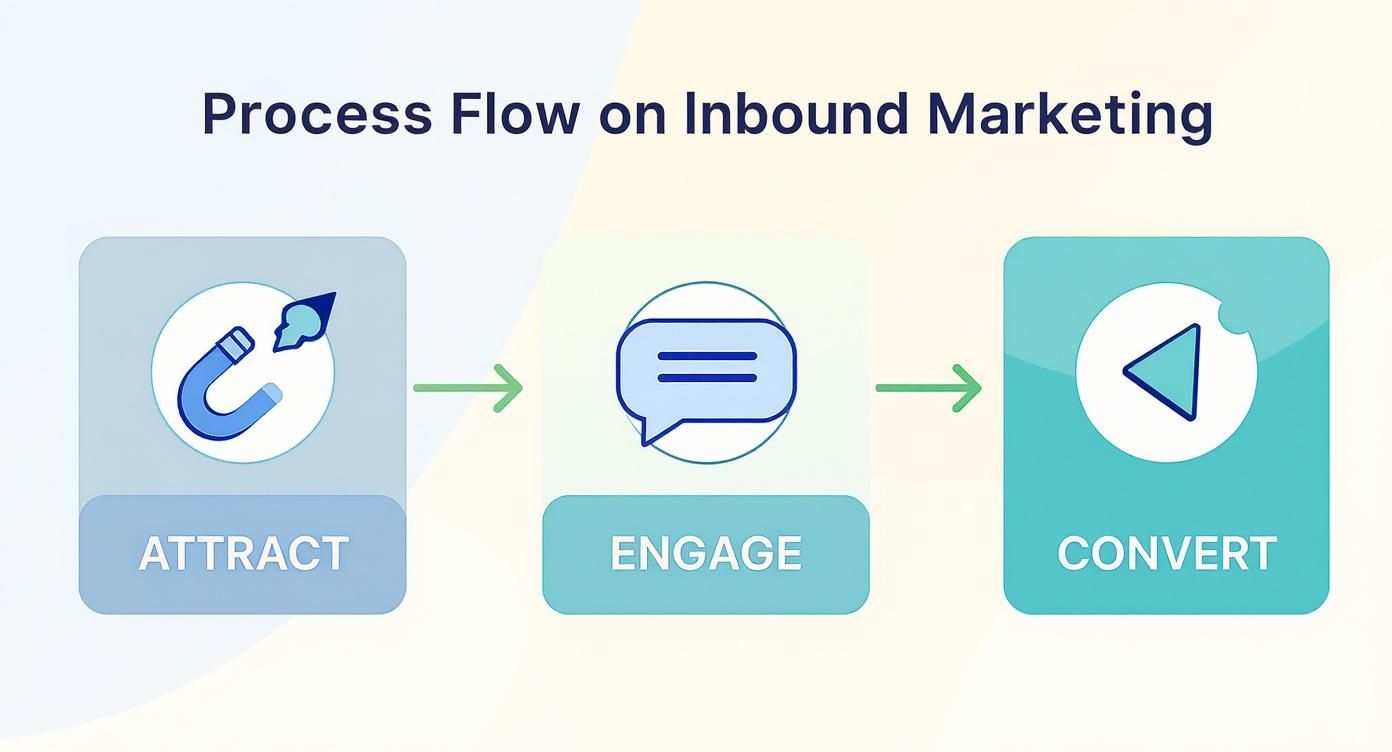
Alt Text: An infographic flowchart for inbound marketing lead generation. It shows steps from attracting strangers with content, converting them into leads with forms, closing leads into customers, and delighting them into promoters.
This infographic shows the simple yet powerful sequence for turning strangers into warm leads by consistently providing value.
Practical Example: Building a Content Funnel
Let’s make this actionable. Imagine you run a B2B SaaS company that sells project management software. Your keyword research reveals a major pain point is “managing remote team tasks effectively.”
Here’s a step-by-step plan to turn that insight into leads:
- Create Awareness Content: Write a blog post titled, “5 Common Pitfalls of Managing Remote Teams (and How to Fix Them).” It’s 100% helpful and not salesy. You share it on LinkedIn and in relevant online communities.
- Develop a Consideration-Stage Lead Magnet: Inside that post, offer a free downloadable “Remote Team Productivity Checklist.” To get it, readers must provide their work email address. You have now generated a lead.
- Deploy Decision-Stage Follow-up: The automated email sequence they receive after downloading the checklist includes a case study on how a similar company doubled its efficiency using your software, followed by an invitation for a no-pressure, 15-minute demo.
This sequence builds trust and establishes your authority. You’re not just pushing software; you’re solving a real-world problem at every step. This foundational approach ensures your inbound marketing lead generation efforts attract prospects who are genuinely interested.
Actionable Takeaways
- Find Problem-Focused Keywords: Use a tool like Semrush or Ahrefs to identify what your audience is actually searching for. Look for questions and “how-to” phrases.
- Map Your Content: Outline one content idea for each stage of the buyer’s journey (Awareness, Consideration, Decision) based on your keyword research.
- Build a “Pillar Page”: Create a comprehensive, long-form guide on a core topic. This acts as a magnet for backlinks and helps you rank for high-value keywords.
- Link Internally: Weave links between your related blog posts to guide users naturally from an awareness-stage article to a consideration-stage guide, keeping them on your site.
Tools and Resources
- Keyword Research: Google Keyword Planner (Free), Semrush (Paid)
- Content Ideation: AlsoAsked, AnswerThePublic
- AI Marketing Tools: Explore a curated list of AI marketing tools to automate and accelerate content creation.
- Further Reading: HubSpot’s guide on creating a Content Marketing Strategy.
Turn Website Visitors into Actual Leads
Getting the right people to your website is a huge win, but it’s only half the battle. Traffic doesn’t pay the bills; a well-oiled conversion machine does. This is where you turn anonymous visitors into identifiable leads by offering them something so valuable they are happy to provide their contact information in return.
At its core, this is a simple value exchange. You offer a helpful resource—a lead magnet—and they give you their email. It’s the first step in building a relationship built on trust.

Alt Text: A marketing professional analyzes a conversion rate optimization dashboard on a computer. The screen shows charts and graphs related to website performance and lead generation.
Crafting Irresistible Lead Magnets
A great lead magnet solves a specific problem for your ideal customer. Forget generic “sign up for our newsletter” pleas. The more targeted and genuinely useful it is, the higher your conversion rate will be.
An irresistible lead magnet is specific, instantly valuable, and easy to digest. Nobody wants a 100-page manifesto to solve one small problem. Matching the right format to your audience’s needs is key.
Essential Lead Magnet Formats and Their Use Cases
| Lead Magnet Type | Best For | Practical Example |
|---|---|---|
| Checklists | Providing quick, scannable, and actionable steps that are easy to implement. | A cybersecurity firm offers a “10-Point Network Security Checklist for Small Businesses.” |
| Ebooks or Guides | In-depth explorations of complex topics where your audience needs comprehensive information. | A B2B SaaS company creates “The Ultimate Guide to Streamlining Your Team’s Workflow.” |
| Webinars | Demonstrating complex products, sharing expert insights, and interacting directly with potential leads. | A software company hosts a live demo on “Mastering Advanced Features in Our Project Management Tool.” |
| Templates | Giving your audience a practical tool they can use immediately to save time and effort. | A marketing agency provides a free “Monthly Content Calendar Template” in Google Sheets. |
The takeaway is that the format should make the value easy to access. Whether it’s a simple checklist or a detailed guide, the goal is to solve a problem quickly and effectively.
The secret to a great lead magnet is specificity. A guide on “Streamlining Your Workflow with Automation” is far more compelling than a generic “Business Tips” newsletter. It speaks directly to a visitor’s pain point.
Designing Landing Pages That Convert
Your landing page has one job: convince the visitor to download your lead magnet. Simplicity and clarity are your best friends. A cluttered page with a dozen messages will confuse users and kill your inbound marketing lead generation efforts.
Here’s a step-by-step process for building a high-converting landing page for that B2B SaaS company’s ebook:
- Write a Killer Headline: Start with a benefit-driven headline like “Stop Juggling Tasks—Streamline Your Workflow Today.” It immediately tells the visitor what’s in it for them.
- Add Persuasive, Scannable Copy: Keep it brief. Use bullet points to highlight what they’ll learn, such as “How to automate 5 repetitive tasks” or “A framework to cut project time by 20%.”
- Keep the Form Simple: Only ask for what you absolutely need right now. Name and work email are usually sufficient. Every extra field is another reason for someone to abandon the page.
- Create a Clear Call-to-Action (CTA): The button should stand out and use active, compelling language. Ditch “Submit” for something like “Get My Free Guide Now.”
Email marketing and landing pages are a powerful combination. Data shows that 48% of marketers see email as their most effective lead gen channel, followed by landing pages at 44%. A whopping 68% of B2B companies use strategic landing pages to capture leads. You can dig into more lead generation effectiveness stats on EmailToolTester. Modern tools like our Lead Diffusion AI can help you build and manage these conversion assets efficiently.
Actionable Takeaways
- Audit Your CTAs: Are they specific and benefit-driven? Swap any generic “Learn More” buttons for something punchier, like “Download Your Free Checklist.”
- Simplify One Form: Find your most important lead capture form and remove at least one non-essential field. Monitor the impact on your conversion rate.
- Brainstorm a New Lead Magnet: Look at your most popular blog post. What checklist, template, or quick guide could you create this week to capture more leads from that traffic?
- Test Your Headline: On your highest-traffic landing page, run a simple A/B test with a new, more benefit-focused headline.
Tools and Resources
- Landing Page Builders: Unbounce, Leadpages
- Form Tools: HubSpot Forms, Typeform
- Heatmap & A/B Testing: Hotjar, Google Optimize
- Further Reading: Unbounce’s guide on Landing Page Best Practices.
Nurture Leads with Marketing Automation
Getting a new lead is a great start, but it’s just that—a start. An email address in your database is an opportunity, not a victory. Now, your inbound marketing lead generation strategy must shift from acquiring contacts to building relationships. Marketing automation is the engine that drives this process, turning a spark of interest into genuine sales readiness.
Without a follow-up plan, a huge chunk of your hard-won leads will go cold. Lead nurturing is about delivering the right information at the right moment to build trust and keep your brand top-of-mind.
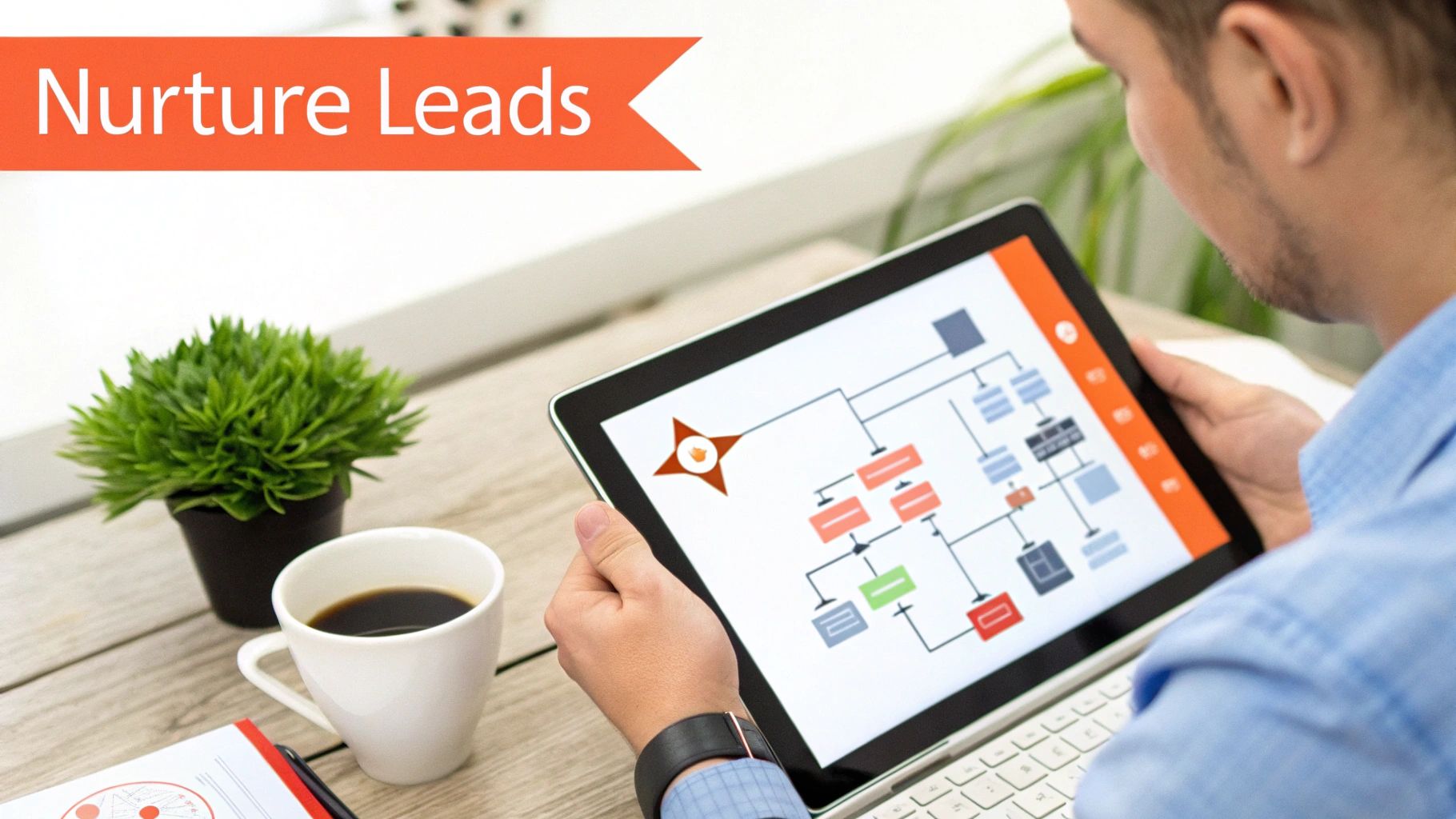
Alt Text: A marketing automation workflow flowchart. It starts with a trigger (e.g., “Form Submitted”) and branches into different email paths based on conditions like “Opened Email” or “Clicked Link.”
A Practical 5-Day Nurture Sequence in Action
Let’s make this real. A prospect just downloaded your ebook, “The Ultimate Guide to Streamlining Your Workflow.” Here’s a simple but effective 5-day automated email sequence to guide them toward a sales conversation.
Step-by-Step Nurture Sequence Setup:
- Day 0 (Immediate): Deliver the Asset. The first email must arrive instantly. Its only job is to deliver the ebook and say thank you. Subject: “Here’s the guide you requested!” Body: “Thanks for your interest. Here’s your guide to streamlining your team’s workflow. Hope you find it helpful!”
- Day 1: Offer a Quick Win. Send a follow-up highlighting one actionable tip from the ebook. Subject: “A 2-minute productivity game-changer.” Body: “Did you see the tip on page 8 about the ‘2-Minute Rule’? It’s a game-changer. Give it a try today!”
- Day 2: Share a Related Resource. Provide more value by linking to a related blog post or short video. Subject: “A deeper dive into workflow automation.” This positions you as an expert, not a salesperson.
- Day 4: Introduce Social Proof. Now, gently pivot toward your solution with a case study. Subject: “How [Client Name] cut project time by 30%.” This connects their problem to your solution with real-world proof.
- Day 5: Make a Soft Offer. Finally, make a low-commitment offer. Instead of a hard “Book a Demo,” try something softer. Subject: “A few ideas for your team?” Body: “Curious how this might apply to your workflow? I’d be happy to share a few specific ideas in a quick 15-minute chat.”
This sequence works because it’s built on giving before asking, establishing a foundation of trust before you ever mention a sale.
Your real goal in a nurture sequence isn’t to sell. It’s to be so consistently helpful that when the lead is finally ready to buy, you’re the first person they think of. Value first, always.
Using Lead Scoring to Find the Hottest Prospects
Not all leads are created equal. Some are just browsing, while others are actively evaluating solutions. Lead scoring is how you automatically tell the difference. By assigning points to leads based on their actions, you can separate the hot prospects from the casual lookers.
Here’s how to set it up in your marketing automation platform:
- Opened an email: +1 point
- Clicked a link in an email: +3 points
- Visited your pricing page: +10 points
- Watched a product demo video: +15 points
Once a lead hits a certain score—say, 30 points—the system can automatically flag them as a Marketing Qualified Lead (MQL) and route them to your sales team for personal follow-up. This ensures your sales reps focus their energy on prospects who have demonstrated clear interest, dramatically boosting efficiency. This process can be further enhanced with AI workflow automation tools.
Actionable Takeaways
- Map Your First Nurture Sequence: Outline a 3-5 email follow-up for your most popular lead magnet. Focus on adding value with every email.
- Define Your Scoring Rules: Brainstorm 5-7 key actions a prospect can take (visiting key pages, downloading content) and assign a point value to each one.
- Set Your MQL Threshold: Decide what score signifies a lead is ready for sales and set up an automated alert to notify your team when a lead hits that number.
- Rewrite One Email to Be More Helpful: Review your current automated emails. Find one that asks for something and rewrite it to give something of value instead.
Tools & Resources
- Marketing Automation Platforms: HubSpot, Mailchimp, ActiveCampaign
- Email Copywriting: Copy.ai, Jasper
- Further Reading: Check out HubSpot’s excellent examples of lead nurturing campaigns.
- Code Repos: Find open-source email templates on GitHub to get started quickly.
Fine-Tuning Your Lead Generation Machine
Getting leads is just the beginning. The real growth happens when you dig into the data to understand what’s working, what isn’t, and why. A methodical, data-driven approach turns guesswork into a clear roadmap for improving your results. This means looking past vanity metrics (like raw traffic) and focusing on the Key Performance Indicators (KPIs) that tell the true story of your inbound marketing lead generation funnel.
The KPIs That Actually Tell You Something
To get a clear picture of performance, you need to track specific metrics at each stage of the buyer’s journey. This is how you find and fix leaks in your funnel.
- Visitor-to-Lead Conversion Rate: This is the big one: the percentage of website visitors who fill out a form. A low number here is a red flag, often pointing to a weak offer, a confusing landing page, or a CTA that doesn’t stand out.
- Cost Per Lead (CPL): Simple but powerful. How much does it cost you to acquire one lead? Knowing your CPL is crucial for budgeting and for understanding which channels provide the best return.
- Lead-to-Customer Rate: This metric connects your marketing efforts directly to revenue. It tells you what percentage of your leads are high-quality enough to become paying customers.
- Time to Conversion: How long does it take for a new contact to become a customer? Understanding your sales cycle length helps you spot opportunities to streamline your nurturing process.
Pro Tip: To truly understand your competitive position, embrace modern visibility metrics like Share of Visibility. They provide a more accurate picture of how you stack up against competitors in search results than traditional rank tracking alone.
Turning Numbers into Action: A Step-by-Step Example
Having data is one thing; knowing what to do with it is another. Imagine your Google Analytics shows tons of traffic, but your visitor-to-lead conversion rate is a dismal 0.5%. Your attraction strategy is working, but your conversion process is broken.
Here’s how to diagnose and fix that leak, step-by-step:
- Investigate User Behavior: Use a tool like Hotjar to view heatmaps and session recordings of your key landing pages. You might discover that your main call-to-action is “below the fold,” and 80% of visitors never see it.
- Form a Testable Hypothesis: Based on your observation, create a clear hypothesis. Example: “Moving the CTA button to the top of the page and changing its color from gray to bright orange will increase form submissions.”
- Run an A/B Test: Don’t just make the change and hope. Use a tool like Google Optimize to set up a proper A/B test. Show the original page (“control”) to 50% of your visitors and the new version (“variant”) to the other 50%.
- Analyze the Results: Let the test run until you have statistically significant data. You’ll get a clear winner. A simple tweak can often double or even triple your conversion rate.
Exploring how AI and bots can personalize the user experience can unlock another level of optimization.
Key Inbound Lead Generation KPIs
This table breaks down the most important metrics to track at each stage of your inbound funnel. Keep an eye on these numbers to know where to focus your optimization efforts.
| Funnel Stage | Primary KPI | How to Calculate It |
|---|---|---|
| Attract | Website Traffic & Channel Source | Total unique visitors. Break down by Organic, Social, Referral, etc. |
| Convert | Visitor-to-Lead Conversion Rate | (Total Leads Generated / Total Website Visitors) x 100 |
| Convert | Cost Per Lead (CPL) | Total Marketing Spend / Total Leads Generated |
| Close | Lead-to-Customer Rate | (Total New Customers / Total Leads Generated) x 100 |
| Overall | Time to Conversion | Average # of days from first touchpoint to customer conversion. |
By regularly reviewing these metrics, you can move from reactive problem-solving to proactively improving your entire lead generation system.
Actionable Takeaways
- Build a Simple KPI Dashboard: Use a Google Sheet or your CRM to track your top 3-4 KPIs weekly.
- Find Your Biggest Leak: Look at your numbers. Where is the biggest drop-off? From visitor to lead? From lead to customer? That’s where you should focus first.
- Launch One A/B Test This Week: Pick one element on your most important landing page—the headline, the form length, the CTA button text—and run a test.
- Audit Your Lead Magnets: Review the conversion rates of your ebooks and checklists. Refresh the copy on an underperforming landing page to make the value proposition clearer.
Common Questions About Getting Inbound Leads
When you’re starting with inbound marketing, a few key questions always come up. Let’s tackle them directly so you can set realistic goals.
How Long Does It Really Take to See Leads?
Let’s be direct: inbound marketing is not a magic button. Unlike paid ads, it’s about building a valuable asset over time. You are laying a foundation of trust and authority, which requires patience.
- First Trickles (3-6 months): You’ll likely see the first leads as your initial articles begin to rank for long-tail keywords.
- Steady Stream (6-12 months): To get a predictable flow of leads, you need a 6 to 12-month runway. This is when your SEO efforts compound and your content library becomes substantial.
Consistency is the key. A company that diligently publishes two helpful articles every week will dramatically outperform one that posts sporadically. Think of it like a savings account—the more consistently you contribute, the faster the interest compounds.
What Tools Do I Need to Start (Without Breaking the Bank)?
You don’t need to spend thousands on an all-in-one platform right away. You can build a powerful inbound machine with a few affordable tools.
- Website Platform: WordPress is the industry standard—free, customizable, and perfect for blogging.
- Website Analytics: Google Analytics is non-negotiable. It’s free and gives you all the data you need to see what’s working.
- Email Marketing: A tool like Mailchimp or ConvertKit is perfect. Their free or low-cost plans are great for creating forms and sending emails.
- Keyword Research: Between Google’s Keyword Planner and the free version of a tool like Ubersuggest, you have more than enough power to find excellent content ideas.
Can I Actually Do This on a Shoestring Budget?
Yes, absolutely. Inbound marketing is one of the most cost-effective strategies available, making it ideal for new or small businesses. Your primary investment will be your time and creativity, not your money.
In fact, you can start a business with very little upfront cost by focusing on these organic methods. Our guide on how to start an online business walks you through the steps. Your most valuable assets—helpful blog posts, downloadable checklists, and engaging social media content—cost nothing but the effort it takes to create them.
Ready to supercharge your content creation and streamline your inbound marketing workflow? RichlyAI offers a suite of AI-powered tools to help you create high-quality text, images, and marketing copy in minutes, not hours. Start for free on richlyai.com and see how easy it is to build your lead generation machine.
