
So, you’re considering launching an online business in Nigeria? That’s an excellent step toward financial independence, scalability, and global opportunities. While the digital ecosystem can feel overwhelming, the foundation of building a successful online business is far more straightforward than most people realize. At its core, it involves identifying a real, urgent problem people face, establishing your business legally, building a strong online presence, and ultimately, attracting your first paying customers—the moment your idea becomes a business.
This guide goes beyond surface-level advice. It breaks down each stage into practical, actionable steps tailored to Nigeria’s unique market dynamics, regulatory environment, and digital landscape. Whether you’re launching a product, service, or tech-driven solution, you’ll learn exactly how to validate your idea, register your business with confidence, build an online identity that stands out, and implement growth strategies that convert interest into consistent revenue.
If you’re ready to move from concept to execution, this guide will walk you through the entire journey—step by step—until your idea becomes a sustainable, profitable venture. Let’s begin.
Your Guide to Launching a Nigerian Online Business
Forget any notion of a “secret formula” for starting an online business in Nigeria. Success here isn’t about magic; it’s about following a proven roadmap. We’re talking about the real work of turning a spark of an idea into a legitimate, profitable business that operates and grows online.
The timing couldn’t be better. Nigeria’s digital economy isn’t just growing; it’s exploding. This creates incredible opportunities for entrepreneurs who are ready to jump in. We’re seeing huge online demand in sectors like fashion, consumer electronics, and beauty products. This isn’t a fleeting trend—it’s a deep shift in how Nigerians are choosing to shop and connect with businesses.
Why Now Is the Perfect Time
You can feel the momentum everywhere. Projections show Nigeria’s e-commerce market hitting a staggering $8.53 billion in 2025, with an expected annual growth rate of nearly 12% all the way to 2033. What’s driving this incredible surge?
- Growing Internet Penetration: More Nigerians are getting online every single day.
- A Young, Digital-Native Population: The country’s youth are comfortable and eager to shop online.
- The Convenience Factor: People want more choices and the simple ease of buying from their phones or computers.
This means there’s a massive, and growing, audience actively searching for the exact solutions you could be offering. To truly grasp the scale, I recommend you read the full research about the Nigerian e-commerce industry.
The best online businesses do more than just sell things—they solve real problems. Whether that’s delivering everyday items faster or offering a specialised service that’s tough to find elsewhere, your true value lies in the solution you provide. For example, a business that offers curated gift boxes for busy professionals solves the problem of “no time to find the perfect gift.”
Let’s get one thing straight: you don’t need a massive pile of cash or a fancy business degree to get started. What you absolutely need is a clear, smart strategy.
Before we dive into the step-by-step process, let’s look at the big picture. Starting an online business can be broken down into a few core pillars. Understanding these stages from the outset will give you a clear map for the journey ahead.
Core Pillars for Launching Your Online Business
| Stage | Key Action | Why It Matters |
|---|---|---|
| 1. Idea & Validation | Find a viable problem to solve and confirm people will pay for your solution. | A great idea is useless if no one wants it. This stage prevents you from wasting time and money. |
| 2. Planning & Legal | Create a simple business plan and legally register your company with the CAC. | This turns your idea into a real business, gives you credibility, and lets you open a corporate bank account. |
| 3. Building Your Platform | Choose your sales channel (e.g., website, social media) and set it up professionally. | This is your digital storefront. It needs to be easy to find, use, and trust. |
| 4. Marketing & Sales | Develop a strategy to attract your target audience and convert them into customers. | A great product won’t sell itself. This is how you get your first sale and build momentum. |
| 5. Operations & Scaling | Set up payment and delivery systems, then look for ways to grow efficiently. | Smooth operations create happy customers, and a scaling plan ensures long-term success. |
These pillars form the foundation of everything we’ll cover. With the right approach, building a successful online business is completely within your grasp. Let’s get started.
Finding a Business Idea That Actually Works

Let’s be honest, the foundation of any great online business isn’t just some clever idea that pops into your head. It’s about finding a genuine solution to a real problem that a specific group of people is facing. Forget waiting for that lightning bolt of inspiration. The best, most profitable ideas almost always come from careful observation and a bit of resourceful research, especially right here in the vibrant Nigerian market.
Your mission is to uncover what people need but can’t find, or what frustrates them about their current options. Start by simply listening to the conversations happening all around you, both online and offline. What are people always complaining about? What service do they constantly wish existed? This is the fertile ground where your business idea will take root.
Performing Scrappy Market Research
You absolutely don’t need a massive budget to figure out what customers actually want. In fact, some smart, low-cost research can give you incredible insights and help you start your online business with a concept that has genuine demand. It’s all about knowing where to look.
A fantastic starting point is to take a hard look at Nigeria’s current e-commerce space. The sheer diversity of online stores gives you clues about popular and promising sectors. For instance, looking ahead to 2025, the Apparel category is a giant, with an estimated 2,880 online stores making up almost 14% of the entire market. Right behind it are Business & Industrial (9.23%) and Beauty & Fitness (8.69%). This data shows you where the money is already flowing.
You can discover more insights about Nigeria’s e-commerce landscape to see where the real opportunities are hiding. Think of this data as your treasure map.
Tapping into Online Conversations
These days, digital platforms are absolute goldmines for customer insights. You can learn so much about what people need just by paying attention to what they’re saying and doing online.
-
Google Trends: This brilliant free tool from Google shows you what Nigerians are searching for. Actionable Step: Go to Google Trends and type in a few keywords related to your passion. For example, compare “vegan skincare Nigeria” vs. “organic soap Nigeria.” A rising trend is a direct signal of a hungry market.
-
Social Media Listening: You need to become a fly on the digital wall. Actionable Step: Join three Nigerian Facebook groups related to your interests (e.g., a group for new mothers in Lagos). Spend a week just reading posts and comments. If you spot dozens of people asking where to find reliable, custom-fit traditional wear, you’ve just stumbled upon a potential business.
-
Marketplace Analysis: Don’t just browse on popular platforms like Jumia and Konga; analyse them. Actionable Step: Search for a product you’re interested in selling. Find the top 3 best-selling items and read the 1-star and 2-star reviews. A pattern of complaints about the poor quality of kitchen gadgets could be your cue to source and sell a much better alternative.
Key Takeaway: The most successful online business ideas aren’t just pulled out of thin air. They’re discovered by finding the gap between what people desperately want and what’s currently on offer. Your job is to spot that gap and fill it.
Practical Example: A fashion enthusiast notices there’s a serious lack of high-quality, affordable accessories for men. By checking style forums and Instagram comments, they confirm that lots of guys are searching for unique lapel pins and cufflinks but can’t find good local options. That observation, backed by real online chatter, is the beginning of a solid business idea.
Validating Your Idea with Minimal Risk
Okay, so you’ve got an idea. Now comes the most critical part: validation. You have to confirm that people will actually open their wallets for your solution before you pour your time and money into it. This is how you protect yourself from building something nobody wants.
The great news is you can test the waters without a full-blown launch. Think of it as running a small, low-risk experiment to see if there’s real interest.
Here is a step-by-step guide to validation:
- Create a Simple Offer: Define exactly what you’re selling. For a physical product, create great photos or mock-ups and write a compelling description. For a service, outline the clear benefit. Example: “A curated box of 5 Nigerian-made snacks, delivered to your door monthly.”
- Set a Validation Goal: Decide what success looks like. Example: “Get 20 pre-orders in two weeks” or “Collect 100 email sign-ups for my ‘Coming Soon’ page.”
- Launch a Test Campaign:
- For Products (Pre-Order): Post on your personal social media and in relevant online groups. Say something like, “I’m launching a limited run of these handmade leather bags! Pre-order now for 15% off. I need 10 orders to make it happen. Link in bio!”
- For Any Business (Landing Page): Use a simple tool like Carrd or Mailchimp to build a single “Coming Soon” page. Drive traffic to it with a small social media ad budget (even ₦5,000). The page should clearly state the benefit and have a sign-up form.
- Analyze the Results: Did you hit your goal? If yes, you have validation! If no, ask for feedback. Why didn’t people buy? Is the price wrong? Is the offer unclear? Use this feedback to pivot.
This validation phase isn’t optional; it’s a crucial checkpoint. It either gives you the green light to move forward with confidence or the critical insight to pivot before you’ve gone too far down the wrong road.
Laying the Legal Groundwork for Your Business
Okay, your idea has legs. Now it’s time for the exciting part—turning that concept into a real, breathing business. This is where you build the formal foundation that gives you credibility, protects you legally, and sets you up for future growth. Don’t worry, this isn’t as daunting as it sounds. It’s about putting a simple plan on paper and making your business official.
Taking these steps sends a powerful signal to customers, banks, and even yourself: you’re serious, professional, and built to last.
Scribble Down a Simple Business Plan
Forget those intimidating, 50-page business plans they talk about in business school. Right now, all you need is a lean, one-page guide. This document isn’t for pitching investors; it’s a personal roadmap to keep you focused on what truly matters.
Think of it as a cheat sheet for your own business. It should answer a few core questions, straight to the point:
- What you sell: Be specific. Instead of “fashion,” write “Affordable, ready-to-wear Ankara jackets.” Why is it better? “We use higher quality fabric than most online vendors at a similar price point.”
- Who you sell to: Get specific. Don’t just say “women.” A better target is “Lagos-based working mothers aged 30-45 who value convenience and style.”
- Your pricing: How much will your product or service cost? Briefly, why did you choose that price? Example: “Jackets will be ₦25,000. This covers material cost (₦8,000), tailoring (₦5,000), marketing/operations (₦4,000), and leaves a ₦8,000 profit margin.”
- Your initial goals: What’s a realistic sales target for your first three to six months? This gives you something concrete to aim for. Example: “Sell 50 jackets in the first 3 months.”
This simple document is your north star. Whenever you face a decision—like a new product idea or a marketing channel—glance back at your plan. Does it align with your core mission and serve your target customer? If not, you know what to do.
Choosing Your Legal Structure in Nigeria
Next up is the big one: registering your business with the Corporate Affairs Commission (CAC). Honestly, this is non-negotiable if you want to build a sustainable online business in Nigeria. It’s the key that unlocks a corporate bank account and lets you operate officially.
You have two main options to start with.
Sole Proprietorship (Business Name):
This is the simplest, quickest, and cheapest route. Legally, you and the business are the same entity. It’s perfect if you’re a solo founder just getting your feet wet. Practical Example: A freelance writer, a graphic designer, or someone selling handmade jewellery on Instagram—this is often where they start.
Private Limited Company (LTD):
This option creates a separate legal person for your business. This is a huge advantage because it separates your personal assets from the business. If the company runs into debt or legal trouble, your personal car and house are safe. This is the way to go if you dream of getting investors, bringing on partners, or building a larger-scale company. Practical Example: A tech startup building an app or an e-commerce store planning to hold significant inventory.
Here’s a quick comparison to help you decide:
| Feature | Sole Proprietorship (Business Name) | Private Limited Company (LTD) |
|---|---|---|
| Legal Status | You and the business are one. | The business is a separate legal entity. |
| Liability | Unlimited personal liability. | Limited liability (personal assets are protected). |
| Best For | Solo founders, freelancers, small vendors. | Businesses seeking investment or with partners. |
| Credibility | Good | Excellent |
A Step-by-Step Guide to Legal Setup
- Choose Your Structure: Decide between a Business Name and an LTD based on the table above.
- Register with CAC: Visit the CAC website or use an accredited agent. You’ll need to do a name search first to ensure your desired name is available.
- Get Your Documents: Once approved, you will receive your registration documents. For an LTD, this includes the Certificate of Incorporation.
- Open a Corporate Bank Account: Take your CAC documents to a bank. Do not skip this step. Mixing personal and business funds is a recipe for chaos and makes you look unprofessional.
- Get Your Tax ID (TIN): Register with the Federal Inland Revenue Service (FIRS) to get a Tax Identification Number. This is essential for tax compliance.
- Understand Your Tax Obligations: Briefly research your potential obligations for Company Income Tax (CIT) and Value Added Tax (VAT). You don’t need to be an expert, but having a basic awareness from day one is smart.
Building Your Digital Storefront and Sales Channels
Alright, with the legal groundwork out of the way, it’s time to get to the exciting part: building your digital home. This is where your brand truly comes to life, where you’ll connect with customers, and, most importantly, where you’ll make sales. Choosing the right platform and getting the design right isn’t just a technical step; it’s fundamental to building trust and encouraging people to buy from you.
Think of your digital storefront as your online equivalent of a physical shop. It has to feel welcoming, be dead simple to navigate, and inspire confidence. For most entrepreneurs in Nigeria, this boils down to a key decision: build your own dedicated website, leverage massive marketplaces, or sell directly where your customers hang out on social media.
This visual roadmap breaks down the essentials for getting your own store off the ground.
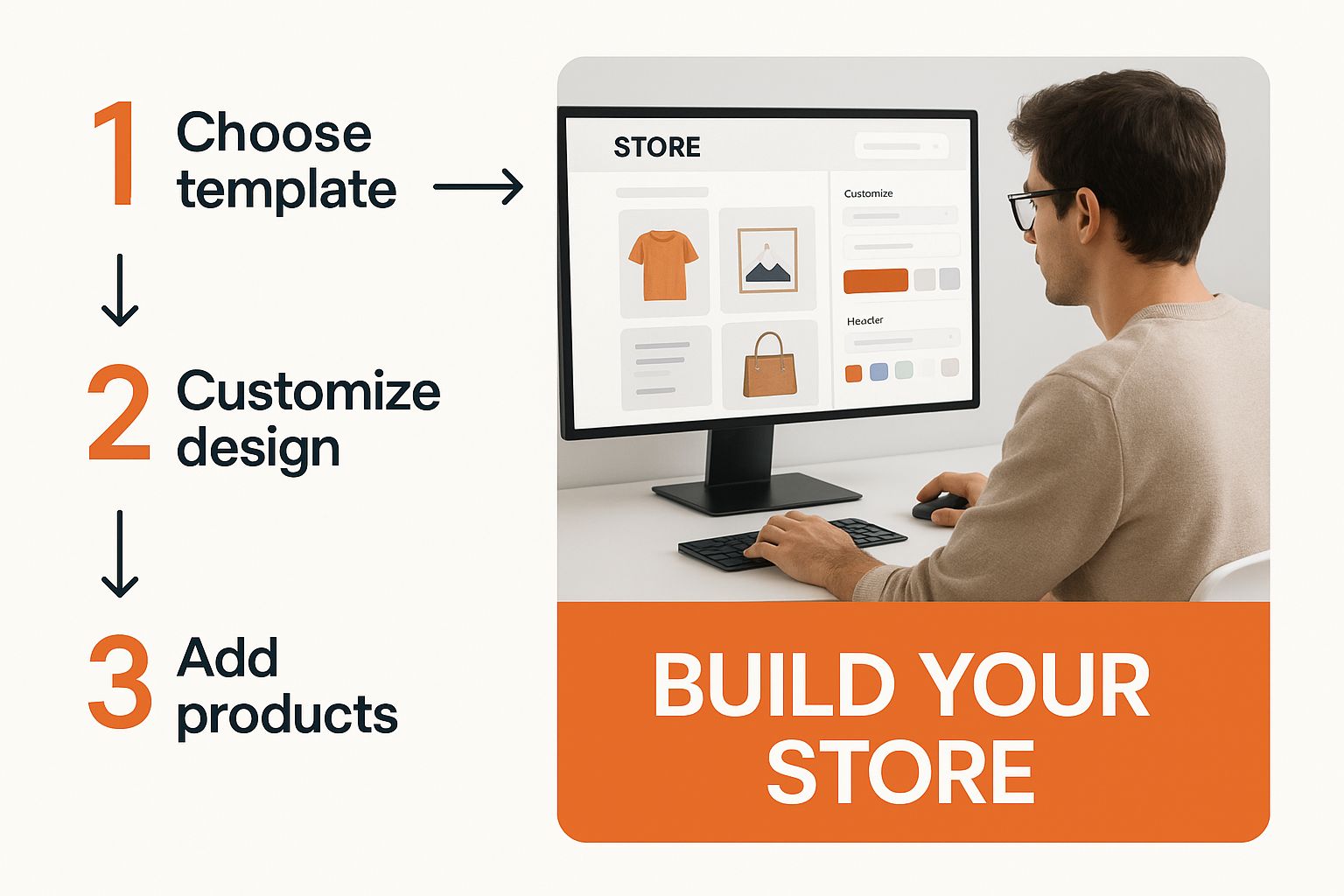
As you can see, a successful online shop begins with a solid plan. It’s all about nailing the user experience and having reliable systems in place before you even think about opening your virtual doors.
Choosing Your Primary Sales Platform
Your first big call is deciding where you’re going to sell. Every option has its own set of pros and cons that depend entirely on your budget, technical comfort level, and what you’re trying to achieve with your business. A huge part of this is understanding the nuts and bolts of setting up an ecommerce website, as this will likely be the heart of your entire online operation.
- Your Own E-commerce Website: This gives you total control. Your brand, your customer data, your design—it’s your piece of digital real estate. Best for: Building a long-term brand.
- Online Marketplaces: Think Jumia and Konga. These platforms give you immediate access to a huge, built-in audience that already trusts them. Best for: Quick access to a large audience.
- Social Commerce: Selling directly on Instagram and Facebook means you can engage with customers and make sales right where they’re already spending their time. Best for: Visual products and impulse buys.
Many businesses end up using a mix of these, but my advice is to start with one and master it before you spread yourself too thin.
Website Builder Showdown: Shopify vs. WordPress
If you’ve decided to build your own site, you’ll quickly find that two names dominate the conversation: Shopify and WordPress (using the WooCommerce plugin). They represent two completely different approaches to building a store.
| Feature | Shopify | WordPress + WooCommerce |
|---|---|---|
| Ease of Use | Incredibly beginner-friendly. It’s an all-in-one platform designed for simplicity. | Has a much steeper learning curve. You’ll need to get your hands dirty with the technical setup. |
| Cost | You pay a monthly subscription fee, plus transaction fees on sales. | The software itself is free, but you’ll pay for hosting, themes, and any premium plugins. |
| Control | You have less freedom to customise, but the trade-off is that everything just works. | You get complete creative control and endless flexibility. |
| Best For | Entrepreneurs who want a fast, simple, and reliable store without the technical headaches. | Business owners who want full control and are comfortable with a more hands-on approach. |
Practical Example: A fashion entrepreneur with zero coding experience would be wise to choose Shopify to get their brand online quickly. On the other hand, a tech-savvy founder selling digital courses might prefer the limitless customisation of WordPress to build a truly unique user experience.
Leveraging Marketplaces and Social Commerce
Remember, you don’t have to build everything from scratch. Tapping into existing platforms can be a very smart move, especially when you’re just starting out.
Selling on Jumia or Konga
Think of this as renting a stall in a massive, buzzing market. The number one benefit is the instant traffic—millions of Nigerians are already browsing these sites every day. The catch? You’re surrounded by direct competitors, you’ll pay a commission on every sale, and you have very little control over your branding. It’s a classic trade-off: visibility for autonomy.
Social Commerce on Instagram & Facebook
With features like Instagram Shopping, you can tag products directly in your posts and stories. This lets people buy straight from their feed, which is incredibly powerful for visual products like fashion, beauty, or food. Actionable Step: Once you have a Facebook Business Page, you can set up a “Shop” tab. Upload your products with prices and descriptions. When you post on Instagram, you can then tag these products, creating a seamless shopping experience.
My Takeaway: Your choice of sales channel should be guided by one simple question: where are my target customers most active? If your audience lives on Instagram, start there. If they hunt for deals on Jumia, you need to consider having a presence there.
Essential Elements of a Trustworthy Storefront
No matter which platform you end up choosing, there are a few things that are absolutely non-negotiable for building customer trust and actually making sales.
- A Memorable Domain Name: If you’re building a website, pick a domain name that’s short, easy to spell, and says something about your brand. A
.comor.com.ngis the standard you should aim for. - Clean, Professional Design: Your website’s design needs to be clutter-free. Use high-quality product photos (taken in good, natural light with your phone) and write clear, helpful descriptions. That first impression online is everything.
- Reliable Nigerian Payment Gateways: This is critical. You must integrate trusted payment processors. In Nigeria, solutions like Paystack and Flutterwave are the undisputed industry standards. They allow customers to pay securely with their cards, bank transfers, or USSD, which is a massive trust signal.
A Practical Marketing Plan to Get Your First Customers
So you’ve built a brilliant online store. That’s fantastic, but it’s only half the job. An amazing product without marketing is like hosting a party and forgetting to send out the invitations. The real work begins now: making sure your ideal customers actually know you exist.
Let’s get you into a growth mindset. This isn’t just about having a business; it’s about actively building one. We’ll walk through a mix of foundational strategies for long-term success and some quick wins to get that all-important initial momentum, even if you’re working with a tight budget.
Start with Search Engine Optimisation (SEO)
SEO sounds complicated, but the core idea is simple. It’s about helping people find you on Google when they’re already searching for what you sell.
When someone in Abuja types “organic skincare products” into Google, you want your store to pop up. This isn’t about paying for ads; it’s about earning your spot on the results page. The best way to do this from the ground up is through content marketing. This means creating genuinely helpful content that answers your audience’s questions.
Actionable Step-by-Step Guide to Content Marketing:
- Identify 5 questions your customers ask. Example (for leather sandals): “How do I clean leather sandals?” “What shoes to wear with an ankara dress?”
- Write a short blog post answering one of those questions. Make it genuinely helpful, not just a sales pitch. Use clear headings and photos.
- Share the post on your social media. Say, “Struggling with how to style your trad? We wrote a quick guide to help you out! Link in bio.”
- Repeat this process once a week. Over time, Google will see you as an authority and start showing your articles to people searching for these topics.
Use Social Media Ads Smartly
While organic content builds a foundation for the long haul, paid social media ads on platforms like Instagram and Facebook can give you an immediate boost. The trick is to be laser-focused with your targeting to avoid burning through your cash.
A Practical Step-by-Step Guide to Your First Facebook Ad:
- Go to Facebook Ads Manager. Select “Traffic” or “Sales” as your objective.
- Define Your Audience. Imagine you sell custom-fit Ankara dresses. Don’t just show your ad to every woman in Nigeria. Get specific:
- Location: Women in Lagos, Abuja, and Port Harcourt.
- Age: 25-45.
- Detailed Targeting (Interests): People who have shown interest in brands like Tiffany Amber, Lisa Folawiyo, or BellaNaija Weddings.
- Set Your Budget. Start small—even with ₦2,000 to ₦5,000 a day—to test which ads resonate.
- Create Your Ad. Use a beautiful, eye-catching photo or a short video of your product. Write a simple caption: “Tired of ill-fitting dresses? Get a stunning Ankara dress made just for you. Shop now and get 10% off.”
- Track and Optimize. After a few days, check which ad version gets the most clicks for the lowest cost. Turn off the losing ads and put more budget behind the winner.
Build Your Email List from Day One
Your email list will become one of your most precious assets. Why? Because you own it. Your social media following can disappear overnight if the platform changes its algorithm, but your email list is a direct line to people who have actively chosen to hear from you.
Actionable Step: Use a free tool like Mailchimp to create a simple pop-up form for your website. Offer a 10% discount on their first purchase or a free downloadable guide (e.g., “5 Ways to Style Your Scarf”) in exchange for their email address.
Once you have their email, you can build a real relationship. Send a warm welcome message, share behind-the-scenes stories, announce new products, and give them exclusive deals. It’s personal, direct, and consistently delivers one of the highest returns on investment in e-commerce.
Choosing Your Initial Marketing Channels
Deciding where to spend your time and money first can feel overwhelming. This table breaks down some popular options to help you make a strategic choice based on your specific business.
| Marketing Channel | Best For | Cost Level | Effort Level |
|---|---|---|---|
| Content/SEO | Building long-term authority and trust; great for niche products. | Low | High |
| Social Media Ads | Quick results, brand awareness, and driving targeted traffic. | Medium-High | Medium |
| Email Marketing | Nurturing leads and driving repeat purchases from loyal customers. | Low | Medium |
| Influencer Marketing | Building social proof and reaching highly engaged, specific audiences. | Low-Medium | Medium |
Ultimately, the best approach is a mix. Start with one or two channels, get comfortable, and then gradually expand as you grow.
Collaborate with Micro-Influencers
You don’t need to chase big-name celebrities with massive price tags. The real magic often lies with micro-influencers—creators with 5,000 to 50,000 followers. These influencers tend to have incredibly engaged communities that trust their recommendations.
Actionable Step:
- Find them: Search relevant hashtags on Instagram (e.g., #LagosMums, #NigerianFoodBlogger).
- Reach out: Send a polite DM or email. Introduce yourself and your brand, tell them why you love their content, and propose a collaboration.
- Offer value: Practical Example: “Hi [Name], I love your fitness content! I just launched a brand of healthy snacks made in Nigeria and I think your audience would love them. Would you be open to me sending you a complimentary box for you to try and possibly share if you enjoy it?” Many will happily collaborate for free products.
By weaving these strategies together—SEO, targeted ads, email, and influencer outreach—you create a robust system for attracting your first customers. As you grow, you’ll find that managing customer queries can become time-consuming. It’s worth exploring how AI chatbots in Nigeria can handle questions 24/7, freeing you up to focus on the bigger picture.
Managing Operations from Launch to Growth

Getting your first sale is an incredible feeling, but it’s also the starting gun for the real marathon. Your focus now pivots from the launch to the day-to-day rhythm of actually running your business. This is where the foundation for long-term success is laid, brick by brick. It’s all about building slick, repeatable processes for everything from keeping track of stock to making sure every customer walks away happy.
How you manage these daily tasks will ultimately define your brand’s reputation and your capacity to grow.
Smart Inventory Management
Right out of the gate, you’ll face a big question: how will you handle your products? This decision alone can dramatically shape your startup costs and daily workload. For new businesses, there are really two main paths to consider.
-
Self-Stocking: This is the classic approach. You buy your inventory upfront and store it yourself. It gives you total control over the quality of your products and how quickly they ship. Practical Example: A Lagos-based jewellery designer would keep all their beads, chains, and finished pieces in a dedicated box at home, ready to assemble and ship as orders come in. This is fantastic for quality control, but it does mean tying up cash at the start.
-
Dropshipping: This model flips the script—you don’t hold any stock yourself. When an order comes in, you simply forward it to a third-party supplier, who then ships the product directly to your customer. Practical Example: A tech gadget store could use a platform like AliExpress to list hundreds of phone cases on their website. When a customer buys a case, the store owner places the order on AliExpress with the customer’s shipping details, keeping the profit margin. This slashes initial investment.
Each path comes with its own set of pros and cons. Self-stocking generally means better profit margins and hands-on control, while dropshipping keeps your financial risk and operational headaches to a minimum.
Navigating Logistics in Nigeria
Getting your product to your customer efficiently is not just a nice-to-have; it’s everything. Here in Nigeria, logistics can genuinely make or break your online venture. A single botched delivery can quickly turn into a scathing review that scares off countless potential buyers.
Your mission is to find delivery partners who are genuinely reliable. Don’t just chase the cheapest quote. Look for companies with a solid reputation, positive customer feedback, and a transparent tracking system.
Partnering with a dependable local delivery service is one of the smartest investments you can make. It safeguards your brand’s reputation and ensures the fantastic customer experience you’ve worked so hard to create isn’t ruined at the final hurdle.
Actionable Step: Before committing to one logistics company, test two or three. Send small packages to friends in different parts of your city or state using companies like GIG Logistics or Kwik Delivery. Track how long each takes, the condition of the package on arrival, and the quality of their customer communication. Choose the one that performs best.
The Power of Customer Service
Never underestimate the power of brilliant customer service. It’s your secret weapon for turning a one-off buyer into a loyal advocate who raves about you to their friends. In a packed marketplace, the way you treat your customers is often your most potent differentiator.
This means being on the ball with inquiries, responding promptly and professionally whether they reach out via email, WhatsApp, or a comment on your social media page. Practical Example: When a customer complains about a delayed delivery, don’t just blame the logistics company. Respond with empathy: “I am so sorry to hear your order is delayed. I understand how frustrating that is. I am contacting the delivery company right now to get an update for you and will get back to you within the hour.” This shows you care and are taking ownership.
Using Data for Growth
Finally, if you want to scale, you have to listen to what your data is telling you. Your sales figures, website analytics, and customer feedback are a goldmine of actionable insights.
Actionable Step: At the end of each month, dedicate one hour to review your data.
- Check your sales platform: Which product was your top seller? Which one sold the least? This helps you decide what to restock and what to discontinue.
- Look at your social media insights: Which post got the most engagement (likes, comments, shares)? This tells you what kind of content your audience loves. Do more of that.
- Read customer feedback: Scan your DMs, emails, and reviews. If you get several requests for a product in a different colour or a specific size, that’s a massive clue about unmet demand. This data-driven approach takes the guesswork out of your growth strategy.
Frequently Asked Questions About Starting an Online Business in Nigeria
Embarking on a new online venture naturally brings up a lot of questions. If you’re a budding entrepreneur in Nigeria, you’re not alone in wondering about the practicalities. Let’s tackle some of the most common concerns head-on.
How Much Money Do I Really Need to Get Started?
This is the big one, isn’t it? The honest answer is, it truly depends on your business model. You could kick off a service business, like social media management or freelance writing, with next to nothing. All you really need are your skills and a smartphone.
If you’re leaning towards selling products, a dropshipping setup keeps costs low. Your primary expenses would be business registration and a website subscription, which could all come in under ₦50,000. On the other hand, if you plan to hold your own inventory, your startup capital will need to cover the cost of that stock.
The secret is to start lean. Don’t sink a ton of cash into an unproven idea. Instead, focus on creating a minimum viable product (MVP) to test the waters first. You don’t need a massive loan; you need proof that people actually want what you’re selling.
Can I Genuinely Run My Business Just from My Phone?
Absolutely! For many online businesses today, especially in the early stages, it’s completely feasible. Your smartphone can easily become your entire command centre.
Think about it: with powerful apps from platforms like Shopify for managing your store, and local payment gateways like Paystack for collecting money, the tools are right at your fingertips. A classic example is the Instagram vendor selling fashion accessories who handles everything—from posting new items and chatting with customers to confirming payments—all from their mobile device.
