
A manifesto is more than a mission statement; it’s a public declaration of your beliefs, intentions, and vision for the future. It’s a tool to rally a community, define a brand’s soul, or anchor your personal philosophy. Think of it as your North Star—a guiding document that cuts through the noise, creates alignment, and sparks real change.
This guide provides a step-by-step process for crafting a manifesto that resonates and inspires people to act.
What Is a Manifesto and Why Does It Matter?
A modern manifesto is a practical tool for anyone—an entrepreneur, a creative, a leader, or an individual seeking clarity. It forces you to answer the big questions: What do I truly believe? Why is this important? And what am I going to do about it?
In a world saturated with noise, a well-crafted manifesto slices through the clutter. It can unite a team around a shared purpose, define the very soul of a brand, or anchor your personal philosophy.
The word manifesto comes from the Latin “manifestum,” meaning clear or obvious. Its job is to make your position impossible to misunderstand.
The Three Core Types of Manifestos
Understanding how to write a manifesto begins with choosing the right framework. While all manifestos are bold statements, they serve different goals.
- Personal Manifesto: This is your personal constitution—a written record of your core values, non-negotiables, and the principles you intend to live by. It acts as a compass for decision-making.
- Brand Manifesto: This captures a company’s soul. It explains why the company exists beyond profit, articulating the change it aims to bring to its industry and giving employees and customers a reason to believe.
- Political or Social Manifesto: This is designed to inspire collective action. It outlines a vision for a better future, identifies flaws in the current system, and presents a clear plan for change.
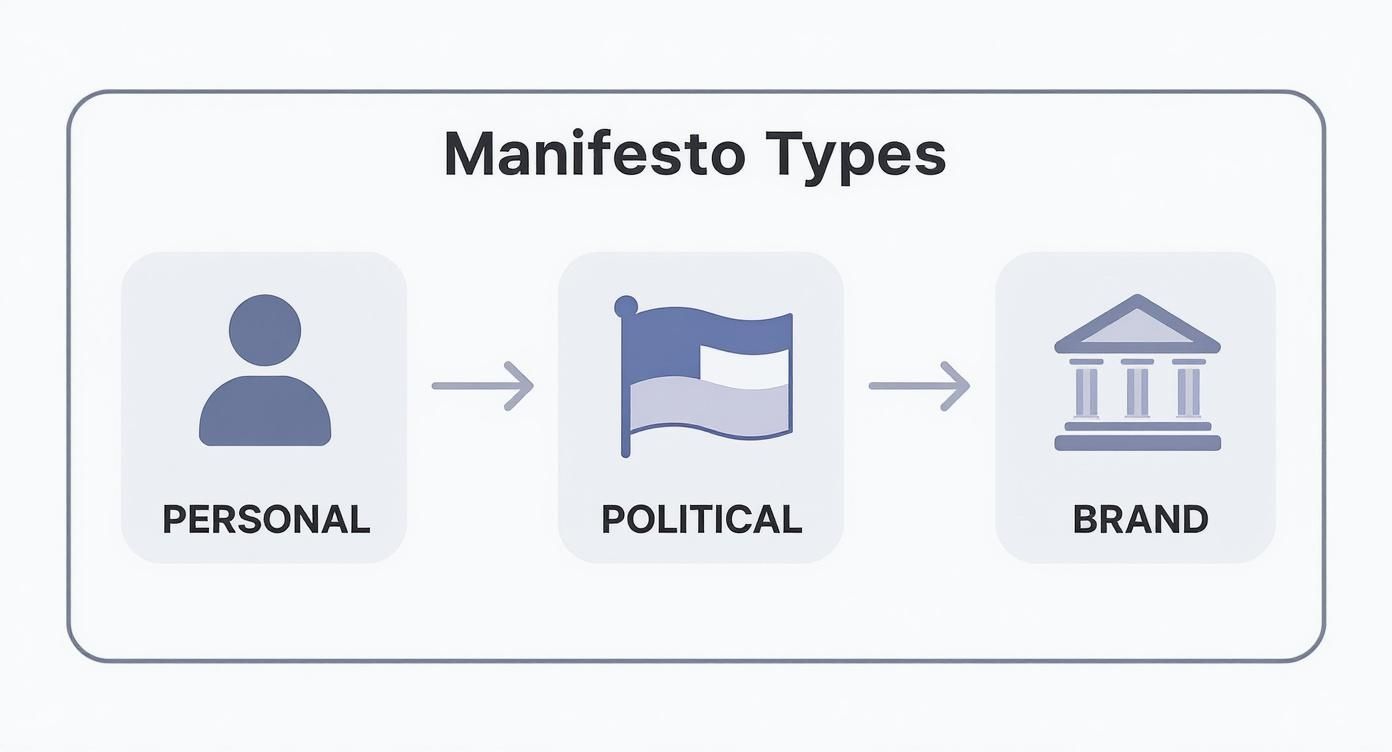
Alt text: Infographic showing the three main types of manifestos: Personal, Political, and Brand, each with a corresponding icon.
Choosing Your Manifesto Framework
Selecting the right framework clarifies your audience and message. This table breaks down the key differences to help you decide.
| Manifesto Type | Primary Goal | Core Focus | Real-World Example |
|---|---|---|---|
| Personal | To guide individual choices and actions. | Core values, life principles, personal mission. | Warren Buffett’s “2 List” strategy for focusing on what truly matters. |
| Political/Social | To inspire collective action and societal change. | A vision for a better society, critique of the status quo. | Martin Luther King Jr.’s “I Have a Dream” speech. |
| Brand | To define a company’s purpose and rally a community. | Why the company exists beyond profit, its unique beliefs. | Lululemon’s Manifesto, which focuses on wellness and personal growth. |
Practical Example: A Startup’s Brand Manifesto
Imagine a small, sustainable fashion startup. They’re not just selling clothes; they’re fighting industry waste. A brand manifesto is the perfect tool to declare their commitment to ethical production, challenge the fast-fashion model, and call on customers to think differently.
Their manifesto might include powerful statements like:
- “We believe clothes should outlast trends.”
- “Our materials honor the earth, from soil to stitch.”
- “We put the planet before profit, every time.”
This isn’t just marketing copy. It becomes their internal compass for every decision and turns their brand into a movement.
Step 1: Find Your Core Message
A manifesto that tries to be everything to everyone ends up being nothing. Before you write, you must get brutally honest about what you stand for. This foundational work is what separates a manifesto that resonates for years from one that’s forgotten tomorrow.

Alt text: A person at a desk using a mind map to brainstorm ideas for their manifesto, with sticky notes and a laptop.
Unearthing Your Fundamental Beliefs
Start by getting everything out of your head and onto paper without filtering. The goal is to spot recurring themes, frustrations, and passions.
- Mind Map Your Ideas: Put a central idea—like “My Vision for Tech” or “A Better Way to Work”—in the middle of a page. Let every connected thought spiderweb outwards. Don’t censor anything.
- Use the “Five Whys” Exercise: Start with a basic belief and repeatedly ask “Why?” to drill down to the core issue.
Practical Example: The Five Whys
Let’s apply this to a new belief:
- Statement: “I believe companies should adopt a four-day work week.”
- 1. Why? Because it improves employee well-being.
- 2. Why? Because more rest time reduces burnout and stress.
- 3. Why does that matter? Because burnt-out people aren’t creative or engaged.
- 4. Why is engagement important? Because real engagement leads to meaningful work, not just ticking boxes.
- 5. Why is that the core issue? Because the chance to do meaningful work is a fundamental human need that our current system often ignores.
Your core message just transformed from being about a shorter work week to a powerful stance on the human right to find meaning through work. This is the depth your manifesto needs. If you feel stuck, trying a few creative thinking exercises can help.
Identify Who You Are For (and Against)
A strong stance naturally creates a divide. It pulls in the people who get it and pushes away those who don’t. This is a good thing. Your message becomes sharper when you’re specific about who you’re fighting for and what system you’re fighting against.
Ask yourself:
- Who is my audience? Get specific.
- What is the “enemy”? This is usually an outdated idea, a broken system, an industry norm, or a shared frustration.
- What future am I building? Paint a clear picture of the world you want to create.
For example, a direct-to-consumer brand’s manifesto might be for customers who demand transparency and against the hidden markups of traditional retail.
Distill Your Ideas into Core Principles
Now, boil everything down into 3-6 clear, actionable statements that summarize your worldview. These principles will be the pillars of your manifesto. This requires the sharp focus of an expert; it might be helpful to understand what subject matter experts are and how they think.
Practical Example: Principles for a Personal Manifesto
For a personal manifesto on creative independence, your principles might be:
- Create for the process, not the prize.
- Share work generously, with no strings attached.
- Say no to anything that compromises integrity.
- Build a community, not just an audience.
- Treat rest as a non-negotiable part of creating.
These principles are direct, simple, and provide a clear framework for action.
Step 2: Structure Your Manifesto for Impact
A powerful idea with a weak structure falls flat. Aim for a narrative arc that hooks your reader, shifts their perspective, and spurs them to action. Most effective manifestos follow a simple three-part pattern: Problem, Vision, and Call to Action.
Think of it as diagnosing the pain, revealing the cure, and writing the prescription.

Alt text: A blueprint or architectural drawing illustrating the structure of a document, with boxes for intro, body, and conclusion.
The Problem: The Unsettling Hook
Start by challenging the status quo. Identify the “enemy”—an outdated practice, a lazy assumption, or a societal norm that no longer works. Your opening needs to create tension and make the audience recognize the problem you’re about to solve.
- Ask a provocative question: “What if everything we believe about productivity is holding us back?”
- Make a bold declaration: “The era of mindless consumption is over.”
- Tell a relatable story: Start with an anecdote about a frustration your audience has felt.
The goal is to get your reader thinking, “Yes, that’s exactly it!”
The Vision: The Better Future
Once you’ve established the problem, paint a vivid picture of the alternative. This is the heart of your manifesto. Weave in your core principles not as a list, but as the foundational laws of this new world. Much like you define a company’s character when you learn how to write a business profile, you’re setting the tone for a movement.
Practical Example: The Agile Manifesto
The authors of the Agile Manifesto brilliantly framed their vision as a series of value comparisons: “We are uncovering better ways of developing software… Through this work we have come to value: Individuals and interactions over processes and tools… Working software over comprehensive documentation…” This structure powerfully contrasts the old way (the problem) with their new vision.
The Call to Action: The Final Push
A manifesto without a call to action is just a philosophical essay. You must end by telling the reader what to do with the energy you’ve stirred up. Make this final section direct, unambiguous, and empowering.
The action should match the manifesto’s scale:
- Personal: “Commit to living by these principles every day.”
- Brand: “Join our community and demand better from our industry.”
- Social: “Sign the petition. Share this message. Show up on Tuesday.”
Your final sentence should be your most memorable line—short, active, and impossible to forget. It turns a passive reader into an active participant.
Step 3: Craft a Voice That Commands Attention
With a solid structure, it’s time to focus on how you say it. Your voice is the soul of your manifesto; it’s what transforms a list of principles into a declaration people feel. The tone must be an authentic reflection of you, your brand, or your movement.
Finding Your Authentic Tone
You don’t invent your tone; you uncover it. It’s already in your core beliefs. If your manifesto rails against corporate jargon, it shouldn’t be filled with it.
Here’s a step-by-step process to find your voice:
- Record Yourself: Grab your phone and speak about your core principles for two minutes. No script. Just talk as if you’re explaining it to a friend.
- Transcribe and Analyze: Use a transcription tool to get your words on paper. Read what you said. What words did you use? Were they simple or academic? Metaphorical or factual? This is the raw material of your authentic voice.
This exercise helps you sound like a person, not a corporate robot, similar to the goal when you how to write an informal letter.
Wielding Words with Purpose
Once you have a feel for your tone, sharpen it with specific writing techniques.
Always Use the Active Voice
The active voice is direct, confident, and energetic. It assigns responsibility and creates momentum.
- Passive: “A new way of thinking is needed by us.”
- Active: “We need a new way of thinking.”
The active version is a command, a statement of intent—exactly what a manifesto should be.
Practical Example: A Tech Startup’s Manifesto
Imagine a tech startup focused on data privacy. Their core belief: “Your data should belong to you.”
Draft 1 (Weak Voice):
“It is believed that user data should be handled with more respect by corporations. Our platform is designed to provide better security protocols. We think that transparency is a good policy for companies to have.”
This is passive and forgettable. There’s no fire.
Draft 2 (Commanding Voice):
“Your data is not a product. We reject a world where your privacy is sold to the highest bidder. We build tools that put you back in control. We demand transparency. We are drawing a line in the sand. Join us.”
This version is electric. It uses:
- Short, punchy sentences.
- Powerful verbs like “reject,” “build,” and “demand.”
- Repetition (“We…”) to create a rhythmic, chant-like momentum.
This is a voice that commands attention.
Step 4: Refine Your Draft
A first draft is raw clay. The real work is shaping it into a polished, powerful declaration. This process involves sharpening your arguments, trimming the fat, and ensuring every sentence lands with force. Break it down into focused passes to avoid getting overwhelmed.

Alt text: A person editing a document on a laptop, with a red pen and printed pages next to them, signifying the revision process.
The Read-Aloud Test
Before editing, read your entire manifesto out loud. Your ears will catch what your eyes miss: awkward phrasing, clunky sentences, and anywhere the rhythm falls flat. If you stumble over a sentence, it needs a rewrite. This simple act ensures a more human, conversational tone.
The Three-Pass Revision Process
- Clarity Edit: Your first pass is solely about clarity. Is your core message obvious? Have you removed all jargon? Are your sentences concise? Hunt down ambiguity and destroy it.
- Impact Edit: Your second pass is about adding emotional punch. Strengthen your verbs (e.g., change “a decision was made” to “we decided”). Sharpen your opening and closing lines. Vary sentence length to create a compelling rhythm. The goal is to move from a document that informs to a declaration that inspires.
- Conciseness Edit: The final pass is about being ruthless. A powerful manifesto is lean. Delete filler words (“really,” “very,” “in order to”). Cut redundant sentences. Challenge every word: “Is this essential?” If not, it goes.
Honing these elements is a key part of writing, and you can always find more ways to improve your writing skills. As you finalize, consider how it will be packaged, much like refining a document for public consumption in this guide on how to create an ebook.
Step 5: Share Your Manifesto
A manifesto is a public declaration. Once polished, your job shifts from writer to launcher. The goal is to get your message in front of the right people and turn words into a living movement.
Create a Home for Your Manifesto
Your manifesto needs a permanent, shareable online address. A dedicated landing page on your website is ideal. This gives you a central link to share and track.
Your manifesto hub should include:
- The full text, formatted for readability.
- A downloadable PDF version.
- Prominent social media share buttons.
- A short video of you or your team reading it aloud for greater impact.
Data from the Manifesto Project website shows that online publication directly drives engagement and sharing, a strategy adopted by the majority of modern political parties.
Launch Your Declaration
Treat the release like a product launch. Build anticipation by teasing key lines or principles on social media for a few days before the big reveal. A manifesto launch is about starting a conversation.
Consider creating a simple media kit, which makes it easy for others to spread your message accurately. You can find inspiration from these media release examples.
Finally, live your manifesto. Embed its principles into everything you do—social media content, email newsletters, and public talks. This proves it’s more than just words; it’s the code you operate by.
Actionable Takeaways
- Start with Why: Use the “Five Whys” exercise to dig deep and find the emotional core of your message before you write a single word.
- Structure for Clarity: Build your manifesto around the “Problem, Vision, Call to Action” framework to create a logical and persuasive narrative.
- Use the Active Voice: Write with direct, commanding language. Replace passive phrases like “it is believed” with “we believe” to convey conviction.
- Edit in Three Passes: Revise your draft systematically: first for clarity, then for impact, and finally for conciseness.
- Create a Launch Plan: Don’t just publish. Build a dedicated landing page, tease the release, and make your manifesto easy to share.
Tools & Resources
- Writing & Editing:
- Hemingway App: Helps you spot passive voice and complex sentences to improve clarity.
- Grammarly: Catches grammatical errors and offers suggestions for tone and conciseness.
- ProWritingAid: An in-depth editing tool with detailed reports on style and readability.
- Brainstorming & Voice:
- Otter.ai: Transcribes your spoken thoughts, helping you capture your authentic voice.
- Design & Sharing:
Further Reading & References
Answering Your Lingering Questions
Here are answers to common questions that arise when writing a manifesto.
What’s the Perfect Length for a Manifesto?
There isn’t one. The goal is impact and clarity, not word count. Some of the most powerful manifestos are under 500 words. It’s better to write one powerful page that people remember than a ten-page document they skim. Focus on making every word count.
Can We Write This as a Team?
Yes, and for organizations, it’s often necessary. A collaborative approach ensures buy-in.
Follow this step-by-step process:
- Hold a Workshop: Gather key stakeholders to brainstorm and align on core beliefs and purpose.
- Designate a “Penholder” Group: Assign a small group (2-3 people) to write the first draft. This prevents a “design by committee” outcome.
- Gather Feedback: Share the draft with the wider team for input and refinement.
This method combines collective ownership with a focused writing process.
Should I Ever Update My Manifesto?
Yes. A manifesto should be a living document. While your core principles should remain steady, the world changes. Reviewing it periodically keeps it relevant. A brand might review its manifesto annually; an individual might do so every few years. The goal is evolution, not a constant identity crisis. You should only consider a complete rewrite if your entire mission has fundamentally changed.
Ready to bring your ideas to life? With RichlyAI, you can generate compelling text, stunning visuals, and even code with a single click. Start creating faster and smarter by signing up for your free plan at RichlyAI Hub.
