
Too many enterprise AI projects die after pilot stage, leaving investment and insights on the table. Here’s how to break that pattern.
We’ve all seen the dazzling AI demos. The ones that promise to completely change how a business operates. Yet, an astonishing number of these projects never make it out of the lab. As analysts at VTN an estimated 80% of AI pilots fail to reach production. They get stuck in what’s grimly known as “pilot purgatory.”
This happens because there’s a massive difference between a successful proof-of-concept (PoC) in a controlled setting and a reliable, scalable system that works in the messy reality of your actual business. Understanding this gap is the first and most critical step toward building an enterprise AI strategy that actually delivers value in 2026.
Key Takeaways for Decision-Makers
- 80% of AI Pilots Fail: Most AI proofs-of-concept never reach production, often getting stuck in “pilot purgatory” due to a lack of strategic planning.
- Strategy > Tools: Successful AI deployment starts with a clear business problem and measurable KPIs, not with chasing the latest technology.
- Data is the Foundation: Poor data quality is the silent killer of AI projects. A solid data foundation with clear governance is non-negotiable.
- MLOps & Governance Are Mandatory: Build with automation, monitoring, security, and compliance from day one. They cannot be bolted on later.
- Scale After Proving ROI: Pilot with real users, measure the impact against your KPIs, and only then scale the solution across the organization.
Why Most Enterprise AI Projects Fail After the PoC Stage
Too many organizations fall into the same predictable traps, dooming their AI initiatives before they ever see a return. The road from a promising demo to a production-ready tool is littered with obstacles, but the good news is, they’re almost always avoidable if you know what to look for.

Alt text: Two professionals brainstorming enterprise AI strategies in an office, using a whiteboard covered with sticky notes and a laptop.
Data Readiness Goes Beyond Storage
Enterprise AI initiatives often fail not because of model quality, but because of inconsistent or poorly governed data. Teams should implement formal data quality frameworks that track completeness, accuracy, timeliness, and lineage. Without measurable data standards, production deployments quickly become unreliable and difficult to scale.
Metadata management is equally important. Maintaining catalogs, ownership tags, and lineage tracking helps teams understand where data originates and how it flows through models, which reduces risk during audits and future updates.
The “Demo Trap” and Tool-First Thinking
The most common failure pattern is the “demo trap.” It starts when a team builds a PoC using a perfectly clean, curated dataset. It works flawlessly. But the moment it’s exposed to real-world, chaotic data streams, the model’s performance completely collapses.
This is usually a symptom of tool-first thinking—getting excited about a trendy new AI model and then searching for a problem to solve with it.
Practical Example: The Chatbot That Couldn’t Chat
A retail company spent months building a sophisticated customer service chatbot PoC. In demos using a pre-written script, it was brilliant. But once it went live, it failed spectacularly. It couldn’t grasp regional slang, misspelled product names, or the complex, multi-part questions real customers were asking. The project was shelved because it was designed for perfect data, not real people. The takeaway: Start with the real-world problem and its messy data, not the shiny tool.
Poor Data Quality and No Ownership
You can have the most advanced algorithm in the world, but it’s useless if you feed it garbage data. According to IBM, poor data quality costs the U.S. economy up to $3.1 trillion annually.
Inconsistent, incomplete, or biased data is the silent killer of AI projects. This problem gets worse when no one truly owns the data. When there isn’t a clear owner, data issues fester until they derail the entire project.
Modern AI infrastructure stack
From a tooling perspective, enterprises should adopt mature MLOps platforms that support automated training, deployment, and monitoring. Solutions such as AWS SageMaker, Azure Machine Learning, and Kubeflow provide CI/CD-style pipelines that move models from experimentation to production reliably.
These platforms also enable version control, rollback capabilities, and continuous performance monitoring — all critical for enterprise-grade stability.
Security, Compliance, and Lack of ROI Measurement
Security and compliance can’t be bolted on at the end. A model trained on sensitive customer data without proper governance is a massive liability. Countless projects get shut down by legal or compliance teams late in the game because these factors were ignored early on.
Ultimately, an AI project without a clear path to value is just an expensive science experiment. The industry is feeling this disconnect firsthand. While 70% of organizations have dabbled in generative AI, only a mere 21% have managed to integrate it across the enterprise, often because of a major skills gap.
If these challenges sound familiar, you might find our article on separating AI hype from value a useful read.
What “Production-Ready AI” Actually Means in 2026
“Production-ready” AI isn’t about flashy demos. It’s about building a system your business can depend on—one that delivers real, measurable value under the messy pressures of the real world. Think of it less like a science experiment and more like core operational infrastructure.
For any AI system to be considered truly production-ready in 2026, it must be built on these non-negotiable pillars:
- Reliability: The system generates predictable, accurate, and consistent outputs every time.
- Scalability: The system handles growing workloads without performance degradation, scaling from 100 users to 100,000 seamlessly.
- Monitoring: You have continuous, real-time visibility into model performance, health, and data inputs to catch issues like model drift before they impact the business.
- Governance: The system operates within a strict framework of security, compliance (like GDPR or SOC2), and ethical boundaries, with fully auditable decisions.
- Measurable Business Value: The system is directly wired to a key business metric, like reducing operational costs or boosting revenue.
Production-Ready AI Maturity Checklist for 2026
Use this checklist to assess if your AI initiative is prepared for a successful transition from PoC to full production deployment.
| Maturity Pillar | Criteria for Production Readiness | Status (Not Started, In Progress, Ready) |
|---|---|---|
| Reliability | The model’s performance is consistent and accurate across diverse, real-world data inputs, not just clean training data. | |
| Scalability | Your infrastructure is designed to automatically scale resources up or down to meet fluctuating user demand without manual intervention. | |
| Monitoring | Automated alerts are configured to immediately notify the team of performance degradation, data drift, or system health issues. | |
| Governance | Clear, immutable audit trails exist for all model predictions and data access, ensuring you can meet compliance requirements. | |
| Business Value | The AI’s impact is directly tied to specific, measurable KPIs that the business has agreed upon and is actively tracking. |
If you find yourself marking “Not Started” or “In Progress,” it’s a signal to address those gaps. For teams exploring more complex architectures, our deep dive on multi-agent AI systems in our detailed guide can provide additional context.
The 7-Step Framework to Move AI From PoC to Production
Moving a promising AI PoC into production isn’t a one-time handoff; it’s a repeatable playbook that integrates business goals, data readiness, and technical execution from day one. Here’s a step-by-step framework for a successful AI production deployment.
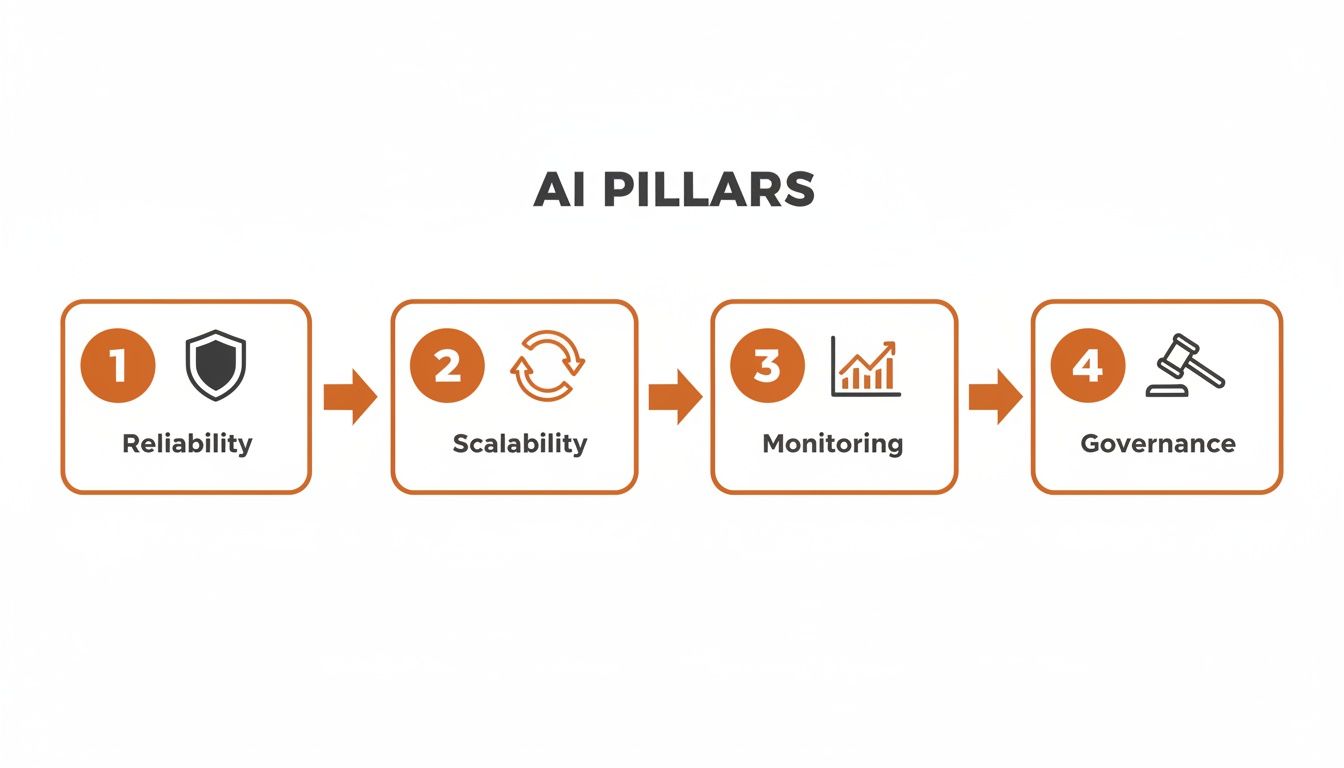
Alt text: A diagram illustrating the four pillars of production AI: Reliability, Scalability, Monitoring, and Governance.
Step 1 — Start With Business Outcomes (Not Models)
Every successful AI initiative starts by answering: “What business problem are we solving?” Before writing any code, define the specific, measurable outcome.
Actionable Insight: Define your project’s goal in a single sentence: “We will use AI to [achieve X measurable outcome, e.g., reduce customer support ticket resolution time by 20%] for [Y business unit], which will save [Z dollars or hours].” This clarity aligns everyone from engineers to executives.
Step 2 — Audit & Prepare Your Data Foundation
An AI model is only as good as its data. Conduct an honest audit of your data landscape.
How to do it (step-by-step):
- Map Data Sources: Identify all systems where relevant data lives (CRM, ERP, logs, etc.).
- Assess Quality: Profile the data for completeness, accuracy, and consistency. Use data quality tools to identify gaps.
- Establish Pipelines: Build automated, reliable pipelines to ingest, clean, and transform data for model consumption.
- Define Governance: Assign clear ownership for each data source and establish rules for access and usage.
Step 3 — Choose the Right Architecture
Decide whether to build a custom model, use a SaaS product, or integrate with an API. This decision impacts cost, speed, and competitive advantage. (See our “Build vs. Buy vs. Integrate” section for a detailed matrix).
Step 4 — Build With MLOps & Automation From Day One
Treating model deployment as a one-time handoff is a recipe for failure. An MLOps framework is essential for automating the entire lifecycle.
Actionable Insight: Implement CI/CD (Continuous Integration/Continuous Deployment) for your models. This means creating automated workflows for data validation, model training, testing, and deployment, ensuring a repeatable and reliable process.
Step 5 — Integrate Security, Compliance & Risk Controls
Security can’t be an afterthought. Involve your security and compliance teams from the start.
How to do it (step-by-step):
- Data Classification: Identify and tag sensitive data (like PII) that the model will use.
- Access Control: Implement role-based access controls for data, models, and infrastructure.
- Pre-deployment Review: Create a formal sign-off process with legal, compliance, and security before any model goes live.
Align with regulatory frameworks
Enterprises must design AI systems with regulatory requirements in mind from day one. Frameworks such as GDPR, HIPAA, and emerging AI governance standards require strict controls around data privacy, consent, and traceability. Embedding compliance early prevents costly redesigns and reduces legal exposure during audits or investigations.
Step 6 — Pilot With Real Users (Not in a Sandbox)
A lab environment can never replicate real-world chaos. Pilot your solution with a small, controlled group of actual end-users.
Use techniques like shadow deployments (running the model silently in the background) or A/B testing to compare its performance against your current process. The feedback is invaluable.
Step 7 — Scale Gradually Across the Organization
Once the pilot proves its value against your original KPIs, plan a phased rollout. Create playbooks, run training sessions, and actively manage the organizational change to ensure adoption. For more hands-on guidance, check out our guide on how to implement AI in your business.
Cross-Functional Teams
Successful AI programs depend on clearly defined responsibilities. Data engineers focus on building and maintaining pipelines, MLOps engineers manage deployment and monitoring infrastructure, data scientists develop and validate models, and product managers align solutions with business outcomes. Without this role clarity, ownership gaps slow production releases and increase operational risk.
Example team structure
A typical enterprise AI team might include:
• 1–2 Data Engineers (pipelines and warehousing).
• 1–2 Data Scientists (model development and evaluation).
• 1 MLOps Engineer (deployment and monitoring).
• 1 Product Owner (business alignment and KPIs).
• 1 Compliance or Risk Lead (governance oversight).
Clear accountability ensures models don’t stall between experimentation and deployment.
Enterprise AI Stack for 2026 (Reference Architecture)
A successful enterprise AI strategy requires a well-designed technology stack. This isn’t about chasing the flashiest tools; it’s about assembling a cohesive architecture where each layer has a critical job.
Alt text: A modern workspace with a laptop displaying an ‘Enterprise AI Stack’ banner, representing a well-organized AI technology architecture.
Data Layer
This is your foundation. It’s responsible for storing, processing, and managing the data your models consume.
- What it does: Data warehousing, data lakes, ETL/ELT pipelines, feature stores.
- Example Tools: Snowflake, Google BigQuery, Databricks, Amazon S3.
Model Layer
This is the engine room where algorithms are built, trained, and fine-tuned.
- What it does: Model development, training, fine-tuning, experimentation.
- Example Tools: Hugging Face, OpenAI API, Anthropic, TensorFlow, PyTorch.
Application Layer
This layer bridges your AI’s intelligence to the end-user, integrating it into business processes.
- What it does: Serves model predictions, powers user interfaces, integrates AI into workflows.
- Example Tools: Custom apps (React, Vue), LangChain, LlamaIndex, Retool.
Monitoring Layer
Your early warning system. It tracks model accuracy, data drift, and system health in real-time. Neglecting this is a primary reason for post-launch failure.
- What it does: Observability, performance tracking, drift detection, alerting.
- Example Tools: Arize AI, WhyLabs, Datadog, Grafana.
Explainability and auditability
Production AI systems should be explainable and auditable. Decision logs, model versioning, and feature attribution tools allow organizations to justify outcomes and detect bias. These practices are especially critical in regulated industries such as healthcare, finance, and insurance, where automated decisions directly affect customers.
Governance Layer
These are the guardrails. This layer provides audit trails, manages access controls, and catalogs data and models to ensure security and compliance.
- What it does: Data and model cataloging, access control, compliance tracking, lineage.
- Example Tools: Collibra, Alation, Privacera.
For a closer look at specific solutions, explore our list of AI tools for business automation.
Real-World Use Cases That Successfully Reached Production
Here are five common enterprise AI use cases and the key factors that enabled them to move from PoC to production.
- Customer Support Automation: Succeeded by starting with a narrow, high-volume problem (e.g., “password reset” requests), which allowed for clean training data and a clear ROI calculation based on deflected tickets.
- Document Processing: Succeeded by integrating human-in-the-loop validation. The AI handles 80% of invoice data extraction, and a human operator quickly verifies the exceptions, ensuring high accuracy while still achieving massive efficiency gains.
- Internal Copilots: Succeeded by focusing on a well-defined internal knowledge base (like Confluence or SharePoint). This constrained the data source, reduced hallucinations, and provided immediate value to employees searching for company information.
- Fraud Detection: Succeeded by implementing robust real-time monitoring. The team continuously tracks model performance and has automated alerts for sudden changes in transaction patterns, allowing for rapid retraining.
- Marketing Personalization: Succeeded because the team directly tied the model’s recommendations to A/B tests measuring conversion rates and customer lifetime value, proving its financial impact.
Common Mistakes That Kill Enterprise AI Rollouts
- Chasing Hype: Picking a technology (e.g., the newest LLM) before clearly defining the business problem it solves.
- Overbuilding Custom Models: Spending a year building a custom sentiment analysis model when a high-quality API could have delivered 95% of the value in a week.
- Ignoring Change Management: Rolling out a powerful new tool without training users or redesigning workflows, leading to poor adoption.
- Skipping Monitoring: Deploying a model and assuming it will work perfectly forever, only to have its performance silently degrade over time due to data drift.
- Vendor Lock-In: Building your entire AI strategy around a single proprietary platform, limiting your flexibility as technology evolves.
Budgeting & ROI: How to Justify Enterprise AI Investments
Every AI project needs a rock-solid business case that speaks the language of the C-suite: numbers.
Cost Categories to Include
A realistic budget goes beyond the initial build.
- Talent: Salaries for data scientists, ML engineers, and project managers.
- Infrastructure: Cloud compute (especially GPUs), data storage, and networking.
- Data: Costs for acquisition, cleaning, and labeling.
- Software & Licensing: Fees for MLOps platforms, API calls, or SaaS tools.
- Maintenance & Monitoring: Ongoing operational costs for retraining and system management.
ROI Formulas and a Sample Business Case
The core formula is simple: ROI (%) = ( (Gain from Investment – Cost of Investment) / Cost of Investment ) x 100
Sample Business Case Template: Automating Invoice Processing
- Problem: Our accounts payable team spends 400 hours per month manually processing 10,000 invoices, costing us $20,000/month in labor and leading to a 5% error rate.
- Solution: An AI document processing tool that will automate 80% of this work, reducing manual effort to 80 hours/month.
- Cost Breakdown (Year 1):
- Software License: $30,000
- Implementation & Training: $10,000
- Total Cost: $40,000
- Projected ROI:
- Annual Labor Savings: ($16,000/month * 12) = $192,000
- Gain from Investment: $192,000
- ROI = (($192,000 – $40,000) / $40,000) * 100 = 380%
- Payback Period: 2.5 months
Presenting a clear case like this transforms your project from a “cost center” into a strategic investment. Highlighting these advantages is non-negotiable, and digging into the specific benefits of leveraging AI in app development can give you more concrete examples.
Governance, Risk & Compliance in the AI Regulation Era
As AI becomes more embedded in business, AI governance 2026 is moving from a best practice to a regulatory necessity. A strong governance framework is crucial for responsible operationalizing AI.
- Internal AI Policy: Establish a clear, company-wide policy that defines acceptable use cases, ethical guidelines, and review processes for all AI projects.
- Audit Trails: Ensure every model prediction can be traced back to the data, model version, and inputs that produced it. This is critical for accountability and debugging.
- Model Explainability: For high-stakes decisions (e.g., credit scoring), use techniques (like SHAP or LIME) to explain why a model made a particular decision.
- Human Oversight: Define clear points in the process where a human must review and approve AI-driven decisions, especially in sensitive applications.
- Vendor Risk: If you use third-party AI tools, rigorously vet their security, compliance, and data privacy practices. The risk doesn’t disappear when you use a vendor.
Build vs Buy vs Integrate: Choosing the Right Approach
Getting this strategic decision right is critical for moving from PoC to production.
Decision Matrix: Build vs. Buy vs. Integrate AI Solutions
This matrix compares the three main approaches to implementing enterprise AI.
| Factor | Build (Custom) | Buy (SaaS) | Integrate (API) |
|---|---|---|---|
| Speed to Value | Slowest | Fastest | Fast |
| Total Cost | Highest | Predictable (Subscription) | Moderate (Usage-based) |
| Customization | Full | Low | Medium |
| Competitive Edge | High Potential | Low | Medium Potential |
| Maintenance | High (Internal Team) | Low (Vendor Managed) | Low |
A mature enterprise AI strategy will likely use a mix: build your core, proprietary recommendation engine; buy a tool for sales forecasting; and integrate with a foundation model to power your chatbot.
Enterprise AI Implementation Checklist
Use this checklist to ensure your project is on the path to production.
- Clear Business Case: The problem is defined, and success is tied to a measurable KPI.
- Data Readiness: Data sources are identified, quality is assessed, and pipelines are in place.
- MLOps Foundation: A plan for CI/CD, versioning, and automated deployment exists.
- Security & Compliance: Security and legal teams have been involved from the start.
- User Training Plan: A strategy exists to train end-users and manage organizational change.
- Monitoring Strategy: A plan is in place to track model performance, drift, and system health post-launch.
- ROI Tracking: A mechanism is in place to measure the project’s business impact against the original KPIs.
Key Takeaways
- Define measurable business outcomes early.
- Prepare data and infrastructure for scale.
- Build cross-functional teams with clear ownership.
- Embed governance and compliance from Day 1.
- Use MLOps for reliable production pipelines.
Frequently Asked Questions
How long does it take to move AI to production?
A realistic window to get a well-defined AI project from proof-of-concept to its first production deployment is typically six to nine months. The PoC may take weeks, but data preparation, building resilient MLOps pipelines, and passing security reviews constitute the bulk of the timeline.
What is the success rate of AI pilots?
Industry data suggests that only about 20% of AI proofs-of-concept ever make it into a live production environment. Failures are rarely due to the algorithm itself but rather to poor data quality, unclear business objectives, or a lack of planning for operational realities.
What is MLOps?
MLOps (Machine Learning Operations) is a set of practices that combines machine learning, data engineering, and DevOps to automate and manage the entire lifecycle of an AI model. It provides the framework for building, deploying, and monitoring models in a reliable, repeatable, and scalable way.
How much does enterprise AI cost?
The budget for an enterprise AI project can range from $50,000 for a focused pilot to millions for a complex custom system. The biggest cost drivers are talent (ML engineers, data scientists), cloud compute resources (especially GPUs), data acquisition and labeling, and software licensing or API fees.
When should we build vs buy an AI solution?
Build a custom model only when the capability is a core, unique competitive advantage. Buy a SaaS solution for common business problems where speed-to-value is critical. Integrate via APIs to leverage powerful foundation models without the overhead of building them from scratch.
Risk assessment practices
Regular risk assessments help teams identify operational, ethical, and security risks before deployment. Techniques such as model stress testing, failure scenario analysis, and bias evaluation provide guardrails that ensure AI systems remain safe and reliable at scale.
Final Thoughts: From Experimentation to Enterprise Advantage
Moving AI from a promising experiment to a core business capability is the defining challenge for enterprises in 2026. Success is no longer about having the cleverest algorithm; it’s about disciplined execution.
The organizations that win will be those that master the strategic trifecta of starting with business value, building on a solid data and MLOps foundation, and managing AI as a product, not a project.
Next Steps You Can Take Today:
- Audit Your AI Readiness: Use the checklists in this guide to perform an honest assessment of your current capabilities.
- Explore Key Tools: Investigate the MLOps and governance tools mentioned to understand the modern AI stack.
- Deepen Your Knowledge: Check out our other guides on AI strategy to continue learning.
Ready to move your AI projects from the drawing board to real-world impact? At RichlyAI, we provide the tools and resources to help you build, discover, and implement AI solutions that drive real business value. Explore our platform and see how we can accelerate your journey. Find your solution at RicglyAI.
