
The year 2026 marks a pivotal moment where artificial intelligence transitions from a promising technology to a core business function. The rapid acceleration of AI applications has created a strategic demand from businesses globally, moving beyond experimental pilots to full-scale integration.
This article explores the AI trends verified by analysts from Deloitte, CompTIA, and IBM, focusing on practical applications in multi-modal AI, ethical governance, digital twins, shadow AI, and AI democratization that are shaping the competitive landscape.
According to research and forecasts from Capgemini, IBM, and Deloitte, AI adoption is shifting from experimentation to enterprise-scale transformation. IBM reports that more than one-third of enterprises now deploy AI in core workflows.
Sources include industry analyst reports, enterprise technology forecasts, and global consulting research.
Analyst & Enterprise Context
- Capgemini (AI as enterprise backbone) https://www.capgemini.com/insights/research-library/top-tech-trends-of-2026/
- IBM (AI tech trends predictions for 2026) https://www.ibm.com/think/news/ai-tech-trends-predictions-2026
- Deloitte (AI breakthroughs shaping 2026) https://www.deloitte.com/us/en/what-we-do/capabilities/applied-artificial-intelligence/blogs/pulse-check-series-latest-ai-developments/new-ai-breakthroughs-ai-trends.html
AI in 2026: The Strategic Business Imperative
AI adoption is no longer a question of if but how. Enterprise AI use is surging, with leaders prioritizing strategic transformation over mere tool acquisition. According to IBM’s Global AI Adoption Index, 42% of enterprise-scale companies have actively deployed AI, with many more in the exploration phase.
CEOs and CIOs are championing investments that integrate AI into core workflows, aiming for measurable gains in efficiency, innovation, and customer value. Projections from analysts like Deloitte and CompTIA indicate that by 2026, AI maturity will be a key differentiator, separating market leaders from laggards.
Core AI Trends Shaping Business and Technology
1. Multi-Modal AI
Definition: Multi-modal AI refers to systems that can process, understand, and generate information from multiple data types simultaneously, such as text, images, speech, and video.
Why it matters: This trend enables far richer and more intuitive human-machine interactions by mirroring how humans perceive the world. Instead of siloed tools for text or images, a single system can create a holistic, contextual understanding. Multiple trend trackers list multi-modal intelligence as a foundational shift in how AI systems will operate in 2026.
Practical Example: Unified Product Launch Campaign
A marketing manager needs to launch a new product. Instead of using separate tools, they give a multi-modal AI a single prompt: “Launch a campaign for our new ‘Eco-Smart’ water bottle.”
- Input: The AI is given a product photo and a short text brief.
- Processing: It analyzes the image (identifying features like its sleek design and bamboo lid) and understands the text (“eco-friendly,” “for active lifestyles”).
- Output: It generates a complete campaign package:
- Text: Ad copy for social media and Google Ads.
- Image: A new lifestyle photo showing the bottle in a hiking setting.
- Audio: A script for a 15-second podcast ad.
- Video: A short animated video for Instagram Reels, combining the generated image and an AI-generated voiceover.
Actionable Takeaways
- Audit your data: Identify where you have combined text, image, and audio data (e.g., product catalogs with descriptions and photos) that could feed a multi-modal system.
- Start with combined search: Implement a search tool that allows users to search with an image and text to find products or information.
- Pilot a content workflow: Use a multi-modal tool to generate a small-scale social media campaign from a single brief to measure time savings.
Tools & Resources
- “How Multimodal AI is Changing the Game” (TechCrunch)
- Appinventiv – AI Trends 2026 — Lists multi-modal AI as a core business trend https://appinventiv.com/blog/ai-trends/
- Omind – AI in Tech Top Trends — Describes the rise and impact of multi-modal AI systems https://www.omind.ai/blog/unified-cxm/ai-in-tech-top-trends/
- CompTIA (mentions multimodal interfaces as a key trend) https://www.comptia.org/en-us/blog/ai-trends-to-watch-in-2026-what-you-need-to-know

alt text: A modern desk setup with a laptop, smartphone, and a large monitor displaying the words ‘Multimodal AI’ against a dynamic background, symbolizing an integrated AI workspace.
2. AI Democratization (Low-Code/No-Code)
Definition: AI democratization involves making AI development accessible to non-technical users through intuitive low-code/no-code (LCNC) platforms. These tools use visual, drag-and-drop interfaces to build and deploy AI models and applications.
Analyst Insight: Trend trackers like Gartner identify democratization as core for scaling AI, predicting that over 70% of new applications developed by enterprises will use LCNC technologies by 2025. This empowers subject-matter experts to solve their own problems without waiting for specialized data science teams.
Practical Example: Building a Customer Sentiment Analyzer
A marketing analyst wants to track customer sentiment from support emails without writing code.
- Select Platform: They log into a no-code AI platform like Zapier, Make, or a specialized tool like Levity.ai.
- Connect Data: They connect their company’s support email inbox as the data source.
- Define Logic: They create a simple workflow: “When a new email arrives…”
- Apply AI Block: They drag an “AI Sentiment Analysis” block into the workflow. They configure it with three labels: “Positive,” “Negative,” and “Neutral.”
- Train the Model: They provide a few examples for each category by labeling 10-15 sample emails directly in the interface.
- Define Action: They add a final step: “If sentiment is ‘Negative,’ create a new row in a Google Sheet called ‘Urgent Follow-Up’.”
- Deploy: They activate the workflow. Now, every incoming support email is automatically analyzed and escalated if necessary, providing real-time insights without a single line of code.
Actionable Takeaways
- Identify a bottleneck: Find a simple, repetitive manual process in a business unit (e.g., HR, Marketing).
- Pilot a no-code tool: Task a non-technical team member with automating that process using a free trial of a no-code AI platform.
- Create a center of excellence: Establish a small internal group to evaluate and recommend approved LCNC tools to ensure security and governance.
Tools & Resources
- Platforms: Zapier, Make.com, Microsoft Power Automate, Bubble.
- Further Reading:
- The “AI for Everyone” course by Andrew Ng on Coursera.
- Newmetrics – Top AI Trends for 2024 (Democratization) — Contextual support for democratization of AI access https://www.newmetrics.net/insights/top-ai-trends-for-2024/
3. Ethical AI & Governance
Definition: Ethical AI is a framework for developing and deploying AI systems responsibly and transparently. Key components include Explainable AI (XAI), bias mitigation, data privacy, and robust governance to ensure fairness and accountability.
Analyst Backing: Ethics and governance are repeatedly featured in analyst forecasts from Forrester and others as essential for building customer trust, ensuring regulatory compliance (like the EU AI Act), and mitigating brand risk.
Practical Example: Auditing a Hiring AI for Bias
A company uses an AI tool to screen resumes. To ensure fairness, they implement an ethical AI audit.
- Define Fairness Metrics: The governance team decides that hiring rates should be proportional across demographic groups (e.g., gender, ethnicity).
- Data Analysis: They analyze the historical training data used for the AI model. They discover it was trained on data from a previously male-dominated industry, causing the AI to favor male candidates.
- Bias Mitigation: The data science team uses a technique called “re-weighting” to adjust the training data, giving more importance to underrepresented groups to balance the dataset.
- Explainability Check: They use an XAI tool (like SHAP or LIME) to force the model to explain why it rejected a specific resume. It highlights that the model was penalizing candidates who took a career break, a pattern that disproportionately affects women.
- Model Retraining: The team retrains the model on the balanced dataset and adjusts its features to ignore career gaps.
- Continuous Monitoring: The model is deployed with a monitoring dashboard that tracks approval rates across demographics in real-time to catch any new biases that emerge.
Actionable Takeaways
- Form an AI ethics council: Create a cross-functional team (including legal, HR, and tech) to review all high-impact AI projects.
- Start with a data audit: Before building any model, analyze your datasets for inherent biases.
- Demand transparency from vendors: If you buy an AI solution, require the vendor to provide documentation on how they address bias and ensure fairness.
- Create an AI usage policy: Clearly document for all employees what is and isn’t an acceptable use of AI tools.
Tools & Resources
- Frameworks: IBM’s AI Fairness 360, Google’s Responsible AI Toolkit.
- Further Reading:
- “ethical AI in daily decisions” for practical applications
- 101Blockchains – Top AI Trends — Highlights explainable and ethical AI as business priorities https://101blockchains.com/top-ai-trends/
-
Brochesia (ethical and governance focus) https://www.brochesia.com/ai-trends-2026-the-new-challenges-that-will-shape-the-future-of-ai
-
CompTIA (emphasizes ethics & governance as trend drivers) https://www.comptia.org/en-us/blog/ai-trends-to-watch-in-2026-what-you-need-to-know

alt text: A balanced scale with a glowing brain icon on one side and a gavel icon on the other, symbolizing the critical balance between AI innovation and ethical governance.
4. Digital Twins and Intelligent Simulation
Definition: A digital twin is a dynamic, virtual replica of a physical object, process, or system. Infused with AI, these twins use real-time data from sensors (IoT) to simulate performance, predict failures, and optimize operations.
Analyst Validation: Gartner has recognized digital twins as a disruptive AI trend for years, especially in manufacturing, supply chain, and smart city infrastructure, where they bridge the physical and digital worlds for unprecedented operational insight.
Practical Example: Predictive Maintenance for a Wind Farm
An energy company manages a remote wind farm and wants to prevent costly turbine failures.
- Create the Twin: They create a high-fidelity digital twin for each wind turbine, modeling its physical components (blades, gearbox, generator).
- Connect Real-Time Data: IoT sensors on the actual turbines stream data—vibration, temperature, rotation speed, and energy output—to their corresponding digital twins in the cloud.
- Run AI Simulations: An AI model continuously runs simulations on the digital twins, using the live data to predict future states. It simulates the effects of weather forecasts (e.g., high winds) on component stress.
- Predict Failures: The AI detects a subtle vibration pattern in the digital twin of Turbine #17 that corresponds with a 95% probability of gearbox failure within the next 7-10 days.
- Trigger Proactive Action: The system automatically generates a maintenance work order, schedules a technician, and pre-orders the necessary replacement parts, all before the physical turbine shows any outward signs of a problem. This prevents a catastrophic failure and expensive downtime.
Actionable Takeaways
- Identify a high-value asset: Start with a single, critical piece of equipment where downtime is extremely costly.
- Begin with data collection: Install IoT sensors to start gathering the real-time operational data needed to feed a future digital twin.
- Use simulation for ‘what-if’ analysis: Before building a full twin, use existing data to simulate process changes (e.g., “what if we increased production line speed by 5%?”) to demonstrate value.
Tools & Resources
- Platforms: NVIDIA Omniverse, Siemens Mindsphere, Microsoft Azure Digital Twins.
- Further Reading:
- “Digital Twins: Bridging Physical and Digital Worlds” (IBM)
- Appinventiv https://appinventiv.com/blog/ai-trends/
5. Shadow AI & Uncontrolled AI Use
Definition: Shadow AI refers to AI tools and applications that are adopted by individuals or departments within an organization without formal approval or oversight from the central IT department.
Analyst Insight: While often boosting productivity, analysts from firms like CompTIA warn that shadow AI introduces significant governance, security, and data privacy risks. It’s a growing trend driven by the easy accessibility of powerful consumer-grade AI tools.
Practical Example: Unsanctioned Use of a Public AI for Sensitive Data
A legal team, trying to be efficient, needs to summarize a confidential client contract.
- The Problem: The team is on a tight deadline and finds it faster to paste the entire contract text into a free, public version of a large language model like ChatGPT.
- The Action: They get a great summary in seconds and use it for their report.
- The Hidden Risk: What they don’t realize is that the public tool’s terms of service allow the provider to use their input data to train future models. They have now leaked confidential client information and created a massive compliance and security breach. The central IT and security teams have no visibility into this action.
Actionable Takeaways
- Conduct an AI discovery audit: Use network monitoring and employee surveys to identify which third-party AI tools are already in use.
- Create an approved AI tool catalog: Instead of banning all tools, provide a vetted list of secure, enterprise-grade AI applications that employees can use safely.
- Provide training on data security: Educate employees on the risks of entering sensitive company or client data into public AI platforms.
- Develop a clear AI usage policy: Publish simple, clear guidelines on what data can and cannot be used with external AI services.
Tools & Resources
- Governance Tools: Secure access service edge (SASE) platforms can help monitor and control access to unsanctioned web applications.
- Further Reading:
- “The Rise of Shadow AI: How to Manage the Risks” (Gartner)
- Appinventiv https://appinventiv.com/blog/ai-trends/
6. Agentic AI & Autonomous Systems
Definition: Agentic AI systems are proactive agents that can independently plan and execute complex, multi-step tasks to achieve a goal with minimal human oversight. They move beyond simple command-response to autonomous problem-solving.
Analyst Backing: Analysts at Gartner highlight agentic systems as a key evolution for 2026, predicting they will automate entire workflows, not just individual tasks.
Practical Example: An Autonomous Travel Booking Agent
A manager needs to book a trip for a conference.
- The Goal: They give the AI agent a simple instruction: “Book my trip to the ‘AI World’ conference in San Francisco next month. Keep the total cost under $2,000 and prioritize a direct flight.”
- Planning: The AI agent breaks the goal down into sub-tasks:
- Find conference dates and location.
- Search for flights matching the criteria.
- Find hotels near the venue within budget.
- Check the manager’s calendar for availability.
- Create a proposed itinerary.
- Execution: The agent autonomously uses different tools (APIs):
- It scrapes the conference website for dates.
- It queries airline APIs for direct flights.
- It accesses hotel booking APIs.
- It checks the manager’s Outlook calendar.
- Human-in-the-Loop: The agent presents a complete itinerary: “I have found a direct flight on United for $450 and a room at the Marriott for $300/night, totaling $1,350. Your calendar is free. Shall I book it?”
- Final Action: The manager replies “Yes,” and the agent proceeds to make the reservations using stored payment information.
Actionable Takeaways
- Map a complex workflow: Identify a multi-step business process that involves coordinating between different software tools (e.g., lead qualification, employee onboarding).
- Start with a single-domain agent: Pilot an agent that automates tasks within one system, such as a customer service agent that can fully resolve a ticket within your CRM.
- Define clear guardrails: Implement strict permissions and “human-in-the-loop” approval checkpoints for any actions that involve spending money or communicating externally.
Tools & Resources
- Platforms: Frameworks like LangChain and Microsoft’s AutoGen are used to build these systems.
- Further reading:
- Agentic AI in 2026: What It Really Means for Developers and Businesses
- Medium – Top 10 AI Trends to Watch in 2026 — Lists agentic / autonomous AI as a future trend https://medium.com/%40yanliuharvard/no-53-top-10-ai-trends-to-watch-in-2026-how-ai-is-reshaping-our-world-e949f59012f3
- Wikipedia – AI Agent — Explains agentic AI and current enterprise adoption https://en.wikipedia.org/wiki/AI_agent
- Hyperight (multi-agent systems & agentic trend projections) https://hyperight.com/top-12-ai-predictions-for-2026

alt text: A laptop on a desk displaying code with the text ‘AI CODE ASSIST’ highlighted, next to an orange mug and a small plant, illustrating AI’s role in software development.
7. Generative AI and Content-Driven Innovation
Definition: Generative AI creates novel content, including text, images, code, and synthetic data. Its evolution continues to be a leading trend shaping business productivity, creativity, and product development.
Trend Validation: Analysts from all major firms agree that generative AI will remain a dominant force, becoming more integrated, specialized, and capable of producing high-quality, brand-aligned content.
Practical Example: Generating Personalized Marketing Content at Scale
A retail company wants to create personalized email campaigns for thousands of customers.
- Define the Goal: The marketing team sets a goal to create unique email subject lines and body copy for different customer segments based on their past purchase history.
- Connect to Data: They connect their generative AI platform to their customer relationship management (CRM) system.
- Create a Template: They create a base email template with placeholders for AI-generated content:
[Subject Line],[Personalized Greeting],[Product Recommendation Copy]. - Run the Generation: For each customer segment (e.g., “Recent Shoe Buyers,” “Inactive Customers”), they prompt the AI:
- For “Recent Shoe Buyers”: “Generate 5 subject lines for a customer who just bought running shoes. Mention our new line of athletic socks.”
- For “Inactive Customers”: “Write a short, engaging paragraph to win back a customer who hasn’t purchased in 6 months. Offer a 15% discount.”
- Automate and Send: The system automatically populates the email template with the generated content for each segment and sends out thousands of semi-unique emails, increasing engagement far beyond what a manual process could achieve.
Actionable Takeaways
- Establish an AI style guide: Create clear guidelines for tone, voice, and brand-specific terminology to ensure AI-generated content is consistent.
- Start with internal content: Pilot generative AI for low-risk internal communications or first drafts of blog posts to test its capabilities.
- Use AI for ideation: Leverage generative tools to brainstorm campaign ideas, ad headlines, or product names to accelerate the creative process.
- Always have human review: Implement a mandatory human review step for any external-facing content generated by AI to ensure quality, accuracy, and brand alignment.
Tools & Resources
- Enterprise AI Strategies That Move From Proof-of-Concept to Production in 2026
- Wikipedia – Generative Artificial Intelligence — Overview of generative AI progress & models https://en.wikipedia.org/wiki/Generative_artificial_intelligence
- Talent500 – Top AI Trends for Businesses 2026 — Highlights generative AI for content & code creation https://talent500.com/blog/ai-trends-2026-for-business-growth/
- XCube Labs (generative AI trends including multi-modal and agentic) https://www.xcubelabs.com/blog/generative-ai-trends-to-watch-in-2026/
- Kanerika (AI trend overview with generative examples) https://kanerika.com/blogs/generative-ai-trends/

alt text: A creative workspace with a neon sign that says ‘AI Content Studio’, along with a tablet showing analytics, a camera, and a notebook, depicting an AI-powered content creation environment.
Cross-Cutting AI Trends That Influence All Sectors
- AI + IoT & Edge Computing: Processing AI workloads directly on IoT devices (edge computing) enables real-time decision-making for applications like autonomous vehicles, smart factories, and retail analytics without cloud latency.
- Hyper-Personalization: AI algorithms are moving beyond simple recommendations to create dynamically adaptive user experiences in real-time, tailoring website layouts, product offers, and content streams to individual user behavior.
- Quantum-Enhanced AI: While still in its early stages, research into using quantum computing to accelerate complex machine learning problems is a strategic area to watch. By 2026, expect early commercial applications in fields like materials science, drug discovery, and complex financial modeling.
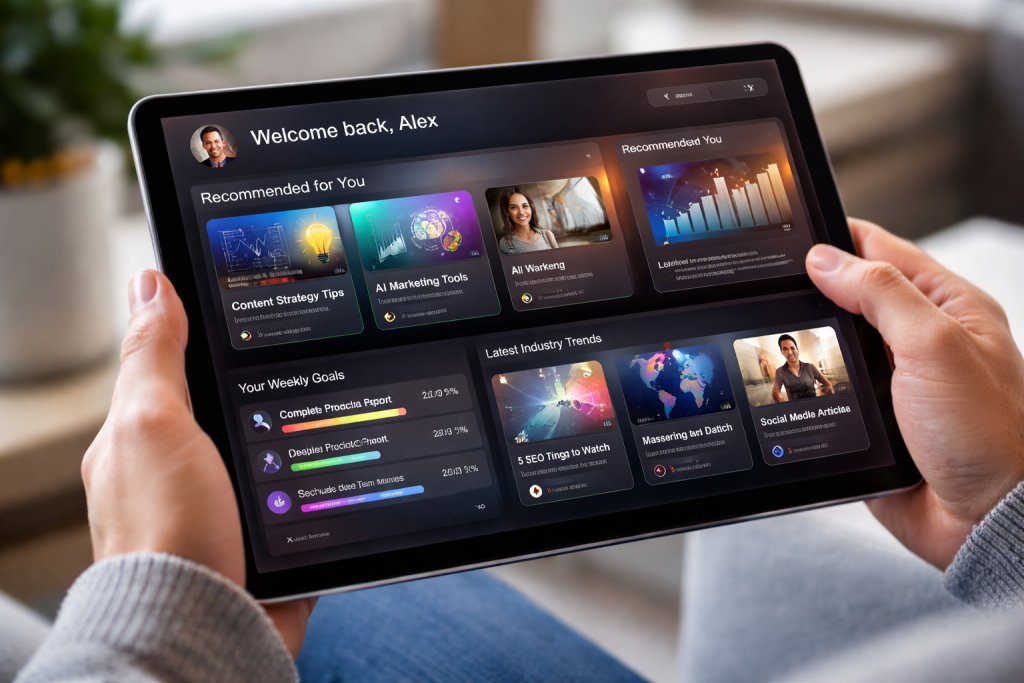
alt text: A close-up of a user’s hands holding a tablet that displays a highly personalized user interface with adaptive content modules and tailored recommendations.
Industry-Specific Applications in 2026
- Healthcare: Multi-modal AI diagnostic assistants will analyze patient charts (text), medical images (vision), and doctor’s notes (speech) to suggest potential diagnoses.
- Finance: Agentic AI will autonomously monitor financial markets for anomalous trading patterns, flagging potential fraud or risk in real-time and executing pre-approved mitigation strategies.
- Manufacturing: Digital twins of entire production lines will use AI to predict bottlenecks and recommend adjustments to optimize output and energy consumption before they happen.
- Retail: AI-driven hyper-personalization will power autonomous commerce, where smart assistants pre-emptively order household goods for customers based on usage patterns and preferences.
Organizational Readiness And Challenges
To capitalize on these trends, organizations must address three core areas:
- Skill Gap and Change Management: The biggest barrier is not technology but people. Organizations must invest in upskilling and reskilling programs to prepare their workforce for AI-augmented roles.
- Data Strategy: AI is only as good as the data it’s trained on. A clean, accessible, and well-governed data infrastructure is the non-negotiable foundation for AI success.
- Governance, Security, & Compliance: Balancing innovation with responsibility is paramount. A robust governance framework is needed to manage risks from shadow AI, ensure ethical deployment, and comply with emerging regulations like the EU AI Act.
Conclusion
The top AI trends shaping business and technology in 2026 point to a strategic tipping point. Success is no longer about isolated pilots but about building a holistic, integrated AI strategy.
Organizations that align leadership, data strategy, governance, and talent development around these verified trends will not just stay competitive—they will define the future of their industries.
The call to action is clear: move from observation to implementation and build an organization that is ready for the AI-powered era.
References & Notes
- IBM Global AI Adoption Index 2023.
- IBM’s predictions for AI in 2026 — talks to experts on AI acceleration and enterprise impact https://www.ibm.com/think/news/ai-tech-trends-predictions-2026
- Gartner, “Top Strategic Technology Trends.”
- Deloitte, “Tech Trends” reports.
- CompTIA, “IT Industry Outlook.”
- Forrester, “The AI Market Forecast.”
- Bernard Marr’s “AI Agents Lead the 8 Tech Trends Transforming Enterprise in 2026” https://bernardmarr.com/ai-agents-lead-the-8-tech-trends-transforming-enterprise-in-2026/
Ready to move from strategy to execution? The trends outlined here require powerful, scalable, and responsibly governed AI solutions. At RichlyAI, we provide the enterprise-grade platform to help you integrate these advanced capabilities, from multimodal data processing to secure generative AI, into your core business workflows. Visit RichlyAI to learn how our solutions can accelerate your journey to becoming an AI-first organization in 2026 and beyond.
