

Bringing AI into your business isn’t a single event; it’s a strategic journey. I’ve seen it work best when broken down into five core phases: assess where AI can make the biggest impact, prepare your data and teams, run a focused pilot project, measure the results, and then scale what you’ve proven to work.
This roadmap turns the abstract idea of “doing AI” into a concrete plan that delivers real value.
Your AI Implementation Roadmap: An Executive Summary
Let’s be honest, integrating artificial intelligence is no longer optional. It’s a critical tool for staying competitive. The problem is, many leaders know they should be using AI, but the “how” is often a confusing mess of technical jargon and hype. This confusion leads to stalled projects and wasted money.
This guide cuts through that noise. It provides a clear, actionable framework that moves from high-level strategy to tangible business outcomes.
The secret is a structured, step-by-step approach. You’ll learn how to pinpoint the most valuable use cases tied directly to your business goals, get your data and infrastructure ready for the change, and—most importantly—prove the value of AI quickly with a low-risk pilot. This method is all about building momentum and getting that crucial executive buy-in for the long haul.
The Five Phases of AI Implementation
This journey, from initial idea to company-wide adoption, can be visualized to make it clearer.
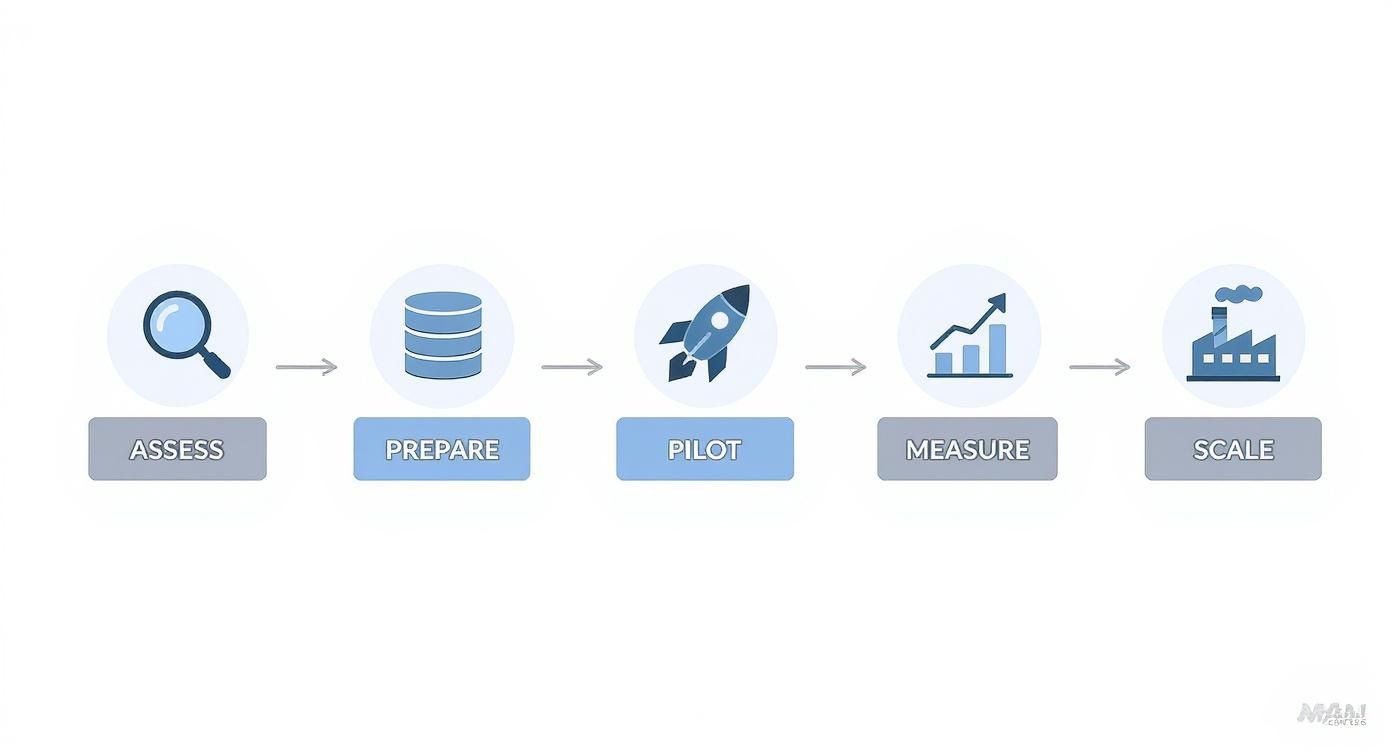
{: alt=”An infographic outlining the five steps to implement AI in business: Assess, Prepare, Pilot, Measure, and Scale, each with a corresponding icon.” }
Think of this less as a straight line and more as a cycle. Successful AI implementation is an iterative process of learning and improving, not a one-and-done project.
While AI adoption is exploding, success is far from guaranteed. A solid 78% of organizations now use AI in at least one business function. Yet, a shocking 70-85% of these initiatives fail to deliver on their promises. Even worse, the average company scraps 46% of its AI proof-of-concepts before they ever see the light of day.
The difference between a successful AI initiative and a failed one often comes down to one thing: a clear, phased implementation plan that prioritizes business value over technology for technology’s sake.
To help you navigate this, we’ve put together a quick-reference table that summarizes each phase of the journey.
The 5 Phases of AI Implementation at a Glance
This table breaks down the core stages for successfully implementing AI in your business, from initial assessment to full-scale deployment.
| Phase | Key Objective | Critical Actions | Common Pitfall |
|---|---|---|---|
| Assess | Identify high-impact AI opportunities aligned with business goals. | – Brainstorm use cases – Map potential ROI – Evaluate strategic fit |
Chasing trendy tech instead of solving real business problems. |
| Prepare | Build the foundation for your AI projects. | – Clean and organize data – Assemble the right team – Choose tools (build vs. buy) |
Underestimating the effort required for data preparation (“garbage in, garbage out”). |
| Pilot | Test your AI solution on a small, controlled scale. | – Define clear success metrics – Run the pilot – Gather feedback |
Picking a project that is too complex or too simple to prove real value. |
| Measure | Quantify the business impact of your pilot. | – Analyze KPIs and ROI – Compare against baseline – Document learnings |
Failing to define what “success” looks like before starting the pilot. |
| Scale | Roll out the proven solution across the organization. | – Develop a full rollout plan – Manage change and training – Continuously monitor and optimize |
Neglecting the human side of change, leading to poor adoption by end-users. |
This framework helps you avoid the common traps that derail so many promising AI projects.
Arming your team with the right knowledge and tools is essential. Exploring a directory of AI tools for business is a great way to see what’s possible for your pilot projects.
Following a structured roadmap like this dramatically improves your odds of turning AI hype into a genuine competitive advantage.
Step 1: Find and Prioritize Your First AI Opportunities
The goal isn’t just to use AI. It’s to fix something specific that’s holding your business back. Before you even glance at a vendor’s website, you have to connect AI to your core strategy. This means shifting from a vague idea of “doing AI” to a concrete list of projects that will actually move the needle on revenue or efficiency.
Where are repetitive tasks eating up your team’s valuable time? Where are you flying blind, lacking the insights to make smarter, faster decisions? These are your starting points.
Become a “Pain Point” Detective
To find your best AI opportunities, you need to map out how your business actually runs. A simple flowchart for each core function—sales, marketing, operations—is a fantastic place to start. Then, go talk to your team leads. Ask them one simple question: “What is the most tedious, repetitive, or data-heavy part of your day?”
Their answers are pure gold. You’re listening for patterns that scream “AI use case,” like these:
- Mind-numbing data entry: Maybe your finance team spends 15 hours a week just copying invoice data from PDFs into your accounting software. That’s a perfect job for an AI-powered document processing tool.
- Endless repeat questions: Is your support team answering the same five questions about shipping status all day long? An AI chatbot could likely handle 80% of those, freeing up your agents for the truly tough problems.
- Guesswork-driven sales: If your sales reps are just using their “gut feeling” to prioritize leads, you’re leaving money on the table. An AI model could analyze past successes to predict which new leads are most likely to close.
When you anchor your first AI project to a real, recognized pain point, you build momentum from day one. It creates immediate credibility and makes it so much easier to get your team on board.
Use a Simple Matrix to Prioritize
Once you have a list of potential projects, use the AI Opportunity Matrix to map each project based on its potential business impact versus how complex it will be to implement.
Here’s how to do it, step-by-step:
- Draw a four-quadrant grid. Label the vertical axis “Business Impact” (low to high) and the horizontal axis “Implementation Complexity” (low to high).
- Plot your ideas. Take each potential project from your pain point list and place it on the grid.
- High Impact, Low Complexity (Quick Wins): These are your top priorities. Start here. Example: Using an off-the-shelf AI tool for email marketing personalization. It’s fairly easy to set up and can give you an immediate boost in engagement.
- High Impact, High Complexity (Strategic Projects): These are big-ticket items, like building a custom fraud detection system. The payoff is huge, but they require serious investment. Plan for these, but don’t make them your first move.
- Low Impact, Low Complexity (Fill-Ins): These are nice-to-haves. Example: Using an AI writing assistant for social media captions. Do them when you have spare capacity, but don’t let them distract you.
- Low Impact, High Complexity (Avoid): Run from these. A project like developing a custom AI to optimize the office snack supply is technically interesting but offers almost zero business value.
- Select your pilot. Your first project should come directly from the “Quick Wins” quadrant.
A mid-sized e-commerce company I worked with had two big ideas: a customer churn prediction model (high impact, medium complexity) and a fleet of fully autonomous warehouse robots (high impact, very high complexity). The churn model was the obvious first project. It delivered real value much faster and with far less risk.
This matrix turns a messy brainstorming session into a clear, actionable roadmap. Small and medium-sized businesses, in particular, get a huge advantage by focusing on those “quick win” projects first. For more ideas specifically for smaller organizations, check out our guide on how SMEs in Africa can use AI for growth.
Actionable Takeaways
- Start a “Pain Point” Log: Create a shared document and ask each department head to list their top three most repetitive, time-sucking tasks.
- Draw Your Matrix: Sketch out the Impact vs. Complexity matrix. Plot the ideas from your pain point log onto it.
- Pick Your First “Quick Win”: Find one project that lands squarely in the High Impact, Low Complexity box. This is your pilot.
- Research Off-the-Shelf Tools: For your chosen project, spend an hour researching existing SaaS tools that could solve the problem without needing a team of developers.
Tools and Resources
- Diagramming Tools: Lucidchart or Miro are great for quickly mapping out processes and building your AI Opportunity Matrix.
- AI Use Case Libraries: Sites like Gartner often publish reports on common AI applications by industry. They’re a great source of inspiration if you’re feeling stuck.
- Must Read: How SMEs in Africa Can Use AI for Growth
Step 2: Prepare Your Data and Technology Foundation
Before you touch an algorithm, you have to look at your data. AI models are only as good as the information you feed them. It’s the classic “garbage in, garbage out” problem, and it’s the number one reason promising AI projects fail.
Think of it like building a house. You wouldn’t put up walls without pouring a solid foundation. In AI, your data and tech infrastructure are that foundation.

{: alt=”A server room with glowing blue lights, representing the technological foundation needed for AI.” }
This stage is about getting your data house in order—finding key sources, cleaning them up, and setting clear management rules. Only then can you decide what technology you’ll use to bring it all to life.
Conduct a Data Readiness Assessment
Here’s how to assess your data readiness in three steps:
- Catalog your data sources. Map where your information lives. It’s often scattered across more places than you’d think:
- Customer Relationship Management (CRM): Your Salesforce or HubSpot instance holds customer interactions and purchase history.
- Enterprise Resource Planning (ERP): Systems like SAP or Oracle are packed with operational data—inventory levels, supply chain movements, and financial records.
- Website & App Analytics: Tools like Google Analytics tell the story of how people interact with your brand online.
- Unstructured Data: Don’t overlook PDFs, customer support chats, social media comments, and old emails. They often hold the richest insights.
- Evaluate data quality. For the specific data needed for your pilot, be brutally honest. Is it accurate? Is it riddled with gaps and missing fields? Is it stored in a consistent format?
- Assign ownership. Who is responsible for the quality of customer data? Who owns sales data? Assigning a clear owner for each key dataset is critical for maintaining quality over time. This cleanup work isn’t glamorous, but it’s the most important thing you will do.
The Million-Dollar Question: Build vs. Buy
With a plan to get your data in shape, you’ve reached a major fork in the road: build a custom AI solution or buy an existing tool? This is a strategic business decision with a huge impact on your budget, timeline, and team.
The most common trap is assuming that building a custom solution is always better. The reality is that for many businesses, a well-chosen “buy” solution can deliver 80% of the value for 20% of the effort. That’s a smart path to a fast, measurable win.
Here’s a simple framework to guide this decision.
| Factor | You Should Probably Build If… | You Should Probably Buy If… |
|---|---|---|
| The Problem | Your challenge is truly unique to your business, and no off-the-shelf tool really fits. | Your problem is a common one (like sentiment analysis or chatbots) with many proven solutions. |
| Team Expertise | You have in-house data scientists, ML engineers, and a strong DevOps culture. | You have a small technical team or no specialized AI talent on staff. |
| Budget & Timeline | You have a significant budget and a longer runway for development, testing, and iteration. | You need a working solution quickly and have a more defined or constrained budget. |
| Data Advantage | You own proprietary data that gives you a unique competitive edge if you build a model around it. | Your data is fairly standard for your industry, and you don’t have a unique dataset. |
Practical Example: A small e-commerce startup wants to understand customer sentiment from product reviews. Buying an off-the-shelf SaaS tool that connects via an API is a no-brainer. It’s fast, affordable, and requires zero data scientists. On the flip side, a large financial firm developing a new fraud detection algorithm would absolutely build it in-house to protect and capitalize on its unique transaction data.
Market dynamics also play a role. U.S. private AI investment, for example, hit $109.1 billion in 2024—nearly 12 times the $9.3 billion invested in China. This fierce competition in markets like the U.S. fuels the development of incredibly sophisticated “buy” solutions.
Actionable Takeaways
- Create a Data Inventory: Fire up a simple spreadsheet. List your key data sources, who owns them internally, and a quick rating of their quality (e.g., clean, messy, incomplete).
- Define Data Governance Roles: Assign clear responsibility. Who is on the hook for making sure your customer data is clean and compliant? This can’t be an afterthought.
- Evaluate One SaaS Tool: Take your top “quick win” project from the last step and find three off-the-shelf AI tools that claim to solve it. This makes the “buy” option feel real and tangible.
- Talk to Your Tech Lead: Walk through the build vs. buy framework with your head of engineering or CTO. Get their honest take on what your team can realistically handle right now.
Tools and Resources
- Data Quality Tools: If your data is a mess, look at platforms like Trifacta or Talend to help automate the cleaning and prep work.
- AI Platforms (for building): Managed platforms like Amazon SageMaker or Google AI Platform can give your team a huge head start.
- LLM Libraries (for building): For projects involving text, open-source libraries like Hugging Face Transformers provide powerful pre-trained models you can adapt for your own needs.
Step 3: Launch a Winning Pilot Project
You’ve identified a use case and started cleaning your data. Now it’s time to prove the concept can work for your business. A pilot project is your chance to move from theory to reality, delivering real results that build momentum for your wider AI strategy. The goal is to start small, validate the idea, and create a powerful success story.
The secret to a great pilot is a brutally narrow scope. Instead of trying to automate your entire customer service operation, for example, start with a chatbot trained to handle just the top 10 most common support questions. This tight focus minimizes risk and dramatically increases your chances of a quick, measurable win.

{: alt=”A team of professionals collaborating around a computer screen, planning their AI pilot project in a modern office.” }
This “start small, prove value fast” method is critical. According to industry data, only about 53% of AI projects actually make it from a prototype into full production. A thoughtfully designed pilot is your best bet for landing in that successful majority.
Setting Clear and Quantifiable KPIs
Your pilot project will live or die by its metrics. Vague goals like “improve customer satisfaction” are useless. You need specific, quantifiable Key Performance Indicators (KPIs) that leave zero doubt about whether the project worked. These metrics must tie directly back to the business pain point you identified.
Make your KPIs SMART—Specific, Measurable, Achievable, Relevant, and Time-Bound.
- For a sales AI: Don’t just “help the sales team.” A better goal is to “Increase lead qualification accuracy by 20% within Q3.”
- For an operations AI: Forget “make things faster.” Your target should be to “Reduce average ticket resolution time by 15% in the first 60 days.”
- For a marketing AI: Instead of “improve campaigns,” aim to “Boost email click-through rates by 5% on our next product launch.”
A pilot without clear KPIs is just an expensive science fair project. A pilot with clear KPIs is a business case in the making. It gives you the hard data you need to justify a larger investment.
The table below shows examples of specific, measurable KPIs for common AI pilot projects.
| Business Function | AI Use Case | Primary KPI | Secondary KPI |
|---|---|---|---|
| Marketing | Content Personalization | Increase email CTR by 10% | Decrease unsubscribe rate by 2% |
| Sales | Lead Scoring Model | Increase SQL conversion rate by 15% | Reduce time on unqualified leads by 5 hours/week per rep |
| Customer Service | Automated Ticket Routing | Reduce average first response time by 25% | Improve CSAT score by 0.5 points |
| Operations | Inventory Demand Forecasting | Reduce stockouts by 30% | Decrease excess inventory holding costs by 12% |
These examples show the level of detail you need. They’re not just goals; they’re precise targets that tell a clear story of success or failure.
Building Your Pilot Project Plan
A formal plan keeps your pilot from going off the rails. A simple, shared document is all you need to ensure everyone knows their role and what success looks like.
Here’s how to create your plan:
- Define Roles and Responsibilities: Assign one person to each key role:
- Project Lead: Owns the timeline and outcomes.
- Technical Expert: Manages the tool or build process.
- Business SME: Provides context and validates the solution.
- Stakeholder: The executive who needs to see the results.
- Set a Timeline with Milestones: Break the project into clear phases—data prep, model training, user testing, and launch—each with a firm deadline. A realistic timeline for a focused pilot is 60-90 days.
- Conduct a Risk Assessment: List what could go wrong (poor data, low user adoption, technical glitches) and create a simple plan for how you’ll handle each issue.
Actionable Takeaways
- Define Your “Top 10” Problem: Find a single, high-frequency issue to solve first. Don’t try to solve everything at once.
- Draft Three SMART KPIs: Write out specific, measurable goals for your pilot. Run them by the relevant department head for their input.
- Assemble a “Pilot Squad”: Identify one person for each key role—a project lead, a technical expert, and a business expert.
- Create a One-Page Project Plan: Keep it simple. Outline the scope, KPIs, team, and a 90-day timeline.
Tools and Resources
- Project Management Tools: Use a simple tool like Trello or Asana to keep tasks and timelines visible to the whole team.
- Pilot Plan Template: You don’t need to start from scratch. A great place to look for inspiration is on collaboration platforms like Miro.
- Further Reading: For a deeper dive, read our complete guide on how to implement AI in business.
Step 4: Measure ROI and Scale Your AI Initiatives
You’ve successfully navigated your pilot project—congratulations. Now, the real value comes from scaling those proven successes across the organization. This is where the focus shifts from tech to business strategy: proving the financial return and getting your people on board.
Scaling effectively boils down to two things: building a rock-solid business case showing the Return on Investment (ROI) and creating a thoughtful plan to guide your team through the transition.

{: alt=”A graph showing an upward trend with various business-related icons, symbolizing growth and ROI from AI initiatives.” }
Calculating a Holistic AI ROI
When leadership hears “ROI,” they often think of cost savings. But a compelling ROI model looks at the full picture.
- Hard ROI (The Numbers):
- Cost Savings: Fewer hours on manual tasks, lower operational spend, fewer errors.
- Revenue Growth: More sales from smarter lead scoring, higher customer lifetime value.
- Productivity Gains: Faster project turnaround times, quicker decision-making.
- Soft ROI (The Strategic Wins):
- Improved Customer Experience: Higher satisfaction scores (CSAT), stronger loyalty.
- Enhanced Decision-Making: More accurate forecasting and planning.
- Increased Agility: The ability to pivot quickly in response to market shifts.
Practical Example: A marketing team uses an AI tool to personalize email campaigns. The hard ROI is a 15% boost in click-through rates that directly leads to $50,000 in new quarterly revenue. The soft ROI is a 10-point jump in their Net Promoter Score (NPS) and a team now freed up to think about strategy instead of manually building email lists.
Managing the Human Side of AI
The biggest hurdle you’ll face when scaling AI is cultural resistance, usually rooted in the fear of being replaced. The key is to reframe the conversation: AI is here to augment your team, not replace them.
Here’s how to manage the change step-by-step:
- Lead with the “Why”: Don’t just announce a new tool. Frame it around the problem it solves. Instead of “We’re implementing an AI,” say, “We’re bringing in a tool to eliminate manual data entry, which will give the finance team more time for critical analysis.”
- Invest in Upskilling: If a task is being automated, immediately offer training on the skills people will need next, like interpreting AI-driven insights. This shows you’re investing in their careers.
- Find and Empower AI Champions: In every department, some people get excited by new tech. Identify these early adopters, give them a voice, and empower them to become advocates. A recommendation from a trusted colleague is infinitely more powerful than a memo from management.
Build an AI Center of Excellence (CoE)
As you grow from one AI project to several, you can’t have every team reinventing the wheel. An AI Center of Excellence (CoE)—even if it starts with just a couple of dedicated people—becomes essential.
The CoE’s role is to:
- Establish best practices for how AI is developed and rolled out.
- Maintain a curated portfolio of vetted AI tools and vendors.
- Offer expert support and advice to teams across the business.
- Ensure governance and ethical standards are applied consistently.
This central group ensures that as you implement AI, it’s done in a coordinated, efficient, and responsible way. For specific functions, a CoE can research and recommend from a list of the best AI tools for marketing to give teams a vetted starting point.
Actionable Takeaways
- Map Your Full ROI: For your pilot project, create a simple chart listing at least two hard ROI metrics (e.g., hours saved) and two soft ROI metrics (e.g., improved team morale).
- Draft a Communication Snippet: Write a one-paragraph announcement for your next AI tool, focusing entirely on the “why” and how it helps your employees do more meaningful work.
- Identify Your First “AI Champion”: Think of one person on your team who loves new technology. Ask them to help test and advocate for your next AI initiative.
- Form a Proto-CoE: Name one person from your tech team and one from a business unit to be the first point of contact for any new AI ideas. This is your CoE in its simplest form.
Tools and Resources
- ROI Calculators: Many software vendors, like HubSpot, offer free ROI calculators that can be a great starting point for modeling financial impact.
- Change Management Frameworks: Check out established models like the Prosci ADKAR Model for a proven, structured approach to managing the people side of change.
- Must Read: Best AI Tools for Marketing
Taking the Plunge: Your Next Steps and Essential AI Resources
You’ve made it through the roadmap. But a map is useless if you don’t start the journey. This is where you turn theory into tangible action.
Your Immediate Action Checklist
The biggest mistake is getting stuck in “analysis paralysis.” Build momentum with small, deliberate wins. Pick one of these to tackle this week.
- Kick off a process audit. Ask a single department—customer service is often a great place to start—to map out their top three most time-consuming, repetitive daily tasks. This is ground zero for finding your first, easy AI wins.
- Assemble a small “AI Tiger Team”. This isn’t a massive new department. Grab one person from IT, one from a key business area like marketing, and a leader who can clear roadblocks. Their first mission? To vet one, low-risk AI use case.
- Pilot one SaaS AI tool. Find a real, nagging pain point. Maybe it’s the hours wasted transcribing meeting notes. Have a team member sign up for a free trial of a tool like Otter.ai and report back on how well it actually works.
The best way to learn about AI is to use it. A small, successful pilot with an off-the-shelf tool builds more confidence and practical knowledge than months of sitting in strategy meetings.
Essential Tools and Further Reading
Arming your team with the right resources saves a ton of time. Here are a few foundational resources I personally recommend.
- AI Strategy Template: This visual template from Miro is perfect for getting your goals, initiatives, and KPIs onto a shared board.
- Data Readiness Checklist: Before you dive in, you need to know if your data is up to snuff. A checklist like this one is an absolute must.
- AI Tool Directory: If you’re a smaller team looking for ready-made solutions, browsing a curated list of the best AI tools for small business is a smart starting point.
- Open-Source Power: For teams with in-house technical chops ready to build something custom, TensorFlow remains a powerful open-source library for machine learning projects.
- Further Reading: For a different but equally valuable perspective, I highly recommend reading through this comprehensive guide on how to implement AI in business.
Common Questions (and Straight Answers) About AI Implementation
As you start your AI journey, a few key questions always come up. Let’s tackle them head-on.
What’s the Real Cost of Implementing AI?
There’s no magic number. You could be looking at $50-$500 per month for a ready-made SaaS tool, like a simple customer service chatbot. A fully custom predictive analytics model could easily top $100,000.
Actionable Insight: Start with a small, contained pilot. Testing a content creation tool like Jasper on a small team might only cost a few hundred dollars. This lets you prove the ROI before you commit to a bigger investment.
Do I Need a Team of Data Scientists on Day One?
Not necessarily. The rise of “low-code” and “no-code” AI platforms puts powerful tools directly into the hands of your existing team.
- For quick wins: Many tools you already use probably have AI baked in. No specialized staff is needed to flip those switches.
- For custom work: If your goal is to build something completely proprietary—say, a unique algorithm to forecast supply chain disruptions—then yes, you’ll need to bring in specialized data science talent.
Where Should We Start? Which Department Goes First?
Go for the quick, measurable win. Look for areas with well-defined processes and good data.
Practical Examples:
- Marketing: Use AI to personalize email campaigns or optimize ad targeting.
- Customer Service: Deploy a chatbot to handle the top 20% of common questions.
- Operations: Find a process bogged down by repetitive data entry and automate it.
How Do We Keep Our AI Ethical and Fair?
This is non-negotiable and starts with strong governance. First, look at your data. If your training data is messy or doesn’t accurately represent your entire customer base, your AI’s outputs will be skewed. Garbage in, garbage out.
The most effective way to spot potential bias is to involve a diverse team in the development and review process. Different perspectives catch different problems.
Actionable Insight: Establish a clear AI governance framework. This isn’t a one-and-done task; it means scheduling regular audits for bias and demanding transparency in how your models make decisions.
Ready to discover the right tools for your first AI project? The AI Tools Hub features over 11,000 solutions across 2,000 categories, making it easy to find and compare the perfect AI tool to achieve your business goals. Start exploring today.