
For years, the global conversation around artificial intelligence has been dominated by policy rhetoric and high-level principles. But 2026 marks a turning point—a decisive shift from abstract discussion to practical implementation. Why now? The launch of the new AI Innovation Hub at the World Economic Forum (WEF) in Davos signals a global commitment to operationalizing AI policy for real-world impact.
This guide explores how the hub bridges the critical gap between high-level AI policy and tangible innovation. We’ll break down how this model will turn ambitious goals into deployable solutions, scaling real AI adoption across sectors and borders.
AI Governance Landscape: Policy Foundations and Gaps
Global forums like the World Economic Forum have made significant strides in establishing AI governance frameworks. These dialogues prioritize responsible AI, multi-stakeholder governance, and public-private collaboration, setting the ethical guardrails for innovation.
But a vision on paper isn’t enough. Policy sets norms and expectations but often lacks the mechanisms for implementation and measurable outcomes. This creates an “implementation gap,” a major bottleneck slowing down global AI adoption.
Why Policy Alone Isn’t Enough
The real problem is that policy tells us what to do but rarely explains how to do it. This gap leads to persistent roadblocks:
- Fragmented Regulatory Approaches: Without a common testing ground, countries develop conflicting rules, making it incredibly difficult for innovators to build solutions that can scale across borders.
- Lack of Shared Experimentation Spaces: Companies and governments often work in silos. There are few neutral, well-resourced environments where they can team up to test new AI models against agreed-upon safety and ethical standards.
- Limited Access to Infrastructure: Cutting-edge AI requires massive compute power, vast datasets, and specialized talent. Many smaller companies, researchers, and emerging economies are locked out, stifling innovation.
This is precisely why a bridge from policy to practice is necessary. We need an action-oriented platform to translate high-level goals into tangible, scalable, and globally accessible AI solutions.
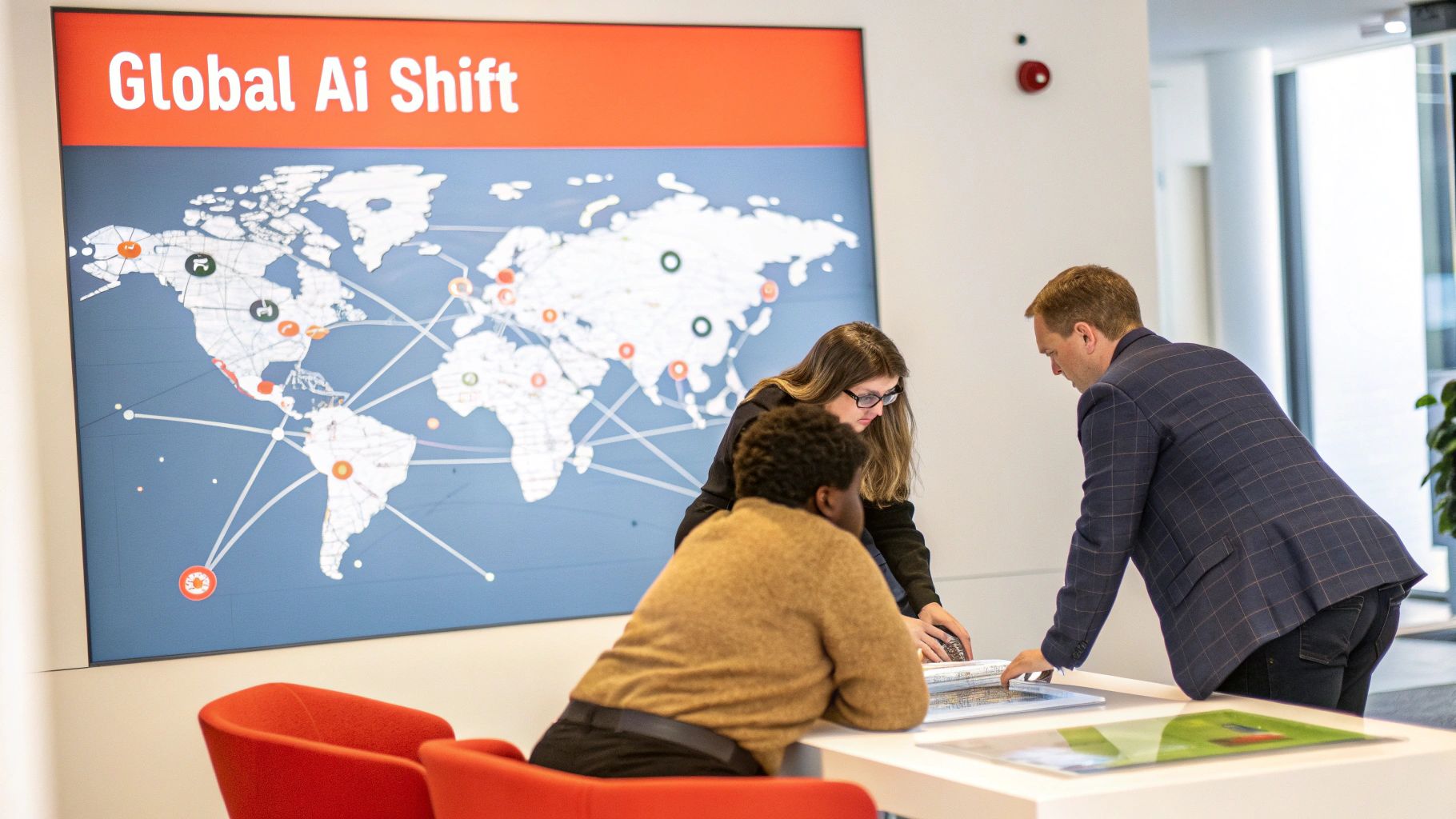
Alt text: Three colleagues collaborate on AI innovation in a modern office, standing before a large digital world map display with the title “Global AI Shift.”
The AI Innovation Hub: From Davos Announcement to Global Platform
The Telangana AI Innovation Hub (TAIH), launched by Chief Minister A. Revanth Reddy at the WEF in Davos on January 20, 2026, is the answer to this challenge. It is designed to be a “Global AI Proving Ground” for experimentation, testing, and scaling applied AI solutions.
Don’t think of it as another think tank churning out white papers. It’s a shared, state-of-the-art laboratory where governments, industry leaders, academics, and startups can build and validate AI systems that solve genuine problems in a controlled, collaborative way.
Strategic Vision and Goals
The hub’s vision is simple but powerful: directly integrate policy with execution. It takes ambitious national AI goals—like building responsible innovation or boosting economic competitiveness—and provides the infrastructure to make them happen.
This ecosystem is built on key strategic goals:
- Operationalize AI ambitions into deployable, real-world solutions.
- Foster cross-border collaboration to solve shared global challenges.
- Accelerate startup growth by providing access to resources and funding.
- Develop critical infrastructure for compute, data, and testing.
- Mobilize a global talent pipeline through targeted training and partnerships.
Turning Policy Goals into Practice
So how does the hub actually turn abstract policy goals into tangible results? It provides a structured environment where collaboration is institutionalized, deployment is accelerated, and responsible practices are embedded from day one.
Bridging Collaboration Across Sectors
When a policy calls for “public-private collaboration,” the hub gives it a framework. It moves beyond networking events to create shared labs and testbeds where stakeholders build solutions together.
Practical Example: Smart Urban Mobility
A city government wants to use AI to reduce traffic congestion, aligning with a national smart city policy.
- Define the Challenge: The city agency presents the problem and shares anonymized traffic and public transit data in the hub’s secure sandbox.
- Assemble the Team: The hub connects the agency with an industry partner specializing in logistics AI, university researchers with expertise in urban modeling, and a startup building innovative sensor technology.
- Build and Test: The team uses the hub’s shared compute power and simulation software to build and test a predictive traffic model without risking disruption to live city infrastructure.
- Align with Policy: The project is benchmarked against national AI standards for data privacy and ethical use, ensuring the final solution is compliant from the start.
Accelerating Applied AI Deployment
The hub’s mission is to move AI from small-scale pilots to population-scale applications that deliver real value in key sectors:
- Public Services: Optimizing resource allocation in healthcare or creating personalized learning paths in education.
- Industry: Deploying predictive maintenance in manufacturing or AI-driven logistics in agriculture.
- Smart Infrastructure: Enhancing energy grid management and urban planning.
Understanding the top AI trends shaping business and technology makes it clear why these practical platforms are so vital for moving from proof-of-concept to production.
Embedding Responsible AI Practice
When a policy calls for “responsible AI,” the hub acts as a practical proving ground where new solutions are stress-tested against ethical standards for fairness, transparency, and security before public release. For instance, a new algorithm for loan approvals can be rigorously audited for bias using the hub’s datasets and analytical tools. This process turns vague ethical guidelines into hard, verifiable engineering requirements, which is critical for building trust, as detailed in how new AI regulatory guidelines are shaping healthcare innovation.
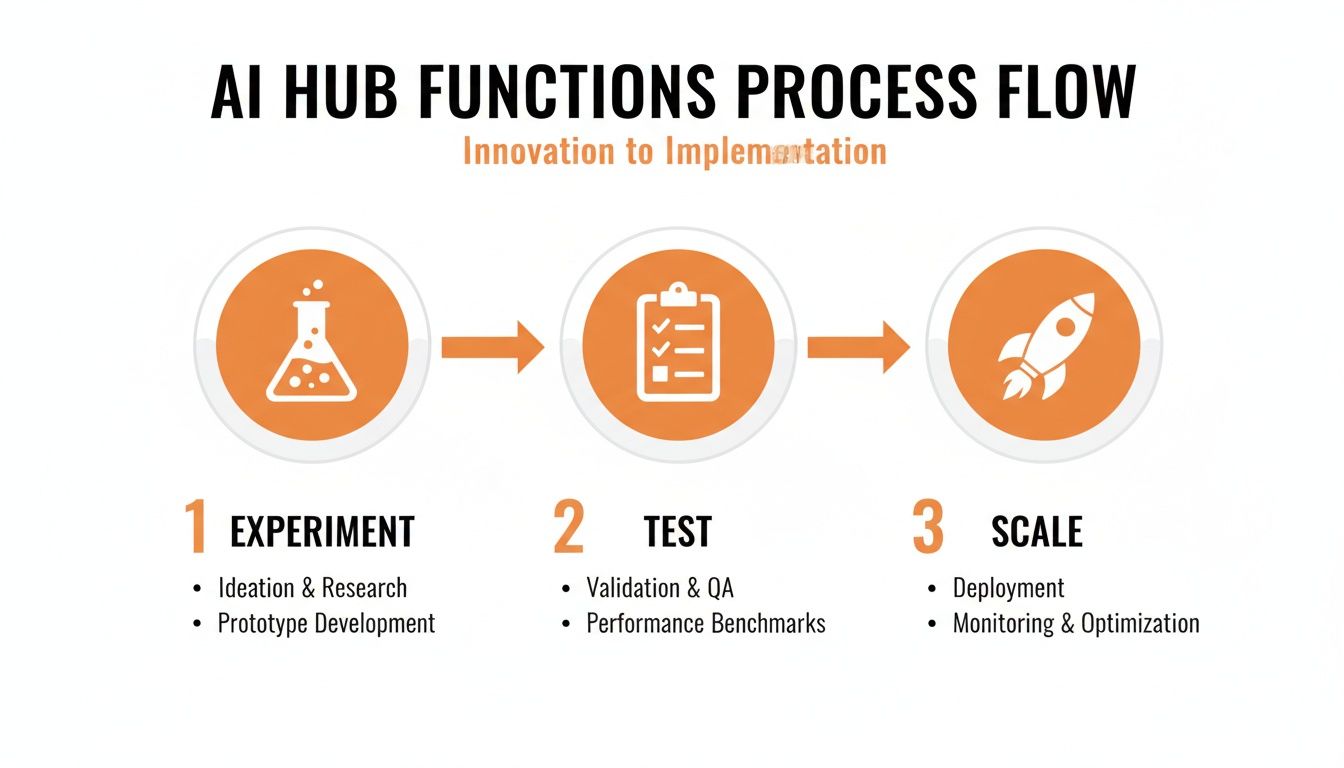
Alt text: A process flow diagram illustrating the AI Hub’s functions, showing circular steps from Experiment to Test to Scale, with arrows indicating the flow from innovation to implementation.
Practical Mechanisms of the Hub
The hub functions as a dynamic platform with several core mechanisms designed to foster innovation and translate policy into practice.
A. AI Experimentation and Testing Infrastructure
Provides startups and researchers with access to high-performance compute, curated data ecosystems, and secure sandbox environments. This allows for real-world use case validation and stress-testing of AI models.
B. Talent Enablement and Capacity Building
Offers targeted programs to develop skills for researchers, practitioners, and policymakers. It collaborates with universities and institutions to build a sustainable global talent pipeline.
C. Startup Acceleration and Deep-tech Commercialization
Integrates incubators, accelerators, and direct funding mechanisms. The hub also provides market entry support for AI products with global demand, helping them navigate complex regulatory landscapes.
D. Knowledge Exchange and Shared Best Practices
Hosts workshops, maintains shared datasets, and develops practical playbooks to turn abstract policy principles into actionable steps. Open innovation programs encourage collaborative problem-solving.
Case Studies: Policy to Practice in Action
The real test of the hub is its ability to deliver tangible results in key sectors. Here are illustrative examples of how it turns policy goals into deployed solutions.
Public Sector Innovation
Policy Goal: “Improve e-citizen services and optimize public resource deployment.”
- In Practice: A government agency uses the hub to develop an AI-powered platform that automates permit applications, reducing processing times by 60%. The system integrates with regional public digital infrastructure, ensuring data security and interoperability.
Industrial AI Deployment
Policy Goal: “Enhance manufacturing competitiveness with deep-tech solutions.”
- In Practice: A consortium of automotive manufacturers collaborates within the hub to create a shared AI model for predictive maintenance on robotic assembly lines. Using pooled, anonymized sensor data, a startup trains a multi-modal AI that not only predicts part failure but also generates augmented reality repair guides for technicians.
Alt text: A factory worker uses a tablet to interact with a large robotic arm in a modern industrial setting, with the words ‘POLICY IN ACTION’ overlaid on the image.
Ethical and Responsible AI Wins
Policy Goal: “Ensure fairness and explainability in financial AI systems.”
- In Practice: A fintech company leverages the hub’s resources to build a new credit scoring model. They test the algorithm against diverse synthetic datasets to proactively identify and mitigate biases. The final product includes a built-in “explanation feature” that clearly communicates the reasons for a loan decision, meeting strict regulatory demands for transparency.
The need for such platforms is urgent. Deloitte’s 2026 State of AI in the Enterprise report shows a wide gap between strategy and execution, which the hub is designed to close.
Global Impacts and Ecosystem Benefits
The AI Innovation Hub model promises a broad impact that extends far beyond individual projects, creating a virtuous cycle for the entire global ecosystem.
A. Catalyzing Global AI Adoption
By breaking down silos, the hub allows countries and institutions to adopt proven solutions and best practices, reducing duplication of effort and accelerating the diffusion of innovation worldwide.
B. Enhancing Innovation Capacity Globally
The model strengthens AI ecosystems, particularly in emerging markets. It provides a platform for small firms and research institutions to access world-class infrastructure and collaborate on a global stage.
C. Supporting Policy Makers with Empirical Evidence
The hub generates data-driven insights from real-world deployments. This evidence flows back to policymakers, enabling them to refine global AI policy based on what works, not just theory.
Challenges and Risks
Bringing such an ambitious platform to life means navigating significant legal, ethical, and financial challenges.
- Coordination Across Jurisdictions: Aligning regulatory goals and data privacy laws (like GDPR) across varied legal systems is a monumental task that can slow collaboration.
- Ethics, Privacy, and Security Concerns: Managing responsible AI at scale requires ironclad protections for individual rights. Privacy-by-design principles must be embedded into every project to maintain public trust.
- Sustainability and Long-Term Funding: The hub requires sustained investment. A hybrid funding model that blends public grants with private-sector partnerships and revenue-generating services is crucial for long-term operational continuity.
The Road Ahead: A Blueprint for Policy-Driven AI Deployment
The AI Innovation Hub model is more than a one-off project; it’s a replicable blueprint for how policy can be a catalyst for innovation when paired with real infrastructure and measurable outcomes. As other regions adopt similar models, they can accelerate global AI democratization.
This marks a fundamental shift: the future of global AI adoption will increasingly depend on effective public-private hybrid platforms that connect high-level strategy with on-the-ground execution.
The journey from policy to practice demands a dedicated platform that can translate ambitious goals into tangible, scalable, and globally accessible AI solutions. This is how we stop just talking about the future of AI and actually start building it.
Actionable Takeaways
- For Policymakers: Champion the creation of shared innovation hubs to bridge the gap between policy and real-world implementation.
- For Businesses: Actively seek partnerships within these hubs to de-risk innovation, access top talent, and co-develop solutions with built-in regulatory compliance.
- For Startups: Leverage hub resources like compute power, curated datasets, and mentorship to accelerate your path from prototype to market-ready product.
- For Researchers: Collaborate on cross-disciplinary projects within the hub to test theoretical models against real-world challenges and data.
Tools & Resources
- AI Tools Hub: A comprehensive directory of over 11,000 AI tools across 2,000 categories to accelerate your projects. Visit AI Tools Hub.
- Deloitte State of AI Report: In-depth analysis of enterprise AI adoption trends and challenges. https://www2.deloitte.com/us/en/insights/focus/cognitive-technologies/state-of-ai-and-intelligent-automation-in-business-survey.html
- DataReportal Global Digital Reports: Essential data on global technology and AI usage trends. https://datareportal.com/reports/digital-2026-one-billion-people-using-ai
References and Further Reading
- World Economic Forum. (2026). Global AI Governance Dialogue Outcomes.
- RichlyAI. (2026). Enterprise AI Strategies that Move from Proof of Concept to Production.
- RichlyAI. (2026). Ethical Use of AI in the Workplace: Building Trust, Equity, and Accountability.
- National University. (2026). https://www.nu.edu/blog/ai-statistics-trends/
Ready to turn your own AI ambitions into reality? RichlyAI provides the tools and resources you need to create, discover, and build with artificial intelligence for your business. Explore our platform and start building today at RichlyAI.
