
Online education in Nigeria isn’t just a fleeting trend. It’s a powerful, practical solution to some of the country’s most pressing educational and economic challenges. It’s creating flexible, accessible, and often more affordable ways for millions—from secondary school students prepping for exams to working professionals aiming for a promotion—to gain critical skills.
This guide provides actionable steps and real-world examples to help you navigate the landscape of online education in Nigeria and use it to achieve your goals.
Why Online Education Is Taking Off in Nigeria
The surge in digital learning across Nigeria is driven by a perfect storm of factors: a massive, young population, an overstretched traditional education system, and skyrocketing internet access. This has created a gap that online education is perfectly positioned to fill, not as a replacement for universities, but as a vital and complementary path to knowledge.
The numbers back this up. The market for online education in Nigeria is projected to hit USD 125.88 million in 2025 and is expected to grow at an impressive compound annual rate of 23.7% between 2025 and 2033. This growth is largely fueled by mobile internet adoption. For a detailed breakdown, you can explore the full market analysis.
What’s Fuelling the E-Learning Boom?
So, what’s actually driving this shift? A few key catalysts are accelerating the adoption of online learning across the country. Each one addresses a specific challenge or meets a growing demand, creating the ideal environment for digital education to flourish.
The table below breaks down the primary drivers and their direct impact on how Nigerians learn today.
| Driving Factor | Impact on Education & What to Do |
|---|---|
| Skyrocketing Internet Access | More Nigerians are online via smartphones, making digital courses easier to access. Action: Use mobile-friendly platforms to learn on the go. |
| Demand for In-Demand Skills | The job market needs tech skills. Action: Use online platforms to gain job-ready skills in coding, data analysis, and digital marketing. |
| Overburdened Universities | Limited admission spots leave qualified candidates seeking alternatives. Action: Pursue accredited degrees or professional certifications online. |
| Flexibility for Professionals | Working adults need to upskill without career breaks. Action: Choose asynchronous courses you can complete in the evenings or on weekends. |
These drivers show that online learning isn’t just a convenient alternative; for many, it’s the most practical and logical choice for career advancement and personal growth.
Choosing the Right Online Learning Platform
With countless options for online education in Nigeria, picking the right one can feel overwhelming. The key is to start with a single, clear question: “What specific goal am I trying to achieve?”
Your objective—whether it’s acing WAEC, breaking into tech, or earning a Master’s degree while working—is the most critical factor. The best platform for a JAMB candidate is completely different from what a budding data analyst needs. Defining your goal first ensures you choose a path that delivers real results.
Comparing Nigerian and International Platforms
Online learning platforms generally fall into two categories: local Nigerian providers and major international players. Each offers distinct advantages.
Local platforms understand the Nigerian context. Their courses are often designed around the national curriculum (WAEC, JAMB) and tailored to the skills demanded by the local job market. International platforms offer globally recognized certifications and degrees from world-renowned institutions.
Here are some popular choices for Nigerian learners:
- For K-12 and Exam Prep: uLesson is a leading app-based platform with video lessons aligned with the Nigerian curriculum, making it ideal for secondary school students.
- For Tech Skills: Utiva focuses on delivering practical, job-ready tech skills like data analysis, product management, and digital marketing, with strong ties to the African tech ecosystem.
- For University Degrees and Professional Certificates: Global giants like Coursera and edX partner with top universities (e.g., Yale, Imperial College London) to offer everything from short courses to full online Master’s degrees.
This decision tree offers a simple framework for choosing a path based on your need for flexibility.
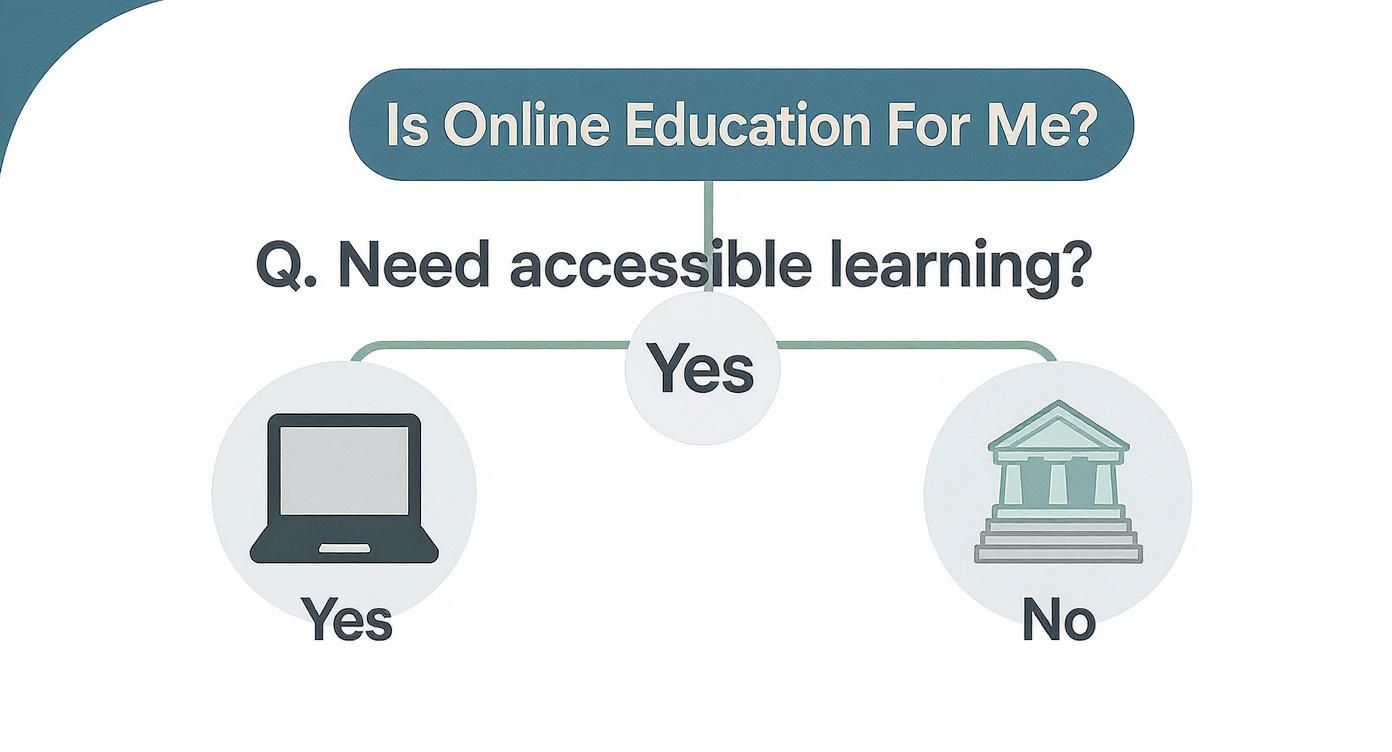
Alt text: An infographic decision tree. It starts with “Do you need accessible, flexible learning?” If yes, it points to “Online Education.” If no, it points to “Traditional University.”
For anyone needing to learn on their own schedule, online education is the clear solution.
How to Vet Any Online Platform: A Step-by-Step Checklist
Before committing to a platform, perform your due diligence. Don’t be swayed by flashy ads. Use this checklist to evaluate your options. You can also see what experts think by checking out reviews of the best online learning platforms.
- Check Accreditation and Recognition: Ask yourself: “Will employers in Nigeria respect this certificate?” If it’s a university program, confirm the institution’s accreditation status. For professional skills, check if the platform is recognized within that industry.
- Investigate Instructor Quality: Look up the instructors. Are they academics or industry veterans who have practical, real-world experience in the field they teach? Search for them on LinkedIn to view their professional background.
- Verify Curriculum Relevance: Check when the course content was last updated. Technology and business practices change rapidly. Ensure you are learning current, in-demand skills, not outdated information.
- Assess Learner Support Systems: Find out what happens when you get stuck. Do they offer mentor support, live Q&A sessions, active student forums, or tutor access? Strong support systems are crucial for success.
Choosing a platform is about finding the best fit for you. By focusing on your goals and using this checklist, you can select a platform that provides a real return on your investment.
Real-World Benefits for Nigerian Learners
Online education is more than a new learning method; it’s a powerful tool for dismantling long-standing barriers to opportunity in Nigeria. It’s solving real, everyday problems for millions of people.

Alt text: A young Nigerian woman smiles while studying on her laptop in a bright, comfortable living room, showcasing the flexibility of online education.
A working professional in Abuja can earn a Master’s degree without quitting her job. A talented student in a remote village can access world-class instruction. These are life-changing opportunities, not minor conveniences.
Accessibility That Crosses Borders
The greatest advantage of online education in Nigeria is its ability to make geography irrelevant. Previously, your location heavily influenced your educational opportunities. Online learning changes that. A student in Sokoto can now join a top coding bootcamp based in Lagos. This newfound access also creates inclusive pathways for individuals with physical disabilities, allowing them to pursue education from home.
“The greatest impact of online education in Nigeria is its power to level the playing field. It ensures that a brilliant mind in a rural area has the same access to knowledge as someone in a major city.”
Flexibility That Fits Modern Nigerian Life
The rigid schedule of traditional education doesn’t work for most working adults. Online learning offers the flexibility needed to succeed. Most courses are asynchronous, meaning you can learn whenever it fits your schedule.
This model is perfectly suited to the hustle of modern Nigerian life:
- Professionals can study during their commute or late at night.
- Entrepreneurs can acquire new skills without neglecting their business.
- Parents can weave their studies around family commitments.
This demand for convenience is a primary driver of market growth. The online education market is expected to hit US$159.59 million in 2025 as more people seek learning that adapts to their lives. Discover more insights into Nigeria’s education statistics to see the full picture.
Affordability That Makes Sense
Traditional university education is expensive. When you factor in tuition, accommodation, and transport, the cost is prohibitive for many. Online education often presents a much more affordable alternative. By eliminating the need for a physical campus, online platforms can offer high-quality courses at a fraction of the cost, making skill development a realistic goal for a wider audience.
Actionable Takeaways
- Look Beyond Your Location: Don’t let your address limit you. Search for the best courses globally, not just locally.
- Build a Flexible Study Plan: Use the on-demand nature of online learning to design a schedule that fits your unique lifestyle. Block out specific times in your calendar.
- Do a Cost-Benefit Analysis: Before enrolling in a traditional program, compare the total cost (including transport and accommodation) with high-quality online alternatives.
- Explore New Skills: Take advantage of accessible online courses to learn something new, like how to leverage AI. Find practical examples in our guide on AI for Nigerian Students Top Use Cases.
How to Overcome Common E-Learning Challenges
While online education in Nigeria offers incredible opportunities, it comes with unique challenges. The key is to anticipate these hurdles—like unstable power, high data costs, and device limitations—and have a practical plan to overcome them.
With the right strategies, these obstacles don’t have to stop your progress. This section provides a step-by-step guide to navigating your e-learning journey smoothly.

Alt text: A determined individual wearing headphones works on a laptop in a low-light setting, symbolizing overcoming challenges in online education.
How to Conquer Power and Data Issues
The two biggest pain points for online learners in Nigeria are erratic power and the high cost of internet data. Here’s a practical, step-by-step plan to manage them.
Step-by-Step Guide to Managing Data Costs:
- Find a Night Data Plan: Most mobile networks (MTN, Glo, Airtel) offer “night plans” or “off-peak” data bundles at a significantly lower cost. Check your provider’s mobile app or dial their USSD code to find these offers.
- Schedule Your Downloads: Before bed, queue up all your large course files—video lectures, PDFs, and software—to download during the off-peak window (usually between midnight and 5 AM).
- Learn Offline: The next day, you can watch lectures and read materials completely offline, using your expensive daytime data only for essential tasks like submitting assignments or participating in live discussions.
For power, a reliable power bank (at least 20,000mAh) can keep your laptop or tablet charged through most outages. For a more robust solution, a small desktop inverter system is a worthwhile investment.
“Your success in online learning often depends less on your academic brilliance and more on your ability to creatively solve practical problems. A good power bank and a smart data plan are just as important as your textbooks.”
Practical Solutions to Common E-Learning Challenges in Nigeria
| Challenge | Actionable Solution | Recommended Tool/Resource |
|---|---|---|
| Unstable Power Supply | Invest in a backup power source. A power bank is great for short-term use, while a small inverter offers longer-lasting support. | A power bank with at least 20,000mAh capacity, or a small desktop inverter system. |
| High Cost of Data | Utilise off-peak/night data plans offered by mobile networks to download all large course materials for offline viewing. | Check the mobile apps for networks like MTN, Glo, or Airtel for their latest night data bundle offers. |
| Lack of a Laptop | Choose learning platforms that are optimised for mobile use. Most essential tasks can be completed on a modern smartphone. | Coursera, uLesson, and edX all have excellent, user-friendly mobile apps. |
| Feeling Isolated | Actively connect with classmates. Form a study group on WhatsApp or Telegram to share notes, discuss concepts, and stay motivated. | WhatsApp, Telegram, or the built-in discussion forum on your learning platform. |
| Security on Public Wi-Fi | If you use public Wi-Fi (e.g., at a café), avoid logging into sensitive accounts. Use a Virtual Private Network (VPN) for an extra layer of security. | Reputable VPN services like NordVPN or ProtonVPN. |
These proactive steps can transform potential frustrations into minor inconveniences, allowing you to focus on what truly matters: learning and achieving your goals.
Where Digital Learning in Nigeria is Headed Next
The evolution of online education in Nigeria is just beginning. The future isn’t just about more online courses; it’s about creating smarter, more engaging, and deeply personalized learning experiences powered by technology. These advancements will redefine how we acquire skills and knowledge.
The Rise of Personalised and AI-Driven Learning
The next major shift is AI-powered personalization. Imagine a learning platform that understands your individual strengths, weaknesses, and learning pace. As you progress through a course, an AI engine analyzes your performance and tailors the content specifically for you.
How it works: If you’re struggling with a concept, the system can automatically provide extra practice problems or alternative explainer videos. If you’re excelling, it can unlock advanced modules to keep you challenged. This approach acts like a 24/7 personal tutor, guiding you efficiently toward mastery. To see how this is already taking shape, explore AI’s future impact on education.
Mobile-First Platforms and Microlearning
With the smartphone as the primary internet device for most Nigerians, the future of e-learning is mobile-first. This trend is driving the adoption of microlearning—breaking down complex subjects into small, digestible units.
Instead of hour-long lectures, you’ll learn through five-minute videos, interactive quizzes, and quick exercises that you can complete on your phone. This makes learning accessible during a commute, on a lunch break, or in any short window of free time.
Immersive Technologies and Government Backing
Further on the horizon, immersive technologies like Virtual Reality (VR) and Augmented Reality (AR) will transform technical and vocational training. Imagine a medical student performing a virtual surgery or an engineering student assembling a 3D engine model. These technologies provide risk-free, hands-on experience that was previously impossible without expensive equipment.
For these innovations to become widespread, supportive government policies that improve digital infrastructure and reduce data costs are essential.
Actionable Takeaways
- Experiment with AI Tools: Try out AI-powered learning apps like Duolingo (for language) or Khan Academy to experience personalized education firsthand.
- Embrace Microlearning: Look for courses that offer bite-sized lessons and integrate them into your daily routine to make learning a consistent habit.
- Stay Informed: Keep an eye on government initiatives related to digital skills and infrastructure, as new policies can create new learning opportunities.
So, How Do You Actually Get Started?
Knowledge without action is useless. Let’s turn this guide into a simple, step-by-step plan to launch your online learning journey. It’s time to stop reading and start doing.
Follow these steps to begin with a clear goal and a solid strategy.
Step 1: Define a Specific, Measurable Goal
Before browsing any platform, stop and answer this question: “What, exactly, do I want to achieve?” A vague goal like “I want to learn online” leads nowhere. You need a clear target.
Example of Effective Goal Setting:
- Weak Goal: “I want to learn about marketing.”
- Actionable Goal: “I will complete a Professional Certificate in Digital Marketing on Coursera within six months to qualify for a marketing associate role.”
Write your specific goal down. It will serve as your compass for every decision you make.
Step 2: Create a Realistic Study Schedule
Flexibility is a major benefit of online learning, but it requires self-discipline. Without a schedule, it’s easy to procrastinate. You must be your own timekeeper.
How to Build Your Schedule:
- Identify Your Pockets of Time: Look for consistent free slots in your week—early mornings, lunch breaks, or late evenings.
- Block the Time in Your Calendar: Treat your study sessions like non-negotiable appointments. Set reminders on your phone.
- Set Weekly Objectives: Aim to complete a specific number of modules or assignments each week to maintain momentum. Consistency over a few hours per week is more effective than cramming.
Step 3: Build a Support System
Online learning doesn’t mean learning alone. Connecting with other learners is a powerful motivator.
How to Find Your Community:
- Join Platform Forums: Actively participate in the discussion boards on your learning platform.
- Create a Study Group: Start a WhatsApp or Telegram group with a few classmates to share notes, ask questions, and keep each other accountable.
- Use Professional Networks: Find relevant learning communities on LinkedIn related to your field of study.
Checking a detailed guide on available https://richlyai.com/blog/online-courses-in-nigeria/ can also help you find popular programs with existing student communities.
Your Immediate Action Plan
- Write Down Your Goal: Right now, open a notebook or a new document and write your specific learning objective in one clear sentence.
- Research Two Platforms: This week, based on your goal, investigate two relevant learning platforms. Compare their curriculum, instructor credentials, and cost.
- Draft a Schedule: Open your calendar and block out at least three hours of dedicated study time for the upcoming week.
- Find One Community: Log in to LinkedIn or your chosen platform’s forum and join one student group related to your course.
Tools & Resources
- Learning Platforms:
- Productivity & Security:
- Power Banks: Anker, Oraimo
- VPNs: NordVPN, ProtonVPN
- Scheduling: Google Calendar, Todoist
- Further Reading:
- AI’s future impact on education
- The role of cybersecurity awareness in office technology and management
Ready to create compelling content, generate code, or design stunning visuals with the power of AI? RichlyAI provides a full suite of intelligent tools to supercharge your productivity. Sign up for your free plan and start creating today.
